BIOGAS TECHNOLOGY
D.B. SALUNKHE,
PG Student,
Department of Civil Engineering, Government College of Engineering, Amravati,
Maharashtra, India, 444604. [email protected]
R. K. RAI
Associate Professor, Department of Civil Engineering, Government College of Engineering, Amravati,
Maharashtra, India, 444604. [email protected]
R. P. BORKAR,
Principal,
Government College of Engineering, Jalgaon, Maharashtra, India, 425001.
Abstract:
Due to scarcity of petroleum and coal it threatens supply of fuel throughout the world also problem of their combustion leads to research in different corners to get access the new sources of energy, like renewable energy resources. Solar energy, wind energy, different thermal and hydro sources of energy, biogas are all renewable energy resources. But, biogas is distinct from other renewable energies because of its characteristics of using, controlling and collecting organic wastes and at the same time producing fertilizer and water for use in agricultural irrigation. Biogas does not have any geographical limitations nor does it require advanced
technology for producing energy, also it is very simple to use and apply.
Anaerobic digestion is controlled biological degradation process which allows efficient capturing & utilization of biogas (approximately 60% methane and 40% carbon dioxide) for energy generation. Anaerobic digestion of food waste is achievable but different types, composition of food waste results in varying degrees of methane yields, and thus the effects of mixing various types of food waste and their proportions should be determined on case by case basis.
Key Words: Biogas; BOD; Calorific Value; Kitchen Waste; Methane; Slurry INTRODUCTION
Deforestation is a very big problem in developing countries like India, most of the part depends on charcoal and fuel-wood for fuel supply which requires cutting of forest. Also, due to deforestation, it leads to decrease the fertility of land by soil erosion. Use of dung, firewood as energy is also harmful for the health of the masses due to the smoke arising from them causing air pollution.
Kitchen waste is organic material having the high calorific value and nutritive value to microbes, that’s why efficiency of methane production can be increased by several orders of magnitude as said earlier. It means higher efficiency and size of reactor and cost of biogas production is reduced. Also in most of cities and places, kitchen waste is disposed in landfill or discarded which causes the public health hazards and diseases like malaria, cholera, typhoid. Inadequate management of wastes like uncontrolled dumping bears several adverse consequences: It not only leads to polluting surface and groundwater through leachate and further promotes the breeding of flies, mosquitoes, rats and other disease bearing vectors. Also, it emits unpleasant odour & methane which is a major greenhouse gas contributing to global warming.
Mankind can tackle this problem successfully with the help of methane by low calorific inputs like cattle dung, distillery effluent, municipal solid waste or sewerage, in biogas plants, making methane generation highly inefficient. This system can be extremely efficient by using kitchen waste/food wastes.
EXPERIMENTAL SET UP
made to the gas holder to collect biogas from gas holder. In that hole, a cock was fixed to control the entry of biogas. One end of tube was inserted in hole for outlet of biogas and another end was joined to biogas stove.
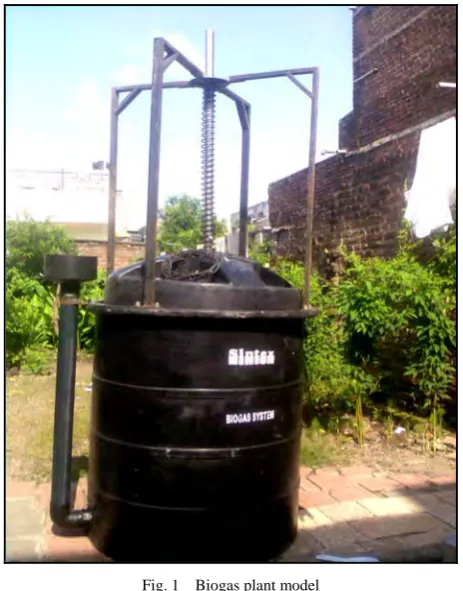
Two holes were made in digestion tank around two pipes were fitted in those holes, one for inlet chamber for feeding of biomass and another for outlet chamber for outlet to collect slurry. A grill of four angles with spring was fitted to increase pressure. The parameters of this model are listed in Table 1 and it is as shown in Fig. 1.
Fig. 1 Biogas plant model
Table 1: Parameters of biogas plant model
Sr. No. Parameters Unit
1 Gas Holder
Diameter 1.00 m
Capacity 1.00 Cu m
Depth 1.27 m
2 Digester
Diameter 1.10 m
Capacity 1.20 Cu m
Depth 1.25 m
3 Inlet Chamber
Diameter of pipe 80 mm Depth of pipe 1.45 m
4 Outlet Pipe
Diameter 80 mm
Distance from bottom 1.05 m 5 Outlet for gas
Diameter 8 mm
6 Stove
Total gas input 450 g/hr
Pressure 747 KN/ m2
7 Place for installation of model
Over the ground
8 Tube for carrying biogas
Diameter 8 mm
DETERMINATION OF CALORIFIC VALUE OF BIOGAS AND THERMAL EFFICIENCY OF STOVE
Biogas generated by kitchen solid waste contains 70 % of methane. Calorific value of 100 % methane is 8560 KCal / m3.
1. Determination of Calorific Value of Biogas
Calorific Value of Pure Methane = 8560 KCal / m3 % of Methane in Biogas = 70 %
Calorific Value of Biogas = 8560 x 0.70 = 5992 KCal / m3 Calorific Value of Biogas ≈ 6000 KCal / m3
2. Determination of Thermal Efficiency of Stove Thermal Efficiency of Stove can be determined by
A = 100(B + C)(T2-T1)
G x H Thermal Efficiency of Stove = A
Weight of Water = B Specific Heat of Aluminum X
Weight of Empty Pot = C
Initial Temperature of Water = T1 Final Temperature of Water = T2 Gas Utilized in L = G Calorific Value of Biogas = H Now,
Weight of Empty Pot = 0.4 Kg
Weight of Water = 2.0 Kg
Product of Specific Heat of Aluminum and Weight of Empty Pot
= 0.212 x 0.4
Initial Temperature of Water = 200C Final Temperature of Water = 1000C Gas Utilized to Raise Temperature = 45 L
Calorific Value of Biogas = 6000 KCal / m3
Thermal Efficiency of Stove = 100 [2+(0.212 x 0.4)] [100-20]
45 x 6.0 = 61.77 %
Thermal Efficiency of Stove ≈ 62 % ANALYSIS OF SLURRY
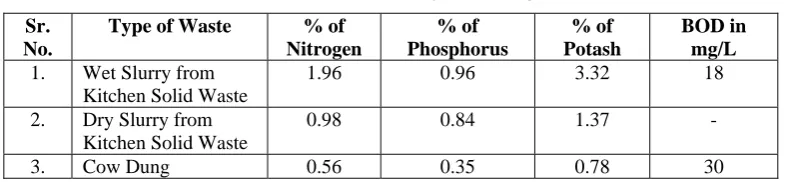
Slurry generated in kitchen solid waste based biogas digester contains more nutrients i.e. NPK and less BOD as compared to conventional biogas plant. Slurry was tested in laboratory for the % of NPK in dry and wet slurry and Biochemical Oxygen Demand. Results were tabulated in Table 2.
Table 2 Nutrients in slurry and cow dung
Sr. No.
Type of Waste % of Nitrogen % of Phosphorus % of Potash BOD in mg/L 1. Wet Slurry from
Kitchen Solid Waste
1.96 0.96 3.32 18
2. Dry Slurry from Kitchen Solid Waste
0.98 0.84 1.37 -
3. Cow Dung 0.56 0.35 0.78 30
Fig. 2 Slurry utilization to the plant
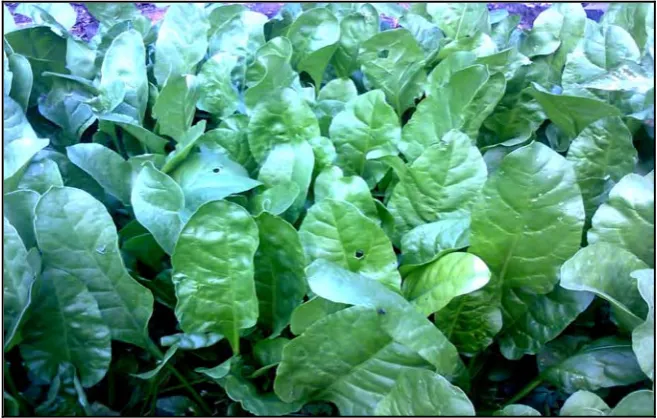
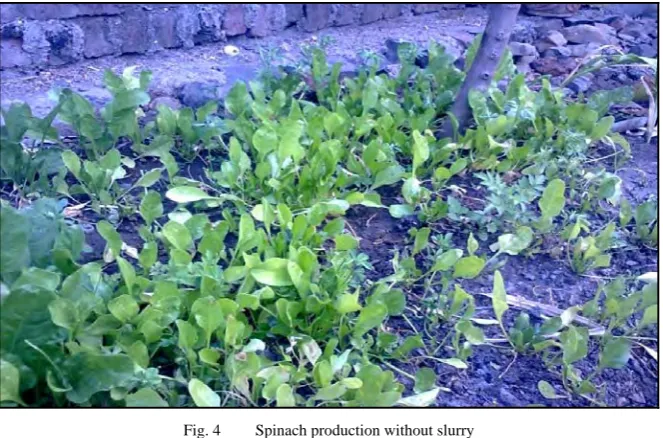
Ground was prepared for spinach production. Same ground was divided in two parts. Same seeds were bowed in both parts at same conditions. Slurry containing NPK as shown in Table 2 was poured to one part of ground but only water was poured to second part. The production of first and second part was as shown in Fig. 3 and Fig. 4 respectively.
Fig. 4 Spinach production without slurry
Bitter gourd requires black cotton soil for production. But seeds of bitter gourd sowed in sandy soil fig.5 and slurry was poured regularly. It was resulted in maximum production of bitter guard fig.6.
Fig. 5 Bitter guard production in sandy soil
Slurry was also poured to fenugreek and the products were as shown in fig. 7.
Fig. 7 Production of fenugreek
Application of slurry also increases the production capacity of soil by 20-25% (Karanjekar, 1990). Last year the production of turmeric was 4 Kg but due to application of slurry generated from biogas plant, this year the production of turmeric fig. 8 was 5 Kg in same area and same condition of soil.
Fig. 8 Production of turmeric
25% part of digestate is used for converting solids to biogas and remaining 75% digestate converts in slurry as fertilizer. Slurry contains higher % of NPK as well as micro element and humus which keeps the texture of soil good and increases the holding capacity of soil. Implementation of slurry does not affect the quality of soil or product as chemical fertilizers.
COMPARISON BETWEEN CONVENTIONAL AND KITCHEN SOLID WASTE BIOGAS SYSTEM Biogas production system receives the organic material (feedstock) into an airtight tank, where the bacteria break down the organic materials and release biogas. Through this compact system, it has been demonstrated that by using feedstock having high calorific and nutritive value to microbes, the efficiency of methane generation can be increased. It is an extremely user friendly system.
Conventional biogas system is built by using traditional materials such as bricks, sand, concrete, cement and steel. For construction of this system skillful labours are required and also more space is required for its construction. More quantity of cow dung is required and maintenance of this system is also difficult. This traditional system is useful in villages where the people are having 2-3 cows from which 25 Kg of cow dung can be collected daily. The slurry generated from this system is thick having more solids and thus it requires drying the slurry. Slurry can be utilized as fertilizer where it is difficult to transport the slurry in liquid form.
in urban area where less space is available and kitchen solid waste can be available easily. Slurry can be sold as a fertilizer for gardening purpose as in city area, for gardening less space is available and also it can be sold in Rs. 10.00 /- per L. Citizens can get more profit using less space for gardening in less amount by using slurry generated from this biogas system.
Experimental study was performed and the results obtained are shown in Table 3.
Table: 3 Comparison between conventional and kitchen solid waste biogas systems
Sr. No.
Parameters Conventional Biogas System
Kitchen Waste Biogas System 1. Material of Construction Bricks, Sand, Cement,
Concrete and Steel
Polyethylene
2. Space Required Large Small
3. Quantity of Feedstock 25.0 kg + 25.0 L water 2.0 kg + 2.0 L water
4. Type of Feedstock Cow Dung Food Waste
5. Quantity and Nature of Slurry to be Disposed
40.0 L (Semi Solid) 6.0 L (Liquid)
6. Reaction Time for Full Utilization of Feedstock
30 Days 12 Hours
7. Standard Size to be Installed 4 000 L 1 000 L
8. Production of Biogas 1 Cu m 1 Cu m
9. % of Methane in Biogas 55.0 % 70.0 %
10. Calorific Value 4700 KCal/m3 6000 KCal/m3
11. % of Nitrogen in Wet Slurry 0.84 % 1.96 %
12. % of Phosphorus in Wet Slurry 0.64 % 0.96 %
13. % of Potash in Wet Slurry 1.65 % 3.32 %
14. % of Nitrogen in Dry Slurry 0.56 % 0.98 %
15. % of Phosphorus in Dry Slurry 0.32 % 0.84 %
16. % of Potash in Dry Slurry 1.10 % 1.37 %
17. BOD of Slurry 30 mg/L 18 mg/L
18. Maintenance High None
19. Portability No Yes
20. Pay Back Period 3-4 Years 1 Year
CONCLUSIONS
From the experimental study and observations conclusions were as follows.
1. Calorific value of biogas generated from food waste was 6000 KCal/m3 and the thermal efficiency of stove was 62 %.
2. Nutrients i.e. NPK in wet slurry were 1.96, 0.96 and 3.32 respectively and NPK in dry slurry were 0.98, 0.84 and 1.37 respectively. But NPK in cow dung were 0.56, 0.35 and 0.78 respectively i.e. NPK in slurry were four times more than that of cow dung.
3. BOD5 at 200C of slurry of biogas plant model was 18 mg/L and that of cow dung was 30 mg/L.
4. When slurry was applied to spinach, bitter guard, fenugreek and turmeric, the production increased about 25 % than that of not applied.
5. Kitchen solid waste i.e. food waste based biogas system was more useful than conventional i.e. cow dung based biogas system.
REFERENCES
[1] Bhide A. D. & Sundaresan B. B., Solid Waste Management Collection, Processing and Disposal, Mudrashilpa Publication, Nagpur, 2001.
[2] Maharashtra Energy Development Authority, http//www.mahaurja.com, sited on 01/02/2011.
[3] Shrikant Karanjekar, Biogas Technology – Science, Construction and Maintenance, Center of Science for Villagers, Dattapur, Wardha, 1990.