EODVGA: An Enhanced ODV Based Genetic Algorithm
for Multi-Depot Vehicle Routing Problem
Prabu
U
1*, Ravisasthiri
P
2, Sriram
R
3, Malarvizhi
N
4and Amudhavel
J
51Department of CSE, Koneru Lakshmaiah Education Foundation, Andhra Pradesh, India, email: [email protected] 2
Department of IT, RAAK College of Engineering and Technology, Pondicherry, email: [email protected] 3Department of CSE, Rajiv Gandhi College of Engineering and Technology, Pondicherry, email: [email protected] 4Department of CSE, IFET College of Engineering, Villupuram, Tamil Nadu, India, email: [email protected] 5School of Computer Science and Engineering, VIT Bhopal University, M.P, India, email: [email protected]
Abstract
Multi-Depot Vehicle Routing Problem (MDVRP) is a familiar combinative optimization problem that simultaneously determines the direction for different vehicles from over one depot to a collection of consumers. Researchers have suggested variety of meta-heuristic and heuristic algorithms to elucidate MDVRP, but none of the existing technique has improved the fitness of the solution at the time of initial population generation. This motivates to propose an enhanced ODV based population initialization for Genetic Algorithm (GA) to solve MDVRP effectively. The Ordered Distance Vector (ODV) based population seeding method is a current and effective population initialization method for Genetic Algorithm to produce an early population with quality, individual diversity and randomness. In the proposed model, the customers are first grouped based on distance to their nearest depots and then routes are scheduled and optimized using enhanced ODV based GA. The experiments are performed based on different types of instances of Cordeau. From the experimental results, it is very clear that the proposed technique outperforms the existing techniques in terms of convergence rate, error rate and convergence diversity
Keywords: Multi-Depot Vehicle Routing Problem (MDVRP), Ordered Distance Vector (ODV), Genetic Algorithm (GA) Received on 31 January 2019, accepted on 23 May 2018,published on 10 June 2019
Copyright © U. Prabu et al., licensed to EAI. This is an open access article distributed under the terms of the Creative Commons Attribution licence (http://creativecommons.org/licenses/by/3.0/), which permits unlimited use, distribution and reproduction in any medium so long as the original work is properly cited.
doi: 10.4108/eai.10-6-2019.159099
*
Corresponding author. Email:[email protected]
1. Introduction
Dantzig and Ramser [1] in 1959 introduced the Vehicle Routing Problem (VRP) which was derived from the traveling salesman problem. It is one of the most challenging optimization problems. Based on a particular depot, the routes are determined by VRP for a set of vehicles. Subsequently around ten to twelve variants are introduced in VRP such as Open vehicle Routing Problem (OVRP), Capacitated Vehicle Routing Problem (CVRP), Period vehicle routing problem (PVRP), Split delivery vehicle routing problem (SDVRP), Time Dependent Vehicle Routing Problem with Time Windows (TDVRPTW), Vehicle Routing Problem with Time
Windows (VRPTW), Vehicle Routing Problem with Pickup and Delivery (VRPPD), and Multi-Depot Vehicle Routing Problem (MDVRP) and also many other variants are there. Our research focuses on one of the most important variant – multi depot VRP (MDVRP). MDVRP is a classical vehicle routing problem. In last few years researchers are very much interested in these variants and in solving it using methods such as heuristic and meta-heuristic techniques.
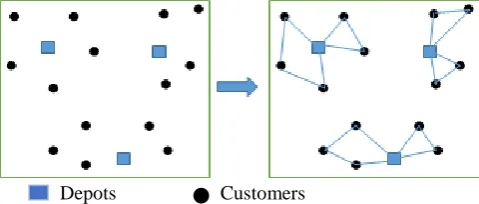
customers, the fleet of vehicles has to return to same depot. Fig.1 illustrates the multi-depot VRP, it has 3 depots and 14 customer and optimal routes for the customers are shown. More number of depots and group of vehicles are assigned to each depot, and the customers nearest to the depot are clustered within that depot. At first customers and depot are clustered then Multi depot VRP is solved. The goal of MDVRP is to reduce the entire cost of the collective routes for collection of vehicles. Cost is closely related with distance thus the objective is to reduce the full distance travelled by vehicle fleet.
Depots Customers
Figure 1. Multi-Depot Vehicle Routing Problem
2. Related Work
Genetic Algorithm (GA) is one of the methods of Meta-heuristic algorithm. Meta-Meta-heuristic algorithm finds solutions in less computational time for routing problems. Variable Neighbourhood Search Algorithm for the Multi Depot Heterogeneous Vehicle Routing Problem with Time Windows is one of the variants of heuristic and meta-heuristic methods presented by Yingcheng Xu et al.,[2]. Multi-Phase Meta-Heuristic for Multi-Depots Vehicle Routing Problem uses extremal optimization (EO) for re-adjusting the solutions. For every cluster it implements the Shuffled Frog Leaping Algorithm (SFLA). It was proposed by Jianping Luo, Xia Li et al., [3]. For solving min–max Multi-Depot Vehicle Routing Problem K. Venkata Narasimha et al., [4] proposed Ant colony optimization technique. Modular heuristic algorithm to solve Fleet-sizing for multi-depot and periodic vehicle routing problem was proposed by Alireza Rahimi Vahed., [5]. Under capacity and route length constraint for solving multi-depot vehicle routing problem C. Contardo, R. Martinelli et al., [6] proposed variable fixing, column-and-cut generation. For solving large-scale multi-depot vehicle routing problem W. Tu et al., [7] proposed Bi-level Voronoi diagram-based metaheuristic. There are various methods namely Tabu search [8, 9], Simulated annealing [10, 11], Genetic approach [12], Ant colony optimization [13, 14, 20], Particle swarm optimization [15, 16].
Genetic Algorithm (GA) takes less computation time and results in reasonable and optimal solutions when compared with further meta-heuristic algorithms. Because of these things still Genetic Algorithm (GA) is used for solving NP hard problems [21, 22], Vehicle routing
problem, Travelling salesman person problem. Still today there exists no solution for determining how Genetic Algorithm influences the process of searching upcoming variants, different aspects setting and operator of GA. Ordered Distance Vector (ODV) [17] is a recent population seeding and effective population initialization method for Genetic Algorithm.
3. Ordered Distance Vector (ODV) Based
Genetic Algorithm
Genetic algorithm (GAs) is a seeking procedure used to discover sufficient results for optimization. It has been ended up being effective at seeking ideal arrangement among a substantial and complex examination space in a versatile way. The need of it is to locate the best arrangement in the substantial search space which is the gathering of every doable arrangement among which the coveted arrangement re-sides. The Ordered Distance Vector (ODV) based population seeding system is a successful population initialization strategy for GA to produce an underlying population with irregularity, quality and individual assorted variety. It has three sorts of population initialization strategies; they are Vari-begin with Variable diversity (VV), Equi-begin with Variable diversity (EV), Vari-begin with Equal diversity (VE). In our proposed work Equi-begin with Variable diversity (EV) is used to solve MDVRP.
3.1. ODV based EV technique
The effective population initialization technique is used to initialize the initial population in Genetic Algorithm. Since the starting city is fixed in our work, we are using EV (Equi-begin with Variable diversity) based ODV (Ordered Distance Vector) population seeding technique which is built on the ODV Matrix (ODVM).
Ordered Distance Vector (ODV): ODV based population seeding system produces an arrangement of change of „n‟ cities utilizing the Ordered Distance Vector matrix. In every permutation, the categorization of the cities is picked in such a way where the sum of distance among the cities is close least. By the permutation of cities, the distance is computed and based on it the cities are sorted here. The ODV of is as appeared in the Equation and the condition for the distance between the city and the following cities are given.
( ) ( ) , Then ( ) ( ) ( ) ( )
Where ( ) distance between the and
request and rank the cities on the basis of distance, at that point it will be moved to the ODM (Ordered Division Matrix) that is given by n(n − 1) matrix as given.
[ ]
[
( ) ( ) ( ) ( )
( ) ( ) ( ) ( )
( ) ( ) ( ) ( )]
Equi-begin and Vari-diversity (EV)
Equi-begin (E): The starting city of the each individual is always same here. So remains stable for all the individuals in the population. In VRP the starting city of the individuals is fixed (depot) so here this method is applied.
Variable diversity (V): The succeeding city in the individual is added based on the value, is a selected integer whose range is within value. The city in the position of value is progressed to the succeeding city location of the individual.
The population is generated using Equi-begin with Variable diversity (EV), the starting city of each individual is fixed and based on the value and the succeeding city of the individual is chosen and added. The individuals in the population have high permutation of cities and the time complexity can be reduced. During initialization the number of maximum individuals in the population is as given,
( ( )) ( )
Where ( ) total amount of individuals in the population,
best adjacent value and total cities. EV method generates the initial population as given,
[
( ) ( ) ( ) ( ) ( ) ( ) ( ) ( )
( ) ( ) ( ) ( ) ]
4. Proposed System
4.1 ODV based EV for MDVRP
The Ordered Distance Vector (ODV) Equi-begin and variable diversity (EV) population seeding technique based on GA is proposed to solve MDVRP. The proposed algorithm consists of two stages first; an Order Distance Matrix (ODM) will be generated from the Distance Matrix (DM) and followed by generation of the initial population based on the ODM. The second stage of the technique can be performed by EV, VE and VV depending on the type of population seeding technique to be chosen. In our proposal we are using Equi-begin with
Variable diversity (EV) technique. The algorithm for MDVRP using ODV based EV techniques as shown below.
Algorithm for MDVRP using ODV- EV
Step1: Initialization of no_cities, gen, pop_size, Q, max_gen, len, ba
Step2: Iterating Step1 to 6 until
Step3: Assign the distance matrix into temp. Distance matrix
Step 4: Iterating Step 5 to 7 until
Step 5: Customer with minimum distance from Sth customer is identified and moved to ODM
* +
Step 6: The customer with min distance has changed as maximum
* + * +
Step 7: Incrementing
Step 8: Completed current customer and iterating for next customer S
Step 9: Initialization the initial customer Step10: Iterate step 19 to 20 until
Step 11: Iterate through Step 18 until
Step 12: Initialize the initial customer and total demand Step 13: Random number is generated ( ), based on best adjacent (ba) value
Step 14: Obtaining the next customer from ODM using current customer
Step 15: Checking next customer belongs to individuals Step 16: Obtaining the demand of the customer and then added to total demand
Step 17: Iterate Step 18 until total demand is less than are equal to Q
Else goto Step 11
Step 18: Incrementing the length of individual and initializing the next customers to the individuals
Step 19: Move the current individual of the population Step 20: Increment the size
Step 21: End
generated, using that best adjacent (ba) value the next customer is visited, these process is done for until the service is done for all the customers.
5. Experimentation and Result Analysis
The enhanced ODV EV population initialization technique based genetic algorithm is implemented in MATLAB 2011b. The experiments are performed different types of Cordeau‟s Instances (p01, p02, p03, p04, po7, p15, p18, pr05, pr06, pr10) obtained from (http://neo.lcc.uma.es/vrp/vrp-instances). The significance of the proposed techniques is examined by the performance factors such as Convergence rate, Error rate and Convergence diversity.
Convergence rate: Convergence rate of an individual of a population set is defined as the percentage of fitness value obtained by the individual according to the optimal fitness value given below,
( )
Error rate: Error rate of an individual of a population set is defined as the percentage of difference between fitness obtained by the individual and optimal fitness value given below,
Convergence diversity: The convergence diversity of the population is the difference between the convergence best rate and convergence error rate. This factor shows that diversity among the individuals in the population. It is calculated by the below shown equation.
( )
5.1 Result analysis
The result analysis of the proposed enhanced ODV EV technique is described in this section and comparison of ODV with other state of the art methods. The proposed enhanced ODV- EV based Genetic Algorithm is compared with other state of the art methods [18, 5, 19]. There are three performance factors used to examine the significance of the proposed techniques and they are Convergence rate, Error Rate and Convergence Diversity.
Convergence Rate
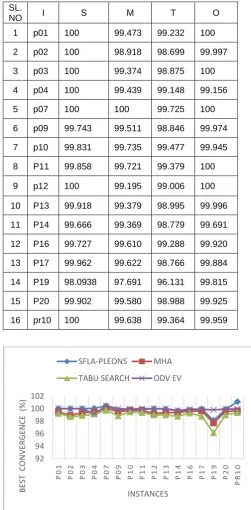
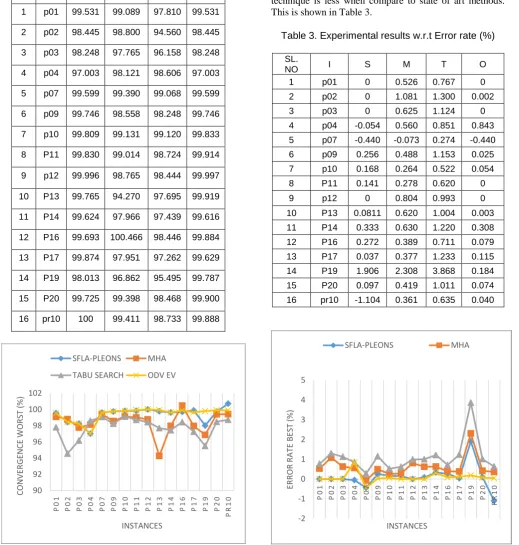
Convergence rate is commonly used for technical analysis. It indicates the series of convergence between the various instances. Different types of Cordeau‟s Instances (p01, p02, p03, p04, po7, p09, p10, p11, p12, p16, p17, p19, p10, pr10) are taken. For convergence rate (%) consider the Table 1 and Table 2. The proposed ODV technique system has high convergence for more number of instances. This shows ODV EV technique is best when
comparing to other state of the art methods. The fig.2 shows the performance of different technique w.r.t best convergence rate and fig.3 shows the performance of different technique w.r.t worst convergence rate.
In the forthcoming table I refers to the Instance, S refers to SFLA-PLEONS, M refers to MHA, T refers to Tabu Search, O refers to ODV EV
Table 1. Experimental results w.r.t Best Convergence rate (%)
SL.
NO I S M T O
1 p01 100 99.473 99.232 100
2 p02 100 98.918 98.699 99.997
3 p03 100 99.374 98.875 100
4 p04 100 99.439 99.148 99.156
5 p07 100 100 99.725 100
6 p09 99.743 99.511 98.846 99.974
7 p10 99.831 99.735 99.477 99.945
8 P11 99.858 99.721 99.379 100
9 p12 100 99.195 99.006 100
10 P13 99.918 99.379 98.995 99.996
11 P14 99.666 99.369 98.779 99.691
12 P16 99.727 99.610 99.288 99.920
13 P17 99.962 99.622 98.766 99.884
14 P19 98.0938 97.691 96.131 99.815
15 P20 99.902 99.580 98.988 99.925
16 pr10 100 99.638 99.364 99.959
Figure 2. Performance of different technique w.r.t
92 94 96 98 100 102
P
0
1
P
0
2
P
0
3
P
0
4
P
0
7
P
0
9
P
1
0
P
1
1
P
1
2
P
1
3
P
1
4
P
1
6
P
1
7
P
1
9
P
2
0
P
R
1
0
BE
ST
CO
N
V
ER
G
EN
CE
(
%
)
INSTANCES
SFLA-PLEONS MHA
Best Convergence rate (%) Table 2. Experimental results w.r.t
Worst Convergence rate (%)
SL.
NO I S M T O
1 p01 99.531 99.089 97.810 99.531
2 p02 98.445 98.800 94.560 98.445
3 p03 98.248 97.765 96.158 98.248
4 p04 97.003 98.121 98.606 97.003
5 p07 99.599 99.390 99.068 99.599
6 p09 99.746 98.558 98.248 99.746
7 p10 99.809 99.131 99.120 99.833
8 P11 99.830 99.014 98.724 99.914
9 p12 99.996 98.765 98.444 99.997
10 P13 99.765 94.270 97.695 99.919
11 P14 99.624 97.966 97.439 99.616
12 P16 99.693 100.466 98.446 99.884
13 P17 99.874 97.951 97.262 99.629
14 P19 98.013 96.862 95.495 99.787
15 P20 99.725 99.398 98.468 99.900
16 pr10 100 99.411 98.733 99.888
Figure 3. Performance of different technique w.r.t Worst Convergence rate (%)
Error Rate
Different types of Cordeau‟s Instances are chooses, now the instances are evaluated for the proposed technique and compared with the existing techniques. As per the computational results, the error rate for the ODV- EV technique is less when compare to state of art methods. This is shown in Table 3.
Table 3. Experimental results w.r.t Error rate (%)
SL.
NO I S M T O
1 p01 0 0.526 0.767 0
2 p02 0 1.081 1.300 0.002
3 p03 0 0.625 1.124 0
4 p04 -0.054 0.560 0.851 0.843
5 p07 -0.440 -0.073 0.274 -0.440
6 p09 0.256 0.488 1.153 0.025
7 p10 0.168 0.264 0.522 0.054
8 P11 0.141 0.278 0.620 0
9 p12 0 0.804 0.993 0
10 P13 0.0811 0.620 1.004 0.003
11 P14 0.333 0.630 1.220 0.308
12 P16 0.272 0.389 0.711 0.079
13 P17 0.037 0.377 1.233 0.115
14 P19 1.906 2.308 3.868 0.184
15 P20 0.097 0.419 1.011 0.074
16 pr10 -1.104 0.361 0.635 0.040
Figure 4. Performance of different techniques w.r.t Error rate (%)
90 92 94 96 98 100 102 P 0 1 P 0 2 P 0 3 P 0 4 P 0 7 P 0 9 P 1 0 P 1 1 P 1 2 P 1 3 P 1 4 P 1 6 P 1 7 P 1 9 P 2 0 P R 1 0 CO N V ER G EN CE W O R ST ( % ) INSTANCES SFLA-PLEONS MHA
TABU SEARCH ODV EV
Convergence Diversity
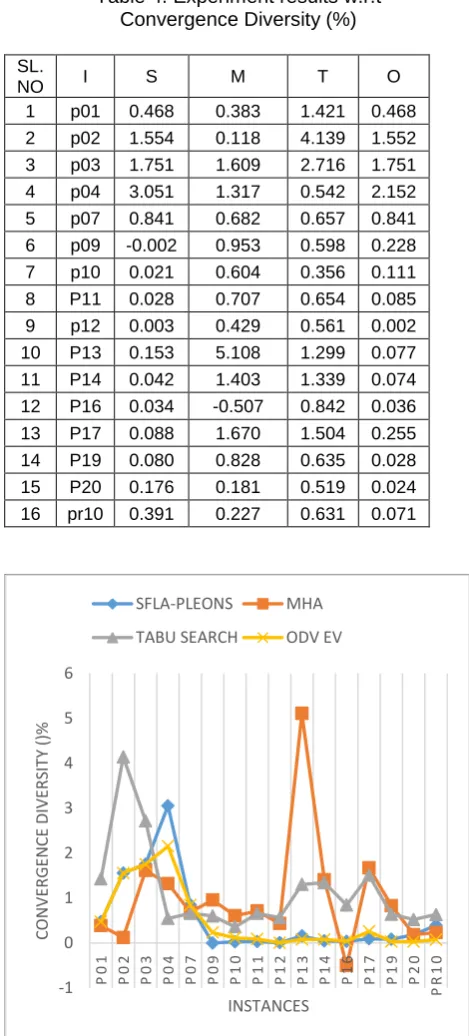
ODV EV technique produces low convergence when compare to other existing techniques. Hence our proposed technique is proven to be efficient. To overcome the pre-mature convergence problem convergence diversity is an important factor which illustrates the different range between the individuals. This shown in Table 6.5 and ODV- EV is efficient as per computational results.
Table 4. Experiment results w.r.t Convergence Diversity (%)
SL.
NO I S M T O
1 p01 0.468 0.383 1.421 0.468 2 p02 1.554 0.118 4.139 1.552 3 p03 1.751 1.609 2.716 1.751 4 p04 3.051 1.317 0.542 2.152 5 p07 0.841 0.682 0.657 0.841
6 p09 -0.002 0.953 0.598 0.228 7 p10 0.021 0.604 0.356 0.111 8 P11 0.028 0.707 0.654 0.085 9 p12 0.003 0.429 0.561 0.002 10 P13 0.153 5.108 1.299 0.077 11 P14 0.042 1.403 1.339 0.074
12 P16 0.034 -0.507 0.842 0.036 13 P17 0.088 1.670 1.504 0.255 14 P19 0.080 0.828 0.635 0.028 15 P20 0.176 0.181 0.519 0.024 16 pr10 0.391 0.227 0.631 0.071
Figure 5. Performance of different techniques w.r.t Convergence diversity (%)
6. Conclusion and Future Work
Enhanced Ordered Distance Vector (ODV) based Genetic Algorithm (GA) is proposed to solve Multi-Depot Vehicle Routing Problem (MDVRP). For generating an initial population with individual diversity, randomness and quality, the ODV based population seeding technique is an active and recent population initialization method for GA and ODV based GA improves the fitness of the solution at the time of population initialization itself. The performance of the proposed technique is compared with state of the art methods and the experimental analysis is done through based performance factors such as convergence rate, error rate and convergence diversity. The values obtain from various instances shows that our proposed ODV EV population seeding technique based genetic algorithm solves MDVRP effectively than other methods. In future these ODV EV work can be extended to solve the others variants of vehicle routing problem in efficient manner.
References
[1] G.B. Dantzig, J.H. Ramser (1959), “The truck dispatching problem”, Management Science, volume: 6(1) 80-91. [2] Yingcheng Xu, Li Wang, Yuexiang Yang (2012) , “A New
Variable Neighborhood Search Algorithm for the Multi Depot Heterogeneous Vehicle Routing Problem with Time Windows”, Electronic Notes in Discrete Mathematics,
volume: 39 289–296.
[3] Jianping Luo, Xia Li, Min-Rong Chen (2013), “Multi-Phase Meta-Heuristic for Multi-Depots Vehicle Routing Problem”, Journal of Software Engineering and Applications, volume: 6 82-86.
[4] Koushik Venkata Narasimha , Elad Kivelevitch , Balaji Sharma , Manish Kumar, “An ant colony optimization technique for solving min–max Multi-Depot Vehicle Routing Problem”, Swarm and Evolutionary Computation,
volume: 13 63-73.
[5] Alireza Rahimi Vahed, Teodor Gabriel Crainib, Michel Gendreau, Walter Rei (2015), “Fleet-sizing for multi-depot and periodic vehicle routing problems using a modular heuristic algorithm”, Computers & Operations Research,
volume: 53 9-23.
[6] Claudio Contardo, RafaelMartinelli (2014), “A new exact algorithm for the multi-depot vehicle routing problem under capacity and route length constraints”, Discrete Optimization, volume: 12 129-146.
[7] Wei Tu , Zhixiang Fang, Qingquan Li, Shih-Lung Shaw, BiYu Chen (2014) , “A bi-level Voronoi diagram-based metaheuristic for a large-scale multi-depot vehicle routing problem”, Transportation Research Part E: Logistics and Transportation Review, volume: 61 84-97.
[8] Minghe Sun (2012), “A Tabu search heuristic procedure for the capacitated facility location problem”, Journal of Heuristics, volume: 18 91-118.
[9] J.F. Cordeau, M. Maischberger (2012), “A parallel iterated tabu search heuristic for vehicle routing problems”, -1
0 1 2 3 4 5 6
P
0
1
P
0
2
P
0
3
P
0
4
P
0
7
P
0
9
P
1
0
P
1
1
P
1
2
P
1
3
P
1
4
P
1
6
P
1
7
P
1
9
P
2
0
P
R
1
0
CO
N
V
ER
G
EN
CE
DIV
ER
SIT
Y
()
%
INSTANCES
SFLA-PLEONS MHA
Computers & Operations Research, volume: 39 2033-2050.
[10] J. Qin, L. Ni, F. Shi (2012), “Combined simulated annealing algorithm for the discrete facility location problem”, The Scientific World Journal, volume: 2012 1– 7.
[11] V.F. Yu, S.-W. Lin, W. Lee, C.-J. Ting (2010), “A simulated annealing heuristic for the capacitated location routing problem”, Computers & Industrial Engineering,
volume: 58 288-299.
[12] S.H.R. Pasandideh, S.T.A. Niaki (2012), “Genetic application in a facility location problem with random demand within queuing framework”, Journal of Intelligent Manufacturing, volume: 23 651-659.
[13] S. Wang, J. Watada, W. Pedrycz (2009), “Recourse-based facility-location problems in hybrid uncertain environment", IEEE Transactions on Systems, Man, and Cybernetics—Part B: Cybernetics, volume: 40 1176-1187. [14] Y.-J. Gong, J. Zhang, O. Liu, R.-Z. Huang, H.S.-H. Chung,
Y.-H. Shi (2012), “Optimizing the vehicle routing problem with time windows: a discrete particle swarm optimization approach”, IEEE Transactions on Systems, Man, and Cybernetics, Part C (Applications and Reviews),
volume: 42 254-267.
[15] S. Wang, J. Watada (2012), “A hybrid modified PSO approach to VaR-based facility location problems with variable capacity in fuzzy random uncertainty”,
Information Sciences, volume: 192 3–18.
[16] S. Wang, J. Watada, W. Pedrycz (2009), “Value-at-risk-based two-stage fuzzy facility location problems”, IEEE Transactions on Industrial Informatics, volume: 5 465-482. [17] P. Victer Paul et al (2014), “A new population seeding technique for permutation-coded Genetic Algorithm: Service transfer approach”, Journal of Computational Science, volume: 5 277-297.
[18] Jianping Luo, Min-Rong Chen (2014), “Improved Shuffled Frog Leaping Algorithm and its multi-phase model for multi-depot vehicle routing problem”, Expert Systems with Applications, volume: 41 2535-2545.
[19] Yongle He ,Weidong Miao, Rong Xie, Yanjun Shi (2014), “A tabu search algorithm with variable cluster grouping for multi-depot vehicle routing problem”, Proceedings of the 2014 IEEE 18th International Conference on Computer Supported Cooperative Work in Design (CSCWD).
[20] Qin Y., Sheng Q.Z., Mehdi M., Wang H., Xie D. (2013), “Effectively Delivering XML Information in Periodic Broadcast Environments”, International Conference on Database and Expert Systems Applications, 165-179. [21] G Wang, H Wang, X Tao, J Zhang, X Yi, J Yong (2014),
“Positive influence dominating set games”, Proceedings of the 2014 IEEE 18th International Conference on Computer Supported Cooperative Work in Design (CSCWD), 469-473.