Poster information for SimHealth 2012 Background:
Educating undergraduate nurses in the 21st century provides some very realistic challenges. As nursing and faculty shortages collide they create what Hinshaw (2008) calls the “perfect storm” a unique moment in nursing history (Campbell and Daley, 2009). This coupled with decreased government health budgets, increased student numbers and higher patient acuities has resulted in a reduction in the availability and quality of clinical placements (Wilford & Doyle, 2006; Cangelosi, 2008; Feingold, Calaluce, & Kallen, 2004). Simulated nursing practice, an innovative strategy designed to address these concerns is rapidly gaining global momentum (Kardong-Edgren, 2011)
The Programme:
For first year, second semester students at the At the Waikato Institute of Technology, I designed a simulation programme. The programme reinforces and facilitates the integration of new skills and knowledge. Students work in groups of three, each group consisting of; a primary nurse, an observer nurse and a patient. The students are divided into one of two or three rotations for the semester. In each rotation half of the students attend a 4 hour workshop and the other half begin a two hour clinical duty in a simulated hospital ward followed a debriefing session. They then swap over. The programme runs four consecutive 4 days.
Day 1 Day 2 Day 3 Day 4
Patient admission
-The unconscious / bedridden patient -All admission documentation… -Basic nursing care
A day in the ward
-Patient Manual Handling/ -Medications
A day in the ward
-Collaborative care
-Multi Disciplinary Meeting -Referrals.
Patient Discharge
-Discharge process
-Patient summary/presentation -Documentation audit.
Workshop 1 Workshop 2 Workshop 3 Workshop 4
-Admission process
-Professional documentation
-Introduction to Medication Management
-Time Management
-Mobility Aids/documentation -Medication Management cont’d
-Collaborative care…referral system -Fluid balance
Aim: The aim of this study was to evaluate student perceived learning from the newly introduced simulation programme.
Method: Prior to the commencement of the programmeand again at programme completion, 78 students were asked to evaluate their: clinical skills and knowledge; therapeutic skills; clinical judgement; documentation and interdisciplinary knowledge, using a scale of 0-10, ten being the highest score.
Student scores were recorded and analysed in three ways. All scores for responses 1-8, pre and post simulation were analysed using descriptive statistics. A paired and unpaired t-Test was used for analysis. Paired Scores using a paired t-Test were considered more appropriate as the scores were from the same individuals. In order to carry out this test the individuals with only one score (either before or after) were filtered out and the analysis carried out on 61 individuals with valid two time scores. Given that there were 17 missing cases a 2 sample t-test was done which allowed allowed all data to be included.
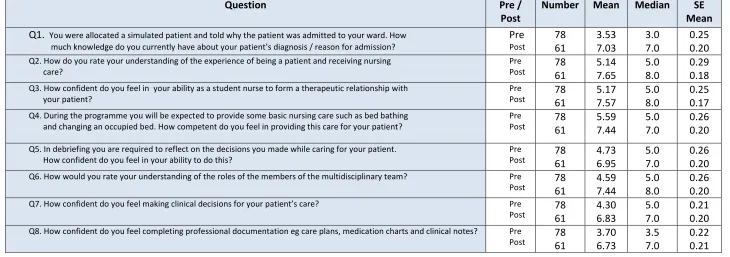
Table 1a- Descriptive Statistics: scores for questions 1-8 before and after the simulation
Question Pre /
Post
Number Mean Median SE Mean
Q1. You were allocated a simulated patient and told why the patient was admitted to your ward. How much knowledge do you currently have about your patient’s diagnosis / reason for admission?
Pre Post 78 61 3.53 7.03 3.0 7.0 0.25 0.20 Q2. How do you rate your understanding of the experience of being a patient and receiving nursing
care?
Pre
Post 78 61 5.14 7.65 5.0 8.0 0.29 0.18
Q3. How confident do you feel in your ability as a student nurse to form a therapeutic relationship with your patient?
Pre
Post 78 61 5.17 7.57 5.0 8.0 0.25 0.17
Q4. During the programme you will be expected to provide some basic nursing care such as bed bathing and changing an occupied bed. How competent do you feel in providing this care for your patient?
Pre
Post 78 61 5.59 7.44 5.0 7.0 0.26 0.20
Q5. In debriefing you are required to reflect on the decisions you made while caring for your patient. How confident do you feel in your ability to do this?
Pre
Post 78 61 4.73 6.95 5.0 7.0 0.26 0.20
Q6. How would you rate your understanding of the roles of the members of the multidisciplinary team? Pre
Post 78 61 4.59 7.44 5.0 8.0 0.26 0.20
Q7. How confident do you feel making clinical decisions for your patient’s care? Pre
Post 78 61 4.30 6.83 5.0 7.0 0.21 0.20
Q8. How confident do you feel completing professional documentation eg care plans, medication charts and clinical notes? Pre
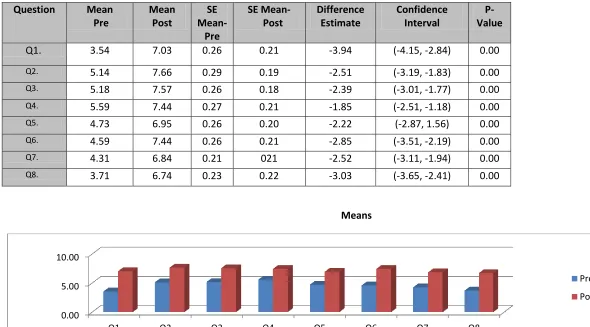
Table 1b-Knowledge/skill differences before and after simulation programme - paired t-test
Means
0.00 5.00 10.00
Q1 Q2 Q3 Q4 Q5 Q6 Q7 Q8
Pre
Post Question Mean
Pre
Mean Post
SE Mean-
Pre
SE Mean- Post
Difference Estimate
Confidence Interval
P- Value
Q1. 3.54 7.03 0.26 0.21 -3.94 (-4.15, -2.84) 0.00
Q2. 5.14 7.66 0.29 0.19 -2.51 (-3.19, -1.83) 0.00
Q3. 5.18 7.57 0.26 0.18 -2.39 (-3.01, -1.77) 0.00
Q4. 5.59 7.44 0.27 0.21 -1.85 (-2.51, -1.18) 0.00
Q5. 4.73 6.95 0.26 0.20 -2.22 (-2.87, 1.56) 0.00
Q6. 4.59 7.44 0.26 0.21 -2.85 (-3.51, -2.19) 0.00
Q7. 4.31 6.84 0.21 021 -2.52 (-3.11, -1.94) 0.00
Table 1c-Unpaired t-Test (Pre=78, Post =61)
The results show that the greatest difference between pre and post scores was in questions one and eight which relate to students’ knowledge about their patients conditions/ illnesses and their confidence in completing professional documentation. The least difference as perceived by students was related to their confidence in providing basic care for their patients. Overall, all analyses show that there is a difference between the students’ pre and post scores for each of the eight questions. The difference in scores is statistically significant (paired t-test= -3.94, -2.51, -2.39, -1.85, - 2.22, -2.85, 2.52, -3.03; p=0.000).
Conclusion
The simulation programme seems to, on average, raise the knowledge/skill levels of first year student nurses and the results of this study provide some prima faci evidence to continue to develop the simulation programme and test its effects. Future research should include a larger sample and include the use of a widely used evaluation tool.
Question Mean Pre
Mean Post
Difference SE Mean
Confidence Interval
P- Value
Q1. 3.50 7.03 -3.52 0.35 (-4.23, -2.81) 0.00
Q2. 5.04 7.65 -2.60 0.34 (-3.30, -1.91) 0.00
Q3. 5.19 7.57 -2.37 0.33 (-3.04, -1.70) 0.00
Q4. 5.41 7.44 -2.03 0.32 (-2.68, -1.38) 0.00
Q5. 4.62 6.95 -2.32 0.34 (-3.02, 1.63) 0.00
Q6. 4.34 7.44 -3.09 0.35 (-3.81, -2.38) 0.00
Q7. 4.23 6.83 -2.60 0.34 (-3.28, -1.92) 0.00
References
Cangalosi, P.R. ( 2008). Accelerated nursing students and theatre students: Creating a safe environement by acting the part. Nursing Education Perspective. Retrieved from http://www.thefreelibrary.com/Accelerated+nursing+students+and+theater+students%3A+Creating+a+Safe...-a0190747317.
Campbell, S.H. & Daley, K.M. (2009). Setting the Foundation for Simulation. New York: Springer publishing.
Feingold, C.E., Calaluce, M. & Kallen, M.A. (2004). Computerized patient model and simulated experiences: Evaluation with baccalaureate nursing students. Journal of Nursing Education, 43(4), 156-163.
Hinshaw, A.S. (2008). Navigating the perfect storm: Balancing a culture with workforce challenges. Nursing Research, 57(1S), S4-S10.
Kardong-Edgren, S. (2011). Report on the 2nd Swiss Conference on Simulated Patients and Simulation. International Nursing Association for Clinical Simulation and Learning. Elsevier Inc. doi 10.1016/j.ecns.2010.10.001