Available online on 23.08.2019 at http://jddtonline.info
Journal of Drug Delivery and Therapeutics
Open Access to Pharmaceutical and Medical Research© 2011-18, publisher and licensee JDDT, This is an Open Access article which permits unrestricted non-commercial use, provided the original work is properly cited
Open Access
Research Article
Formulation, Development and Evaluation of Bilayer Floating Tablet of
Gemfibrozil
Mohammad Faizan Mohammad Gufran*
1, Sailesh Kumar Ghatuary
1, Reena Shende
1, Prabhat Kumar Jain
2,
Geeta Parkhe
21 RKDF School of Pharmaceutical Science, Bhopal (M.P.), India 2 Scan Research Laboratories, Bhopal (M.P.), India
ABSTRACT
Formulation development is an important part of drug design and development. Bioavailability and bioequivalence are totally dependent on formulation development. Now-a-days formulation development is done by following QbD (Quality by Design).The aim of present study is to formulate Gemfibrozil (Gem) sustained release (SR) and immediate release (IR) bilayer tablet by different concentration of Hydroxypropyl methylcellulose (HPMC) and HPMC K 100 M to control the release pattern. The sustained release layer of Gem was prepared by using different grades of HPMC like, HPMC K-15, HPMC K-4 along with other excipients by direct compression technique. The immediate release layer of Gem was prepared by Cross carmellose sodium, Crospovidone and Sodium starch glycolate by direct compression technique. The powders were evaluated for their flow properties and the finished tablets were evaluated for their physical parameters. The both immediate release and sustained release layers of Gem were characterized by FT-IR and in vitro dissolution studies. The drug release study of Gem was evaluated using USP-II paddle type dissolution apparatus. The release rate of Gem in immediate release layer was studied for 15 min in 0.1 N HCL media and that of Gem in sustained release layer was studied for 12 h in 0.1 N HCL. From the nine batches F6 batch showed good release behaviour 99.85% of drug is released over 12 hours. Gem belongs to BCS Class II (log P 3.6) with poor solubility and high permeability resulting in limited and variable bioavailability. Total four trial batches of each drug have been manufactured to optimize and develop a robust and stable formulation, the stability studies of the products also comply with ICH guideline.
Keywords: Bilayer floating tablets, Gemfibrozil, Biphasic drug release, HPMC K 15.
Article Info:Received 22 June 2019; Review Completed 31 July 2019; Accepted 18 August 2019; Available online 23 August 2019 Cite this article as:
Mohammad Gufran MF, Ghatuary SK, Shende R, Jain PK, Parkhe G,Formulation, Development and Evaluation of Bilayer Floating Tablet of Gemfibrozil, Journal of Drug Delivery and Therapeutics. 2019; 9(4):574-578
http://dx.doi.org/10.22270/jddt.v9i4.3401
*Address for Correspondence:
Mohammad Faizan Mohammad Gufran, RKDF School of Pharmaceutical Science, Bhopal (M.P.)
INTRODUCTION
The bilayer tablet is a concept which is composed of different layers. The system allows the incorporation of more than one drug into the dosage form. Formulation of layers from different polymers allows manipulation over more than one rate-controlling polymer, thus enabling
different types of drug delivery of one or more drugs1.
Floating Bilayer drug delivery system is combined principle of bilayer tablet as well as floating mechanism. Floating Bilayer tablet is suitable for sequential release of two drugs in combination, separate two incompatible substances and also for sustained release tablet in which one layer is immediate release as initial dose and second layer is
maintenance dose2. Floating drug delivery systems have a
bulk density less than gastric fluids and so remain buoyant in the stomach without affecting the gastric emptying rate
for a prolonged period of time3. While the system is floating
on the gastric contents, the drug is released slowly at the desired rate from the system. Bioavailability of poorly water‐soluble hydrophobic drugs is limited by their
solubility and dissolution rate4,5. Gemfibrozil (Gem) is a
widely used antihyperlipidemic agent classified as fibric acid derivative. It increases the activity of extrahepatic
lipoprotein lipase, resulting in the lipolysis process6. Gem
activates peroxisome proliferator-activated receptor-alpha transcriptor factor ligand, a receptor that is involved in the metabolism of carbohydrates and fats and also in adipose
tissue distribution7. This results in increased synthesis of
lipoprotein lipase thereby increasing the clearance of triglyceride. Gem belongs to BCS Class II (log P 3.6) with poor solubility and high permeability resulting in limited
and variable bioavailability8,9. In the present study, a bilayer
MATERIALS AND METHODS
Gem was obtained from Aurobindo Pharma, Hyderabad, as a gift sample. HPMC K4, K15, PVP K30 was obtained from Mapromax, Life sciences Pvt. Ltd. Dehradun. Sodium bicarbonate, citric acid, magnesium stearate and talc were obtained from Loba Chemical Pvt Ltd (Mumbai, India). Hydrochloric acid was obtained from S. D. Fine Chem. Ltd., Mumbai. All other chemical were purchased from Hi Media, Mumbai. Double distilled water was prepared freshly and used whenever required. All other chemicals used in this study including those stated were of analytical reagent (A.R.) grade.
Procedure for the determination of λ max
Accurately weighed 10 mg of Gem separately and dissolved in 10 ml of 0.1N HCL in 10 ml of volumetric flask and prepared suitable dilution to make it to a concentration of 100 μg/ml make adequate of sample with concentration range of 5-25μg/ml Gem calculate the spectrum of this solution was run in 200-400 nm range in U.V spectrophotometer (Labindia UV 3000 +). The higher absorption peak was obtained at 278nm which was the λmax of drug.
Formulation development
Formulation of immediate release (IR) layer
The immediate release granules were prepared by blending
the drug with different concentration of superdisintegrants
like sodium starch glycolate, crospovidone, croscarmellose sodium and other excipients like microcrystalline cellulose by direct compression method. The powder blend was lubricated with magnesium stearate and talc. A weighed quantity of above lubricated drug mixture blend was fed manually into the die and directly compressed using 8 mm flat faced punch of 16 station Rimek mini press rotary compression machine to get IR layer. Nine formulation
batches with different super superdisintegrants were made
in order to achieve desired disintegration time and drug release. The composition of Gem immediate release tablets were shown in Table 1.
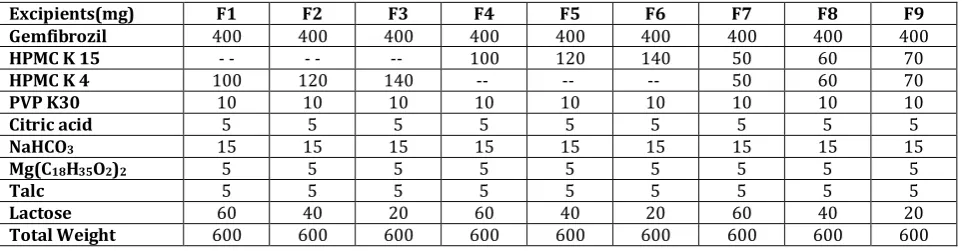
Formulation of floating sustained release (SR) layer The floating sustained release granules were prepared by direct compression technique. Required quantity of Gem and polymers like HPMC K4, HPMC K15, PVP K30, alkalizing agent sodium bicarbonate and acidifying agent citric acid were weighed and passed through sieve with mesh #40 and were mixed homogeneously in a poly-bag for about 5-10 min and was taken in a mort. The powder mass was passed through mesh #14. Finally the powder was lubricated with lactose and talc Table 2.
Formulation of bilayer tablet
Optimized formulation IF-6 of immediate release layer and optimized formulation of F-6 for sustained release used for formulation of Bi-layer tablet.
Table 1 Composition of Gemfibrozil fast dissolving tablets
Ingredients(mg) Formulation code
IF1 IF 2 IF 3 IF 4 IF 5 IF 6 IF 7 IF 8 IF 9
Gemfibrozil 200 200 200 200 200 200 200 200 200
Sodium Starch glycolate 15 20 25 - - - -
Croscarmellose sodium - - 15 20 25 - - -
Crospovidone - - - 15 20 25
Microcrystalline cellulose 24 19 14 24 19 14 24 19 14
Talc 5 5 5 5 5 5 5 5 5
Magnesium stearate 6 6 6 6 6 6 6 6 6
Total weight 250 250 250 250 250 250 250 250 250
Table 2 Formulation of sustained release floating layer
Excipients(mg) F1 F2 F3 F4 F5 F6 F7 F8 F9
Gemfibrozil 400 400 400 400 400 400 400 400 400
HPMC K 15 - - - - -- 100 120 140 50 60 70
HPMC K 4 100 120 140 -- -- -- 50 60 70
PVP K30 10 10 10 10 10 10 10 10 10
Citric acid 5 5 5 5 5 5 5 5 5
NaHCO3 15 15 15 15 15 15 15 15 15
Mg(C18H35O2)2 5 5 5 5 5 5 5 5 5
Talc 5 5 5 5 5 5 5 5 5
Lactose 60 40 20 60 40 20 60 40 20
Total Weight 600 600 600 600 600 600 600 600 600
Evaluation of precompression parameter Angle of repose (θ)
The angle of repose was determined by using fixed funnel method. The physical mixtures of drug with different excipients were prepared and the accurately weighed drug powder or its physical mixture was taken in a funnel. The height of the funnel was adjusted in such a way that the tip of the funnel just touches the apex of the heap of the drug
powder. The powder was allowed to flow through the funnel freely onto surface. The angle of repose was calculated using
the following equation.
θ = tan-1(h/r)
Bulk density
Both loose bulk density (LBD) and tapped density (TBD) were determined were calculated using the following formulas.
LBD = Powder weight/volume of the packing TBD = Powder weight /tapped volume of the packing Compressibility index
The compressibility index of the granules was determined
by Carr’s compressibility index.
Carr’s index (%) = [(TBD – LBD)/TBD] × 100. Hausner’s ratio
Hausner’s ratio is an indirect index of ease of measuring the
powder flow. It was calculated by the following formula10-12.
Hausner’s ratio = Tapped density/Bulk density. Evaluation of post compression Parameter
General appearance
Morphological characters like shape and texture was determined visually.
Thickness
Thickness and diameter of tablets were determined using Vernier caliper. Five tablets from each batch were used and an average value was calculated.
Hardness
For each formulation, the hardness of five tablets was determined using the Monsanto hardness tester (Cadmach)
and measured in terms of kg/cm2.
Weight variation
The weight variation test was performed as per the U.S guidelines. Twenty randomly taken tablets were weighed together and the average weight was determined. Each tablet was then weighed individually and deviation from average weight was calculated.
Friability
A sample of twenty randomly selected tablets were accurately weighed and placed in a Roche friabilator. The friabilator was operated for 4 min at a speed of 25 rpm. The tablets were removed from the friabilator, de-dusted and reweighed. The percent loss in weight due to abrasion and impact was calculated as,
%Friability= (Loss in weight/ Initial weight) x 100 Drug content
Twenty tablets were taken and amount of drug present in each tablet was determined. The tablets were crushed in a mortar and the powder equivalent to 100mg of drug was transferred to 100ml standard flask. The powder was dissolved in 50 ml of 0.1 N HCL and made up to volume with of 0.1 N HCl. The sample was mixed thoroughly and filtered through a 0.45μ membrane filter. The filtered solution was diluted suitably and reacts with dye and analyzed for drug content by UV spectrophotometer at a λ max of 278.0nm using of 0.1 N HCL as blank.
Buoyancy lag time determination & total floating time
In vitro buoyancy was determined by floating lag time as per
the method described below. The tablets were placed
separately in a 100 ml glass beaker containing simulated
gastric fluid (SGF), pH 1.2 as per USP. The time required for the tablet to rise to the surface for floating was determined as the buoyancy lag time and further total floating time of all tablets was determined by visual observation.
In vitro disintegration time of immediate release tablets The disintegration time for all immediate release formulations was carried out using tablet disintegration test apparatus. Six tablets were placed individually in each tube of disintegration test apparatus and discs were placed. The medium, water was maintained at a temperature of 37° ± 2°C and time taken for the entire tablet to disintegrate completely was noted.
In vitro dissolution studies
In vitro drug release of the sample was carried out using USP- type II dissolution apparatus (Paddle type). The dissolution medium, 900 ml 0.1N HCl was placed into the
dissolution flask maintaining the temperature of 37±0.50C
and rpm of 75. One Betahistine tablet was placed in each
basket of dissolution apparatus. The apparatus was allowed to run for 10 hours. Sample measuring 5 ml were withdrawn after every 1 hour up to 10 hours using 10ml pipette. The
fresh dissolution medium (370C) was replaced every time
with the same quantity of the sample. From this take 0.5 ml and dilute up to 10 ml with 0.1 N HCL and take the absorbance at 278nm using spectroscopy.
Stability studies
The stability of Gem bilayer floating tablets to assess their stability with respect to their physical appearance, drug content and release characteristics after storing at 25°C/60% RH and 40°C/75% RH in properly closed HDPE bottles along with 1 g desiccant for 3 months.
RESULTS AND DISCUSSIONS
Solubility of Gem was soluble in ethanol, methanol, chloroform, 0.1N HCl water, sparingly soluble in water, 0.1 N NaOH, 6.8 pH Phosphate buffer. The melting point of Gem
was 58-61°C and λ max of Gem was found to be 278 nm by
using U.V. spectrophotometer (Labindia-3000+) in linearity
range 5-25µg/ml Fig.1.
Fig. 1Calibration curve of gemfibrozil in 0.1 HCL at 278 nm
using the superdisintegrants exhibited the LBD, TBD, angle
of repose, compressibility index and Hausner’s ratio of within the range, which shows good flow properties of the powdered blend.
Table 3 Results of pre-compression parameters of powder blend of immediate release
Formulation code
Parameters Loose Bulk
density(gm/ml) density(gm/ml) Tapped bulk Index (%) Carr’s Hausner’s Ratio
IF1 0.456 0.535 14.766 1.173
IF2 0.469 0.536 12.500 1.143
IF3 0.476 0.537 11.359 1.128
IF4 0.471 0.532 11.466 1.130
IF5 0.475 0.541 12.200 1.139
IF6 0.479 0.539 11.132 1.125
IF7 0.475 0.541 12.200 1.139
IF8 0.472 0.532 11.278 1.127
IF9 0.476 0.541 12.015 1.137
Table 4 Result of pre-compression properties of sustained release floating tablets
Material Bulk
density(gm/ml) density(gm/ml) Tapped Compressibility index Hausner’s ratio
F1 0.489 0.578 15.398 1.182
F2 0.485 0.582 16.667 1.200
F3 0.482 0.579 16.753 1.201
F4 0.479 0.589 18.676 1.230
F5 0.485 0.578 16.090 1.192
F6 0.489 0.571 14.361 1.168
F7 0.482 0.573 15.881 1.189
F8 0.485 0.574 15.505 1.184
F9 0.478 0.582 17.869 1.218
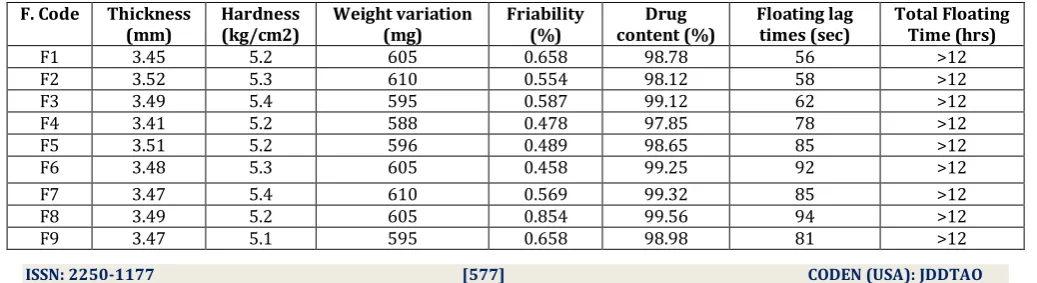
The prepared tablets were evaluated for different physico-chemical properties and the results are summarized in Table 5 & 6. The tablets were white, circular in shape and were found to be uniform with respect to weight variation,
hardness; thickness, friability and content uniformity of different batch of tablets were found within acceptable range and the distribution of drug in all the formulations was uniform.
Table 5 Results of post-compression parameters of immediate release
F. Code Hardness
test (kg/cm2)
Friability
(%) variation (%) Weight Thickness (mm) content (%) Drug In vitro(sec.) (n=3) Mean ± SD Disintegration Time
IF1 3.2 0.856 255 2.45 95.56 115±8
IF2 3.4 0.789 250 2.42 97.89 98±9
IF3 3.3 0.658 256 2.39 98.85 88±8
IF4 3.4 0.456 260 2.45 98.78 125±9
IF5 3.4 0.521 245 2.48 98.85 110±6
IF6 3.5 0.478 248 2.43 99.25 105±8
IF7 3.4 0.652 252 2.42 98.78 165±9
IF8 3.4 0.745 255 2.41 97.78 133±9
IF9 3.4 0.658 255 2.43 98.85 120±5
Table 6 Results of post compression properties of sustained release floating tablets
F. Code Thickness
(mm) Hardness (kg/cm2) Weight variation (mg) Friability (%) content (%) Drug Floating lag times (sec) Total Floating Time (hrs)
F1 3.45 5.2 605 0.658 98.78 56 >12
F2 3.52 5.3 610 0.554 98.12 58 >12
F3 3.49 5.4 595 0.587 99.12 62 >12
F4 3.41 5.2 588 0.478 97.85 78 >12
F5 3.51 5.2 596 0.489 98.65 85 >12
F6 3.48 5.3 605 0.458 99.25 92 >12
F7 3.47 5.4 610 0.569 99.32 85 >12
F8 3.49 5.2 605 0.854 99.56 94 >12
The prepared bilayer tablets were evaluated for different physico-chemical properties and the results are summarized in Table 7. The tablets were found to be uniform with
respect to weight variation and hardness (6.20±0.2kg/cm2).
The thickness (5.42±0.03mm) and friability (0.658±0.062%)
of optimized batch of tablets were found within acceptable range. Content uniformity of formulations was found to be 98.96%, where the distribution of drug in all the formulations was uniform.
Table 7 Post-compressional parameters of bilayer tablets
Formulation Hardness
test (kg/cm2)
Friability
(%) variation Weight Thickness (mm) (% Label Claim) Gemfibrozil
1. 6.20±0.2 0.658±0.062 Passes 5.42±0.03 98.96
The Instant layer of Gem release Approx 98.00±1.23 percent drug within 15 minutes and control floating layer Gem shows release up to 12 Hours Approx 99.89 percent. The release of bilayer tablet is shown in Fig.2.
Fig. 2 Graph of release of bilayer tablets
CONCLUSION
Based on the above study, it can be concluded that Gemfibrozil, a conventional drug for antihyperlipidemic activity can be successfully formulated in the form of bilayer tablet by optimizing drug polymer ratio using different grades of common polymers like HPMC K4, HPMC K 15 etc. This is basically done to improve bioavailability of the drug and better therapeutic compliance. The sustained layer of the drug showed steady state release behaviour over a prolonged duration of time which may reduce dose related side effects. In future, natural biodegradable polymers can be used to improve therapeutic efficacy of the drug and further minimizing side effects.
ACKNOWLEDGMENTS
The authors would like to thank the Mr. Prabhat Kumar Jain, Geeta Parkhe and All supporting staff of Scan Research
Laboratories, Bhopal (M.P.) who helped in the experiments during research work.
REFERENCES
1. Shaikh TK, Gadhave MV, Jadhav SL, Gaikwad DD. Different techniques of bilayer tablet: a review. Int J Univ Pharm Life Sci 2012; 2(2): 450-460.
2. Mayavanshi AV, Gajjar SS. Floating drug delivery systems to increase gastric retention of drugs: A review. J Pharm Tech 2008; 1(14): 345-348.
3. Patra CN, Kumar AB, Pandit HK, Singh SP, Devi MV. Design and evaluation of sustained release bilayer tablets of propranolol hydrochloride, Acta Pharm 2007; 57: 479-489.
4. Deshpande RD, Gowda DV, Mahammed M, Maramwar DN, Bi-Layer tablets-an emerging trend: a review, Int J Pharm Sci Res2011; 2(10); 2534-2544.
5. Yadav BV, Yadav VA. Enhancement of solubility and dissolution rate of BCS class II pharmaceuticals by nonaquious granulation technique. Int J Pharma Res Devel 2010; 1: 1‐12.
6. Taneja S, Shilpi S, Khatri K. Formulation and optimization of efavirenz nanosuspensions using the precipitation-ultrasonication technique for solubility enhancement. Artif Cells Nanomed Biotechnol 2016; 44:978-84.
7. Patel R, Baviskar T, Rajput A. Development and in-vivo characterization of SMEDDs (self-microemulsifying drug delivery system) for gemfibrozil. Int J Pharm Pharm Sci 2013; 5:793-800.
8. Talib H, Watersa L, Gareth M, Parkes G. Microwave processed solid dispersions for enhanced dissolution ofgemfibrozil using non-ordered mesoporous silica. Colloids Surf A Physicochem Eng Asp 2017;520:428-35
9. Huang QP, Wang JX, Chen GZ, Shen ZG, Chen JF, Yun J. Micronization of gemfibrozil by reactive precipitation process. Int J Pharm 2008; 360:58-64.
10. Liberman HA, Lachman L, Schwartz JB. Pharmaceutical dosage forms: Tablets, 3rd edition, Marcel Dekker, New York, 1990. 11. Lordi GN. Sustained release dosage forms. In: Lachman L,
Liberman HA, Kanig JL, 3rd edition. The Theory and Practice of Industrial Pharmacy. Mumbai, India: Varghese Publishing House; 1987:430-456;