IJSRSET1738144 | Received : 20 Nov 2017 | Accepted : 15 Dec 2017 | November-December-2017 [(3) 8 : 962-966]
© 2017 IJSRSET | Volume 3 | Issue 8 | Print ISSN: 2395-1990 | Online ISSN : 2394-4099 Themed Section : Engineering and Technology
109
A Survey on Heterogeneous Resource Scheduling Algorithm in Cloud
Computing
S. Lakshmanan
Assistant Professor, Department of B. Voc. (SD & SA), St. Joseph‟s College, Trichirapalli, Tamil Nadu, India
ABSTRACT
Cloud computing is a distributed computing model. This model provides the dynamic service for scheduling task in virtual machines over the internet. The task scheduling and allocation of virtual resource used in distributed dynamic environment. There are more many standard algorithms are used in dynamic service. The virtual resource is specialized in high communication cost and time. This paper presents a comparative analysis of ABC, FIFS, RR, SJF, Priority tasks and merits, demerits scheduling algorithms in the cloud platform; above the algorithms used allocate resources to virtual machines, it varied the cost, time ,speed efficiency time of allocation.
Keywords : Cloud Computing, Virtual Machine, ABC, FIFS, RR, SJF Algorithms
I.
INTRODUCTION
A cloud computing is an essential component of the advanced computing system. The computing concepts, technology, and architecture are combined to gather for the goal. Job scheduling is one of the main activities in virtual machine technology, it upcoming latest technology for the cloud. The goal of scheduling, maximizing the resource allocation, minimizing the total number of task execution time. The resources are optimizing the solution to adaptable resource job with sequence time order. The task scheduling schedule for the distribution system, grid system, parallel system. It‟s emulated many issues for all of the system. There are various types of scheduling algorithms, such as static, and dynamic, preemptive, non-preemptive, centralized and distributed exist. Actually, the cloud service is a virtual product of a supply chain. The service scheduling classified into two types such as (a) User level scheduling (b) System level scheduling.
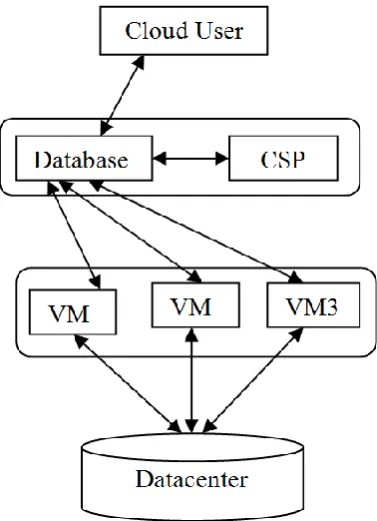
Figure 1. Service Scheduling Types
User Level Scheduling: User level scheduling problem born on between the providers and customers. It mainly focuses the economic concerns, user requirements and demand, competition among the consumer and cost
minimizing the under consumer performance.
System Level Scheduling: It handles resource management in cloud datacenters, the customer point of view. These improve the system utilization, real time satisfaction, resource sharing, fault tolerance etc.
From these various scheduling techniques are used for task scheduling. The CloudSim tool helps of simulation every task, the result obtained reduces the total
turnaround time, makespan and also increase the speed.
The algorithm has three phases; the process consisting of matching, allocating and scheduling. The allocating stage fills the gap between matching and scheduling. The Scheduling can be classified three stages.
Stage1: Determining a resource and filtering them. Stage2: Choose an object resource.
Figure 2. Job Scheduling stages
II.
RELATED WORKSEr.Geetinderkaur et al., [2] the author proposed the
Hyper-Heuristic scheduling algorithm. It is a
combination of two low levels scheduling algorithms FIFO and Max-Min. It finds the optimal solution of the job, and reduced the calculated time. It consists of two
operators (a) Diversity detection
operator-Automatically detected the algorithm is select.
(b)Perturbations Operator-this algorithm is to optimize and improve the makespan time. HHSA is applied to job scheduling is minimize the average makespan time.
Dr.Thomasyeboah et al., [3] designed the new algorithm RRSJF, This algorithm using the following factors Context Switches, Average waiting time, Average turnaround time. It is more efficient than Round Robin algorithm. It reduces the starvation of processes of at the CPU burst by assigning higher priority.
Medhat Tawfeek et al., [4] the author proposed the Ant colony of FCFS and RR algorithms with the cloudSim toolkit. This both algorithms are minimizing the makespan time in given task. The compare ACO, RR, FCFS average makespan time ,automatically increase the quantity of task. This improves and compares the ACO algorithm is better than RR and FCFS algorithms.
S.Swathi et al., [5] the author designed the ABC algorithm and CloudSim tool. This algorithm main objective reduces the makespan and response of data processing time. It is helpful for preemptive scheduling job; the highest priority of the job.
Dr.Amit Agarwal et al., [6] the author proposed framework algorithm for FCFS, Round Robin, Generalized priority algorithms. The scheduling stages categorized as, Resource discovering, filtering, Task submission .The CloudSim tool used to find the optimum value VMs task. This tool supports the job host, virtual machine resource allocation, and scheduling, resource provider. The result is compare proposed algorithms are better than FCFS and Round Robin algorithm.
Monica Gahlawat et al., [7] the author designed the CPU scheduling algorithms. It is focused two common CPU algorithms such as FCFS, SJF. Each job set priority and sequential order. It helps to find out the best VM to run the application, used the parameter as size, bandwidth, and cost of VM. It is reduced that SJF turnaround time, waiting time-based on the size of the task.
Javed Hussain et al., [8] author proposed ABC, ABC-LJF, ABC-FCFS, and ABC-SJF algorithms. It is used an analyzed the VM loads balancing and reduced the makespan of data process time. These algorithms combined the job and VM performance is more improvement in scalability. It is based on the number of process time.
Swathi Patel et al.,[9] the author proposed priority based job a scheduling algorithm, it mainly focuses on resource bandwidth, memory . To reduce in job completion time .It is calculated mathematical models for Criteria decision-making (MCDM) and Multi-Attribute decision-making (MCDM).These algorithm issues are complexity, consistency and finishing time.
III. Various Approaches of Virtual Machine
Heterogeneous Scheduling Algorithm
Scheduling Methods:
(a) Preemptive Scheduling Methods; the job which is
in processing can be Stopped or On hold (b)
execution cannot be stopped until the program
execution finishes (c) Static Priority Algorithm;
Priority cannot be changed (d) Dynamic Priority
Algorithm user can modify the Priority[17].
The scheduling algorithm applied to between the cloud users and service provider process. These types of algorithms designed and can perform the load balancing and resource allocation, scheduling the task on the Virtual machine [11].The virtual machine scheduling algorithms to solve the job store, execute and reallocate data problems. This type of problem can be categories
Single Cloud Environment: VM is scheduled within an infrastructure and provides the multiple datacenter,
distributed geographically. Multi-Cloud Scenarios: It
is a cloud infrastructure, the work load assigned to another infrastructure. It consists of improving the service availability [12].
3.1 Introduction to ABC algorithm
Artificial Bee Colony algorithm developed by Dr.Karaboga in 2005.It is used for resolving the optimization scheduling problems.
3.1.1) Step for ABC Algorithm
This algorithm computes the foraging behavior of honey
bees. It has three phases. Scout bee: It is finding new
food randomly. Onlooker bee: estimate the fitness and
select the greatest food source. Employee bee: It
searches the food source around the area and shares the information to the onlooker bees.
ABC algorithm used to find the optimization problem based on jobs scheduling. This algorithm contains single background female and male known as Drones.
This algorithm starts the scout bees for initial populations, first, the bees choose randomly from space. Then, suitable is space planned for bees. The highest
suitable is chosen as “selected bees” and remaining
bees are workers. The particular bees alone walk the site by select neighbors search.
3.1.2) Pseudo coded [13]
Begin
Compute the populace of the scout bees generate randomly scout bees into the food sources and calculate the suitability values
Repeat
1. Each the employed bees search around the
food sources and update the new suitable value if the new suitable value is better than the old value
2. Select employee bees and recruit onlooker
bees to search around the food sources and compute on their proper values.
3. Choose the onlooker bees with have the best
fitness value.
4. Send scout bees into the food sources to
discover new food sources
Until (Stopping criterion is not met)
End
3.1.3) Application
It is quite simple and flexible, robust and Neural networks training for the XOR Problem , Scheduling resource to a virtual machine, Resolve the continues problem ,Vision and image analysis.
3.2 Introduction to Round Robin Algorithm
Round Robin algorithm is similar to FCFS for the time sharing Systems. It is a small unit of time used to allocate to the job such as called time slices or quantum. Each process is read to work circular queue with time interval up to 1-time quantum. Actual time quantum is 10-100 milliseconds. When the task assigned to the virtual machine form of circular order with equal portions. The Round robin algorithm categorized two
types (a)Preemptive Round Robin Algorithm; do not
finish with in a time quantum before time expires. Then
next job is waiting on the circular queue.
(b)Non-Preemptive Round Robin Algorithm; The task completed within a time quantum, it is voluntary release the CPU process.
3.2.1 Merits
3.2.2 Demerits
The largest job takes enough time for completion
Any point of time some servers may be severely loaded and others remain idle. It simply works on time slicing; it allocates the load on various nodes on bases of time for without considering the need of resource [6].
3.2.3) Pseudo coded [14]
3.3 Priority Scheduling Algorithm
Priority scheduling algorithm each task assigned a priority order and allowed to run. It supposes two or more process same priority over queue to run FCFS order. The priority fixed range as 0 and 7, 0 represent the highest priority, 7 represent the lowest priority. These algorithms can be defined either internally or
external measure. The internally priority use of
measure time limits, memory, File, I/O requirements. The external priority measure of the important process, amount to funds pay for computers use.
3.3.1Preemptive priority algorithm
If the priority process is the new arrival, whenever higher priority is currently running.
3.3.2 Nonpreemptive priority algorithm
When the new processes assign the head of the queue and ready to run.
3.3.3 Merits
Task priority order vise job allocated and run the resource
3.3.4 Demerits
Indefinite blocking (starvation), more than highest priority tasks load into CPU, it can be an idle stage (Wait the system long period of time).
3.3.5 Pseudo coded [15]
1. Input: UserServiceRequest
2. //call Algorithm to form the list of task based on Priorities
3. Get global Available VM t and User List and also available Resource List from each cloud scheduler
4. // find the appropriate VM List from each cloud Scheduler
5. If AP(R, AR)! = ф then
6. // call the algorithm to load balancer 7. Deployable=load-balancer (AP(R, AR)) 8. Deploy service on deployable VM 9. Deploy=true
10. Else if R has advance reservation and best-effort Task is running on any cloud then
11. // Call algorithm for executing R With advance reservation
12. Deployed=true
13. Else if global Resource Able to Host Extra VM then 14. Start new VM Instance
15. Add VM to Available VM List 16. Deploy service on new VM 17. Deployed=true
18. Else
19. Queue service Request until 20. Queue Time > waiting Time 21. Deployed=false
22. End if
23. If deployed then 24. Return successful 25. Terminate 26. Else
27. Return failure 28. Terminate
3.4) First Come First Server
FCFS algorithm called as FIFO, Run-to-Completion, Run-Until-Don, It is the simplest scheduling algorithm and implement easily, minimize the context, switch overhead problems.
1. RoundRobinVmLoad Balancer maintains an index of VMS and state of VMS (bus/Available).
At start, all VMs have zero allocation
2. a) The datacenter controller data receives the user request/cloudlets.
b) It Store the arrival time and burst time of the request c) The request are allocated to VMs on the basis the of their states know from virtual machine queue
d) The round robin load balancer will allocate the time of quantum for user request
3. a) the round robin load balancer will calculate the turn – around time of each process
b) It also calculates the response time and average waiting time of user request.
c) It decides the Scheduling order.
4. after the execution of cloudlets, the VMs de-allocated by RoundRobinVmLoadBalancer
5. The datacenterdatacontrolor check for new /pending/waiting for a request in the queue.
3.4.1 Preemptive FCFS Algorithm:
The process entire in CPU, that process keeps until it releases the CPU based on terminating or requesting I/O.
3.4.2 Non-Preemptive FCFS Algorithm:
The CPU is free it is assigning the process is at the head of the queue to running.
3.4.3 Merits
Long time processes, Minimum overhead, No starvation.
3.4.4 Demerits
The Very small task should wait for turning and come to utilize the CPU.
3.4.5 Pseudo coded [16]:
3.5) Shortest Job First Scheduling
SJF algorithm also called the shortest job Next (SJN) or Shortest Process Next (SPN).it is one of the scheduling algorithms is used to choose the job of the smallest execution times. If the job is the smallest time placed in first whereas longest placed in last with the lowest priority [16].FCFS and SJF both algorithms are non-preemptive, because does not useful in timesharing environment. It is specialized in for batch jobs of for the run times.
Difficult of SJF is
1. Knowing the length Of CPU
2. The list of all the process arrival of same time
SJF may be preemptive or non-preemptive process based on job arrival time.
3.5.1 Preemptive SFC Algorithm
The new process arrives with CPU burst length less than remaining time of currently executing a task is preemptive. It is called as Shortest Remaining -Time- First (SRTF).
3.5.2 Non-Preemptive SFC Algorithm
When the CPU is free, it is assigning the new process also estimated the completion time of jobs to run next.
3.5.3 Merits
It can be improving the optimal solution to a given set of task that is minimizing the waiting time
3.5.4 Demerits
It can be or may not be starvation for the longest job.
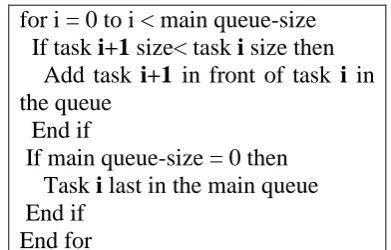
3.5.5 Pseudo coded [16]:
for i = 0 to i < main queue-size
If task
i+1
size< task
i
size then
Add task
i+1
in front of task
i
in
the queue
End if
If main queue-size = 0 then
Task
i
last in the main queue
End if
End for
IV. Comparison of Scheduling Algorithms
TABLE 1 Schedu lin g Alg o rit hm Schedu lin g P a ra met er T y pe o f Sy st ems Co mp lex it y Schedu lin g F a ct o r E nv iro nm e nt ABC Algorithm Shared time. Space and cost, resource
- Difficult Code Various task Cloud Round Robin algorithm Size And Time Time Sharin g Depends upon the size of time quantum An array of job Cloud And Grid Priority Scheduling algorithm size, memory, bandwidt h schedulin g policy Batch and Time sharin g Difficult to Understa nd Priority to each queue Cloud FCFS algorithm Time and incoming task
Batch Simple An array of job Cloud SJF algorithm Arrival time, process time, deadline and I/O requireme nt
Batch Difficult to understa nd and code An array of small size of job Cloud
1. Initialize Tasks.
2. The first tasks assigned to the queue and add
tasks up to n numbers.
3. Add next task „I‟ at last position in the main
V.
V.CONCLUSION
This survey paper is contributed the several of algorithm mainly focused. To summarize the algorithms parameters, job executes environment, types of job, it is used to reducing the makespan time, waiting for time and complexity of the code. The above the algorithm generally used the following factors cost, the size of the task, time, memory; it can resolve optimum solution problem and resource allocation problem.
VI. REFERENCES
[1]. Pinal Salot "A survey of various scheduling
algorithm in cloud computing
environment,"International Journal of Research in Engineering and Technology, Vol. 2 No-2, Feb-2013.
[2]. Er.Geetinder kaur,and Er.Sarabjit kaur
"Performance Enhancement of Hyper-Heuristic Scheduling Algorithm in Cloud Computing Framework," International Journal of Engineering Research-Online, Vol.3, Sep.2015.
[3]. Dr.Thomas Yeboah, Odabi I. Odabi, and Kamal
Kant Hiran"An Integration of Round Robin with
Shortest Job First Algorithm for Cloud
Computing Environment," ICMCT, Vol.3, April 2015.
[4]. Medhat Tawfeek, Ashraf El-Sisi, Arabi Keshk
and Fawzy Torkey "Cloud Task Scheduling Based on Ant Colony Optimization," The International Arab Journal of Information Technology, Vol. 12, No. 2, March 2015.
[5]. S.Swathi, S.Saravanan and V.Venkatachalam
"Preemptive Virtual Machine Scheduling Using CLOUDSIM Tool," International Journal of Advances in Engineering, 2015,Vol. 1(3), PP-323 to 327.
[6]. Dr. Amit Agarwal and Saloni Jain"Efficient
Optimal Algorithm of Task Scheduling in Cloud Computing Environment,"International Journal of Computer Trends and Technology (IJCTT) , vol. 9, No-7, Mar 2014.
[7]. Monica Gahlawat and Priyanka Sharma "Analysis
and Performance Assessment of CPU Scheduling Algorithm in Cloud Sim" International Journal of Applied Information System (IJAIS)-1SSN: (2013)
[8]. Javed Hussain and Durgesh Kumar Mishra "An
Efficient Resource Scheduling In Cloud Using
Abc Algorithm," International Journal of
Computer Engineering and Applications, Vol.9, No-6, June 2015
[9]. Swachil Patel, UpendraBhoi:"Priority Based Job
Scheduling Techniques In Cloud Computing", International Journal of Scientific and Technology Research, Vol. 2, No-11, Nov. 2013.
[10]. Nimisha Singla, Seema Bawa"Priority Scheduling
Algorithm with Fault Tolerance in Cloud Computing," International Journal of Advanced Research in Computer Science and Software Engineering , Vol.3, No-12, Dec.- 2013, PP- 645 to 652.
[11]. Lovejit Singh,Sarbjeet Singh"A Survey of
Workflow Scheduling Algorithms and Research
Issues,"International Journal of Computer
Applications (0975 – 8887) Vol.74, No-15, July 2013.
[12]. Wubin Li"Algorithms and Systems for Virtual
Machine Scheduling in CloudInfrastructures,"
[13]. B. Kruekaew and W. Kimpan "Virtual Machine
Scheduling Management on Cloud Computing Using Artificial Bee Colony," Proceedings of the International MultiConference of Engineers and Computer Scientists 2014 Vol.1, March 12 - 14, 2014, Hong Kong.
[14]. Hafiz Jabr Younis "Efficient Load Balancing
Algorithm in Cloud Computing"
[15]. M.Gokilavani, S.Selvi and C.Udhayakumar" A
Survey on Resource Allocation and Task
Scheduling Algorithms in Cloud
Environment,"International Journal of
Engineering and Innovative Technology (IJEIT) Vol.3, No-4, Oct. 2013.
[16]. Rajveer Kaur and Supriya Kinger"Analysis of Job
Scheduling Algorithms in Cloud
Computing,"International Journal of Computer Trends and Technology (IJCTT) – vol.9, No- 7, Mar 2014.
[17]. Mrs.M.Padmavathi, Shaik. Mahabbob Basha, and
Mr.Srinivas Pothapragada," A Survey on