IJSRSET1738144 | Received : 10 March | Accepted : 20 March 2018 | March-April-2018 [(4) 7 : 43-47 ]
© 2018 IJSRSET | Volume 4 | Issue 7 | Print ISSN: 2395-1990 | Online ISSN : 2394-4099 Themed Section : Engineering and Technology
43
Smart Public Transport Management System Via IOT Based
Automation
Senthil Ganesh R1, Vinoth Kumar K2, Vijayagopal N3, Prithvi Raj K4, Mohanasundar R5
1Assistant Professor, Electronics and Communication Engineering, Info Institute of Engineering, Coimbatore, Tamil Nadu, India
2,3,4,5 UG Scholar, Electronics and Communication Engineering, Info Institute of Engineering, Coimbatore, Tamil Nadu, India
ABSTRACT
In most of the countries, the common medium of travelling is done by public bus transport. The loss due to the public bus transport management system is pretty much higher. This paper concentrates mainly to reduce the death caused by over loading of the bus, accident caused due to travelling in foot board via automation and ticket automation in a smart way. By using the transportation smart card which we have proposed, we automate the ticket issuing process to the passenger and money transfer is made cashless. The cashless payment is already existing method which is used in different application and has also been used in foreign bus transportation system, but the drawback is it has less security. Ticket automation can reduce the cheating done, that is travelling without taking ticket and taking ticket for nearby stop and travelling for far distance in a crowded bus. The death caused due to the travelling in the foot board is also a serious issue that has to be noted. We propose a method of automating the door opening and closing of the bus only at the bus stop without the help of the driver. We use a future generation technology named Internet of Things (IoT) for the communication purpose, which helps in monitoring the arrival and departure of the bus to each and every stop and to maintain the passenger details. The cloud is used to store the database about buses and the passenger. Keywords : Public transport management system, Transportation smart card, Automation, IoT
I.
INTRODUCTION
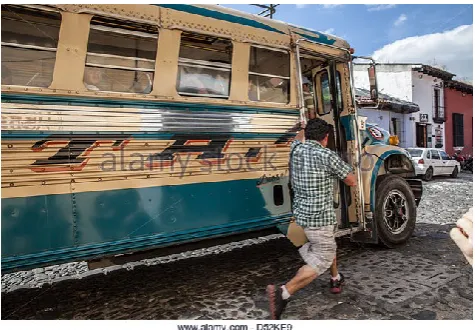
The accident caused due to the over loading of the passenger is one of the main reasons for the bus accident caused. Carrying more passengers than capacity by bus has been a problem state. Some transportation medium squeeze people in the spaces between the seats. The road safety problem in developing countries is much worse than the official statistics projects because of widespread of underreporting road accident deaths [1]. Boarding the bus while it is in the movement also causes the death to the passenger. The boarding of a passenger while the bus is in movement as shown in Fig 1.
Fig 1 Passenger boarding the bus by chasing
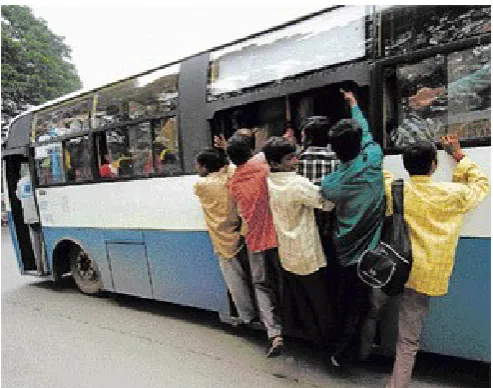
said over 92,500 people were killed each year in road accidents in the country coming under the wheels of the overloaded vehicles [1]. The overloading of the public bus transport as shown in Fig 2.
Fig 2 Overloading of the public bus transport
The vehicle will be less steady, hard to guide and take more time to stop. Vehicles respond diversely when the most extreme weights which they are intended to convey are surpassed. Over-burden vehicles can cause the treys to overheat and wear quickly which expands the possibility of early, risky and costly disappointment or successes [1].
Bus stop is the connection between travelling passenger andbus service system. Both the transportation system and passengersatisfaction are under the influence of bus stop [2]. The review of past researches on waitingtime at bus stop into three categories. The first category studied the waiting time using microscopic simulation models [3, 4]. The second involved studies that compared the actual waiting time with the time perceived by passengers [5, 6]. In the third category, waiting time at busstops was estimated based on the vehicles’ arrival information[7, 8].
The main objective of our work is listed below
To reduce the death caused by travelling in the foot board of the bus.
To automate the ticket issue and make cashless translation for payment.
II.
EXISTING SYSTEM
In the general way, every transport is controlled by a conductor. The conductor will get the cash from each passenger and issue ticket. At first, printed papers or tokens are utilized as tickets. These days, handheld machines are utilized to print tickets. This framework has numerous weaknesses. The traveler need to take the ticket till reaching the destination, the conductor has to guarantee that everybody has the ticket,the time taken for ticketing is nearly more what's more, more measure of paper is expected to print the Ticket. These days conductors are prepared to work the handheld ticketing machine.The ticket issued by the conductor is as shown in Fig 3.
Fig 3 Bus ticket issue by conductor.
Travelling in the foot board of the public bus causes more number of death. In most of the buses the doors are always opened. This increases a thought of boarding the bus while it is in movement which may lead to some serious accident. The habit of travelling in the foot board has become a trending habit for the people in the age between 13-19. This is a serious issue which has to be noticed. But there are very few methodologies that has been invented, which is not efficient.It may come as no shock to city residents that 17 persons died and 51 suffered injuries due to footboard travelling in 2012.
conductor. In most of the cases the unsatisfied arises due to the reason that the changes are not returned correctly. But now-a-days cashless translation is used for cashless translation for different sectors. It is not more likely been implemented in the bus transportation for cash translation. The main motive of the cashless translation as shown in Fig 4
Fig 4 Motive of the cashless translation
The overloading of the bus is a major issue which causes accident. This issue is not event taken into consideration. Over loading a vehicle can cause damage to some critical parts in the bus and can cause accident. The method followed to prevent this overloading is pretty much less and some times the method to prevent the overloading is not been followed.
III.
PROPOSED METHODOLOGY
In our methodology, we have a unique barcode for each and every bus stop so when the reader reads the bar code the door opens automatically. We can also intimate the arriving time of the bus to each stop by knowing the time at which the bus has reached to the before stop. This will be helpful for the passengers to know about the approximate time of arrival of the bus. The manual ticket issuing process is risky at the peak hours and with current rate of population growth with insufficient transportation system. By using our smartmethodology, we reduce the time consumption for issuing the ticket to the passenger.
The money translation is also made cashless so it makes the process easier than the method followed before. In our methodology the number of seats available is also indicated in the LCD display out side the bus which will be helpful for the passenger to know that there are any seats available or not to board the bus.
A. Work Flow
When the bus arrives to a specific stop the barcode reader in the bus reads the code and opens the door through which the passenger can get in and also get out of the bus. The opens automatically if the code matches without the help of the bus driver. The door closed automatically after 5 min delay which will be a sufficient to board and departure the bus. The flow diagram of the door automation as shown in Fig 5.
Now we move on the to the next methodology, after the passenger boards the bus after seeing the number of seat available, which is displayed outside bus in LCD. There is an automatic lock which is placed in every seat for the passenger’s safety and also it helps to reduce the ticket cheating in the bus transportation. When the passenger shows the transportation smart card the data and the time of boarding of the passenger is send to the transportation department server and in mean while the seat opens and the passengers can now use the seat to travel. We have placed a barrier sensor which indicates the availability of the seat. If the passengers occupy the seat, the sensor gives the output high which will reduce the count of seat available which is displayed in the LCD.
Now when the passenger destination is reached there is a common alert made about the next stop so the passenger will be ready to departure before few
minutes. When the passenger shows the
transportation smart card again to the reader the amount is calculated for their travel and the amount is automaticallydebited from passenger bank account and credited to the transportation department account. After the amount transaction only, the lock gets opened and the passenger can come out from the seat to departure. The transportation department will issue emergency unlock card to the bus drivers in order to unlock the seats during critical situations.So, ifany emergency situation occurs, the bus driver useemergency unlock card to unlock the passenger from the seat. The technology IoT is used here to transmit the data to the transportation department. The flow diagram for the above-mentioned methodology is shown in Fig 6.
Fig 6 Flow diagram for the safe and smart ticket collection
B. Block Diagram
The block diagram for the automaticdoor open and ticket automation as shown in Fig 7.
Fig 7 Block diagram for both door automation and ticket automation.
The alert system consists of both LCD and audio system that will alert the passenger before the stop is reached. Which helps passenger to get ready to departure before the stop reaches. The data are stored in the cloud using IoT.
IV.
CONCLUSION
human life. In public bus transportation accident caused due to whoever may be the problem is faced by the government and it also affects the law-and-order. We strongly believe that our methodology can reduce the death rate due to foot board travel and boarding the bus while the bus is in movement. The over loading of the bus can vanish if the methodology which we have proposed is followed.Apart from this by automating the bus ticket, we can reduce the cheating done and also reduce the loss due to the bus transportation for the government to a great extent. Using of Cloud to store data can provide much memory to store the data about the passenger and bus. The transportation smart card can also be use for passenger safety also. Since we have used the technology IoT for the communication, it will be suitable for the further upgrade of the methodology proposed.
V.
REFERENCES
[1]. Senthil Ganesh R, Mohanasundar R, Prithvi Raj K, Vijayagopal N, Vinoth Kumar K, "A Survey on Issues in Public Transport Management System", International Journal for Research in Applied Science & Engineering Technology (IJRASET) Volume Issue III, pp 866-870, March 2018.
[2]. Guangzhao Xin andWei Wang "Model
Passengers’ Travel Time for Conventional Bus Stop" Hindawi Publishing Corporation Journal of Applied Mathematics Volume 2014, Article ID 986546, 9 pages.
[3]. R. Fernandez, "Modelling public transport
stops by microscope simulation,
TransportationResearch C: Emerging
Technologies,vol. 18, no. 6, pp. 856-868, 2010. [4]. Q. Zhang and B. M. Han, "Simulation model of pedestrianPhysics A: Statistical Mechanics and its cations, vol. 390, no. 4, pp. 636-646, 2011.
[5]. D. B.Hess, J.Brown, andD. Shoup, "Waiting for the bus," Journal of Public Transportation, vol. 7, no. 4, pp. 67-84, 2004.
[6]. I. Psarros, K. Kepaptsoglou, and M. G. Karlaftis, "An empirical investigation of passenger waits time perceptions using Hazard-Based duration models," Journal of Public Transportation, vol.14, no. 3, pp. 109-122, 2011.
[7]. P. G. Furth and T. H. J. Muller, "Service reliability and hiddenwaiting time insights
from automatic vehicle location
data,"Transportation Research Record, vol. 1955, pp. 79-87, 2006.