Original Research Article
Antenatal, intranatal and postnatal care: a tertiary centre study of
North India
Anjali Gupta
1*, Anish Khanna
1, Rekha Sachan
2, V. K. Singh
1, O. P. Singh
1INTRODUCTION
Globally, about 800 women die every day of preventable causes related to pregnancy and child birth, 20 percent of these women are from India where around 55,000 mothers die annually. The maternal mortality ratio – the number of maternal deaths per 100,000 live births– reduced from 212 in 2007 to 178 in 2012, but this figure is still higher as compared to other developed countries.1
Mothers and children in the lower socio economic class have about a two and half times higher rates of mortality. Families lack access to accurate and comprehensive health information regarding maternal, neonatal and child health practices, and how to implement them. The keys to maternal and child survival and wellbeing include: the age of a mother at delivery and her education status, spacing between children, knowledge about the maternal
ABSTRACT
Background: Care of pregnant lady during antenatal period is the key to reducing maternal mortality and morbidity during pregnancy and child birth and futher improving the growth and development of the newborn. Optimal weight gain in the initial 6 months is very essential. Therefore, study aims to assess antenatal, intranatal and postnatal factors affecting the growth of newborn child.
Methods: A Community based cross sectional study was conducted twice – at delivery and second after 6 months. A total of 220 ladies delivered at QMH, King Georges Medical University, Lucknow between August-2016 to September-2017 were included. WHO Standards were used to calculate the deviation from normal growth. Data was entered in SPSS-23 and assessment was made for factors affecting the growth of newborn.
Results: At the time of birth the weight, length and head circumference of newborn was measured. Normal weight, length and H.C of ±2 SD was seen in 91%, 88%, 94% males respectively and 87.8%, 97.8 and 73.3% females. Repeat measurements at 6 month age of newborn showed normal weight, length and H.C in 62%, 58% and 87% males respectively and 87.8%, 74.4% and 96.7% females. Multivariate logistic regression analysis of factors revealed that growth of newborn upto 6 months was significantly associated with exclusive breastfeeding (OR 0.161; 95% CI 0.053-0.492; p=0.001), Illness in past 6 months (OR 6.820; 95%CI 2.376-19.579; p<0.001) low birth weight (OR 0.101; 95% CI 0.015-0.665; p=0.017).
Conclusions: Although adherence to the proper schedule of antenatal, intranatal and postnatal visits and care varies between individuals and over time, the factors can be addressed with periodic counselling and motivation of pregnant ladies and their families.
Keywords: Antenatal, Intranatal and postnatal care, Exclusive breastfeeding, Low birth weight, Maternal mortality
1
Department ofCommunity Medicine and Public Health, 2Department of Obstetrics and Gynaecology, King George’s Medical University, Lucknow Uttar Pradesh, India
Received: 27 March 2018
Revised: 10 May 2018
Accepted: 10 May 2018
*Correspondence:
Dr. Anjali Gupta,
E-mail: [email protected]
Copyright: © the author(s), publisher and licensee Medip Academy. This is an open-access article distributed under the terms of the Creative Commons Attribution Non-Commercial License, which permits unrestricted non-commercial use, distribution, and reproduction in any medium, provided the original work is properly cited.
and new born care practices access to health facility, maternal and child nutrition.
Every year in India there are about 1.34 million deaths of children aged under five; 1.05 million infant deaths; and 0.748 million newborn deaths.2 Our country accounts for more than one fourth (26 per cent) of the world’s neonatal deaths. The states of Uttar Pradesh, Madhya Pradesh, Bihar and Rajasthan contribute to more than half of the newborn deaths in India. More than half (56 per cent of under-five deaths happen in the first 28 days of life and nearly three-fourth of these newborn deaths occur in the first week of life.3
Most newborn deaths are preventable by improving quality of care during antenatal period and at delivery. Simple interventions like institutional deliveries, access to essential and emergency obstetric care, early initiation of breastfeeding can reduce NMR significantly.2 Uttar Pradesh has Infant mortality rate of 70 per 1000 live births while Lucknow district has IMR of 44 per 1000 live births. Neonatal mortality rate of Uttar Pradesh was 50 per1000 live births while Lucknow district has NMR of 27 per 1000 live births.4
To achieve millennium development goals, it is expected to reduce the neonatal mortality by two third, which is not an easy task by any standard of neonatal care.3 Every newborn child requires basic care which has to be provided by the mother at home. This includes warmth, feeding, basic hygiene and identification of danger signs if any, and seeking help from health personnel whenever required. Therefore, the present study aims to assess the antenatal, intranatal and postnatal care practices and how they affect the growth of newborn child.
METHODS Study design
The present study is a descriptive, cross sectional study and was conducted in the Department of Community Medicine in collaboration with the Department of Obstetrics and Gynaecology at Queen Mary Hospital, KGMU, Lucknow, a tertiary care hospital in Uttar Pradesh. The study participants were the mothers delivered at QMH, KGMU, Lucknow between Aug-2016 to Sep-2017 and their newborn child. They were followed till 6 months when a home visit was done in the community.
Selection criteria
Co-operative mothers of newborns delivered at QMH with permanent resident of Lucknow and term baby without any congenital anomaly were included in the study. Exclusion criteria were preterm babies, twins, any chronic illness or disease in mother/baby, surrogate mother and non-cooperative mothers.
Sample size
Taking prevalence of exclusive breastfeeding as 45 (NFHS 3), and an absolute precision of 5%, the total sample size came out to be 208 (formula used n = z2p x q/d²; where n=sample size, z=value of standard normal deviate = 1.96 at 95% (CI), p= prevalence, q=1-p and d=allowable relative error.
Sample selection
The study employed purposive sampling. Co-operative mothers of newborns delivered at QMH, King Georges Medical University, Lucknow with permanent resident of Lucknow.
Ethical clearance
This study was approved by Ethics Committee of King George’s Medical University. Pregnant ladies were first briefed about the purpose of the study and assured about the confidentiality of the data given. After written consent was obtained from the participants, they were interviewed (Ref no. 81st ECM II B- Thesis/P42).
Data collection tool
Interview was done with the help of predesigned and pretested schedule and data regarding socio demographic characteristics, antenatal visits were collected. Weight, height, head circumference of new born was taken so that comparison can be made with the same at 6m age. WHO standards were used to calculate the deviation from normal parameters. Besides miles stones were also accessed at 6 m age, the score for each was given as 1 desired level reached and 0 for delayed growth. Assessment of maternal care was done on the basis of antenatal care received during pregnancy, the antenatal and postnatal visits done and problems faced by mother during care of newborn.
Data management
Descriptive statistics such as mean, standard deviation (SD) for continuous variables and frequencies, proportions for categorical variables were used to present study results. P values were calculated to test the statistical significance at the 5% level of significance.
Association between independent and dependent
variables was determined using Chi Square test. Independent variables that were found to be statistically significant in bivariate analysis were considered for application in logistic regression model to determine factors affecting growth and development of newborn. A p value ≤0.05 was considered statistically significant.
RESULTS
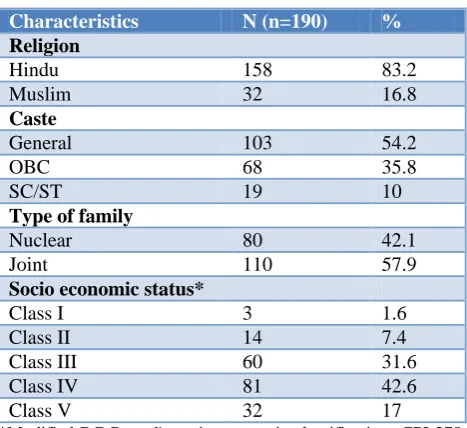
religion. Caste wise 54.2% of newborns belonged to general category. Among the type of family 57.9 percent belonged to joint families and about 42.1 percent belonged to nuclear family. For socio economic classv1.6 percent families belonged to upper Socio-economic class ,7.4 percent to upper middle, 31.6 percent belonged to middle class,42.6 percent belonged to lower middle and 17 percent families belonged to lower Socio-economic class (Table 1).
Table 1: Distribution of families according to biosocial characteristics.
Characteristics N (n=190) %
Religion
Hindu 158 83.2
Muslim 32 16.8
Caste
General 103 54.2
OBC 68 35.8
SC/ST 19 10
Type of family
Nuclear 80 42.1
Joint 110 57.9
Socio economic status*
Class I 3 1.6
Class II 14 7.4
Class III 60 31.6
Class IV 81 42.6
Class V 32 17
*Modified BG Prasad's socio-economic classification- CPI-278 update June 2017.
ANC was registered before delivery in majority (93.2%) of the women, while four or more ANC visit schedule was completed by 66.3%.Tetanus immunization complete in 92.1% and 93.7% received IFA tablets. Regarding intranatal care– mode of delivery was caesarean in 60.5% while normal vaginal delivery in 38.9%.Duration of stay in the health facility for ≥5 days was followed by only 50.5% ladies. Complicated deliveries were 21.6% while newborns with birth injuries were 1.1% (Table 2).
Regarding the postnatal visits 54.7 % had 1-2 visit, 31.5% had more than equal to 3 visit and 13.8% had no visit. 21.6% mothers suffered from excessive bleeding and 12.6% had infection postdelivery.11.6% took iron, 6.8% took calcium supplements. 57.9% got there Hb levels after delivery and 65.3% got counselling related to family. (Table 3)
Anthropometric measurement of the male newborns, normal weight ±2SD at birth were seen in 91%. For length 88% had normal birth length.94% had normal head circumference. Amongst the female newborns normal weight ±2SD at birth were seen in 87.8%. For length 97.8% had normal birth length.73.3% had normal head circumference. At 6 month age the male newborns normal weight ±2SD were seen in 62%. For length 58%
had normal birth length.87% had normal head circumference (Table 4).
Table 2: Antenatal care of mother during index pregnancy.
Antenatal care in index
neonates N (n=190) %
ANC registered
Yes 177 93.2
No 13 6.8
Total no. of antenatal visit
Nil 13 6.8
1-3 51 26.8
≥4 126 66.3
Tetanus toxoid
2 doses 175 92.1
1 dose 13 6.8
None 2 1.1
Iron and folic acid tab
supplementation received 178 93.7
Status of intra natal care during index pregnancy Mode of delivery
Normal 74 38.9
Caesarean section 115 60.5
Assisted 1 0.5
Duration of stay in health facility after delivery
<2 days 5 2.6
2 to 4 days 89 46.8
≥5 days 96 50.5
Complicated deliveries 41 21.6
Meconium passed in the womb 14 7.4
Mothers receiving counseling
during hospital stay 180 94.7
Newborns with birth injuries 2 1.1
Table 3: Status of post natal care during index pregnancy (up to 6 months).
Characteristics N (n=190) %
How many postnatal visits done/received
≥3 visits 60 31.5
1-2 visits 104 54.7
Nil 26 13.8
Suffer from any pregnancy related complication post delivery
Excessive bleeding 41 21.6
Infection 24 12.6
Supplement tablets intake
Iron 22 11.6
Calcium 13 6.8
Hb levels measured post
delivery 110 57.9
Received counseling related to
family planning methods 124 65.3
Table 4: Anthropometric measurements of newborn male child.
Newborn male child at birth Measurements of male child at 6 month age
Characteristics N (n=100) % N (n=100) %
Weight
±2 SD (normal) 91 91 62 62
<-2 SD to >-3 SD 9 9 27 27
<-3SD nil Nil 11 11
Length
±2 SD (Normal) 88 88 58 58
<-2 SD to >-3 SD 9 9 22 22
<-3SD 2 2 20 20
Head circumference
±2 SD (Normal) 94 94 87 87
<-2 SD to >-3 SD nil Nil 12 12
<-3SD 6 6 1 1
Table 5: Anthropometric measurements of newborn female child at birth.
Newborn female child at birth Measurements of female child at 6 month age
Characteristics N (n=90) % N (n=90) %
Weight
±2 SD (Normal) 79 87.8 79 87.8
<-2 SD to >-3 SD 9 10 9 10
<-3SD 2 2.2 2 2.2
Length
±2 SD (Normal) 88 97.8 67 74.4
<-2 SD to >-3 SD 1 1.1 22 24.4
<-3SD 1 1.1 1 1.1
Head circumference
±2 SD (Normal) 66 73.3 87 96.7
<-2 SD to >-3 SD 21 23.3 2 2.2
<-3SD 3 3.4 1 1.1
Table 6: Result of logistic regression of factors associated with weight of child at 6 month age (growth).
Variables (males) P value Adjusted OR 95% CI
Lower Upper
Birth weight
Normal Reference
Low 0.017 0.101 0.015 0.665
Illness (0-6) m
No Reference
Yes <0.001 6.820 2.376 19.579
Exclusive breastfeeding
Yes Reference
No 0.001 0.161 0.053 0.492
Amongst the female newborns normal weight ±2SD at 6 month age were seen in 87.8%. For length 74.4% had normal length at 6 month age. 96.7% had normal head circumference (Table 5).
Multivariate logistic regression analysis revealed that factors affecting the growth of newborn at 6 month age are exclusive breastfeeding (OR 0.161; 95% CI
0.053-0.492; p=0.001), illness in past 6 months (OR 6.820; 95%CI 2.376-19.579; p<0.001) low birth weight (OR 0.101; 95% CI 0.015-0.665; p=0.017) (Table 6).
DISCUSSION
done by Chaudhary et al which showed that mean age of mothers was 24 years with standard deviation ±4 years.5 Madhu et alin their study showed that majority of the mothers were between the ages of 21 and 25 years old (60%),which is slightly younger.6
In present study most of the women were house wives (89.5%) and graduate/postgraduate educational status (46.8%). Sinha et al in their study showed that most mothers were housewives (211, 66%).7 In the present study 93.2 percent pregnancies had ANC registration and most of them had a total of four or more ANC visits 126 (66.3%). Tetanus immunization complete in 92.1% and 93.7% received IFA tablets. Similar findings were seen in the study by Ayaz et althat majority (70%) of women received antenatal care during pregnancy however only 54.5% had four or more visits.8 About 79% of women received tetanus toxoid vaccination during pregnancy and of these 88% had two doses of the vaccine. Madhu et alin their study showed that total of 97% of the mothers went for at least two antenatal check-ups, whereas, only approximately 30% went for post natal check-ups.6 Gandhi et al in their study showed that all the mothers under study had adequate ANC check-ups.9
In the present study more deliveries were caesarean 115 (60.5), normal vaginal delivery were lesser 74 (38.9%) owing to the fact that QMH is a tertiary care facility where many referral cases from secondary and primary care centers are managed. Similar results were seen in the study by Madhu et al in that total of 90% of the deliveries were hospital deliveries and 10% were home deliveries.6 Grover et al in their study showed that majority of the deliveries (64%) took place at home and most of the home deliveries (75%) were conducted by a traditional birth attendant.10 This is quite different from the present study since only hospital deliveries have been considered. Samina et alin their study showed that 12.97% deliveries were home deliveries while 322 (87.03%) were hospital deliveries.11 Majority of the total i.e. (79.45%) were normal deliveries, 6 (1.62%) were instrumental deliveries and 70 (18.91%) were caesarean sections. Sinha et al in their study showed that home deliveries by traditional birth attendants (TBAs) were reported by 165 (52%) mothers, and 63 (36%) mothers had not been counselled on newborn care.7
In the present study amongst the various factors studied above significant positive association for growth of male
newborn was seen maximum with Exclusive
breastfeeding (p<0.001), colostrums intake (p<0.001), illness in newborn (p<0.001). Also birth weight (p=0.014) and complicated delivery (p=0.032) were statistically significant. On multiple logistic regression factors found to be associated with normal growth at 6
months were Exclusive breastfeeding (adjusted
OR=0.161, 95% CI: 0.053 – 0.492) and illness in newborn during first 6 months (Adjusted OR=6.820, 95% CI: 2.376-19.579). Similar results were obtained in following studies- Aoxing et al found that the intensity of breastfeeding of infants within 6 months old was
(26.56±10.56).4 Age, pre-pregnant BMI, intelligence, delivery mode, gender, gestational age, birth weight and family economic status adjusted, compared to never-breastfeeding. Gessica et al that the factors with the highest percentages of associations with maintenance of breastfeeding for 12 months or more with normal growth.12 Schafer et al found in there study that experiencing trouble with baby's latch, problems with milk flow/supply and painful breast-feeding were significantly associated with breast-feeding duration.13
Gizaw et alfound in their study that one hundred eighty eight of the children were fed breast milk exclusively for the first 6 months of age; the rate of EBF in the study area was 74% (95% CI 70, 78%).14 Exclusive breastfeeding was statistically associated. Xu found similar results that changes in growth are apparently related to the onset of colostrum ingestion, because starved or water-fed newborns showed little changes in the GI tract.15 Similar results were found byBinkin et al who studied the relationship between birth weight and childhood growth have concentrated on the growth of low birth weight infants.16 Hummert et al showed in their study the effects of common illnesses on the growth of otherwise healthy and well-nourished children.17
Limitations
However, the study was subject to several limitation. It is possible that selection bias occurred, as only those women who were residents of Lucknow and cooperative were included. Secondly the study was conducted at a tertiary care hospital hence more complicated and referred cases were present.
CONCLUSION
Although adherence to the proper schedule of ANC Visits and care varies between individuals and over time, the factors can be addressed with periodic counselling and motivation of pregnant ladies and their families. Health education for the community focused on newborn care practices like exclusive breast feeding for 6 months, proper positioning and attachment, frequency of breast feeding, timing of first bath, proper wrapping of baby, skin to skin contact, cord care and eye care, immunization. These will help to improve the birth weight and prevent illness episodes in newborn thus enhancing better growth and weight gain.
The status of postnatal visits and maternal wellbeing assessment postdelivery is lagging largely. Also mothers need to be motivated to continue Iron and Calcium tablets postdelivery up to at least 6 months. Calcium deficiency manifests as back pain and osteoporosis in later years.
Funding: No funding sources Conflict of interest: None declared
REFERENCES
1. Available at:
Data.unicef.org/topic/maternal-health/newborn-care. Accessed 10 January 2018. 2. Parlato RP, Darmstadt GL, Tinker A. Saving
newborn lives, Initiative. Washington, DC: 2005.
3. UNICEF India. Available at:
http://unicef.in/Whatwedo/2/Neonatal-Health http://www.censusindia.gov.in/vital_statistics/AHS Bulletins/files2012/Uttar%20Pradesh_Bulletin2011-12. Accessed on 10 January 2018.
4. Aoxing Y, Tao X, ShuangqinY, Azhu Z, Weijun P,
Kun H, et al. Effect of breastfeeding on the behavioral development of infants and children: a birth cohort study in Ma'anshan. Zhonghua Yu Fang Yi Xue Za Zhi. 2017;51(9):807-13.
5. Chaudhary J, Dhungana GP, Ghimire H. Original Research Article Factors Affecting Newborn Care Practices Among Tharu Mothers in Selected Village Development Committees of Chitwan District. J Chitwan Med Coll. 2013;3(3):42–5.
6. Madhu K, Chowdary S, Masthi R. Breast feeding practices and newborn care in rural areas: a descriptive cross-sectional study. Indian J Community Med. 2009;34(3):243–6.
7. Sinha LN, Kaur P, Gupta R, Dalpath S, Goyal V, Murhekar M. Newborn care practices and home-based postnatal newborn care programme - Mewat, Haryana, India, 2013. Western Pac Surveill Response J. 2014;5(3):22–9.
8. Ayaz A, Saleem S. Neonatal Mortality and
Prevalence of Practices for Newborn Care in a Squatter Settlement of Karachi, Pakistan: A Cross-Sectional Study. PLoS One. 2010;5(11):1–6.
9. Gandhi S, Godara N, Modi A, Kantharia S.
Newborn care practices of mothers in rural areas of
Navsari district. Int J Med Sci Public Heal. 2014;3(7):1.
10. Grover P. Neonatal Care Practices in Urban Villages. Ind Med Gaz. 2012;1:32–8.
11. Samina A, Mohan J, Nandkishor K. Prevalent neonatal care practices in rural area of central India: The truth revealed. 2014;4(2):43–6.
12. Santana GS, Giugliani ERJ, Vieira TO, Vieira GO. Factors associated with breastfeeding maintenance for 12 months or more: a systematic review. J Pediatr (Rio J). 2018;94(2):104-22.
13. Schafer EJ, Campo S, Colaizy TT, Mulder PJ, Breheny P, Ashida S. First-time mothers' breast-feeding maintenance: role of experiences and changes in maternal perceptions. Public Health Nutr. 2017;20(17):3099-108.
14. Gizaw Z, Woldu W, Bitew BD. Exclusive
breastfeeding status of children aged between 6 and 24 months in the nomadic population of Hadaleala district, Afar Region, northeast Ethiopia. Int Breastfeed J. 2017;12:38.
15. Xu RJ. Development of the newborn GI tract and its relation to colostrum/milk intake: a review. Reprod Fertil Dev. 1996;8(1):35-48.
16. Binkin NJ, Yip R, Fleshood L, Trowbridge FL. Birth weight and childhood growth. Pediatrics. 1988;82(6):828-34.
17. Hummert JR, Goodman AH. An assessment of the effects of minor childhood illness on growth in height and weight. Growth. 1986;50(3):371-7.