Original Research Article
Cervical cancer: a hospital based KAP study among women
aged 18 years and above in Northern India
Rajiv Kumar Gupta
1*, Parveen Singh
1, Bhavna Langer
1, Rashmi Kumari
1,
Pawan Sharma
1, Riya Gupta
2INTRODUCTION
Cervical cancer is the fourth most common cancer in women worldwide, with an estimated 5,28,000 new cases in the year 2012. Around 85% of this global burden occurs in the less developed regions, where it accounts for almost 12% of all female cancers. There were an estimated 2,66,000 deaths from cervical cancer worldwide in 2012, accounting for 7.5% of all female cancer deaths. Almost nine out of ten cervical cancer
deaths occur in the less developed regions.1 In India 1, 23,000 new cases and 67,000 deaths from cervical cancer were estimated in 2012, it was reported as the leading site among women in 6 population based cancer registry areas viz., Barshi rural, Barshi expanded, Mizoram, Tripura, Nagaland and Pasighat.2
Cervical cancer is a malignant neoplasm arising from cells in the transformation zone in cervix uteri. Although asymptomatic in the early stages it presents with
ABSTRACT
Background: Cervical cancer is known for its late detection due to a variety of reasons chiefly lack of knowledge, undesirable attitudes and poor practices. Early screening and adequate knowledge about the disease remains the important safe guards against this disease. The study aimed to assess the knowledge, attitudes and practices of the women aged 18 years and above regarding cervical cancer visiting a tertiary care teaching hospital.
Methods: The present cross sectional hospital based study was conducted in Jammu city, Jammu and Kashmir, India. All the women aged 18 years and above visiting OPD of gynaecology-obstetrics department of Government Medical College Jammu and willing to participate were administered a pretested questionnaire to collect the relevant data.
Results: It was found that 91.56% of the respondents had heard of cervical cancer with 83% reporting that it was both preventable as well as curable. Multiple sex partners were the most important risk factor identified. Among the attitudes, 62% agreed that screening was harmless to the client. Only one third knew about the availability of preventive vaccine. About 83.6% of them had never been screened by Pap smear. However willingness to get HPV vaccination was found to be high.
Conclusions: Though knowledge among the respondents was found to be adequate but it lacked transformation into attitudes and practices. In this connection, authors recommend health promotion campaigns to educate women and the community about cervical cancer and its preventability through screening.
Keywords: Cervical cancer, Knowledge, Attitude, Practices, Prevention
Department of Community Medicine, 1Government Medical College, Jammu, 2Acharya Shri Chander College of Medical Sciences and Hospital, Sidhra, Jammu, Jammu and Kashmir, India
Received: 28 January 2019
Revised: 06 March 2019
Accepted: 07 March 2019
*Correspondence:
Dr. Rajiv Kumar Gupta,
E-mail: [email protected]
Copyright: © the author(s), publisher and licensee Medip Academy. This is an open-access article distributed under the terms of the Creative Commons Attribution Non-Commercial License, which permits unrestricted non-commercial use, distribution, and reproduction in any medium, provided the original work is properly cited.
persistent pelvic pain, weight loss, bleeding or unusual vaginal discharge and post coital bleeding. Various risk factors like multiple sexual partners, early age of sexual intercourse, increasing parity, use of oral contraceptive pills and tobacco consumption etc. are implicated in its causation. Studies have shown Cervical cancer occurs due to infection with a high-risk genotype of the human papilloma virus (hrHPV+). In majority of cases the infection does not lead to any cellular abnormalities. But if infection persists for a longer period, changes develop in epithelial cells leading to, cervical intraepithelial neoplasia (CIN)–a precursor of cancer cervix. A long latent period of about fifteen years makes cervical cancer an ideal ‘candidate’ for screening.3
In India, the peak age of incidence of cervical cancer is found to be 55–59 years and unfortunately, a considerable proportion of women report to the health services in the late stages of disease. India developed a national program for cancer in 1975 and in 2010 cancer control and management activities became a part of a more comprehensive and broad program on non-communicable diseases called National Programme for Prevention and Control of Cancer, Diabetes, Cardiovascular Disease and Stroke (NPCDCS) which primarily aims to address the common risk factors in an integrated manner. It focuses on population based cervical screening through VIA (visual inspection with acetic acid) across different levels of health care coupled with early intervention. To make the screening activities more effective and acceptable a multipronged approach is required which can increase the acceptability towards screening through activities like behaviour change communication exercises, sensitizing the people of the area, including men folk, increased participation in vaccination against types 16 and 18 HPV among adolescent girls.4
Increased uptake of all these activities will require an in depth knowledge regarding perceptions of stake holders so that they can be effectively targeted. Review of literature revealed that a few studies have been conducted in various parts of India but no study was carried out in this part of the country. With this purpose a study was planned to assess the knowledge, attitude, practices and prevention regarding cervical cancer in females aged 18 years and above visiting OPD of gynaecology and obstetrics department of a tertiary care hospital in Jammu city.
METHODS
The present cross sectional study was conducted among the females visiting the OPD of gynaecology and obstetrics department of Government Medical College Jammu, J and K, India. Inclusion criteria included females aged 18 years and above visiting the OPD due to any reason and willing to participate. Exclusion criteria’s included females not willing to participate, mentally ill
and already diagnosed with cervical cancer. Due approval was sought from institutional ethical committee and the study was conducted from March 2018 to May 2018 over a period of three months.
The questionnaire for the present study was prepared by the experts from community medicine department with extensive review of literature. The questionnaire so developed was pilot tested on a sample of 25 females who didn’t comprise the final study population. The feedback so obtained was incorporated and the final questionnaire was thus ready for use. The final version was 31- item questionnaire comprising of four parts. The first part gathered socio demographic information with 8 items. Knowledge followed by attitudes and practices had 9 and 8 items respectively. The fourth part elicited information regarding human papilloma virus (HPV) and HPV vaccine containing 6 items.
The data thus collected was tabulated and analyzed. Descriptive statistics like frequency and proportion were used to represent the data.
RESULTS
During the study period, a total of 415 females visiting the OPD of gynaecology and obstetrics were enquired about the cervical cancer, but only 91.56% (380/415) of them had heard of the cervical cancer, hence the final sample size interviewed was 380.
Majority (70%) of the respondents belonged to Hindu religion and were in the age group 30-49 years. More than 70% of the respondents belonged to urban areas and about one third of them were homemakers as per their occupation. Almost 90% of the respondents were married and half of them were literate above secondary levels. About two third were married since more than 20 years and 71.5% of the respondents had parity of <2 (Table 1).
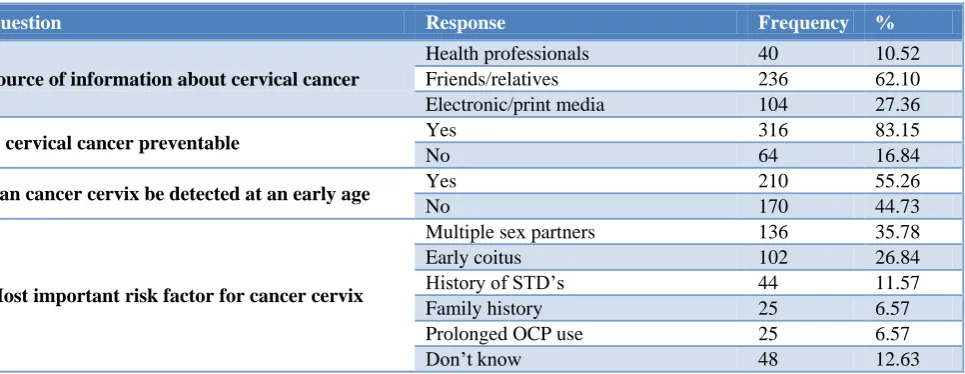
Among the respondents who had heard of cervical cancer, the main source of information was friends and relatives. 83.15% of the respondents said that cervical cancer was preventable and equal proportion replied that the disease was curable. Among the most important risk factor for, 35.78% identified multiple sex partners. Almost one third of the respondents replied that bleeding after intercourse was the most important symptom of the disease. Majority of the respondents were aware of availability of screening test for cervical cancer through knowledge about treatment varied. Regarding frequency of screening test, about one third said that it should be on yearly basis (Table 2).
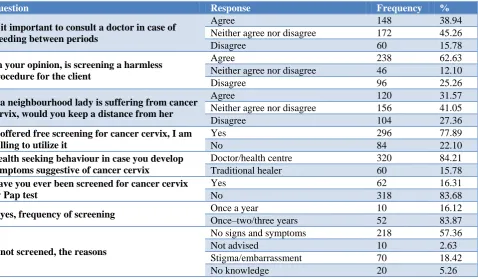
cervical cancer. Among the practices, about 78% of the respondents would go for screening of cancer cervix if offered free. 84.2% would go to a doctor/health center in case symptoms suggestive of cancer cervix develop. 83.6% of the respondents had never been screened by Pap
test and those screened, only 16.12% were screened once a year. Among those not screened, 57.36% reported that the reason was non presence of any signs and symptoms suggestive of the disease (Table 3).
Table 1: Socio-demographic profile of the respondents (n=380).
Socio-demographic variable Frequency %
Age group (in years)
<20 28 7.36
20-29 82 21.57
30-39 142 37.36
40-49 101 26.57
>50 27 7.10
Religion
Hindu 266 70.00
Muslim 64 16.84
Others 50 13.15
Residence Rural 110 28.94
Urban 270 71.05
Occupation
Home makers 130 34.21
Student 28 7.36
Employed 112 29.47
Own business 86 22.63
Others 24 6.31
Literacy levels
Illiterate 78 20.52
Primary 112 29.47
Secondary 52 13.68
Higher secondary 92 24.21
Graduate and above 46 12.10
Marital status
Unmarried 30 7.89
Married 338 88.94
Widowed 12 3.15
Duration of marriage (years)
<10 56 16.56
10-20 72 21.30
>20 210 62.13
Parity
None 40 10.52
<2 272 71.52
>2 68 17.89
Table 2: Knowledge of the respondents regarding cervical cancer (n=380).
Question Response Frequency %
Source of information about cervical cancer
Health professionals 40 10.52 Friends/relatives 236 62.10 Electronic/print media 104 27.36
Is cervical cancer preventable Yes 316 83.15
No 64 16.84
Can cancer cervix be detected at an early age Yes 210 55.26
No 170 44.73
Most important risk factor for cancer cervix
Multiple sex partners 136 35.78
Early coitus 102 26.84
History of STD’s 44 11.57
Family history 25 6.57
Prolonged OCP use 25 6.57
Don’t know 48 12.63
Question Response Frequency %
Most important symptom of cancer cervix
Intermittent bleeding between periods 98 25.78 Bleeding after intercourse 114 30.00 Foul smelling discharge 78 20.52 Bleeding/spotting after menopause 48 12.63
Don’t know 42 11.05
Is screening test for cancer cervix Yes 340 89.47
No 40 10.52
Knowledge about treatment of cancer cervix
Drug therapy 76 20.00
Radiotherapy 74 19.47
Surgery 150 39.47
Don’t know 80 21.05
Knowledge about persons who undergo screening for cancer cervix
Women aged 25 years or more 80 21.05 Women with multiple sex partners 165 43.42
Elderly women 65 17.10
Don’t know 70 18.42
Knowledge about screening frequency in cancer cervix
Once in a year 120 31.57 Once every 3 year 95 25.00 Once every 5 year 75 19.73
Don’t know 90 23.68
Table 3: Attitudes and practices of the respondents towards cervical cancer (n=380).
Question Response Frequency %
Is it important to consult a doctor in case of bleeding between periods
Agree 148 38.94
Neither agree nor disagree 172 45.26
Disagree 60 15.78
In your opinion, is screening a harmless procedure for the client
Agree 238 62.63
Neither agree nor disagree 46 12.10
Disagree 96 25.26
If a neighbourhood lady is suffering from cancer cervix, would you keep a distance from her
Agree 120 31.57
Neither agree nor disagree 156 41.05
Disagree 104 27.36
If offered free screening for cancer cervix, I am willing to utilize it
Yes 296 77.89
No 84 22.10
Health seeking behaviour in case you develop symptoms suggestive of cancer cervix
Doctor/health centre 320 84.21 Traditional healer 60 15.78
Have you ever been screened for cancer cervix by Pap test
Yes 62 16.31
No 318 83.68
If yes, frequency of screening Once a year 10 16.12
Once–two/three years 52 83.87
If not screened, the reasons
No signs and symptoms 218 57.36
Not advised 10 2.63
Stigma/embarrassment 70 18.42
No knowledge 20 5.26
Table 4: KAP towards HPV and vaccination (n=380).
Question Response Frequency %
Transmission of HPV infection is by sexual contact
Yes 130 34.21
No 250 65.78
Is a preventive vaccine for cervical cancer available
Yes 135 35.52
No 245 64.47
Have you had the HPV vaccination Yes 19 5.00
No 361 95.00
Question Response Frequency %
Main reason for not having the HPV vaccination
Lack of knowledge about vaccine 180 49.86 No risk as not exposed to the sexual
contact 160 44.32
High cost 21 5.81
Willingness to vaccinate your daughter against HPV
Yes 320 84.21
No 20 5.26
Don’t know 40 10.52
If not screened, the reasons
Before sexual contact 110 28.94 After sexual contact/child birth 76 20.00 Any time after marriage 64 16.84
Don’t know 130 34.21
When information regarding human papilloma virus (HPV) and vaccination was elicited, only about one third knew that HPV infection was transmitted by sexual contact and almost similar proportion knew that a preventive vaccine for cervical cancer was available. Only 5% of the respondents had HPV vaccination though a whopping 84.2% were willing to vaccinate their daughter against HPV. More than one third of them though didn’t know the best time to have HPV vaccination (Table 4).
DISCUSSION
The current study explored the knowledge, attitude and practices of the females who were attending the OPD of gynaecology and obstetrics department of a tertiary care teaching hospital in Jammu city of J and K state.
The results revealed that 91.56% had heard of cervical cancer and these are higher than reported by Narayana et al.5 Since the present study was conducted in a tertiary care teaching hospital where women are able to assess better information, could be the major reason for large proportion of women having heard of cervical cancer. Also the proportion of urban respondents was higher which may be another reason for these results. In contrast to the results of the present study, Pattupara et al reported from Uttrakand that 93% had no knowledge about cancer cervix.6 Among the studies conducted abroad, Touch et al reported 74%, Shrestha et al reported 65.7% and Tran NT et al reported more than 60% having heard of the disease in Combodia, Nepal and Korea respectively.7-9 In the current study , friends and relatives followed by media were the main information sources for the respondents and these results are in agreement with those reported by Narayana et al and Abdullahi et al.5,10
More than 80% of the respondents were aware that cervical cancer was preventable and about the availability of screening test for the disease. Tran et al reported that only 36% of the respondents knew that cancer cervix could be prevented.9 Pattupara et al reported dismal 3.25% respondents knowing about pap smear. In contrast to these studies, Narayana et al reported that more than half of population of women were aware of symptoms,
risk factors and preventive measures for cervical cancer.5,6 Similar findings were also reported from North Uganda by Mukana et al.11 The most important risk factor mentioned by respondents in the present study was multiple sex partners which was in consonance with that reported by Bansal et al.12 Bleeding from intercourse was the commonly mentioned symptoms in the present study whereas intermenstrual bleeding was commonly reported by Bansal et al.12
Attitude among half of the respondents were positive on parameters like cervical cancer being not transmitted from one patient to another and screening being a harmless procedure for the client. However, in contrast, most of the respondents showed positive attitude towards cervical cancer in the study conducted by Narayan et al.5
More than three fourth were willing to utilize free screening for cancer cervix if offered. The results are congruent with those reported by Touch et al and Bansal et al.12 Only 16% of the respondents had undergone pap test screening but still this ratio was higher than reported by Bansal et al and Touch et al in their respective studies.7,12 More than half of the respondents cited no signs and symptoms of the disease as the reason for not undergoing screening which are in agreement with the results reported by Bansal et al.12
Although about one third of the women knew about the preventive vaccine for cervical cancer, only 5% of them had under taken the HPV vaccination. Main reasons for not having HPV vaccination were lack of knowledge and no risk entailed due to safe sexual practices. These results are almost similar to those reported by Touch et al from Cambodia except that only 1% of had got HPV vaccination.7
year screening prevalence (5%) estimated for developing countries by WHO.13
Funding: No funding sources Conflict of interest: None declared
Ethical approval: The study was approved by the Institutional Ethics Committee
REFERENCES
1. IARC WHO-GLOBOCAN. Estimated cancer Incidence, mortality and prevalence worldwide, 2012. Available at: http://globocan.iarc.fr/Pages/ fact_sheets_cancer.aspx. Accessed 5 January 2019. 2. Incidence, Distribution, Trends In Incidence Rates
And Projections Of Burden Of Cancer, Bengaluru, India, 2016. Available at: http://www.ncdirindia. org/NCRP/Annual_Reports.aspx. Accessed 8 January 2019.
3. Health Council of the Netherlands. Population screening for cervical cancer. The Hague: Health Council of the Netherlands, 2011. Available at: https://www.gezondheidsraad.nl/sites/default/files/2 01107E_PopulationSCC_0.pdf). Accessed 8 January 2019.
4. Sreedevi A, Javed R, and Dinesh A. Epidemiology of cervical cancer with special focus on India. Int J Womens Health. 2015;7:405–14.
5. Narayana G, Suchitra MJ, Sunanda G, Ramaiah JD, Kumar BP, Veerabhadrappa KV. Knowledge, attitude, and practice toward cervical cancer among women attending Obstetrics and Gynecology Department: A crosssectional, hospital-based survey in South India. Indian J Cancer. 2017;54:481-7. 6. Pattupara AJ, Dhiman N, Singh A, Chaturvedi J.
Knowledge, Attitude and Practice Study on Screening of Cervical Cancer Among Women Visiting A Tertiary Care Center. SOJ Gynecol Obstet Womens Health. 2016;2(2): 3.
7. Touch S, Oh JK. Knowledge, attitude and practices towards cervical cancer prevention among women in Kampong Speu Province, Cambodia. BMC Cancer. 2018;18:294
8. Shrestha J, Saha R, Tripathi N. Knowledge, attitude and practice regarding cervical cancer screening amongst women visiting tertiary centre in Kathmandu, Nepal. Nepal J Med Sci. 2013;2:85–90. 9. Tran NT, Choe SI, Taylor R, Ko WS, Pyo HS, So HC. Knowledge, attitude and practice (KAP) concerning cervical cancer and screening among rural and urban women in six provinces of the Democratic People's Republic of Korea. Asian Pac J Cancer Prev. 2011;12:3029–33.
10. Abdullahi A, Copping J, Kessel A, Luck M, Bonell C. Cervical screening: Perceptions and barriers to uptake among Somali women in Camden. Public Health. 2009;123:680-5.
11. Mukama T, Ndejjo R, Musabyimana A, Halage AA, Musoke D. Women’s knowledge and attitudes towards cervical cancer prevention: A cross sectional study in Eastern Uganda. BMC Womens Health. 2017;17:9.
12. Bansal AB, Pakhare AP, Kapoor N, Mehrotra R, Kokane AM. Knowledge, attitude, and practices related to cervical cancer among adult women: A hospital‑based cross‑sectional study. J Nat Sci Biol Med. 2015;6:324-8.
13. Control of cancer of the cervix uteri. A WHO meeting. Bull World Health Organization. 1986;64:607-18.