Dynamic Virtual Machines Placement in a Cloud
Environment by Multi-Objective Programming
Hanying Kao
*, Yumin Yang
Department of Computer Science and Information Engineering, National Dong Hwa University. No. 1, Sec. 2,
Da-Hsueh Rd., Shoufeng, Hualien 97401, Taiwan.
* Corresponding author. Tel.:+886-3-8634059; email: [email protected] Manuscript submitted January 16, 2017; accepted June 24, 2017.
doi: 10.177606/ijcce.2017.6.3.193-200
Abstract: Recently, cloud services and cloud computing have revolutionized both academic research and industrial practices. A corresponding focus on how to improve the performance of cloud computing is growing apace. It is a significant approach to allocate virtual machines (VMs) on a set of physical machines (PMs). Computing resources can be utilized effectively with the optimal distribution of the virtual machines among the physical machines. This study aims to establish the dynamic placement model of VMs by multi-objective programming (MOP) for minimizing energy consumption, maximizing effectiveness of physical machine, and minimizing the task waiting time. The genetic algorithm (GA) is used to solve the multi-objective programming models and compared with the greedy method (GM). Experiments are implemented to verify the effectiveness of the proposed methods.
Key words: Virtual machine placement, cloud computing, multi-objective programming, genetic algorithm, greedy method.
1.
Introduction
Recently, cloud services and cloud computing [1]-[3] have revolutionized both academic research and industrial practices. A corresponding focus on how to improve the performance of cloud computing is growing apace. It is a significant approach to allocate virtual machines (VMs) on a set of physical machines (PMs) [4]-[7]. Computing resources can be utilized effectively with the optimal distribution of the virtual machines among the physical machines. This study aims to establish the dynamic placement model of VMs by multi-objective programming (MOP) for minimizing energy consumption, maximizing effectiveness of physical machine, and minimizing the task waiting time. Experiments are implemented to verify the effectiveness of the proposed methods.
2.
Methods
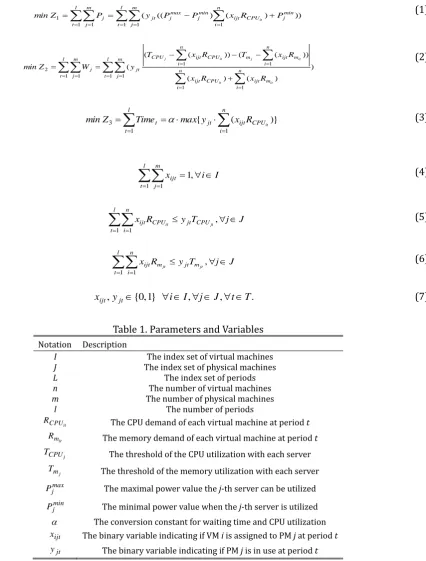
Consider a set of virtual machines to be allocated in another set of physical machines (servers) in successive periods. The parameters and variables are defined in Table 1.
2.1.
The multi-Objective Programming Model
l t m j min j n i CPU ijt min j max j jt l t m jj y P P x R P
P Z
min
it
1 1 1
1 1
1 ( (( ) ( ) ))
(1)
l t m j n i m ijt n i CPU ijt n i m ijt m n i CPU ijt CPU jt l t m j j it it it j it j R x R x R x T R x T y W Z min 1 1 1 1 1 1 1 1 2 ) ) ( ) ( ) ) ( ( ) ) ( ( ( (2) } ) ( { 1 13
n i CPU ijt jt l t
t max y x R it
Time Z
min (3)
s.t. I i x l t m j
ijt
, 1 1 1 (4) J j T y R x jt it jt CPU lt n
i
CPU
ijt
, 1 1 (5) J j T y R x jt jt jt m lt n
i m
ijt
, 1 1 (6) . , , } 1 , 0 {,y i I j J t T
xijt jt (7)
Table 1. Parameters and Variables
Notation Description
I The index set of virtual machines J The index set of physical machines L The index set of periods n The number of virtual machines m The number of physical machines
l The number of periods
it CPU
R The CPU demand of each virtual machine at period t
it m
R The memory demand of each virtual machine at period t
j CPU
T The threshold of the CPU utilization with each server
j m
T The threshold of the memory utilization with each server
max j
P The maximal power value the j-th server can be utilized
min j
P The minimal power value when the j-th server is utilized
The conversion constant for waiting time and CPU utilization
ijt
x The binary variable indicating if VM i is assigned to PM j at period t
jt
y The binary variable indicating if PM j is in use at period t
The model minimizes the total power consumption in (1), minimizes the power wastage in (2), and minimizes the waiting time of the processes in (3). Constraint (4) assigns every virtual machine to only one physical server in every period. Inequalities (5) and (6) ensure that the usages of CPU and memory are under their capacities in the execution duration. Constraints (7) and (8) define xijt,yjt as binary variables
representing the association of VM i and server j in time t, and the activation of server j, respectively.
2.2.
The Solution Processes
them are inspired by Zimmermann’s fuzzy approach [8]. This study develops the solution process based on Zimmermann’s approach to solve the model as (1) - (7).
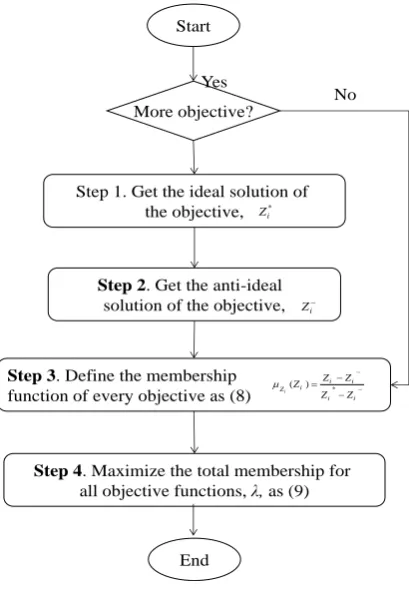
Step 1. Get the ideal solution of each objective.
To obtain the ideal solution *
i
z
, each objective function is minimized independently regardless of otherobjectives.
Step 2. Get the anti-ideal solution of each objective.
To obtain the anti-ideal solution
z
i, each objective function is maximized independently regardless of other objectives.Step 3. Define the membership function of each objective by its ideal and anti-ideal solutions as below.
i i
i i i z
z z
z z z
i( ) *
(8)
The membership function evaluates the fulfillment level of each objective.
Step 4. Get the final solution.
The final solution is found by maximizing the total satisfaction level as below.
) 7 ( ) 4 ( . .
3 2 1
t s
z z
z
(9)
The flowchart of the solution processes is illustrated as in Fig. 1.
Fig. 1. The solution processes of MOP.
This study uses the genetic algorithm [9], [10] to carry out the computation for MOP. Genetic algorithm
Start
End
Step 1. Get the ideal solution of the objective,
Step 2. Get the anti-ideal solution of the objective,
Step 3. Define the membership function of every objective as (8)
Step 4. Maximize the total membership for all objective functions, λ, as (9)
More objective? Yes
No
* i
Z
i
Z
i i
i i i Z
Z Z
Z Z Z
(GA) is a meta-heuristic method inspired by genetic evolution for combinational optimization as described below. It is a practical approach in common use to solve complex computational problems in information and communication technology.
Algorithm-GA
Set initial population
While (not termination condition)
determine the fitness of each individual select parent population
crossover mutation End while
On the other hand, the greedy method [11], [12] is implemented for comparison.
3.
Experiments and Results
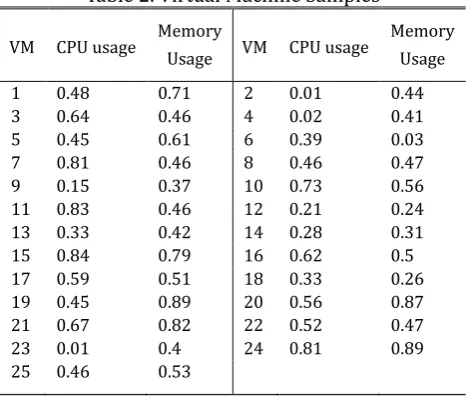
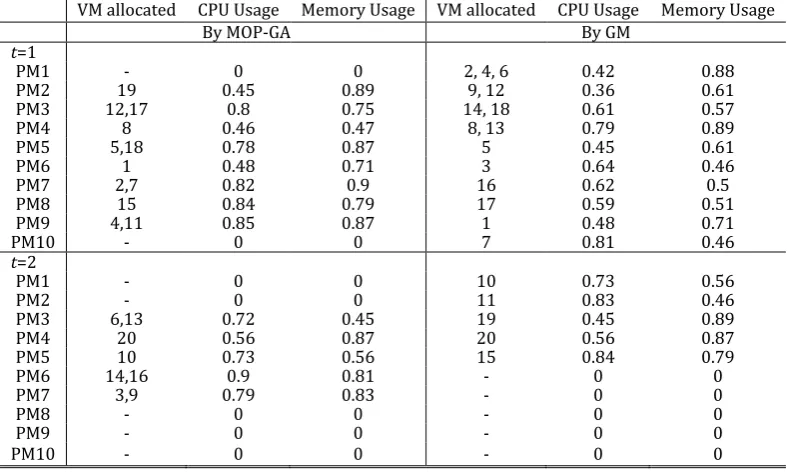
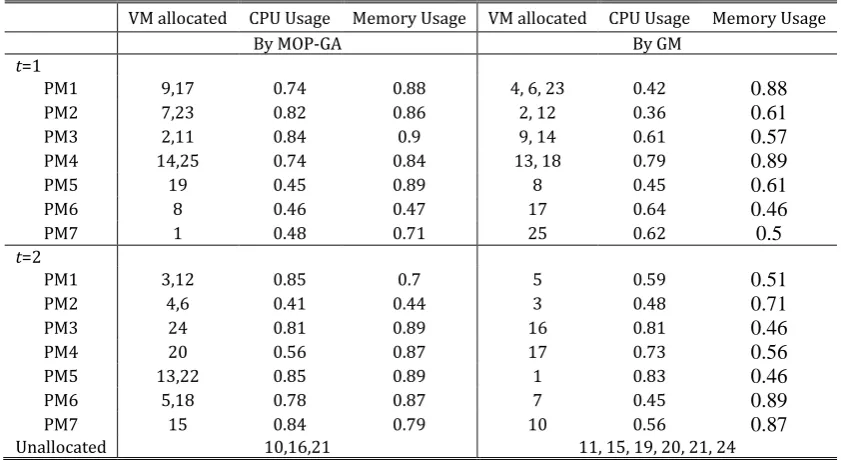
Consider a set of virtual machines to be allocated in another set of physical machines (servers) in two successive periods. This study assumes identical specifications for all physical servers equipped with Pentium(R) Dual-Core E5300 / 2.6 GHz processor, 2 GB memory. Assume that every physical server can satisfy the requirements of any virtual machines. This work randomly generates 25 virtual machine samples and expresses their requirements as the utilization rate of CPU and memory in Table 2. Three
scenarios of experiments are conducted using randomly selected subsets of the samples in Case 1: 15 VMs
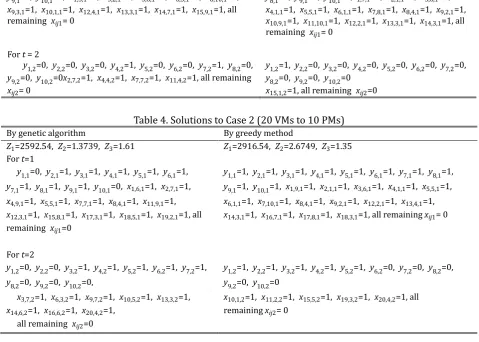
to 10 PMs; Case 2: 20 VMs to 10 PMs; and Case 3: 25 VMs to 7 PMs. The solutions and detailed results of
the three cases are summarized in Table 3-5, and Table 6-8, respectively.
In Case 1 (Table 3), the multi-objective programming with genetic algorithm (MOP-GA) outperforms the
greedy method (GM) in power wastage (Z2) and waiting time (Z3). In case 2 (Table 4), the MOP-GA obtains
lower power consumption (Z1) and power wastage (Z2), but generate longer waiting time (Z3). In case 3
(Table 5), the GM outperforms the MOP-GA except in power wastage (Z2). However, in case 3 the computing
requirements of the virtual machines exceed the resources of the physical servers, so several virtual machines are unallocated (as shown in Table 8). In Case 3, 6 virtual machines (11, 15, 19, 20, 21, 24) are unallocated with the GM, and 3 virtual machines (10, 16, 21) are unallocated with the MOP-GA. That is, the MOP-GA generates higher completion compared to the greedy method.
Table 2. Virtual Machine Samples
VM CPU usage Memory
Usage VM CPU usage
Table 3. Solutions to Case 1 (15 VMs to 10 PMs)
By genetic algorithm By greedy method
Z1=2133.39, Z2=0.8971, Z3=1.1 Z1=2133.39, Z2=1.9539, Z3=1.26
For t =1
y1,1=1, y2,1=1, y3,1=1, y4,1=1, y5,1=1, y6,1=1, y7,1=1, y8,1=0, y9,1=1, y10,1=1, x1,5,1=1, x3,2,1=1, x5,6,1=1, x6,3,1=1, x8,10,1=1,
x9,3,1=1, x10,1,1=1, x12,4,1=1, x13,3,1=1, x14,7,1=1, x15,9,1=1, all
remaining xij1= 0
y1,1=1, y2,1=1, y3,1=1, y4,1=1, y5,1=1, y6,1=1, y7,1=1, y8,1=1, y9,1=1, y10,1=1,x1,7,1=1, x2,1,1=1, x3,6,1=1,
x4,1,1=1, x5,5,1=1, x6,1,1=1, x7,8,1=1, x8,4,1=1, x9,2,1=1,
x10,9,1=1, x11,10,1=1, x12,2,1=1, x13,3,1=1, x14,3,1=1, all
remaining xij1= 0
For t = 2
y1,2=0, y2,2=0, y3,2=0, y4,2=1, y5,2=0, y6,2=0, y7,2=1, y8,2=0, y9,2=0, y10,2=0x2,7,2=1, x4,4,2=1, x7,7,2=1, x11,4,2=1, all remaining
xij2= 0
y1,2=1, y2,2=0, y3,2=0, y4,2=0, y5,2=0, y6,2=0, y7,2=0, y8,2=0, y9,2=0, y10,2=0
x15,1,2=1, all remaining xij2=0
Table 4. Solutions to Case 2 (20 VMs to 10 PMs)
By genetic algorithm By greedy method
Z1=2592.54, Z2=1.3739, Z3=1.61 Z1=2916.54, Z2=2.6749, Z3=1.35
For t=1
y1,1=0, y2,1=1, y3,1=1, y4,1=1, y5,1=1, y6,1=1, y7,1=1, y8,1=1, y9,1=1, y10,1=0, x1,6,1=1, x2,7,1=1,
x4,9,1=1, x5,5,1=1, x7,7,1=1, x8,4,1=1, x11,9,1=1,
x12,3,1=1, x15,8,1=1, x17,3,1=1, x18,5,1=1, x19,2,1=1, all
remaining xij1=0
y1,1=1, y2,1=1, y3,1=1, y4,1=1, y5,1=1, y6,1=1, y7,1=1, y8,1=1, y9,1=1, y10,1=1, x1,9,1=1, x2,1,1=1, x3,6,1=1, x4,1,1=1, x5,5,1=1,
x6,1,1=1, x7,10,1=1, x8,4,1=1, x9,2,1=1, x12,2,1=1, x13,4,1=1,
x14,3,1=1, x16,7,1=1, x17,8,1=1, x18,3,1=1, all remainingxij1= 0
For t=2
y1,2=0, y2,2=0, y3,2=1, y4,2=1, y5,2=1, y6,2=1, y7,2=1, y8,2=0, y9,2=0, y10,2=0,
x3,7,2=1, x6,3,2=1, x9,7,2=1, x10,5,2=1, x13,3,2=1,
x14,6,2=1, x16,6,2=1, x20,4,2=1,
all remaining xij2=0
y1,2=1, y2,2=1, y3,2=1, y4,2=1, y5,2=1, y6,2=0, y7,2=0, y8,2=0, y9,2=0, y10,2=0
x10,1,2=1, x11,2,2=1, x15,5,2=1, x19,3,2=1, x20,4,2=1, all
remainingxij2= 0
Table 5. Solutions to Case 3 (25 VMs to 7 PMs)
By genetic algorithm By greedy method
Z1=2778.39, Z2=1.2545, Z3=1.65 Z1=2664.97, Z2=2.3243, Z3=1.33
For t=1
y1,1=1, y2,1=1, y3,1=1, y4,1=1, y5,1=1, y6,1=1, y7,1=1, x1,7,1=1, x2,3,1=1, x7,2,1=1, x8,6,1=1, x9,1,1=1,
x11,3,1=1,
x14,4,1=1, x17,1,1=1, x19,5,1=1, x23,2,1=1, x25,4,1=1,
all remaining xij1=0
y1,1=1, y2,1=1, y3,1=1, y4,1=1, y5,1=1, y6,1=1, y7,1=1, x2,2,1=1, x4,1,1=1, x5,8,1=1, x6,1,1=1, x7,10,1=1, x8,5,1=1,
x9,3,1=1, x12,2,1=1, x13,4,1=1, x14,3,1=1, x17,6,1=1, x18,4,1=1,
x23,1,1=1, x25,7,1=1 all remainingxij1=0
For t=2
y1,2=1, y2,2=1, y3,2=1, y4,2=1, y5,2=1, y6,2=1, y7,2=1, x3,1,2=1, x4,2,2=1, x5,6,2=1, x6,2,2=1, x12,1,2=1,
x13,5,2=1, x15,7,2=1, x18,6,2=1,
x20,4,2=1, x22,5,2=1, x24,3,2=1, all remaining xij2= 0
y1,2=1, y2,2=1, y3,2=1, y4,2=1, y5,2=1, y6,2=1, y7,2=1,
x1,5,2=1, x3,2,2=1, x5,1,2=1, x7,6,2=1, x10,7,2=1, x16,3,2=1, x17,4,2=1,
all remainingxij2=0
4.
Concluding Remarks
minimizing energy consumption, maximizing effectiveness of physical machine, and minimizing the task waiting time. The multi-objective programming with genetic algorithm and the greedy method are compared in solving the placement models. Three scenarios are prepared to test the feasibility and effectiveness of the model. Based on the results, the proposed MOP model is effective the virtual machine placement in cloud computing environments considering both power efficiency and allocation performance. In summary, the multi-objective programming with genetic algorithm outperforms the greedy method when the physical servers provide sufficient resources (case 1 and case 2) and higher throughput under insufficient computing resources (case 3). Without loss of generality, the two-period setting can be extended to multi-period scenarios. For future studies, various objective functions and algorithms can be consolidated to raise the precision and robustness of the models.
Table 6. Results of Case 1 (15 VMs to 10 PMs)
VM allocated CPU Usage Memory Usage VM allocated CPU Usage Memory Usage
By MOP-GA By GM
t=1
PM1 10 0.73 0.56 2, 4, 6 0.42 0.88
PM2 3 0.64 0.46 9, 12 0.36 0.61
PM3 6, 9, 13 0.87 0.82 13, 14 0.61 0.73
PM4 12 0.21 0.24 8 0.46 0.47
PM5 1 0.48 0.71 5 0.45 0.61
PM6 5 0.45 0.61 3 0.64 0.46
PM7 14 0.28 0.31 1 0.48 0.71
PM8 - 0 0 7 0.81 0.46
PM9 15 0.84 0.79 10 0.73 0.56
PM10 8 0.46 0.47 11 0.83 0.46
t=2
PM1 - 0 0 15 0.84 0.79
PM2 - 0 0 - 0 0
PM3 - 0 0 - 0 0
PM4 4, 11 0.85 0.87 - 0 0
PM5 - 0 0 - 0 0
PM6 - 0 0 - 0 0
PM7 2, 7 0.82 0.9 - 0 0
PM8 - 0 0 - 0 0
PM9 - 0 0 - 0 0
PM10 - 0 0 - 0 0
Table 7. Results of Case 2 (20 VMs to 10 PMs)
VM allocated CPU Usage Memory Usage VM allocated CPU Usage Memory Usage
By MOP-GA By GM
t=1
PM1 - 0 0 2, 4, 6 0.42 0.88
PM2 19 0.45 0.89 9, 12 0.36 0.61 PM3 12,17 0.8 0.75 14, 18 0.61 0.57
PM4 8 0.46 0.47 8, 13 0.79 0.89
PM5 5,18 0.78 0.87 5 0.45 0.61
PM6 1 0.48 0.71 3 0.64 0.46
PM7 2,7 0.82 0.9 16 0.62 0.5
PM8 15 0.84 0.79 17 0.59 0.51
PM9 4,11 0.85 0.87 1 0.48 0.71
PM10 - 0 0 7 0.81 0.46
t=2
PM1 - 0 0 10 0.73 0.56
PM2 - 0 0 11 0.83 0.46
PM3 6,13 0.72 0.45 19 0.45 0.89
PM4 20 0.56 0.87 20 0.56 0.87
PM5 10 0.73 0.56 15 0.84 0.79
PM6 14,16 0.9 0.81 - 0 0
PM7 3,9 0.79 0.83 - 0 0
PM8 - 0 0 - 0 0
PM9 - 0 0 - 0 0
Table 8. Results of Case 3 (25 VMs to 7 PMs)
VM allocated CPU Usage Memory Usage VM allocated CPU Usage Memory Usage
By MOP-GA By GM
t=1
PM1 9,17 0.74 0.88 4, 6, 23 0.42 0.88
PM2 7,23 0.82 0.86 2, 12 0.36 0.61
PM3 2,11 0.84 0.9 9, 14 0.61 0.57
PM4 14,25 0.74 0.84 13, 18 0.79 0.89
PM5 19 0.45 0.89 8 0.45 0.61
PM6 8 0.46 0.47 17 0.64 0.46
PM7 1 0.48 0.71 25 0.62 0.5
t=2
PM1 3,12 0.85 0.7 5 0.59 0.51
PM2 4,6 0.41 0.44 3 0.48 0.71
PM3 24 0.81 0.89 16 0.81 0.46
PM4 20 0.56 0.87 17 0.73 0.56
PM5 13,22 0.85 0.89 1 0.83 0.46
PM6 5,18 0.78 0.87 7 0.45 0.89
PM7 15 0.84 0.79 10 0.56 0.87
Unallocated 10,16,21 11, 15, 19, 20, 21, 24
Acknowledgment
The authors appreciate the anonymous referees for their helpful comments and suggestions to improve the quality of this manuscript. Also we are indebted to the Ministry of Science and Technology, Taiwan for financially supporting this research under grant No. 103-2410-H-259-084- (H.-Y. Kao). The brief portion of this work has been presented in International Conference on Intelligent Informatics and BioMedical Sciences 2015 (iciibms 2015), Okinawa, Japan.
References
[1] Abadi, D. J. (2009). Data management in the cloud: Limitations and opportunities. IEEE Data
Engineering Bulletin, 32, 3-12.
[2] Chen, C. L. P., & Zhang, C. Y. (2014). Data-intensive applications, challenges, techniques and technologies: A survey on big data. Information Sciences, 275(1), 314-347.
[3] Guazzelli, A., Stathatos, K., & Zeller, M. (2009). Efficient deployment of predictive analytics through
open standards and cloud computing. ACM SIGKDD Explorations Newsletter, 11(1), 32-38.
[4] Gao, Y., Guan, H., Qi, Z., Hou, Y., & Liu, L. (2013). A multi-objective ant colony system algorithm for virtual machine placement in cloud computing. Journal of Computer and System Sciences, 79(8), 1230-1242.
[5] Ramezani, F., Lu, J., & Hussain, F. K. (2014). Task-based system load balancing in cloud computing using particle swarm optimization.International Journal of Parallel Programming, 42(5), 739-754.
[6] Zhao, Y., Huang, Y., Chen, K., Yu, Wang, M., S., & Li, D. S. (2015). Joint VM placement and topology optimization for traffic scalability in dynamic datacenter networks. Computer Networks, 80, 109-123. [7] Coutinho, R. C., Drummond, L. M. A., Frota, Y., & Oliveira, D. (2015). Optimizing virtual machine
allocation for parallel scientific workflows in federated clouds. Future Generation Computer Systems, 46, 51-68.
[8] Zimmermann, H. J. (1978). Fuzzy programming and linear programming with several objective
functions. Fuzzy Sets and Systems, 1(1), 45-55.
[9] Kaaouache, M. A., & Bouamama, S. (2015). Solving bin packing problem with a hybrid genetic algorithm
for VM placement in cloud. Procedia Computer Science, 60, 1061-1069.
cloud computing. Journal of Network and Computer Applications, 66, 106-127.
[11]Omara, F. A., Khattab, S. M., & Sahal, R. (2014). Optimum resource allocation of database in cloud computing. Egyptian Informatics Journal, 15(1), 1-12.
[12]Palmieri, F., Fiore, U., Ricciardi, S., & Castiglione, A. (2016). GRASP-based resource re-optimization for effective big data access in federated clouds. Future Generation Computer Systems, 54, 168-179.
Hanying Kao is currently the professor with the Department of Computer Science and Information Engineering, National Dong Hwa University, Hualien, Taiwan. She received her Ph.D. degree in Information Management from National Chiao Tung University, Taiwan. Dr. Kao has rich experiences in manufacturing information systems and related academic research. Her current interests include multi-objective decision methods, knowledge modeling, fuzzy optimization, etc. Her works have been published with
Yumin Yang received his master degree in computer science and information engineering, National Dong Hwa University, Hualien, Taiwan. His current interests include multi-objective decision methods, cloud computing, knowledge based systems, etc.