Abstract
adOPTing and iMPleMenTing
advanced ManuFacTuring TecHnOlOgy
Problems, Benefits, and Performance Appraisal Techniques
Lena Elitan
Universitas Widya Mandala, Surabaya [email protected]
This article attempts to discuss about the issues on factor inducing technology adoption, some empirical finding on AMT and the role of AMT in manufacturing sectors. There is also growing consensus that many of the failures in adopting AMT are, in fact, due to inadequate planning for, and/or faulty implementation of the systems. The key to successful AMT planning and implementation appears to be choice of an appropriate manufacturing systems and the attainment of an organizational infrastructure that will offer maximum support to the chosen system.
Further, this article presents an overview and guidance for manufacturing companies which are preparing to invest in advanced manufacturing technology (AMT). The purpose of this article is to explain the reasons why the company may encounter problems while adopting AMT, and to look at the many suggestions offered by the relevant literature for improving the performance of evaluation in AMT investment. According to the our major steps in adopting AMT (i.e. strategic planning, justification, training and installation, and implementation) , the research work here aims to assist managers or investors to recognize problems at each step, thus offering appropriate ways to avoid and/or solve those problems. It is believed that improved justification methods will encourage more firms to invest in AMT and to realize the benefits these investments can offer.
Keywords: Investment analysis, Advanced manufacturing technologies, Problems, Benefits, Performance Appraisal Techniques.
survey on patient culture. America : AHRQ Publication.
Wikipedia – Adverse Events
Zohar 2000. A group-level model of safety climate: Testing the effect of group climate on micro accidents in manufacturing Jobs.
the AMT, inconsistent nature of corporate
governance, insufficient level of technological
confidence, unclear financial environment,
behavior of competitors, and unsuitable time
to establish the critical performance measures
and performance benchmarks.
Moreover, some manufacturers hold the view
that the adoption of AMT involves a high
level of investment, and its payback period is
usually longer than that traditionally required
by business enterprises. Consequently, the
investment may initially result in an increase
in the cost of manufacturing. Apart from
these factors, there is often a lack of sufficient
experience with AMT implementation and
it is not unusual for organizations that have
invested in AMT to discover unexpected areas
of application or benefit.
According to the different operating
conditions and technological base of individual
companies, quoted improvement rates may
have been achieved in one company, but
cannot be achieved equally in another. For
these reasons, management may adopt a
rather conservative policy, and hence refuse
to consider AMTs, even though they could
potentially benefit the firm. Because of the
potentially high investments in AMT and the
moderate-to high risk involved in adopting
these technologies, there should be an
adequate economic analysis and justification
method to assist companies in selecting the
appropriate technology, most suited to their
operations and business objectives. Generally,
the widespread investment appraisal
techniques can be classified into three
groups: (1) strategic evaluation approach;
(2). economic evaluation approach; and (3)
analytic evaluation approach.
In the survey of current research and the
applications of existing investment appraisal
techniques, this article attempts to provide
an overview and guidance for manufacturing
companies which are planning to invest AMT.
Furthermore, it also reviews the literature
relevant to the management aspect of
adopting and implementing AMT, and
explores the use of appropriate evaluation
methodologies from the strategic and
economic points of view.
Elements of Successful Adoption and
Implementation of AMT
Adoption of Advanced Manufacturing
Technology (AMT) promises benefits but
are potentially risky. Many firms that have
O
wing to the intense globalcompetition in manufacturing,
manufacturers need to increase
their level of competitiveness in the global
market. Some manufacturing companies,
therefore, are forced to undergo a period of
transformation in order to compete more
effectively. Under these circumstances,
advanced manufacturing technology (AMT)
is considered as a means of improving
competitiveness.
The term ”AMT’’ refers to computer-aided
technologies in design, manufacturing,
transportation and testing, etc. In general,
AMT can be categorized into two principle
ways: 1 the classical continuum of basic
manufacturing processes which extends
from make-to-order manufacturing to
continuous manufacturing; and the level
of integration of the overall manufacturing
system (Hill, 1989). AMT is a generic term
for a group of manufacturing technologies,
which combine both scope and scale
capabilities in manufacturing environment.
Since manufacturing strategy has become
more sophisticated, as a result AMT can play
an important role in making its possible to
compete on “traditionally” contradictory
competitive priorities simultaneously.
According to Youseff (1993), advanced
manufacturing technology can be classified
into three groups (1) technology used in
the design of the product, (2) technology
used in the manufacture of the product or
advanced manufacturing technology and (3)
technology used in planning, administrating
and controlling activities related to the
product. In other words, the term AMT
refers to hardware-based technology in the
design, manufacturing and administration
of all the activities that are necessary to
produce a product or provide service. Some
industrialists and economists (Stainer et al.,
1996) believe that AMT has great potential
to offer manufacturing companies, with
many tangible and intangible benefits.
Some examples of the benefits which may
be obtained are reduced labour (Hayes &
Jaikumar, 1991), improved product quality
(Attaran, 1989; Poo, 1990), increased product/
process flexibility (Attaran, 1989; Willis &
Sullivan, 1984), enhanced time efficiency
(Meredith, 1987a) and shortened time-to
market. These benefits are significant but
there are several internal and external factors
inhibiting the success of AMT investment
decisions such as (Stainer et al., 1996): lack of
readily accessible and acceptable methods
to the effective implementation of new
manufacturing technologies. Management
should be committed to training during
the adoption phase and develop worker
selection programs.
Functional relationship. In order to
take full advantage of the considerable
manufacturing and marketing capabilities
offered by AMT there must be a balance
between marketing and manufacturing
strategies. In the condition when radical
changes happened in process capabilities,
market strategies must also be innovated.
Likewise, rapid changes in market capabilities
or market condition will signal a need for
manufacturing strategy changes.
R e l a t i o n s h i p w i t h t h e ex t e r n a l environment. The adoption of AMT
requires close collaboration with system
vendors, customers and suppliers. During
the implementation phase, there is a need
for major vendor commitment. Firms should
also foster tighter link with customer, with the
emphasis being on achieving quick response
to customer demand and improved customer
service. Wherever possible, customer
should be allowed to participate in product
development. Further, manufacturing
firms should work toward a relationship of
interdependence with supplier.
Justifying advanced manufacturing technology. The major considerations in
economic justification of AMT project are
the quantification of cost and benefit. While
the costs (hardware, software, planning,
training, operation, etc.) are generally
easily quantifiable, the benefits are often
very difficult to quantify. Specifically, major
strategic benefit such as early entry to
market, perceived market leadership, the
ability to offer a continuous stream of
customized products and improved flexibility,
although extremely important for the growth
and survival of the firms, are not readily
convertible into cash value.
To the extent that global and domestic
environment, manufacturing firms are
adopting AMT as mean to effectively
compete in their respective markets (e.g.
Flexibility, delivery, quality, and time based
competition). Whatever the objectives may
be the adoption of any new technology
involves uncertainty about achieving the
objectives.
In addition, to the inherent human resistance
to change and to be innovative, at least two adopted these new technologies have not
been able to reap all the potential benefits.
Since the technical abilities of the AMT are
relatively well proven, there is a growing
belief that managerial issues, from planning
to implementation, present the major barrier
to employing these technologies effectively.
Chen and Small (1994) proposed seven
elements of successful AMT adoption and
implementation:
Strategic planning for the adoption of AMT. The strategic planning approach takes
a long term, comprehensive view of both
business and technology issues. There is
a greater possibility of adoption success if
the decision to implement AMT is based on
strategic consideration. Whatever the basis
of the particular strategy that is adopted, the
firm should develop an integrated business
plan which provides the vision and sense of
direction for each organization unit of the
company to meet the strategic objectives.
Match product with process. Companies
should first identify the range of product
types that are to be manufactured, followed
by identifying the technologies and processes
required to manufacture this product. In
seeking to match product and process,
companies should be aware that adoption of
AMT can bestow not only operational benefits
but also marketing and strategic benefits as
well. Benefit such as increased market share,
reduced prices, improved responsiveness
to changes in the market places, the ability
to offer a continuous stream of customized
product, faster product innovation and
improvement of the company’s image,
have all been ascribed to the operation
of the flexible advanced manufacturing
technologies.
Monitoring advanced manufacturing technology. To determine the strategic and
operational benefits offered by AMT, firms
should continuously monitor the usage and
performance of AMT in their core industry.
Etlie (1988) emphasized the importance of
monitoring technology. He argued that firms
must be more innovative in new processing
technologies and management practices in
order to improve their competitive position
and ensure survival.
Management commitment and control. It
is critical for the success of AMT adoption and
implementation. The lack of an appropriate
management commitment and control
justification approaches and the adoption of
AMT. Determining the relationships between
justification actions and the performance
of a project are usually disregarded (Small
& Chen, 1995). Excessive attention has
been paid to technical development, but
not enough to the adjustments needed
in the organizations to accommodate the
technology. Apart from these, the use of
inappropriate appraisal methods may
make a company unwilling to invest in
AMT (Stainer et al., 1996). Many companies
aim to evaluate their chosen technology
by quantifying the costs of technology
implementation. Although costs such as
hardware, software, training, operations, etc.
are generally easily quantifiable, many other
benefits, for instances quality and flexibility,
are often very difficult to estimate
(Amoako-Gyampah & Maffei, 1989; Wabalickis, 1988).
The most popular capital-acquisition
policies, which evaluate the investment
in financial terms, have been found to be
inappropriate for automation investment
decisions (Attaran, 1989; Meredith and
Hill, 1987; Roth et al., 1991; Swann and
O’Keefe, 1990a, 1990b). For instance, it
has been suggested that conventional
cost accounting cannot accurately value
improvements in quality, flexibility, customer
service and other synergistic effects of AMT
(Dornan, 1987). Some researchers find that
AMT accounting practices reflect external
reporting requirements rather than the
reality of the AMT production environment
(Curtis, 1987; Kaplan, 1984). Many of the
problems raised by the introduction of AMT
are due to unawareness of the strategic
role of AMT, by all levels of management.
This situation is caused by the rigid use of a
formal budgetary control system, and also
due to too much emphasis on
piece-by-piece decision processes that are designed
to achieve short-term goals (Currie, 1991).
Since the benefits are difficult to quantify
in financial terms and the decision making
process requires a long-term perspective,
industry does not invest sufficiently in AMT
(Bromwich & Bhimani, 1991).
It is commonly claimed that investment
in AMT may result in strategic benefits.
However, managers always ignore this
advantage as they sometimes consider such
investments as an operational or functional
decision rather than a strategic one (Toone,
1994). It is suggested that arguments
based on comparison with competitors,
the retention, attainment or perception of
industry leadership, and expected future types of uncertainty emerge when adopting
AMT (Mamer & Cardle, 1987):
First, technological uncertainty, which refers
to the problem whether the adoption of
technology will be profitable, and
Second, strategic uncertainty, which involves
the decision to adopt a new technology.
The effect of technological uncertainty can be
reduced by research and testing. On the other
hand, strategic uncertainty is more difficult
and problematic to evaluate. It might be due
to the difficulties to anticipate the decisions
and actions of the competitors. Mechling et
al. (1999) argued that it is difficult to reduce
the technological and strategic uncertainty
both in the acquisition and implementation
stages. The first attempt to identify critical
factors to reduce these uncertainties and
support their strategic objectives is to
provide a link between firm’s long-term
competitive strategy and its technology
(Kantrow, 1980).
Conventional Problems in AMT Investment
It is generally agreed that the competitiveness
of manufacturing companies will be
potentially improved by implementing AMT.
However, the unsatisfactory performance
of the manufacturing sector in terms of per
capita value added and exports share is also
related to the low level of investment in AMT
(Wilkes & Samuels, 1991). There are quite a
number of practical cases reporting the failure
of AMT implementation (Bessant, 1990). It has
become a well-recognized assumption that
strategic and organizational issues should
be considered at an earlier stage prior to the
AMT implementation (Bessant, 1990; Gerwin,
1982; Kidd, 1990). However, there are still
some implicit questions. For instance:
First, what specific strategic, organizational
and technological issues should be
considered when investing in AMT?
Second, how could the strategic, organizational
and technological issues be interrelated with
each other during the implementation of
AMT?
Third, when should specific strategic,
organizational and technological issues
be addressed during the implementation
process (Sun and Riis, 1994)?
A survey of related literature indicates that
most researchers have only focused on
the justification of AMT dealing with the
extremely important for the growth and
survival of the firm, they are not readily
convertible into cash flow values (Kakati
& Dhar, 1991; Meredith, 1988). Therefore,
a meaningful justification should require
the identification and assessment of all the
variables that determine the success of the
AMT projects.
The faith in traditional accounting
procedures in firms has led some researchers
to advocate the justification of AMT on the
basis of strategic arguments. Hence, many
companies might adopt a hybrid approach
which consists of both strategic and economic
evaluations in justifying the adoption
of AMT. Consequently, researchers do
believe that adequate investment appraisal
methodologies will encourage more firms
to invest in AMT. In addition, managers
should realize how AMT investments can
offer tangible and intangible benefits to their
companies.
AMT: Expected Benefit VS Anticipated Risks
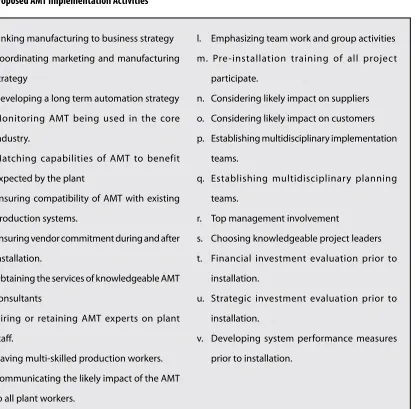
This section is devoted to discuss proposed
AMT adoption /implementation activities,
expected benefits and anticipated risk based
on studies done in developed countries and
developing countries. To summarize the
results of the previous studies, a detailed
list of activities identified most prevalently
in the literature as being critical for Amt
implementation success is presented in
Table 1.
Furthermore, based on a lot of studies done
on AMT adoption, Tables 2 and 3 summarized
the expected benefits as well as anticipated
risks and difficulties of the manufacturing
firms those adopt, implement and invest on
sophisticated technologies.
Based on the above review, it is important
to note that many determinants of
implementation success, anticipated risks
and difficulties as well as expected benefit are
actions and conditions that should be in place
prior to purchase and installation. Thus the
pre installation stage is indeed an essential
part of the entire AMT implementation
process.
Motivated by this pressing need, this article
proposes some stages to help management
determine when the adoption of new
technology is necessary and the planning
procedures to follow and to ensure successful
AMT adoption and implementation. For
manufacturers to analyze their operational developments in the industry should be
deemed as additional factors for decision
makers to approve AMT projects (Vrakking,
1989). Therefore, strategic criteria are
considered to be more important than
financial criteria in the AMT justification
decision making process (Slagmulder &
Bruggeman, 1992b).
To address these concerns, AMT investment
requires the decision makers to take
a strategic perspective (Stainer et al.,
1996). Major strategic benefits such as
early entry to market, perceived market
leadership, the ability to offer a continuous
stream of customized products, and
flexibility improvement, although they are a. Linking manufacturing to business strategy
b. Coordinating marketing and manufacturing
strategy
c. Developing a long term automation strategy
d. Monitoring AMT being used in the core
industry.
e. Matching capabilities of AMT to benefit
expected by the plant
f. Ensuring compatibility of AMT with existing
production systems.
g. Ensuring vendor commitment during and after
installation.
h. Obtaining the services of knowledgeable AMT
consultants
i. Hiring or retaining AMT experts on plant
staff.
j. Having multi-skilled production workers.
k. Communicating the likely impact of the AMT
to all plant workers.
l. Emphasizing team work and group activities
m. Pre-installation training of all project
participate.
n. Considering likely impact on suppliers
o. Considering likely impact on customers
p. Establishing multidisciplinary implementation
teams.
q. Establishing multidisciplinary planning
teams.
r. Top management involvement
s. Choosing knowledgeable project leaders
t. Financial investment evaluation prior to
installation.
u. Strategic investment evaluation prior to
installation.
v. Developing system performance measures
prior to installation.
Table 1. Proposed AMT Implementation Activities
of available AMT, b) matching of these
technologies to the process requirement of
the manufacturing concern, c) ensuring the
compatibility of the available technology
with the plant’s existing systems.
Third, operational and organizational
planning for the adoption of AMT and
financial strategic justification. The stage
consists of the development of integrated
operational and organizational plans for the
adoption of the AMT followed by financial
and strategic justification. The operational
plan identifies the activities that are needed
to ensure the successful adoption of the
AMT into existing operating system. The
organizational plan details the type of
operational structure and human resource
changes that will be needed to support the
operation of the new system.
A study of Chen and Small (1995) showed
that in term of organizational planning
activities, successful manufacturing firms
expended significantly higher level of effort
in following areas:
First, communicating the likely impact of
AMT to all plant staff. Second, emphasizing
team work and group activities. Third,
having multi-skilled production workers.
Fourth, pre-installation training for all project
participants.
Therefore, it is recommended that these
elements be viewed as integral part of
organizational planning process of adoption
of AMT. In addition, the more successful
AMT adopted had exhibited significantly
higher level of effort on the following
operational activities: First, establishing
multidisciplinary implementation teams. a. Disruption during implementation
b. Adverse effect on workflow
c. Failure to achieve financial target.
d. Problems with interconnection of equipment
e. Amt skilled deficiencies
f. Lack of integration of information system
g. Produc tion and management sk illed
deficiency
h. Opposition by workforce
i. Opposition by staff/management
j. Obsolesce of technology
k. Lack of integration across system.
Source: Previous studies.
Table 3. Anticipated Risks and Difficulties with AMT Investment
a. Improved quality
b. Reduced cost
c. Obtaining competitive advantage
d. Increase throughput
e. Increased flexibility
f. Better management control
g. Increased sales
h. Improved response to variation in product
volume
i. Improved integration of manufacturing
information system
j. Improved response to variation in product
mix
k. Reduced work in progress
l. Improved workforce attitude
m. Improved integration of management
information systems across function
n. Improved working environment
o. Reduced change over set up times
p. Improved ability to response variation in
supplier lead times
q. Overcoming skill deficiency
r. Improved management attitudes
s. Enhance company image
t. Reduced product development time
u. Improved ability to implement engineering
changes
v. Widening product range
w. Overcoming production skilled deficiencies
x. Better working environment
Source: Previous studies.
Table 2. Expected Benefit of AMT Adoption
and organizational environment as well as
make critical decision about accepting or
rejecting new technology development can
utilize these stages below.
First, define the company objectives and
determine required product/process changes.
The need for technological innovation in
production processes is often initiated as
a result of changing strategic or business
objectives, which require an evaluation of
current production processes. If existing
process are found to be adequate for
achieving the firm’s business and strategic
objectives, the manufacturers will maintain
the existing processes, otherwise system
changes that could be made in order to
obtain the most efficient and cost effective
should be considered.
Second, technology monitoring. Monitoring
technology is an integral part of the planning
process and should consist of the following:
product, volumes, and variants of parts. The
clarification of strategic goals is necessary to
the success of the AMT implementation (Sun
& Riis, 1994).
Supportive Organization Infrastructure
There is a growing consensus that the key to
successful AMT planning and implementation
depends on the choice of a suitable
manufacturing system, and the attainment
of an organizational infrastructure which
will offer maximum support to the chosen
system. In a recent survey, several AMT
implementations have been reported as
failing to achieve their promised benefits.
This is mainly due to problems within the
organizational structure (Attaran, 1996; Boer
et al., 1990; Hayes & Jaikumar, 1991; Meredith,
1986; Meredith, 1987b; Udoka and Nazemetz,
1990; Zammuto and O’Connor, 1992).
The management level can clarify some
ambiguities through the following questions
(Sun & Riis, 1994):
Can the current human resources support the
AMT? What are the qualifications of the staff
needed for the AMT? What is the division
of labour? What are the responsibilities
and the authority of the operators? How
could those people replaced by the AMT be
reassigned/redeployed? How could the AMT
be integrated with the existing system and
other functions?
Furthermore, the firm should also put a
great effort into the organizational and
operational planning activities (Chen &
Small, 1994) such as: announcing the
possible impact of AMT to all staff; stressing
teamwork and group activities; providing
pre-installation training for all project
participants;
forming multi-disciplinary planning and
implementation teams; and considering
likely impact on customers and suppliers.
Management Commitment and
Supervision
Top management should recognize the
range of product types that are likely to be
manufactured, and identify the technologies
as well as the manufacturing processes of
these product types more effectively and
efficiently. Rapid changes in marketing
capabilities or market conditions will signal
a need for manufacturing strategy changes
(Blois, 1986). Top management should be
aware not only of operational benefits such as
Second, establishing multidisciplinary
planning teams. Third, considering likely
impacts on customers. Fourth, considering
likely impact on suppliers. Fifth, top
management involvement.
Review of Existing Methodologies
There are four major steps often recognized
in adopting AMT. These steps are (Small
& Chen, 1995): 1) strategic planning, (2)
justification, 3) training and installation;
and, 4) implementation of the selected
technology. Hence, this article will be
guided by these stages to overview the
relevant literature as a source of information
for industries, which are planning to invest
AMT. It should be mentioned that there will
be no sharp borderlines between stages. In
fact, some of them are partially in parallel.
Strategic Planning
The strategic planning can be divided
into five phases: objectives identification,
organization infrastructure supporting,
management commitment and supervision,
performance variables assignation, and
technologies identification.
Objectives Identification
The strategic approach takes a long-term,
comprehensive view of both business
and technological issues. A critical step in
the adoption of new technologies is the
identification of corporate strategic goals
and objectives. According to the various
objectives and operating characteristics in
each company, the decision on selecting
a technology will be different. Besides, the
company should point out the problems
hindering the accomplishment of the
goals, and the contribution of the proposed
AMT to these goals. The objectives of the
company can be set from self-questioning.
For example:
What are the strategic goals of the company?
What problems are faced with the current
manufacturing system? Will the new AMT
encourage the production tasks at operations
level and the manufacturing goals? What
types of product are going to be produced
now and in the future? What is the technology
strategy in the near future?
During the strategic planning stage, it
should also cover the elaboration of product
and manufacturing strategy down to
And conversely, top management does not
have full understanding of operational details.
This often results in frustration as operations
engineers are expected to meet unrealistic
demands of top management. Therefore, the
steering committee should create the vision
of the project for the company, and know
how to convert that vision into reality. System
interfaces, database requirements, types of
information to be shared and timeliness of the
information should also be involved (Attaran,
1996).
Furthermore, some researchers (Beatty &
Gordon, 1990) indicated that a champion is the
most important figure in AMT implementation.
The champion plays both path-finding and
problem-solving roles. Without a capable
and skilled champion in companies, the
implementation would proceed very slowly,
and remain restricted to a small corner of the
organization, or, more importantly, would not
achieve the objectives expected at the outset
(Beatty, 1990). Therefore, the most useful
support is to officially appoint the champion
as the leader of the AMT implementation
project, to give him or her enough authority
to carry out the implementation, and to
provide the necessary financial resources.
Moreover, good coordination of all parties
provides strong support for the champion
which is a critical success factor (Sun & Riis,
1994).
Performance Variables Assignation
Another essential issue is the timing of the
establishment of the performance measures,
and the performance benchmarks. Some
authors state that the correct time for
establishing these criteria is during the
planning stage, especially during the financial
and strategic justification of the technology
(Chen & Small, 1994; Gold, 1988). If the
performance variables can be established
in good time, the plant will be better able to
monitor progress during and after installation
of the AMT and make adjustments to project
goals and objectives. The performance
variables which are considered generally can
be listed as follows:
Time needed for a major design change in an
existing product Compatibility with existing
machine, machine breakdown, utilization,
the average number of tasks per operator,
production lot sizes, operator output rates,
work morale, human integration, cost
product cost, maintenance cost, labor
cost material cost, plant revenues from flexibility improvement, but also of marketing
and strategic advantages as well. Cash et al.
(1988) and Noori (1990) have reported that
there are two sets of trends which have an
impact on market and manufacturing. Market
trends embrace increased new product or
process introductions, such as a short product
life cycle, fragmented markets and demand
uncertainty, etc. Manufacturing trends
include inventory reduction, product and
process simplification, quality improvement
and so on. According to these two sets of
trends, stability must be maintained between
marketing and manufacturing strategies.
A recent flexibility-uncertainty model (Chen
et al., 1992) provides an innovative link
between marketing and manufacturing in
the new manufacturing environment. The
model demonstrates ways of employing
different types of flexibility to cope with the
various forms of environmental uncertainty
that can cause tension between marketing
and manufacturing.
A survey of related literature reports that
during the AMT justification process, the more
the number of functional departments is
involved, the more effective it is in explaining
project performance. Functional departments
involved in justification are (Small & Chen,
1995): production/operations management,
engineering/research and development,
finance, management information system,
general administration, marketing, and
personnel.
All departments concerned can identify
their expectation from the technology, and
seek to determine the time period within
which these expectations should be met.
Furthermore, the performance of the AMT
should be gauged by its impact on all
concerned departments, not only on the
department where it is installed (Primrose,
1991). This can best be achieved through the
use of multi-functional steering committees
as well as interdisciplinary multi-skilled
teams, and they should assist in fostering
inter departmental communication (Falkner
& Benhajla, 1990). In order to encourage
integration between separate functional
departments, the concept of the
multi-functional steering committees could be
promoted by the firms (Boer et al., 1990). The
team should comprise members from various
functional areas (Ferraro et al., 1988). This
is because manufacturing managers with
experience in operations often do not have
Co m p a n i e s m u s t a s ce r t a i n w h i c h
technologies can fulfill their objectives and
identify the selected technologies belonging
to a system (i.e. stand-alone, intermediate
or integrated systems), since it will affect
the following justification methods chosen.
For stand-alone systems where the purpose
is the straightforward replacement of old
equipment, even if some economic benefits
not usually considered are obtained, the
standard economic justification approaches
can be used.
However, for the linked systems, flexibility,
risk and non-economic benefits are expected,
more analytical procedures are needed.
In such cases, subjective estimates of
probability distributions are obtainable
and can be included in the analysis. Lastly,
with systems approaching full integration,
clear competitive advantages and major
increments towards the firm’s business
objectives are usually being obtained.
In such cases, strategic approaches
are needed to take these benefits into
consideration, although tactical and
economic benefits may arise as well. Each of
the justification categories spans a number
of approaches. In the following sections,
we will describe these approaches and
discuss their pros and cons. Justification
methodologies As mentioned before,
evaluation techniques can be partitioned
into three groups, i.e. strategic, economic
and analytic justifications.
Strategic Justification Approaches
Strategic approaches tend to be less
technical than the economic and analytic
methods, but they are frequently used
in combination with them. Performance
approaches is their direct tie to the goals of
the firm. A disadvantage is the possibility
of overlooking the economic and tactical
impact of the project, myopically focusing
entirely on the strategic impact. However, if
a strategic approach is used, the economic
and analytic implications should also be
checked, simply for a clear understanding
of the impact of the project (Meredith and
Suresh, 1986). There are several commonly
used strategic approaches.
Technical importance. This approach is
based on the concept of technical importance
which means the project is a prerequisite
for a crucial follow-on activity. It may have
negligible returns, or even disadvantages, manufacturing operations, flexibility,
changeover times, variety of part-types or
products manufactured, design change
accommodation, capacity growth.
Then, routing and scheduling flexibility,
market responsiveness, quality Scrape
value, rework, product conformance and
consistency, delivery Time scheduling,
delivery time, lead time from receipt of order
to delivery, transportation, customer services,
inventory/work in progress, innovativeness
Research and development, and introduce
product variation.
Technologies Identification
The advanced manufacturing technologies
are broadly classified into seven sub-groups.
The classification scheme adopted here is
similar to the US Department of Commerce
(1989) Survey of Manufacturing Technology.
The findings of some researchers show that
the technologies are also cross-categorized
as stand-alone systems, intermediate
systems, and integrated systems (Meredith
& Suresh, 1986). This classification scheme
links technologies that have similar benefits
and costs. The advanced technologies are
classified into three main groups, and seven
subgroups are further divided as shown
below (Small & Chen, 1995):
First, design and engineering technologies: aided design (CAD) and
Computer-aided process planning (CAPP).
Second, fabricating/machine and assembly
technologies: NC/CNC or DNCmachines, Materials working laser (MWL),
Pick-and-place robots, Other robots, Intermediate
systems.
Third, automated material handling technologies: Automatic storage and retrieval systems (AS/RS)
and Automated material handling systems
(AMHS).
Fourth, automated inspection and testing
systems: Automated inspecting and testing equipment (AITE) and Integrated systems.
Fifth, Flexible manufacturing technologies: Flexible manufacturing cells/systems (FMC/
FMS).
Sixth, computer-integrated manufacturing
systems : Computer-integrated manufacturing (CIM).
Seventh, logistic related systems: Just-in-time (JIT), Material requirements planning (MRP),
six types of manufacturing output (i.e. cost,
performance, quality, delivery, flexibility, and
innovation) at target levels, to the rest of an
organization. Thus, appropriate plans and
policies are designed for some or all decision
areas (i.e. production capacity, facilities,
process technology, supplier relations,
planning and control, measurement, work
force, quality and structure policies) within
manufacturing. It shows precisely what
the manufacturing function will provide
(specific outputs at specific levels) to the
rest of the organization and indicates how
the manufacturing functions provide such
outputs.
Economic Justification Approaches
Economic justification calculations will
commonly be made in combination with
strategic considerations, but analytic
evaluations are rarely included. This is
because analytic approaches always require
a lot of time and trouble. Some newly
industrialized countries have a relatively low
labour cost but highly motivated workforce
and generous supply of raw material, so
it often makes economic justification of
projects difficult (Zhao & Co, 1997). There exist
a number of formulae and approaches that
companies use for the economic justification
of equipment. They are concerned with
simple economic functions such as payback
(PB), return on investment (ROI), internal
rate of return (IRR), net present value (NPV),
and so on, used in situations where they
are assuming no uncertainty (Fotsch, 1984;
Rosenthal, 1984; Schall et al., 1978).
One school of thought is that return on
investment (ROI) and payback calculations
cannot identify potential AMT improvements,
since these techniques only assess financial
feasibility of the technology (Attaran, 1996).
Many researchers (Kakati and Dhar, 1991;
Kaplan, 1984; Park and Son, 1988; Primrose,
1991) consider the use of discounted cash
flow (DCF) techniques to be critical for
AMT investment. However, recent studies
(Baldwin, 1991; Cole, 1987) show that DCF
is inherently biased against technological
capital investment; furthermore, some
skeptics believe that the widespread use of
these methods has led to a decline in the
level of capital investment. In addition, DCF
techniques have some drawbacks such as
conceptual weakness, inability to evaluate
strategic investments with future growth
opportunities, and especially biased against
long term projects (Krinsky and Miltenburg, but later, more desirable work cannot be
attempted without implementing this
activity first. It is common for activities such
as these to be grouped with the desired
follow-on project in a ``package’’ that is
approved en masse by the approval board.
Business objectives. Through the business
objectives justification approach, a firm can
check whether the project achieves the firm’s
business objectives or not.
Competitive advantage. In the competitive
advantage justification approach an
opportunity may exist for the firm to gain
a significant advantage over its competitors
by implementing this project. The advantage
may not belong to one of the strategic
business objectives of the firm but it is very
important for the company to press on. The
opportunity may have arisen from a unique
set of circumstances or may be an outgrowth
of a slight competitive advantage the firm
already holds. This situation occurs frequently
in all areas of technology. A firm may hold a
crucial patent that allows it to build on an
existing base for a significant advantage over
its competition.
Research and development. Treating a
project as an R&D investment admits that
it may fail but it holds sufficient strategic
promise to justify the investment. The point is
that one of many such projects will eventually
come through and provide returns to the
firm to reimburse all the failures. Without
risk, nothing is gained. The R&D approach
can be evaluated through the pilot project,
setting up one group technology line, or
one manufacturing cell to observe how well
it works, what it costs, its problems, and its
benefits (Meredith & Suresh, 1986).
Swamidass (1987) pointed out that planning
for manufacturing technology requires
the assessment of the deterioration of
technology over time. In this connection,
an ``organization technology index’’ (i.e. a
measure of the capability of the technology
being used by the firm) will be calculated and
compared with the index for the state-of-the
art firm in the industry. When the firm’s index
deviates from the industry’s index by a
pre-specified value (labeled the ``modernization
point’’), a signal indicating the need for
technological improvement will be triggered.
Recent studies show that the manufacturing
strategic map (Krinsky & Miltenburg, 1991)
can be used to simplify the strategic analysis.
It is a set of plans and policies from which
hybrid financial and strategic appraisal
approaches (Boaden & Dale, 1990).
Analytic Justification Approaches
The analytic techniques are largely
quantitative but more complex than the
economic techniques. When intangible
benefits are taken into consideration, the
analytic investment appraisal techniques for
investment are required. It is because they
can collect more information and frequently
consider uncertainty and multiple measures
and effects. The superiority is that they
are more realistic, taking more factors and
subjective judgements into account, and
hence better reflect reality as understood
by knowledgeable managers (Meredith &
Suresh, 1986). Even though a computer can
be used for the complex analysis, it is still time
consuming to collect data for analysis.
Several Commonly Used Approaches are
Described Below
The analytic hierarchy process (Sullivan, 1986)
structures a complex decision into a hierarchy
of elements. The attributes are compared
pair-wise, relative to the company objectives.
The pair-wise comparisons are based on
judgments about the relative differences
among comparable elements. The relative
weights are then set by the eigenvector
method and combined to derive a single
overall rating for each decision alternative.
The advantages of using hierarchies are
that:
they can describe how changes in priority at upper levels affect the priority ofelements in lower levels; They also provide a
great detail of information on the structure
and activity of a system in the lower levels
and give an overview of the actors and
their purposes in the upper levels; and
natural systems assembled hierarchically,
i.e. through modular construction and final
assembly of modules, decision making
evolves much more efficiently than those
assembled as a whole (Saaty, 1990).
Nevertheless, they also have some flaws
which are:
the absence of a theoretical framework to model decision problemsinto a hierarchy. The pair-wise comparisons
are based on subjective judgments. The
estimated relative weights are set by the
eigenvector method, and without formal
treatment of risk (Zahedi & Fatemeh,
1986). 1991). Although these techniques are not
inherently flawed, the main problem is that
the investors do not recognize the value of
a wide range of competitive commitments.
When an organization invests in a new
product or process that decreases the value of
existing products, it is said to be cannibalizing
its business. This kind of cannibalization can
be overcome by the capital budgeting
systems. Through the calculation of NPV or
IRR, the investment which may decrease
the organization’s value can be avoided
(Stainer et al., 1996). However, there are still
some loopholes when employing the capital
budgeting systems.
For example: They support decisions that
are sensible when viewed in isolation. They
do not always indicate the best action within
an inter-related set of decisions, and they
are inherently incremental so that long-run
survival cannot adopt.
Apart from these, some authors mention
the possible source of error in investment
appraisal procedures to which the investors
should pay more attention (Cole, 1987), such
as: employing unreasonably high discount
rates, failure to identify all the costs of new
investment, neglecting crucial benefits from
new investment, employing short payback
periods, adjusting inappropriately for risk,
comparing investments with irrational
continuation of status quo alternatives, and
putting stress on incremental rather than
global opportunities.
It should be highly recommended that if
the previously cited possible hazards can be
avoided, discounted cash flow analysis is a
powerful and valid tool where benefits can
be properly quantified. On the other hand,
some scholars suggest that all projects can
be appraised through a single evaluation
approach which uses sensitivity analysis
to compensate for the risk associated with
evaluating the intangible benefits (Primrose,
1991; Smith, 1983). Sensitivity analysis
encourages identification of variables that
might be disregarded in the assessment
of uncertainty. The key variables that are
likely to affect the result of investment
would probably include such elements as
unit variable costs, fixed cost, market share,
market size, and unit price achievable. These
would be adjusted in turn, and the overall
effect on NPV or IRR would be calculated.
To alleviate the problems inherent in using
purely financial or purely strategic appraisal
such as gambling. The probabilities of a series
of outcomes are established which seem
straightforward. Second, a specific outcome is
defined as value to the decision maker by the
concept of utility. A survey of recent literature
highlights that there are two prime risks
having a profound impact on decision making
behaviour (Sitkin and Pablo, 1992).
They are: 1) The probability of variance in
the cash flows which are initiated by the
project. 2) The probability of variance in the
time taken before such cash flows occur,
and in the case of the development of some
new technologies, whether they would be
feasible, acceptable and suitable. The use of
risk analysis, therefore, provides management
with extended risk-adjusted capabilities for
assessing the feasibility of the project.
Training and Installation
During this stage, the company should consider
several aspects which have impacts on the
overall performance: to select a suitable
site for installation, to test and install the
equipment piece by piece before they were
integrated, to select and train the operators
and maintenance staff; and to take into
consideration human resource allocation.
A survey of literature indicates that
management must realize the critical
nature of proper training and education,
as experience has shown that between 25
per cent and 40 per cent of the total cost
of a project will be spent on education
and training (Mize, 1987). Furthermore, the
company should conduct a complete skill
assessment of the workforce. For example, it
should determine what skills are needed and
what changes have to take place.
Besides, it should ensure that the human
element is prepared for the new equipment
utilization, before any equipment is installed.
Support is needed at all stages for those
who are being trained on new equipment
(Attaran, 1996). Recent researches claim
that training and involvement of managers,
accountants and technologists at all levels
can minimize the uncertainties and enhance
the effectiveness of AMT investment (Zhao
and Co, 1997).
Implementation
After the equipment haa been installed, a
reasonable period of time is needed for the
managers and workers to gain sufficient
organizational and technical experiences The linear additive model (Sullivan, 1986) can
be applied to justify long-term and
short-term manufacturing investment alternatives.
Each alternative is ranked by combining the
information from independent criteria. The
score for each alternative is the summation
of the rating assigned to each decision factor
multiplied by the weight of that factor relative
to a weight of one for the most significant
decision factor. The alternative with the
highest score will eventually be preferred. It
seems to be easy for the decision makers to
use because it has produced a rank ordering
which appears to correspond closely to their
actual ultimate choices (Morris, 1977). Since
the alternatives considered are not really
independent in reality, the model may have
some difficulties in implementation (Soni et
al., 1990).
Profile charts and symbolic scorecards
(Sullivan, 1986) offer a visual aid for the
analyst to choose between alternatives with a
summary of intangible performance criteria.
The charts themselves make no attempt to
rank importance, so subjective judgment is
needed to determine the relative importance
of the criteria presented in the graphical
display. Hence, profile charts are very useful
in the decisions where only a simple visual
indication of the desirable criteria is desired.
Generally, there are a number of programming
models which are based on the equation
given for the weighted factor scoring model.
Integer programming is used; 0-1 variable to
represent each project. The project is selected
when the set of project total weighted scores
is maximized, subject to resource constraints
such as capital and facilities (Meredith and
Mantel, 1985). Goal programming is used
to show the different factors as goals to be
attained, subject to resource constraints.
Again, weights are used on the goal deviations
to give importance to each of the factors
(Ignizio, 1976). Linear programming technique
is used to assist decision makers to allocate
limited resources, such as company money, to
the investing technologies while considering
their interdependence (Kuei et al., 1994).
The risk analysis approach is to simulate the
projects under consideration to determine the
variables of interest, such as benefits, costs,
yields, and capacity etc., and to describe the
outcomes statistically or graphically. In general,
cumulative distribution functions are always
used to determine each variable of interest. In
risk analysis, there are two broad approaches.
First, the probability of a particular outcome
will offer maximum support to the chosen
system. The achievement of desired benefit
from AMT requires systematic and integrated
operational planning prior to the adoption
of new systems. Such planning requires
the identification of likely product and the
matching of these products with efficient
AMT processes. In addition the processes
should be matched with the organizational
structure and worker’s skills to allow for
organizational infrastructure changes, which
might be needed prior to adoption of the
technology. Closer working relationship
among all functions of the organization will
be required.
Finally, planning for AMT must be seen as a
critical step in the implementation process
if up front planning for the operational
and organizational aspect of the AMT
project is performed, the likelihood of
encountering installation will be greatly
reduced. Management to continuously meet
organizational objectives and determine
when the adoption of an innovative
technology is warranted can use the three
stages that we propose in this article.
A common belief is that the implementation
of advanced manufacturing technologies
involve large initial investments. If these
investments can be fully justified, it will lead
some companies to be willing to invest.
Moreover, some of the benefits, such as
tangible and intangible, are difficult to
quantify in financial terms and require
long-term considerations. Our review of literature
indicates that achievement of the desired
benefits from advanced manufacturing
technologies requires systematic and
integrated planning rather than the adoption
of new systems. Generally, AMT adoption can
be divided into four major stages: strategic
planning, justification, training and installation,
and implementation.
The article presented here is followed by
these four major steps to offer a systematic
guidance for decision makers via the relevant
literature. It also points out what factors
should be considered and what conventional
problems the company will encounter. As
revealed by the literature survey, some
technology evaluations are based on the
weighted averages of expert or decision
maker judgments. All of these judgments
must be measured in numerical and exact
values. We do believe that there is a need
to consider both subjective and objective
factors during the selection of technologies. for the normal and continuous operation
of the AMT. here may be some strategic
changes that arise from environmental
alternations, such as technology, economy,
customers and competition, after the
installation of AMT. Unpredictable and
inevitable uncertainties always occur
both in technology and organization.
For instance, Meredith (1987) reported a
case where the AMT implemented forced
the top management to reconsider their
strategy. Therefore, all departments are
able to monitor the whole implementation
progress via the inter-departmental teams
as mentioned before. Whenever any
environmental change occurs, the top
management can respond quickly and
make necessary adjustments to project
goals and objectives.
Conclusion and Recommendations
The advent of AMT has given manufacturing
organization a new dimension on which
to compete. Product-base competition
must not be driven by cost alone. In 21st
century, management must move beyond
cost and quality as the only dimensions
on which to compete. Agility, quick
responses to customer needs, timeless in
all manufacturing activities necessitate the
use of time as a new metric or dimension
for competition.
In order for organization to be more flexible
and responsive to customer needs, it is
necessary that proper environment for
implementing AMT is created. For the
environment to exist, we suggest the
following: first, top management must be
convinced about the synergistic impact
of these technologies. Second, the motive
for implementing AMT should be of a
strategic nature. Third, the integration of
these technologies beyond the design of
the product.
The implementation of AMT is a complex
process whose success depends on myriad
aspects of the organization structure,
systems (formal & informal) culture and
environment.
There is also growing consensus that many
of the failures in adopting AMT are, in fact,
due to inadequate planning for, and/or faulty
implementation of the systems. The key to
successful AMT planning and implementation
appears to be choice of an appropriate
manufacturing systems and the attainment
Bessant, J. (1990), “Organization adaptation and manufacturing technology’’, in Haywood (Ed.), Proceedings of the Final IIASA Conference on CIM: Technologies, Organizations, and People in Transition, Luxembourg, pp. 351-60.
Beaumont, N.B. & Schroeder, R.M. (1997). Technology, Manufacturing Performance, and Business Performance Amongst Australian Manufacturers. Technovation, 17 (6), pp. 297-307.
Blois, K.J. (1986) , “Marketing strategies and the new manufacturing technologies’’,
International Journal of Operations Production Management, Vol. 6 No. 1, pp. 34-41.
Boaden, R.J. and Dale, B. (1990), “Justification of CIM’’, IEEE Transactions on Engineering Management, Vol. 37 No. 4, pp. 291-6. Boer, H., Hill, M. and Krabbendam, K. (1990), “FMS
implementation management: promise and performance’’, International Journal of Operations Production Management, Vol. 10 No. 1, pp. 5-20.
Bromwich, M. and Bhimani, A. (1991), “Strategic investment appraisal’’, Management Accounting (US), Vol. 72 No. 9, March, pp. 45-8.
Burgess, T.F. Gules, H.K. Gupta, J.N.D., & Tekin, (1998). Competitive priorities, process innovations and time based competition in the manufacturing sectors of industrializing economies: the case of Turkey. Benchmarking for
Quality Management and Technology, 5(4), pp. 304-316.
Cash, J.I., Machfarlan, F.W. and Mckenney, J.L. (1988), Corporate Information Systems Management, Dow Jones-Irwin, Homewood, IL.
Chen and Small MH. (1994). Implemented advanced manufacturing technology: an integrated planning model. Omega,
International Journal of Management Science, 22(1), pp.91-103.
Chen, I.J., Calantone, R.J. and Chung, C.H. (1992), “The marketing-manufacturing interface and manufacturing flexibility’’,
International Journal of Management Science, Vol. 20 No. 4, pp. 431-43. Cole, G.S. (1987), “The survival of US
manufac tur ing ± the ultimate management decision’’, International Journal of Technology Management, Vol. 2 No. 1-3, December, pp. 13-21.
Currie, W.L. (1991), “Investing in CAD: a case of ad-hoc decision-making’’, Long Range Planning, Vol. 22 No. 6, December, pp. 85-91.
Curtis, D.A. (1987), “An heuristic to evaluate investments for improved economies of scope in manufacturing’’, Journal of Manufacturing Systems, Vol. 6 No. 4, pp. 325-7.
Currie, W. 1989. Investing in CAD: acse ad hock decion making, Long Range Planning, Vol. 22, Pp. 85-91.
Subjective factors are commonly evaluated by
the experienced decision makers or experts. It
is most appropriate and convenient for them
to express their opinions on the comparative
importance of various factors in linguistic
variable scales, i.e. very high, high, medium,
low and very low, since the decision makers
or experts feel comfortable in giving relative
weighting in linguistics (Prabhu & Vizaykumar,
1996). It will be better and meaningful to
convert these linguistic variables into fuzzy
numbers to evaluate the technologies by
using fuzzy multi-criteria methods. For these
reasons, further development will be needed
to study its advantages, limitations and
accuracy compared with the conventional
evaluation methodologies.
As evidenced by the literature review, it
shows that most companies are only using
one (i.e. strategic, economic or analytic
alone)or hybrid evaluation approaches (i.e.
strategic and economic or economic and
analytic) to decide AMT investment. And
thus, integrated approaches (i.e. strategic,
economic and analytic) are recommended to
quantify the tangible and intangible benefits
throughout the technology investment. Since
each individual evaluation technique can
rectify another’s deficiencies, a more accurate
management decision can be made.
Amoako-Gyampah, K. and Maffei, M.J. (1989) , “The adoption of flexible manufacturing systems: strategic considerations’’,
Technovation, Vol. 9 No. 6, pp. 479-91. Attaran, M. (1989), “The automated factory:
justification and implementation’’,
Business Horizons, Vol. 32 No. 3, pp. 80-5.
Attaran, M. (1996), “Gaining CIM benefits’’,
Computers in Industry, Vol. 29, pp. 225-7.
Baldwin, C.Y. (1991), “How capital budgeting deters innovation and what to do about it’’, Research Technology Management, November/December, pp. 39-45.
Beatty, C.A. (1990), “Implementing advanced manufacturing technology’’, Business Quarterly, Autumn, pp. 46-50.
Beatty, C.A. and Gordon, J.R.M. (1990), “Advanced manufacturing technology: making it happen’’, Business Quarterly, Spring, pp. 46-53.