www.astrophys-space-sci-trans.net/6/1/2010/ © Author(s) 2010. This work is distributed under
the Creative Commons Attribution 3.0 License. Astrophysics and Space Sciences
Transactions
Modelling the steady state spectral energy distribution of the
BL-Lac Object PKS 2155-30.4 using a selfconsistent SSC model
M. Weidinger, M. R ¨uger, and F. Spanier
Institut f¨ur Theoretische Physik und Astrophysik, Universit¨at W¨urzburg, Am Hubland, 97074 W¨urzburg, Germany Received: 6 April 2009 – Revised: 19 October 2009 – Accepted: 23 November 2009 – Published: 13 January 2010
Abstract. In this paper we present a fully selfconsistent SSC model with particle acceleration due to shock and stochastic acceleration (Fermi-I and Fermi-II-Processes re-spectively) to model the quiescent spectral energy distribu-tion (SED) observed from PKS 2155. The simultaneous August/September 2008 multiwavelength data of H.E.S.S., Fermi, RXTE/SWIFT and ATOM give new constraints to the high-energy peak in the SED concerning its curvature. We find that, in our model, a monoenergetic injection of electrons atγ0=910 into the model region, which are ac-celerated by Fermi-I- and Fermi-II-processes while suffering synchrotron and inverse Compton losses, finally leads to the observed SED of PKS 2155-30.4 shown in H. E. S. S. and Fermi-LAT collaborations (2009). In contrast to other SSC models our parameters arise from the jet’s microphysics and the spectrum is evolving selfconsistently from diffusion and acceleration. Theγ0-factor can be interpreted as two coun-terstreaming plasmas due to the motion of the blob at a bulk factor of0=58 and opposed moving upstream electrons at moderate Lorentz factors with an average ofγu≈8.
1 Introduction
Among the class of active galactic nuclei (AGN), blazars are showing a spectral energy distribution (SED) that is strongly dominated by nonthermal emission across a wide range of wavelengths, from radio waves to gamma rays, and rapid, large-amplitude variability. Presumably, these characteristics are due to a highly relativistic jet which covers a small angle to the line-of-sight, emitting the observable Doppler-boosted synchrotron and inverse Compton radiation.
Correspondence to: M. Weidinger
In SSC models the characteristic double humped spec-tra of blazars are explained by electrons in the jet emitting synchrotron radiation while being accelerated in a magnetic field, which gives the first peak in the SED. These high en-ergy electrons upscatter the very same synchrotron photons to TeV energies due to the inverse Compton effect, resulting in a second peak in the SED. Another approach to the ex-planation of the double humped structure are proton initiated electromagnetic cascades (e.g., Mannheim, 1993) or external Compton models.
The key issue is to understand which physical mechanisms are leading to such SEDs. In particular that means to explain the ultrarelativistic electron spectra within the jet, which are believed to be responsible for the gamma radiation.
The high peaked BL Lac objects (HBLs) as a subclass of blazars show a peak in their SED in the X-ray regime, sug-gesting that an inverse Compton peak should occur at cor-respondingly high gamma-ray energies. In fact, a large frac-tion of the known nearby HBLs have already been discovered with Cerenkov telescopes, such as H.E.S.S., MAGIC, and VERITAS. Since 2008 the Fermi satellite measures at these high gamma-ray energies. The energy range of the Fermi data is slightly different from the H.E.S.S. and VERITAS-Telescopes which gives new constraints to the SEDs.
The first Fermi data published is from PKS 2155-30.4, a HBL at redshift z=0.117 (luminosity distance:
dL=1.67·1027cm) (H. E. S. S. and Fermi-LAT collabora-tions, 2009).
in-verse Compton radiation and energy losses of the electrons. The emphasis lies on the accurate treatment of the two possi-ble particle acceleration mechanisms (Fermi-I- and Fermi-II) which are able to produce high energy electrons as well as on the selfconsistent treatment of the radiation processes.
2 The model 2.1 Model geometry
We extend the well-established SSC model by Fermi-I and Fermi-II acceleration mechanisms to a selfconsistent SSC model with two zones in a nested setup. Both regions (the acceleration- and the radiation zone) forming the blob are as-sumed to be spherical and homogeneous containing isotrop-ically distributed non-thermal electrons and a randomly ori-ented magnetic field. The acceleration zone is assumed to be spatially significantly smaller than the surrounding radi-ation zone. Furthermore every electron leaving the acceler-ationzone enters the radiation zone. These assumptions are common place in SSC models (e.g., Kirk et al., 1998).
To derive the kinetic equations describing the time evolu-tion ofne(γ ),Ne(γ )(ne in the acceleration zone,Nein the
radiation zone) as the differential electron densities we use the one dimensional diffusion approximation (Eq. (1)) of the relativistic Vlasov equation (e.g. Schlickeiser, 2002), which is applicable due to the assumptions made above.
∂
∂tf (p,t )=
1
p2
∂ ∂p
F
p,f, ∂ ∂pf
+S(p,t ) , (1)
wheref (p,t )is a particle distribution function, with the par-ticle’s momentum valuep.F describes the contributing pro-cesses, such as synchrotron radiation or acceleration, in mo-mentum space. Catastrophic particle gains and losses are considered viaS(p,t ).
Making use of the relativistic approximation
E≈pc=γ mc and the relation n(p,t )=4πp2f (p,t )
one can derive the kinetic equations governing the model. 2.2 Kinetic equations
2.2.1 Acceleration zone
While the blob propagates through the jet, electrons are con-tinuously injected into the acceleration zone when consider-ing the blob’s rest frame, leadconsider-ing to an injection function
Qinj(γ ,t ):=Q0δ(γ−γ0)ϑ (t−t0) , t0=0 (2) which we assume monoenergetic and time independent. These low- to mid-energy electrons are accelerated system-atically and stochastically due to Fermi-I and Fermi-II pro-cesses while suffering synchrotron and inverse Compton losses. Energy losses due to inverse Compton scattering are calculated using the full Klein-Nishina cross section, see
Eq. (15). This leads to PIC(γ ) given in Eq. (8) with the corresponding radiation fieldnPHof the acceleration zone. Due to the non equilibrium of magnetic and radiative en-ergy in the acceleration zone the enen-ergy losses via inverse Compton scattering can become quite significant and must not be neglected, also the Thomson limit is not appropriate here. The synchrotron losses are calculated using Eq. (3) from Ginzburg and Syrovatskii (1969) for isotropic particle distributions
Ps(γ )=
1 6π
σTB2
mc γ
2=β
sγ2 (3)
with the Thomson cross sectionσT. According to Schlick-eiser (1984) particle acceleration via parallel shockfronts and stochastic acceleration caused by scattering at Alfv´en waves leads to
F
p,f, ∂ ∂pf
=p4 v
2
A
9K||
∂f ∂p+p
3 v 2
S
4K||
f (4)
for the functionF. With the parallel spatial diffusion coeffi-cientK||, which is momentum independent for hard spheres and the characteristic speeds vA for the Alfv´en mediated
stochastic acceleration andvS for parallel shockfronts.
Sub-stitutingp→γ in Eq. (1) and Eq. (4) according to the rela-tivistic approximation mentioned above, one will finally find Eq. (5); the kinetic equation of the acceleration zone.
∂ne(γ ,t )
∂t =
∂ ∂γ
h
(βsγ2+PIC(γ )−tacc−1γ )·ne(γ ,t )
i
+ ∂
∂γ
[(a+2)tacc]−1γ2
∂ne(γ ,t )
∂γ
+Q0(γ−γ0)−tesc−1ne(γ ,t ) , (5)
where the characteristic acceleration timescale tacc is given by
tacc=
vs2
4K|| +2 v
2
A
9K||
!−1
. (6)
The parametera≈vs2/vA2 determines the ratio of shock to stochastic acceleration. tesc=ηRacc/c is the characteristic timescale for electrons escaping from the acceleration region, whereηis an empirical factor set toη=10 andRacc the ra-dius of the acceleration sphere. All escaping electrons enter the radiation zone downstream the jet. The seperation in two zones can firstly explain the injected electron spectra and sec-ondly takes account of a much more confined shock region for Fermi-I acceleration will probably not occur in the whole blob region when considering physical sources.
Our model can be compared with the model presented by Katarzy´nski et al. (2006). The kinetic equation (Eq. (3) in their paper) is almost similar to the kinetic equation in the acceleration zone Eq. (5). One major difference to our model is their sole use of stochastic acceleration. In fact their model is the limit of our model fora→0. Additionally they limit themselves to radiation in the acceleration zone, which is useful when not taking into account shock acceleration. Be-sides that there are number of minor differences regarding the exact treatment of inverse Compton losses and the derivation of escape rates.
Due to the small spatial extent the acceleration zone does not contribute to the SED directly, i.e.nph(ν)is only calcu-lated in order to determine the inverse Compton loss rate for the electrons in the acceleration zone.
2.2.2 Radiation zone
The electrons are not accelerated here. Thus the kinetic equa-tion takes the simple form
∂Ne(γ ,t )
∂t =
∂ ∂γ
h
βsγ2+PIC(γ )
·Ne(γ ,t )
i
−Ne(γ ,t )
trad,esc +
R
acc
Rrad
3n
e(γ ,t )
tesc
. (7)
Electrons in the radiation zone suffer synchrotron (∝βsγ2)
and inverse Compton losses (Eq. (8)), other energy losses are irrelevant in jetsystems of such low electron density (see e.g. B¨ottcher and Chiang, 2002).
PIC(γ )=m3c7h
Z αmax
0
dαα
Z ∞
0
dα1Nph(α1)
dN (γ ,α1)
dt dα (8)
The integrals in Eq. (8) are solved numerically using the full Klein-Nishina cross section for a single electron given in Eq. (15). The photon energies are rewritten in terms of the electrons rest mass, i.e.hν=αmc2for the scattered pho-tons andhν=α1mc2for the target photons. The integration bounds of the outer integral in Eq. (8) are a direct conse-quence of the kinematics. The non-trivial dependency of
PIC(γ )fromNph and thus ofNefrom Eq. (8) makes the
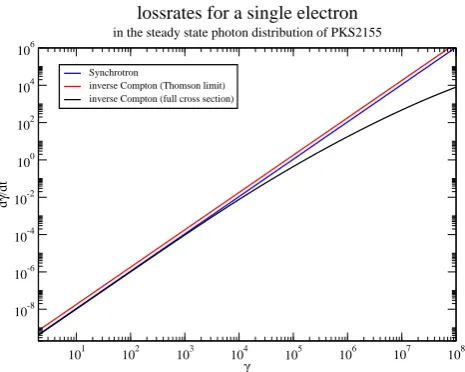
nu-merical treatment of the kinetic equations inevitable leading to a time resolved model. The loss rates for the electron dis-tribution of PKS 2155 in the steady state are shown in Fig. 1, which indicates that in our case the inverse Compton losses
101 102 103 104 105 106 107 108 γ
10-8 10-6 10-4 10-2 100 102 104 106
d
γ
/dt
Synchrotron
inverse Compton (Thomson limit) inverse Compton (full cross section)
lossrates for a single electron
in the steady state photon distribution of PKS2155
Fig. 1. Lossrates due to the inverse Compton effect for an electron
of Lorentzfactorγin the model photon field of PKS 2155 (Thomp-son limit, red and used Klein-Nishina treatment, black) compared to the synchrotron losses, blue. Other losses like adiabatic cooling, pair production are irrelevant at typical SSC configurations.
would be slightly overestimated in the often used Thomson limit for all Lorentzfactorsγ because of the dependency on the photon field Pthom∝RdννNphγ2 and its special shape due to the modified injection atγ0=910. This would not be the case for low energetic injected electrons and the resulting powerlaw-like photon distribution. For high Lorentzfactors
γ however the deviation of the Thompson limit for the in-verse Compton scattering to the real Klein-Nishina treatment becomes more significant in each case. Again electrons es-caping the blob are taken into account viatesc,rad=ηRrad/c with the empirical factor η set to η=10. Both electronic PDEs are connected via the catastrophic particle loss/gain-term. The factor(Racc/Rrad)3ensures particle conservation.
To determine the time-dependent spectral energy distribu-tion of blazars we solve the differential equadistribu-tion for the dif-ferential photon number density, obtained from the radiative transfer equation, including the corresponding terms with re-spect to the SSC model,
∂Nph(ν,t )
∂t =Rs−cανNph(ν,t )+Rc−
Nph(ν,t )
tph,esc
. (9)
To describe the synchrotron photon production rateRs in a
convenient way we use the well known Melrose approxima-tion (see e.g., Pohl, 2002)
Rs=1.8
√ 3e3B⊥
hνmc2
Z
dγ Ne(γ ,t )
ν
νc(γ )
13
e− ν
νc (γ ) . (10)
with the characteristic frequency Eq. (11) for an electron with a Lorentz factor ofγ.
νc(γ )=
3γ2eB⊥
In optically thick regimes the emitted synchrotron radiation is absorbed by the emitting electrons itself. This is described by the synchrotron self absorption coefficient,
αν=
1 12
c
ν2eBPν(γc)
Ne(γ0,t )
γ02 . (12)
(withγc=f (νc)−1). Here we made use of the
monochro-matic approximation (e.g., Felten and Morrison, 1966) for the synchrotron power:
Pν(ν,γ )=
√ 3e2B⊥
mc2
ν νcγ
Z ∞
0
dν0K5 3(ν
0
) (13)
In SSC models the second hump in the SED of a blazar is due to inverse Compton scattered photons by the syn-chrotron radiation emitting electrons themselves. Here the full Klein-Nishina cross section from Blumenthal and Gould (1970) is used to calculate the inverse Compton photon pro-duction rate.
Rc=
Z
dγ Ne(γ )
×
Z
dα1
Nph(α1)
dN (γ ,α1)
dt dα −Nph(α)
dN (γ ,α) dt dα1
(14) To fully exploit the Klein-Nishina cross section, Eq. (14), we used the approximate inverse Compton spectrum of a single electron scattering off a unit density photon field (e.g., Jones, 1968; Jauch and Rohrlich, 1976):
dN (γ ,α1)
dt dα =
2π r02c α1γ2
2qlnq+(1+2q)(1−q)
+1 2
(4α1γ q)2
(1+4α1γ q)
(1−q)
, (15)
with the electron’s Lorentz radius r0=e2/(mc2), the scattering parameter q=α/(4α1γ2(1 − α/γ )) and 0≈1/(4γ2)<q≤1. Due to momentum and energy conser-vation this equation is valid forα1<α≤4α1γ2/(1+4α1γ ).
The last catastrophic term in Eq. (9) describes photons es-caping from the emitting region, where
tph, esc= 3Rrad
4c , (16)
is the approximate escape time, withRrad the radius of the emitting blob. The escape time is chosen to be the light cross-ing time of the photons.
The photon lossrate due to the pair production of elec-trons and posielec-trons is not taken into account for two rea-sons. Firstly it is insignificant compared to the dominating synchrotron and inverse Compton processes. This is a con-sequence of the relatively low density (B¨ottcher and Chiang, 2002). Secondly it would violate the selfconsistency of our model for positrons are not treated, hence violating energy conservation.
To compute the SEDs in our model we must shift the frame of reference from the blob to the observer. For a sphere of radiusRthe observed flux at distanceris
Fνobs(r)=π IνobsR
2
r2 . (17)
With the Lorentz boosted intensityIνobs=δ3Iνblob due to the bulk motion with a doppler factor δ of the blob and the Lorentz transformed, red shifted frequencyνobs=δ/(1+z)ν. WhereIνblobis calculated from the photon unit density
Iνblob=hνc
4πNph(ν) (18)
for homogenous spheres.
3 Numerics
In our model we numerically solve the kinetic equations for-ward in time in order to obtain a model SED. The down-stream motion of the electrons induces the sequence of solv-ing the acceleration zone’s equation before the kinetic equa-tion of the radiaequa-tion zone in each time step. The simple Euler scheme was found adequate to do the time integration.
In the acceleration zone we had to combine the Crank-Nicholson scheme (Press, 2002) with Godunov’s method to provide both correct treatment of the characteristics and sta-bility for the derivation inγ. In the radiation zone the charac-teristic flows, due to the absence of acceleration, only in one direction making the Crank-Nicholson scheme sufficient.
With our carefully tested code it is possible to calculate the dynamics of SEDs in a range of 20 orders of magni-tude. The implemented code complies particle conservation in each zone alone and both together as well as the conser-vation of the total energy (i.e. of the electrons and the pho-tons) over typical simulation times with a maximum error of O(5%). For negligible stochastic acceleration, i.e.a→ ∞, and without a radiation field, i.e. no inverse Compton losses, the steady state solution for the kinetic equation yields
ne,steady(γ )=C 1
γ2
1
γ −βstacc
tacc−tesc
tesc
101 102 103 104 105 106 γ
10-10 10-8 10-6 10-4 10-2 100 102 104
ne
(
γ
) / cm
-3
injection function, Q0
time evolution steady state electron density
acceleration zone
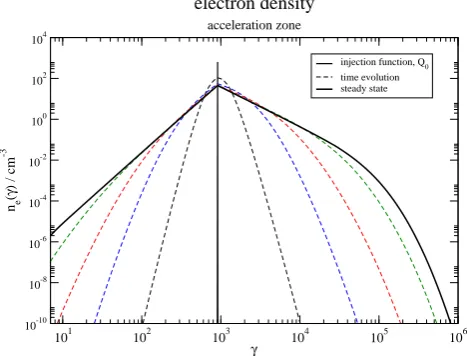
Fig. 2. Steady state electron distribution and its time development in
the acceleration zone modelling the SED of PKS 2155-30.4 shown in Fig. 3 as arising from the injection function Q0. The corre-sponding intrinsic times are t=1000 s (dashed black), t=5000 s (dashed blue),t=1·104s (dashed red),t=2·104s (dashed green). The steady state with its rising and falling powerlaw and the expo-nential cutoff atγ≈105is reached at aboutt=105s.
confirmed against the approximate analytical results (low en-ergetic Thompson regime and extreme Klein-Nishina limit) before implementing. Concerning the photon distributions we validated the expected spectral indices in the steady state solution for the different frequency regimes, which together with the energy conservation between electrons and photons approves the integrity of the model.
A detailed description of the used numeric techniques as well as the implemented model also in context with the vari-ability of the sources will be given in a paper yet to be pub-lished.
4 Results
The recent Fermi data give new constraints on the gamma-ray peak of the HBL PKS 2155-30.4 concerning its curva-ture. This is leading to a deep dip between the optical/X-ray and the gamma-ray peak. We are able to model the SED of PKS 2155-30.4 with our model by setting
γ0=910 (19)
for the monoenergetic injection into the acceleration zone. This is rather unusual but required to model the SED of PKS 2155. Such moderate but not small Lorentz factors can be explained e.g. by two counterstreaming plasmas. If the upstream electrons would be at rest, the bulk doppler fac-tor ofδ=116 would automatically lead toγ0=0≈58. As-suming speculatively that the upstream electrons moving in the opposite direction of the blob with a mean velocity of
Table 1. Chosen parameters for the model SED shown in Fig. 4
to fit the data (H. E. S. S. and Fermi-LAT collaborations, 2009) of PKS 2155-30.4.
Q0(cm−3) B(G) Racc(cm) Rrad(cm) tacc/tesc a 0
5.25·104 0.29 3·1013 6.3·1014 1.55 1 58
vu hence a upstream Lorentz-Factorγu theγ0 factor in the blob’s rest frame must be calculated according to the rela-tivistic superposition:
γ0=
v u u t1−
√
02−10+p
γ2
u−1γu
02+γ2
u−1
!2
−1
(20)
Solving Eq. (20) for our setup we findγu≈8 for the upsteam
electrons which are streaming towards the blob. The numer-ically solved steady state electron density in the acceleration zone is shown in Fig. 2. We also show the time develop-ment for a “switched on” injection, i.e.ne(γ )|t <0=0∀γ and
Q=Q0δ(γ−γ0)ϑ (t ), until the steady state is reached. In Fig. 2 it can clearly be seen tvhat accelerating electrons using Fermi-I and Fermi-II processes leads to powerlaw elec-tron distributions with an exponential cut-off often used as the ad-hoc injection function in onezone-SSC models (Chi-ang and B¨ottcher, 2002) (right side ofγ0in Fig. 2), thus ex-plaining them using the diffusion theory derived from plasma physics. By injecting electrons with Eq. (19) and significant stochastic acceleration (i.e.a=O(1)) we are also able to pro-duce rising electron spectra before decreasing in a power-law and an exponential cut-off, like introduced in B¨ottcher and Chiang (2002) (left side ofγ0 in Fig. 2). The Fermi-II processes are responsible for the rising power-law and ex-ponential cut-off, whereas the ratio of tacc/tesc determines the spectral index of the power-law atγ > γ0. It can clearly be seen from Fig. 2 that the convergence against the steady state solution for the electron density begins relatively rapid while slowing down eventually. The simulation time when the steady state is reached corresponds to the escape time of the electrons in the acceleration zone. When concerning variability and time resolved lightcurves of blazars this is an advantage of the twozone model because the rising part in such lightcurves corresponds partially to the escape time of the acceleration zone (while the falling part is connected to the response time of the system,trad,esc).
1014 1016 1018 1020 1022 1024 1026 1028 ν / Hz
10-19 10-18 10-17 10-16 10-15 10-14 10-13 10-12 10-11 10-10
ν
F(
ν
) / erg cm
-2 s
-1
time evolution (model)
PKS2155 spectral energy distribution
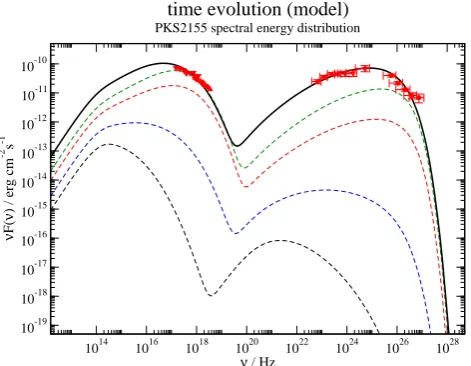
Fig. 3. Time evolution due to the switched on injection
func-tion until the steady state of the SED of PKS2155 is reached (see also Fig. 4). The intrinsic times aret=1·104s (dashed black), t=2·104s (dashed blue), t=5·104s (dashed red), t=1·105s (dashed green), the complete steady state is reached at about t=2·106s, which correlates to the response time of the system due totesc,rad.
not to be taken into account for the SSC modelling. The cur-vature and deep dip in the model SED is a direct consequence of the rising part in the electron density of the acceleration zone. Thus it can be modeled by varying the ratioaof shock to stochastic acceleration. All the parameters in Table 1 are consistent with the limits given via other observations and statistics, e.g. determination of0using superluminal motion of Quasar jets.
The recent Fermi, H.E.S.S. and ATOM data (H. E. S. S. and Fermi-LAT collaborations, 2009) have been averaged over a period of 14 days and show a lowstate of the HBL PKS 2155-30.4. This is confirmed by the Aharonian et al. (2005) data of H.E.S.S. a few years ago which show the same flux level as the recent data. We used the EBL studies described in Primack et al. (2005) to do the EBL deabsorption for the H.E.S.S. datapoints, a correction of the Fermi data is not nec-essary.
The time development of the SED due to a switched on injection of electrons into the acceleration zone at timet0=0 is shown in Fig. 3. It can clearly be seen that the final state of the model SSC correlates with the response time of the radiation zonetesc,radand that the convergence again begins fast and slows down rapidly at higher simulation times.
5 Conclusions
Our model is able to explain the injection function of many onezone-SSC models as shock and stochastic acceleration of electrons upstream the jet entering the blob while
continu-1014 1016 1018 1020 1022 1024 1026 1028
ν / Hz
10-13 10-12 10-11 10-10
ν
F(
ν
) / erg cm
-2 s
-1
ATOM observation 25.08.-06.09.08 SWIFT observation 25.08.-06.09.08 RXTE observation 25.08.-06.09.08 Fermi observation 25.08.-06.09.08 our SSC fit
thermal contribution
PKS2155 spectral energy distribution 2008 multiwavelength observations and our SSC-Model
Fig. 4. Lowstate of PKS 2155-30.4 with the simultaneous
data of ATOM, SWIFT, RXTE, Fermi and H.E.S.S of the Au-gust/September 2008 campaign from H. E. S. S. and Fermi-LAT collaborations (2009) (red triangles and circles). The 2003 H.E.S.S. data (blue circles) is also shown, proofing the lowstate of PKS2155-30.4. The VHE data have been deabsorbed using Primack et al. (2005). The dashed black curve shows a thermal fit for the con-tribution of the host-galaxy. Our model SSC fit, arising from the steady state electron distribution in the radiation zone is shown in the solid black curve, a moderate energy injection atγ0≈910 into the acceleration zone together with stochastic and systematic accel-eration is needed to meet the curvature of the VHE peak given via the Fermi data.
ously suffering synchrotron losses. By introducing Fermi-II acceleration we get rid of the sharp cut-off introduced in Kar-dashev (1962) or Kirk et al. (1998) which probably does not occur in physical sources. Additionally we are able to model relatively complex electron densities with increasing and de-creasing parts through the stochastic acceleration of elec-trons, only by varying the monoenergetic injection to higher
γ0. In contrast to the ad-hoc injection of some onezone-SSC models such Lorentz factors have a physically reasonable, but highly speculative, explanation as upstream previously accelerated but already partially cooled electrons. These electrons are averagely moving in the opposite direction of the blob with a mean Lorentz factor ofγu≈8 resulting,
to-gether with the motion of the blob, inγ0≈900 for the mo-noenergetic injection function used in the acceleration zone of our model.
many SSC models, which are not able to produce such elec-tron spectra.
With our model we are able to form the curvature of the gamma-ray peak and the dip by varying the influence of the Fermi-II processes. The shape and position of the syn-chrotron peak in the model SED is dominated by tacc and
Racc,Rradas well asB. For the parameters concerning the ac-celeration arise from plasmaphysics considerations we gain insight into the jets microphysics while modelling observed SEDs. We have also shown that in such environments the Thomson approximation for the inverse Compton effect can not always be applied, especially when considering time res-olution and hence non equilibria of the energy distribution in the blob.
Here we only introduced steady state solutions of our model, but due to the spatially relatively small acceleration region, which is at least an oder of magnitude smaller than the emitting region, this twozone-SSC model is able to self-consistently model the rising part in the lightcurves of flar-ing blazars which are connected to the behavior in the ac-celeration zone, especially the energy transport from low to high energies. This, together with the consequences of the model geometry on the observable SEDs and lightcurves of blazars like in Sokolov et al. (2004), will be subject of a fol-lowing paper.
Acknowledgements. M. Weidinger acknowledges support from
the Deutsche Forschungsgemeinschaft through Graduiertenkolleg 1147, M. R¨uger acknowledges support from the Elitenetzwerk Bayern.
F. Spanier acknowledges support from the Deutsche Forschungsge-meinschaft through grant SP 1124/1
Edited by: H. Fichtner
Reviewed by: three anonymous referees
References
Aharonian et al.: Multi-wavelength observations of PKS 2155-304 with HESS, 442, 895–907, doi:10.1051/0004-6361:20053353, 2005.
Bednarz, J. and Ostrowski, M.: The acceleration time-scale for first-order Fermi acceleration in relativistic shock waves, 283, 447– 456, 1996.
Blumenthal, G. R. and Gould, R. J.: Bremsstrahlung, Synchrotron Radiation, and Compton Scattering of High-Energy Electrons Traversing Dilute Gases, Reviews of Modern Physics, 42, 237– 271, doi:10.1103/RevModPhys.42.237, 1970.
B¨ottcher, M. and Chiang, J.: X-Ray Spectral Variability Signatures of Flares in BL Lacertae Objects, Astrophys. J., 581, 127–142, doi:10.1086/344155, 2002.
Chiang, J. and B¨ottcher, M.: Synchrotron and Synchrotron Self-Compton Spectral Signatures and Blazar Emission Models, As-trophys. J., 564, 92–96, doi:10.1086/324294, 2002.
Ellison, D. C., Reynolds, S. P., and Jones, F. C.: First-order Fermi particle acceleration by relativistic shocks, Astrophys. J., 360, 702–714, doi:10.1086/169156, 1990.
Felten, J. E. and Morrison, P.: Omnidirectional Inverse Compton and Synchrotron Radiation from Cosmic Distributions of Fast Electrons and Thermal Photons, Astrophys. J., 146, 686–708, 1966.
Ginzburg, V. L. and Syrovatskii, S. I.: Developments in the Theory of Synchrotron Radiation and its Reabsorption, Ann. Rev. As-tron. Astrophys., 7, 375–+, doi:10.1146/annurev.aa.07.090169. 002111, 1969.
H. E. S. S. and Fermi-LAT collaborations: Simultaneous observa-tions of PKS 2155-304 with H.E.S.S., Fermi, RXTE and ATOM: spectral energy distributions and variability in a low state, ArXiv e-prints, 2009.
Jauch, J. M. and Rohrlich, F.: The theory of photons and elec-trons. The relativistic quantum field theory of charged particles with spin one-half, Texts and Monographs in Physics, New York: Springer, 1976, 2nd ed., 1976.
Jones, F. C.: Calculated Spectrum of Inverse-Compton-Scattered Photons, Physical Review, 167, 1159–1169, doi:10.1103/ PhysRev.167.1159, 1968.
Kardashev, N. S.: Nonstationariness of spectra of young sources of nonthermal radio emission, Soviet Astronomy - AJ, 39, 393–409, 1962.
Kataoka, J., Takahashi, T., Makino, F., Inoue, S., Madejski, G. M., Tashiro, M., Urry, C. M., and Kubo, H.: Variability Pattern and the Spectral Evolution of the BL Lacertae Object PKS 2155-304, Astrophys. J., 528, 243–253, doi:10.1086/308154, 2000. Katarzy´nski, K., Ghisellini, G., Mastichiadis, A., Tavecchio, F., and
Maraschi, L.: Stochastic particle acceleration and synchrotron self-Compton radiation in TeV blazars, 453, 47–56, doi:10.1051/ 0004-6361:20054176, 2006.
Kirk, J. G., Rieger, F. M., and Mastichiadis, A.: Particle accelera-tion and synchrotron emission in blazar jets, 333, 452–458, 1998. Mannheim, K.: The proton blazar, 269, 67–76, 1993.
Pohl, M.: Einfuehrung in die Hochenergieastrophysik, Shaker Ver-lag, Aachen, 2002.
Press, W. H.: Numerical recipes in C++ : the art of scientific com-puting, Numerical recipes in C++ : the art of scientific comput-ing by William H. Press. xxviii, 1,002 p. : ill. ; 26 cm. Includes bibliographical references and index. ISBN : 0521750334, 2002. Primack, J. R., Bullock, J. S., and Somerville, R. S.: Observational Gamma-ray Cosmology, in: High Energy Gamma-Ray Astron-omy, edited by F. A. Aharonian, H. J. V¨olk, and D. Horns, vol. 745 of American Institute of Physics Conference Series, 23–33, doi:10.1063/1.1878394, 2005.
Schlickeiser, R.: An explanation of abrupt cutoffs in the optical-infrared spectra of non-thermal sources. A new pile-up mecha-nism for relativistic electron spectra, 136, 227–236, 1984. Schlickeiser, R.: Cosmic ray astrophysics, Astronomy and
Astro-physics Library; Physics and Astronomy Online Library. Berlin: Springer. ISBN 3-540-66465-3, 2002, XV + 519 pp., 2002. Sokolov, A., Marscher, A. P., and McHardy, I. M.: Synchrotron