Proposed Methodology for Securing Wireless
LANs from Wormhole Attack
A.K. Patel
C.U.Shah College of Master of Computer Application, Wadhwan City, Gujarat. India Email: [email protected]
Jaypalsinh. A. Gohil
C.U.Shah College of Master of Computer Application, Wadhwan City, Gujarat. India Email: [email protected]
D.T. Meva
C.U.Shah College of Master of Computer Application, Wadhwan City, Gujarat. India Email: [email protected]
---ABSTRACT--- Wormhole attacks enable an attacker with limited Resources and no cryptographic material to wreak havoc on wireless networks. Initial research focused that this attack is possible only on Adhoc networks, but in present condition wormhole attack is possible on infrastructure based wireless LANs also. We propose architecture and analyze the possibility of wormhole attack along with a countermeasure to avoid such an attack. The proposed mechanism involves the shared information between communicating Access Points to prevent Rouge Access Points from masquerading as false neighbours. Our defense greatly diminishes the threat of wormhole attacks and requires no location information or clock synchronization.
Keywords : Access Point (AP), GPS, Rouge Access Point (RAP), SSID, Wormhole Attack, Wireless Network.
--- Date of Submission: 12, January 2010 Date of Acceptance: 08, April 2010
---
1. INTRODUCTION
W
ireless networks are promising platforms for a variety of application areas in both military and civilian domains. These networks are especially attractive for scenarios where it is infeasible or expensive to deploy significant networking infrastructure. However, the open nature of the wireless communication channels, the lack of infrastructure, the fast deployment practices, and the hostile environments where they may be deployed, make them vulnerable to a wide range of security attacks. These attacks could involve eavesdropping, message tampering, or identity spoofing, which have been addressed by customized cryptographic primitives in the wired domain. Routing in wireless networks is an especially hard task to accomplish securely, robustly and efficiently. Many proposed routing protocols are focused on energy, and provide no protection against an adversary. Some secure routing protocols also have been proposed. However, due to the unpredictability of wireless networks, it is hard to detect behaviour anomalies in route discovery. In particular, proposed routing protocols cannot prevent [1] wormhole attacks. Initially all proposed protocol to prevent wormhole attack focused on Ad-hoc network only, but in present scenario wormhole attack is possible in Infrastructure mode also by using two rouge access point and high quality, low-latency link. A Rogue Access Point is a Wi-Fi Access Point which is setup by an attacker for the purpose of sniffing wireless network traffic. In a possible wormhole attack for infrastructure mode, anattacker introduces two Rouge access point into a wireless back-haul network and connects them with a high quality, low-latency link. Routing messages received by one wormhole endpoint are retransmitted at the other End point. Attackers can exploit wormholes to build bogus route information, selectively drop packets, and create routing loops to waste the energy of network. We propose a hybrid architecture and possible severe security attack, called the wormhole attack, in the context of proposed architecture.
The rest of the paper is organized as follows: Section II describes Worm-hole attacks, Section III focuses on the related work, Section IV describes the proposed Methodology, Section V addresses Detection strategy and the algorithm for securing the network against wormhole attacks and the final section concludes the paper.
2. WORMHOLEATTACKS
near Y, packets transmitted near X travelling through the wormhole will arrive at Y before packets travelling through multiple hops in the network. The attacker can make A and B believe they are neighbours by forwarding routing messages, and then selectively drop data messages to disrupt communications between A and B.
Fig. 1 wormhole attack.
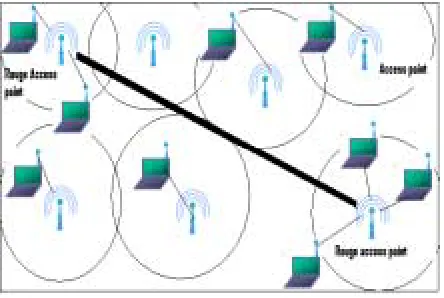
Fig. 2 shows a typical scenario of a possible worm hole attack in the Infrastructure WLANs. A Rouge Access point captures packets from one location in the network, and ‘‘tunnels’’ them to another at a distant point, which replays them locally. [2, 3, 4] The tunnel can be established in many different ways, e.g., through an out- of band hidden channel (e.g., a wired link), packet encapsulation, or high powered transmission. This makes the tunnelled packet arrive either sooner or with a lesser number of hops compared to the packets transmitted over normal multi-hop routes. This creates the illusion that the two end points of the tunnel are very close to each other.
Fig. 2 worm hole attack in infrastructure mode wlans
The adversary controls Rouge access points X and Y and connects them through a low-latency link. Finally, it is worth noting that the wormhole attack can be launched even without having access to any cryptographic keys or compromising any legitimate node in the network.
3. RELATEDWORK
A lot of research has been done in exploring wormhole attacks and a variety of counter measures to overcome the same has been proposed. The wormhole attack in wireless networks was independently introduced by Dahill [5],
Papadimitratos [6], and Hu [7]. Initial proposals to thwart wormhole attacks suggest using secure modulation of bits over the wireless channel that can be demodulated only by authorized nodes. This only defends against outside attackers who do not possess cryptographic keys. A similar approach called RF watermarking [8] modulates the radio waveform in a specific pattern and any change to the pattern is used as the trigger for detection. This mechanism will fail to prevent a wormhole if the waveform is accurately captured at the receiving end of the wormhole and exactly replicated at the transmitting end.
Y.C. Hu[7] introduced the concept of geographical and temporal packet leashes for detecting wormholes. They define a leash to be any added information to the packet for the purpose of defending against the wormhole. The geographical leash sensor confirms that the recipient of the packet is within a certain distance from the sender. They require each node to know its own location and require all the nodes to have loosely synchronized clocks. The temporal leashes ensure that the packet has an upper bound on its lifetime, which restricts the maximum travel Distance. They require that all nodes have tightly synchronized clocks. An implicit assumption is that packet processing, sending, and receiving delays are negligible. Both geographical and temporal leashes need to add authentication data to each packet to protect the leash, which add processing and communication overhead. In addition, a large amount of storage is needed at each node since a hash tree based authentication scheme (Merkle hash trees) is used.
Capkun[9] presented SECTOR, a set of mechanisms for the secure verification of the time of encounters between nodes in multi-hop wireless networks. They show how to detect wormhole attacks without requiring any clock synchronization through the use of MAD (Mutual Authentication with Distance- Bounding). Each node u estimates the distance to another node v by sending it a one bit challenge, which node v responds to instantaneously. Using the time of flight, node u detects if node v is a neighbour or not. The approach uses special hardware for the challenge request- response and accurate time measurements. Neither of the above two techniques nullifies the capacity of the compromised nodes from launching attacks in the future. Hu and Evans [10] used directional antennas [11, 12] to prevent wormhole attacks. To thwart the wormhole, each node shares a secret key with every other node and maintains an updated list of its neighbours. Neighbour lists are built in a secure manner by using the direction in which a signal is heard from a neighbour with the assumption that the antennas on all the nodes are aligned.
legitimate neighbours in their conservative approach to prevent wormholes from materializing.
Till now there is no concrete research which addresses the possibility of a worm hole attack in Infrastructure WLANs. As a core we would like to expose this fact that there is a possibility of a wormhole attack in Infrastructure WLANs. This type of attack uses a set of rouge access points and a base channel of low latency to achieve this attack. There are some tools/software to identify a rouge access points. The two most popular tools of choice are Nets tumbler and Kismet. These tools work by attempting to identify the wireless networks within range, and can be used to detect the presence of an access point which is unauthorized. The fundamental difference between the two is the manner in which they work; Nets tumbler is an active sniffer whereas Kismet is a passive sniffer.
Nets tumbler: Nets tumbler is a piece of software that works on the Windows platform. It works by sending an 802.11 Probe request to a broadcast address, upon receiving this packet all access points within the signal issue a probe response containing their network configuration information that includes their SSID and whether WEP is enabled or not. Furthermore, it can also be integrated with a GPS unit that allows the position of discovered access points to put onto a map for easier consumption.
Kismet: Kismet is a passive sniffer with the ability of detecting 802.11 packets for the presence of a WLAN. It identifies networks by collecting packets and identifying their name. It is also capable of detecting hidden networks unlike Nets tumbler. The use of Kismet, however, may be deemed as illegal unless prior authorization has been provided from owners of the access points, whose traffic is being captured. Although, if the scan is in an area where multiple access points are owned by numerous entities then getting authorization may not be feasible.
Identifying a rouge access point is a little difficult one, because if there are multiple rouge access points the tool may fail to identify some of them. As of now identifying a wormhole in Infrastructure WLANs is still under cover. We explore this and propose a methodology which can not only identify a rouge access point but also prevent Infrastructure LANs from wormhole attacks.
4. PROPOSEDMETHODOLOGY
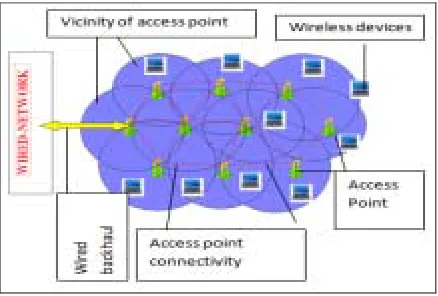
For the purpose of explaining our methodology we take an example of a WLAN as in Fig. 3 to achieve a real Wireless network we need to provide a wireless backhaul between the access points. In our architecture we have one access point connected to the corporate network (i.e) the wired network using a wired backhaul, the access points that cover the entire area are installed in such a way that they have a wireless backhaul and are wirelessly connected to the nearby access points.
Fig. 3 sample architecture
We also assume that the wireless devices that are a part of our WLAN can roam across the network and have a single sign on or one point authentication. Our proposed work involves two modules, namely: 1. Neighbors Discovery, 2. Link verification these two process work simultaneously to detect and prevent wormhole in our architecture.
4.1 SYSTEM ASSUMPTION
We assume that the communication links are bidirectional which means that if a node A can hear node B then B can hear A. We assume that a finite amount of time is required from a node’s deployment for it to be compromised. We further assume that no external or internal Rouge Access points exist before the completion of the first- and second-hop neighbour discovery. External RAP is AP that is added to network by an attackers for purpose of creating wormhole and the internal RAP are existing AP in the network which are used for creating wormhole. Route changes due to Access point failures is not permitted that is network is completely functional and all the access points are operational.
4.2 NEIGHBOURS DISCOVERY
AP that is not a Neighbour. Also, second-hop neighbour information is used to determine if a forwarded packet comes from a neighbour of the forwarder. If a node C receives a packet forwarded by B purporting to come from A in the previous hop, C discards the packet if A is not a second-hop neighbour. Finally, A activates local monitoring immediately after building its first and second-hop neighbour lists.
4.3 LINK VERIFICATION
This module detects the wormhole attack and diagnoses the malicious AP involved in launching it. Link verification starts immediately after the completion of neighbor discovery. It uses a collaborative detection strategy, where an AP monitors the traffic going in and out of its neighbors. For an AP, say V, to be able to monitor an AP say, M, V must be a neighbor of both M and the previous hop from M, say B. If this is satisfied, we call V the Verifier AP of M over the link from B to M. This implies that V is the Verifier AP for its entire outgoing links. For example, in Figure 4, Access points M, N, and X are the Verifier AP of A over the link from X to A. Information for each packet sent from X to A is saved in a watch buffer at each Verifier AP. The information includes the packet identification and type, the packet source, the packet destination, the packet’s immediate sender (X), and the packet’s immediate receiver (A). The verifiers expect that A will forward the packet toward the ultimate destination, unless A is itself the destination. Each entry in the watch buffer is time stamped with a time threshold, s, by which A must forward the packet. Each packet forwarded by A with X as a previous hop is checked for the corresponding information in the watch buffer.
Fig. 4 X, M, and N are Verifiers of A over the link from X to A
5. DETECTIONSTRATEGY
(1) Each AP has an RA (Responder of Access point) list of its Own and of its neighbors, If Any External AP pretends itself to be false Neighbor, it will be easily identified. (2) If Attack is on Internal AP, it can be checked in manner that- A malicious Log (Mal L(I,J)) is maintained at each Verifier AP, I, for a node, J, at the receiving end of each link that I is monitoring , For any malicious activity of J that is detected by I. The Log (Mal L) is created and forwarded to all the Neighbors of J and all link of J is dropped leading to prevention of desired attack.
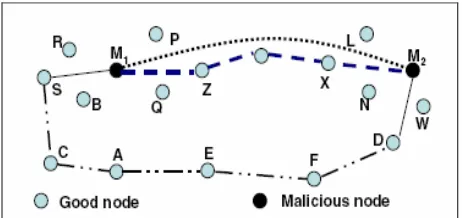
Fig. 5 malicious activity by M1 and M2
For example in Fig.5, the malicious Log (Mal L) of M1 and M2 are maintained by [P, Q, Z] and [L, X, N] over a link Z-M1 and X-M2 respectively. If Z-M1 claims that it had receive packets from M2, the verifier AP of M1 will look in its watch buffer and detects the malicious activity of M1 and they will declare the M1 to Malicious AP and will send alert message to all neighbors of M1.
5.1 ALGORITHM
1. Broadcast a HELLO to all the neighbors 2. V responses
Initialize RA
3. Broadcast RA to all neighbors and request for their RA’s
4. V responses
Store RA of Neighbors 5. Initialize Watch buffer 6. Set (Mal L) =0
7. If (Communication Request (CR) arrives from any Access Point (ID))
If (Check ID in RA) Allow communication goto step 7
Else
Discard communication goto step 8
/* Verification*/
8. If (accept packets from neighbor access point) If ((Source and destination of coming packet) Є
Stored RA of Neighbors) Link verification
If (AP lies within vicinity of two or more Access Point)
Store in watch buffer V links If (Mal L(I,J) Є Link from I to J)
Set (Mal L) =0
If (any malicious activity found) Increment (Mal L) by 1
Broadcast Alert Message to all Neighbor
Go to step 5 9. End
5.2 BENEFITS
Our proposed mechanism requires no
not require extra devices. This mechanism also does not require any software tool for detecting rouge access point.
6. CONCLUSIONANDFUTUREWORK
Wormhole attacks are a powerful attack that can be conducted without requiring any cryptographic breaks. An attacker who conducts a successful wormhole attack is in a position to disrupt routing, deny service to large segments of a network. In this paper, we have presented taxonomy for possible worm hole attack using a Infrastructure based wireless Architecture. We have presented a mechanism that incorporates a detection strategy. The fundamental mechanism used is Neighbour Discovery and Link Verification that monitors traffic in and out of its neighbouring AP and uses a data structure of first and second-hop neighbours. Our mechanism reduces the threat of wormhole attacks and requires no clock synchronization and location information. In future we will try to overcome some more sophisticated wormholes using Mobile agents.
REFERENCES
[1]. Using Directional Antennas to Prevent Wormhole
Attacks,Lingxuan Hu David Evans Department of
Computer Science University of Virginia Charlottesville, VA
[2]. C. Karlof, D. Wagner, Secure routing in sensor
networks:attacks and countermeasures, (First IEEE
International Workshop on Sensor Network Protocols and Applications,2003).
[3]. Y.C. Hu, A. Perrig, D.B. Johnson, Packet leashes: a defence against wormhole attacks in wireless
networks, (Proceedings of the 22nd INFOCOM, 2003,
pp. 1976–1986).
[4]. L. Hu, D. Evans, Using directional antennas to
prevent wormhole attacks, (Proceedings of Network
and Distributed System Security Symposium, 2004). [5]. B. Dahill, B. N. Levine, E. Royer, and C. Shields,
“A secure routing protocol for ad-hoc networks”
(Electrical Engineering and Computer Science, University of Michigan, Tech. Rep. UM-CS-2001-037, August 2001).
[6]. P. Papadimitratos and Z. Haas, “Secure routing for
mobile ad hoc network,” (SCS Communication
Networks and Distributed Systems Modeling and Simulation Conference (CNDS 2002), January 2002). [7]. Y. C. Hu, A. Perrig, and D.B. Johnson, “Packet
leashes: a defence against wormhole attacks in
wireless network,” (Proceedings of the 22nd Annual
Joint Conference of the IEEE Computer and Communications Societies (INFOCOM), pp. 1976-1986, 2003).
[8]. Defence Advanced Research Projects Agency.
Frequently Asked Questions v4 for BAA 01-01, FCS
Communications Technology. Washington, DC.
[9]. S. Capkun, L. Buttya´n, J.-P. Hubaux, SECTOR:
secure tracking of node encounters in multihop
wireless networks (Proceedings of the First ACM
Workshop on Security of Ad hoc and Sensor Networks
(SASN 03), 2003, pp. 21–32).
[10]. L. Hu, D. Evans, Using directional antennas to
prevent wormhole attacks (Proceedings of Network
and Distributed System Security Symposium, 2004). [11].Y. Ko, V. Shankarkumar, N. Vaidya, Medium
access control protocols using directional antennas in
ad hoc network, (Proceedings of the 19th Annual
Joint Conference of the IEEE Computer and Communications Societies (INFOCOM), 2000, pp. 13–21).
[12]. R. Choudhury, X. Yang, R. Ramanathan, N. Vaidya,
Using directional antennas for medium access control
in ad hoc networks (the 8th ACM International
Conference on Mobile Computing and Networking (MobiCOM), 2002).
[13]. Helion Technology Ltd. High Performance Solutions
in Silicon—MD5 Core. Cambridge, England.
Available at http://www.heliontech.com/core5.htm. [14].Lingxuan Hu and David Evans. Using Directional
Antennas to Prevent Wormhole Attacks. (Proceedings
of the 2004 Symposium on Network and Distributed Systems Security (NDSS 2004), February 2004). [15]. Jean-Pierre Hubaux, Levente Buttya´n, and Srdjan Cÿ
apkun. The Quest for Security in Mobile Ad Hoc
Networks (Proceedings of the 2001 ACM Symposium
on Mobile Ad Hoc Networking and Computing (MobiHoc 2001), pages 146–155, October 2001). [16].David B. Johnson and David A. Maltz. Dynamic
Source Routing in Ad Hoc Wireless Networks.
(Mobile Computing, edited by Tomasz Imielinski and Hank Korth, chapter 5, pages 153–181. Kluwer Academic Publishers, 1996).
Authors Biography
Amit. K. Patel (B.Com, MCA) is working as a Lecturer at C. U. Shah College of MCA, Wadhwan City (Gujarat). He is in the field of teaching since last 4 years. His area of interest are Web Technologies, Network security, Wireless Networking, Computer Architecture Operating System and DW & DM.
Jaypalsinh. A. Gohil (B.Com, MCA) is working as a Lecturer at C. U. Shah College of MCA, Wadhwan City (Gujarat). He is in the field of teaching since last 5 years. His areas of interest are DBMS, System Analysis & Design, Wireless Networking, RDBMS, RFID, Computer Graphics and Data Warehousing & Data Mining.