Original Research Article
Dental caries and its association with present day dietary patterns:
a cross-sectional study
Vaibhav Munjal
1, Puneet Singh Talwar
2, Jagjit Singh
3, Mandeep Kumar
4,
Ramandeep Singh Gambhir
5*
INTRODUCTION
Oral health is an integral part of general health and well-being.1 Dental caries, one of the most prevalent diseases afflicting the human beings, poses a major public health problem all over the world over due to its universal prevalence and insidious nature.2 It is a transmissible, complex biofilm disease that creates prolonged periods of low pH in the mouth, which results in net mineral loss from the teeth.3
Information on the epidemiological figures of dental caries of a population at a given point of time is a fundamental requirement which updates our knowledge on the changing trends of the disease, its treatment needs and helps in understanding the ways and means to prevent its onset, limit its progression and consequences.4 A number of epidemiological studies conducted throughout the world have shown that dental caries is universally distributed, however its severity varies within and between the populations.4,5
ABSTRACT
Background: Dental caries is a multifactorial disease with diet being one of the contributing factors. The influence of vegetarianism on the development of caries has scarcely been investigated in the past. Therefore, this study was done to evaluate the association of dental caries with frequency of sugar exposures and vegetarian / mixed diet.
Methods: The present cross-sectional study was conducted among 2500 school children of 12 and 15 years age groups selected on the basis of simple random sampling from different schools of the city. Dental caries was recorded using Decayed, Missing and Filled teeth index (WHO modification, 1997) and correlated with the different dietary variables. Subjects were also segregated on the basis of diet: vegetarian and mixed. Statistical analysis was done using Student t-test and Pearson’s Correlation Coefficient.
Results: The prevalence of dental caries in the 12 and 15 year age group of subjects consuming mixed diet was 83.36% and 86.47% respectively. It was lower in case of subjects on vegetarian diet. The correlation between DMFS and TSE, FSE and AMSE was found to be statistically significant (p<0.05) in the 12 year age-group. In the 15 year age-group the correlation of DMFS with TSE and LSE was also found to be statistically significant (p<0.05).
Conclusions: There was no statistically significant difference in dental caries status among subjects in both the groups (vegetarian and mixed). However, there was significant association between sugar exposures and dental caries among subjects of both the age-groups.
Keywords: Dental caries, Vegetarians, Schools, Life style, Oral hygiene
1
Department of Pedodontics and Preventive Dentistry, 3Department of Periodontics, 5Department of Public Health Dentistry, BRS Dental College and Hospital, Panchkula, Haryana, India
2
Department of Public Health Dentistry, Bhojia Dental College and Hospital, Baddi, India
4
Department ofProsthodontics, Rayat and Bahra Dental College and Hospital, Mohali, India
Received: 14 March 2018
Revised: 04 April 2018
Accepted: 05 April 2018
*Correspondence:
Dr. Ramandeep Singh Gambhir, E-mail: [email protected]
Copyright: © the author(s), publisher and licensee Medip Academy. This is an open-access article distributed under the terms of the Creative Commons Attribution Non-Commercial License, which permits unrestricted non-commercial use, distribution, and reproduction in any medium, provided the original work is properly cited.
Innumerable studies conducted in the mid-nineties revealed that the use of fluoride in its various forms has contributed most significantly to the decline in dental caries.6 Moreover, the caries decline has also been attributed to a number of other factors like increased dental awareness, decrease in sugar consumption, dental health education programmes, changing lifestyles and improved self-care practices along with of course, the change in the system of recording dental caries.7
India, the largest democratic country in the world, has an interesting conglomeration of populations in terms of social, economic and cultural conditions. The different regions of the country have different oral hygiene habits as well as different dietary patterns. According to recent reports, caries experience in India was high in all the age groups and the percentage of individuals with caries experience increased as age advanced, ranging from 51.9 percent at 5 years, 53.8 percent at 12 years, 63.1 percent at 15 years, 80.2 percent at 35-44 years and 85.0 percent at 65-74 years. The treatment needs of Indian children were also significantly high.8
As far as epidemiological data regarding dental caries prevalence is concerned, a limited number of studies have been conducted so far in the Northern region of India. Also, keeping in view the rise in per capita income in India along with the increasing mass media influence on the fast changing lifestyles, the present study was designed to collect the baseline data to confront the most common dental affliction, i.e., dental caries.9 As majority of Indian population (Asian Indians) is vegetarian, therefore it is important to know the dental caries risk involved with this type of diet.10 The present study was conducted to determine relationship between different dietary variables and type of diet (vegetarian/mixed) with dental caries in this present era.
METHODS
Ethical clearance and informed consent
The present study was conducted in schools of Ludhiana, the industrial hub of Northern India. A formal permission for the examination of subjects of different schools was obtained from Deputy Commissioner of Ludhiana and further from the Principals of the selected schools. Ethical clearance for the study was obtained from Institutional authorities. A consent form was signed by the parents who granted permission to have their children undergo an oral health examination. The study was conducted over a period of four months (February 2014- May 2014).
Study population and study sample
According to the list obtained from local educational authorities, Ludhiana city has around 105 recognized schools (private and government). Children in the age
on the basis of simple random sampling. The required sample size was determined using the formula for estimating sample size for single population proportion with 95% confidence level and 0.05 degree of accuracy required using the formula:
N= - z2Pq d2
z = standard normal deviant at 95% confidence level that is, 1.96,
P=prevalence of dental caries, d=relative precision of 20%.
The final sample size for the study was 2500 (1250 subjects in each of the two age-groups). According to type of the diet, the individuals were also divided into 2 groups: vegetarian and mixed (veg and non-veg), and the effect of this variable was observed on the relative status of dental caries. The study was conducted on a three-day schedule every week and 40 subjects were examined every day.
Recording and diagnosing criteria
The recording procedure of dental caries and treatment needs assessment was standardized by repeated sessions of calibration between the principal investigator and one of the supervisors in the Department of Pedodontics and Preventive dentistry, as per the WHO 1997 recording criteria.11 Prior to examination, the subjects were asked to rinse their mouth with water and their teeth were subsequently dried with cotton swabs. Root caries was not included in the survey as it is an age related disease and is not normally present in the younger age groups. The findings were recorded on a specially formulated performa. Intra examiner calibration was undertaken by examining 25 subjects followed by re‑examination a week later which resulted in 82% of diagnostic acceptability with a kappa value of 0.84.
Dietary analysis
The diet diaries of individual children were analyzed for total diet exposures and total sugar exposures in a day and the analysis was transferred to another computerized performa specially formulated for this purpose. The sugar exposures were recorded according to Nizel.12 The average number of sugar exposures per day was determined from the perspective of timing, concentration, and consistency according to the following criteria.
Timing of sugar exposure was related to a meal or a snack. More than one exposure during a meal or a snack was counted as only one exposure.
Number of sugar exposures on the basis of consistency was recorded as follows: a sugar exposure which at body temperature is a fluid was classified as a liquid; solid-sticky was defined as a solid which adheres to the teeth at body temperature, solid-crunchy was defined as a solid that at body temperature breaks apart without adhering to the teeth.
The investigator at the time of dietary recording was not aware of the caries status of the individual, therefore eliminating any bias in diet diary recording. The various variables generated were as follows:
Total Diet Exposures (TDE) - no. of times child has eaten per day during major meals and in between meals
Total Sugar Exposures (TSE) - no. of times child had any sugary/sweet food per day
Liquid Sugar Exposures (LSE) - sugar containing liquids consumed in a day
Raw Sugar Exposures (RSE) - e.g. sugar, jaggery when eaten raw
Fruit Sugar Exposures (FSE) - citrus fruits and apples were considered Half exposure. Banana, mango, grapes, apricot was taken as One exposure
At Meal Sugar Exposures (AMSE) - no. of sugar exposures taken with major meals
Between Meal Sugar Exposures (BMSE) - all sugar exposures except during major meals
Retentive Sugar Exposures (RtSE) - sticky sweet foods and sweet baking products consumed.
Statistical analysis
The findings on the caries recording performa were evaluated and statistically analysed using SPSS package version 23 (Statistical Package for Social Sciences, Chicago, IL, USA). Dental Caries status was correlated with various risk factors using the students ‘t’ test. The dental caries variables were compared and correlated with the different dietary variables using Pearsons’s correlation coefficient ‘r’. Statistical significance was set at p<0.05.
RESULTS
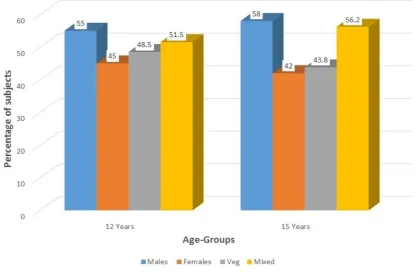
Distribution of subjects on the basis of gender and type of diet is depicted in Figure 1. More than 50% of subjects in both the age-groups were males (55% in 12 years and 58% in 15 years). 51.5% of subjects in 12 year age-group and 56.2% of subjects in 15 year age-group were consuming mixed diet.
Dental caries prevalence and type of diet
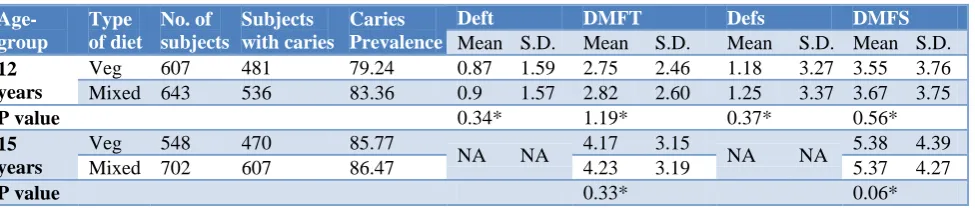
In the 12 year age-group, the prevalence of dental caries was 79.24% in the vegetarian group and 83.36% in the subjects consuming mixed diet. In the 15 years old, vegetarian group had 85.77% caries prevalence and in mixed diet group, the prevalence of caries was 86.47 % (Table 2). No statistically significant difference was found in caries status with relation to type of diet among both the age- groups (p>0.05) (Table 1).
Table 1: Comparison of type of diet with dental caries prevalence in 12- year and 15 years old subjects.
Age-group
Type of diet
No. of subjects
Subjects with caries
Caries Prevalence
Deft DMFT Defs DMFS
Mean S.D. Mean S.D. Mean S.D. Mean S.D.
12 years
Veg 607 481 79.24 0.87 1.59 2.75 2.46 1.18 3.27 3.55 3.76
Mixed 643 536 83.36 0.9 1.57 2.82 2.60 1.25 3.37 3.67 3.75
P value 0.34* 1.19* 0.37* 0.56*
15 years
Veg 548 470 85.77
NA NA 4.17 3.15 NA NA 5.38 4.39
Mixed 702 607 86.47 4.23 3.19 5.37 4.27
P value 0.33* 0.06*
Test used- Student t-test, S.D.- Standard deviation, *Statistically non-significant
Table 2: Comparison of total sugar exposures with dental caries prevalence in 12- year and 15 year old subjects.
Age-group
No. of sugar exposure per day
No. of subjects
Subjects with caries
Caries Prevalence
deft DMFT defs DMFS
Mean S.D. Mean S.D. Mean S.D. Mean S.D.
12 years
Low 3 57 47 82.46 0.74 1.33 2.28 2.23 0.81 2.59 3.09 3.43
High >3 193 147 76.16 0.92 1.46 2.75 2.61 1.20 2.95 3.51 3.85
P value 0.84* 1.24* 0.90* 0.74*
15 years
Low 3 66 56 84.85
NA NA 3.39 2.75 NA NA 4.58 4.44
High ->3 184 169 91.85 4.11 2.61 5.46 3.91
P
value 0.84* 1.52*
Table 3: Correlation (r) between dental caries status and different dietary variables among 12 year and 15 year old subjects.
Age-group Dental caries
status TSE LSE RSE FSE AMSE BMSE TDE RtSE
12 years
DMFT 0.050 -0.006 0.026 0.021 0.106 0.006 0.018 0.019
deft 0.085 -0.002 -0.083 0.052 -0.031 0.097 -0.007 -0.180
DMFS 0.265* 0.131 -0.077 0.304* 0.202* 0.022 -0.016 -0.168
defs -0.113 -0.074 -0.042 -0.161 -0.059 -0.035 -0.382** 0.025
15 years DMFT 0.082 -0.019 -0.155 0.090 0.112 0.006 0.043 0.222*
DMFS 0.213* 0.246* -0.155 0.041 0.195 -0.030 0.122 0.170
Test used –Pearson’s correlation coefficient, * Statistically significant (p<0.05), ** Statistically highly significant (p<0.001); TSE- Total Sugar Exposures, LSE- Liquid Sugar Exposure, RSE- Raw Sugar Exposure, FSE- Fruit Sugar Exposure;
AMSE- At Meal Sugar Exposure, BMSE- Between Meal Sugar Exposure, TDE- Total Diet Exposure, RtSE- Retentive Sugar Exposure.
Figure 1: Distribution of subjects on the basis of gender and type of diet.
Frequency of sugar exposure and dental caries
Considering the total number of sugar exposures per day (TSE), subjects were divided into 2 groups: Low (3 TSE) and High (>3 TSE), and the effect of this variable on the dental caries prevalence was observed. In 12 years old, the caries prevalence for Low TSE Group was 82.46 percent while in the High TSE Group, the Caries Prevalence was found to be 76.16 percent. No statistically significant difference in caries status was found with increase in total sugar exposures. In 15 years age Group, the caries prevalence for low TSE group was observed to be 84.85 percent and for the High TSE Group, it was 91.85%. Again no statistically significant difference was found in dental caries status with increase in total sugar exposures (Table 2).
Correlation between sugar exposures and dental caries
hand, DMFS was found to be positively correlated with TSE, LSE, FSE, AMSE, TDE and RtSE. Moreover, the correlation of DMFS with TSE and LSE was also found to be statistically significant (p<0.05) (Table 3).
DISCUSSION
There is scanty literature available on the relationship between vegetarian/mixed diet and risk of dental caries. Vegetarian diet in our country usually consists of cereals, rice, wheat, pulses, lentils, peas, beans, milk products, leafy vegetables and fruits.13 As most of the Indian population is vegetarian, it is important to know the dental caries risk involved with type of diet.
In the present study, no statistically significant difference was found in dental caries status between both the groups which is different from the results of some other study conducted elsewhere.14 Findings of another observational study revealed greater incidence of demineralization and white spots in the vegan subjects compared to the omnivorous ones localized at the neck of the teeth and on the vestibular surfaces of dental elements.15 However, present study suggests that there may be some benefit in the reduction of caries levels from consumption of a vegetarian diet. Such a benefit may be indirect and associated with the vegetarian lifestyle, characterized by cautious intake of foodstuffs.16
Recent surveys show that the nature of sugar-caries relationship has changed in countries with fluoride use.17 The relationship is further complicated by the wide variation in sugar consumption patterns among individuals. Thus, the present study showed that the ‘total sugar exposure’ exhibit a trend of positive bearing on the dental caries variables in both the age groups. The 24 hour diet recall method to assess dietary intake of children in a day is the most practical method for field studies where the sample is enormous.
The Vipeholm study has directly established that the more frequently sugar is consumed, the greater the risk.18 Similar results indicating a positive correlation of total sugar exposures with dental caries have been reported in the present study and some other studies.19,20 Therefore it can be concluded that with increase in TSE, there is an effect on caries increment.
To further study the effect of total sugar exposures, student’s ‘t’ test was applied to bring about the relative differences in caries status, if any, with high and low total sugar exposures. In the 12 years age group, the caries prevalence for high sugar exposure group was lower than low sugar exposure group. This could probably be due to the fact that most of the children examined were in the high sugar exposure group and therefore, a less number of children belonging to low sugar exposure group were obtained from the sample. Thus, a direct correlation could not be established.
In the 15 years age group, the present study reported lower caries prevalence for low sugar exposure group than the high sugar exposure group. Similar results showing direct correlation between sugar consumption and dental caries have been shown in some other studies conducted elsewhere.21-23 It has also been reported in the literature that the intake of extrinsic sugars greater than 4 times a day increase caries risk.24
The present study found no statistically significant difference in dental caries status in both age groups with increase in total sugar exposures. A few recent studies have also revealed a weak or no correlation between dental caries and sugar consumption.23 It is also stated in some other study that the degree of incrimination of sugar as a cause of caries is grossly exaggerated.25 It has also been suggested that the apparent weak relationship between sugar and caries in developed countries is because of widespread use of sugar with other factors becoming more important discriminators of caries experience.26 Some authors have reported that if good oral hygiene is maintained and fluoride is supplied frequently, teeth will remain intact even if carbohydrate-containing food is frequently eaten.27 Moreover, an important consideration at this juncture is that even in the presence of increased sugar consumption, caries has declined in many industrialized countries.
The present study had some limitations also. We conducted the study without considering the effect of different variables which can affect the progression of dental caries like fluoride content of the drinking water, socio-economic status of the parents, method of cleansing teeth etc. This was done keeping in view the word limit of the manuscript. However, these will be reported later in another study which is being conducted separately.
CONCLUSION
The present study found no statistically significant difference in dental caries status among subjects in both the groups (vegetarian and mixed). However, there was significant association between sugar exposures and dental caries among subjects of both the age-groups. Given the availability of food at every turn and our human propensity to graze, it is very likely that many sugar containing processed foods can contribute to caries experience. Although fluoride has raised the threshold of sugar intake, at which caries will progress to cavitation, fluoride has its own limitations. Measures to educate the public on the dangers of frequent sugar consumption, combined with recommendations for proper oral hygiene and fluoride use are still warranted. Individual dietary counselling is highly recommended for patients at high caries risk.
Funding: No funding sources Conflict of interest: None declared
REFERENCES
1. Kishore M, Panat SR, Choudhary A, Aggarwal A, Upadhyay N, Agarwal N, et al. Oral diagnostics: an integral component to geriatric health care. Aging Male. 2013;16:159-63.
2. Petersen PE. World Health Organization global policy for improvement of oral health-World Health Assembly 2007. Int Dent J. 2008;58:115-21. 3. Kutsch VK. Dental caries: an updated medical
model of risk assessment. J Prosthet Dent. 2014;111:280-5.
4. Fejerskov O. Concepts of dental caries and their consequences for understanding the disease. Community Dent Oral Epidemiol. 1997;25:5-12.
5. WHO Oral Health Country / Area Profile
Programme, WHO Headquarters Geneva, Oral Health Programme, WHO Collaborating Centre, Malmo University, Sweden. CAPP Home Page: http://www.whocollab.od.mah.se/index.html. Accessed on 12 July 2017.
6. Bratthal D, Hansel Petersson G, Sundberg H. Reasons for Caries Decline. What do experts believe? Eur J Oral Sci. 1996;104:423.
7. Lagerweij MD, van Loveren C. Declining Caries Trends: Are We Satisfied? Curr Oral Health Rep. 2015;2:212-7.
8. Bali RK, Mathur VB, Talwar PP, Chanana HB. National oral health survey and fluoride mapping. New Delhi: Dental Council of India; 2002-03. 9. Ghimire N, Rao A. Comparative evaluation of the
influence of television advertisements on children and caries prevalence. Glob Health Action. 2013;6:20066.
10. Green R, Milner J, Joy EJ, Agrawal S, Dangour AD. Dietary patterns in India: a systematic review. Br J Nutr. 2016;116:142-8.
11. World Health Organization. Oral Health Surveys: Basic Methods. 4th ed. Geneva: WHO; 1997: 40– 45.
12. Nizel AE. Preventing dental caries: the nutritional factors. Pediatr Clin North Am. 1977;24:141-55. 13. Agrawal S, Millett CJ, Dhillon PK, Subramanian
SV, Ebrahim S. Type of vegetarian diet, obesity and diabetes in adult Indian population. Nutr J. 2014;13:89.
14. SS Rajesh, P Venkatesh. Prevalence of dental caries among school-going children in South India. Int J Med Sci Public Health. 2016;5:700-4.
15. Laffranchi L, Zotti F, Bonetti S, Dalessandri D, Fontana P. Oral implications of the vegan diet:
observational study. Minerva Stomatol.
2010;59:583-91.
16. Rahmatulla M, Guile EE. Relationship between dental caries and vegetarian and non-vegetarian diets. Comm Dent Oral Epidemiol. 1990;18:277-8. 17. Walsh T, Worthington HV, Glenny AM, Appelbe P,
Marinho VC, Shi X. Fluoride toothpastes of different concentrations for preventing dental caries in children and adolescents. Cochrane Database Syst Rev. 2010;(1):CD007868.
18. Gustafasson B, Quersel C, Larka L, Lurdqvist C, Graham H, Bonous B, et al. The Vipeholm dental caries study: The effect of different level of carbohydrate intake on caries activity in 436 individuals - Observed for 5 years. Acta Odont Scand. 1954;11:232.
19. Gupta P, Gupta N, Pawar AP, Birajdar SS, Natt AS, Singh HP. Role of sugar and sugar substitutes in
dental caries: a review. ISRN Dent.
2013;2013:519421.
20. Moynihan PJ, Kelly SA. Effect on caries of restricting sugars intake: systematic review to inform WHO guidelines. J Dent Res. 2014;93:8-18. 21. Rugg-Gunn AJ. Diet and dental caries. Dent Update.
1990;17:198-201.
22. Skrīvele S, Care R, Bērziņa S, Kneist S, de Moura-Sieber V, de Moura R, et al. Caries and its risk factors in young children in five different countries. Stomatologija. 2013;15:39-46.
23. Pereira SM, Tagliaferro EP, Pardi V, Cenci MS, Cortellazzi KL, Ambrosano GM et al. Sugar consumption and dental health: Is there a correlation? Gen Dent. 2010;58:e6-12.
24. Sheiham A. Dietary effects on dental diseases. Public Health Nutr. 2001;4:569-91.
25. Walker AR, Cleaton-Jones PE. Sugar intake and dental caries: where do we stand? ASDC J Dent Child. 1989;56:30-5.
26. Sujlana A, Pannu PK. Family related factors associated with caries prevalence in the primary dentition of five-year-old children. J Indian Soc Pedod Prev Dent. 2015;33:83-7.
27. Ramos-Gomez F, Crystal YO, Ng MW, Tinanoff N,
Featherstone JD. Caries risk assessment, prevention, and management in pediatric dental care. Gen Dent. 2010;58:505-17.