A Cognitive Study of Sentiment Analysis
Techniques and Tools: A Survey
1
Upma Kumari,
2Dinesh Soni,
3Dr. Arvind K Sharma
1Dept. of CSE, Rajasthan Technical University Kota, Rajasthan, India 2Rajasthan Technical University Kota, Rajasthan, India
3Dept. of CSI, University of Kota, Kota, Rajasthan, India
Abstract
Sentiment analysis is a task of identifying positive and negative opinion, emotion and evaluation in text available over the social networking websites and the World Wide Web. The sentiment analysis has been gained quite popularity in the recent years. The analysis serves as an important feedback for further improvement in the offered services and user experiences. Several techniques have been utilised frequently including machine learning approaches and vocabulary oriented semantic algorithms. This paper presents a cognitive study of various techniques and tools which have been used in the sentiment analysis process.
Keywords
Sentiment Analysis, Machine Learning, Tools, Techniques
I. Introduction
The growth of the web and social networking sites such as Facebook, Instagram, Twitter, Blogs, and Forums etc. have been emerged into a huge volume of user reviews and opinions about particular aspects of products or services. People like to share their experiences, thoughts, opinions, feelings, and preferences according to their understanding and observation about the services. Their point of view or impression may be positive, negative or neutral. This opinion is used for identifying trends, user interest, and prediction of stock markets, political polls, and market researches, enhancing the user experience by presenting
the things of their own interest and to influence them towards a
particular direction. For one particular aspect, one may have a positive opinion while some other may have a negative opinion at the same time. Thus, classifying opinion and sentiment of people
is a difficult task. Furthermore, the shared reviews and feelings are not in specifically structured format, thus identifying its positivity
or negativity perspective automatically, is also convenient. Therefore, analysis of an unstructured format of text and extract the information for determining the user’s sentiments requires special machine learning techniques and semantic algorithms
for their classification. In sentiment analysis, major tasks listed are subjectivity and sentiment classification, sentiment lexicon
generation, opinion spam detection and quality of reviews [2].
The rest of the paper is organised as follows: Section II explains the complete process of sentiment analysis. Section III presents literature survey. Section IV shows sentiment analysis techniques and their taxonomy. Section V explores different tools. Section VI provides proposed methodology. Section VIII concludes the paper while references are mentioned in the last.
II. Sentiment Analysis Process
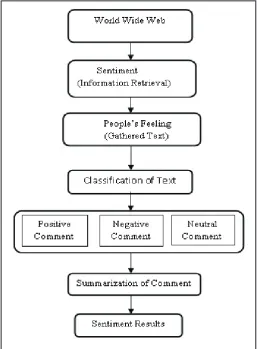
Sentiment analysis is a process of finding user’s review towards a website or a product. Sentiment analysis is classified into positive
comment, negative comment or neutral comment. Fig. 1 shows
the complete process of sentiment analysis that refers how the
input is being classified on the various steps.
Fig. 1: Process of Sentiment Analysis
The sentiment analysis summarization process contains three main
steps, first is Sentiment information retrieval, second is Sentiment classification and third is Sentiment summarization. Review text is
retrieved from review websites such as Twitter, Facebook, Amazon and News Sites etc. Sentiment text in the blog, reviews, comments,
microblogs etc. contains subjective information about the topic or
issue. Sentiment results are generated based on features (sentiment sentences) selection about a matter.
II. Literature Survey
In this section, a literature survey on the basis of literature and research papers of past year’s carried out by several researchers in the sentiment analysis domain has been presented. A few work are has been discussed.
In 2016, Ebru Aydogan et al. [2], has carried out a comprehensive survey on Sentiment Analysis using different types of Machine learning algorithms and found that SVM and NB were most commonly employed due to their higher estimation capability. In 2016, Mohammed Qasem et al. [3], used two weighting schemes namely Unigram term frequency (TF) and Bigram term frequency- inverse term frequency (TF-IDF) to classify different tweets into positive, negative and neutral classes. Positive tweets were determined by positive emoticons and negative tweets by negative
emoticons while the neutral tweets were defined as those with no
emoticons or keywords that indicate polarity, like happy, sad, good, bad, etc. The weak point was due to the automatic annotation of neutral class. In 2016, M. Trupthi et al. [4], explored machine learning approaches with different feature selection schemes, to
identify the best possible approach and found that the classification
using high information features, resulted in more accuracy than Bigram Collocation. They also proposed that there was a scope for
improvement using hybrid techniques with various classification
algorithms. In 2016, Orestes Appel et al. [5], proposed a hybrid system using Naive Bayes (NB) and Maximum Entropy (ME) methods to the same dataset which worked very well with the high level of accuracy and precision.
In 2016, S. Brindha et al. [6], presented a survey on different
classification techniques (NB, KNN, SVM, DT, and Regression). Authors found that almost all classification techniques were suited
to the characteristics of text data. Authors concluded that further
study on classification development could get the enhanced quality
of text results and accurate data along with minimized accessing time. In 2015, Huang Zou et al. [7], introduced a syntactic feature in pre-existing words-bag method that revealed more on Pos Tags. They applied SVM and Naive Bayes and observed that word dependency and pos tags did improved accuracy. In 2014,
P. Kalaivani and K.L. Shunmuganathan [8], proposed an improved KNN algorithm by incorporating information gain for feature
selection to improve and show that this approach out performed
Naive Bayes and KNN.
In 2013, Mostafa Karamibekr and Ali A. Ghorbaniss [9], focused
their work mainly on topic originated opinion mining, where only opinions about particular topic or issue would be considered. A text may not necessarily contain opinion about a targeted topic. As per
their experiments the Precision or Recall method for subjectivity of classification at the sentence level was considerably lower than
those of previous works. However, the F-measure was higher which indicated an improved overall balance between Precision
and Recall. In 2012, Saif et al. [10], worked on Semantic sentiment
analysis of twitter and their results shown that the semantic feature model out performs the Unigram and POS baseline for identifying both negative and positive sentiment. In 2010, Alexander Pak and Patrick Paroubek [11], worked on Corpus for sentiment analysis using twitter that is most popular Microblogging platform. Authors presented a method for an automatic collection of a corpus that
could be used to train a sentiment classifier. In 2010, Khin Phyu
Phyu Shein et al. [12], proposed combination of using Natural Language Processing techniques (NLP), ontology based on Formal Concept Analysis (FCA) design, and Support Vector Machine (SVM) which have used for classifying the software reviews as
positive, negative or neutral. In 2009, Sun Yueheng et al. [13],
proposed a method through which they could decide the ‘mood’ of a user review. And to do this they took an approach for automatic sentiment analysis by:
Generating positive and negative sentiment words from •
Tongyici Cilin with paradigm words.
Determining the sentiment orientation of ambiguous words
•
according to their contexts.
Setting up proper weight factors to different
part-of-•
speeches.
Expanding the initial sentiment words by an iterative process,
•
but through this, they could only achieve an average
precision of 83.52%.
In 2009, Cheng Mingzhi at el. [14], proposed a method in which
a word association graph was constructed from a text corpus, i.e. product reviews, in which each node was a word and if there was an edge between two words, it meant two words co-occur in the same sentence. And then, with a random walk algorithm, the sentiment score was calculated for all the words in the graph at one time. In 2007, Mostafa Al Masum Shaikh et al. [15], presented a paper in which various approaches to sense sentiments contained in a sentence by applying a numerical-valence based analysis.
IV. Sentiment Analysis Techniques
Sentiment analysis is the process of classifying the opinions conveyed in the documents or statements of the web contents as positive, negative or neutral. The huge amount of data available on the Internet which is right now useless, so to make that data useful we need to convert that data through sentiment analysis process. Sentiment analysis concept or Opinion Mining refers the use of natural language processing, text analysis and computational
linguistics to identify and get subjective information in source
materials. Sentiment analysis is frequently available for reviews
and social media for different applications. Generally, sentiment
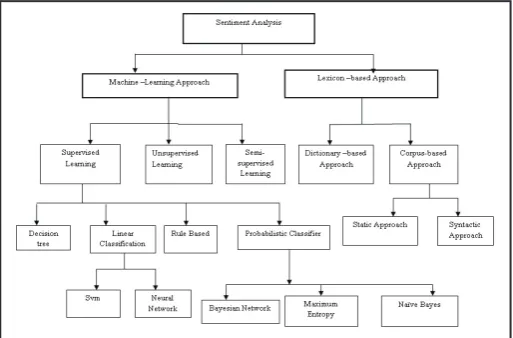
analysis means to determine the idea of a speaker or a writer or user regarding a topic or the overall explanation of a document. The approach may be person’s evaluation, affective state (the sentiments of the author during writing) or the intended emotional communication (the emotional effect the author wishes for a reader). Several techniques have been presented in the recent years, some rely on the machine learning approaches with supervised, unsupervised or semi-supervised learning and other may use semantic-based approaches. Moreover, few hybrid approaches may also be used from techniques related to different domains.
The taxonomy of sentiment analysis techniques is classified into the following categories as shown in fig. 2.
Fig. 2: Taxonomy of Sentiment Analysis Techniques
A. Supervised Learning
sentiment classification with very promising results. Supervised classification techniques such as Naive Bayes, SVM, DT, KNN and Regression are used to find the classification accuracy for
different dataset [6].
B. Unsupervised Learning
Text classification classifies documents into a number of
predefined categories. A large number of training data are used for
categorization in supervised learning and its performance depends on the similarity between the training and the testing data. In text
categorization, it is usually difficult to create labelled training
documents and it requires human efforts. However, it is easy to collect the unlabeled documents. The unsupervised learning
methods can overcome these difficulties. Many research studies are presented in this field because in sentiment classification
unsupervised learning is less dependent on the domain or topic and its performance is much better. Tweet words are used as features and tweet data were accumulated in positive, negative and neutral [2].
C. Semi-supervised Learning:
Semi-supervised learning is a little bit different from supervised learning and unsupervised learning. Semi-supervised learning uses both labelled and unlabeled data. Main idea behind the semi supervised learning is that unlabeled data hold many information
about classes, but they contain information about joint distribution over classification features. To improve the results of supervised
and unsupervised learning, where there is limited labelled data we use semi-supervised learning method [2].
V. Sentiment Analysis Tools
Now day’s several sentiment analysis tools are available in the market. The (open-source text analytics tools) have been used for natural language processing (NLP), such as information extraction
and classification which can also be applied for web sentiment
analysis, In this section we have been explored some of the popular tools used for sentiment analysis. Some of them as are follows:
A. Ntlk
A natural language toolkit is a tool for text processing, cataloging, tokenization, stopping, tagging, parsing, etc. It provides easy-to-use interfaces to more than 50 corpora and lexical resources such as WordNet [17].
B. Opinion Finder
It supports in identifying individual sentences and to create different
parts of subjectivity in these sentences, it includes the conclusion holder of the subjectivity and words that are incorporated into
expressions by communicating positive or negative suppositions
[18].
C. Open Nlp
The toolkit which is based on machine learning technique, and is
used for processing natural language text is the Apache OpenNLP library. The most common NLP task included are tokenizer, part of speech tagger, named entity extractor, chunker, parser, and conference resolution. In order to build more advanced text
processing services, these tasks are usually required [19].
D. Web Fountain
It is a sentiment analysis tool that completes the requirements of analysis agents such as text gathering, storing indexing and querying. At distributed platforms, this high-performance tool can be used [20].
E. Weka
This tool is based on machine learning techniques, JAVA programming language is used to implement this tool, and it
has its GUI to show the data. Many algorithms and techniques are used such as Classification, clustering, preprocessing, linear
regression[21].
F. Ling Pipe
Ling pipe is used for linguistic processing for text, including clustering, cataloging, and extraction [22].
G. Opinion Observer
This tool is used for analyzing and comparing the opinions, which are user generated contents on the internet. As well as it shows the resulting graphical format with respect to opinion generated for product feature by feature. It uses WordNet exploring method to assign prior polarity.
H. Review Seer Tool
The work done by the Review site is automated by this tool. To
collect positive and negative sentiment for assigning a score to
extracted feature terms, we have to use the Naive Bayes classifier
approach.
I. Red Opals
It is a tool that enables the users to determine the opinion orientations of products based on their features. It assigns the score to each product based on feature extracted from the customer reviews.
J. Stanford Parser
It is used as a pos tagger and sentence parsing from the NLP group [16].
VI. Proposed Methodology
In this section, the proposed methodology has been presented with following steps:
A. Data Collection:
Defining dictionary of positive and negative adjectives •
Defining polarity of positive and negative adjectives •
B. Data Processing
Extracting of useful data from social networking web sites.
•
Removing ambiguous data e.g., sarcasm, interrogative •
comments.
Integrating multiple social media channels for accuracy.
•
Extracting sentiments from comments.
•
C. Decision Making
Use of polarity databases and comments as decision making
•
for sentiment analysis.
D. Data Sources
We discuss the various important data sources to be used for sentiment analysis. There are many data sources available on the
World Wide Web e.g. Blogs, Microblogs, Forum Sites, Review
Sites, Datasets , Posts, and Corpus etc. from there, the data can be determined in the form of speech, text etc.
1. Blogs
Blogs are the reviews about a particular topic, event or issues in which people express their emotions in their own ways over the internet [16].
2. Micro Blogs
Microblogging platforms are used by different people to express their opinion about different topics, thus it is a valuable source of people’s opinion [11] twitter.
3. Forums Sites
An internet forum, or message board, is an online discussion website where people can hold a conversation in the form of posted message.
4. Review Sites
Review sites are the websites which consider many reviews of
the customers in order to provide best products and services. Many review sites are available such as www.myntra.com,www. yahoo.com etc.
5. Datasets and Posts
We can take dataset from many websites like News sites, Social media websites and many other websites for sentiment analysis. In the online posts, we share videos and photos and sometimes likes and dislikes some posts.
6. Corpus
Using Twitter API we collect a corpus of text, and form a dataset of three classes, positive sentiments, negative sentiments, and a
set of objective texts [1].
VII. Conclusion
Now a day’s Sentiment analysis is one of the hot research areas for the researchers. The information gathered from the online data sources like blogs, microblog, forums, review sites etc. has been playing an important role in expressing people’s feelings, thoughts, emotions, and opinions for the particular topic, event or issue.
The objective of sentiment analysis is mining the opinion behind
the user’s statement and revealing the user’s interest, preferences and thoughts about the particular thing.
In this paper a cognitive study of sentiment analysis techniques and tools has been presented. The proposed methodology provides important phases the sentiment of text, whether it is positive or
negative. This paper will be helpful to the researchers of the sentiment analysis domain.
Reference
[1] Fang Luo et al.,“Affective-feature-based Sentiment Analysis
using SVM Classifier”, IEEE 20th International Conference
on Computer Supported Cooperative Work in design 2016. [2] Ebru Aydoan et al.,“A Comprehensive Survey for Sentiment
Analysis Tasks Using Machine Learning Techniques”, IEEE,
2016.
[3] Mohammed Qasem et al.,“Twitter Sentiment Classification Using Machine Learning Techniques for Stock Markets”,
IEEE, 2015.
[4] M. Trupthi et al.,“Improved Feature Extraction and
Classification - Sentiment Analysis,“International Conference
on Advances in Human Machine Interaction (HMI-2016),
March 03-05, 2016, R. L. Jalappa Institute of Technology,
Doddaballapur, Bangalore, India.
[5] Orestes Apple et al.,“A Hybrid Approach to Sentiment
Analysis”, IEEE, 2016.
[6] S. Brindhaet et al.,“A Survey on Classification Techniques for Text Mining”, 3rd International Conference on Advanced
Computing and Communication Systems (ICACCS-2016), Jan. 22-23, 2016, Coimbatore, INDIA.
[7] Huang Zou et al.,“Sentiment Classification Using Machine Learning Techniques with Syntax Features”, International
Conference on Computational Science and Computational intelligence, IEEE, 2015.
[8] P. Kalaivani et al.,“An Improved K-nearest-neighbor algorithm using Genetic Algorithm for Sentiment Classification”
International Conference on Circuit, Power and Computing Technologies [ICCPCT], IEEE, 2014.
[9] Mostafa Karamibekr et al.,“A Structure for Opinion in Social Domains”, IEEE, 2013.
[10] Hassan Saif et al.,“Semantic Sentiment Analysis of Twitter”,
11th International Semantic Web Conference (ISWC 2012). [11] Alexander Pak et al.,“Twitter as a Corpus for Sentiment
Analysis and Opinion Mining”, 2010.
[12] Khin Phyu Phyu Shein et al.,“Sentiment Classification based on Ontology and SVM Classifier”, 2010 Second International
Conference on Communication Software and Networks IEEE, 2010.
[13] Sun Yueheng et al.,“Automatic Sentiment Analysis for Web User Reviews”, 1st International Conference on Information Science and Engineering (ICISE2009).
[14] Cheng Mingzhi et al.,“A Random Walk Method for Sentiment Classification”, Second International Conference on Future
Information Technology and Management Engineering,
IEEE, 2009.
[15] Mostafa Al Masum Shaikh et al.,“An Analytical Approach
to Assess Sentiment of Text”, IEEE, 2007.
[16] Dr. Arvind K Sharma et al.,“Web Opinion Mining Techniques and Tools for Finding User’s Opinion”, In the 5th International Conference on Innovative Research in Engineering Science and Management (ICIRESM-16) at India International
Centre, Max Mueller MargS, New Delhi, India. [17] [Online] Available: http://Ntlk.logo
[18] [Online] Available: http://opinion finder. Logo/ [19] [Online] Available: http://open nlp.biolab.si/
Upma Kumari has received her
B.Tech degree in Computer Science and Engineering from Modi Institute
of Technology, affiliated to Rajasthan Technical University, Kota, India
in 2015 and presently pursuing her M.Tech Computer Science and
Engineering from Rajasthan Technical University, Kota, Rajasthan, India.
Her research interest includes- Sentiment Analysis, Opinion Mining, and Machine Learning.
Dinesh Soni has received his B.E. degree in Computer Engineering
from Rajasthan University, Jaipur,
India, in 2007 and M.Tech degree in Computer Technology from Indian Institute of Technology, Delhi, India in 2015. He is working as Assistant Professor in Department of Computer
Science and Engineering, Rajasthan Technical University, Kota since 2008.
His research interests include: machine learning and Computer Vision.
Dr. Arvind K Sharma has received his
Ph.D degree in Computer Science in the year 2013. He has more than 13 years of work experience in academic
field. He has published more than 40
Papers in many National, International Journals and Conference Proceedings. He is a Managing Editor of International Journal of Computer Science and Technology. He is also Editorial Board
Member and Reviewer of several
National and International Journals and Conferences. He is a Member of numerous academic and professional bodies such as
IEEE, WASET, IEDRC, IAENG Hong Kong, IACSIT Singapore, UACEE UK, ACM, New York. His area of interest includes- Web