R E S E A R C H
Open Access
Development of an animal-borne
“
sonar
tag
”
for quantifying prey availability: test
deployments on northern elephant seals
Gareth L. Lawson
1*, Luis A. Hückstädt
2, Andone C. Lavery
1, Frédéric M. Jaffré
1, Peter H. Wiebe
1, Jonathan R. Fincke
1,
Daniel E. Crocker
3and Daniel P. Costa
2Abstract
Background:Developments in electronic tagging technologies have provided unprecedented insight into the movements and behavior of marine predators. Concurrent information on the prey of these tracked animals, however, is mostly lacking. We developed and tested a prototype autonomous echosounder (aka the sonar tag) for deployment on large marine animals intended to provide quantification of their prey fields.
Results:The resulting fully autonomous, internally recording prototype sonar tag operated at a power of 1 W and a frequency of 200 kHz. A series of test deployments were successfully conducted on four juvenile female elephant seals (Mirounga angustirostris) captured at the Año Nuevo State Reserve, California, and released short distances away. Translocated seals were instrumented with a sonar tag and a Fastloc GPS tag with an integrated time-depth recorder (TDR). All four animals returned to land after 3–18 days, making dives to depths of up to 778 m. Strong backscattering from the bottom was observed during many dives, indicating an often close association with the seafloor. Numerous observations of strongly scattering targets, potentially indicative of prey, were also made in the water column, often associated with particular dive and movement behaviors. During dives identified as foraging-type and also travel-type, one animal with the acoustic transducer on its head showed successive targets getting increasingly closer to the animal, possibly consistent with prey pursuit.
Conclusion:These results demonstrate the value of active acoustic backscattering measurements made from free-ranging animals, complementing the ecological insight afforded by traditional depth- and position-logging tags. Future refinements will include further miniaturization, performance optimization, and extensions in the deployment duration.
Keywords:Sonar, Tag, Northern elephant seal, Prey
Background
Recent developments in electronic tagging technologies have provided unprecedented insight into the movements and behavior of a variety of large marine predators at spatial and temporal scales previously inaccessible via traditional sampling techniques [1–6]. Examining the relationships of movements and behavioral decisions revealed by such tech-nologies with the animal’s physical and biological environ-ment is an active area of investigation [7, 8]. Some tags are capable of measuring physical and biological parameters
such as temperature, salinity, and chlorophyll-a, and can be correlated to tag observations of the animal’s be-havior made at the same scale and resolution [9–13]. Behavioral patterns can also be examined in relation to remote satellite observations of environmental conditions (e.g., temperature, chlorophyll-a[14]). Information on the in situ abundance of the prey exploited by these top preda-tors, however, has been more difficult to obtain.
Typically, information on the relative availability of prey has been inferred from changes in the behavior of tagged animals through time [e.g., 10, 15, 16]. In the case of northern and southern elephant seals (Mirounga angustir-ostris and Mirounga leonina), for instance, small-scale
* Correspondence:[email protected]
1Woods Hole Oceanographic Institution, Woods Hole, MA 02543, USA
Full list of author information is available at the end of the article
changes in movement and diving behaviors have been re-lated to changes in oceanographic variables and, presum-ably, changes in prey availability and perhaps prey type. Indirect metrics of foraging have included measurements of surface movements (e.g., transit rate, indices of area-restricted search) and dive characteristics (e.g., frequency of
“drift dives” thought to be postprandial), often coupled to estimates of energy gain based on pre- and post-trip mea-surements of body composition [3, 9, 10, 14, 17–20]. Jaw motion events recorded by accelerometers have also been used as an index of feeding, with initial deployments on adult female northern elephant seals suggesting that feeding occurred during the majority of dives, including during dive types and movement patterns believed previously not to be associated with feeding [21]. These approaches provide valuable estimates of when and how much prey the animal consumed, but provide little or no information on prey dis-tribution, which is also critical to understanding the for-aging ecology of top predators.
Direct measurements of prey fields relative to the for-aging behavior of top predators have often been made via sampling from vessels with acoustic, optical, and/or net sampling methods conducted concurrent or nearby to predators observed through ship-based visual surveys [e.g., 22, 23] or tracked with various tagging technologies (e.g., blue whales [24]; right whales [25]; humpback whales [26, 27]). This latter approach is logistically quite demanding, however, as it requires that a ship remain in close contact with the tracked animal while prey sam-pling is carried out, and is difficult to carry out at night. As such these studies have been limited to relatively short time (hours to days) and small spatial (kilometers) scales. Furthermore, there is still a spatial and temporal mismatch between the predator and prey observations that introduces uncertainty into attempts to correlate the two at fine scales. There are a few methods that have provided direct data on rates of prey encounter along with rates of prey ingestion. For echolocating cetaceans, acoustic recording tags can be used to record echoes from prey resulting from the tagged animal’s echoloca-tions [28]. Video or still camera systems attached to a variety of marine species, including seals, turtles, and seabirds have been used with success to capture direct images of prey and estimate prey density, although these are limited by memory and power considerations and can only sample to short ranges given the rapid attenu-ation of light in seawater [29].
High-frequency active acoustic systems deployed from ves-sels are often used to characterize the distribution of zoo-plankton and fish prey for higher predators [22–24, 26, 30] and offer an attractive option for quantifying prey abun-dance associated with tag observations of animal behavior. Active acoustic backscattering systems, or echosounders, operate by emitting pulses of sound and measuring
echoes returned back to the transducer (i.e., backscat-tering). The intensity of backscattering provides infor-mation on the abundance and nature of organisms in the water column while the time-delay provides infor-mation on their range; the latter is the principle underlying sonar (originally an acronym for SOund Navigation And Ranging). Sound attenuates in water less than light and so active acoustic systems can pro-vide remote and non-intrusive samples at high reso-lution and sampling to larger ranges than camera systems. Substantial recent progress has also been made in reducing the power consumption of active acoustic systems and in miniaturizing transceiver com-ponents, making deployment on increasingly small au-tonomous platforms a possibility. The development of a miniaturized echosounder intended for potential at-tachment to marine animals has been reported previ-ously [31]. To our knowledge, however, active acoustic devices have not previously been successfully deployed on marine animals, but could provide important new information on prey distribution at previously inaccess-ible spatial and temporal scales.
The objectives of this study were to develop a compact, autonomous, high-frequency echosounder for deployment on live animals and to conduct test deployments of this prototype“sonar tag”system on juvenile northern elephant seals. Juvenile elephant seals translocated short distances away from the Año Nuevo State Reserve north of Santa Cruz, California, are known to return to the Año Nuevo or a nearby colony after time periods of hours to days, making a series of dives to depths of up to 900 m during their re-turn transit [32]. The behavior of translocated animals thus closely mimics their natural behavior, allowing new tag technologies to be tested under real-world conditions and within short amounts of time [e.g., 33–35]. The focus of the present work is on data recorded by the prototype sonar tag and associated depth- and position-logging tags during a series of test deployments. The goals are first to verify the nature of the acoustic backscattering relative to known or expected patterns, such as from the sea floor and the deep scattering layer (a pervasive acoustic layer often evident in off-shelf waters, typically comprised of small fishes and large invertebrates); and second to provide initial insight into elephant seal dive behavior and foraging ecol-ogy. The broader aim of this work is to assess the value of the approach of using active acoustics in the study of for-aging ecology via the direct characterization of the prey fields of free-ranging tagged top predators over long, and ecologically relevant, time scales.
Methods
Sonar tag specifications
turbulence studies [36] and later modified for measurement of acoustic backscattering and applications involving the characterization of pelagic animal abundance. Relative to other active acoustic devices, the board is compact, autono-mous, low power, and low-cost, and was designed for use on autonomous platforms. The system has been used at frequencies ranging from 100 kHz to 2 MHz and is capable of transmitting and receiving both narrowband (i.e., single-frequency) or broadband signals (i.e., spanning a broad and continuous frequency band). It is composed of a single 13.3 × 3.8 cm circuit board that includes a transmit/receive circuit, 24 MHz analog-to-digital converter, a low-power Digital Signal Processor (DSP), and 32 GB flash memory card. The system requires a supplied voltage between 4 and 32 V and has a total power consumption less than or equal to 1 W. The DSP allows for the execution of pre-programmed mission instructions such as duty cycling the system between pinging and not pinging (i.e., idling). The ping rate, sample range, sampling frequency, decimation rate, gains, and transmit signal can all be adjusted by the user according to the application at hand.
Certain modifications to this generic sonar module design were required in developing the sonar tag. The transmit/ receive circuitry was redesigned and optimized for imped-ance matching with a 200 kHz transducer. Custom battery packs were built from 26 AA disposable lithium batteries wired together (with diodes as necessary) to supply the de-sired voltages. The voltage supplied to the board was 6 V and a separate input voltage (0.6, 1, 1.5, 3, or 6 V, varying between different tests) was supplied to the transmitter via a linear power regulator external to the board; the out-put voltage supplied to the transducer from the transmit-ter was then increased by a factor of 10. A modular approach to packaging the system was used where the bat-tery and electronics were housed separately. The design goal for this prototype was to keep the maximum size below that which has been used previously on juvenile ele-phant seals (10 × 36 cm cylinder [33]), with the intent of miniaturizing further in the future. The final system was comprised of one custom cylindrical aluminum housing for the electronics and one for the batteries (each 7.9 cm diameter × 17.0 cm length) cabled together, with the elec-tronics housing also cabled to a cylindrical transducer (10.2 cm diameter × 5.8 cm length). The transducer was mounted on a cradle made of a rigid plastic (Delrin) and was surrounded and backed by a layer of corprene baffling material (a mixture of neoprene and cork). The corprene was intended to reduce sound output toward the animal although it is a compressible material and attenuation thus is decreased at depth (from 5 dB/cm near sea level to 1 dB/cm at ca. 400 m depth [37]). Together, the system components weighed 4.34 kg in air and 1.7 kg in water.
The system used an Airmar transducer with a center frequency of 200 kHz, chosen to be outside the elephant
seal’s hearing range [38] and to be consistent with fre-quencies commonly used in fisheries acoustics. At the nominal frequency of 200 kHz, the transducer had a full beam-width (3 dB down) of 8 °, with first side-lobes at ca. 15 ° off-axis that were ca. 18 dB down relative to on-axis, second side-lobes at ca. 45 ° that were ca. 28 dB down, and a lobe at 180 ° that was ca. 28 dB down. A variety of transmit signal types were explored, including narrowband tones and linear frequency modulated broadband signals (limited by the transducer’s frequency response to ca. 20 kHz bandwidth). The final transmit signal selected was a 200 kHz gated sine wave of dur-ation 150 μs, with a ping rate of 1 Hz. This short, and hence low power, signal produced the least sound at lower frequencies. To further reduce the level of sub-harmonics, the transmit pulse was tapered using the pulse width modulation technique [39], linearly increas-ing from 1 to 50 % at the end of the 150μs pulse.
Calibrations and performance tests
Calibrations were performed following the standard target method [40, 41] using tungsten carbide spheres (5 % cobalt binder) with diameters of 12, 21.2, and 38.1 mm. The acoustic properties and expected target strength for these targets are known, and hence calibrations allow absolute backscattering levels to be calculated from relative mea-surements of digitized signal strength. Signal-to-noise ratios were measured relative to range and operating voltage using standard targets suspended at multiple ranges. The full system was pressure tested to the equivalent of 2000 m in depth.
Source levels were quantified relative to frequency and angle off-axis while operating the system at a series of transmitter input voltages using a Reson Model TC4047 calibrated hydrophone in a specialized tank (3.7 m diam-eter × 3.7 m deep). This hydrophone was chosen as it not only is optimized for use in the 1–100 kHz band, allowing high-accuracy measurements within the range in which elephant seals hear [38], but also has a useable frequency response in the 100–200 kHz band, allowing measurements of source level at the nominal operating frequency of 200 kHz. The hydrophone was positioned 1 m from the transducer face. Spectra of source levels vs. frequency were calculated by taking the Fourier transform of the isolated direct-path incident pulse from the transducer. The transducer was mounted on a rotat-ing platform, and source level measurements were made in 5 ° increments.
Field deployments
Animal handling
Over the course of the field effort, four healthy juvenile female seals were selected based on size and overall ap-pearance, and when feasible were known from an on-going flipper-tagging program to have been born at Año Nuevo. This increased the likelihood that they would re-turn to the Año Nuevo colony after translocation. The animals were sedated using an intramuscular injection of Telazol (teletamine/zolazepam HCl) at a dose of ap-proximately 1.0 mg per 100 kg. Sedation was maintained with intravenous doses of ketamine (100 mg.mL−1) as necessary. Upon initial sedation, a series of morphomet-ric measurements were taken, including weight, length, and blubber thickness. The seals were transported in a specially designed aluminum cage to the Long Marine Laboratory of the University of California Santa Cruz, where the tags were attached.
The sonar tag’s electronics and battery housings were tie-wrapped to a cloth mesh patch and mounted in-line with one another along the animal’s midline in the mid-dorsal region by gluing the mesh to the animal’s pelage using a 5-min marine epoxy (Loctite). The electronics housing connected via a cable to the acoustic transducer, similarly mounted on either the animal’s shoulder region (aimed to the side) or head (aimed forward). An ARGOS-linked Mk10 Fastloc GPS tag with integrated time-depth recorder (TDR, Wildlife Computers, Washington) and a Mk9 three-dimensional accelerometer/magnetometer (Wildlife Computers, Washington; data not analyzed in this study) were also secured to the animal’s head and posterior dorsal region, respectively, to provide track, movement, and dive data. A radio transmitter (148–150 MHz frequency) was attached to the mid-dorsal region to facilitate location of the animal once it returned to shore. The combined weight of these instruments (excluding the sonar tag) was 0.4 kg and volume of 212 cm3. Seal handling took a max-imum of 120 min. The seals were then transported by truck to release locations along Monterey Bay. At-sea movements of the seals were monitored via ARGOS satellite uplinks, allowing the animals to be recaptured shortly after their re-turn to land. The same sedation protocol was used to immobilize the animals during recapture, at which time the sonar tag package and other instruments were removed from the mounting system with the animals on the beach, and new morphometric measurements were collected.
Tag effect tests
A series of measures was taken in order to assess possible effects of the sonar tag on the study animals. Each sonar tag was duty cycled on a 4 h on and 4 h off basis. This allowed comparisons of the animals’ dive behavior during periods when the tag was pinging to periods when it was not, based on a similar set of dive characteristics as used in an earlier study of translocated elephant seals exposed to
the Acoustic Thermometry of the Ocean Climate (ATOC) low-frequency sound source [34]. At the time of animal re-lease, the tag was programmed to be off. The track and dive behavior of the tagged seals were also compared to previ-ously translocated seals not instrumented with the sonar tag. Blood samples were collected in serum and EDTA plasma tubes from tagged animals at the time of initial cap-ture and post-translocation in order to examine changes in stress hormones. Samples were kept on ice until centrifuga-tion and stored at−80 °C until analysis. Serum cortisol and plasma epinephrine (EPI), norepinephrine (NE), and adre-nocorticotropic hormone (ACTH) were measured in dupli-cate using commercially available radioimmunoassay (RIA) kits (Siemens, Salem NH; Alpco, Salem, NH) previously validated for use in elephant seals [42, 43]. The average du-plicate coefficients of variation for the assays were 2.2, 2.7, 2.5 and 3.1 % for cortisol, EPI, NE and ACTH, respectively.
Tag data analysis
Acoustic data collected in binary format by the sonar tag were unpacked and processed using custom Matlab-based routines. The raw data were converted to abso-lute (i.e., calibration-corrected) volume backscattering strength, also corrected for range and attenuation. Volume backscattering strength represents the summed contribu-tion of backscattering from all targets present, normalized to sample volume. Backscattering is a complicated function of both the abundance of scatterers present and their na-ture (e.g., composition, size, and orientation); here we use volume backscattering strength as a relative index of animal abundance. The acoustic data were integrated with the track and dive data from the GPS-TDR tag based on their respective time records, which were synchronized at de-ployment and recovery. GPS locations were filtered using a simple forward-backward speed filter to eliminate any erro-neous locations [15], using a conservative threshold max-imum speed of 20 km h−1. The TDR data were analyzed using custom Matlab algorithms to classify dives into cat-egories of travel dives (combining the A- and B-types of LeBoeuf et al. [44]), pelagic foraging dives (D-type), benthic dives (E-type), and drift or processing dives (C-type) follow-ing established classification schemes [44, 45]. A variety of dive metrics were also quantified including dive duration, maximum depth, amount of time spent in the bottom phase of the dive, descent/ascent rates, post-dive interval duration, and the number of inflections during the descent/ bottom/ascent phases of the dive.
Results
Source level and performance tests
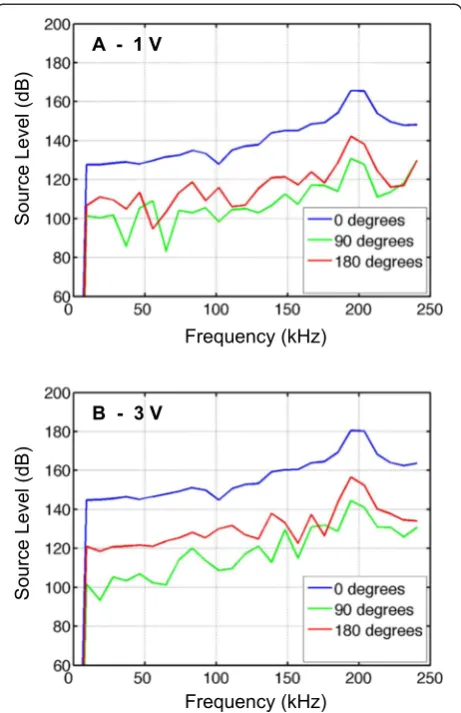
(re. 1μPa RMS Hz−0.5 at 1 m), respectively. The goal of the source level calibrations relative to frequency was to determine operational voltages for which the source level would be as low and as close to inaudible to the seal as possible in its hearing band while also maintain-ing reasonable signal-to-noise ratios (SNR). The upper frequency cutoff for northern elephant seal hearing in
water is ca. 55 kHz, and in the 1–55 kHz band where the seal’s hearing is best, the hearing threshold is ca. 60 dB re. 1μPa at 1 m [38]. Source levels in this 1–55 kHz band were relatively flat and above the 60 dB threshold (Fig. 1); the prototype system thus unfortunately produced sound potentially audible to the seal. Calibrations of source level relative to angle off-axis confirmed that the transducer was highly directional, with source levels at 90 ° and 180 ° off-axis minimally 20 dB lower than on-off-axis (Fig. 1). The trans-ducer was to be mounted on its side, meaning that the sound output at 90 ° would be toward the animal’s head/ ears while sound output on-axis and at 180 ° would be at angles in a direction away from the animal. Operating the system at 3 V or less resulted in source levels in the 1–55 kHz band below 150 dB in a direction away from the animal (i.e., on-axis and 180 °) and ca. 100 dB (close to the noise floor of the calibration equipment) toward the animal (90 °). Tests of SNR conducted with standard targets sus-pended at a series of ranges and operating at voltages of 0.1 to 6 V determined that 0.6 V was the minimum voltage in order to maintain an acceptable SNR (i.e., in excess of 10 dB) at a range of 2 m for a target with target strength of−50 dB (an estimated minimum target strength for po-tential elephant seal prey). Small fishes (<10 cm) were often observed during calibrations in the coastal test facility, con-firming the tag’s ability to detect such targets at operational voltages as low as 0.6 V (data not shown).
Translocation data
Four test field deployments were conducted between April 6 and May 11, 2012 (Table 1). Given that the tag was likely audible to the seal when underwater, power was increased on successive deployments to assess and avoid effects the tag might have on the animals. The first two animals were deployed with the system operating at 1 V (transmitter in-put voltage) with the transducers mounted on the animals’ shoulders and aimed to the side. Following successful re-covery of these first two animals and examination of the track and dive data for signs of aberrant behavior, incre-mental modifications were made for the next two animals. In the third animal, the voltage was increased to 3 V in order to achieve higher source levels, and hence improved signal-to-noise ratios and increased ranges to which targets could be detected, while for the fourth animal, the voltage was set to 1 V and the transducer was mounted on the ani-mal’s head in order to sample water immediately in front of Fig. 1Underwater source level measurements (dB re. 1μPa RMS Hz−0.5
at 1 m) made ata1 V andb3 V at angles of 0 °, 90 °, and 180 ° off-axis. The transducer was to be mounted on its side on the animal, such that the measurements at 90° are representative of sound levels in the direction of the animal’s head/ears while 0 and 180 ° indicate directions away from (approximately normal to) the animal. Note that at 1 V the source levels at low frequencies at angles of 90 ° and 180 ° started to approach the noise floor of the calibration equipment and the true source levels are likely lower than those shown
Table 1Capture, release, and recovery information for the four translocated elephant seals
it (Table 2). In all cases, data were collected to a range of 22 m from the animal, although useable data were mostly restricted to shorter ranges by SNR.
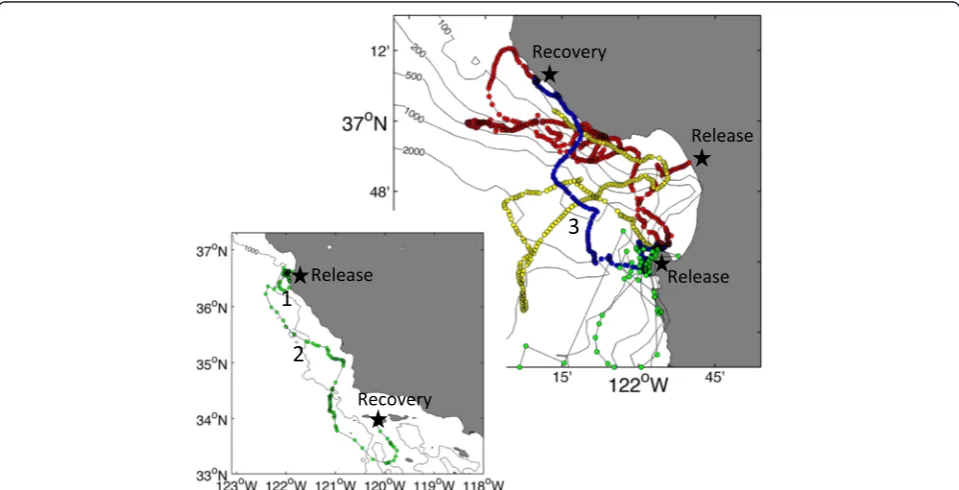
All four translocations proceeded smoothly and the animals were released and later recovered in good health (Fig. 2). The first two individuals were known to have been born at Año Nuevo, while the second two were of unknown origin. The seals took 3–18 days to return to a colony, conducting a regular series of dives during the return transit to depths of up to 778 m (e.g., Fig. 3b). For seal #1, a failure of the SD card led to the sonar tag only pinging for three 4-h“on” intervals and the animal returned to Año Nuevo long after the tag ceased to transmit (Additional file 1: Figure S1; Tables 1 and 2). For seals #2 and #3, the duty cycling operated as pro-grammed and the tags were still functioning when the ani-mals returned to the Año Nuevo colony (Tables 1 and 2). Seal #4 returned to Santa Rosa Island off southern California after 18 days. The tag operated as pro-grammed for the first 8.05 days, after which it ceased
pinging, presumably due to battery failure (Additional file 2: Figure S2).
Regions of enhanced acoustic backscattering were ob-served on all four deployments corresponding to known scattering features. For all of the animals, during time periods spent at the surface between dives, strong scat-tering associated with the ocean surface was observed (e.g., Fig. 3c–e). During many dives, especially those cat-egorized as benthic-type, strong backscattering from the bottom was also evident at very close ranges (<1 m) and at depths consistent with the bathymetry of the region, indicating that the animals often spent protracted pe-riods of time during dives in close association with the bottom (e.g., Fig. 4). For seal #4, for instance, the animal spent the initial 3.5 days post-release near the Monterey Peninsula, repeatedly moving from shallow (<100 m) nearshore waters into deep waters, and then back again (region 1 in Fig. 2), conducting mostly benthic-type di-ves. Scattering observed during this time period was mostly associated with bottom returns and showed
Table 2Sonar tag settings and performance for the four translocated elephant seals
Seal Voltage (V) Transducer location Sonar tag first on Sonar tag last on Times turned on Days operating 1 1 Shoulders April 6, 2012 16:00 April 7, 2012 14:11 3 0.92
2 1 Shoulders April 10, 2012 16:00 April 13, 2012 17:17 9 3.05 3 3 Shoulders April 16, 2012 16:00 April 20, 2012 10:31 6 3.77 4 1 Head April 16, 2012 20:00 April 24 21:06 25 8.05
evidence of the animal following the bottom as it moved in and out of shallow regions (Fig. 4). The exact angles of the transducers relative to the animals were not mea-sured, but were approximately horizontal; assuming that the first bottom return was detected in the second side-lobe (at 45 ° off-axis), a return at 1 m would suggest that the transducer (and hence the top of the animal’s back or head) was only 70.7 cm from the bottom. Returns from closer ranges and/or detected in the first side-lobe or the main lobe would suggest an even closer association with the bottom. Little scattering suggestive of animal-released bubbles [46] was observed, with the exception of
occasional periods of regular enhancements in
backscattering at close range observed during the ascents and descents of dives conducted by seal #1 (Additional file 1: Figure S1E).
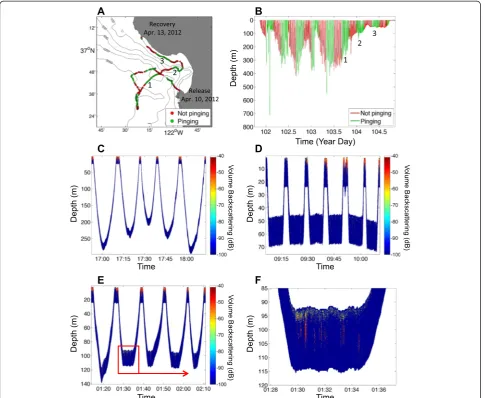
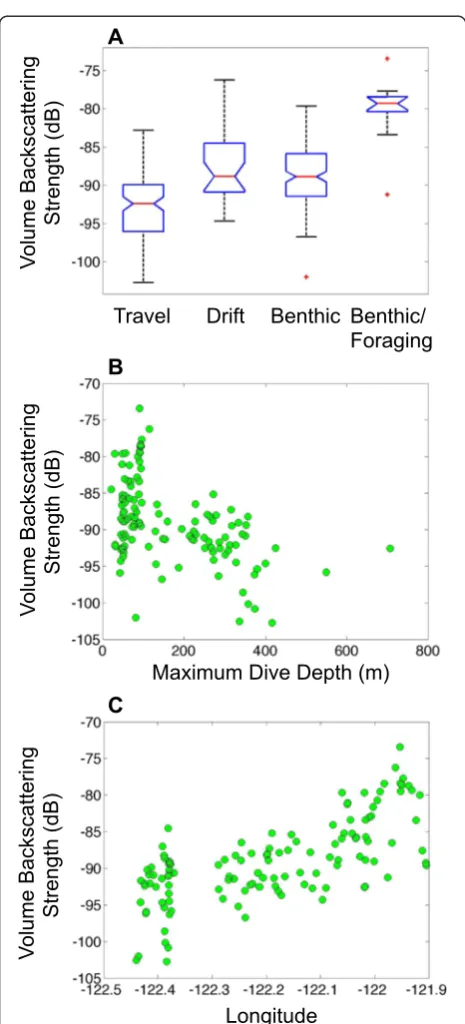
datasets. Seal #2 mostly performed dives categorized as travel-type and benthic-type, and made no pelagic foraging-type dives during time periods when the tag was pinging (Fig. 3b). Low scattering was observed during travel-type (i.e., U-shaped) dives (Fig. 3c), particularly during the time period of relatively directional horizontal movement as the animal moved from the deeper waters at the mouth of Monterey Canyon back toward Monterey Bay (Fig. 3a, region 1). As the animal moved into Monterey Bay and adopted a more tortuous track along the northern flank of Monterey Canyon (Fig. 3a, region 2), it undertook benthic-type dives, defined by prolonged amounts of time spent at relatively constant depths, during which high acoustic scat-tering levels were measured to ranges of up to 3–4 m, sug-gestive of multiple relatively strong targets in the vicinity of the animal (Fig. 3e, f). Later, during a period of more direc-tional movement along the coast and toward the Año Nuevo colony (Fig. 3a, region 3), benthic-type dives contin-ued, but with much reduced levels of backscattering (Fig. 3d). During both periods of benthic-type dives, scattering from the bottom was intermittently observed (Fig. 3d, e), supporting the common inference from TDR data that such dives reflect a close association with the seafloor [44]. Over the course of the entire de-ployment, mean volume backscattering strength dif-fered significantly between dive types (Kruskal-Wallis non-parametric one-way ANOVA chi-square test statis-tic = 45.47, p< 0.001; Fig. 5a). Tukey-Kramer post hoc tests suggested that backscattering during dives catego-rized as travel-type was significantly lower than drift di-ves (thought to be postprandial) and benthic didi-ves. Those benthic dives associated with the time the ani-mal adopted a more tortuous track when near the northern flank of Monterey Canyon were associated with significantly greater backscattering than benthic dives conducted at other times (Fig. 5a). Of the metrics calculated to characterize the animal’s dives, the stron-gest correlates of mean volume backscattering strength
observed during the dives were maximum dive depth (ρ=−0.48, p< 0.001) and the animal’s longitude (ρ= 0.69, p< 0.001) (Fig. 5b, c).
Foraging-type dives conducted at a time when the sonar tag was pinging were only observed for seal #4. This individual was at liberty the longest and spent a prolonged period of time conducting repeated deep di-ves (mostly >200 m) over a period of 4.5 days after departing Monterey Bay and before the batteries on the sonar tag failed as the animal headed south (Additional file 2: Figure S2C, D); seal #4 was also the one animal with the acoustic transducer mounted on its head. Nine dives conducted while the tag was pinging were catego-rized as foraging-type, and in all nine instances, en-hanced scattering stemming from strong single targets was evident (e.g., Fig. 6), primarily during the bottom phases of dives rather than during the ascent or descent. Similar strong single targets in close proximity to the an-imal’s head were also evident, however, during dives cat-egorized as travel- and drift-type. In multiple instances during both foraging- and travel-type dives, successive measurements indicated the presence of scatterers get-ting increasingly close to the animal (e.g., Fig. 6).
at depths of 280–340 m and were observed repeatedly as the animal passed through this depth range (Fig. 7c). Similar observations of multiple targets made at these
relatively large ranges in this depth layer were not evi-dent for the other seals where the sonar tag operated at lower voltages.
Tag effect tests
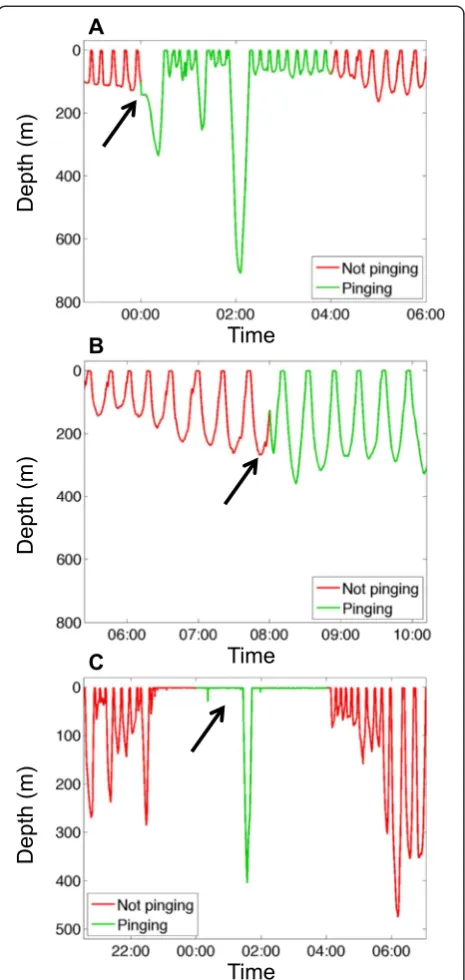
Examination of the dive data indicated mostly normal be-havior. On five occasions out of the 43 total times when a tag started the pinging phase of its duty cycle, the seal soon dived to deeper depths (Fig. 8a). On five different occasions, the tag started pinging as the seal was ascending from a dive and the animal aborted surfacing and dived deeper (Fig. 8b). For both of these unusual dive behaviors, only the dive during which the tag started pinging was affected, after which no abnormal behavior was evident. In the one animal deployed with the sonar tag operating with higher source level (3 V), somewhat atypical diving behavior was evident during two periods when the animal was in deep waters at the mouth of Monterey Bay and spent protracted time at the surface with infrequent dives (Fig. 8c); it is noteworthy, however, that this protracted surface period actually commenced at a time when the tag was not pinging. No obvious changes in diving behavior were evident once the tags stopped pinging entirely for those two an-imals where the tag ceased pinging while the animal was still at liberty (Additional file 1: Figure S1B and Additional file 2: Figure S2D).
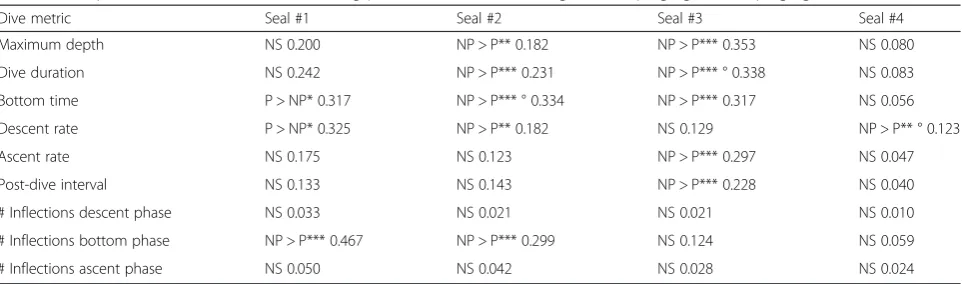
Dive characteristics were also quantified and compared for each animal between times when the tag was pinging vs. when it was not. Statistical comparison of all dives made with the tag pinging relative to those made with it not pin-ging for each seal showed some significant differences for some dive metrics for seals #1–3 (Table 3). These differ-ences were not consistent across all three seals, however, and in some instances the direction of the differences dif-fered; time spent in the bottom phase of dives, for instance, was significantly greater when the tag was pinging vs. not for seal #1, but significantly greater when the tag was not pinging for seals #2 and #3. To some extent, these compari-sons for the first three seals may have been limited by the short deployment durations and small sample sizes, with influences on dive behaviors of the tag being confounded by changes in the seals’location and behavior as they made their way back to the colony. Seal #4 provided the largest sample of dives and showed no significant differences in dive characteristics when the sonar tag was on vs. off other than a slightly higher descent rate when the tag was pinging (Table 3). These analyses based on comparison of individual dives may also be limited by possible serial correlation in dive behavior; statistical comparison of dive metrics aver-aged over all dives made during intervals where the tag was pinging vs. intervals where it was not, however, similarly found few significant differences (in only three of the in-stances revealed by the by-dive analysis as significant) (Table 3).
Fig. 6Sonar tag acoustic data suggestive of prey pursuit.aOne hour subset of acoustic data associated with translocated seal #4 showing strong targets and high scattering observed during foraging-type dives in off-shelf waters south of Monterey Bay (region 2 in Fig. 2).bZoom-in shows targets observed getting closer and closer to the seal on successive pings as the animal increased and then decreased in depth, possibly indicative of prey pursuit
Blood serum cortisol and catecholamine concentrations showed some individual variation, but were within the 95 % confidence limits of published baseline values in juvenile elephant seals [42, 47]. Across the four animals, the concentrations of ACTH, cortisol, and catecholamines (NPI, NE) at the time of recapture did not differ signifi-cantly from samples made at initial capture (Table 4; paired ttests,p> 0.05), suggesting no long-term activation of the hypothalamic-pituitary-adrenal axis due to carrying the tags.
Discussion
Overall, the test deployments of the prototype sonar tag described here demonstrate the value of acoustic mea-surements made from free-ranging animals based on echosounders attached to the animals themselves and, despite the experimental nature of these tests, also allow certain initial insight into elephant seal foraging ecology. Measurements of enhanced acoustic scattering in some instances indicative of the bottom and in others poten-tially indicative of prey were made from all four of the translocated elephant seals, complementing and enhancing the concurrent information provided by the position- and depth-logging tags.
Seal #4 was the one animal where the sonar tag was deployed with the transducer mounted on its head sam-pling water immediately in front of it and also spent the longest time at liberty due to its returning to the Santa Rosa Island colony off southern California (ca. 410 km away from Año Nuevo). Likely as a result, this seal dis-played dive behavior that included a series of dives clas-sified as pelagic foraging-type under the traditional dive classification scheme of LeBoeuf et al. [44] on the basis of inflection points in the TDR data during dive bottom phases, thought to be indicative of foraging. Strong acoustic targets were observed during all of these identi-fied foraging dives associated with the dive bottom phase periods of inflection points. These targets and their associ-ation with putative foraging dives are suggestive of prey, although the sonar tag measurements alone cannot confirm whether or not these scatterers are prey or simply non-prey nearby to the animal; in applications of passive acoustic re-cording tags to echolocating odontocetes, for instance, echoes from nearby strong targets are often observed but based on other indicators of feeding are apparently not se-lected as prey (see review in [28]).
Even though with the sonar tag operating at 1 V tar-gets were mostly only detected against background noise levels to ranges of ca. 2 m from the animal, during for-aging dive bottom phases and periods of inflections in the TDR data, multiple instances were observed of tar-gets getting increasingly close to the animal. In some cases, targets appeared as the seal was descending or as-cending in the water column and then became Fig. 8Representative examples of unusual dive types.a,b
successively closer as the animal changed direction (e.g., Fig. 6b), as might be expected during active prey pursuit, although it is difficult with the present data to distin-guish pursuit from the animal simply approaching a sta-tionary target. It is noteworthy that similar patterns of strong targets potentially consistent with prey were also observed during dives by this seal made close in time and location to the foraging dives but classified as travel- and drift-type. Using accelerometers affixed to the jaws of individual adult female elephant seals during their post-breeding winter migration, Naito et al. [21] similarly detected jaw motions indicative of feeding ing all dive types other than drift dives, and not just dur-ing foragdur-ing-type dives. Together with the present results, this suggests that dive behaviors and the func-tions of different dive types may be more complex than has previously been thought based on TDR data alone.
For the three animals with the transducer mounted on the shoulders and aimed to the side, time spent at liberty was shorter than for seal #4 and movements were stricted to the Monterey Bay vicinity. Nonetheless, re-gions of enhanced backscattering were evident during certain portions of each animal’s transit to the Año Nuevo colony. None of these animals conducted dives categorized as pelagic foraging-type during times when
the sonar tag was pinging. Seal #2 did, however, conduct a series of benthic-type dives along the northern flank of Monterey Canyon at the same time as its horizontal track became more tortuous and less directional. Acous-tic scattering was significantly enhanced at this time relative to nearby dives also categorized as benthic-type that did not show enhanced scattering and where the horizontal track was more directional. Demersal foraging has been speculated as one possible function of these benthic-type dives [44]. The enhanced acoustic scatter-ing observed durscatter-ing the dives along Monterey Canyon was collected with the transducer aimed to the side of the animal, and hence, these measurements likely do not represent prey targeted at that moment, but they none-theless may be indicative of overall greater prey availabil-ity during the dives conducted in that region and time period. Bottom scattering was evident during both pe-riods of benthic-type dives, supporting the earlier infer-ence that the prolonged time spent at relatively constant depths that characterize such dives reflect a close associ-ation with, and perhaps constraint by, the bottom [44].
Seal #3 conducted a series of travel-type dives where aggregations of strong scatterers were observed to ranges in excess of 15 m from the animal (and to its side relative to the transducer mounted on the seal’s back). Based on these data, it is not certain whether the seal was simply passing through these aggregations or foraging during these dives (despite their having been classified as travel- rather than foraging-type). It is noteworthy, however, that Naito et al. [21] detected jaw motions indicative of feeding during descents and ascents as well as during the bottom phases of dives. Irrespective of whether or not seal #3 was foraging, these measurements demonstrate the abil-ity of the sonar tag to characterize scatterer abundance in the water column and provide a quantitative descriptor of
Table 4Mean (± standard error) stress hormone concentrations at capture and recovery for the four translocated seals
Cortisol (nM) EPI (pM) NE (nM) ACTH (pM) Capture 181 (68) 273 (32) 1.75 (0.22) 4.1 (0.8) Recovery 126 (26) 258 (12) 1.58 (0.15) 3.0 (0.2)
pvalue p= 0.56 p= 0.65 p= 0.51 p= 0.32
pvalues are for a pairedttest comparing hormone concentrations at capture and recovery
EPIepinephrine,NEnorepinephrine,ACTHadrenocorticotropic hormone
Table 3Comparison of dive characteristics during periods when the sonar tag was not pinging (NP) vs. pinging (P)
Dive metric Seal #1 Seal #2 Seal #3 Seal #4 Maximum depth NS 0.200 NP > P** 0.182 NP > P*** 0.353 NS 0.080 Dive duration NS 0.242 NP > P*** 0.231 NP > P*** ° 0.338 NS 0.083 Bottom time P > NP* 0.317 NP > P*** ° 0.334 NP > P*** 0.317 NS 0.056 Descent rate P > NP* 0.325 NP > P** 0.182 NS 0.129 NP > P** ° 0.123 Ascent rate NS 0.175 NS 0.123 NP > P*** 0.297 NS 0.047 Post-dive interval NS 0.133 NS 0.143 NP > P*** 0.228 NS 0.040 # Inflections descent phase NS 0.033 NS 0.021 NS 0.021 NS 0.010 # Inflections bottom phase NP > P*** 0.467 NP > P*** 0.299 NS 0.124 NS 0.059 # Inflections ascent phase NS 0.050 NS 0.042 NS 0.028 NS 0.024
Kolmogorov-Smirnov tests were used to compare the distribution of these metrics comparing all dives made by each seal with the system pinging relative to when it was not. Table entries provide the Kolmogorov-Smirnov test statistics and for comparisons where dive metrics differed significantly indicate whether the metric was greater with the system pinging (P > NP) or not pinging (NP > P) and indicate the significance level. Kolmogorov-Smirnov tests were also conducted on the average of metrics for all dives conducted during a pinging or non-pinging interval. The small number of such intervals limits the power of these tests, which mostly found non-significant differences, other than three tests (denoted via°) where differences were significant at thep< 0.05 level
NSnon-significant
the animal’s environment, as has been done previously using passive acoustic measurements of backscattering made from echolocating beaked whales [48]. Findings such as the correlation of mean dive backscattering with longi-tude for seal #2 furthermore demonstrate the potential of using the seal effectively as an autonomous platform for oceanographic observation in order to map regional back-scattering patterns. Similarly, in addition to measurements of water column scattering, bottom returns were clearly de-tected during all four deployments. The sonar tag can thus additionally be used as an altimeter to estimate height off the bottom during dives (similar to [48]), potentially provid-ing insight into the means by which elephant seals travel and navigate. In locations where bathymetry data are sparse or unavailable, this information could also be used to map bottom depth, similar to how the depth of southern ele-phant seals’benthic dives have been used as an estimate of bathymetry in under-sampled regions of the Antarctic con-tinental shelf [49].
The single-frequency measurements made by the sonar tag do not provide enough information to make inferences about the exact nature of observed water column scatterers based on the acoustic data themselves, but the targets are likely to be geometric scatterers of size greater than the acoustic wavelength of 0.75 cm. The depths of the targets and aggregations observed by seals #3 and #4 (ca. 280– 350 m) are also consistent with the off-shelf deep scattering layer, typically thought to be composed of a mixture of small fishes (e.g., myctophids) and large invertebrates (e.g., squid, shrimp, gelatinous organisms) [50]. Although insights were gained about the seal’s environment and availability of possible prey, because the present proto-type system was limited in the voltages, and hence source levels, at which it was operated, overall few tar-gets were observed and measurements of water column scatterers at 1 V were limited to ca. 4 m. With the system operating at 3 V, observations of acoustic targets were made to ranges greater than 15 m, however, far exceeding the limits of camera systems associated with the rapid attenu-ation of light in seawater and highlighting the ability of the sonar tag to make high resolution and frequent measure-ments to relatively large ranges.
Previous studies have enjoyed a great deal of success in studying the foraging ecology of elephant and other seal species using indirect indices of foraging based on dive behavior [e.g., 9, 10, 20, 44, 51] and horizontal movement patterns [e.g., 3, 14, 16, 18], indices of buoy-ancy indicative of successful foraging [e.g., 9, 10, 17, 20], measurements of stomach temperature as an indicator of prey consumption [52], and more recently measure-ments made with accelerometers to measure jaw motion [21] and acoustic transceivers designed to measure the at-sea associations of multiple animals instrumented with acoustic pinger tags [53, 54]. The acoustic
measurements made by the sonar tag do not themselves provide evidence that observed targets are prey, but they do provide a relative indication of the abundance and potentially size of nearby animals. The potential insight into foraging ecology promised by the sonar tag thus complements the mostly indirect information provided by these approaches with direct observations of nearby organisms and extends the time scales over which infor-mation can be collected; by providing measurements to relatively large ranges, the sonar tag also offers poten-tially valuable information to understanding foraging and fine scale prey capture behaviors through observa-tions of organisms not targeted and/or not captured and estimates of encounter rates. Measurements of backscat-tering from free-ranging animals have provided substan-tial insight into prey distribution and foraging ecology for echolocating odontocete species, using passive acoustic re-cording tags (notably the DTAG [55]) that receive back-scattering arising from the echolocations of tagged individuals [28]; the sonar tag extends possibilities for such on-animal measurements of backscattering to non-echolocating species. Future deployments of the sonar tag in conjunction with other approaches (e.g., jaw accelerom-eters and video systems) would provide greater insight into questions such as whether or not observed acoustic targets represent prey, whether associated patterns in the TDR data represent pursuit, and whether targets are captured.
The behavior of the animals instrumented with the sonar tag was consistent with that of previously studied animals with data-logging tags attached, but without the sonar tag [32]. Previous studies have found no detectable effect of typical tag packages (e.g., TDR, radio transmitters) on the homing rate or homing speed of translocated ele-phant seals [32], and our emphasis was thus on examining the potential impact of bearing the sonar tag, in addition to the other complement of other instruments attached to our study seals. The experimental animals took 3–18 days to re-turn to a colony, with three of the individuals rere-turning to the Año Nuevo colony and the fourth to the colony at Santa Rosa Island. Previous translocation studies have found that the majority of animals swim in a directional fashion to Año Nuevo, but that a minority takes a more cir-cuitous route and requires a longer time to return (>7 days), and infrequently (ca. 10–20 %), animals will return to a col-ony other than Año Nuevo ([32], D. Costa unpublished ob-servations). Our findings thus fall within the range of observations of previous studies. The fact that the one ani-mal returned to a colony other than the Año Nuevo loca-tion where it was captured is also less surprising given that it was not known whether or not this animal was born at Año Nuevo.
and the transducer’s relatively strong performance in the 1–55 kHz band where the animal can hear was unex-pected. Although we were able to take measures to re-duce this off-band output, budget constraints prevented us from realizing fully our design goal of having the sonar tag be entirely inaudible to the seal. The threshold for reversible hearing effects (i.e., temporary threshold shift) within the elephant seal’s hearing range has been shown to be ca. 140–150 dB (received level) based on behavioral psychophysical studies of responses to signals of 500 ms in duration [56, 57]. Given the off-axis source levels and much shorter durations (150 μs) of the sonar tag’s signals, the sound levels received by the seal were certainly much lower than this threshold for temporary loss of hearing sensitivity. We were mindful of the im-portance of examining the potential impact of the sonar tag on the test animals since, for instance, translocated northern elephant seals instrumented with passive acoustic data loggers that were exposed to the Acoustic Thermometry of the Ocean Climate (ATOC) low-frequency sound source exhibited subtle changes in their diving behavior [34]. Unusual dive patterns were in some instances observed associated with the first dive in a 4-h pinging interval. Statistical comparisons of dive charac-teristics associated with times when the sonar tags were pinging vs. not pinging also showed some differences, al-though which characteristics and the direction of the ef-fect differed between individuals and did not show any consistent patterns. Overall, effects of the sonar tag on seal behavior appeared relatively minor and mostly asso-ciated with the start of a 4-h pinging interval. Furthermore, the concentrations of stress hormones measured in blood sampled at the time of recapture did not differ significantly from samples made at initial capture and
were typical for free-ranging juveniles [42, 47].
Characterization of hormones associated with the general-ized stress response is a common method for evaluating the significance of a disturbance on marine mammals and information regarding stress markers is informative on the effects of varying stress levels on individuals’health [58]. These results thus suggest that the fact that the tag was likely audible to the seals did not cause them any long-term stress [42].
Conclusion
A miniaturized high-frequency autonomous echosoun-der was developed, and a series of four successful test deployments of this prototype sonar tag was conducted on juvenile elephant seals translocated short distances away from their colony at Año Nuevo State Reserve, California. During dives made over the course of their return transits, measurements were made of enhanced acoustic scattering consistent in some instances with po-tential prey and in others with the bottom, often
associated with particular dive and movement behaviors. Strong backscattering from the bottom was observed during dives identified as benthic-type under the trad-itional classification scheme of LeBoeuf et al. [44], con-firming a very close (often <1 m) association with the seafloor; enhanced near-bottom backscattering during a subset of these dives suggested possible demersal for-aging [44]. Measurements of water column backscatter-ing were mostly low durbackscatter-ing travel-type dives, with the exception of one animal that transited repeatedly through a depth range of strong acoustic targets consist-ent with the deep scattering layer. The one animal that spent the longest amount of time at liberty conducted a series of deep off-shelf dives classified as pelagic foraging-type during which strong acoustic targets were observed, in multiple instances getting increasingly close to the animal. These observations are possibly consistent with prey pursuit although the sonar tag measurements alone do not provide conclusive evidence that observed targets are prey. Similar patterns of strong targets at depth were also evident during dives classified as travel-type, possibly suggesting that the functions of different dive types may be more complex than has been thought based on time-depth recorder data alone.
The initial data described here demonstrate the value of acoustic observations of nearby organisms made from free-ranging animals based on echosounders attached to the animals themselves. Such observations hold potential for characterizing prey distributions and providing insight into foraging ecology, both complementing and enhancing the information provided by traditional position- and depth-logging tags. The key advantages of the sonar tag lie in a combination of high resolution and frequent measurements made to relatively large ranges; as a result, ecologically meaningful measurements were made to ranges in excess of 15 m, exceeding, for in-stance, the limits of optical systems associated with the rapid attenuation of light in seawater.
periods spent at sea. Future efforts will thus focus on a series of modifications to the current tag design including the following: (1) reducing the system’s output in the seal’s hearing band while simultaneously increasing the output at the operational frequency, in part by using a higher fre-quency; (2) further miniaturization and design of a more hydrodynamic housing; and (3) increasing the maximum deployment duration through more efficient power con-sumption and duty cycling. Pending the continued success of this development, our hope is to use the sonar tag in studies of the foraging ecology and habitat use of adult fe-male elephant seals over the broad spatial scales over which they migrate and over the long time periods that they spend at sea. Ultimately, the sonar tag potentially could be de-ployed on any marine animal large enough to bear it and where tag attachment and recovery is feasible.
Additional files
Additional file 1: Figure S1.Track, dive, and acoustic data associated with translocated seal #1. (A) Track and (B) dive data for seal #1, with green denoting times when the sonar tag was pinging. (C) A one hour’s worth subset of the acoustic data associated with the region denoted by 1 in panels A and B with volume backscattering strength (dB) plotted on the color scale relative to time and range from the animal. Scattering from the surface and bottom are clearly evident. (D) The same acoustic data as in panel C corrected for the depth of the animal; note that for ease of presentation the acoustic data are plotted starting at the animal’s depth and extending vertically downwards even though the transducer was mounted on the animal’s back sideways looking. (E) Enhanced water column scattering observed during the ascent phase of the first dive shown in panel D. Such regular patterns of enhanced backscattering were evident during the descent and ascent phases of multiple of the animal’s dives.
Additional file 2: Figure S2.Track, dive, and acoustic data associated with translocated seals #3 and #4. (A) Track and (B) dive data associated with translocated seal #3, with green denoting times when the sonar tag was pinging. Note the periods of prolonged surface-associated behavior punctuated by few very deep dives when the sonar tag was pinging while the seal was in deep waters at the mouth of Monterey Canyon. Region denoted by 1 in panels A and B indicates the location of the acoustic data shown in Fig. 7. (C) Track and (D) dive data for seal #4. Regions denoted by 1 and 2 in panels C and D indicate the location of acoustic data shown in Figs. 4 and 6, respectively.
Abbreviations
ACTH:adrenocorticotropic hormone; ANOVA: analysis of variance; ATOC: Acoustic Thermometry of the Ocean Climate; DSP: digital signal processor; EPI: plasma epinephrine; GPS: Global Positioning System; NE: norepinephrine; RIA: radioimmunoassay; SNR: signal-to-noise ratio; TDR: time-depth recorder.
Competing interests
The authors declare that they have no competing interests.
Authors’contributions
This study and the sonar tag concept were conceived jointly by GLL, DPC, ACL, and PHW. FMJ, ACL, GLL, and PHW designed the sonar tag, guided with input specific to the elephant seal application by DPC and LAH. FMJ and JRF built the two prototype sonar tag units and conducted calibrations and initial performance tests. LAH, DPC, GLL, PHW, and DEC designed the translocation experiments, which were executed by LAH, DPC, FMJ, JRF, GLL, and PHW. GPS and TDR data were processed by LAH, stress hormone samples were processed by DEC, and sonar data were processed by FMJ,
ACL, JRF, and GLL. GLL conducted data synthesis and statistical analysis. All authors helped to draft the manuscript and read and approved the final manuscript.
Acknowledgements
This work was conducted under National Marine Fisheries Service permit #14636 and with the approval of the WHOI and UCSC Institutional Animal Care and Use Committees. We gratefully acknowledge the field assistance and seal handling capabilities of Selene Fregosi, Michael Tift, Sarah Peterson, Claudio Rojas, and John Harley. Keenan Ball provided much appreciated assistance with source level calibrations. The measures taken to assess any negative effects on the study animals benefited substantially from discussions with Peter Tyack and Mark Baumgartner. The board upon which the sonar tag was based was originally designed by Thomas Austin and Eugene Terray. Support for tag development was provided by The Cecil H. and Ida M. Green Technology Innovation Awards. The elephant seal fieldwork was supported by the E&P Sound and Marine Life Joint Industry Project of the International Association of Oil and Gas Producers (JIP2207–23), The Ida Benson Lynn Endowed Chair in Ocean Health, and grant N00014-10-1-0356 from the Office of Naval Research. Recapture of the fourth seal at Santa Rosa Island was supported by the Margaret A. Cargill Foundation.
Author details
1Woods Hole Oceanographic Institution, Woods Hole, MA 02543, USA. 2
Department of Ecology and Evolutionary Biology, University of California Santa Cruz, 100 Shaffer Rd, Santa Cruz, CA 95060, USA.3Department of
Biology, Sonoma State University, Rohnert Park, CA 94928, USA.
Received: 3 January 2015 Accepted: 19 June 2015
References
1. Holland KN, Brill RW, Chang RKC. Horizontal and vertical movements of yellowfin and bigeye tuna associated with fish aggregating devices. Fish Bull. 1990;88:493–508.
2. Lawson GL, Castleton MC, Block BA. Movements and diving behavior of Atlantic bluefin tuna (Thunnus thynnus) in relation to water column structure in the northwestern Atlantic. Mar Ecol Prog Ser. 2010;400:245–65. 3. Simmons SE, Crocker DE, Hassrick JL, Kuhn CE, Robinson PW, Tremblay Y,
et al. Climate-scale hydrographic features related to foraging success in a capital breeder, the northern elephant sealMirounga angustirostris. Endanger Species Res. 2010;10:233–43.
4. Peckham SH, Maldonado-Diaz D, Tremblay Y, Ochoa R, Polovina J, Balazs G, et al. Demographic implications of alternative foraging strategies in juvenile loggerhead turtles Caretta caretta of the North Pacific Ocean. Mar Ecol Prog Ser. 2011;425:269–80.
5. Costa DP, Breed GA, Robinson PW. New insights into pelagic migrations: implications for ecology and conservation. Annu Rev Ecol Evol Syst. 2012;43:73–96.
6. Weimerskirch H, Louzao M, de Grissac S, Delord K. Changes in wind pattern alter albatross distribution and life-history traits. Science. 2012;335:211–4. 7. Bost CA, Cotté C, Bailleul F, Cherel Y, Charrassin JB, Guinet C, et al. The
importance of oceanographic fronts to marine birds and mammals of the southern oceans. J Mar Syst. 2009;78:363–76.
8. Block BA, Jonsen ID, Jorgensen SJ, Winship AJ, Shaffer SA, Bograd SJ, et al. Tracking apex marine predator movements in a dynamic ocean. Nature. 2011;475:86–90.
9. Bailleul F, Charrassin J-B, Monestiez P, Roquet F, Biuw M, Guinet C. Successful foraging zones of southern elephant seals from the Kerguelen Islands in relation to oceanographic conditions. Proc R Soc Lond B. 2007;362:2169–81.
10. Biuw M, Boehme L, Guinet C, Hindell M, Costa D, Charrassin JB, et al. Variations in behavior and condition of a Southern Ocean top predator in relation to in situ oceanographic conditions. Proc Natl Acad Sci. 2007;104:13705–10. 11. Teo SLH, Kudela RM, Rais A, Perle C, Costa DP, Block BA. Estimating chlorophyll profiles from electronic tags deployed on pelagic animals. Aquat Biol. 2009;5:195–207.
13. Jaud T, Dragon A-C, Garcia JV, Guinet C. Relationship between chlorophyll a concentration, light attenuation and diving depth of the southern elephant sealMirounga leonina. PLoS ONE. 2012;7:e47444.
14. Simmons SE, Crocker DE, Kudela RM, Costa DP. Linking foraging behaviour of the northern elephant seal with oceanography and bathymetry at mesoscales. Mar Ecol Prog Ser. 2007;346:265–75.
15. McConnell BJ, Fedak MA. Movements of southern elephant seals. Can J Zool. 1996;74:1485–96.
16. Dragon AC, Bar-Hen A, Monestiez P, Guinet C. Comparative analysis of methods for inferring successful foraging areas from Argos and GPS tracking data. Mar Ecol Prog Ser. 2012;452:253–67.
17. Biuw M, McConnell BC, Bradshaw JA, Burton H, Fedak M. Blubber and buoyancy: monitoring the body condition of free-ranging seals using simple dive characteristics. J Exp Biol. 2003;206:3405–23.
18. Bailleul F, Pinaud D, Hindell M, Charrassin JB, Guinet C. Assessment of scale-dependent foraging behaviour in southern elephant seals incorporating the vertical dimension: a development of the first passage time method. J Anim Ecol. 2008;77:948–57.
19. Biuw M, Nost OA, Stien A, Zhou Q, Lydersen C, Kovacs KM. Effects of hydrographic variability on the spatial, seasonal and diel diving patterns of Southern elephant seals in the Eastern Weddell Sea. PLoS ONE. 2010;5:e13816.
20. Robinson PW, Costa DP, Crocker DE, Gallo-Reynoso JP, Champagne CD, Fowler MA, et al. Foraging behavior and success of a mesopelagic predator in the northeast Pacific Ocean: insights from a data-rich species, the northern elephant seal. PLoS ONE. 2012;7:e36728.
21. Naito Y, Costa DP, Adachi T, Robinson PW, Fowler M, Takahashi A. Unraveling the mysteries of a mesopelagic diet: a large apex predator specializes on small prey. Funct Ecol. 2013;27:710–7.
22. Friedlaender AS, Lawson GL, Halpin PN. Evidence of resource partitioning between humpback and minke whales around the Western Antarctica Peninsula. Mar Mamm Sci. 2009;25:402–15.
23. Friedlaender AS, Johnston DW, Fraser WR, Burns J, Halpin PN, Costa DP. Ecological niche modeling of sympatric krill predators around Marguerite Bay, Western Antarctic Peninsula. Deep-Sea Res Part II. 2011;58:1729–40. 24. Croll DA, Tershy BR, Hewitt RP, Demer DA, Fiedler PC, Smith SE, et al. An
integrated approach to the foraging ecology of marine birds and mammals. Deep-Sea Res Part II. 1998;45:1353–71.
25. Baumgartner MF, Mate BR. Summertime foraging ecology of North Atlantic right whales. Mar Ecol Prog Ser. 2003;264:123–35.
26. Hazen EL, Friedlaender AS, Thompson MA, Ware CR, Weinrich MT, Halpin PN, et al. Fine-scale prey aggregations and foraging ecology of humpback whalesMegaptera novaeangliae. Mar Ecol Prog Ser. 2009;395:75–89. 27. Nowacek DP, Friedlaender AS, Halpin PN, Hazen EL, Johnston DW, Read AJ,
et al. Super-aggregations of krill and humpback whales in Wilhelmina Bay, Antarctic Peninsula. PLoS ONE. 2011;6:e19173.
28. Johnson M, de Soto Aguillar N, Madsen PT. Studying the behavior and sensory ecology of marine mammals using acoustic recording tags: a review. Mar Ecol Prog Ser. 2009;395:55–73.
29. Moll RJ, Millspaugh JJ, Beringer J, Sartwell J, Zhihai H. A new‘view’of ecology and conservation through animal-borne video systems. Trends Ecol Evol. 2007;22:660–8.
30. Lawson GL, Wiebe PH, Stanton TK, Ashjian CJ. Euphausiid distribution along the Western Antarctic Peninsula—(A) development of robust multi-frequency acoustic techniques to identify euphausiid aggregations and quantify euphausiid size, abundance, and biomass. Deep-Sea Res Part II. 2008;55:412–31.
31. Miyamoto Y, Sakai T, Furusawa M, Naito Y. Development of high-frequency micro echo sounder. Fisheries Sci. 2004;70:381–8.
32. Oliver GW, Morris PA, Thorson PH, LeBoeuf BJ. Homing behavior of juvenile northern elephant seals. Mar Mamm Sci. 1998;14:245–56.
33. Burgess WC, Tyack PL, Le Boeuf BJ, Costa DP. A programmable acoustic recording tag and first results from free-ranging northern elephant seals. Deep-Sea Res Part II. 1998;45:1327–51.
34. Costa DP, Crocker DE, Webb PM, Houser DS, Blackwell SB, Waples D, et al. The effect of a low-frequency sound source (acoustic thermometry of the ocean climate) on the diving behavior of juvenile northern elephant seals,
Mirounga angustirostris. J Acoust Soc Am. 2003;113:1155–65.
35. Aoki K, Watanabe YY, Crocker DE, Robinson PW, Biuw M, Costa DP, et al. Northern elephant seals adjust gliding and stroking patterns with changes
in buoyancy: validation of at-sea metrics of body density. J Exp Biol. 2011;214:2973–87.
36. Jaffré FM, Austin TC, Terray G. Miniature, low power, generic Doppler sonar. OCEANS 2010;20–23 Sept. 2010. doi:10.1109/OCEANS.2010.5663860. 37. Tressler JF, Corsaro RD. Properties of Corprene, revisited. J Acoust Soc Am.
2014;135:2481–4.
38. Kastak D, Schusterman RJ. In-air and underwater hearing sensitivity of a northern elephant seal (Mirounga angustirostris). Can J Zool. 1999;77:1751–8. 39. Horowitz P, Hill W. The art of electronics. 2nd ed. New York: Cambridge
University Press; 1989.
40. Foote KG, Knudsen HP, Vestnes G, MacLennan DN, Simmonds EJ. Calibration of acoustic instruments for fish density estimation: a practical guide. ICES Coop Res Rep. 1987;144:1–69.
41. Lavery AC, Chu D, Moum J. Measurements of acoustic scattering from zooplankton and oceanic microstructure using a broadband echosounder. ICES J Mar Sci. 2010;67:379–94.
42. Champagne CD, Houser DS, Costa DP, Crocker DE. The effects of handling and anesthetic agents on the stress response and carbohydrate metabolism in northern elephant seals. PLoS ONE. 2012;7:e38442.
43. Ensminger DC, Somo DA, Houser DS, Crocker DE. Metabolic responses to adrenocorticotropic hormone (ACTH) vary with life-history stage in adult male northern elephant seals. Gen Comp Endocrin. 2014;204:150–7. 44. LeBoeuf DJ, Naito Y, Asaga T, Crocker D, Costa DP. Swim speed in a female
northern elephant seal metabolic and foraging implications. Can J Zool. 1992;70:786–94.
45. Hindell MA, Slip DJ, Burton HR. The diving behavior of adult male and female southern elephant seals,Mirounga leonine(Pinnipedia, Phocidae). Aust J Zool. 1991;39:595–619.
46. Hooker SK, Miller PJO, Johnson MP, Cox OP, Boyd IL. Ascent exhalations of Antarctic fur seals: a behavioural adaptation for breath-hold diving? Proc R Soc Lond B. 2005;272:355–63.
47. Kelso EJ, Champagne CD, Tift MS, Houser DS, Crocker DE. Sex differences in fuel use and metabolism during development in fasting juvenile northern elephant seals. J Exp Biol. 2012;215:2637–45.
48. Arranz P, de Soto NA, Madsen PT, Brito A, Bordes F, Johnson MP. Following a foraging fish-finder: diel habitat use of Blainville’s beaked whales revealed by echolocation. PLoS ONE. 2011;6:e28353.
49. Padman L, Costa DP, Bolmer ST, Goebel ME, Huckstadt LA, Jenkins A, et al. Seals map bathymetry of the Antarctic continental shelf. Geophys Res Lett. 2010;37:L21601.
50. Davies IE, Barham EG. The Tucker opening-closing micronekton net and its performance in a study of the deep scattering layer. Mar Biol. 1969;2:127–31. 51. Thums M, Bradshaw CJA, Hindell MA. A validated approach for supervised
dive classification in diving vertebrates. J Exp Mar Biol Ecol. 2008;363:75–83. 52. Kuhn CE, Crocker DE, Tremblay Y, Costa DP. Time to eat: measurements of
feeding behaviour in a large marine predator, the northern elephant seal Mirounga angustirostris. J Anim Ecol. 2009;78:513–23.
53. Lidgard DC, Bowen WD, Jonsen ID, Iverson SJ. Animal-borne acoustic transceivers reveal patterns of at-sea associations in an upper-trophic level predator. PLoS ONE. 2012;7:e48962.
54. Hayes SA, Teutschel NM, Michel CJ, Champagne C, Robinson PW, Folwer M, et al. Mobile receivers: releasing the mooring to“see”where fish go. Environ Biol Fish. 2013;96:189–201.
55. Johnson MP, Tyack PL. A digital acoustic recording tag for measuring response of wild marine mammals to sound. J Oceanic Eng. 2003;28:3–11. 56. Kastak D, Schusterman RJ, Southall BL, Reichmuth CJ. Underwater
temporary threshold shift induced by octave-band noise in three species of pinniped. J Acoust Soc Am. 1999;106:1142–8.
57. Kastak D, Southall B, Schusterman RJ, Reichmuth Kastak C. Underwater temporary threshold shift in pinnipeds: effects of noise level and duration. J Acoust Soc Am. 2005;118:3154–63.