Salunkhe et al. World Journal of Engineering Research and Technology
TESTING AND PERFORMANCE OF SINGLE CYLINDER CI ENGINE
WITH USING RICE BRAN BIODIESEL
Sagar A. Salunkhe*1 and Prof. Dr. M. K. Chopra2
1
P.G., Student M.E (Mechanical), RKDF Institute of Science & Technology Bhopal, 462047. 2
Professor & Head of Department of Mechanical Engineering RKDF Institute of Science &
Technology Bhopal, 462047.
Article Received on 12/10/2018 Article Revised on 02/11/2018 Article Accepted on 23/11/2018
ABSTRACT
The consumption of fuels in the world is increasing rapidly and it
affects the global economy of all the countries so this factor forced all
the countries to find the alternative fuel to reduce and even replace the
usage of petroleum fuel. Thus use of biodiesel from non-edible oil
sources serves as an alternative fuel to overcome this problem. The
present study focuses on impact assessment of rice bran and crude rice
bran biodiesel and its blends with diesel on diesel engine performance and testing. The
experimental analysis provides in study detail of the biodiesel production process, fuel
properties evaluation and impact on engine performance testing. The study also investigates
the optimization of the Compression ratio (CR) of a compression ignition engine fueled with
blends of biodiesel. In order to find out the optimum CR of the engine, experiments were
conducted at different CRs ranging from 12 to 18. Then the experiments were conducted
using B10, B20 and B30 blends of crude rice bran bio-diesel and diesel at CR of 14 and 16
and these results were compared with the results obtained when the same engine was tested
on conventional diesel fuel. Similarly the experimental results of B10, B20 and B30 blends of
rice bran bio-diesel at CR 14 were investigated and analyzed. Based on the experimental
investigation the blends of crude rice bran bio-diesel can be used as fuel in diesel engine
without making any modification to the diesel engine.
World Journal of Engineering Research and Technology
WJERT
www.wjert.org
SJIF Impact Factor: 5.218*Corresponding Author
Sagar A. Salunkhe
KEYWORDS: Biodiesel; Transesterification; Crude rice bran oil; Rice bran oil; Diesel Engine.
I. INTRODUCTION
More than 90% world’s rice production coming from Asia. Rice production first among
agricultural commodity of Indonesia. Rice bran is a brown layer present between rice and the
outer husk of the paddy. Rice bran oil is an important derivative of rice. Depending on variety
of rice and degree of milling, the bran contains 16-32 wt% of oil. About 60-70% of the oil
produced from this bran is non-edible oil, due to the problems attributed to the stability and
storage of the rice bran and the dispersed nature of rice milling. Rice bran oil (RBO) is
considered to be one of the most nutritious oils due its favorable fatty acid composition and
unique combination of naturally occurring biologically active and antioxidant compounds.[1,2]
Biodiesel can be produced from a great variety of feedstock’s which includes most common
vegetable oils (e.g., soybean, cottonseed, palm, peanut, rapeseed/canola, sunflower, coconut)
and animal fats (usually tallow) as well as waste oils (e.g., used frying oils). The choice of
feedstock depends largely on availability. Biodiesel has a higher cetane number than diesel
fuel, no aromatics, no sulfur, and contains 10–11% oxygen by weight.[3,4] Generally the direct
use of vegetable oils in the diesel engine is not recommended due to their high viscosity,
which affects combustion. So in order to reduce its viscosity so that it can be used in common
diesel engines without making any modification in the engine the transesterification method
is used to reduce the high viscosity of oil.[5–8] The results obtained show a 49% reduction in
smoke, 35% reduction in HC and 37% reduction in CO emissions for the blends whereas the
brake power and BTE are reduced by 2.4% and 3.2% respectively with 4.3% increase in the
SFC . Therefore it is concluded from the present experimental study that the blends of RBO
and Diesel fuel can successfully be used in Diesel engines as an alternative fuel without any
modification in the engine and it is also environment friendly by the emission standards. The
present research is aimed to investigate experimentally the performance and exhaust emission
characteristics of a direct injection (DI) diesel engine when fuelled with conventional diesel
fuel, rice bran oil biodiesel, a blend of diesel and rice bran oil biodiesel and three blends of
diesel-biodiesel-ethanol over the entire range of load on the engine.[9-10] Rice bran oil ranks
first among the non-conventional, inexpensive, low-grade vegetable oils. Furthermore, crude
rice bran oil is a rich source of high value-added byproduct. Therefore, use of rice bran oil as
raw material for the production of biodiesel not only makes the process economical but also
make the process attractive and remunerative. Thus, if the by-products are derived from crude
rice bran oil and the resultant oil is used as feedstock for biodiesel, the resulting biodiesel
could be quite economical and affordable. In the present study, crude rice bran oil and refined
rice bran oil are chosen as potential alternatives for producing biodiesel and use as fuel in
four stroke compression ignition engines.[11-13] The kinematic viscosity of crude rice bran oil
and refined rice bran oil is however several times higher than that of diesel oil[6] and this
leads to problems in pumping and atomization in the injection system of a diesel engine so
their viscosity must be lowered. The combined effect of high viscosity and low volatility
causes poor cold engine start up, misfire and ignition delay. Hence, it is necessary to bring
their combustion related properties closer to those of diesel oil.[4] The free fatty acid (FFA)
content of crude rice bran oil is high depending on the quality of rice bran from which the oil
has been extracted. Because of the high FFA content for crude rice bran oil a 2-stage
transesterification process is carried out which includes an acid catalyzed transesterification
followed by a base catalyzed transesterification. For refined rice bran oil a single stage base
catalyzed transesterification was carried out. The present study focuses on production and
performance evaluation of rice bran biodiesel as an alternative source of fuel.
In India, total consumption of crude oil was 103,44 million tonnnes (MT) in 2000-2001and
160.03MT in 10,whereas production was 32.43MT in 200-01 and 33.69MT in
2009-10.Thus increment in production is only 3.7% as compared to increment in computation of
35.36%1.Transportation and agricultural sectors are major consumers of fossil fuel and
biggest contributors to environmental pollution. Current price of vegetable oil worldwide is
nearly competitive with petroleum based fuels.
II. Biodiesel Production by Transesterification Method
The idea of using plant-based oils, such as soybean oil or canola oil, to fuel an internal
combustion engine is as old as the diesel engine itself. Rudolph Diesel, inventor of the diesel
engine, used peanut oil to demonstrate his new invention at the Paris World’s Exhibition in
1900. Throughout the 20th century, however, petroleum-based diesel fuel has been relatively
cheap and convenient. As a result, diesel engines have been refined through the years to work
well with this fuel source. Petroleum diesel flows more easily (i.e. is less viscous) than either
plant or animal based fats and oils. As a result, using non-petroleum-based oils in today’s
diesel engines requires either modifying the vehicle’s fuel system to accept these slower
The chemical process commonly used make bio-oils less viscous, turning them into
“biodiesel” is called “transesterification”. Rice bran oil and methanol were mixed and poured
into the test reactor. Then base catalyst (CAO) in 1% w/w was added into the already present
mixture in the reactor. The mixture inside the reactor was heated to a temperature of 65 0C
and stirred continuously. The mixture in the reactor was allowed to remain at the same
temperature for a period of 3 hrs and then it was allowed to settle under gravity. After settling
two layers were formed, the upper layer was found to be Rice bran
oil methyl esters (RBO) and the lower layer being glycerol.
• Biodiesel is made from the combination of a triglyceride with a monohydroxy alcohol (i.e. methanol, ethanol…).
• What is a triglyceride? Made from a combination of glycerol and three fatty acids.
Fig. 1: Chemistry of triglycerides.
Tran’s esterification
While actually a multi-step process, the overall reaction looks like this.
Vegetable Oil Biodiesel
III. Preparation of Biodiesel Blends
After production the RBO was blended with neat diesel fuel in various volume concentrations
to prepare biodiesel blends. These blends were subsequently used in the engine tests. The
level of blending for convenience is referred as RBXX. Where XX indicates the percentage
of biodiesel present in the blend. For example a RB10 blend is prepared with 10% biodiesel
and 90% diesel oil by volume. During the present engine experiments the blends prepared
and used were RB10, RB20, and RB30.
IV. Properties of biodiesel comparison with diesel
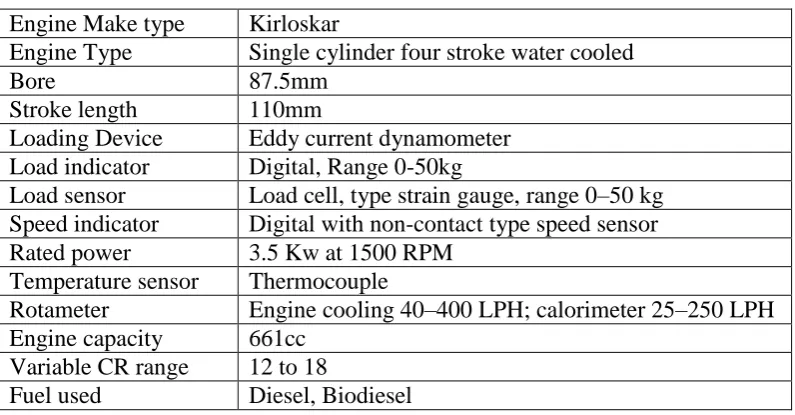
The specification of the engine used for experimentation is given in Table 1 The set-up
enables the study of engine brake power, fuel consumption, air consumption, heat balance,
thermal efficiency, volumetric efficiency etc. The performance tests were carried out on the
variable CR single cylinder four stroke diesel engine using various blends of crude rice bran
oil biodiesel and refined rice bran oil biodiesel and diesel as fuels. The tests were conducted
at variable loads. The experimental data generated were documented and presented here
using the biodiesel– diesel mixture for the engine test operation. In each experiment, engine
performance parameters such as brake specific fuel consumption (BSFC), brake thermal
efficiency (BTE) and variation of cylinder pressure with crank angle were measured. Fig. 3
shows variable CR compression ignition engine test Rig.RB10, RB20, RB30.and Diesel oil.
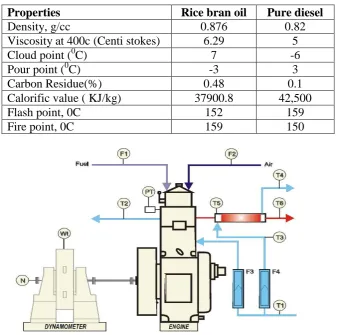
Before application on the engine, various physico-chemical properties is given in Table 2. of
all the above test fuels were determined and compared to each other.
Table 1: Engine specification.
Engine Make type Kirloskar
Engine Type Single cylinder four stroke water cooled
Bore 87.5mm
Stroke length 110mm
Loading Device Eddy current dynamometer Load indicator Digital, Range 0-50kg
Load sensor Load cell, type strain gauge, range 0–50 kg Speed indicator Digital with non-contact type speed sensor Rated power 3.5 Kw at 1500 RPM
Temperature sensor Thermocouple
Rotameter Engine cooling 40–400 LPH; calorimeter 25–250 LPH Engine capacity 661cc
Variable CR range 12 to 18
Table 2: Fuel characterization.
Properties Rice bran oil Pure diesel
Density, g/cc 0.876 0.82
Viscosity at 400c (Centi stokes) 6.29 5
Cloud point (0C) 7 -6
Pour point (0C) -3 3
Carbon Residue(%) 0.48 0.1
Calorific value ( KJ/kg) 37900.8 42,500
Flash point, 0C 152 159
Fire point, 0C 159 150
Fig. 3: Schematic arraignment.
V. RESULT AND DISCUSSION Objectives of Project
Keeping in mind the benefits of biodiesel and so the consequential importance renewable in
the near future, the work was undertaken with following specific objectives:
1. To conduct short term field test on C.I. engine.
2. To study performance of C.I. engine with biodiesel produced Rice bran oil.
3. By varying C.R and Load.
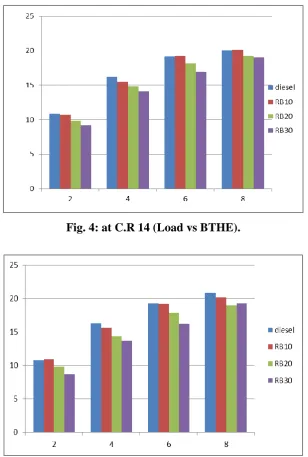
1. Brake thermal efficiency analysis: - The variation of thermal performance parameters at different values of CRs at 14 and 16 with a load of 2 kg, 4kg, 6kg and 8 kg and IP of 200 bar
it represented in figure 4 to 5. It can be observed that BTHE increases continuously with
increase in Load. The increasing trend is due to higher air temperature achieved at diesel due
to better combustion of fuel. From above two results clearly indicates at full load condition
only Brake thermal efficiency increases continuously in RB20 as compare than pure Diesel at
to 5. It depicts the variation of brake thermal efficiency with variation of engine load at CR of
16 for the good one in X-axis load and Y-axis BTHE.
Fig. 4: at C.R 14 (Load vs BTHE).
Fig. 5: at C.R 16(Load vs BTHE).
2. Brake specific fuel consumption analysis: - It can be observed (Fig 6 and 7) that as the CR of the engine increases, then BSFC of decreases when load increases and result will
obtained nearly RB20 is same BSFC as of pure Diesel but RB30 but in almost all CR the
RB20 gives better performance in increased the combustion efficiency. in x- axis is the load
Fig. 6: at C.R 14 (Load vs BSFC).
Fig. 7: at C.R 16 (Load vs BSFC).
2. BMEP analysis: -Figure 8 to 9 shows a comparison of the variation of BMEP with CR 14 and 16 and with load Rice bran oil with Diesel oil at 2kg, 4kg, 6kg and 8kg at IP 200 bar.
Brake Mean Effective pressure (BMEP) is the external shaft work per unit volume
displacement of the engine. From the figures, it can be observed that CR effect is slightly
significant effect on BMEP. It can be observed that BMEP increases linearly with load for all
the rates of blends. As the load on the engine increases, the rate of fuel consumption resulting
in Grate thermal energy release and hence effective pressure on the piston increases to
Fig. 8: at C.R 14 (Load vs BMEP).
Fig. 9: at C.R 16 (Load vs BMEP).
REFERNCES
1. Singh SP, SinghD. Biodiesel production through the use of different sources and
characterization of oil sand their esters as the substitute of diesel: a review. Renew
Sustain Energy Rev, 2010; 14: 200–16.
2. Karim, G. A., An examination of some measures for improving the performance of gas
fuelled diesel engines at light load. SAE Paper No. 912366, 1991.
3. Karim, G A and Burn, K S: The combustion of gaseous fuels in a dual fuel engine of
compression ignition type with particular, 1980.
4. Pahl G.; McKibben B., “Biodiesel: Growing a New Energy Economy”, Ed. Chelsea
Green Publishing, 2008; 368.
5. Bhandari, K et al., Performance and emissions of natural gas fueled internal combustion
6. Youtonge, Z et.al, the effect of palm biodiesel fuel on the Performance and Emission of
the automotive diesel engine” International, the CIGR Ejournal, Manuscript EE 07 005.
7. Karim, G A: The dual fuel engine of the compression ignition type –prospects, problems
and solutions– a review. SAE Paper No. 831073, 1983.
8. T.V. Rao, K.H.C. Reddy, G. Rao, Jordan J. Mech. Ind. Eng., 2008; 2: 117–122.
9. G. Knothe, J.V. Gerpen, J. Krahl, The Biodiesel Handbook, AOCS Press Champaign,
Illinois, 2005.