Abstract—Ocean bottom sensor nodes can be used for oceanographic data collection, pollution monitoring, offshore exploration and tactical surveillance applications. Moreover, Unmanned or Autonomous Underwater Vehicles (UUVs, AUVs), equipped with sensors, will find application in exploration of natural undersea resources and gathering of SCIENTIFIC data in collaborative monitoring missions. Underwater acoustic networking is the enabling technology for these applications Conventional network coding (CNC) and physical layer network coding (PNC) are the existing techniques for the wireless network to share the medium simultaneously to avoid the collision. But these existing techniques cannot apply in the multi hop network. To overcome these issues proposed a new technique called physical layer network coding in distributed medium access control protocol (PNC-DMAC). This technique is applicable for simultaneously transmit the data from source to destination without collision in multi hop wireless network. This proposed protocol is used to increase the throughput, packet delivery ratio and network lifetime. Using the relay nodes can perform the transmission with CSMA (Carrier Sense Multiple Access) strategy and used the extension of IEEE 802.11medium access control protocol. Simulation results analyze the performance of the proposed protocol using quality of service parameters.
I. INTRODUCTION
With the advancement in acoustic modem technology that enabled high-rate reliable communications, current research concentrates on communication. between several remote instruments within a network atmosphere. Research on underwater networking has become an attractive, interesting and challenging area today because of its support to the applications i.e. pollution monitoring, oceanographic data collection, disaster prevention, offshore exploration and assisted navigation. We can describe underwater acoustic networking as the enabling technique for these
applications. Underwater acoustic (UWA) networks are normally configured by acoustically linking autonomous underwater vehicles, bottom sensors and a surface station, which offers a connection to an on-shore control centre.
In conventional operation, network nodes utilize the store-forward techniques, and network transmission performance is constrained by the capacity of some bottleneck connections. With respect to the Maximum Flow Minimum Cut theory, the transmission rate between the receivers and transmitters cannot increase the maximum network flow. So the conventional multipath routing often cannot arrive the upper bound of the maximum flow. Comes network coding which breaks the conventional way of data transmission. With network coding, the intermediary nodes no longer just send packets only. They are permitted to process the packets, and integrate two or many income packets into one or many output packets for transmission. This builds it possible to utilize less network bandwidth to forward the same amount of information. At last, the actual packets can be retrieved in their destinations.
Network coding technology is a discovery in network communication area. It has been broadly studied in current years because of its powerful advantages of enhancing the throughput of the network, decreasing transmission times, increasing end-to-end performance and offering a high degree of network flexibility. It can also save bandwidth, balance traffic load and enhance the network security. Routing Protocols and algorithms depending on network coding are applied to wireless or wired communication. With its capability of enhancing network performance, it could also be used to ad-hoc networks, wireless multi-hop networks, wireless sensor networks and particularly underwater sensor networks.
Physical Layer Network Coding In Distributed Medium
Access Control Protocol (PNC-DMAC) On Underwater
Sensor Network
Pooja Sharma1 Mrs. Shashi Lata2
M-Tech Student1, Head of Department.2& Department of ECE & Advance Institute of Technology & Management Palwal, Haryana, India
UAN (Underwater Acoustic Network) is an application of wireless networks which utilizes acoustic as the data transmission medium in underwater atmosphere. As compared to terrestrial radio channel, underwater channel has several natural loss factors i.e. Doppler shift, ocean noise, multipath impact and transmission fading. These unique UAN features cause high bit rate, long propagation delay, restricted bandwidth and restricted energy, and build it hard to obtain efficient data transmission
II. NETWORK CODING ALGORITHMS
Network coding idea is first introduced by R. Ahlswede et al. From the information flow point of view, they showed that in a multicast network with a single source and many sinks, the maximum network throughput as determined by the max-flow min-cut theory can be obtained by utilizing a simple network coding; the bandwidth can be saved also.
The basic feature of network coding is the optimal processing of different transmission data. This should be directly reflected by the different design of coding techniques, and the code structure is the main concern. So the actual research in network coding primarily concentrates on the coding algorithms, the enhancement of performance brought by a coding technique and the complexity degree of the coding algorithm. The code structure algorithm design should ensure the targeted nodes can decode the actual packets after they obtained a specific amount of coded packets. During this time, the coding complexity should be decreased. The coding structure algorithms studied so far can be classified into three categories: algebraic coding, linear coding and random coding.
A construction of linear coding was introduced for its practicability and simplicity. A multicast network is developed and it is shown that the max-flow bound can be arrived through a linear coding multicast. Linear coding also involves the polynomial time algorithm. But perhaps the easiest form is the coding based on the XOR operation i.e., just perform the Exclusive-OR operation on the bits of two packets. There are several XOR-based protocols i.e. ROCX (Routing with Opportunistically Coded eXchanges) and COPE. In the introduced algebraic framework-based coding mechanism a polynomial algorithm was utilized to solve network issues and an algebraic tool was offered to the network coding research. A randomized network coding for numerous source multicast networks was proposed in where the success possibility.
III. LITERATURE REVIEW
Yangze Dong et al [1],Here author investigate various denial of service attack in underwater acoustic network such as flooding ,wormhole and selective forwarding
attack via simulation . for the performance evaluation authors had taken OPNET 14.5 as an simulation tool. In this paper three kinds of DOS attacks against UAN are simulated and analyzed.
Ian F. Akyildiz et al [2] ,Here, author(ocean sensors nodes can be used for monitoring application of the ocean environment in UMSN such as oceanographic data collection ,pollution monitoring, off-shore exploration and tactical surveillance applications the author can discuss two dimensional and three dimensional architecture. .The author had taken OPNET 16 as an simulation tool.
C. Ellammal et al [3],Here author performance analysis of distributed Mac protocol with physical layer network coding scheme . The performance of the proposed PNCDMAC protocol is analyzed using network simulator NS -2.The number of nodes vary from 50 to 300 nodes. The actual queue size is 50 packets; it will vary from 50 packets to 150 packets.
IV. Proposed PNC DMAC Protocol:
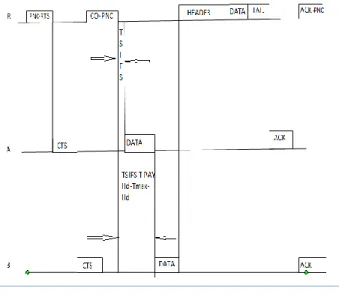
The proposed protocol physical layer network coding distributed medium access control modify the control messages to perform the multi hop operation in distributed networks using physical layer network coding. In PNC-DMAC protocol, all the nodes notify the queue status of the neighbor node. It will add more bytes to the control information to know the queue status of the neighbor nodes. Based on the queuing status it will transmit the data. This proposed protocol uses proactive routing protocol and it will create the routing table using the control messages such as RTS (Request to send) and CTS (Clear to send). This protocol is used to maintain the topology and know about the topology within the two to three hop counts. Here using relay node denoted as R, which is used to update the routing information and stored the queue status of the neighboring nodes. Consider relay node R has two neighbor nodes such as A and B. this relay node R store the queue information of the neighbor nodes of A and B. The transmission between the R and neighbor nodes of A and B is shown in Figure 1 [10]. This packet exchange is initiated by using relay node. This relay node sometimes will act as coordinator node for packet transmission. Relay node R is used to perform the PNC, first it sends RTS-PNC frame to the neighbor nodes. It contains the source address of R node and destination address of A node and B node. Queue status of node A and node B to be stored in the CTS frame node A and node B. After receiving the CTS frame, R node sends coordination PNC frame to node A and node B. A node receives the CO-PNC frame after that time TIFS, it starts to send the data. Likewise B node receives the Co-PNC frame after the time of 2TIFS+Tphy-Hd+Tmac-Hd., it will start to send the data. They is the time taken for the
process in the physical layer and Tmac is the time taken for the process in the MAC layer. In this propose protocol, neighbor nodes of A and B should not be synchronizing each other. During the transmission of data, A and B should not be collide each other and to avoid the collision using relay node. Using the CO-PNC frame relay node maintain the synchronization between the neighbor nodes of A and B. To maintain the synchronization, it needs to perform the physical layer network coding method [11]. Data from the node B contains the bit reversed order; it will send the tail of the data at first and header of the data at last. Compared to the node a, node B has longer packet. During the time period of TSIFS and TSIFS +Tphy- Hd+ Tmac- Hd, node B will not be interfered with node A. Relay node R can successfully decode the data by using the time difference between the two different frames. When the relay R node decode the header data frames, from that it will update the queuing status of the node A and node B will be updated in the relay node R. Relay node R will code the data signal that is received from the node A and B. after that relay node R send the coded packets to the neighbor nodes of A and B. if successfully data packets received from the relay nod R, node A and node B sends the ACK acknowledgment frame to the relay node R. after that R relay node sends the ACK-PNC frame to the node A and B, that contains the source node address and destination node address. After that ACK-PNC frame, the entire source node in the network clears the cache [12].
Figure 1: Packet exchanges in DMAC
V. FRAMEWORK SIMULATOR
There are lot of simulation tools for underwater networks, we have chosen three of them that we consider the most representative and that also have their code available for testing and comparing results..
AUV Net Sims
This simulator exclusively programmed in python. Highlights in this simulator are the MAC layer and the routing layer, including power control. But the drawback is that the results are difficult to compare with new research discoveries and the definition of the channel is too simple, and so different environmental conditions cannot be detailed.
Xie Gibson simulator
This propagation model is presented and implemented in OPNET for the physical layer, and the MAC layer. The drawback of this model is that many model parameter needed and very time consuming. Also, the model only works on static scenarios with static conditions across the simulation period. The code necessary to build this simulator is not available.
WOSS (world ocean simulator system)
One of latest and most complete simulator tools at the present time . It is implemented in the Network Simulator 2 package. It uses world databases that measure the sound speed profile (SSP), bathymetry and floor sediment, such as the General Bathymetric Chart of the Oceans (GEBCO) and National Oceanic and Atmospheric Administration (NOAA). Combining this data with scenario information like latitude, longitude and depth position of the nodes, it creates environmental files that describe the scenario.
VI. SIMULATOR FRAMEWORK
PROPOSAL
The simulator framework is based on OPNET, MATLAB and the Bellhop ray tracking tool. Uses information related to underwater scenario characteristics like bathymetry, salinity, and seafloor composition, found at real worldwide locations that are downloaded NOAA and GEBCO worldwide ocean databases. This information is obtained with the OPNET network scenario module in order to create the corresponding environmental file. In OPNET, it is very easy to set the network world location just by clicking on an area or introducing the GPS coordinates as manually.
CONCLUSION
The proposed protocol PNC-DMAC, this extends from the IEEE 802.11 protocol and it will add the PNC protocol. This protocol is used to transmit the data simultaneously in multi hop network. The existing protocol CNC and PNC is used only for single hop network. To overcome this issue, move to the PNC-DMAC protocol. This PNC-PNC-DMAC protocol achieves the successful transmission using the actual and virtual queue. It used the relay node R to transmit the data from coordinator node to neighbor node. The simulation results show that the performance of the proposed
the actual and virtual queue size. This protocol increased the performance of the entire network and it will suitable for the multi hop communication. PNC protocol will only applicable for single hop communication, apply this PNC scheduling in distributed network and it will generate the multi hop transmission using relay node. This research work concentrates on the bidirectional flows in the distributed network. In future, unidirectional flow with the listening of medium using PNC scheduling will be developed with mobile scenario. It will support the opportunistic listening and it will estimate the future channel conditions. Because this will not be overlap the sources and destination nodes. This future work may help the MAC protocols to improve the entire performance of the distributed network even in unidirectional flow between the source and destination.
REFERENCES
[1] Yangze Dong, Hefeng Dong, and Gangqiang Zhang “ On Denial of service against underwater Acoustic Networks”,Journal of Communication ,volume no. 9, Issue no. 2, pp 135-141,februrary 2014.
[2] Ian F. Akylidiz, Dario Pompili, Tommaso Melodia “Challenges for Efficient Communication in Underwater Acoustic Sensor Networks”,Georgia Institute of Technology,Atlanta
[3] C. Ellammal and S. S mys “ Performance Analysis of Distributed Mac Protocoal with Physical Layer
Network Coding Scheme” ,World Engineering and Applied Science Journals , volume no.6, issue no. 2, pp 97-103, 2015.
.
[4] A. Abel and W. Schwarz, "Chaos communications-principles, schemes, and system analysis," Proc IEEE, vol. 90, pp. 691-710, 2002..
[5] I. F. Akyildiz, W. Su, Y. Sankarasubramaniam and E. Cayirci, "A survey on sensor networks," Communications Magazine, IEEE, vol. 40, pp. 102-114, 2002.
[6] I. F. Akyildiz and M. C. Vuran, Wireless Sensor Networks. John Wiley & Sons, 2010.
[7] I. T. Almalkawi, M. G. Zapata, J. N. Al-Karaki and J. Morillo-Pozo, "Wireless Multimedia Sensor Networks: current trends and future directions," Sensors (Basel), vol. 10, pp. 6662-6717, 2010.
[8] D. Chen and P. K. Varshney, "QoS support in wireless sensor networks: A survey." in International Conference on Wireless Networks, 2004, pp. 1-7.
[9] J. dos Santos Coelho, Underwater Acoustic Networks: Evaluation of the Impact of Media Access Control on Latency, in a Delay Constrained Network, 2005.
[27] M. Erol-Kantarci, H. T. Mouftah and S. Oktug, "A survey of architectures and localization techniques for underwater acoustic sensor networks," Communications Surveys & Tutorials, IEEE, vol. 13, pp. 487-502, 2011.
[28] A. M. Fabregat, A. M. Fabregat and A. M. Fabregat, "Desenvolupament, proves de camp i anàlisi de resultats en una," 2008.
[29] N. Ismail, L. A. Hussein and S. H. Ariffin, "Analyzing the performance of acoustic channel in underwater wireless sensor network (UWSN)," in Mathematical/Analytical Modelling and Computer Simulation (AMS), 2010 Fourth Asia International Conference on, 2010, pp. 550-555.
[30] Jákó, Zoltán. "Performance Improvement of Differential Chaos Shift Keying Modulation Scheme." Thesis submitted to the Department of Measurement and Information Systems. Budapest University of Technology and Economics.
[31] M. C. Jeruchim, P. Balaban and K. S. Shanmugan,
Simulation of Communication Systems: Modeling,
Methodology and Techniques. Springer, 2000.
[32] P. Jurčík and A. Koubâa, "The IEEE 802.15. 4 OPNET simulation model: reference guide v2. 0," IPP-HURRAY Technical Report, HURRAY -TR-070509, 2007.
[33] G. Kaddoum, J. Olivain, G. Beaufort Samson, P. Giard and F. Gagnon, "Implementation of a differential chaos shift keying
communication system in gnu radio," in Wireless
Communication Systems (ISWCS), 2012 International
Symposium on, 2012, pp. 934-938.
[34] M. P. Kennedy and G. Kolumbán, "Digital communications using chaos," Signal Process, vol. 80, pp. 1307-1320, 2000. [35] M. P. Kennedy, G. Kolumbán, G. Kis and Z. Jákó, "Performance evaluation of FM-DCSK modulation in multipath environments," 2000.
[36] M. Kennedy, R. Rovatti and G. Setti, Chaotic Electronics in Telecommunications. CRC press, 2000.
[37] G. KOLUMBaN, K. GaBOR, J. Zoltan and M. P. Kennedy, "FM-DCSK: A robust modulation scheme for chaotic communications," IEICE Trans. Fund. Electron. Commun. Comput. Sci., vol. 81, pp. 1798-1802, 1998.
[38] G. Kolumban, M. P. Kennedy, Z. Jákó and G. Kis, "Chaotic
communications with correlator receivers: theory and
performance limits," 2002.
[39] G. Kolumban and T. Krébesz, "UWB radio: A real chance for application of chaotic communications," Proc.NOLTA’06, pp. 475-478, 2006.
[40] Kennedy, Michael Peter, and Géza Kolumbán. "Digital communications using chaos." Signal processing 80.7 (2000): 1307-1320.
[41] F. C. Lau and K. T. Chi, Chaos-Based Digital Communication Systems: Operating Principles, Analysis Methods, and Performance Evaluation. Springer, 2003. [42] H. Leung, H. Yu and K. Murali, "Ergodic chaos-based communication schemes," Physical Review E, vol. 66, pp. 036203, 2002.
[43] H. Leung, S. Shanmugam, N. Xie and S. Wang, "An ergodic approach for chaotic signal estimation at low SNR with
application to ultra-wide-band communication," Signal
Processing, IEEE Transactions on, vol. 54, pp. 1091-1103, 2006. [44] Y. Liu, I. Elhanan and H. Qi, "An energy-efficient QoS-aware media access control protocol for wireless sensor networks," in Mobile Adhoc and Sensor Systems Conference, 2005, IEEE International Conference on, 2005, pp. 3 pp.-191 [10] G. Kaddoum, J. Olivain, G. Beaufort Samson, P. Giard and F. Gagnon, "Implementation of a differential chaos shift keying
Communication Systems (ISWCS), 2012 International Symposium on, 2012, pp. 934-938.
[11] M. P. Kennedy and G. Kolumbán, "Digital communications using chaos," Signal Process, vol. 80, pp. 1307-1320, 2000. [12] R. Severino and M. Alves, "Engineering a search and rescue application with a wireless sensor network-based localization mechanism," in World of Wireless, Mobile and
Multimedia Networks, 2007. WoWMoM 2007. IEEE
International Symposium on a, 2007, pp. 1-4.
[13] E. M. Sozer, M. Stojanovic and J. G. Proakis, "Underwater acoustic networks," Oceanic Engineering, IEEE Journal of, vol. 25, pp. 72-83, 2000.
[14] E. M. Sozer, M. Stojanovic and J. G. Proakis, "Design and simulation of an underwater acoustic local area network," in Proc. Opnetwork’99, 1999, .
[15] R. D. Standfield, OPNET Implementation of Spread Spectrum Network for Voice and Data Distribution., 1997. [16] M. Stojanovic, "On the relationship between capacity and distance in an underwater acoustic communication channel," ACM SIGMOBILE Mobile Computing and Communications Review, vol. 11, pp. 34-43, 2007
[17] M. Stojanovic, "Underwater acoustic communications," in Electro/95 International. Professional Program Proceedings, 1995, pp. 435-440.
[18] M. Sushchik, L. S. Tsimring and A. R. Volkovskii, "Performance analysis of correlation-based communication schemes utilizing chaos," Circuits and Systems I: Fundamental Theory and Applications, IEEE Transactions on, vol. 47, pp. 1684-1691, 2000.
[19] A. J. Viterbi, "Wireless digital communication: A view based on three lessons learned," IEEE Communications Magazine, vol. 29, pp. 33-36, 1991.
[20] M. C. Vuran and I. F. Akyildiz, "Cross-layer packet size
optimization for wireless terrestrial, underwater, and
underground sensor networks," in INFOCOM 2008, the 27th Conference on Computer Communications. IEEE, 2008 [21] F. C. Lau and K. T. Chi, Chaos-Based Digital Communication Systems: Operating Principles, Analysis Methods, and Performance Evaluation. Springer, 2003. [22] H. Leung, H. Yu and K. Murali, "Ergodic chaos-based communication schemes," Physical Review E, vol. 66, pp. 036203, 2002.
[23] H. Leung, S. Shanmugam, N. Xie and S. Wang, "An ergodic approach for chaotic signal estimation at low SNR with
application to ultra-wide-band communication," Signal
Processing, IEEE Transactions on, vol. 54, pp. 1091-1103, 2006. [24] Y. Liu, I. Elhanany and H. Qi, "An energy-efficient QoS-aware media access control protocol for wireless sensor networks," in Mobile Adhoc and Sensor Systems Conference, 2005, IEEE International Conference on, 2005, pp. 3 pp.-191 [25] M. Lujuan, "Hybrid DCSK/TDMA Multi-Rate MAC Protocol for Underwater Acoustic Sensor Networks," JDCTA: International Journal of Digital Content Technology and its Applications, vol. 6, pp. 565~ 572-565~ 572.
[26] S. Mandal and S. Banerjee, "Performance of differential chaos shift keying communication over multipath fading channels," in National Conference on Nonlinear Systems & Dynamics, 2002, pp. 1-4.
[27] F. Nekoogar, Ultra-Wideband Communications:
Fundamentals and Applications. Prentice Hall Press, 2005.
[28] F. S. Netto and M. Eisencraft, " Spread spectrum digital communication system using chaotic pattern generator," in 10th Experimental Chaos Conference, Catania, 2008.
[29] N. Patwari, J. N. Ash, S. Kyperountas, A. O. Hero, R. L. Moses and N. S. Correal, "Locating the nodes: cooperative localization in wireless sensor networks," Signal Processing Magazine, IEEE, vol. 22, pp. 54-69, 2005.
[30] L. M. Pecora and T. L. Carroll, "Synchronization in chaotic systems," Phys. Rev. Lett., vol. 64, pp . 821-824, Feb 19, 1990. [31] U. Pešović, J. Mohorko, K. Benkič and Ž. Čučej, "Effect of hidden nodes in IEEE 802.15. 4/ZigBee wireless sensor networks," in XVII Telecommunications Forum-TELFOR, 2009, pp. 24-26.
[32] J. G. Proakis, "Digital Communications Fourth Edition, 2001," 1998
[33] T. Rappaport, "Wireless Communications Principles and Practice Second Edition, 2002,"
[34] Z. Ren, G. Wang, Q. Chen and H. Li, "Modelling and simulation of Rayleigh fading, path loss, and shadowing fading for wireless mobile networks," Simulation Modelling Practice and Theory, vol. 19, pp. 626-637, 2011.
[35] J. Rice, "SeaWeb acoustic communication and navigation networks," in Proceedings of the International Conference on Underwater Acoustic Measurements: Technologies and Results, 2005.
[36] R. Rovatti, G. Mazzini and G. Setti, "Enhanced rake receivers for chaos-based DS-CDMA," Circuits and Systems I: Fundamental Theory and Applications, IEEE Transactions on, vol. 48, pp. 818-829, 2001.
[37] M. P. Kennedy, G. Kolumbán, G. Kis and Z. Jákó, "Performance evaluation of FM-DCSK modulation in multipath environments," 2000
[38] M. Kennedy, R. Rovatti and G. Setti, Chaotic Electronics in Telecommunications. CRC press, 2000.
[39] G. KOLUMBaN, K. GaBOR, J. Zoltan and M. P. Kennedy, "FM-DCSK: A robust modulation scheme for chaotic communications," IEICE Trans. Fund. Electron. Commun. Comput. Sci., vol. 81, pp. 1798-1802, 1998
[40] G. Kolumban, M. P. Kennedy, Z. Jákó and G. Kis, "Chaotic
communications with correlator receivers: theory and
performance limits," 2002.
[41] G. Kolumban and T. Krébesz, "UWB radio: A real chance for application of chaotic communications," Proc.NOLTA’06, pp. 475-478, 2006.
[42] Kennedy, Michael Peter, and Géza Kolumbán. "Digital communications using chaos." Signal processing 80.7 (2000): 1307-1320.
[43] A. Savvides, H. Park and M. B. Srivastava, "The bits and flops of the n-hop multi alteration primitive for node localization problems," in Proceedings of the 1st ACM International Workshop on Wireless Sensor Networks and Applications, 2002, pp. 112-121
[44] N. Saxena, A. Roy and J. Shin, "Dynamic duty cycle and adaptive contention window based QoS-MAC protocol for wireless multimedia sensor networks," Computer Networks, vol. 52, pp. 2532-2542, 2008.