PAGELEARN: Learning Semantic
Functions of Attribute Grammars
in Parallel
Gy¨ongyi Szil´agyi
1and Aggelos M. Thanos
21Hungarian Academy of Sciences, Research Group on Artificial Intelligence, Szeged, Hungary 2National Technical University of Athens, Athens, Greece
Attribute Grammars (AGs)are a generalization of the
concept of Context-Free Grammars (CFGs). The
for-malism of AGs has been widely used for the specification and implementation of programming languages. On the other hand there is an intimate relationship between AGs and Logic Programming. The paper presents a paral-lel method for learning semantic functions of Attribute Grammars(AGs)based on AGLEARN2], using PAGE
system 12]. The method is more efficient in both
execution time and interaction needed than the sequential one. The method presented is adequate for S-attributed grammars and for L-attributed grammars as well.
Keywords: attribute grammar, parallel evaluation of at-tribute grammars, machine learning, atat-tribute value learner.
1. Introduction
In the framework of compilation-oriented lan-guage implementation, attribute grammars 3]
are the most widely applied semantic formal-ism. The notion of an attribute grammar is an extension of the notion of a context-free grammar. The idea is to decorate parse trees of a context-free grammar by additional labels which provide a “semantics” for the grammar. Every node of a parse tree labeled by a nonter-minal is to be additionally decorated by a tuple of semantic values called attribute values. The number of attribute values is fixed for any non-terminal symbol of the grammar. Their names are called attributes of nonterminal. Since the definition of an attribute grammar usually re-quires much work it would be a useful tool for inferring semantic rules in attribute grammars from examples.
In the case of inductive learning from exam-ples, the learner is given some examples from which general rules or a theory underlying the examples can be derived. An inductive con-cept learner is given by a set of training exam-ples, some background knowledge, a hypothe-sis description language, and an oracle willing to answer questions(in the case of interactive
learner). The aim is to find a hypothesis such
that the hypothesis is complete and consistent with respect to the examples and background knowledge.
To express efficiently the examples, the back-ground knowledge, and the Hypothesis to be induced we need to use a languageLwith suffi-cient expressive power. Many systems were de-veloped for learning logic programs, using first order predicate logic language tools(Inductive
logic Programming(ILP)). Attribute Grammars
merge the declarative power of predicate logic with the flexibility of a predefined interpretation of its terms. Complex objects and relations can be described in the framework of AGs. Intro-ducing an AG-based description languageLin ILP implies the definition of an Attribute Gram-mar learner.
In the following sections we will see how this integration is carried out using the AGLEARN 2] methodology and we will give the
descrip-tion of an innovative technique for a parallel implementation.
semantic rules of attribute grammars from ex-amples. This is an interactive system, so dur-ing the execution the oracle has to answer a lot of questions, which needs a lot of work and much time. The parallel implementation of AGLEARN makes possible to decrease the number oforacles, so it is more efficient in both execution time and interaction needed. We no-tice that the execution time depends on the num-ber of the user queries. Our method uses the PAGE system that is a general purpose paral-lel parser, augmented with a powerful semantic evaluator. We notice that this parallel method can be implemented using any general purpose parallel parser that has the appropiate facilities to store and handle the necessary information. This paper is organized as follows. Section 2 gives an introduction to the concepts of At-tribute Grammars. Section 3 provides a brief in-troduction to the AGLEARN method, and gives a typical example. Then Section 4 presents the computational model of PAGE in order to rep-resent the necessary facilities to the paralelliza-tion. In Section 5 the PAGELEARN method is presented. We give a detailed description of the parallel method for S-attributed grammars, explaining how we can handle the circuity prob-lem, and giving an illustrative example. Finally we show how the parallel method works for L-attributed grammars.
2. Preliminaries
2.1. Attribute Grammars
Attribute Grammars have been proposed by Knuth 3, 4] as an extension of context-free
grammars. The original motivation was to fa-cilitate compiler specification and development procedure.
While compilers were the initial area of re-search for AGs, they can also be used in a very wide research spectrum, where relations and dependences among structured and inter-preted data are very valuable. Areas like soft-ware engineering 7, 5], visual programming
10], logic programming 1], distributed
pro-gramming 15, 8], functional logic
program-ming 6], pattern recognition 9]and signal
pro-cessing are some notable examples.
Definition 2.1. Acontext-free grammar Gis a quadruple such thatG=<NTPD>, where N is a finite set of nonterminal symbols, T is a set of terminal symbols, P is a finite set of
productions, andD 2 N is thestartsymbol of G.
An element in V = N T is called grammar symbol. The production in P are pairs of the form X ! α, where X 2 N and α 2 V , i.e.
the left hand side symbol(LHSS)Xis a
nonter-minal, and the right hand side symbol(RHSS)
α is a string of grammar symbols. An empty RHSS(empty string)will be denoted byε.
Definition 2.2. An Attribute Grammar con-sists of three elements, acontext-free grammar G, a finite set ofattributes A and a finite set of
semantic rules R. ThusAG=<GAR>.
A finite set of attributesA(X)is associated with
each symbolX2V. The setA(X)is partitioned
into two disjoint subsets, theinherited attributes I(X)and thesynthesized attributes S(X). Thus A=A(X).
The production p 2 P, p : X0 ! X1Xn
(n 1) has an attribute occurrence Xi:a, if a 2 A(Xi)0 i n. A finite set of se-mantic rules Rp is associated with the
produc-tion p, with exactly one rule for each synthe-sized attribute occurrenceX0:aand exactly one
rule for each inherited attribute occurrenceXi:a,
1in.
ThusRpis a collection of semantic rules of the
formXi:a= f(y1yk),k1, where
1. eitheri = 0 anda 2 S(Xi), or 1 i n
anda2I(Xi)
2. each yj1 j k, is an attribute
occur-rence inpand
3. f is a function called semantic function, that maps the values of y1:::yk to the
value of Xi:a. In a semantic rule Xi:a = f(y1:::yk), the occurrenceXi:a depends
Thus R = Rp. By definition, synthesized
attributes are output to the LHSS of the pro-ductions while inherited attributes areoutputto the RHSS. In other words synthesized attributes move the data flow upwards and inherited at-tributes move the data flow downwards in the derivation tree during the attribute evaluation procedure.
Remark: Notice that each semantic rule of an attribute grammar can be seen as a definition of the relation between local attribute values of the neighboring nodes of the parse tree. This rela-tion is defined for a producrela-tion rule and should hold for every occurrence of this production rule in any parse tree. In the original definition of AG(definition 2.2)the definition of the relation
takes the form of the equation. It is possible to generalize the concept of semantic rules and allow them to be arbitrary formulae(not
neces-sarily equalities)over a languageL.
Definition 2.3. AConditional Attribute Gram-mar(CAG)is an attribute grammar having the
concept of the semantic rules extended. Thus a CAG is a 5-tuple<GSAΦI>where:
Gis the underlying context-free grammar
Sis a set of sorts(i.e. of domains where the
attributes take values)
Ais a finite set of attributes. Each attributea
has a sorts(a)inS.
Φ is a map function of a logic formula Φp
written in terms of an S-sorted logic lan-guageLto each production rule p2 P. The
variables of a formulaΦpinclude all output
attribute occurrences of A(p) = X 2PA
(X).
The allowed form of the functionΦpis either
a function f or a relationc.
- in the case of a function, f has the form
f :Xp k:a= f(Xp k
1:a1:::Xp k
m:am)
where f : I(Xp k
1:a1):::I(Xp k
m:am)
!I(Xp k:a).
- in case of relation,chas the form
c:c(Xp k
1:a1:::Xp k
m:am)
where c : I(Xp k
1:a1):::I(Xp k
m:am)
!ftrue f alseg.
I is an interpretation of L in some S-sorted
algebraic structureA.
Semantic rules induce dependences between at-tributes. These dependences can be presented by adependency graph, from which partial or-dering relations are implied. From these partial orderings the evaluation order of the attribute occurrences can be determined. A decorated treeis a derivation tree in which all the attribute occurrences have been evaluated according to their associated semantic rules. The depen-dency graph characterizes all restrictions on the control of computations. The actual sequence of attribute evaluation must preserve this order-ing which is calledattribute evaluation strategy. Attribute grammars can be classified according to the attribute evaluation strategy used . A special class, introduced by Knuth 3], is the S;attributedgrammars in which only
synthe-sized attributes are allowed.
Due to the restrictive form ofS-attributed gram-mars,L;ordered grammars are used in
prac-tice.
Definition 2.4. An attribute grammar is said to be L-attributedif and only if each inherited attribute of Xp j in the production p : Xp0 ! Xp1:::Xp n
p depends only on the attrributes
in the setS
k2f1j;1g
Inh(Xp k)Syn(Xp0)for j=1:::np.
Example 2.1. We now present a typical ample for the type checking of arithmetic ex-pressions 16]. Consider the following attribute
grammar:
Nonterminals: N= fExpressionTerm, FactorAddOpMulOpg
Terminals: T =fRealInteger+;, =()g
Start Symbol: D=Expression Sorts:
S=fSmodeSoperatorgwhere
- Smode=fintrealg
- Soperator=faddsubmuldivg
Φ=faddsubmuldivintrealid f1 f2g
- addsubmuldivint and real are
con-stants
- id : Smode ! Smode denotes the identity
function
- f1 :SmodeSmode!Smode
f1(op1op2):=ifop1 =realorop2= realthenreal
elseint
- f2 :SoperatorSmodeSmode!Smode
f2(op1op2op3):=ifop1 =muland op2=intandop3 =int
thenint
elsereal
Attributes: A = Syn = fmodeoperatorg
so that
Syn(Expression)=Syn(Term)
=Syn(Factor)=mode
Syn(AddOp)=Syn(MulOp)=operator
Productions and Semantic Rules:
1. Expression0!Expression1AddOp Term R(1):Expression0:mode:=
f1(Expression1:modeTerm:mode)
2. Expression !Term
R(2):Expression:mode:=Term:mode
3. Term0 !Term1MulOp Factor
R(3):Term0:mode:=f2(MulOp:operator, Term1:modeFactor:mode)
4. Term!Factor
R(4):Term:mode:=Factor:mode
5. Factor !Real
R(5):Factor:mode:=real
6. Factor !Integer
R(6):Factor:mode:=int
7. Factor !(Expression)
R(7):Factor:mode:=Expression:mode
8. AddOp!+
R(8):AddOp:operator:=add
9. AddOp!;
R(9):AddOp:operator:=sub
10. MulOp!
R(10):MulOp:operator:=mul
11. MulOp!=
R(11):MulOp:operator:=div
3. The AGLEARN Method
AGLEARN 2] is a method for learning
se-mantic functions of attribute grammars. The method uses background knowledge for learn-ing semantic functions of S-attributed and L-attributed grammars. The given context-free grammar and background knowledge allow one to restrict the space of relations and give a smaller representation of data. The basic idea of this method is that the learning problem of semantic functions is transformed to a propo-sitional form and the hypothesis induced by a propositional learner is transformed back into semantic functions. This approach is motivated by the fact that there is a close relationship be-tween attribute grammars and logic programs
1].
AGLEARN uses the same concept as Inductive Logic Programming (ILP) but has a different
representation. The background knowledge and the concepts are represented in the form of at-tribute grammars. An example contains a string which can be derived from the target nontermi-nal. We suppose that the underlying context-free grammar is given. The task of AGLEARN is to infer the semantic functions associated with the production rule. In the learning process the grammar, the background semantic functions and the examples can be used.
The input :
The AG in which :
- The set of productions P is partitioned into two disjoint setsPB (The background
rules) and PT (the target rules). The set
of semantic functions R is fully defined for the rules belonging toPBand there are
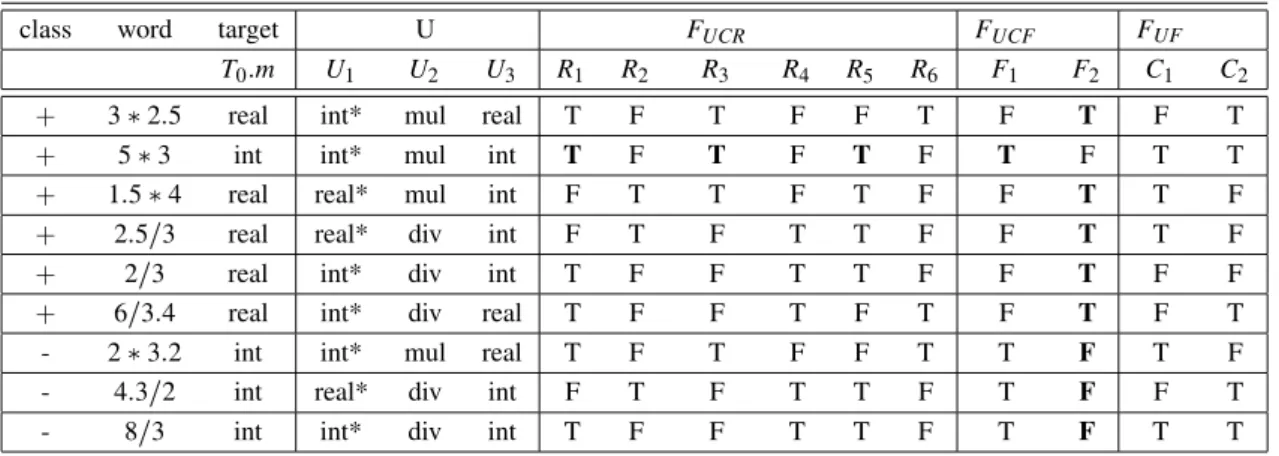
class word target U FUCR FUCF FUF T0:m U1 U2 U3 R1 R2 R3 R4 R5 R6 F1 F2 C1 C2
+ 3 2:5 real int* mul real T F T F F T F T F T
+ 5 3 int int* mul int T F T F T F T F T T
+ 1:5 4 real real* mul int F T T F T F F T T F + 2:5=3 real real* div int F T F T T F F T T F
+ 2=3 real int* div int T F F T T F F T F F
+ 6=3:4 real int* div real T F F T F T F T F T
- 2 3:2 int int* mul real T F T F F T T F T F
- 4:3=2 int real* div int F T F T T F T F F T
- 8=3 int int* div int T F F T T F T F T T
Table 1.The generated propositional table - A partially defined set of semantic
condi-tionsC. Cis fully defined forPBand there
is no condition for any rule inPT.
For each p 2 PT and for each synthesized
attribute occurrence Xp0:aa set of examples Ep(a), which is partitioned into two disjoint
sets, the set of positive E+
p(a) and negative
examples E;
p(a), respectively. Let us
sup-pose that p has the form of p : Xp0 ! Xp1:::Xp n
p. An example e 2 Ep(a) is
given in the form:e= (w(a1v1):::(amvm),
(am +1
vm +1
)), where w 2 T , Xp0 ) w, fa1::amg = Inh(Xp0), andam
+1
= a. A
pair(ajvj)(1jm+1)in the examplee
denotes that the attributeXp0:ajhas the value vjin the evaluated attributed tree built for the
wordw.
The aimis to find a set of functionsFtand for
each productionp 2PT a definition of the sets R(p)andC(p)such that the semantic functions
and conditions inR(p)andC(p)are defined by
the elements ofFiFt. The resultant attribute
grammar must be complete and consistent with the examples.
3.1. Learning Semantic Functions of S-attributed Grammar
The method is based on the idea that the se-mantic functions of the background rules can introduce new columns in the table correspond-ing to the transformed learncorrespond-ing problem. Consider the production p : Xp0 ! Xp1:::, Xp np 2PT, and suppose that the symbols in this
rule can possess only synthesized attributes. We would like to learn the semantic function associ-ated withXp0:a. ForXp0:a, a tableT(a)must be
constructed. Each row of this table corresponds to an example fromEp(a). The table has a set
of columns. The key part is the computation of the columnU (see Table 1) which contains
columns corresponding to the attribute instances
Xp j:b2Syn(Xp j)j=1:::np. Therefore we
build the tree for the actual example fromEp(a),
and if the subtree derived fromXp j contains a
node corresponding to a rule instance belong-ing to PT then the values of the attributes in
Syn(Xp j)are asked from the user for the given
derivation. The if-rules are constructed from the tableT(a), and the semantic functions are
generated from a set of accepted if-rules. (For
a detailed description see 2]).
3.2. Learning L-attributed Semantic Functions
Suppose that the symbols in the rulepcan pos-sess synthesized and inherited attributes. The task of an attribute learner is to define seman-tic functions for the set of defined occurrences
S
k2f1npg
Inh(Xp k)Syn(Xp0). The learning
process of these attributes can be summarized as follows:
1. Learning sematic functions for a2Inh(Xp j)j=1:::np:
The user is asked to provide examples. For the attributeXp j:aa tableT(a)must be
on which the value of Xp j:a depends on Inh(Xp0)
S
k2f1j;1g
Syn(Xp k).
After-wards the propositional part can be con-structed in the same way as that presented for S-attributed grammars. When sematic func-tions for alla2 Inh(Xp j)have been learned,
the attributes of Syn(Xp j) can be computed
by using the background rules. 2. Learning semantic functions for
a2Syn(Xp0)
The semantic functions for a can be deter-mined in the same way as presented for S-attributed grammar.
Example 3.1. Example of AGLEARN method
(taken from 2]).
Apply the above procedure to our example:
PT =fR(1)R(2)R(3)R(4)g
PB =fR(5):::R(11)g.
We demonstrate the learning of the semantic function of R(3).
- E+
3(mode)=f(3 2:5real)(5 3int)(15
4real)(2:5=3real)(2=3real)(6=3:4, real)g
- E;
3(mode)=f(2 3:2int)(4:3=2int)(8=3 int)g
Step 1.
Table 1 shows the generated propositional table+where:
: we have to ask this value from the user
U1:Term1:mode U2:MulOp:Operator U3:Factor:mode R1:Term1:mode=int, R2:Term1:mode=real R3:MulOp:Operator=mul R4:MulOp:Operator=div R5:Factor:mode=int R6:Factor:mode=real F1:Term0:mode=int F2:Term0:mode=real
C1:Term0:mode=Term1:mode C2:Term0:mode=Factor:mode T :true F: f alse
Step 2.
The if-rule :
ifR1 =true&R3=true&R5 =true& then F1=trueelseF2 =true
Step 3.
The transformed semantic function R(3)takes
the form of
ifTerm1:mode=int&MulOp:operator= mul&Factor:mode=int
thenTerm0:mode:=int
elseTerm0:mode:=real
4. The Computational Model of PAGE
One of the objectives of our research was to implement a tool which is portable and inde-pendent of the underlying system architecture. PAGE 11] is built on top of ORCHID kernel
13, 14]which encapsulates the machine
depen-dencies providing a layer with parallel program-ming primitives. In PAGE asupervisorprocess maintains a pool of messages, and is responsible for supplying the processors with computational load(i.e. processes to execute). Eachslave
pro-cess handles a grammar production along with its semantic rules. It collects messages corre-sponding to the RHSS (body) of the
produc-tion in which it is the head, and produces new messages which correspond to the head of the production in which it is a RHSS. All the static information of the grammar(grammar
produc-tions, semantic rules, atomic productions) is
broadcast and kept in the network processors for faster access. All the information generated from the slave processes(i.e. partial solutions)
is stored locally in the network processors, in a caching hierarchy, inducing an incremental attribute evaluationand achieving a controlled grained parallelism.
Example 4.1. Let us assume we have to eval-uate the following grammar:
1. S(x,y,z) :- A(x,y), E(y,z). 2. A(x,y) :- B(x), C(y). 3. E(y,z) :- B(y), D(z).
where S is the start symbol
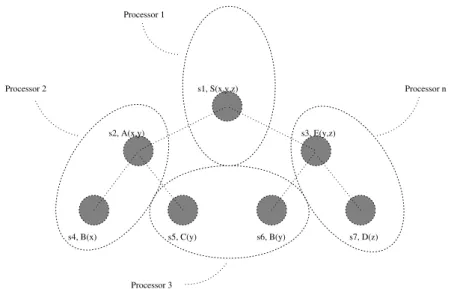
The Supervisor assigns to a new slave(for
s1, S(x,y,z)
s2, A(x,y)
s4, B(x) s5, C(y) s6, B(y) s7, D(z) s3, E(y,z) Processor 1
Processor n Processor 2
Processor 3
Fig. 1. SlaveProcesses generation.
s1 asks the Supervisor for solutions for the RHSS A and E along with their corresponding
inherited attributes. Supervisor checks if there exist already solutions for A(x,y)andE(y,z).
If not, it assigns the evaluation of A(x,y)and
E(y,z) to s1 two new slaves (say s2 and s3),
respectively. This scheme achieves AND paral-lelism. If there already exist solutions for some or for all of the RHSSs, then there is no need for new slaves corresponding to these RHSSs. As a result PAGE achieves controlled grained parallelism, because no unnecessary slaves are generated. Similarly, slave s2 asks the super-visor for solutions for the RHSSBandCalong
with their inherited attributes(i.e., xand y
re-spectively). The Supervisor checks if there
al-ready exist solutions forB(x)andC(y). If not,
it assigns the evaluation ofB(x)andC(y)to two
new slaves (say s4 and s5), respectively. The
procedure goes on in the same manner unfold-ing a proof tree over the network. If we add one more rule to our example
Allocation Table
Results Grammar Input String
Supervisor Process
Fig. 2.Network Supervisor Structure.
4. S(x,y,z) :- A(y,x), E(z,y).
then another similar proof sub-tree will be gen-erated, establishing OR parallelism.
Fig. 1 illustrates the above example. Each slave may be located in different processors or in the same processor with another slave.
Fig. 2 shows the Network Supervisor processor structure in which the AG is stored. The AG is decomposed and broadcast to the network nodes along with the input string, which is sent to the network nodes. Moreover the network Supervisor process maintains a Process Alloca-tion Table in order to prevent an explosion in the number of processes. The results of all the rules evaluated in the network are stored in a special-purpose structure.
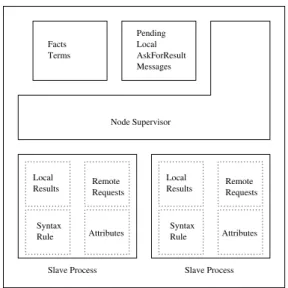
Local
Results RemoteRequests
Syntax
Rule Attributes
Local
Results RemoteRequests
Syntax
Rule Attributes Facts
Terms
Pending Local AskForResult Messages
Node Supervisor
Slave Process Slave Process
Fig. 3.Node Structure.
In general the data-flow style of execution of PAGE assimilate to the computational model of Conery’s AND/OR process model, however it
differs in the following important aspects: We use the above-mentioned structure sharing ap-proach when referring to these structures, so there is no need for stack copying, which is a major source of overhead in the latter model. Solution caching for incremental attribute eval-uation greatly improves our model. Moreover, PAGE tries to keep processes belonging to the same OR-branch locally in the same proces-sor. Finally, we use an interleaved unification scheme where more than one solution of each AND parallel branch are unified at the same time 11].
5. PAGELEARN: A Parallel Approach to AGLEARN, using PAGE Technology
In this section a parallel method is presented for the implementation of AGLEARN using the PAGE general purpose multi-paradigm attribute grammar evaluator. The method is adequate for S-attributed and for L-attributed AGs as well. Parallel learning leads to a more efficient exe-cution time and reduces the oracles that may be needed. In the following section a description of the method of using S-attribute grammars is supplied. We show how the circuity problem can be handled and give a detailed example. A description of the method using L-attribute grammars is also presented.
5.1. Parallel Learning of S-attribute Grammars
Description of the Method
Let AG=<GSAΦI >the given Attribute
Grammar, PB the set of background rules, PT
the set of target rules, andEthe set of the train-ing examples. The target nonterminals possess only synthesized attributes. We would like to learn the semantic functions of eachP 2PT in
parallel using PAGE.
In this case the Supervisor processor and the processors have the AG. The rules of PT are
decomposed, and each processor handles one part of the target rules. Every process(slave)
learns one semantic function of a rule R. So ev-ery rule and evev-ery attribute of the rules inPT is
learned in parallel. The process has to build the tableT (given in example 3.1). This means that
for every example the corresponding process must compute the columnsclass, word, target, U, FUR, FUCR, FUF, FUCF. It is clear from this
procedure that the main issue is the computation ofU, since other columns can be derived from the columnUor target or from the examples. Let us suppose that R has the form of R :
;Xp0!Xp1:::Xp k.
To computeU, in the previous section, we have to know the value of Xp j:b 2 Syn(Xp j)j =
1:::k (AGLEARN method). For this we
build the tree for the actual example, and if the subtree derived from Xp j contains a node
corresponding to a rule instance belonging to
PT, then the values of the attributes ofSyn(Xp j)
are asked from the user for the given derivation. Now we have the possibility of asking the other processes if the rule belonging toPT is already
learned or not(because of parallelism). If this
is the case, we can use these semantic functions and we do not need an oracle. If it hasn’t been learned yet, we have again a possibility of wait-ing until it is learned(or we can ask the user).
At this point we have to handle a difficult prob-lem. If we decide to wait for these semantic rules to be learned, we may face a circuity sit-uation where two processes wait(perhaps
tran-sitively)for one another to produce a semantic
rule.
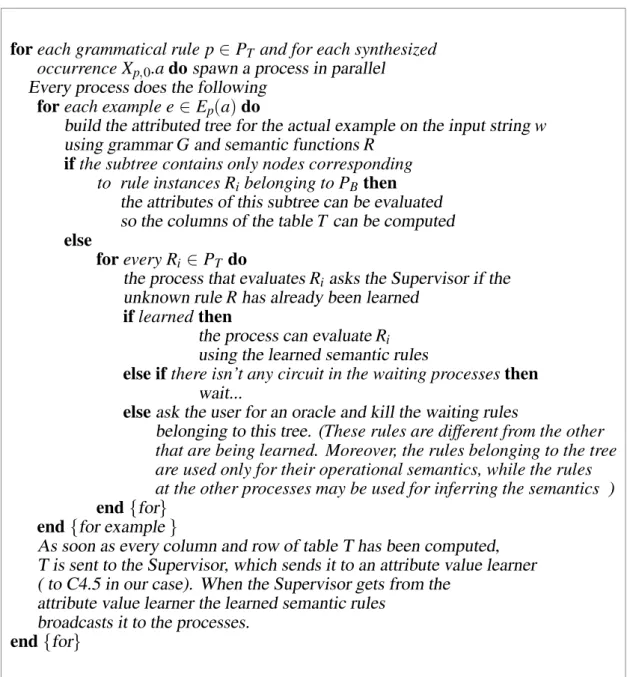
foreach grammatical rule p2PT and for each synthesized occurrence Xp0:adospawn a process in parallel
Every process does the following
foreach example e 2Ep(a)do
build the attributed tree for the actual example on the input stringw
using grammarGand semantic functionsR
ifthe subtree contains only nodes corresponding to rule instances Ribelonging to PBthen
the attributes of this subtree can be evaluated so the columns of the tableT can be computed
else
forevery Ri 2PTdo
the process that evaluatesRiasks the Supervisor if the
unknown ruleRhas already been learned
iflearnedthen
the process can evaluateRi
using the learned semantic rules
else ifthere isn’t any circuit in the waiting processesthen
wait...
elseask the user for an oracle and kill the waiting rules
belonging to this tree. (These rules are different from the other that are being learned. Moreover, the rules belonging to the tree are used only for their operational semantics, while the rules at the other processes may be used for inferring the semantics )
endfforg
endffor exampleg
As soon as every column and row of table T has been computed, T is sent to the Supervisor, which sends it to an attribute value learner ( to C4.5 in our case). When the Supervisor gets from the
attribute value learner the learned semantic rules broadcasts it to the processes.
endfforg
Fig. 4.General Algorithm of the PAGELEARN Method.
Handling the Circuity Problem
The problem can be summarized as follows: Every process learns the semantic rule for an attribute(Ri:aj) in parallel. When the process
creates the columnUfor the given training ex-ample, it has to build the derivation tree for this example, and evaluate this tree. If this tree has a rule that belongs toPT, then the process has to
wait for the semantic rules of this rule. We want to avoid the circuity problem, that is, when two or more processes are waiting one for another.
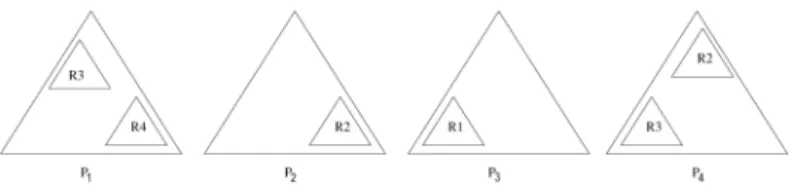
Example 5.1. Assume that we have the pro-cessesP1P2P3P4learning the semantic rules
R1:aR2:aR3:aR4:arespectively. Fig. 5
de-picts the circuity problem when the processes are waiting for the learning of the following se-mantic rules:
M R1 R2 R3 R4
R1 0 0 1 0
R2 0 1 0 1
R3 1 0 0 1
R4 1 0 0 0
Fig. 5.The circuity problem: the waiting processes.
P1 is learning R1:aand in the subtree for
the given example R3 and R4 are used.
(It means that we need the semantic rules
R3.a and R4.a to evaulate the value of the attributes of the derivation tree built for the actual example.)
P2 is learning R2:aand in the subtree for
the given example R2 is used.
P3 is learning R3:aand in the subtree for
the given example R1 is used.
P4 is learning R4:aand in the subtree for
the given example R2 and R3 are used.
In the above example we saw that each learn-ing process of a semantic rule may depend on the learning process of another semantic rule of another grammatical rule. These dependences form a dependency graph G. Let G = (VE)
a directed graph, where V = (R1:::Rk), Rj2PT,j=1:::k,
E=f(RiRj): There is an edge fromRitoRj
if and only ifRjis waiting forRig
R1
R2
R3
R4
Fig. 6.The circuity problem: the dependency graph. In Fig. 6 the dependency graph of the exam-ple 5.1 is shown. In this graph we have three circuits:
R1!R3!R4!R1
R2!R2
R1!R3!R1
In the general algorithm of PAGELEARN(see
Fig. 4)we have to check for the circuity
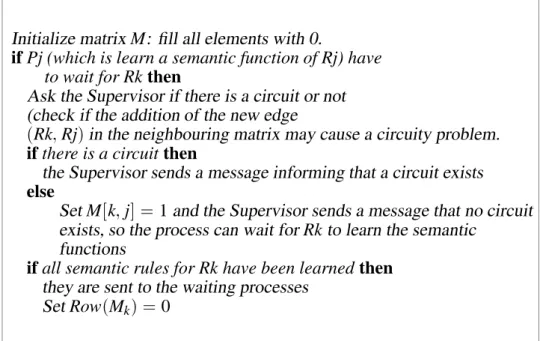
prob-lem. For this purpose a neighbouring matrixM
is used, situated in the Supervisor, and is similar to that of the Table 2. Using this matrix it is easy to detect when a circuity problem is being faced or not. If a circuity problem is being faced then it is enough to cut the circuit only at one point (one rule) and ask the user. The check
algorithm is listed in Fig. 7.
A Detailed Example
This section presents a detailed example de-scribing the proposed parallel method using PAGE. Some processes belonging to a proces-sor, which have been assigned the task of learn-ing the semantic rules of a target rule. Other processes belonging to the same processor work on the learning of the semantic rules of another target rule. Every process has to build a table
Tij(from which the if-rules are generated). The
Supervisor as well as the slave processors know the whole AG specification. To be more pre-cise, each one of the PAGE processes has the following tasks assigned.
The Supervisor:
Handle the table M that is used for dealing
with the circuity problem.
Decompose the target rulesP2PT.
Store the learned semantic rules
Serve the requested messages for the
se-mantic rules or the circuits
The slave processors:
Spawn and delete processes for the rules
and for its attributes
Forward the requests and the learned
Initialize matrixM: fill all elements with 0.
ifPj (which is learn a semantic function of Rj) have to wait for Rkthen
Ask the Supervisor if there is a circuit or not (check if the addition of the new edge
(RkRj)in the neighbouring matrix may cause a circuity problem.
ifthere is a circuitthen
the Supervisor sends a message informing that a circuit exists
else
SetM kj]=1and the Supervisor sends a message that no circuit
exists, so the process can wait forRkto learn the semantic functions
ifall semantic rules for Rk have been learnedthen
they are sent to the waiting processes SetRow(Mk)=0
Fig. 7.Checking Algorithm for the Circuity Problem
Handle the requests of the processes for
the AGs rules
The processes:
compute the tableTij.
Build the derivation tree for the actual
ex-amplefthis is automatic in the PAGE
sys-temg
Ask the Supervisor or other processes or
the user for the unknown semantic rules if it is necessary
Transform the tableTijto the Supervisor
The Supervisor decomposes the target rules and broadcasts them along with the corresponding training examples over the network. The pro-cessors spawn processes (slaves)for every
se-mantic rule corresponding to each one of the synthesized attributes of the target rules. The processes start to learn the target semantic rules from the given examples. The core tasks of PAGELEARN are: creation of the table Ti j,
building of the derivation tree for each of the given corresponding examples, and, if it is nec-essary, asking the Supervisor for the target rules for evaluation of the parse tree, or waiting for other processes to produce target semantic rules. When the tableTi jis computed then the process
generates the if-rules, transforms them into se-mantic rules, and sends them to the Supervisor.
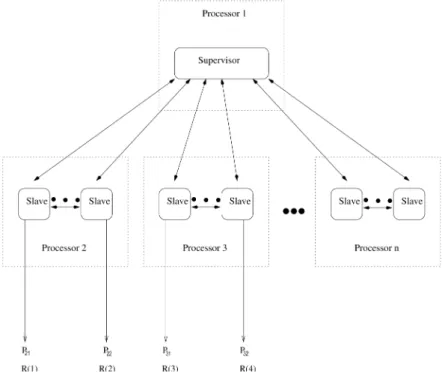
Example 5.2. We demonstrate how the method works in parallel by continuing the previous ex-ample. Recall thatPT=fR(1)R(2)R(3)R(4)g.
Processor 2 handlesR(1)andR(2),
Processor 3 handlesR(3)andR(4).
Processor 2 spawns 2 processes P21 for R(1)andP22forR(2).
Processor 3 spawns 2 processes P31 for R(3)andP32forR(4).
Fig. 8 shows the mapping of the processes in the processor network.
The rules R(1) - R(4) are learned in parallel.
The positive and negative examples are : - E+
1(mode)=f(2:5+3real)(5+3int), (1:5;4real):::g
- E;
1(mode)=f2+3:2int)(4:3;2int):::g
- E+
2(mode)=f(2int)(3:5real):::g
- E;
2(mode)=f(1:3int)(2real):::g
- E+
3(mode)=f(3 2:5real)(5 3int), (15 4real)(2:5=3real)(2=3real), (6=3:4real)g
- E;
Fig. 8.Processes mapping for the Example 5.2. - E+
4(mode)=f(2int)(3:5real):::g
- E;
4(mode)=f(1:3int)(2real):::g
Table 3 shows the tableT(mode)which is
com-puted in parallel.
Class Word Target U1 ... ...
+ 2.5+3 Real int ... ...
+ ... ...
- ... ...
Table 3.The table T(a)for the example 5.2
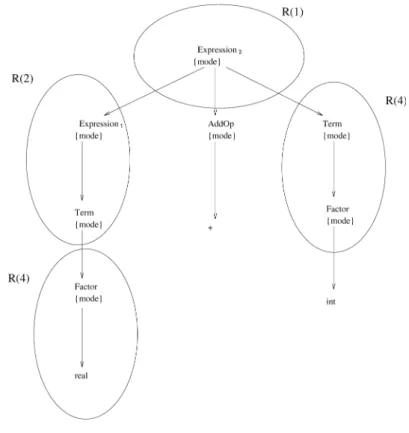
To compute the element of the columnUan at-tributed grammar tree is built on the input string
w of each example. Fig. 9 shows the attribute tree for the rule R(1). Recall that the rulesR(2)
andR(4)are evaluated in parallel.
R(2)andR(4)2PTare used in this
deriva-tion tree.
If we build the derivation tree for the given examples we find that
To learnR(2)we need to use R(4)
To learnR(3)we need to use R(4)
To learn R(4) we don’t need to use rules
fromPT
The corresponding dependency graph for the detection of circuity problem is given in Fig. 10. We do not have a circuit in this graph soP22and
P31can wait untilR(4)is learned, andP21can
wait until R(2) and R(4) are learned. So we
needn’t ask the user, but when we had to learn sequentially we had to ask the user for every example in R(1), R(2)and R(3).
Example 5.3. We give an example to show how there can be a circuit in the dependency graph. LetPT = fR(3)R(7)g. E
+
3 = f(3:2
(4:1+3)real)gandE +
7 =f((4:1 1:2)real)g.
When the process builds the attributed tree for
e3, then we have to wait for R(7)to be learned,
and when the other process builds the attributed tree fore7 then we have to wait for R(3)to be
learned. So we have the circuity problem.
5.2. How the Method Works for L-attributed Grammars
We suppose that a target nonterminal can pos-sess inherited attributes. Consider the produc-tion: p : Xp0 ! Xp1:::Xp n
p 2 PT. The
Fig. 9.Derivation tree for the Example 5.2.
R(1) R(3)
R(2)
R(4)
Fig. 10.Dependency graph for detecting circuity problem for Example 5.2
semantic functions for the set of defined occur-rencesS
0<knp
Inh(Xp k)Syn(Xp0).
In our method we learn the semantic functions for every Xp j, j = 1:::np, and then learn
the semantic functions for Xp0 sequentially.
However, we can learn in parallel the seman-tic functions for the attributes of a given Xp j,
j = 1:::np, and for Xp0 as well since both
are independent.
The whole task of process mapping and decom-position of the rules is similar to the parallel learning of S-attributed grammar. The only difference is that we have to spawn processes for every inherited attribute 2 Inh(Xp j)j =
1:::np, when their semantic functions are
learned, and we have to spawn processes for every synthesized attribute 2 Syn(Xp0) when
we learn the semantic functions ofXp0.
The procedure can be summarized as given in Figure 11.
So we learn in parallel the rules inPT (the set
of the target semantical rules).
For a given rulep :Xp0 !Xp1:::Xp np2 PT
we learn
1. first semantic functions for the inherited at-tributes ofXp1in parallel
2. then semantic functions for the inherited at-tributes ofXp2in parallel
. .
np:finally semantic functions for the inherited
attributes ofXp npin parallel
np+1: and then the synthesized attributes of Xp0in parallel
For steps 1; np to create table Ti , we have
to know the value of S
k2f1i;1g
Syn(Xp k) Inh(Xp0)of which semantic functions are learned
in the previous steps.
We learn in parallel the rules, so for a non-terminal both the inherited and the synthesized attributes are learned parallelly, because
If it is in the right hand side, its inherited
an-for every rule in paralleldo
fp:Xp0!Xp1:::Xp np2PTg
1. forj=1:::npdofsequentialg
forevery inherited attribute2Inh(Xp j)in paralleldospawn and run Process2
2. forevery synthesized attribute2Syn(Xp0)in paralleldospawn and run Process1
endfforg
Process1
foreach grammatical rule p2PT and for each synthesized occurrence Xp0:ado
spawn processes in parallel which do the following
foreach example e 2Ep(a)
build the attributed tree for the actual example on the input stringw
using grammarGand semantic functionsR
ifthe subtree contains only nodes corresponding to rule instances Ribelonging to PB then
the attributes of this subtree can be evaluated, and the columns of the tableT can be computed
else
forevery Ri 2PT do
the process that evaluatesRiasks the Supervisor if the unknown ruleR
has already been learned
iflearnedthenthe process can evaluateRiusing the learned semantic rules
else ifthere isn’t any circuit in the waiting processesthenwait...
elseask the user for an oracle and kill the waiting rules belonging to this tree.
endfforg
endffor exampleg
endfforg
Process2
forevery example do
1. ask the user to give the example for the target attributeXp j:a
2. build the attributed tree for the actual example on the input stringw
3. evaluate the part of the tree in order to get the value ofS
k2f1j;1g
Syn(Xp k)Inh(Xp0)
endfforg
5.generate the if rule
6.generate the semantic rule
Fig. 11.General algorithm for L-attributed grammar other rule of which it is the left hand side
symbol(or this rule belongs toPB).
If it is in the left hand side, its synthesized
attributes are learned in the actual rule, and its inherited attributes are learned in an other rule in that it is on the right hand
side(or this rule belongs toPB).
5.3. Analysis of the Method
or-acle has to answer questions about the learning problem. So the execution time depends on both the oracles needed in the procedure and the ex-ecution time itself of the program.
Our program is parallelized according to three aspects:
1. Every semantic rule of the target rules is learnt in parallel.
2. The PAGE system is a parallel parser, so the attributed tree built for the acutal exam-ple is handled in parallel. Moreover, this facility makes it possible to learn many semantic rules concurrently.
3. The concurrent learning of many seman-tic rules gives tha possibility to reduce the oracles needed in the procedure. The total elimination of oracles is possible in cases when no circuity situation occurs.
While the main problem of the sequen-tial system was the large number of the user queries, this method improves the ef-ficiency of the previous method from this aspect too. The elimination’s percent of the user queries depends (on the training
examples) on the number of the circuits
appearing among the waiting rules during the learning method.
6. Discussion
The method presented here is based on the AGLEARN method described in 2].
Paral-lelism improves the efficiency of the previous method both in execution time and in interaction needed. PAGE is capable to handle the learn-ing of many semantic rules concurrently. OR parallelism PAGE explores gives the ability of reducing the oracles needed in the procedure. The total elimination of oracles is possible in cases when no circuity situation occurs.
Moreover, behind parallelism a “dual nature” of the proposed method is hidden. The concept of the method described is to give the user the ca-pability of handling smaller specifications of the grammar describing the problem the user deals with. The natural order to do this is, firstly to learn the semantic rules from the given exam-ples and secondly to execute the program. Now we can have both steps interleaving each other in the following fashion:
Evaluate the grammar ! if a semantic rule is
needed, try to learn it!continue the execution.
References
1] PIERRE DERANSART AND JAN MALUSZYNSKI, A Grammatical View of Logic Programming, The MIT Press, 1993.
2] TIBORGYIMOTHY ANDTAMASHORVATH, Learning
Semantic Functions of Attribute Grammars,Nordic Journal of Computing, accepted.
3] DONALD E. KNUTH, Semantics of Context-Free
Languages, Mathematical Systems Theory, 2(2),
127–145, 1968.
4] DONALDE KNUTH, Semantics of Context-Free
Lan-guages, correction,Mathematical Systems Theory, 5(1), 95–96, 1968.
5] J. LEWI, K. DEVLAMINCK, E. STEEGMANS ANDJ.
VAN HOREBEEK, Software development by LL(1)
syntax description, John Wiley & Sons, New York, 1992.
6] J. MALUSZYNSKI, S. BONNIER, J. BOYE, F.
KLUZ-NIAK, A. KAGEDAL ANDU. NILSSON, Logic Pro-grams with External Procedures, In K.R Apt, J.W de Bakker and J.J.M.M Rutten, editors,Logic Pro-gramming Languages - Constraints, Functions, and Objects, pages 21–48, The MIT Press, 1993.
7] GEORGE PAPAKONSTANTINOU AND PANAYOTIS
TSANAKAS, Attribute grammars and dataflow com-puting,Information and software technology, 30(5),
306–313, 1988.
8] THOMASREPS, Scan Grammars: Parallel Attribute
Evaluation via Data Parallelism, InProceedings of the 5th ACM Symposium on Parallel Algorithms and Architectures, ACM, Velen, Germany, June 1993.
9] P. TRACHANIAS, AND E. SKORDALAKIS, Syntactic
Pattern Recognition of the ECG,IEEE transactions on Pattern Recognition and Machine Intelligence, 12(7), 648–657, 1990.
10] BRADLEYVANDER ZANDENT., Constraint
Gram-mars in user interface management systems, In
Proceedings of the Graphics Interface Conference, LNCS, Edmonton, Canada, June 6 –10, 1988.
11] C. VOLIOTIS, A. THANOS, N. SGOUROS ANDG. P
A-PAKONSTANTINOU, Daffodil: A Framework for In-tegrating AND/OR Parallelism, In 5th Hellenic Conference on Informatics, Athens, Dec 1995.
12] COSTANTINOSVOLIOTIS, NIKITASM. SGOUROS AND
13] K. VOLIOTIS, G. MANIS, H. LEKATSAS, P. TSANAKAS
ANDG. PAPAKONSTANTINOU, ORCHID: A potrable platform for parallel programming,Euromicro Jour-nal of Systems Architecture.
14] K. VOLIOTIS, G. MANIS, A. THANOS, G.
PAPAKON-STANTINOUP. TSANAKAS, Facilitating the Devel-opment of Portable Parallel Applications on Dis-tributed Memory Systems, InProc. Massively Par-allel Programming Models MPPM-95 conference, Berlin, 1995., IEEE Computer Society Press.
15] ZARINGALANK., Parallel Evaluation in Attribute Grammar-Based Systems, PhD thesis, Department of Computer Science, Cornell University, Ithaca, NY 14853-7501, August 1990.
16] R. WILHELM, Attributierte Grammatiken, Infor-matik Spektrum, 2, 123 – 130, 1979.
Received:November, 1997
Revised:December, 1999
Accepted:January, 2000
Contact address:
Gy¨ongyi Szil´agyi Hungarian Academy of Sciences Research Group on Artificial Intelligence Szeged Hungary Aggelos M. Thanos National Technical University of Athens
Athens Greece
GYONGYISZILAGYIis a research assistant at the Research Group of Ar-tificial Intelligence of the Hungarian Academy of Sciences. From 1995 till 1998 she was a Ph.D. student in computer science at Jozsef Attila University. Her research interests include Logic Programming(LP),
Inductive Logic Programming(ILP), Constraint Logic Programming
(CLP), Learning of CLP, Attribute Grammars(AG), Learning of AG’s
and Slicing of Logic Programs.
AGGELOSM. THANOSreceived his M.S. degree(1993, in Computer
Science)from the University of Crete at Heraklion. In 1993 he entered