109
Potential of Wild Plants as a Source of Bioactive Compounds
Eva Ivanišová
1*, Tomáš Krajčovič
1, Marián Tokár
1, Štefan Dráb
1, Attila Kántor
1,
Miroslava Kačániová
21
Slovak University of Agriculture in Nitra, Department of Plant Storage and Processing, Faculty of Biotechnology and Food Sciences, Tr. A. Hlinku 2, 949 76 Nitra, Slovakia
2
Slovak University of Agriculture in Nitra, Department of Microbiology, Faculty of Biotechnology and Food Sciences, Tr. A. Hlinku 2, 949 76 Nitra, Slovakia
Abstract
The aim of this study was to determine biological activity of four wild plants: Menyanthes trifoliata L., Centaurium erythraea Rafn., Portulaca oleracea L., and Acorus calamus L. The antioxidant activity was detected by ABTS, reducing power and phosphomolybdenum method, total polyphenol content with Folin – Ciocalteu reagent, flavonoids content by aluminium chloride method and total phenolic acid content by Arnova reagent. The detection of antimicrobial activity was carried out by disc diffusion method against three species of Gram-negative bacteria:
Escherichia coli CCM 3988, Salmonella enterica subsp. enterica CCM 3807, Pseudomonas aeruginosa CCM1960 and two Gram-positive bacteria: Bacillus thuringiensis CCM 19, Stapylococcus aureus subsp. aureus CCM 2461. Results showed that wild plants are rich for biologically active substances and can be used more in different kind of industry as a cheap source of these substances. The highest antioxidant activity by ABTS and reducing power method was determined in the sample of Menyanthes trifoliata L.(64.99 mg TEAC – Trolox equivalent antioxidant capacity per g of sample and 69.05 mg TEAG per g) and by phosphomolybdenum method in the sample of
Menyanthes trifoliata L. (237.97 mg TEAC per g of sample). In the sample of Menyanthes trifoliata L. was measured the highest content of total polyphenols (27.91 mg GAE – gallic acid equivalent per g of sample), flavonoids (35.69 mg QE – quercetin equivalent per g of sample) and total phenolic acids (22.56 mg CAE – caffeic acid equivalent per g of sample). All samples also showed antimicrobial activity to inhibit selected kind bacteria with the best results in Menyanthes trifoliata L.
Keywords: antioxidant activity, bacteria, polyphenols, flavonoids, phenolic acids
1. Introduction
Medicinal herbs have been an important part of folk and traditional medicine for thousands of years. According to WHO, 80% of the world´s population primarily relies on traditional medicine, a major part of which involves the use of plant extracts of their active ingredients [1]. WHO estimate also reported that the present demand for medicinal plants is billion annually and by the year 2050, it will be $ 5 trillion.
Menyanthes trifoliata L. (buckbean) is a perennial
*Corresponding author: Eva Ivanišová, tel.: +421376414421, E-mail: [email protected]
aquatic or wetland plant species with a circumpolar distribution from 40N to the Arctic Circle. It grows north of the Arctic Circle in Scandinavia, Greenland, Alaska and Siberia. In traditional and folk medicine leaves are used to treat loss of appetite and dyspeptic complaints, to treat colds, fevers, rheumatism, liver ailments, worms and skin disorders, as an astringent to stop bleeding, and as a remedy against scurvy and other diseases [2]. Centaurium erythraea Rafn. has been used in traditional medicine for its depurative, sedative, antipyretic and anti-inflammatory effects, and is also used in the treatment of diabetes for its antihyperglycemic and hypoglycemic eff
ect
[3]. Portulaca oleracea110 nutritious vegetable and is one of the most common plants in the world. In folk medicine, this herb is utilized as an antipyretic, septic, anti-spasmodic, anti-scorbutic, analgesic, muscle relaxant and diuretic medicine [4]. Acorus calamus L. (Araceae) is widely distributed throughout the northern hemisphere mostly in temperate and subtropical climates including Indian subcontinent, far–east countries, Europe and North America. In folk medicine acorus
rhizomes are considered to possess antispasmodic, antimicrobial, carminative and anthelmintic properties; they are used to treat many mental disorders such as epilepsy, memory impairment, and digestive problems such as gas, bloating, colic and poor digestive functions [5].
The aim of this study was to determine antioxidant activity, total polyphenols, flavonoids, phenolics acid content as well as antimicrobial activity of selected wild plants from Slovakia.
2. Materials and methods
2.1 Biological materials
The wild plants were collected from nature in Slovakia (locality Liešťany): Menyanthes trifoliata L. – leaves, Centaurium erythraea Rafn.. – leaves with flowers, Portulaca oleracea L. – leaves, and Acorus calamus L. – rhizomes. Before the analysis samples were pulverized in the mortar.
2.2 Chemicals
All chemicals were analytical grade and were purchased from Reachem (Slovakia) and Sigma Aldrich (USA).
2.3 Sample preparation
An amount of 0.1 g of sample was extracted with 20 ml of 80% ethanol for 24 hours. After centrifugation at 4000 g (Rotofix 32 A, Hettich, Germany) for 10 min, the supernatant was used for measurement (antioxidant activity, polyphenols, flavonoids, phenolic acids). Extraction was carried out in triplicate.
2.4 ABTS radical cation decolorization assay ABTS radical cation decolorization assay was determined by the method of Re et al., [6] with slight modifications. ABTS
(2,2´-azinobis[3ethylbenzthiazoline]- 6-sulfonic acid) was dissolved in distilled water to 7 mM concentration, and potassium persulphate added to a concentration of 2.45 mM. The reaction mixture was left to stand at room temperature overnight (12~16 h) in the dark before use. The resultant intensely-coloured ABTS•+ radical cation was diluted with 0.01 M PBS (phosphate buffered saline), pH 7.00 to give an absorbance value of ~0.70 at 734 nm. Two milliliter of ABTS solution was mixed with 0.98 mL of PBS and 0.02 mL of sample extract. Absorbance was measured spectrophotometrically (Jenway 6405 UV/Vis, England) at time intervals 6 minutes after addition of sample extract. Trolox (100 – 100 mg.L-1 ; R 2 = 0.9991) was used as the standard, and the results were expressed in mg.g-1 Trolox equivalents.
2.5 Reducing power
Reducing power of extracts was determined by the phosphomolybdenum method of Prieto et al. [7] with slight modifications. The mixture of sample (1 ml), monopotassium phosphate (2.8 ml, 0.1 M), sulfuric acid (6 ml, 1 M), ammonium heptamolybdate (0.4 ml, 0.1 M) and distilled water (0.8 ml) was incubated at 90°C for 120 min, then rapidly cooled and detected by monitoring absorbance at 700 nm using the spectrophotometer Jenway (6405 UV/Vis, England). Trolox (10-1000 mg/L; R2=0.998) was used as the standard and the results were expressed in mg/g Trolox equivalents.
2.6 Total polyphenol content
Total polyphenol content extracts was measured by the method of Singleton and Rossi [8] using Folin-Ciocalteu reagent. 0.1 ml of each sample was mixed with 0.1 ml of the Folin-Ciocalteu reagent, 1 ml of 20% (w/v) sodium carbonate, and 8.8 ml of distilled water. After 30 min. in darkness the absorbance at 700 nm was measured using the spectrophotometer Jenway (6405 UV/Vis, England). Gallic acid (25-300 mg/L; R2=0.998) was used as the standard and the results were expressed in mg/g gallic acid equivalents.
2.7 Total flavonoid content
111 After 30 min. in darkness the absorbance at 415 nm was measured using the spectrophotometer Jenway (6405 UV/Vis, England). Quercetin (0.5-20 mg/L; R2=0.989) was used as the standard and the results were expressed in μg/g quercetin equivalents.
2.8. Total phenolic acid content
Total phenolic acids content was determined using method of Farmakopea Polska [10]. A 0.5 mL of sample extract was mixed with 0.5 mL of 0.5 M hydrochloric acid, 0.5 mL Arnova reagent (10% NaNO2 +10% Na2MoO4), 0.5 mL of 1 M sodium hydroxide (w/v) and 0.5 mL of water. Absorbance at 490 nm was measured using the spectrophotometer Jenway (6405 UV/Vis, England). Caffeic acid (1 – 200 mg.L-1 , R 2 = 0.999) was used as a standard and the results were expressed in mg.g -1 caffeic acid equivalents
2.9 Microbial strains
Five strains of microorganisms were tested in this study, Gram-negative bacteria: Escherichia coli
CCM 3988, Salmonella enterica subsp. enterica
CCM 3807, Pseudomonas aeruginosa CCM1960 and two Gram-positive bacteria: Bacillus thuringiensis CCM 19, Stapylococcus aureus
subsp. aureus CCM 2461. All tested strains were collected from the Czech Collection of microorganisms. The bacterial suspensions were cultured in the nutrient broth (Imuna, Slovakia) at 37°C.
2.10 Disc diffusion method
Antimicrobial activity of each plant extract was determined by a disc diffusion method. Briefly, 100 μl of the test bacteria were grown in 10 ml of fresh media until they reached a count of approximately 105 cells/ml. Then 100 μl of the microbial suspension was spread onto Mueller Hinton agar plates. The extracts were tested using 6 mm sterilized filter paper discs. The diameters of the inhibition zones were measured in millimeters. All measurements were to the closest whole millimeter. Each antimicrobial assay was performed in at least triplicate. Filter discs impregnated with 10 μl of distilled water were used as a negative control.
2.11 Statistical analysis
Differences in absorbance between the measurements before and after the analysis were
expressed as a set of binary values. These values were assigned to exact concentrations. The following formula was created for this specific experiment: value 1 (inhibitory effect) was assigned to absorbance values lower than 0.05, while value 0 (no effect or stimulant effect) was assigned to absorbance values higher than 0.05. For this assigned to absorbance values higher than 0.05. For this statistical evaluation the probit analysis in Statgraphics software was used.
3. Results and discussion
3.1. Antioxidant activity with ABTS radical cation decolorization assay and reducing power Results showed that all tested wild herbs exhibited antioxidant activity (Tab.1). By ABTS method the highest activity was determined in Menyanthes trifoliata L. (64.99 mg TEAC/g) followed by
Centaurium erythraea Rafn., Acorus calamus L. and Portulaca oleracea L. By reducing power the best activity showed sample of Acorus calamus L. (213.50 mg TEAC/g) following by Menyanthes trifoliata L., Centaurium erythraea Rafn. and
Portulaca oleracea L.
Funde [11] tested antioxidant activity of Acorum calamus L. and found highest activity with the best results in methanolic and ethanolic extract with compare to propanol, acetonitrile and water. Elayaraja et al., [12] determined antioxidant activity of ethanolic extract of Acorus by DPPH method and compared this activity with BHA and silymarin. Results showed that Acourus had strong activity (59.13%) which is comparable with BHA (70.37%) and sylimarin (63.55%). Stefkov et al., [13] study dry extract of the aerial parts of
112 Table 1. Antioxidant activity of evaluated wild plants
Sample ABTS
[mg TEAC/g]
Reducing power [mg TEAC/g] Menyanthes 64.99 ±2.51 213.5 ±3.01 Centaurium 35.74 ±3.49 161.48 ±2.12 Acorus 19.90 ±1.77 237.97 ±2.11 Portulaca 13.09 ± 0.61 72.79 ±2.15
± standard deviation; TEAC – trolox equivalent antioxidant capacity
3.2. Total polyphenol, flavonoid and phenolic acid content
Results of total polyphenol, flavonoid and phenolic acid content are presented in Tab. 2. The highest total polyphenols was determined in
Menyanthes trifoliata L. (27.91 mg GAE/g) followed by Centaurium erythraea Rafn., Acorus calamus L. and Portulaca oleracea L. Similar tendency was observed in total flavonoid determination with the best results in Menyanthes
trifoliata L. (35.69 mg QE/g) followed by
Centaurium erythraea Rafn., Portulaca oleracea
L. and Acorus calamus L. In total phenolic acid content assay best values was determined in
Menyanthes trifoliata L. (22.56 mg CAE/g)
followed by Centaurium erythraea Rafn.,
Portulaca oleracea L. and Acorus calamus L. According to Martz et al., [2] leaves of Menyanthes trifoliata L. contain different types of phenolics such as coumarins (scopoletin), flavonols (rutin, hyperin, trifolioside) and iridoids (loganin, menthiafolin, foliamenthin). Iridoids are water-soluble cyclic monoterpenes that are found in various plant species and are important in defense reactions against insects and mammals. Erkan [14] identified by HPLC in Portulaca
extract chlorogenic, caffeic, p-coumaric, ferulic and rosmarinic acid, and also quercetin and kaempferol. Mousavi et al., [15] determined in water-methanolic extract total polyphenol in amout 121.09 mg/kg. Sandru et al., [16] found total polyphenol content in Centaurium erythraea
Rafn. in amount 271.61 mg/L and reported that this plant can be used as digestive drinks in the food industry due to higher concentration of total polyphenols. Ghimire et al., [17] tested total polyphenol and flavonoid content of Acorus
calamus L. from Nepal and found 67.93 mg
GAE/g of total polyphenols which is ten times higher than in our study. Total flavonoid content
in their study was also higher – 23.90 mg QE/g. Difference between results could be attributed to different extraction procedures, time of harvest, and mainly environmental conditions.
3.3. Antimicrobial activity
In our study of wild plants were tested against different strains of Gram-negative bacteria:
Escherichia coli CCM 3988, Salmonella enterica
subsp. enterica CCM 3807, Pseudomonas
aeruginosa CCM1960 and two Gram-positive
bacteria: Bacillus thuringiensis CCM 19,
Stapylococcus aureus subsp. aureus CCM 2461. with disc-diffusion method.
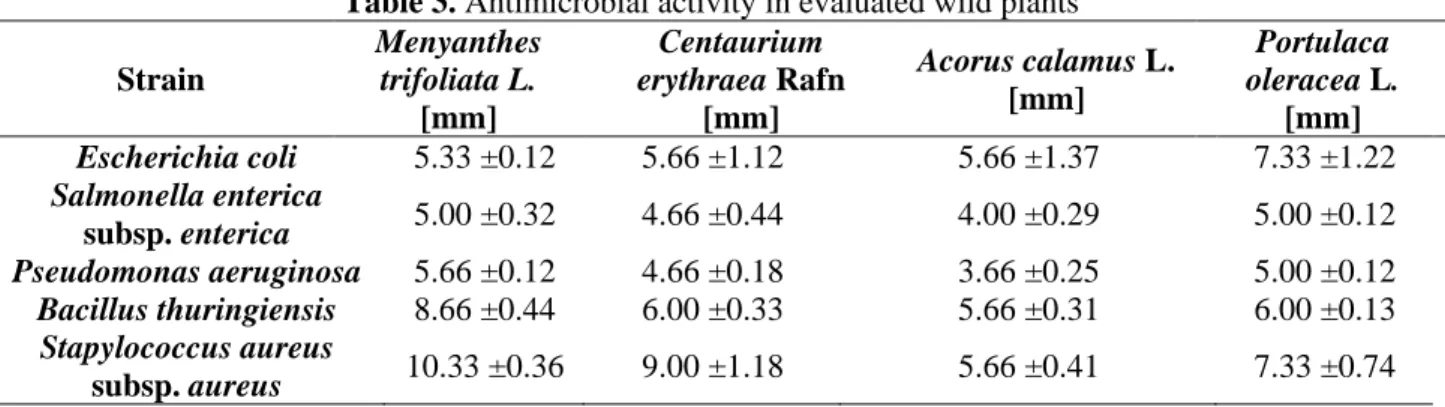
The results of disc diffusion method (Tab. 3) showed that Menyanthes trifoliata L. exhibited the highest antibacterial activity against all tested bacteria, with the strongest effect to inhibited
Stapylococcus aureus subsp. aureus CCM 2461 – 10.33 mm zone of inhibition, following by
Bacillus thuringiensis CCM 19 – 8.66 mm zone of inhibiton. Strong activity also showed extract
Centaurium erythraea Rafn. to inhibited
Stapylococcus aureus – 9 mm zone of inhibition. In study of Kirbag et al., [18] Centaurium erythraea Rafn. extract
had inhibitory effect 13
mm against
Bacillus megaterium
and 8 mm
against
Klepsiella pneumoniae.
In study
Jerković et al.,
[19] was observed antibacterial activity of Centaurium erythraea Rafn. essential oil, with the best effect to inhibited Escherichia coli (13 mm), which was comparable to inhibitory effect of ampicillin (15 mm). This authors also found effect of this oil to inhibited Staphylococcus aureus – 8 mm, which is comparable with our findings – extract from Centaurium erythraeaRafn. – 9 mm inhibitory effect against
Staphylococcus aureus. Kumar et al., [20]
determined inhibitory activity of Acorus calamus
rhizome ethanol extract against Escheria coli with value 5 mm, which is comparable with our results – 5.66 mm against Escheriachia coli. Peng et al., [21] tested antibacterial activity of ethanolic
Portulaca extract and published following results:
Escherichia coli – 16.6 mm zone of inhibition,
Staphylococcus aureus – 12.3 mm zone of
113
Table 2. Total polyphenol, flavonoid and phenolic acid content in evaluated wild plants
Sample Total polyphenol
[mg GAE/g]
Total flavonoid [mg QE/g]
Total phenolic acid [mg CAE/g]
Menyanthes trifoliata L. 27.91 ±2.12 35.69 ±2.27 22.56 ±1.37
Centaurium erythraea Rafn. 13.17 ±1.14 19.77 ±0.34 7.69 ±0.29
Acorus calamus L. 6.06 ±0.32 0.73 ±0.18 5.88 ±0.25
Portulaca oleracea L. 5.09 ±0.36 22.53 ±1.18 8.12 ±0.41
± standard deviation; GAE – gallic acid equivalent; QE – quercetin equivalent; CAE – caffeic acid equivalent
Table 3. Antimicrobial activity in evaluated wild plants
Strain
Menyanthes trifoliata L.
[mm]
Centaurium erythraea Rafn
[mm]
Acorus calamus L.
[mm]
Portulaca oleracea L.
[mm]
Escherichia coli 5.33 ±0.12 5.66 ±1.12 5.66 ±1.37 7.33 ±1.22
Salmonella enterica
subsp. enterica 5.00 ±0.32 4.66 ±0.44 4.00 ±0.29 5.00 ±0.12
Pseudomonas aeruginosa 5.66 ±0.12 4.66 ±0.18 3.66 ±0.25 5.00 ±0.12
Bacillus thuringiensis 8.66 ±0.44 6.00 ±0.33 5.66 ±0.31 6.00 ±0.13
Stapylococcus aureus
subsp. aureus 10.33 ±0.36 9.00 ±1.18 5.66 ±0.41 7.33 ±0.74
± standard deviation
4. Conclusions
Results showed that wild plants is important source of bioactive compounds with not only antioxidant but also with antimicrobial effects, and can be study more in future. In future is also important try to find way how we can used more these plants in different kind of industry.
Acknowledgements
This work was supported by grant VEGA 1/0411/17
References
1. Tripathy,V., Basak, B.B., Varghese, T.S., Saha, A. Residues and contaminants in medicinal herbs – A review. Phytochemistry Letters, 2015, 14, 67-78. 2. Martz, F., Turunen, M., Julkunen-Titto, R., Lakkala, K., Sutinen, M.L. Effects of the temperature and the exclusion of UVB radiation on the phenolics and iridoides in Menyanthes trifoliata L. leaves in the subarctic. Environmental pollution, 2009, 157, 3471-3478.
3. Hamza, N., Berke, B., Cheze, C., Marais, S., Lorrain, S., Abdouelfath, A., Lassalle, R., Carles, D., Moore, N. Effects of Centaurium erythraea Rafn., Artemissia herba-alba Asso and Trigonella foenu-graecum L. on linear fat accumulation in C57BL/6J mice with high-fat
diet-induced type 2 diabetes. Journal of Ethnopharmacology, 2015, 171, 4-11.
4. Noorbakhshnia, M., Kamiri-Zandi, K. Portulaca oleracea L. prevents lipopolysaccharide-induced passive avoidance learning and memory and TNF-α impairments in hippocampus of rats. Physiology and Behavior, 2017, 169, 69-73.
5. Kumar, R., Sharma, S., Sharma, S., Kumar, A., Kumar, D., Nadda, G. Padwad, Y., Ogra, R.K., Kumar, N. Chemical composition, cytotoxicity and insecticidal activities of Acorus calamus accessions from the western Himalayas. Industrial Crop and Products, 2016, 94, 520-527.
6. Re, R. N., Pellegrini, A., Proteggente, A., Pannala, M., Yang, R., Rice-Evans, C. Antioxidant activity applying an improved ABTS radical cation decolorization assay. Free Radical Biology and Medicine, 1999, 26, 1231- 1237.
7. Prieto, P., Pineda, M., Aguilar, M. Spectrophotometric quantitation of antioxidant capacity throught the formation of a phospomolybdenum complex: specific application to the determitation of vitamin E. Analytical Biochemistry, 1999, 269, 337-341.
8. Singleton, V.L., Rossi, J. A. Colorimetry of total phenolics with phosphomolybdic. phosphotungstic acid reagents. American Journal of Enology and Agricultural, 1965, 144-158
114 10. Farmakopea Polska, 1999. The Polish Farmaceutical Society [online] s.a. [cit.2017-01-25] Available:http://www.ptfarm.pl/?pid=1&language=en 11. Funde, S.G. Phytochemicals evaluations, anticancer, antioxidantion and antimicrobial acitivty of
Acorus calamus different solvent extracts. Journal of Chemical and Pharmaceutical Research, 2015, 7, 495-504.
12. Elayaraja, A., Vijayalakshmi, M., Devalarao, G. In vitro free radical scavenging activity of various root and rhizome extracts of Acorus calamus L. International Journal of Pharma adn Bio Sciences, 2010, 1, 301-304.
13. Stefkov, G., Miola, B., Dinevska-Kjoukaraouska, S., Stanoeva, J.P., Stefola, M., Petrusevska, S.K. Chemical characterization of Centaurium erythrea L. And its effects and carbohdrate and lipid metabolism in experimental diabetes. Journal of Ethnopharmacology, 2014, 152, 71-77.
14. Erkan, N. Antioxidant activity and phenolic compounds of fraction from Portulaca oleracea L. Food Chemistry, 2012, 133, 775-781.
15. Mousavi, S.J., Niazamand, R., Noghabi, M.S. Antioxidant activity of purslane (Portulaca oleracea
L.) seed hydro-alcoholic extract on the stability of soybean oil. Journal of Agricultural Sciences and Technology, 2015, 17, 1473-1480.
16. Sandru, D., Niculescu, V., Ecaterina, R., Tita, O. Identification and quantification of total polyphenols in
plants with bioactive potentially. International Journal of Pharmacology, Phytochemistry and Ethnomedicine, 2016, 4, 47-51.
17. Ghimire, B.K., Seong, E.S., Kim, E.H., Ghimeray, A.K., Yu, Ch.Y., Ghimire, B.K., Chung, I.M. A comparative evaluation of the antioxidant activity of the medicinal plants popularly used in Nepal. Journal of Medicinal Plants Research, 2011, 5, 1884-1891. 18. Kirbag, S., Zengin, F., Kursat, M. Antimicrobial activities of extracts of some plants. Pakistan Journal of Botany, 2009, 41, 2067-2070.
19. Jerkovic, I., Gaso-Sokac, D., Pavlovic, H., Marijanovic, Z., Gugic, M., Petrovic, I., Kovač, S.Volatile organic compounds from Centaurium erythraea Rafn. (Croatia) and the antimicrobial potential of its essential oil. Molecules, 2012, 17, 2058-2072.
20. Kumar, V., Sing, R., Joshi, V. Antimicrobial activity of rhizome extract of Acorus calamus against different microorganism. Octa Journal of Biosciences, 2014, 2, 59-63.
21. Peng, S., Yu, W., Wang, Y., Wang, X., Sun, S. Antibacterial activity of aqueous and ethanolic extracts of Portulaca oleracea L. and Taraxacum magnolicum