Folded Interaction Systems and
Their Application to the Survivability
Analysis of Unbounded Systems
*Michael Schiffers and Dieter Kranzlm¨uller
Munich Network Management Team (MNM), Ludwig-Maximilians-Universit¨at (LMU), Munich, Germany
Modeling the fulfillment of global properties like surviv-ability is a challenging problem in unbounded systems such as Grids, peer-to-peer systems, or swarms. This paper proposes Folded Interaction Systems (FIS), an extension of the classic I-Systems framework, to over-come the modeling issues. FIS is applied to a case of survivability assessment in Grids and demonstrates the identification of essential capabilities, the modeling of harmful incidents, and the derivation of standard strategies to sustain the survival of a system’s mission. FIS is not restricted to survivability, it can be used for investigating the preservation of any global property.
Keywords: unbounded systems, survivability, interaction systems, foldings
1. Introduction
The Internet, Grids, peer-to-peer systems, and swarms over dynamic ad hoc networks are all examples of unbounded systems. They differ significantly from bounded systems as they nei-ther exhibit a common administrative control, nor does any of their components have a com-plete view of the (dynamically changing) sys-tem as a whole, nor may any of its components exercise control in other system parts[1]. (We use the term “system” here in its broadest sense which not only covers hardware and software, but also human resources. Examples of “com-ponents” are thus logical entities, human beings, network nodes, or complete Grid sites.)
A serious problem arises when combining sys-tems comprising relatively isolated, small-scale elements into an unbounded conglomerate. As
can be observed in Grids[2], the primary chal-lenge isnotthe coordination of the components for joined problem solving (although difficult enough). Rather, it is the fundamental require-ment to preserve the “local” system properties
(e.g., security, robustness, availability) in-the-large, while at the same time to fulfill the “mis-sion” of the system-as-a-whole defined by a set of global properties to achieve. For example, keeping an essential set of Grid services reli-able does not only depend on the reliability of the underlying Grid resources, but also on the relationships between them [3]. Ensuring that systems survive theirmission– despite the pres-ence of intrusions or disasters – is the primary objective of the discipline of survivability [4]. We will discuss this in more detail in Section 2. Reasoning about survivability is not possible without a formal system model that is able to express global properties, their dependencies on local interactions, the propagation of such interactions, and the transformation from non-safeness to again-non-safeness. Such a framework is not available today. In this paper we propose supplementing Interaction Systems(IS) [5]with foldings for closing this gap. The basic idea is to use IS for modeling systems and foldings for model transformations. Folded Interaction Systemswill be introduced in Section 3.
The suitability of the FIS modeling approach will be demonstrated in Section 4 by exemplar-ily assessing the survivability of (an excerpt from) a production Grid authorization frame-work.
∗ This work has partially been funded by the Seventh Framework Program of the European Commission(Grants 246703
bounded Systems
The primary objective of survivability is the sys-tem’smissionto survive instead of single com-ponents. There are several challenges related to this(cf. [6]):
1. What is the system’s mission?
2. Which essential capabilities need to survive? 3. What do they have to survive?
4. How can systems be designed with surviv-ability already “built-in”?
5. How can system components(especially le-gacy components)be instrumented a poste-riori to achieve survivability?
6. How can survivability be assessed in a metho-dologically sound manner at design time? 7. How can “survivability performance” be
mo-nitored and audited at run time?
While these challenges relate to the survivabil-ity of any system, unbounded systems exhibit specific constraints due to their(partial) auton-omy. In unbounded systems the system com-ponents belong to different administrative do-mains. Typically, they are managed by com-ponent managers. These managers communi-cate with each other for coordinating coopera-tive tasks or for sharing resources, but they are independent otherwise [2]. Within their own component, however, they completely exercise control over the local processes by enabling or disabling local state transitions. The focus is hence on “distributed control” as opposed to specific functionality. The constraints summa-rize to:
1. Some system components may be completely autonomous(example: humans)while oth-ers may be strictly reactive(example: stor-age elements in Grids).
2. Every system component is aware of only a small set of other system parts(example: Grid Resource Providers only know their ad-ministrative domain).
clusive states(examples: exclusive access to resources or forbidden inconsistencies be-tween End Entity Certificates (EEC) and Proxy Certificates in Grids).
Related to survivability these constraints trans-late to questions like: Can components inter-act in an unintended manner? Are there un-reachable global states which would partition the whole system? Is an unintended “coalition” between system components possible (which may lead to deadlocks or livelocks)? How can a system be migrated from a non-safe situation into an again-safe one?
Discussing such issues in the same modeling framework is not possible today as there is no such framework available. We propose Folded Interaction Systems(FIS), a combination of In-teraction System(IS) [5]and structure preserv-ing foldpreserv-ings to close this gap. In the next section we briefly describe IS before introducing fold-ings between IS-models.
3. Folded Interaction Systems (FIS)
Interaction Systems(IS) are based on the sin-gle assumption that every system component
(called part) is in exactly one state (called phase) at any time. Other than related formal approaches (e.g., Petri Nets, communicating Finite State Machines, π-calculus), IS do not specify theallowedinteractions(these would be intractable in large-scale systems). Rather, the idea is to allow everything and specify only the restrictionsto obey. There are exactly two types of restrictions: the mutual exclusion of phases
(called coupling), and the uni-directional en-forcementof phases.
IS are graphically represented as depicted in Figure 1, where phases are represented by small circles and parts by rounded rectangles.
Figure 1.Example of an IS
mutual phase exclusions. Inert parts have a gray background and they are labeled using square brackets. In Figure 1 (2,3)and(4,5)are both examples of mutual exclusion couplings, while
(1,4) expresses an enforcement from phase 1 in part a to phase 4 in part[b]. The semantics behind (1,4) is that 1 exerts a force on [b] to leave 4. [b] will then leave 4 unless prevented by other external influences. As long as 4 has not been left, however, partais supposed to stay in 1. Notice that phases of thesamepart are mu-tually exclusive by definition. More formally:
Definition 1. (IS) An IS is a structure IS = (P,B,I,K,E)with
1. P is afinite set of phases 2. B is a partition of P
3. I is a set of inert parts (I⊆B)
4. K ⊆ P×P is a symmetric coupling rela-tion for expressing mutual exclusion 5. E ⊆P×P is an enforcement relation for
expressing enforcements between phases (E∩(E−1∪K) =∅)
The dynamics of an IS is described by the “firing rule” in Algorithm 1, an axiomatic foundation of which can be found in[5].
The rule is based on a neighborhood concept. A neighbor of a phase p ∈ b is any phase q in a part b = bwhich is related to pby either mutual exclusion (the coupling relation K) or by the enforcements ofEandE−1. A neighbor isoccupiedif it holds a phase token. For exam-ple, the phase set{1,5}in Figure 1 defines the neighborhood of phase 4 ∈ [b] and the occu-pied neighbors are empty under the given phase token distribution.
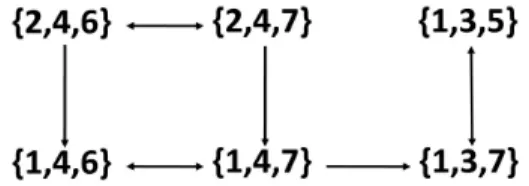
From the behavior graph in Figure 2 we derive the impossibility of a phase transition 1 → 2 in case {1,3,7}, whereas the transition 5 →7
Figure 2.Behavior graph of the IS in Figure 1
is possible. As an example of a multistage in-fluence propagation consider a phase transition in part c from 7 to 5 in case {1,4,7}. The transition would induce part[b] to leave phase 4 to phase 3. Please notice that part a is now unable to leave phase 1 because of the coupling between phases 2 and 3.
Requirep∈bholds current phase token
Requirepis a potential successor
1: if neither p nor p ∈ b have an occupied neighbor
thenbmay decide to pass the phase token on top,
providedbis autonomous(and not inert)
2: ifpis enforced by an occupied neighbor phaseqthen
bhas to leavep
3: ifp∈benforces an occupied neighbor phase thenb
may decide to pass the phase token on top, provided bis autonomous(and not inert)
4: if the phase token may not be passed on, then all neighbors are prompted to leave their current phase 5: no other phase transitions are allowed
Algorithm 1.Local Transition Rule.
Enforced phase transitions often follow a local Finite State Machine(FSM)transition scheme
(reflecting e.g., internal procedures or policies). We indicate this graphically by dotted arrows between phases(as in partVOin Figure 3). After this preparation, we can now define IS-foldings as structure preserving mappings:
Definition 2. (IS-folding) Let IS1 and IS2 be an IS with IS1 = (P1,B1,I1,K1,E1)and IS2 =
Grid authorization framework.
4. Applying FIS to Analyze the Survivability of a Grid Authorization Framework
Loosely, Grid authorization is the act of pro-viding and checking the authority of a user or a Grid job on a specific set of Grid resources. An IS model(DGAF0)of(an excerpt from)the
D-Grid authorization framework(DGAF) [7]is shown in Figure 3.
Resources(the inert part [Resource])are made available to Virtual Organizations (VOs) (part VO) by Resource Providers. Access to re-sources is granted to VO members according to their “position” relative to the VO. This po-sition is defined by group memberships (inert part[Group])and the role tenancies(inert part
[Role]) within each group. Positions are man-aged and published by the Virtual Organiza-tion Membership Service (VOMS) (inert part
[VOMS]). A registration in VOMS implies a registration for a default role in a default group. The attributes that unambiguously identify VO members(and thus implicitly Grid jobs execut-ing on behalf of them)are encoded in X.509 End Entity Certificates(EEC) (inert part[EEC])and
ware specific) Grid Job Manager allows only valid Grid jobs(part[Job Mgr])to “consume” Grid resources.
Starting from the initial global state(indicated by the black phase tokens inDGAF0), we can
easily derive several global properties ofDGAF.
1. Resource access is only granted upon pre-senting a valid proxy certificate (based on a valid EEC) and the corresponding EEC owner has to be registered in VOMS as a VO member (an “applicant” status is not enough).
2. Resource access may nonetheless be denied even for a valid Grid job. A typical scenario would be the unavailability of a required re-source.
3. VO applicants will get member status once they are registered in the VOMS system.
4. VO memberships need to be deleted from the VOMS system upon membership termi-nation(enforcement(member,registered)).
5. Any invalidation of an EEC requires the im-mediate co-invalidation of all derived proxy certificates.
From the discussion before, it should be obvious that further restrictions(e.g., certificate revoca-tion lists, credential repositories)can be added incrementally.
Survivability assessment generally follows a multistage process[6]consisting of an essential property assessment, an incident assessment, and a strategy definition to sustain survivabil-ity. In the following we will briefly demonstrate how FIS can be applied to support these stages.
Essential Property Assessment
One(there may be many)DGAFmission state-ment is‘‘to avoid resource access grants
without a valid certificate’’.
This mission neither requires VOMS to execute nor a VO to operate. It only requires the mu-tual exclusion of the phasesnot valid ∈[EEC]
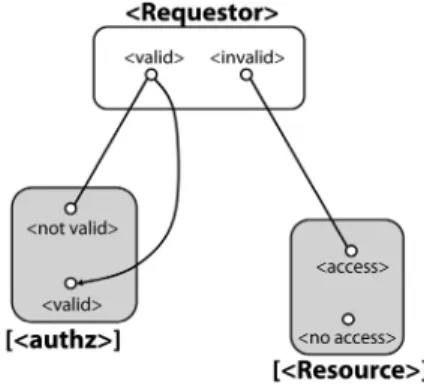
and access ∈ [Resource]. In FIS terms, this translates into the specification of a strong IS-folding the target IS of which(DGAF1)is given
in Figure 4.
Figure 4.Essential property forDGAFderived from IS-foldings(ModelDGAF1)
The folded parts and phases are indicated by angle brackets and are renamed appropriately. Without going into details, DGAF1 was
de-rived from DGAF0 by folding the inert parts
[Role], [Group], [VOMS], [EEC] and [Proxy]
into[<authz>]and the autonomous partsVO andJob Mgr into<Requestor>. Please note that theDGAFmission still holds inDGAF1.
Incident Assessment
In FIS we are able to express incidents as devia-tions from thenominalmodel defined at design
time to specify the “correct service”[4]. Devi-ations either occur as illegal restrictions or as invalidextensions.
For example, an unintended permanent resource access can beforced– provided this was granted before once – by adding a part construct like the one in Figure 5 (part “Disaster”). In a simi-lar way, accessing a Grid resource despite an invalid EEC can be achieved by adding one or more uncoupled phases to partJob Mgr allow-ing for unintended transitions. Generally, inci-dents are(in FIS terms) “combinations” of IS
(the nominal one and models describing intru-sions)integrated by IS-foldings.
Figure 5.Unintended permanent resource access (behavior restriction)
It should be noticed that the detection of in-cidents requires suitable mechanisms to distin-guish “invalid” behavior from intended behav-ior(self/non-self tolerance). This topic will be addressed in more detail in a follow-up paper.
Strategies for Sustaining Survivability
Formally speaking, mission fulfillment means transforming the system from a non-safe global state into an again-safe global state with at least all essential properties preserved. There are several strategies to achieve this transformation. They can be derived directly from the model. We briefly mention just three.
5. Related Work
The FIS-approach is based on the IS frame-work which has been shown to be more ex-pressive than comparable modeling methodolo-gies like Petri Nets or communicating FSM[5]. The latter ones suffer from inherent difficul-ties in enunciating restrictions, violations, and enforcements. Additionally, the intrinsic pos-sibility of incrementally modeling in-the-large reveals a further advantage of IS. The IS frame-work has, however, not been applied for mod-eling property preservation (like survivability)
in “compromised environments”. The folding mechanisms we presented here are examples to close this gap.
Survivability of IT systems, on the other hand, is a relatively new research area with a precise definition of what to achieve and a common un-derstanding of the means how to achieve the goals still lacking. Nonetheless, there are al-ready some more or less mature architectures available with mostly domain specific modeling frameworks [8]. None of them, however, pro-vides a formally sound modeling framework or a practical methodology for dealing with incre-mental restrictions. Emergent algorithms have been proposed in[1]for achieving survivability. Although a promising approach, they require a global observer and do not provide an adequate model for reasoning about propagation of influ-ences.
Related work is also performed in the auto-nomic computing community when studying self*-mechanisms [9]. The autonomic mod-els include very interesting control loops con-structs, but do not allow reasoning about mutual exclusions of local states and influence propa-gations.
6. Conclusion and Further Work
Survivability is a global system property. A problem arises when studying survivability in unbounded systems as there is no central con-trol and the system components only have a
local activities is missing. We proposed Folded Interaction Systems(FIS)as such a framework. FIS uses the Interaction Systems framework for describing system structures and interactions between components and introduces the con-cept IS-foldings to derive essential system ca-pabilities, to describe incidents, and to derive survivability sustaining strategies. We demon-strated the appropriateness of FIS by applying it to the analysis of a production Grid authoriza-tion framework.
The work presented here is a first cornerstone of a comprehensive “survivability toolkit” for unbounded systems including runtime incident detection capabilities and dynamic overwrite mechanisms.
References
[1] D. A. FISHER, H. F. LIPSON,Emergent Algorithms: A New Method for Enhancing Survivability in Un-bounded Systems. Proceedings of HICSS ’99, 1999. [2] I. FOSTER, C. KESSELMAN, S. TUECKE, The Anatomy of the Grid: Enabling Scalable Virtual Organizations.International Journal of High Per-formance Computing Applications. Vol 20, No 3, 2001.
[3] C. DABROWSKI, Reliability in Grid Computing
Sys-tems,Concurrency and Computation: Practice and Experience21(8), 2009.
[4] A. AVIZIENIS, J. LAPRIE, B. RANDELL, Fundamen-tal Concepts of Dependability. Technical Report 01-145, LAAS-CNRS, 2001.
[5] H. F. WEDDE, A. WEDIG, A. LAZARESCU, R.
PAASCHEN, E. ROTARU, Modeling and Analyzing Large-Scale Distributed Interaction. Technical Re-port 793, Technical University Dortmund, Germany, 2004.
[6] J. C. KNIGHT, E. A. STRUNK, K. J. SULLIVAN,
To-wards a Rigorous Definition of Survivability. Pro-ceedings of the DARPA Information Survivability Conference and Exposition, Washington DC, 2003. [7] P. GIETZ, C. GRIMM, R. GROPER¨ , S. MAKEDANZ, H. PFEIFFENBERGER, M. SCHIFFERS, W. ZIEGLER, A Concept for Attribute-Based Authorization on D-Grid Resources,FGCS25(3), 2009.
[9] M. C. HUEBSCHER, J. A. MCCANN, A Survey of
Autonomic Computing – Degrees, Models, and Ap-plications,ACM Computing Surveys40(3), 2008.
Received:June, 2011
Accepted:November, 2011
Contact addresses:
Michael Schiffers Munich Network Management Team(MNM) Ludwig-Maximilians-Universit¨at(LMU) Munich, Germany e-mail:[email protected]
Dieter Kranzlm¨uller Munich Network Management Team(MNM) Ludwig-Maximilians-Universit¨at(LMU) Munich, Germany e-mail:[email protected]
MICHAELSCHIFFERSis a member of the Munich Network Management
(MNM)team and a research scientist at the Department of Informatics at the Ludwig-Maximilians Universit¨at(LMU)in Munich, Germany. His research interests cover Grid computing with special emphasis on the management of virtual organizations and on the survivability of Grid infrastructures. Before joining the MNM Team, he held several positions in the international IT industry. He is a member of the German Society of Informatics(GI)and ACM.
![Figure 3. Excerpt from the D-Grid authorization framework [7] (Model DGAF 0 )](https://thumb-us.123doks.com/thumbv2/123dok_us/8040835.2129119/4.892.239.661.815.1116/figure-excerpt-d-grid-authorization-framework-model-dgaf.webp)