Wavelet Transform-based
Network Traf
fi
c Prediction:
A Fast On-line Approach
Hong Zhao
1and Nirwan Ansari
21Fairleigh Dickinson University, 1000 River Road T-MU1-01, Teaneck, NJ 07666, USA 2New Jersey Institute of Technology, University Heights, Newark, NJ 07102
High speed network traffic prediction is essential to provision QoS for multimedia applications while keep-ing bandwidth utilization high. Wavelet transform is a powerful technique for analyzing time domain signals. When combined with LMS, wavelet based predictor can achieve better performance than time domain predictor for MPEG-4 VBR videos and self-similar traffic. How-ever, the computational complexity in predicting each wavelet coefficient is high. In this paper, LMK(Least Mean Kurtosis), which uses the negated kurtosis of the error signal as the cost function, is first proposed to esti-mate wavelet coefficients; then, by analyzing the wavelet coefficients of two consecutive data sets, Reduced Com-putation Complexity Wavelet LMK (RCCWLMK) is proposed to reduce the computational complexity. Sim-ulation results for a wide range of MPEG-4 videos and network self-similar traffic show that RCCWLMK not only incurs smaller prediction error, but also reduces the computational complexity greatly.
Keywords: multiscale analysis, traffic prediction, MPEG-4 videos
1. Introduction
Traffic prediction plays an important role in network management which is concerned with controlling and allocating network bandwidth, reducing delay, and minimizing congestion in networks. The main goal of network manage-ment is to provide QoS (Quality of Service) guarantees and make efficient use of network resources. Traffic prediction, when combined with dynamic bandwidth allocation, can pro-vide an effective solution to both achieve net-work efficiency and provision QoS guarantees
[1]. The rapid growth of emerging multimedia
applications has exerted tremendous burden on network resources, in particular those on local area networks. The self-similar nature of cur-rent network traffic, which exhibits both SRD
(Short-Range Dependence) and LRD ( Long-Range Dependence)in its correlated structure, has exacerbated the task of network traffic pred-ication. A number of traffic prediction algo-rithms have been proposed in the literature, in-cluding neural network approaches, Normal-ized Least Mean Square (NLMS) approaches and wavelet transform based approaches. These existing algorithms can be broadly classified into two categories: time domain and wavelet domain approaches.
Prediction based on neural networks is a Train-ing Based(TB)technique[2]. Neural networks are composed of simple elements operating in parallel. Connecting those elements in various ways leads to different architectures of neural networks. A neural network can be trained to perform a particular function by adjusting the values of the connections among elements [?]. The training phase is based on the history of the traffic measurements called the training data set. The neural network is then fed by the last obser-vations in order to predict the future value. The main drawback of this approach is the amount of data required for the proper training of neu-ral networks. In this paper, we focus on Non-Training Based(NTB))approaches.
due to their simplicity and relatively good per-formance. In addition, they do not require any prior knowledge of the video statistics nor do they assume stationarity. Thus, they are suit-able for on line VBR video prediction. How-ever, one problem associated with NLMS is its slow convergence. For VBR video traffic char-acterized by frequent scene changes, this slow convergence may result in an extended period of intractability, and thus causing excessive cell loss during scene changes.
Wavelet transform is a powerful technique for analyzing time domain signals. The basic idea of wavelet transform based approaches for pre-diction is to first decompose the original sig-nal into wavelet subspaces, and then, instead of predicting the original traffic directly, this ap-proach predicts the coefficients in the wavelet domain. The predicted values of the original traffic can be constructed based on the pre-dicted coefficients. Several wavelet domain prediction methods have been proposed in liter-ature. These methods decompose the original traffic into wavelet coefficients and scaling co-efficients at different time scales, and then pre-dict each coefficient independently by using the NLMS algorithm. The predicted values of the original traffic can be reconstructed based on the predicted coefficients [6][7][8]. As wavelet transform reduces the eigenvalue spread of the correlation matrix of the input data, fast con-vergence and smaller prediction error could be achieved. However, this method introduces a complexity in the order of (MN), whereM and N are the wavelet filter length and the adap-tive filter order, respecadap-tively. For the wavelet filter length of even as small as, 4,8,and 16 co-efficients, the computation complexity will be in the order of 4N,8N, and 16N, respectively. In this paper, the Reduced Computation Com-plexity Wavelet Transform based Least Mean Kurtosis (RCCWLMK) predictor is proposed. By exploiting the characteristics of input traffic and redundancy in computation of wavelet coef-ficients, the computation complexity is reduced. In addition, LMK, which uses the negated kur-tosis of the error signal as the cost function, is proposed to predict the wavelet coefficients. The rest of the paper is organized as follows. In Section 2, wavelet transform based adaptive filter is briefly reviewed. The fast RCCWLMK is proposed in Section 3; Section 4 presents
simulation results and performance analysis for both MPEG videos and network traffic. Finally, concluding remarks are included in Section 5.
2. Wavelet Transform-based Adaptive Filters
Wavelet transform is similar to Fourier trans-form, but with a completely different merit func-tion. The main difference is that while Fourier transform decomposes signals into sines and cosines–functions localized in the Fourier spa-ce, wavelet transform uses functions that are localized in both real and Fourier spaces. De-pending on the merit functions used in compu-tation, there are many types of wavelet trans-form. Among which, the orthonormal discrete wavelet transform decomposes a signal into mu-tually orthogonal set of wavelets. In the orthog-onal discrete wavelet transform, the quadrature mirror filter(QMF)pair,φ andψ, form an or-thonormal basis of the Hilbert spaceL2(R). One
simple and fast wavelet basis is the Haar-basis DWT with QMF pair[9]:
φ2j[n] =
2−j/2 (n=0, ..,2j−1)
0 otherwise (1)
ψ2j[n] = ⎧ ⎨ ⎩
2−j/2 (n=0, ...,2j−1)
−2−j/2 (n=2j−1, ...2j−1)
0 otherwise
(2) The discrete wavelet transform(DWT)[1]is de-fined as follows:
Wv[2J,2kJ] =
n
f(n)φ2J(n− k
2J), (3)
Ww[2j, k 2j] =
n
f(n)ψ2j(n− k
2j),j=1,2, ...J,
(4)
wavelet transform(IDWT). In the adaptive fil-tering scheme using wavelet transform, the pro-jections of the input signal onto the above men-tioned orthogonal subspaces are used as inputs to a linear combiner. The weights of the linear combiner can hence be updated by the LMS al-gorithm. For the input vectorX(n)of lengthN, the transformed wavelet coefficient vector can be written as follows[10]:
W(n) =RX(n), (5)
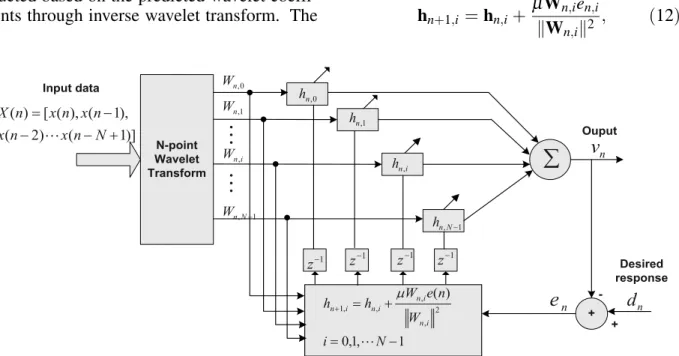
where Ris the wavelet transform matrix com-posed from wavelet basis parameters, X(n) is the input vector, andW(n)is the wavelet trans-formed data vector or wavelet coefficients which include approximation and detail coefficients. Instead of predicting the original signal, the wavelet based adaptive filter predicts approxi-mation coefficients and detail coefficients inde-pendently at each scale by using a linear filter as shown in Figure 1.
ˆ
Wn+1,i =f(Wn,i,Wn−1,i, ...Wn−M+1,i), i=1,2...N, (6)
where f represents the linear predictor, M is the length of the linear predictor, and N is the number of wavelet coefficients that is depen-dent on the length of wavelet filters. The pre-dicted values of the original traffic can be recon-structed based on the predicted wavelet coeffi-cients through inverse wavelet transform. The
prediction of one of those wavelet coefficients can be expressed as follows:
ˆ
Wn+1,i= M−1
k=0
hn,i(k)Wn−k,i. (7)
Eq.(7)shows that wavelet coefficients ˆWn+1,i,i= 1,2...,N, are to be predicted based on the past wavelet coefficients,Wn,i,Wn−1,i, ...,Wn−M+1,i, obtained in the past as inputs. hn,iis the predic-tion coefficient vector which is time varying and updated by minimizing the mean square errorξ
ξ =E[e2n,i]. (8)
The prediction error is
en,i=Wn+1,i−Wˆn+1,i (9)
Wn,i,hn,iare defined as follows, whereμ is the step size andMis the order of the predictor.
Wn,i= [Wn,i,Wn−1,i...Wn−M+1,i], (10)
hn,i = [hn,i(1),hn,i(2)....hn,i(M)]. (11)
The LMS predictor minimizes the mean square error by adaptively adjusting the coefficient vec-tor hn,i. In the normalized LMS algorithm, if we use one-step linear predictor,wn,iis updated by
hn+1,i =hn,i+ μWn,ien,i
Wn,i2 , (12)
N-point Wavelet Transform
Input data Wn,0
1 , n W i n W, 1 ,N n W )] 1 ( ) 2 ( ), 1 ( ), ( [ ) ( N n x n x n x n x n X 0 , n h 1 , n h i n h, 1 ,N n h
¦
+ Desired response Ouput nv
1 z n d -+ 1 z 1 z 1 z 1 , 1 , 0 ) ( 2 , , , , 1 N i W n e W h h i n i n i n i n P ne
where μ, 0 < μ < 2, controls the adjustment step size. Since at timenthe value ofWn+1,iis not available to computeen,i, en−1,i is used in-stead. As the wavelet transform approximately diagonalizes the correlation matrix of the input data, it permits independent adaption of each of the filter coefficients. In addition, it reduces the eigenvalue spread of the correlation matrix of the input data. As a result, the wavelet predic-tor achieves fast convergence and smaller pre-diction error. It is thus expected to perform well in tracking rapid changes in a signal[10]. The only drawback is that the computation complex-ity is high. In the next section, we will propose the RCCWLMK algorithm in predicting MPEG videos and self-similar network traffic.
3. The Reduced Computation Complexity WLMK Algorithm
The main motivation for basing our predictor on the wavelet method is that wavelet trans-form can reduce complex temporal correlation in the MPEG-4 videos and self similar traffic to short range dependence in the wavelet do-main. There is a wide variety of popular wavelet algorithms[11]including Daubechis Wavelets, Mexican Hat Wavelets, and Haar Wavelets. The Haar wavelet[12] is adopted in this paper as it
is conceptually simple, fast, and memory effi-cient. The approximation and detail coefficients are estimated based on a higher order statistics Least Mean Kurtosis.
LetX(n)be the time series representation of a video traffic
X(n) = [x(n),x(n−1), ...,x(n−N+1)]. (13)
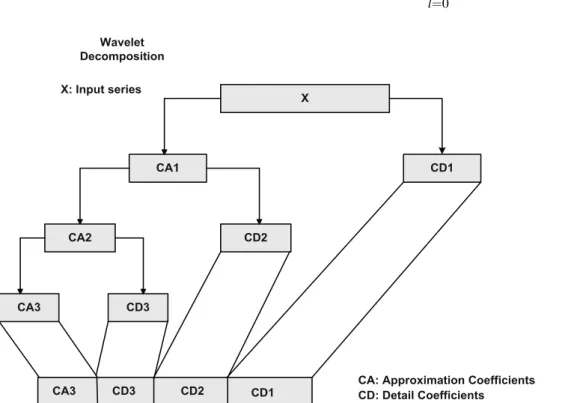
The Haar wavelet transform of X(n)at the de-composition level of 3 is used here as shown in Figure 2. The output decomposition structure contains approximation coefficientsCAand de-tail coefficientsCD, which are organized in the following cell structure:
W(n) = [CA3,CD3,CD2,CD1]. (14)
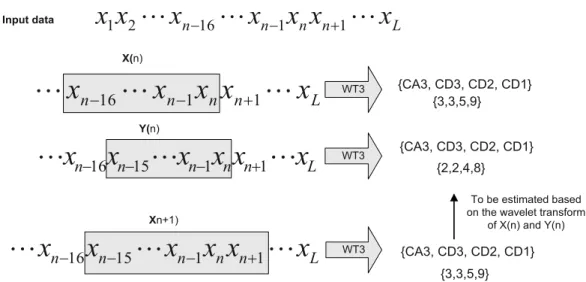
Here,CA3 is a vector, representing approxima-tion coefficients at level 3. CD3,CD2, andCD1 are vectors of detail coefficients at levels 3, 2, and 1, respectively. The length of these vectors depends on the length of the wavelet filter. For example, the 16-point Haar wavelet transform will have 16 coefficients, which are organized in[CA3,CD3,CD2,CD1]of the sizes[2,2,4,8]
as shown in Figure 3 for data setX(n). We pro-pose to use LMK to estimate these coefficients:
ˆ
Wn+1,i = p−1
l=0
hn,i(l)Wn−l,i, (15)
X
CA1 CD1
CA2 CD2
CA3 CD3
CA3 CD3 CD2 CD1
Wavelet Decomposition
CA: Approximation Coefficients CD: Detail Coefficients
X: Input series
WT3
WT3
{CA3, CD3, CD2, CD1} {3,3,5,9}
Input data
WT3
{CA3, CD3, CD2, CD1} {CA3, CD3, CD2, CD1}
{2,2,4,8}
{3,3,5,9} L
n n n
n
x
x
x
x
x
x
x
1 216
1 1
L n
n n
n
x
x
x
x
x
16 1 1
L n
n n n
n
x
x
x
x
x
x
16 15 1 1
L n
n n n
n
x
x
x
x
x
x
16 15 1 1
Y(n)
X(n)
Xn+1)
To be estimated based on the wavelet transform
of X(n) and Y(n)
Figure 3.Reduction of redundancy in the calculations of wavelet coefficients.
en,i =Wˆn,i−Wn,i=hTn,iWn,i−Wn,i, (16)
where hn,i, Wn,i are vectors of adaptive filter coefficients and input wavelet coefficients, re-spectively. Let
hn,i= [hn,i(1),hn,i(2),· · ·hn,i(M)]T,
Wn,i= [Wn,i,Wn−1,i,· · ·Wn−M+1,i]T. In the LMK algorithm, the cost function is de-fined to be the negated kurtosis[14]:
JLMK(h) =3E2[e2n,i]−E[e4n,i]
=3[E(hTn,iWn,i−Wn2,i]2−E[hTn,iWn,i−Wn,i]4.
(17)
The adaptive filter coefficients are then updated as follows:
hn+1,i=hn,i+ μ[
3G(n)−e2
n,i]en,iWn,i
(WT
n,iWn,i)2 . (18)
G(n) =βG(n−1) + (1−β)e2n,i. (19)
Here,μis the step size, andβis a forgetting fac-tor that controls the memory of the error power estimator. Since this prediction is based on a higher order statistics rather than the second or-der statistics used in the LMS algorithm, our earlier work [15]demonstrated that it achieves better performance than the LMS algorithm. In designing the wavelet transform-domain adap-tive filter, LMK could be used to improve the prediction accuracy. It has been shown that the
wavelet transform introduces a computational complexity which is relatively large as com-pared to time domain prediction methods, even when the very short wavelet filters are used. The computational complexity of WLMK is primar-ily attributed to the matrix computation in im-plementing the LMK method. We can see from Figure 1 that the number ofN LMK predictors are needed to predict N coefficients. Thus, it is clear that for the number of wavelet coeffi-cients, even as small as 4 or 8, the number of 4 or 8 LMK adaptive filters are needed[13]. This is generally not acceptable. In the following, we propose the reduced computation complex-ity WLMK(RCCWLMK) method to mitigate this problem.
ForN-point Haar wavelet transform, the data in-put vector,X(n) = [x(n),x(n−1)...x(n−N)], is updated at each new iteration by letting one data sample to enter and one to leave. At itera-tionn, the input data vectorX(n) = [x(n),x(n−
1)...x(n−16)]is decomposed into the wavelet domain at level 3, and the output wavelet coef-ficients in the structure[CA3,CD3,CD2,CD1]
analyzing the wavelet coefficients of input data vectorY(n) = [x(n),x(n−1), ...x(n−15)], we found that there is only one approximation co-efficient difference in CA3 between X(n +1) and Y(n); we have the same coefficients in CD3,CD2,CD1 except that 0 is inserted in de-tail coefficients for X(n +1). Thus, instead of predicting 17 coefficients to get x(n+ 1), we only need to implement one LMK filter to obtain the approximation coefficients in CA3 as the other wavelet coefficients for X(n+1), which are available at iteration n, could be ob-tained through Y(n). This greatly reduces the computational complexity in WLMK and, more importantly, increases the prediction accuracy as the other wavelet coefficients, which are not predicted based on past values, are available at iterationn. Owing to these two merits, this algo-rithm is more practical and accurate for traffic prediction. Figure 3 shows the procedure of reducing the computation complexity in calcu-lating wavelet coefficients.
4. Simulations and Performance Analysis of RCCWLMK
Simulations are conducted on a wide range of video traces including movies, cartoons, sport events and news. These video traces are 60 minutes long each, and are readily available from video library [16]. Simulations are also conducted on self-similar traffic generated by FARIMA. The predictions for the above traf-fic are achieved by the time-domain LMK and our proposed wavelet domain RCCWLMK us-ing the one-step-ahead prediction. For a fair performance comparison, both LMK and RC-CWLMK use the same order of 12 predictors. The parameters for both methods are adjusted once, based on the video trafficStarWars IVand kept the same for the other traffic traces. The reciprocal of the signal to noise ratio is used as the performance metric:
SNR−W1=
e2
n
W2
n, (
20)
SNR−T1 =
(x(n)−xˆ(n))2
x(n)2 , (21)
whereWnis the wavelet coefficient, andx(n)is the time series representation of a video trace or self-similar traffic. SNR−W1 is used to com-pare and evaluate the performance of predict-ing wavelet coefficients while SNR−T1 is used to evaluate the performance of predicting the original video trace and self similar traffic. As bothSNR−W1andSNR−T1are proportional to the square of prediction error to the signal strength ratio, the smaller the better.
4.1. Simulations on MPEG-4 Videos
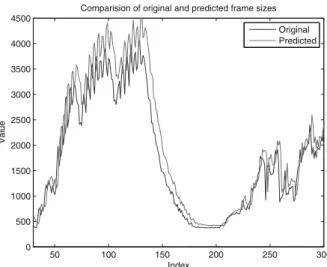
The performance of the proposed RCCWLMK in predicting the approximation coefficient for StarWarIVisSNR−W1 = 0.0014, and SNR−W1 = 0.0135 for theJurassic Parkvideo trace, which were shown in [17]. The approximation co-efficients are fairly well predicted. The origi-nal video traffic is thus accurately reconstructed based on the predicted wavelet coefficients. The performance is SNR−T1 = 0.0181 forStarWar, and SNR−T1 = 0.0135 for Jurassic Park. In Figures 4 and 6, the forecasted values by using WLMK appear very close to the actual values, even during scene changes.
50 100 150 200 250 300 0
500 1000 1500 2000 2500 3000 3500 4000
4500 Comparision of original and predicted frame sizes
Index
Value
Original Predicted
Figure 4.Original and predicted I frame size of StarWarIVby RCCWLMK.
100 150 200 250 300 0
500 1000 1500 2000 2500 3000 3500 4000 4500 5000
Comparision of original and predicted frame sizes
Index
Value
Original Predicted
Figure 6.Original and predicted I frame size ofJurassic Parkby RCCWLMK.
0 100 200 300 400 500 600 0
0.1 0.2 0.3 0.4 0.5 0.6 0.7 0.8 0.9 1
Iteration
MSE
Figure 8.Convergence property of RCCWLMK on StarWarIVtrace.
50 100 150 200 250 300 0
500 1000 1500 2000 2500 3000 3500 4000
4500 Comparision of original and predicted frame sizes
Index
Value
Original Predicted
Figure 5.Original and predicted I frame size of StarWarIVby the time domain LMK.
100 150 200 250 300 0
500 1000 1500 2000 2500 3000 3500 4000 4500
5000 Comparision of original and predicted frame sizes
Index
Value
Original Predicted
Figure 7.Original and predicted I frame size ofJurassic Parkby the time domain LMK.
0 100 200 300 400 500 600 0
0.1 0.2 0.3 0.4 0.5 0.6 0.7 0.8 0.9 1
Iteration
MSE
0 200 400 600 800 1000
Ŧ0.2 0 0.2 0.4 0.6 0.8 1 1.2
Index
Autocorrelation
ACF of Frame size
Figure 10.ACF of P frames ofStarWarIVtrace.
0 200 400 600 800 1000
Ŧ0.2 0 0.2 0.4 0.6 0.8 1 1.2
Index
Autocorrelation
ACF of Wavelet Coefficients
Figure 11.ACF of Wavelet coefficients onStarWarIV trace.
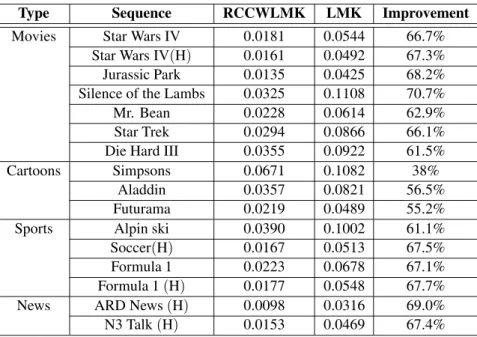
Figures 10 and 11 show the normalized autocor-relations of the frame size traffic and its wavelet coefficients. In Figure 10, it can be seen that the temporal correlation of the traffic decays very slowly; the correlation of the correspond-ing wavelet coefficients shown in Figure 11, on the other hand, decays rapidly to zero, and hence demonstrating that RCCWLMK is short range dependent. Although the video traffic exhibits both SRD and LRD correlation structures, the corresponding wavelet coefficients are all SRD. The simulations show that the SRD wavelet co-efficients can be better approximated by LMK than by LMS as LMK is based on a higher order statistics rather than the second order statistics used in the LMS algorithm[15]. Table 1 shows that RCCWLMK outperforms LMK for all the video traces including movies, cartoons, sport events and news. The average performance improvement is around 63.3%. The improve-ment is larger for video traces with high qual-ity than the ones with medium qualqual-ity. Here, H stands for high quality video. An another important feature about RCCWLMK is the re-duction in the computational load, which has been achieved by exploiting the redundancy in the wavelet coefficients of two successive data sets in each new iteration. Similar results are obtained for other video traces.
Type Sequence RCCWLMK LMK Improvement
Movies Star Wars IV 0.0181 0.0544 66.7% Star Wars IV(H) 0.0161 0.0492 67.3% Jurassic Park 0.0135 0.0425 68.2% Silence of the Lambs 0.0325 0.1108 70.7% Mr. Bean 0.0228 0.0614 62.9% Star Trek 0.0294 0.0866 66.1% Die Hard III 0.0355 0.0922 61.5% Cartoons Simpsons 0.0671 0.1082 38%
Aladdin 0.0357 0.0821 56.5% Futurama 0.0219 0.0489 55.2% Sports Alpin ski 0.0390 0.1002 61.1% Soccer(H) 0.0167 0.0513 67.5% Formula 1 0.0223 0.0678 67.1% Formula 1(H) 0.0177 0.0548 67.7% News ARD News(H) 0.0098 0.0316 69.0% N3 Talk(H) 0.0153 0.0469 67.4%
Table 1.Performance Comparison of RCCWLMK and LMK usingSNR−1
4.2. Simulations on Self-similar Traffic
We also apply the RCCWLMK to estimate the self-similar traffic generated by the FARIMA model. In our simulations[18], the Hurst pa-rameter of the generated self-similar traffic is set as H = 0.8; this experiment is repeated 50 times and the resulting ensemble averaged MSE
(Mean Square Error) is shown in Figure 12. Here, the iteration represents the iteration index. The performance of RCCWLMK is compared with time domain LMS (Least Mean Square). Note that RCCWLMK produces significantly smaller prediction error than LMS does. As we used a training sequence for the first 30 data points in RCCWLMK, the prediction
er-0 50 100 150 200 250 300 350 400 450
Ŧ30
Ŧ25
Ŧ20
Ŧ15
Ŧ10
Ŧ5
0 5 10
Iteration
MSE (dB)
WLMK LMS
Figure 12.Comparison of averaged MSE(dB)of RCCWLMK and LMS versus number of iteration for
the self-similar traffic.
50 100 150 200 250 300 4
5 6 7 8 9 10 11
12 Comparision of original and predicted traffic by WLMK
Index
Value
Original Predicted
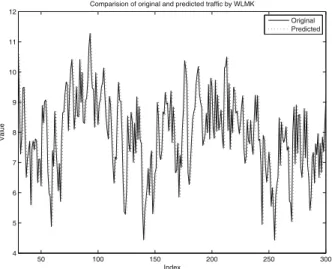
Figure 13. Original and predicted self-similar traffic by RCCWLMK.
rors become a little bit larger than those after the training sequence.
Figure 13 shows the performance of the pro-posed RCCWLMK in predicting self-similar traffic randomly generated by the FARIMA mo-del. The performance is quantified bySNR−T1=
0.0165. Note that the predicted traffic val-ues are very close to the original valval-ues, even during some bursts. For the same self-similar traffic, the LMS performance is quantified by SNR−T1 =0.0278. Figure 14 shows the perfor-mance of LMS. From these figures, we can see the proposed RCCWLMK is more accurate than LMS. Again, this is attributed to the fact that wavelet transform diagonalizes the correlation matrix of the input data so that we can use linear
50 100 150 200 250 300 0
5 10
15 Comparision of original and predicted traffic by LMS
Index
Value
Original Predicted
Figure 14.Original and predicted self-similar traffic by LMS.
1 2 3 4 5 6 7 8 9 10 0
0.01 0.02 0.03 0.04 0.05 0.06
Experiments
SNR
Ŧ
1
Wavelet LMS
correlation to approximate the wavelet coeffi-cients to exploit the long range dependence in self similar traffic.
In Figure 15, LMS and RCCWLMK are com-pared among ten experiments in terms ofSNR−T1. Note that the proposed RCCWLMK incurs much smaller prediction error in all experiments than LMS does; owing to the space limit, results of only ten experiments are presented here. Another important feature about the proposed WLMK is the reduction in computational load, which has been achieved by exploiting the re-dundancy in the wavelet coefficients of two suc-cessive data sets in each new iteration.
5. Conclusions
The ability to predict traffic within a network is critical to network design and management. In this paper, RCCWLMK has been proposed to predict the MPEG-4 video traffic and self-similar traffic. The characteristics and contribu-tions of the proposed RCCWLMK can be sum-marized as follows:
• Raw data traffic is first decomposed into a complete set of wavelet representation– wavelet coefficients by using the Haar al-gorithm at level 3.
• Future wavelet coefficients are then esti-mated by LMK which is based on a higher order statistics and provides better prediction performances than LMS.
• By further analyzing the wavelet coefficients of two consecutive data sets, RCCWLMK not only reduces the computation complex-ity, but also provides more accurate predic-tion, thus making this method more practi-cal for on-line applications. For an N-point wavelet transform, one LMK adaptive fil-ter is required, and the other wavelet coef-ficients can be obtained by exploiting the redundancy of wavelet transform of a set of successive data. Thus, RCCWLMK greatly reduces the computational complexity and improves the prediction accuracy.
• Simulation results show that the proposed RCCWLMK outperforms LMK on a wide range of MPEG-4 videos including movies, cartoons, sports and news, and self-similar
traffic. It reduces the complex temporal cor-relation into short range dependence in the wavelet domain. Fast convergence speed and smaller prediction error are achieved for both MPEG-4 videos and self-similar traffic. Especially for VBR video traffic character-ized by frequent scene changes, the proposed RCCWLMK tracks scene changes much bet-ter with less computational complexity.
References
[1] X. WANG, S. JUNG, J. S. MEDITCH, “Dynamic
band-width allocation for VBR video traffic using adap-tive wavelet prediction”,ICC98 (Interational Con-ference on Communications), vol. 1, pp. 549–553,
(1998).
[2] M. F. ZHANI, H. ELBIAZE, “Analysis and prediction
of real network traffic”,Journal of Networks, vol. 4, No. 9, pp. 855–865,(2009).
[3] G. RUTKA, “Neural network models for Internet
traffic prediction”,Electronics and Electrical Engi-neering, No. 4(68), pp. 55–58,(2006).
[4] A. M. ADAS, “Using adaptive linear prediction to support real-time VBR video under RCBR net-work service model,” IEEE/ACM Transaction on Networking, vol. 6, pp. 635–644,(1998).
[5] L. LANFRANCHI, B. BING, “Long-term prediction of
MPEG video traffic for broadband cable Networks,” Sarnoff Symposium 2010.
[6] X. WANG, X. SHAN, “A wavelet-based method to
predict Internet traffic,”Interational Conference on Communications, Circuits and Systems and West Shin Exposition, pp. 690–694,(2002).
[7] S. ATTALLAH, “The wavelet transform-domain LMS
algorithm: A more practical approach”, IEEE Transaction on Circuits and Systems–Analog and Digital Signal Processing, vol. 47, No. 3 March,
(2000).
[8] S. AHMAD, A. POPOOLA, K. AHMAD,
“Wavelet-based multiresolution forecasting”,Unis Technical Report, June 2005.
[9] M. VETTERLI, J. KOVACEVIC, Wavelet and subband coding,Pretence Hall, 1995.
[10] N. ERDOL, F. BASBUG, “Wavelet transform based
adaptive filters: analysis and new results”, IEEE Transactions on Signal Processing, vol. 44, No. 9, pp. 2163–2171,(1996).
[11] C. S. BURRUS, H. GUO, R. A. GOPINATH,
“Intro-duction to Wavelets and Wavelet Transforms: A Primer”,Printence Hall, ISBN:0-13-489660-9.
[12] I. KAPLAN, “Applying the Haar wavelet transform to time series information”,
[13] S. ATTALLAH, M. NAJJIM, “A fast wavelet
trans-form domain LMS algorithm”, Proc. Intl. Conf. on Accoustics, Speech, and Signal Processing, pp. 1343–1346,(1996).
[14] O. TANRIKULU, A. G. CONSTANTINIDES,
“Least-mean Kurtosis: A novel high-order statistics based adaptive filltering algorithm,”IEEE Electron. Lett., pp. 189–190,(1994).
[15] H. ZHAO, N. ANSARI, Y. Q. SHI, “Network
traf-fic prediction using Least Mean Kurtosis”, IEICE Transaction on communication, vol. E89-B, No. 5, pp. 1672–1674,(2006).
[16] F. H. P. FILTZEK, M. REISSLEIN,
“MPEG-4 and H.263 video traces for net-work performance Evaluation (Extended Ver-sion)”, video traces at http://www.tkn.tu-berlin.de/research/trace/ltvt.html.
[17] H. ZHAO, “A practical wavelet domain LMK
al-gorithm for predicting multimedia traffic”, Intera-tional Conference on Communications(2008).
[18] H. ZHAO, “Multiscale analysis and prediction of
network traffic”, International Performance Com-puting and Communications Conference(2009).
Received:July, 2011 Accepted:December, 2011
Contact addresses: Hong Zhao Fairleigh Dickinson University 1000 River Road T-MU1-01 Teaneck, NJ 07666, USA e-mail:[email protected]
Nirwan Ansari New Jersey Institute of Technology University Heights Newark, NJ 07102 e-mail:[email protected]
HONGZHAOreceived the B.S., M.S., and PhD from Taiyuan University of Technology, Xian Jiaotong University, and New Jersey Institute of Technology, respectively, all in Electrical Engineering. She is an As-sistant Professor of Electrical and Computer Engineering at Fairleigh Dickinson University, New Jersey, US. Her research interests include multimedia streaming over networks, cross-layer design for wireless networks, digital signal processing and network steganography and ste-ganalysis. She has served as a TPC member, technical paper reviewer and book reviewer for IEEE conferences, journal magazines and book publishers. She also serves as Chair of the IEEE North Jersey Computer Society Chapter.
NIRWANANSARIreceived the B.S.E.E.(summa cum laude with a perfect GPA)from the New Jersey Institute of Technology(NJIT), Newark, in 1982, the M.S.E.E. degree from University of Michigan, Ann Arbor, in 1983, and the PhD degree from Purdue University, West Lafayette, IN, in 1988. He joined NJIT’s Department of Electrical and Computer Engineering as Assistant Professor in 1988, became a tenured Associate Professor in 1993, and has been a Full Professor since 1997. He has also assumed various administrative positions at NJIT. He was Visiting
(Chair)Professor at several universities. He authored Computational Intelligence for Optimization(Springer, 1997)with E.S.H. Hou and edited Neural Networks in Telecommunications(Springer, 1994)with B. Yuhas. He has contributed over 400 technical papers, over one third of which were published in widely cited refereed journals/magazines. He has also guest-edited a number of special issues, covering vari-ous emerging topics in communications and networking. His current research focuses on various aspects of broadband networks and multi-media communications.
Prof. Ansari has served on the Editorial Board and Advisory Board of eight journals, including as a Senior Technical Editor of the IEEE Communications Magazine(2006-2009). He has served the IEEE in various capacities such as Chair of the IEEE North Jersey Communi-cations Society(COMSOC)Chapter, Chair of the IEEE North Jersey Section, Member of the IEEE Region 1 Board of Governors, Chair of the IEEE COMSOC Networking Technical Committee Cluster, Chair of the IEEE COMSOC Technical Committee on Ad Hoc and Sensor Networks, and Chair/Technical Program Committee Chair of numer-ous conferences/symposia. Some of his recognitions include an IEEE Fellow, the 2008 NJIT Excellence in Teaching Award in Outstanding Professional Development, a 2008 IEEE MGA Leadership Award, the 2009 NCE Excellence in Teaching Award, a couple of best paper awards