TECHNICAL UNIVERSITY OF CLUJ-NAPOCA
ACTA TECHNICA NAPOCENSIS
Series: Applied Mathematics, Mechanics, and Engineering Vol. 60, Issue IV, November, 2017
THE ASSESSMENT OF THE DYNAMIC RESPONSE TO
SEISMIC EXCITATION FOR CONSTRUCTIONS
EQUIPPED WITH BASE ISOLATION SYSTEMS
ACCORDING TO THE NEWTON-VOIGT-KELVIN MODEL
Polidor BRATU, Adriana STUPARU, Sorin POPA, Nicolae IACOB, Ovidiu VOICU
Abstract: The paper presents the results of the researches carried out for constructions base isolation technical solutions using rheological dissipative elastic devices modelled as a viscous-elastic compound system. In this context, there are analysed the conditions for the achievement of an equivalent viscous-elastic connection, based on the coupling of viscous-elastic and viscous devices in a Newton-Voigt-Kelvin structure. On this basis, the dynamic analysis highlights the level of the dynamic response by the significant amplitudes of the instantaneous displacements to the dominant spectral frequency of the seismic excitation. In the end, there are presented the parametric variation curves which allow the assessment of the dynamic isolation level and the efficiency of the viscous–elastic link, used as a base isolation system for construction (buildings, bridges, viaducts) located in seismic prone areas.
Key words: antiseismic isolation, dynamic response, rheological models, Newton-Voigt-Kelvin
1. INTRODUCTION
The advanced technologies evolution in the field of advanced industry of special devices designed for elastomeric elastic systems, dissipative fluid systems, or shock-absorbing systems has led to the substantiation of new concepts regarding the composition of seismic systems isolation systems for constructions.
Thus, the physical, mechanical, elastic and/or dissipative characteristics grouped in parametric value classes are provided by a large, constructive and functional variety of anti-seismic devices, elastomeric and dissipative with viscous fluid. Under these conditions, the design solutions for base insulation systems can be determined based on the favorable combination of anti-seismic devices, in such a manner that the calculus model to allow a significant and rapid engineering assessment. Nowadays, there are multiple and varied concerns for the identification of specific categories of efficient viscous-elastic systems for the constructions base isolating to seismic
actions. As a result of the researches carried out and the validation of suitable solutions, the present paper presents, in the synthesis, a construction dynamic model, based on an isolation system which contains several and various anti-seismic devices.
On this basis, the isolation system can be represented as a Newton-Voigt-Kelvin equivalent rheological model. For the execution of the system, the fundamental spectral component of the spectral composition of the in action system was adopted. Thus, the calculus model takes into account a rigid with the construction mass, with the Newton-Voigt-Kelvin equivalent link, and with inertial excitation as a result of the transport movement of the ground under the construction foundation, in a horizontal acceleration field according to the fundamental mode a = ω2X0 sinωt, where: X0 is
the horizontal displacement amplitude and ω is
the circular frequency of the seismic movement, with the period T = ω / 2π.
characteristics expressed by amplitude, which can be used in the assessment of the dynamic isolation degree.
2. DYNAMIC RESPONSE IN RELATIVE INSTANTANEOUS DISPLACEMENTS
The Newton-Voigt-Kelvin linear dynamic model with composed viscous link V - (E / V) is represented in Figure 1 where: m - construction mass, k - equivalent rigidity of the
elastomeric devices in displacement on horizontal direction, c - equivalent viscosity of
anti-seismic fluidic devices, M - viscosity
multiplier of fluidic devices (Mc) in serial
connection with group (c/k). The ground seismic
transport motion in the direction OX is noted by
xo (X0) which defines the instantaneous
coordinate of the mobile mark O having the amplitude X and the motion law xo(t)= X0 sinωt,
for the fundamental component ω = 2
π
/ T ofthe spectral composition.
Fig.1 Dynamic model with viscous-elastic link V- (E/V)
The absolute movement of the point A in relation with the fixed mark O1X is given by the
instantaneous displacement x(t) with the
amplitude A, the absolute instantaneous
displacement of the link point B of the rheological system V-(E/V) is y(t) with the
amplitude B .
The motion differential equations, in complex forms can be written as follows:
∙ 0
0 (1)
in care avem:
; , ;
, ;
where:
x X e ; , ; ;
,
Solving the system (1) by using the complex measures o, , , o, , and , the amplitudes
A and B are obtained, expressed as:
, ∙ (2)
, ∙ (3)
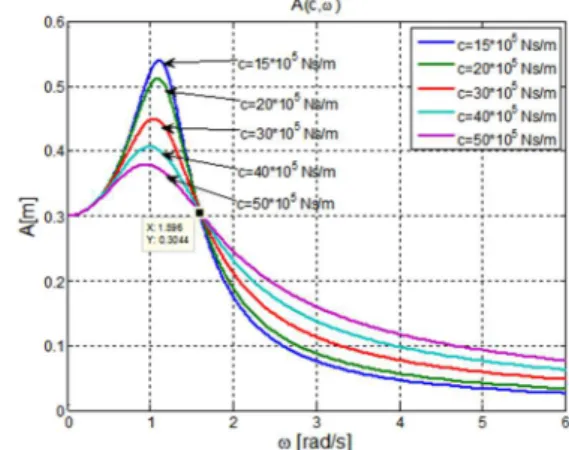
Figure 2 presents the variation curves of the instantaneous displacement amplitude x=Asin(
ωt-θ2).
Fig. 2. The variation curves of the amplitude A in
relation with the current variable ω and the discrete
variable c
Figure 3 presents the variation curves of the amplitude of the instantaneous displacement y=Bsin( ωt-θ1).
Fig. 3. The variation curves of the amplitude B in
relation with the current variable ω and the discrete
variable c
The dephasings θ1 and θ2 of the instantaneous displacements y and x in relation with the instantaneous displacement xo are
expressed by the relations:
(4)
where
1
(6)
so that with the formula (5) the dephasings
θ
1and
θ
2 can be determined in relation with thepulse ω variation.
3. THE INSTANTANEOUS DEFORMA -TION OF THE COMPOSED VISCOUS-ELASTIC SYSTEM V–(E/V)
In dynamic regime, on the composed system direction of deformation, there can be distinguished two the significant deformation: - instantaneous deformation, v1 = v1(t), of the
Voigt-Kelvin viscous-elastic system, denoted (E/V);
- instantaneous deformation v2 = v2(t) of the
Newton viscous system, denoted (V).
The maximum values or the V1 and V2
amplitudes of the instantaneous deformations
v1(t) and v2(t), are required in order to determine
the force in the composed viscous-elastic link and the energy which is dissipated in the analyzed viscous system, on portions and/or on the whole.
3.1 The viscous-elastic system instantaneous deformation (E/V); Voigt-Kelvin model
Considering the instantaneous displacements
o, and in the complex formulation, the
instantaneous deformation can be determined as with , so that , resulting:
(7) where the expression of is introduced, and it is obtained:
(8)
with the amplitude V1 and the dephasing ϕ1
√ (9)
The amplitude V1of the system’s deformation
(E/V) can be written as follows, also:
,
1 (10)
and the dephasing ϕ1 can be expressed as:
1
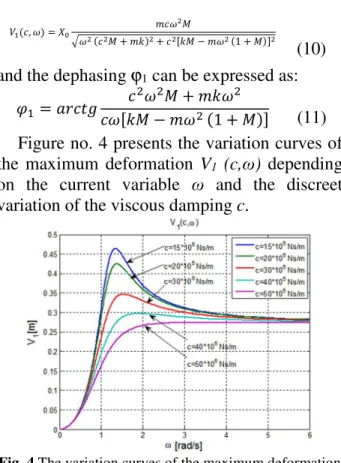
(11) Figure no. 4 presents the variation curves of the maximum deformation V1 (c,ω) depending
on the current variable ω and the discreet
variation of the viscous damping c.
Fig. 4 The variation curves of the maximum deformation
V1 in relation to the continuous variation of ω and the
discrete variation of c
3.2 The viscous- system (V) instantaneous deformation; Newton model
For the linear vascular system with the constant cM, where M is a real and positive
multiplier, the instantaneous deformation is v2(t), and in the instantaneous complex
representation with . Depending on the instant displacements x(t) and y(t), complex formulated, the expression is as follows:
,or , finally obtaining:
, (12)
where:
, , –
, –
(13)
From the formula (12) the amplitude V2(c,ω)
and the dephasing
ϕ
2 are resulting, as follows:(15)
Figure no. 5 presents the curves family for V2
(c,ω) depending on the current variable ω and
the discrete variation of the viscous harmonization c.
Fig. 5 The variation curves of V2 depending on ω and
the parameter c.
4. THE DYNAMIC ISOLATION
PARAMETERS
The force Q0from the V-(E/V) system link
can be determined based on the maximum viscous deformation V2, as follows:
, , (16)
represented in Figure no. 6.
Fig. 6 The variation curves of force Q0 depending
on ω and c
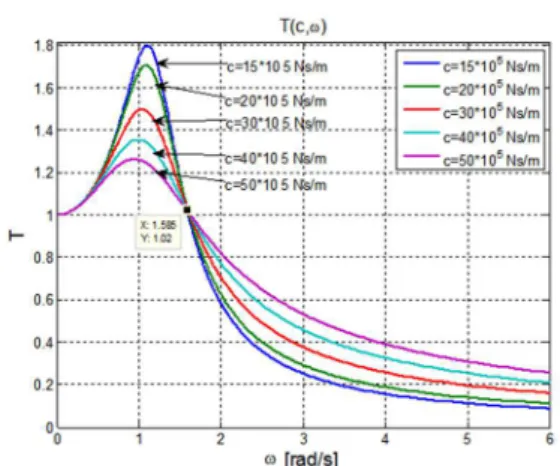
The transmissibility T of the motion from the
excitation source with the displacement xo =
xo(t) to the mass m with the displacement x =
x(t), can be expressed as:
, 1 , (17)
represented in Figure no. 7.
Fig. 7 The variation curves of the transmissibility T
depending on ω and c
5. THE DISSIPATED ENERGY
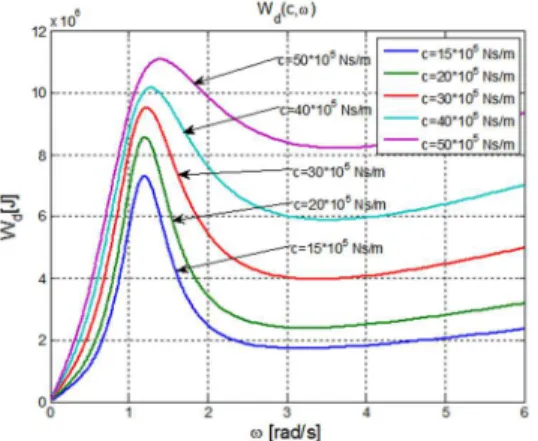
The total dissipated energy in the two dumpers with constant c, and respectively cM is
the sum of the dissipated energies in each linear viscous dumper. The formula is as follows:
(18) where:
, or
(19)
and:
, or
(20)
The total dissipated energy Wd resulting as:
1 (21)
Fig. 8 The variation curves of the dissipated energy depending on the pulsation ω and the harmonization c
6. CONCLUSIONS
The dynamic isolation constructions at the base in order to reduce the transmission of the seismic movements excitation force is an essential component of the research in the field of civil engineering. Thus, as a result of the introduction of a large variety of anti-seismic devices with high performances, today there can be designed anti-seismic systems based on the most favorable combinations in the form of composed rheological models.
In this case, combinations of anti-seismic devices with predominantly viscous, elastic or viscous-elastic properties are possible which ultimately provide the required system parameters (stiffness, damping) for dynamic isolation optimal design. On this basis, in this paper there were tackled the anti-seismic systems using the favorable and necessary connection of the anti-seismic devices, series or parallel, which ensure the rigidity and the equivalent damping on the seismic movement excitation direction..
Thus, it was designed a viscous-elastic anti-seismic system type V-(E/V) in the form of the Newton-Voigt-Kelvin model. The results of the study can be summarized as follows:
a.the dynamic excitation is adapted for the fundamental spectral component of the March 1977 earthquake in Romania;
b.the construction isolated at the base has the following parameters: mass m = 3Mkg; the
equivalent horizontal linear rigidity of the viscous-elastic base isolation link k = 4.8M N /
m; equivalent linear viscous damping, given by the discrete values of five possible variants c
= (1,5 ; 2 ; 3 ; 4 ; 5) MN·s/m; the dynamic excitation for the fundamental component of the seismic spectrum corresponds to T= 2s and a
=3m/s2;
c.the dynamic response of the construction to the given excitation is expressed by the instantaneous displacement x(t) = Asin(ωt+θ2),
with the variation of amplitude A(c,ω)
representation depending on the continuous pulse ω variation and on the equivalent viscous
damping c, with discreet variation;
d.the instantaneous deformation of the two viscous-elastic (E/V) and viscous (V) systems grouped in series is determined as v1=
V1 sin(ωt+ϕ1) and respectively v2= V2
sin(ωt+ϕ2), where the amplitudes V1(c,ω) and
V2(c,ω) are represented in the form of families
of representative curves;
e.the dynamic isolation parameters are expressed both by the maximum transmitted force Qo and the movement transmissibility T.
Both measures are represented by families of curve depending to the excitation pulse ω and
the viscous damping c;
f.the dissipated energy in the hydraulic dampers with constant c and respectively cM is
expressed in analytical form and graphically represented by the families of curves parameterized by the discrete values of c, at the continuous variation of ω, mentioning that M is
a real and positive multiplication parameter. Taking into account the above statements, it is considered that the analytical approach of the dynamic behavior of a construction having its base isolated against seismic actions is a necessary and significant stage for the overall assessment of a technical solution in this domain. As a result, the established analytical relations can be used in the calculations for the analysis and dimensioning of the base insulation systems.
7. REFERENCES
and Vibration (RJAV), vol. 9, page 77-82, Bucuresti, Romania, 2012;
[2] Bratu P., Vasile O. , Spanu C. G. - The Analyses of Insulation Systems based on Hooke-Voight Kelvin Dynamic Rheological model, Journal of Vibration Engineering &
Technologies, vol.5, no. 3, page 255--262, Bucuresti, Romania, June 2017;
[3] Ciuncanu M. - Test performance evaluation for elasatomeric anti-seismic devices on specialized stands with controlled generation functions, 22th ICSV, Florance, Italy, vol.7,
12-16.07.2015;
[4] Dobrescu C. - The rheological behavior of stabilized bioactive soils during the vibration compaction process for road structures, 22th
ICSV, Florance, Italy, vol.7, 12-16.07.2015; [5] Kelly J., Konstantinous A. - Mechanics of
rubber bearings for seismic and vibration isolation, J. Wiley & Sons, Ltd,2011;
[6] Vasile O. - Experimental evaluation of the damping variation of the eleastomeric devices harmonically excited, Applied Mechanics and
Materials, vol.430 page. 329-334, Bucuresti, Romania, 2013.
Evaluarea raspunsului dinamic la excitatii seismice pentru constructii echipate cu sisteme de izolare a bazei dupa modelul Newton-Voigt-Kelvin
Rezumat: Lucrarea prezintă rezultatele cercetărilor efectuate pentru soluţiile de izolare a bazei a construcţiilor realizate cu dispozitive elastice disipative reologice modelate ca un sistem compozit vâscos-elastic. În acest context, sunt analizate condiţiile de realizare a unei conexiuni elastice vâscoase echivalente, bazate pe cuplarea dispozitivelor elastice şi vâscoase într-o structură Newton – Voigt - Kelvin. Pe această bază, analiza dinamică evidenţiază nivelul răspunsului dinamic prin amplitudinile semnificative ale deplasărilor instantanee la frecvenţa spectrală dominantă a excitaţiei seismice. În final, sunt prezentate curbele parametrice de variaţie care permit evaluarea nivelului de izolare dinamică şi a eficienţei legăturii vâsco-elastice utilizate ca sistem de izolare a bazelor de construcţie (clădiri, poduri, viaducte) situate în zonele predispuse la seism.
Polidor BRATU, Prof. dr., President, ICECON SA, Dynamic Behaviour of Structural Systems,
[email protected], +40212025500
Adriana STUPARU, Drd. , Scientific researcher, IMSAR, ICECON SA, Dynamic Behaviour of
Structural Systems, [email protected], +40212025500
Sorin POPA, Drd., Scientific researcher, IMSAR, ICECON SA, Dynamic Behaviour of
Structural Systems, [email protected], +40212025500
Nicolae IACOB, Drd., Scientific researcher, IMSAR, ICECON SA, Dynamic Behaviour of
Structural Systems, [email protected], +40212025500
Ovidiu VOICU, Drd., Scientific researcher, IMSAR, ICECON SA, Dynamic Behaviour of Structural