Global Design and Building Practice:
A Case Study of Hearst Headquarters, New York, NY
Abstract
This paper describes aspects of “Global Design and Building Practice”, a research started at the Harvard University Graduate School of Design in 2002. The objective of this investigation is to provide design and building professionals and researchers with a better understanding of the impacts of globalization on practice. In this research, the impacts of globalization on practice are examined both in breadth and depth. Processes involve qualitative analyses of interviews with design and building professionals and researchers, quantitative analyses of project data, and in-depth case studies of recent and current “global building projects”, i.e. projects for which spatial extensity of actors extends beyond the local.
This paper presents a diversified analytic framework of four distinct global project types. It analyzes the principles behind the transformation of practice and demonstrates the correlations between different global project types and the impacts on practice based on “project DNA”, an innovative concept that acknowledges that it is not only the characteristics of each configuring actor that matters in a global project, but rather the configuration as a whole and the position of each actor within it that determines the its characteristics and impacts on practice.
Both global project type and project DNA are illustrated with the summary of an in-depth case study of Hearst Headquarters, a recently completed global project in New York, NY.
Introduction
In today’s increasingly global economies and markets, design and building practice embody an unprecedented spatial reach and density of a worldwide interconnectedness of clients, architects, builders, and suppliers. Design and building services are increasingly offered globally and global collaboration on building projects has become much more widespread. These developments combined with the related transfer of professional personnel from one place to another have led to projects and practice that in one place are not as apart as building projects and practice elsewhere. Former disparate elements of professional life have been brought much closer together.
Like globalization as a larger phenomenon, the dynamics and consequences of these developments in design and building practice are probably best understood as a
multifaceted phenomenon that does not reflect a simple linear logic. Practice has historically been embedded in environments marked by local, cultural, organizational and institutional particularities, but that does not isolate it from today’s global flows.1 Practice is dynamic and subject to
change and – in the complex interplay of local and global – is affected in varying degrees. The impacts are uneven as these can occur on different levels, with various valences, and with greater or lesser degree of consequence for the respective design and building projects.
Four Distinct Project Types
Based on qualitative analysis of interviews with building professionals and researchers as well as quantitative analysis of project data, I have previously suggested investigating the varying impacts of global projects on design and building practice by establishing four distinct project types.2 These project types are based on two main
project dimensions: spatial extensity of main project actors, and impact on practice.
On a scale running from local to global, high extensity refers to interregional, global networks and flows, while low extensity denotes localized networks and transactions. On a scale running from no changes to changes on all
levels/new, impact is the result of the different effects on
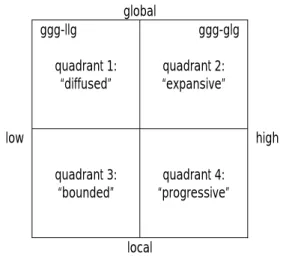
local design and building practice in the investigated project. Figure 1 offers a chart that emerges when the two dimensions are mapped against each other. The four quadrants that result define four distinct project types, which can be used to illustrate the analysis of impacts of spatial extensities of project actors on local practice.
Diffused Global Projects
In this paper I focus on projects located in quadrant 1. These are characterized by a high spatial extensity of project actors, i.e. beyond the region where the project is located, but show low impacts on local practice. I have labeled this project type as “diffused” to illustrate the combination of its characteristics: this project type shows impacts on practice that are dispersed. Other than in the case of the “expansive” project type, the potential for impact is present but local particularities tend to resist changes.
Project DNA
configurations and the four global project types, I have previously introduced the concept of “project DNA”:3
DNA strings carry the genetic information necessary for the organization and functioning of most living cells and control the inheritance of characteristics.4 This is a useful analogy
in describing the different configurations of actors’ spatial extensities of practice and spatial extensities in design and building projects. The suggested coding of the configurations shares several similarities with how DNA functions. Like in a DNA string, it is not only the characteristics of each configuring actor that matters but rather the configuration as a whole and the position of each actor within it that determines the characteristics of the project. The project DNA consists of two distinct parts: DNA part 1 is concerned with the configuration of spatial extensity of practice whereas DNA part 2 is concerned with the spatial configuration of project actors.
Figure 2 suggests the correlation of global project types and two of the most frequent project DNAs based on qualitative analyses of interviews with design and building professionals and researchers and quantitative analyses of project data. The mapping of the DNA of global projects allows for determining the degree to which they inherit and exhibit important characteristics of one or the other global project type and makes it possible to assess the potential impact on design and building practice in a systematic way. In the following I present a case study summary of a project
with a ggg-llg-DNA that embodies the qualities of a diffused global project.
The project DNA maps the client’s, builder’s, and architect’s practices as well as their spatial relationship to the respective project as local (“l”) or global (“g”).5 Some project
DNAs are more frequent in global projects whereas others are less frequent or cannot not be found at all.6
Case Study: Hearst
Headquarters, New York, NY
Project Definition
Project DNA: ggg-llg Global project type: diffused Location: New York, NY
Clients: Hearst Corporation; Tishman Speyer Properties, New York, NY
Project use: company headquarters
Project type: commercial office building with some retail Project size: 856,000 square feet
Project cost: USD 300 million
Architects: Foster and Partners, London, UK; Adamson Associates, Toronto, Canada
Delivery method: cost-guaranteed Construction period: 2003-2006
global ggg-llg
quadrant 1: “diffused”
ggg-glg
quadrant 2: “expansive”
low
quadrant 3: “bounded”
quadrant 4: “progressive”
high
local
Figure 1 Suggested correlation between project DNA and project types
global
quadrant 1: “diffused”
quadrant 2: “expansive”
low
quadrant 3: “bounded”
quadrant 4: “progressive”
high
local
Investigated Practice
Project procurement Personnel
Contracting
Preconstruction and beyond
Profile of Main Actors
Client (1) – The Hearst Corporation, New York, NY: Hearst Corporation is an international media company founded by the legendary William Randolph Hearst in the late 1880s. In 2003, the company was one of the largest diversified communications companies in the world. It owned 12 daily newspapers (including the San Francisco Chronicle and the Houston Chronicle) and 14 weekly newspapers, 18 US consumer magazines (such as Cosmopolitan and Esquire), TV and radio stations and a cartoon and features service (King Features).
Hearst magazines are also published in international versions of their titles, which are distributed in more than 100 countries. The company's UK subsidiary, The National Magazine Company Limited, publishes about twenty monthly magazines. Hearst is also active in cable networks through stakes in A&E, Lifetime, and ESPN; and online services through its 30% stake in iVillage, an Internet network aimed at women. The Hearst Corporation is owned by the Hearst family, but managed by a board of trustees. In 2003, the company had over 18,000 employees worldwide.
Client (2) – Tishman Speyer Properties, New York, NY: Tishman Speyer is one of the leading owners, developers, and operators of first class real estate in the world. The company acquires and develops properties, and manages its portfolio and its assets.
Since Tishman Speyer's formation in 1978, the company has developed or acquired a portfolio of over 52 million square feet, valued at over USD 15 billion. In addition to its reputation for developing high-rise office buildings in major urban centers, Tishman Speyer develops a significant number of mixed-use, retail, and residential projects as well as smaller mid-rise and low-rise office buildings. The company also provides master planning services for large-scale developments, often in public-private partnership with major cities.
Tishman Speyer's properties include such well-known projects as New York's Chrysler Building and Rockefeller Center, Frankfurt's Messeturm, Berlin's Sony Center, and São Paulo's North Tower.
Builder – Turner Construction New York, NY: Turner opened its business unit in New York in 1902. Since then, the New York business unit built extensively throughout the New York Region and added many prominent projects to the Manhattan skyline including the United Nations Building, Madison Square Garden, Lincoln Center for the Performing Arts. Some of the significant commercial projects that are currently under construction or were recently completed include 300 Madison Avenue, Times Square Tower, and Bear Stearns Headquarters.
Turner New York is considered a leader in providing preconstruction services, construction management and general building services to clients in the New York region. It is also a recognized leader in several specialty markets including, advanced technologies, healthcare, higher education and K-12 education. Turner's New York regional
offices currently employ over 1,000 full-time building professionals. The annual revenue in 2003 was USD 1.5 billion.
Architect (1) – Foster and Partners, London, UK: Foster and Partners, the design architect of Hearst Headquarters, is a globally operating firm for architecture, planning and design led by Norman Foster. The practice’s work ranges in scale from Hong Kong’s new airport – the largest construction project in the world – to its smallest commission, a range of door furniture.
The studio established a global reputation with buildings such as the new German Parliament in the Reichstag, Berlin, the Great Court for the British Museum, the Headquarters for HSBC in Hong Kong and London, the Commerzbank Headquarters in Frankfurt, the Metro Bilbao, the Carré d’Art Nîmes, the Sainsbury Center for Visual Arts in Norwich and the Research Center at Stanford University, California. Foster and Partners has received more than 260 awards and citations for design excellence, and won over 55 national and international design competitions.
Architect (2) – Adamson Associates, Toronto, Canada: Gordon Sinclair Adamson (1904–86) established Adamson Architects, the associate architect of Hearst Headquarters, in 1934 in Toronto, Canada. It has been prominent globally for many decades, and is responsible for major, multi-complex modern building projects in Canada, North America and England. Adamson Associates was responsible for coordinating all the buildings that comprised New York’s World Financial Center, and was the architect for the pyramidal-roofed Three World building and the Winter Garden, both designed by Cesar Pelli. The company also acted as executive architect for the Canary Wharf scheme in London’s docklands in association with Cesar Pelli and others. Adamson Associates built the 50-story Canary Wharf tower and designed the Docklands Light Railway Station there.
Summary of Case Study
The plans for a new 42-story tower for Hearst Corporation in Manhattan, to be placed over a landmark art deco building, fulfilled a dream started in the 1920s, when William Randolph Hearst envisaged the area of Columbus Circle as a vibrant new quarter for media, communications and entertainment. He had asked the émigré Austrian architect, Joseph Urban, to design the first stage of a
corporate headquarters for his vast publishing empire, a six-story masonry block with a central courtyard, splayed corners and theatrical statuary. Finished in 1928, the building has always been intended to be topped by a tower, although no designs were ever recorded.
Because of Hearst’s effort to introduce a 21st century
headquarters to New York City some seventy years later, the tower was proposed. The new Hearst building, designed by Foster and Partners, is a combination of a tall structure and a re-modeling of the original base. The Hearst Corporation wanted a building that would be one of the most environmentally friendly high-rise buildings ever constructed. It provides almost 1,000,000 square feet of space for one of Americas largest communications companies. Turner Construction New York, a leading construction firms in the city, was selected as the project’s builder. With a global client acting locally and a global architect acting globally, Hearst Headquarters had the project DNA of a diffused global project.
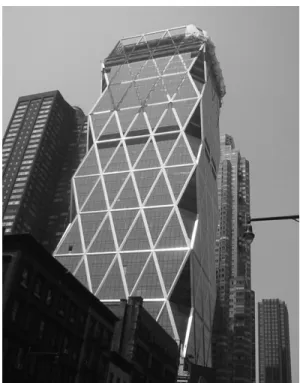
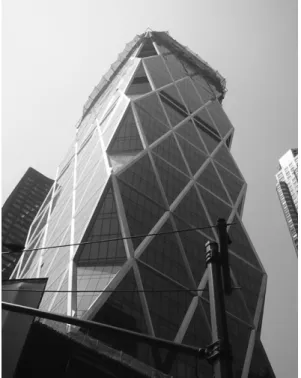
Unlike a conventional tower, the Hearst building has a triangulated structure, which is expressed in stainless steel
on the outside. This was stronger and more efficient than the normal orthogonal grid of vertical columns and horizontal beams - this system also offers more structural redundancy. By peeling away the corners between the diagonals, the vertical proportions of the tower are emphasized along with the image of a distinctively facetted silhouette on the skyline. From the inside, this device also creates spaces, which captured more dramatic views over the city, Central Park and the Hudson River.
From the project’s inception, Hearst had set as its goal the attainment of LEED certification from the U.S. Green Building Council. The “green building” designation is bestowed upon those projects that employ pioneering solutions in a quest to fully utilize renewable sources of energy while offering substantial reductions in pollution and energy consumption.
Practice
Project Procurement: Hearst Headquarters is a unique project in many regards. The following statement illustrates the view of the then upcoming project at Turner Construction’s New York business unit:
“The projects we typically see are very high profile, large scale, and big dollar projects like Hearst Headquarters, a high-rise in midtown. (…) Foster’s design is very unique. The design of the building is innovative and it is difficult to build. But Hearst has got a lot of money. However, even that project is going to be driven by economics. Hearst chose to build the project with a developer (Tishman Speyer).”7
Turner New York had a long-established business relationship with Tishman Speyer, the developer of the project, when it was selected as the builder. The following statement illustrates this relationship:
“About 70% of Turner’s clients are repeat-clients. This is very impressive. Turner was able to establish great relationships of the years. Therefore some of its key clients like Tishman Speyer do not even think about working with a competitor of Turner. They say, Turner, we have a new project and we want you as its builder.”8
However, because of the global nature of the project, Turner New York had to go through a competitive project
procurement phase. The following statement illustrates the situation:
“We put together an A-team to procure the project. We knew that both Tishman Speyer and Hearst would be very demanding and that we had some strong competitors.”9
The process of project acquisition followed Turner’s local practice. To meet the challenges of Hearst Headquarters, Turner pointed out the expertise of its project team and the fact that it had experience in building with global architects.
Personnel: Turner put together what it considered an “A-team” for project procurement. In addition, Tishman Speyer, knowing Turner from a number of prior building projects, demanded particular personnel. The client wanted to make sure that only the best people would work on the prestigious project. Turner subsequently added the requested personnel to the project team.
Contracting: The contract for Hearst Headquarters was split into two. Turner was first only awarded the contract for the core and shell portion of the project. This contract had a value of approximately USD 250 million. Turner then competed again successfully for the fit-out portion of the project and was awarded the second contract with a value of approximately USD 70 million.
Preconstruction and Beyond: According to Mark Pulsfort, Turner Construction New York’s project executive for Hearst Headquarters, Foster and Partners had a strong say in many of the project’s specifications. Particularly when it came to the interior, the architect wanted what Pulsfort called a “European look”. Turner often proposed similar or equal local products and it was up to the client to make final decisions. However, this concerned mainly finishes of the Hearst Building. The examples Pulsfort gave were stones and tiles as finishing materials.
Overall, Pulsfort pointed out that the architect had a much stronger influence on subcontracting decisions than in a typical local project. However, in terms of building practice, there was low impact. The following statement by Pulsfort sums up the way Turner saw the project and its impact on local building practice:
“It was a little give and take but our actual building practice during preconstruction and construction was little affected.”10
Global Project Type
Hearst Headquarters inherited many characteristics of a diffused global project as its project DNA suggested. The global nature of the project had comparably low impact on local building practice. Even though the builder went through an intense project procurement phase, the actual practice of procuring was not affected and would, according to several project actor statements, have been more or less the same with only local actors.
In terms of personnel, the global nature of the project did only show little impact on local practice as well. The builder carefully assembled a project team based on the fact that the project was of a high quality, had a global architect, and was for a key client. However, the project team consisted only of local personnel and the client only asked for personnel known from prior local projects with the builder. Contracting followed the builder’s local practice for projects of this type and size as well.
During preconstruction, procurement showed low impact. The architect requested for many foreign subcontractors and manufacturers while the builder tried to use as many local firms as possible. Both sides had to compromise and some foreign subcontractors and manufacturers were selected for the project. However, the impact this had on the builder’s procurement practice was low. Mainly it made the practice more challenging.
Overall, the builder’s local practice showed only low impacts in the Hearst Headquarters project. According to Turner’s Project Executive, practice would not have been much different if the main actors and agencies would have all been local.
Diffused global projects with the project DNA of Hearst Headquarters are a frequent type. Despite the global nature
of these projects, the local particularities of practice tend to resist changes. However, it is important to note that regardless of this resistance, such projects show many tensions in practice that often require additional, sometimes drastic measures from its actors to be successfully completed.
Endnotes:
1 Castells, Manuel. “The Rise of Network Society.” The Information Age: Economy, Society, and Culture. Volume 1. Malden, Massachusetts: Blackwell Publishers, 1996. 2 Schroepfer, Thomas. Relational Geographies of Building Practice: An Analytic Framework (unpublished dissertation). Cambridge, Massachusetts: Harvard University, 2004. 3 Ibid.
4 DNA stands for deoxyribonucleic acid; it is a complex molecule found in the chromosomes of almost all organisms which acts as the primary genetic material; the part of the cell nucleus that is the repository of hereditary characteristics. 5 E.g. the project DNA “ggg-llg” codes a project in that the practices of the client, the builder, and the architect were all global and in that the client and builder acted locally and the architect acted globally.
6 Schroepfer
7 Negrycz, Gary (Project Executive Turner Construction New York, NY). Personal interview with the author. 25 April 2003 8 Fox, Christian (Project Manager Hochtief Construction Frankfurt, Germany). Personal interview with the author. 16 January 2003