Exploring Knowledge, Attitudes and Practices Regarding the
Intrauterine Contraceptive Device (IUD) among Family Planning
Acceptors in Windhoek, Khomas Region, Namibia
DOI: 10.29063/ajrh2019/v23i4.9
Frieda Ndeshipanda FN Taapopi
1* and Lucille Bertha LB Van der Westhuizen
2Ministry of Health and Social Services, Windhoek, Namibia1; University of Namibia, School of Nursing, Windhoek2
*For Correspondence: Email: [email protected]; Phone: +264812608571
Abstract
The intrauterine contraceptive device (IUD) is one of the contraceptive methods that are under-utilized in many African countries, including Namibia. The aim of this study was to explore and describe knowledge, attitudes and practices regarding the IUD among family planning (FP) acceptors in Khomas Region, Namibia. A non-experimental, quantitative, exploratory, descriptive study was conducted at nine health facilities in Windhoek. A probability sampling technique was applied to select the sample which was calculated using the Epi Info version 7, Statcalc. A total of 582 FP acceptors were interviewed, using a structured questionnaire. Descriptive statistical analyses were done and results presented in percentages, proportions and displayed in tables, graphs. Overall, about half of FP acceptors were not aware of the IUD, while almost all knew the injectables and oral contraceptive pills. FP acceptors lacked adequate specific knowledge content of the IUD. This study did not only establish limited awareness of the IUD among FP acceptors but also inadequate knowledge on IUD characteristics, benefits, common-side effects, which woman can use an IUD and associated myths. Therefore, this study recommends to Ministry of Health and Social Services and its partners to sensitize and educate family planning users on the IUD in order to increase demand and utilization. (Afr J Reprod Health 2019; 23[4]: 75-80).
Keywords: Awareness; knowledge content; characteristics; benefits; common side-effects; myths
Résumé
Le dispositif contraceptif intra-utérin (DCIU) est l'une des méthodes contraceptives sous-utilisées dans de nombreux pays africains, dont la Namibie. Le but de cette étude était d'explorer et de décrire les connaissances, les attitudes et les pratiques concernant le DCIU parmi les femmes qui ont accepté la planification familiale (PF) dans la région de Khomas, en Namibie. Une étude descriptive non expérimentale, quantitative et exploratoire a été menée dans neuf établissements de santé de Windhoek. Une technique d'échantillonnage probabiliste a été appliquée pour sélectionner l'échantillon qui a été calculé en utilisant EPI Info version 7, Statcalc. Au total, 582 femmes qui ont accepté la PF ont été interrogées à l'aide d'un questionnaire structuré. Une analyse statistique descriptive a été effectuée et les résultats présentés en pourcentages, proportions ont été affichés dans des tableaux et des graphiques. Dans l'ensemble, environ la moitié des femmes qui ont accepte la PF n'étaient pas au courant du DIU, alors que presque toutes connaissaient les injectables et les pilules contraceptives orales. Les femmes qui ont accepte la PF n'avaient pas suffisamment de connaissances spécifiques sur le DCIU. Cette étude a non seulement établi une connaissance limitée du DCIU parmi cette catégorie des femmes, mais également une connaissance insuffisante des caractéristiques, des avantages et des effets secondaires courants du DCIU, que la femme peut utiliser un DCIU et les mythes associés. Par conséquent, cette étude recommande au ministère de la Santé et des Services sociaux et à ses partenaires de sensibiliser et d'éduquer les utilisateurs de la planification familiale sur le DCIU afin d'augmenter la demande et l'utilisation. (Afr J Reprod Health 2019; 23[4]: 75-80).
Mots-clés: Sensibilisation; contenu des connaissances; caractéristiques; avantages; effets secondaires courants; mythes
Introduction
Worldwide, estimates for the use of the intrauterine contraceptive device (IUD) stands at
the Caribbean, North America, Africa and Oceania with 6.5%, 4.7%, 4.6 and 1.8% respectively1. China alone accounts for over 60% of all IUD use in the world2.
IUD use is lowest in Africa and varies greatly between countries; from 0.0% in Central African Republic, Chad, Congo Brazzaville and Comoros to 28.3% in Egypt as per the latest DHS data from 2013-2017-183. Whereas, in Southern Africa, the use of IUD among women aged 15-49 is below 2%, 1% in Lesotho and 0.9% in South Africa3. In Asian countries, the use of IUD among women of reproductive age varies from 0.2% in Albania to 13.3% in Taijikistan3.
IUDs utilization in Namibia has been stagnant at below 1% for more than two decades now, while injectables stand at 21% and male condoms 19%, while use of pills, female and male sterilization, and other modern contraceptive methods are all below 5% 4. In some regions, the use of the IUDs is almost non-existent as it ranges between zero percent in Zambezi to 1.3 percent in Khomas region4. Even though the IUDs utilization rate in Khomas is slightly higher at 1.3% as compared to other regions, it is still very low4. The low utilization rate of the IUDs is an indication of under-utilization despite its proven high efficacy and safety5-7, while the majority of the FP acceptors rely on the injectables and condoms4. Moreover, FP services and contraceptives are offered free of charge at all public health facilities in Namibia to women of reproductive age (15-49 years) 8.
The questions that arose were: What are the reasons behind the low utilization of IUD as a contraceptive method in Namibia despite its proven efficacy? Therefore, this study aimed to explore the knowledge, attitudes and practices regarding the IUD among family planning acceptors in Khomas Region, Namibia. It could thus provide valuable insights into the FP programme to develop appropriate interventions tailored to FP acceptors‘ needs.
Methods
This design was therefore appropriate to explore and portray the knowledge, attitudes and practices regarding the IUD among family planning acceptors. The study population comprised of FP
acceptors between the ages of 15-49 who received FP services at nine (9) health facilities in Khomas region on the days of data collection. A sample of 582 FP acceptors was proportionately selected at the nine (9) health facilities to obtain a representative sample. A table of random numbers was applied to select the FP acceptors for interviews.
For this study, structured questionnaires with open and close ended questions were developed for the participants. The instrument covered the following five (5) key sections, namely: Section one on socio-demographic characteristics; section two on knowledge; section three on attitudes; section four on practices and section five on recommendations. The questionnaires were administered face-to-face by the researcher. Permission to conduct the study was granted by the Post-Graduate Studies Committee (PGSC) of the University of Namibia (UNAM) the Ministry of Health and Social Services (MoHSS).
All statistical analysis was performed using the Epi Info version 7. The data on socio-demographic characteristics, knowledge, attitudes and practices were categorized and summarized using descriptive statistics, such as; percentages and proportions displayed in the form of tables and figures.
Results
A total of 582 FP acceptors participated in the study and their age ranged from 15 to 49 years old. The majority (47%) were in their mid-twenties to mid-thirties (25-34), and close to eighty percent (79%) had secondary school education, while more than a half (59%) belonged to either Lutheran or Anglican Church. Furthermore, and the majority (86%) had between 1-4 children. Table 1 shows the detailed demographics.
Knowledge of acceptors
Awareness of the IUD among acceptors was low (48%). Out of 582 FP acceptors interviewed, only 279 were valid for the knowledge content analysis
Table 1: Demographics of FP acceptors
Age category Number (%)
15-19 37 (6)
20-24 146 (25)
25-34 272 (47)
35+ 127 (22)
Total 582 (100)
Level of education
No education 5 (1) Primary 36 (6) Secondary 460 (79) Tertiary 81 (14)
Total 582 (100)
Religion
Pentecost 57 (10) Lutheran/Anglican 346 (59) Catholic 99 (17) None/other 80 (14)
Total 582 (100)
Marital status
Married 76 (13) Unmarried 506 (87)
Total 582 (100)
Children alive
None 56 (10)
1-4 501 (86)
5-9 25 (4)
10+ 0 (0)
Total 582 (100)
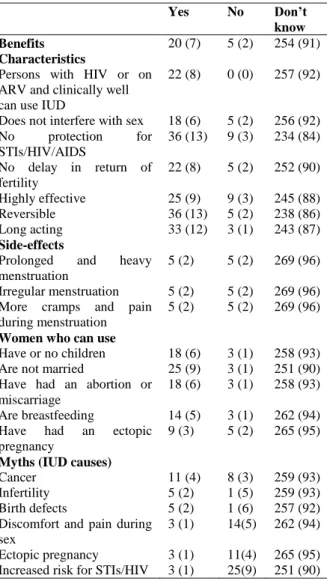
contraceptive method and that it does not protect against STIs/HIV/AIDS, while 12% knew of its long-acting effects. Additionally, those who knew that the IUD is highly effective, does not delay return of fertility once removed, and does not interfere with sex, were only nine, eight, and six percent respectively. A clear majority (93%) of FP acceptors did not know that the IUD does not require frequent visits to health facilities like with pills and injectables. Very few (4%) FP acceptors could correctly identify the three common side-effects of the Copper-IUD. Regarding women who can use the IUD, only a few acceptors knew that those who have or do not have children (6%), not married (9%), have had an abortion or miscarriage (6%), breastfeeding (5%) and have had an ectopic pregnancy (3%) can use an IUD. Furthermore, majority of acceptors could not dispel myths that are associated with the IUD, namely that; it causes ectopic pregnancy (95%), discomfort and pain during sex (94%), infertility and cancer (93% each) and increase risk for STIs/HIV (90%). The table below displays
knowledge of various aspects of the IUD among acceptors.
Attitudes of acceptors
None of the acceptors were IUD users at the time of the study. However, the majority (86%) considered it for future use, and almost all (98%) reported that they will recommend it to others. Moreover, the majority (97%) of acceptors did not experience disapproval of contraceptive use by their churches or sexual partners.
Acceptor experience of provider practices
Only a quarter (25%) of acceptors reported that they were assured of confidentiality, while slightly more than half (54%) were assured of privacy. Out of 582 participants, more than eighty percent were offered a chair to sit on during their visit and were greeted by the provider (86% and 81%, respectively). Moreover, close to sixty percent (59%) of acceptors were informed of all available contraceptive methods and less than half (43%) were shown pictures or samples of various contraceptives.
Discussion
FP acceptors
FP acceptors in their mid-twenties to mid-thirties (47%), with secondary level education (79%, from the Lutheran/Anglican religion (59%), unmarried (87%) and who had one to four living children (86%) were the most likely to utilize FP services in this study. The IUDs was one of the least known modern contraceptive methods in Khomas region, following sterilization. This finding corresponds with findings of studies done in southern Nigeria and Gabon9-10. In contrast, the IUDs were well known as reported in studies conducted in Nairobi County in Kenya and Gujarat, north east of India11-12.
Knowledge about the IUD on at least one non-health benefit that it does not require frequent visits to health facilities unlike pills and
Table 2: Knowledge of acceptors on benefits, characteristics, side-effects, who can use and myths (N=279)
Yes No Don’t
know
Benefits 20 (7) 5 (2) 254 (91)
Characteristics
Persons with HIV or on ARV and clinically well can use IUD
22 (8) 0 (0) 257 (92)
Does not interfere with sex 18 (6) 5 (2) 256 (92) No protection for
STIs/HIV/AIDS
36 (13) 9 (3) 234 (84)
No delay in return of fertility
22 (8) 5 (2) 252 (90)
Highly effective 25 (9) 9 (3) 245 (88) Reversible 36 (13) 5 (2) 238 (86) Long acting 33 (12) 3 (1) 243 (87)
Side-effects
Prolonged and heavy menstruation
5 (2) 5 (2) 269 (96)
Irregular menstruation 5 (2) 5 (2) 269 (96) More cramps and pain
during menstruation
5 (2) 5 (2) 269 (96)
Women who can use
Have or no children 18 (6) 3 (1) 258 (93) Are not married 25 (9) 3 (1) 251 (90) Have had an abortion or
miscarriage
18 (6) 3 (1) 258 (93)
Are breastfeeding 14 (5) 3 (1) 262 (94) Have had an ectopic
pregnancy
9 (3) 5 (2) 265 (95)
Myths (IUD causes)
Cancer 11 (4) 8 (3) 259 (93) Infertility 5 (2) 1 (5) 259 (93) Birth defects 5 (2) 1 (6) 257 (92) Discomfort and pain during
sex
3 (1) 14(5) 262 (94)
Ectopic pregnancy 3 (1) 11(4) 265 (95) Increased risk for STIs/HIV 3 (1) 25(9) 251 (90)
scoring between 1% and 13%, among those who were aware of it. A study in Gujarat, north east of India also has revealed inadequate knowledge among its study participants but score was much higher (9% and 77) as compared to our study12. Our study found that very few (1%-4%) FP acceptors believed in myths about the IUD, in contrast to studies in Thailand-Burma borders and Gujarat, which revealed widespread rumours or myths about the IUDs12-13. These findings highlight serious gaps in knowledge of the FP acceptors about the IUD. One can only speculate that FP acceptors were not aware that the IUD was part of the method mix of modern contraceptives
in public health facilities and therefore never demanded for it. In addition, it could also suggest that acceptors were never informed by providers about the device.
In this study, acceptors showed positive attitudes, as more than eighty percent (86%) expressed their desire for future use and willingness to recommend it to family members and friends. In contrast, in a study conducted in Gujarat, north east of India only close to half (49%) of women had positive attitudes about using the IUD in future, while, an overwhelmingly majority (92%) were willing to recommend it to a friend12. Research indicates that increased knowledge leads to more positive attitude14. In this study, women willingness to use the IUD in future could have been impacted by the information shared by the researcher before they were asked the question of whether they would like to use the IUD in future. Particularly, respondents were shown a sample of the copper-IUD and explained about the benefits, characteristics, side-effects, who are eligible to use the IUD, insertion procedure and myths that are associated with the IUD.
Husband or partner opposition for contraceptive use was not an issue in this study as it was only reported by a small proportion (3%) of FP acceptors as anecdotal reports. This could be a result of positive male involvement and or women empowerment which allows women to exercise autonomy in their reproductive choices. It could also be explained by the small population of married women (17.9%) in Namibia as compared to 59.5% of unmarried women, while 16.1% are living together, 1.0% is divorced and 3.4% are not living together4. In addition, anecdotal experience has shown that unmarried women are more likely to make autonomous decision regarding their own lives including use of contraceptives, unlike their married counterparts. Similarly, husband or partner disapproval was reported in small percentages (6%) in a study conducted in southern Nigeria9. Whereas, a study in Ethiopia reported 12.4% husband disapproval for contraceptive use by women15.
consultations. Counselling was however inadequate as they were less likely to inform clients of all available methods, assuring them of privacy and confidentiality and displaying samples or pictures of various contraceptive methods. Although there was no literature specific to practices of providers at FP consultations, a study conducted in East and southern Africa, described privacy, confidentiality and offering greeting to clients as dignifying and respectful quality improvement activities and overall 83% women were treated with dignity and respect during pregnancy and childbirth16. In Kenya, fewer providers in public health facilities were observed to build rapport with their clients in terms of greeting the client, ensuring privacy or confidentiality during postnatal care consultations as compared to providers in private health facilities17. Assuring clients privacy and confidentiality builds trust between the client and the service provider, boosts confidence of the client and ensures revisit and retention in the service. Where these are lacking clients may be lost to the service or complain incessantly about poor quality service.
Conclusion
FP acceptors in their mid-twenties to mid-thirties, who had more than primary level education, of the Lutheran/Anglican religion, unmarried and with one to four living children were most likely to utilize FP services in Khomas Region. Overall, FP acceptor awareness of the IUD was limited with inadequate knowledge in most specific knowledge content. Attitudes of FP acceptors were overwhelmingly positive, as women saw themselves using the IUD in future and recommending it to others. Anecdotal experience of women revealed that practices that support quality FP services were commonly practiced by providers.
Acknowledgements
The authors are grateful to the Ministry of Health and Social Services for granting us permission to conduct the study. The authors acknowledge the participation of family planning; hence we thank
them too.Neither the research nor the manuscript was sponsored.
Contribution of Authors
Study conception and design: Taapopi and Van der Westhuizen
Data collection and analysis: Taapopi
Manuscript preparation: Taapopi and Van der Westhuizen
Manuscript revision: Van der Westhuizen
Manuscript approval: Taapopi and Van der Westhuizen.
References
1. United Nations (UN), Department of Economic and Social Affairs, Population Division. World contraceptive patterns. 2013. http://www.un.org/en/development/desa/population /publications/family/contraceptive-wallchart-2013.shtml.
2. Buhling KJ, Zite NB, Lotke P and Black K, for the INTRA Writing Group. World use of intrauterine contraception: A review. Contraception 2017; 95:519-528.
[https://doi.org/10.1016/j.contracetion.2013.11.011 ]
3. The DHS Program Demographic and Health Surveys. DHS Program STATcompiler
https://www.statcompiler.com/en/
4. Ministry of Health and Social Services (MoHSS), ICF International. Namibia demographic and health survey 2013. Windhoek: MoHSS, 2014; 1-530. 5. Briggs P, Kovacs G and Guillebaud J, eds.
Contraception. A casebook from menarche to menopause. New York: Cambridge University Press, 2013:1-249. [https://doi.org/10.1017/CB09781107323469] [ISBN: 11073234609781107323469] 6. McVeigh E, Guillebaud J and Momburg R. Oxford
handbook of reproductive medicine and family planning. Oxford University Press, 2013. http://public.eblib.com/choice/publicfullrecord.aspx ?p=1630600.
7. Madden T, Cortez S, Kuzemchak M, Kaphingst KA and Politi MC. Accuracy of information about the intrauterine device on the internet. AM J Obstet Gynecol 2016; 214(4):499.e1-499.e6. [doi:101016/j.ajog.2015.10.928] [PMCID: PMC4808607]
8. Ministry of Health and Social Services (MoHSS). National guidelines on family planning. Windhoek: MoHSS, 2012;1-137.
the reproductive age in Calabar, Metropolis, southern Nigeria. Int J Humanities Social Sci Invention 2013; 2(6):27-34.
http://www.academia.edu/3998107/International_J ournal_of_Humanities_and_Social_Science_Invent ion_IJHSSI.
10. Mayi-Tsonga S, Obiang PA, Minkobame U, Ngouafo D, Ambounda N and De Souza MH. Introduction of postabortion contraception, prioritizing long-acting reversible contraceptives in the principal maternity hospital of Gabon. Int J Gynecol Obstet 2014; 126:s45-s48.
[https://doi.10.1016/j.ijgo.2014.03.012] [PMID: 24745694]
11. Mbuthia FW. Intrauterine device uptake among women seeking family planning services at Mbagathi and Mama Lucy Kibaki hospitals in Nairobi County, Kenya. 2015; http://ir-library.ku.ac.ke/handle/123456789/13346
12. Jogiya PD, Lodhiya K and Chavada P. Assessment of awareness and beliefs regarding intrauterine device amongst its former users attending tertiary care centre in Gujarat. Int J Med Res Health Sci 2015; 4(2):332-338 [https://doi.10.5958/2319-5886.2015.00062.4] [ISSN: 2319-5886]
13. Gedeon J, Hsue SN, Walsh M, Sietstra C, MarSan H and Foster AM. Assessing the experiences of intra-uterine device users in a long-term conflict setting: a qualitative study on the Thailand-Burma border. Confl Health 2015; 9(1):6.
[https://dx.doi.org/10.1186/s13031-015-0034-9] [PMCID: PMC4330595]
14. Chhabra HK, Mohanty IR, Mohanty NC, Thamke P and Deshmukh YA. Impact of structured counselling on choice of contraceptive method among postpartum women. J Obstet Gynaecol India 2016; 66(6):471-479. [doi:10.1007/s13224-015-0721-x] [PMCID: PMC5080220]
15. Mohammed A, Woldeyohannes D, Feleke A and Megabiaw B. Determinants of modern contraceptive utilization among married women of reproductive age group in North Shoa Zone, Amhara region, Ethiopia. Reproductive health 2014; 11(13): [https://dx.doi.org/10.1186/1742-4755-11-13] [ISSN: 1742-4755]
16. Rosen HE, Lynam PF, Carr C, Reis V, Ricca J, Bazant ES and Bartlett LA. Direct observation of respectful maternity care in five countries: a cross-sectional study of health facilities in East and Southern Africa. BMC Pregnancy and Childbirth 2015; 15(1):306. [https://doi.10.1186/s12884-015-0728-4] [ISSN: 1471-2393]