IMPORTANCE OF IMMUNIZATION AND IMMUNIZATION REGISTRIES
By
Jason Blevins
A Master's Paper submitted to the faculty of the University ofNorth Carolina at Chapel Hill
In partial fulfillment of the requirements for the degree of Master of Public Health in
the Public Health Leadership Program.
Chapel Hill
Abstract
Jason Blevins: IMPORTANCE OF IMMUNIZATION AND IMMUNIZATION REGISTRIES
(Under the direction of Lori Evarts)
Abstract: Healthy People 2010 has an important goal of having 95% of children
enrolled in an immunization registry by age two. This paper examines the importance of
vaccines, safety issues with vaccines, the importance of having a useful immunization
registry, benefits and current limitations of vaccine registries, as well as suggestions on how
to improve current registries, including how to ensure future expandability and usefulness. I
conducted a meta-analysis of existing research on the topic of immunization registries,
vaccine importance, and vaccine safety, as well as used my own practicum experience
implementing the North Carolina Immunization Registry into hospital nurseries across the
state. My research found that while immunization registry use has increased dramatically
within the past decade, there are still stumbling blocks and problems that need to be
addressed, but the benefits of a working registry greatly outweigh any limitations. Finally, I
Table of Contents
List of tables………..…iv
List of abbreviations…..………v
Introduction………1
Overview of vaccines and recommendations in the United States………1
Vaccine efficacy………...12
Vaccine safety concerns………...15
Need for immunization registries……….17
Current status of immunization registries………18
Benefits of immunization registry use……….…………21
Barriers to immunization registry adoption……….23
Overcoming barriers to immunization registry use……….25
Conclusion………...28
List of Tables
Table 1: 2010 Recommended immunizations for babies………2
Table 2: R0 and critical vaccination percentages to inhibit disease spread……….13
Table 3: Transmission dynamics for measles affected by vaccination………...14
List of Abbreviations
ACIP - Advisory Committee on Immunization Practices
AAP – American Academy of Pediatrics
AAFP – American Academy of Family Physicians
AKC – All Kids Count Project
CDC – Centers for Disease Control and Prevention
DHHS – Department of Health and Human Services
DTaP – Diphtheria, Tetanus, acellular Pertussis
DTP – Diphtheria, Tetanus, whole-cell Pertussis
FDA – Food and Drug Administration
Hib – Haemophilus influenzae type b
HIV - Human Immunodeficiency Virus
IOM – Institute of Medicine
MCO – Managed Care Organization
MMR – Measles, mumps, and rubella
NCIR – North Carolina Immunization Registry
NIP - National Immunization Program
PCV - Pneumococcal Conjugate Vaccine
R0 – Basic reproductive rate
RV - Rotavirus
VAERS -Vaccine Adverse Event Reporting System
INTRODUCTION
Although Edward Jenner’s work Variolae Vaccinae in 1798 is credited with being the
first scientifically sound reasoning to vaccinate based on his experiments using cowpox to
protect against smallpox, the idea for vaccination came much earlier. One of the earliest
recorded attempts at inducing immunity comes from seventh century Indian Buddhist monks,
who ingested snake venom in an attempt to become immune to its effects. (S. L. Plotkin &
Plotkin, 1999) Unverified reports come from as early as the tenth century about smallpox
variolation in China, but the earliest substantiated report comes from 1695 where a Chinese
medical text entitled The Golden Mirror of Medicine described ways to inoculate against
smallpox, the most common method being plugging the nose with powdered scabs taken
from someone suffering from smallpox. (S. L. Plotkin & Plotkin, 1999)
From these humble beginnings, all the way to the advent of DNA-recombinant
vaccines, (S. L. Plotkin & Plotkin, 1999) vaccination has gone from being something that
was initially an observation made into life-saving science, now appreciated and required by
people in order to preserve health and reduce mortality. Vaccine administration can become
more efficient and effective through use of immunization registries.
OVERVIEW OF VACCINES AND RECOMMENDATIONS IN THE UNITED STATES
Babies, the world’s most precious and vulnerable population, require special scrutiny
and care in order to protect them from diseases that can be especially harmful or fatal, given
their immature immune system. In the United States, the Department of Health and Human
Committee on Immunization Practices (ACIP) and approved by the American Academy of
Pediatrics (AAP), the American Academy of Family Physicians (AAFP), and ACIP as shown
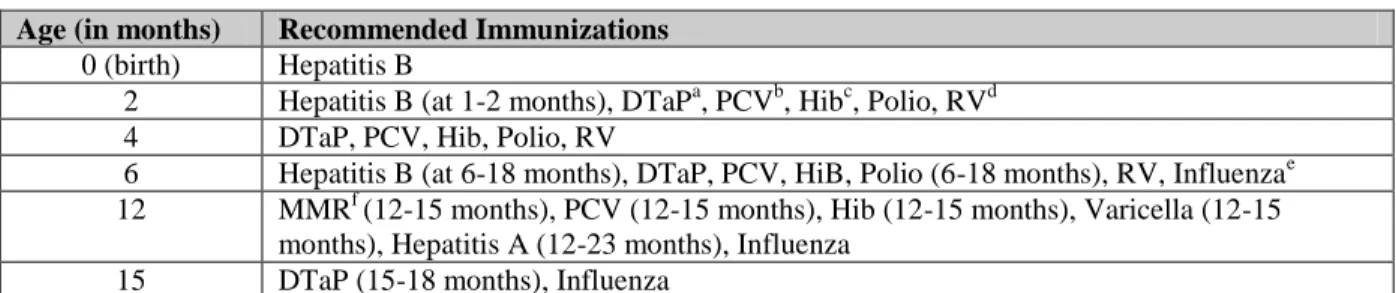
in Table 1. (Centers for Disease Control and Prevention, 2010c) While these vaccinations
are “recommended” instead of “required”, it is worth noting that child care facilities, schools,
colleges, and universities require proof of vaccination before admittance in North Carolina.
(North Carolina Department of Health and Human Services, 2010c)
Table 1: 2010 Recommended immunizations for babies
a: combined vaccine effective against diphtheria, tetanus, and pertussis. b: pneumococcal disease vaccine c: Haemophilius influenzae Type b vaccine d: Rotavirus vaccine e: Annual seasonal influenza vaccine recommended at 6 months-18 years, including 2009 H1N1 vaccine f: Measles, mumps, and rubella vaccine.
Adapted from the U.S. Department of Health and Human Services and Centers for Disease Control and Prevention 2010 Child & Adolescent Immunization Schedule
The first Hepatitis B vaccine, created from purified antigens taken from the blood
plasma of infected persons, was introduced in 1981. While both safe and effective, the
vaccine was not well received from the public due to fears of infection from other blood
borne diseases, most notably from the newly discovered Human Immunodeficiency Virus
(HIV). (Atkinson, Wolfe, Hamborsky, & McIntyre, 2009) A recombinant DNA vaccine,
made by cloning Hepatitis B antigens in yeast, was introduced in 1986. This newer vaccine
had no risk of infection with Hepatitis B, HIV, or any other blood borne disease. (Atkinson
et al., 2009) This newer vaccine was well-received and was integrated into the
immunizations of babies labeled as high-risk, due to ethnicity, mother’s status, or potential
for exposure in the home. (Mahoney & Kane, 1999) Cost-effectiveness analyses were done
Age (in months) Recommended Immunizations
0 (birth) Hepatitis B
2 Hepatitis B (at 1-2 months), DTaPa, PCVb, Hibc, Polio, RVd 4 DTaP, PCV, Hib, Polio, RV
6 Hepatitis B (at 6-18 months), DTaP, PCV, HiB, Polio (6-18 months), RV, Influenzae 12 MMRf (12-15 months), PCV (12-15 months), Hib (12-15 months), Varicella (12-15
and, when coupled with production advancements in vaccine manufacture, data showed that
all babies would benefit from vaccination. (Mahoney & Kane, 1999) By 1997, more than
80% of children between two and three years of age had received each of the three
recommended doses of Hepatitis B vaccine. (Mahoney & Kane, 1999) Between 1990 and
2004, due in large part to the availability of the Hepatitis B vaccine, the all-population United
States incidence of the disease decreased 75%, which included a 94% decline in incidence
among children and adolescents. (Atkinson et al., 2009; Centers for Disease Control and
Prevention, 2010c)(Atkinson et al., 2009; Centers for Disease Control and Prevention,
2010c)
One-third of exposures to Hepatitis B in the United States are due to perinatal and
early childhood exposures; further, 25% of infants who acquire Hepatitis B will die of either
primary hepatocelluar carcinoma or cirrhosis. (Mahoney & Kane, 1999) Also, Hepatitis B is
seen as the second most preventable risk factor for cancer, behind tobacco use. (Duclos,
2003) Consequently, Hepatitis B vaccination at birth is especially important. If not treated
with Hepatitis B vaccine, 70%-90% of babies born to women positive for Hepatitis B would
become infected themselves. In the United States, approximately 25,000 women positive for
Hepatitis B give birth each year, and if not for immunotherapy after birth, 9,500 babies per
year would be infected with Hepatitis B. (Mahoney & Kane, 1999) The number of pregnant
women with Hepatitis B in North Carolina was not available, although Hepatitis B testing for
all pregnant women has been required since 1990. (North Carolina Department of Health
and Human Services, 2010a) The CDC notes that the most commonly reported adverse
events related to Hepatitis B vaccine administered to children are pain at the injection site
(0.4%-6.4% of children). Serious systemic events and allergic reactions are rare. (Centers for
Disease Control and Prevention, 1999a) The Hepatitis B vaccine has been alleged to be
associated with serious adverse events, including development or worsening of Multiple
Sclerosis, rheumatoid arthritis, diabetes, chronic fatigue syndrome, and lymphoblastic
leukemia. (Duclos, 2003) However, none of the associations have been verified, and an
Institute of Medicine (IOM) committee has documented evidence favoring the rejection of an
association between the Hepatitis B vaccine and Multiple Sclerosis. (Duclos, 2003)
The diphtheria, tetanus, and acellular Pertussis (DTaP) vaccine has been in use since
1981 in Japan, and the first DTaP vaccine was licensed for use in the United States in 1991.
Previously, diphtheria, tetanus, and whole-cell Pertussis (DTP) vaccines had been in use,
which contained active Bordatella pertussis bacteria and endotoxins produced by those
bacteria. (Edwards, Decker, & Mortimer, 1999) Injection site reactions occurred in about
half of all DTP administrations, and other adverse events, including fever, swelling, and pain
were common. (Atkinson et al., 2009) Due to the common occurrence of local reactions,
concerns about the use of non-purified bacteria, and demonstrated correlation of the vaccine
with anaphylaxis, febrile seizures, acute encephalopathy, and hypotonic-hyporesponsive
episodes, the whole-cell Pertussis vaccines are no longer in use in the United States.
(Atkinson et al., 2009; Edwards et al., 1999) The most common adverse reactions from DTaP
are fever, redness at the injection site, swelling, fussiness, and drowsiness. DTaP overall has
far fewer adverse reactions than does DTP. (Edwards et al., 1999) Studies have been
conducted investigating links between DTaP vaccination and limb swelling and sudden
infant death syndrome; however, there was no evidence that the correlations were either
et al., 1987; Marshall, Gold, Gent, & et al, 2006; Sekaran & Edwards, 2006; Walker, Jick,
Perera, & et al, 1987)
Current recommendations state that children should receive DTaP vaccine at two,
four, six, and fifteen months of age, with a booster dose between the age of four and six years
when the child enters school. Another DTaP booster should be given between eleven and
twelve years of age, with at least five years elapsing since the previous dose. Then, a booster
should be administered every ten years.(Centers for Disease Control and Prevention, 2010c)
Atkinson provides interesting epidemiological data on diphtheria, Pertussis, and tetanus.
Diphtheria is rare in the United States, with an average of two to three cases per year since
1980. The number of cases of Pertussis has been increasing since 1980, with 25,827 in 2004,
twenty-four percent of which were in children under six months old. While tetanus is not
contagious, vaccine is the preferred method of treatment due to the ineffectiveness of
antibiotic prophylaxis, (Atkinson et al., 2009) thus making the DTaP vaccine all the more
important.
The first pneumococcal vaccine was produced in the United States in 1977, with the
first pneumococcal conjugate vaccine (PCV) following in 2000. (Atkinson et al., 2009) The
non-conjugate pneumococcal vaccine is not effective in children under two years of age.
(Atkinson et al., 2009) Before the development of the PCV, the non-conjugate vaccine was
given to adults for the prevention of conditions caused by the Streptococcus pneumoniae
bacterium, including pneumococcal pneumonia and invasive pneumococcal disease.
(Fedson, Musher, & Eskola, 1999) In children, S. pneumoniae can cause otitis media,
pneumococcal pneumonia, bacteremia, invasive pneumococcal disease, and is the leading
Fedson et al., 1999) Prior to the adoption of PCV, over five million cases of otitis media in
children under five years of age were reported per year in the United States, along with
significant numbers of cases of bacteremia and pneumococcal pneumonia. (Atkinson et al.,
2009) Along with reducing the burden of disease in young children, PCV use is growing in
importance due to growing the growing resistance of S. pneumoniae to penicillin. (Fedson et
al., 1999)
Current recommendations are for children to receive PCV at two, four, and six
months of age, with a booster dose at twelve to fifteen months of age. (Atkinson et al., 2009)
Overall adverse reactions to PCV are lower than to non-conjugate vaccine, but Fedson noted
that fever and pain are more common in those receiving PCV. To date, no serious adverse
reactions have been correlated with PCV, though a temporary increase in the viral load of
HIV patients has been noted. (Fedson et al., 1999)
The Haemophilus influenzae type b (Hib) vaccine was first used in the United States
in 1985, with a Hib conjugate vaccine introduced two years later. (Ward & Zangwill, 1999)
Hib infections generally affect children under five years of age. Most unvaccinated children
have immunity to Hib by the time they are five years old due to having an asymptomatic
infection. (Atkinson et al., 2009) Until 1992, Hib was the leading cause of bacterial
meningitis in children, and also caused epiglottitis, pneumonia, arthritis, and cellulitis.
(Atkinson et al., 2009; Ward & Zangwill, 1999)
Adverse reactions to the Hib vaccine are rare, with the most commonly reported
reactions being injection site swelling, redness, and pain; fever is reported infrequently.
(Atkinson et al., 2009) Recent research suggests that these adverse events may actually be in
Hib vaccine. (Atkinson et al., 2009) No serious adverse events have been reported with Hib
vaccination. (Ward & Zangwill, 1999)
The first vaccine for polio was famously introduced in 1955 by Dr. Jonas Salk.
Salk’s vaccine used an inactivated form of the poliovirus but contained only one serotype of
poliovirus, while Dr. Albert Sabin’s 1963 oral vaccine contained attenuated versions of all
three known serotypes of poliovirus. (Sutter, Cochi, & Melnick, 1999) The polio vaccine
has been extremely effective in the United States. From a high of 21,000 paralytic cases in
1952, the last known case of wild virus acquired polio, which is where a person becomes
infected with polio from a strain of poliovirus circulating in the environment rather than from
a vaccine strain, was reported in the United States in 1979. (Atkinson et al., 2009)
Since 1988, the polio vaccine currently in use in the United States is an
enhanced-potency inactivated poliovirus vaccine. The attenuated oral poliovirus vaccine was
discontinued from use in the United States in 2000, due in part to the fact that eight to ten
persons per year were acquiring polio due to immune dysfunction or a mutation that made
the previously attenuated poliovirus virulent. (Atkinson et al., 2009)
Current recommendations are for children to get poliovirus vaccines at two and four
months of age, between six and eighteen months of age, and a booster before beginning
school, usually between four and six years of age. If necessary, the series of four
immunizations can be accelerated to receive all four within an eighteen week period, but that
is only necessary in the few countries where wild poliovirus is still endemic. (Atkinson et
al., 2009) Perhaps the most well-known to reaction to poliovirus vaccination is known as
the Cutter incident. In 1955, 204 cases of polio developed as a result of improperly
poliovirus vaccine used today is very safe. (S. A. Plotkin, Murdin, & Vidor, 1999) Adverse
reactions to current poliovirus vaccinations are minor and include pain and redness at the
injection site. Since the inactivated poliovirus vaccine contains trace amounts of the
antibiotics streptomycin, polymyxin B, and neomycin, the potential for an allergic reaction to
these ingredients exist, but has not been documented. (Atkinson et al., 2009; S. A. Plotkin et
al., 1999) Guillain-Barré syndrome was suspected as a potential adverse event related to
poliovirus vaccination, but research has been able to determine neither clinical nor statistical
significance. (S. A. Plotkin et al., 1999; Souayah, Nasar, Suri, & Qureshi, 2009)
The first rotavirus (RV) vaccine was introduced in 1998, but withdrawn in 1999 due
to intestinal complications, most namely intussusceptions. A second, safer vaccine was
introduced in 2006. (Atkinson et al., 2009) If every child under five years of age were
vaccinated for RV, 500,000 physician visits, 50,000 hospital visits, and 20-40 deaths per year
would be prevented in the United States. (Clark, Glass, & Offit, 1999) RVs are associated
with dehydration and diarrhea in children, and by age three, virtually all children worldwide
have been infected by a variant of RV, even in developed countries with high standards of
sanitation. (Clark et al., 1999)
Recommendations for RV vaccination include two or three doses, spaced one or two
months apart, beginning at an age of two months. (Atkinson et al., 2009) Adverse reactions
among infant recipients of RV vaccine were rare, but adverse events included
intussusceptions, vomiting, diarrhea, irritability, and fever. No serious adverse events have
been reported. (Atkinson et al., 2009)
The first modern influenza vaccine was produced in 1971 and is one of the first
be mass-produced. (Kilbourne & Arden, 1999) This is especially useful in influenza
vaccines due to the difference in predominant viruses from year to year. While children are
not usually at risk for complications from influenza, they are a major factor in the
transmission of the virus. Interruption of the spread of the virus in children could lead to a
real decrease in community influenza rates. (Atkinson et al., 2009)
Influenza vaccination is recommended yearly for infants. If an infant received two
doses of influenza in the previous season, only one dose is indicated in the current season.
(Atkinson et al., 2009) Influenza vaccines are generally safe, with pain, tenderness, and
itching sometimes developing at the injection site, with fever, chills, and allergic reactions
occurring rarely after influenza vaccine administration. (Atkinson et al., 2009; Kilbourne &
Arden, 1999)
The first measles vaccines were introduced in 1963, the mumps vaccine was first
introduced in 1967, and the rubella vaccine was first introduced in 1969. (Atkinson et al.,
2009) The combination measles, mumps, and rubella (MMR) vaccine was first introduced in
the United States in 1971 and has become the preferred method of MMR combination
vaccination. (Redd, Markowitz, & Katz, 1999) As reported by Atkinson, in the United
States, rubella cases reached a peak of 57,686 cases in 1969, declining to only seven cases in
2003. Measles cases declined rapidly after the introduction of the vaccine, from
approximately 500,000 cases per year prior to vaccine availability, to a low of 37 cases
reported in 2004. However, between the years of 1989 and 1991, there was a dramatic
increase in the number of measles cases, with a total of 55,622 cases reported in that three
year period, with blame being placed on low vaccination coverage. The incidence of mumps
1964 and only 258 cases in 2004. There were spikes in the number of cases of mumps in
1987 (12,848 cases) and 2006 (6,000 cases) which were attributed to a faulty vaccine.
(Atkinson et al., 2009)
Guidelines recommend that children receive doses of MMR vaccine between twelve
and fifteen months of age and a follow-up dose before entering school. (Atkinson et al.,
2009; Centers for Disease Control and Prevention, 2010c) MMR vaccine has few adverse
events with the most common being fever, rash, and joint pain. Rare cases of central nervous
system dysfunction have been reported. Correlation of MMR vaccine with Guillain-Barré
syndrome has been discounted, and the IOM has found no evidence linking MMR
vaccination with thrombocytopenia or anaphylaxis, (Redd et al., 1999) Studies linking
MMR vaccination with autism have been discounted for lack of evidence. (W. Chen,
Landau, Sham, & Fombonne, 2004; Peltola et al., 1998; Taylor, Miller, Farrington, & et al,
1999)
Varicella vaccine is a live, attenuated vaccine that has been in use in Japan since the
1970s, and first became licensed for use in the United States in 1995. Prior to vaccine
availability, there were approximately four million cases of varicella per year. The number
of annual cases dropped 93% by 2006. (Atkinson et al., 2009) While disease caused by
varicella is generally not fatal in children, if the disease is contracted in adulthood, the
case-fatality rate is 25 times greater than if the disease were contracted as a child. Disruption of
the transmission cycle between children and adults, coupled with an estimated $6.6 million
costs savings from varicella vaccinations, mainly due to less work lost by parents caring for
sick children, make varicella vaccination both important for preventing disease as well as
Current guidelines recommend administration of one dose varicella vaccine for
children between twelve and fifteen months of age, with a booster dose before beginning
school, with a minimum of three years between doses. (Atkinson et al., 2009; Centers for
Disease Control and Prevention, 2010c) The vaccine is safe, with the most common adverse
events being injection site reactions such as pain or redness. Since the varicella vaccine does
contain live virus, there is a risk of transmission infection in immunocompromised persons,
including pregnant women, and mild Herpes zoster infection has also been reported in rare
cases. (Atkinson et al., 2009; Gershon et al., 1999) However, varicella vaccine efficacy can
be as low as 70%. (Atkinson et al., 2009)
The first Hepatitis A vaccine was licensed for use in the United States in 1995. The
incidence of Hepatitis A is low in the United States when compared to other endemic areas
such as Central and South America, Africa, the Middle East, Asia, and the Western Pacific;
however, there are cyclical epidemics of Hepatitis A that occur approximately every ten
years in the United States. (Atkinson et al., 2009) The most commonly reported method of
exposure in the United States is contact with an infected household member. Children, who
are generally asymptomatic when infected with Hepatitis A, can be a major source of
potential infections if not vaccinated. (Hall, Kane, Roure, & Meheus, 1999) The number of
Hepatitis A infections peaked in the United States in 1971 with 59,606 cases, declining to
2,974 cases in 2007, most of which were in children older than two years of age. (Atkinson
et al., 2009)
Current guidelines recommend a dose of Hepatitis A vaccine between twelve and 23
months of age. (Atkinson et al., 2009; Centers for Disease Control and Prevention, 2010c)
site reactions. Diarrhea, fever, headache, and vomiting occur rarely. More serious adverse
events such as syncope, jaundice, and convulsions have been reported, but no evidence to
indicate clinical or statistical significance has been shown. (Atkinson et al., 2009; Feinstone
& Gust, 1999)
VACCINE EFFICACY
Vaccination has been heralded as number one of the top ten public health
achievements of the twentieth century (Centers for Disease Control and Prevention, 1999b),
being second throughout history only to the availability of clean water as the greatest
contributor to mortality reduction and population growth for the world’s people. Not even
the availability of antibiotics has had as profound an effect on the health of the world. (S. L.
Plotkin & Plotkin, 1999) Due to advances in vaccines and the benefits of keeping diseases
under control, it is now more important than ever to make sure that as many people as
possible receive all necessary vaccines. Immunization information systems, or immunization
registries, can help keep track of vaccinations and schedules in an increasingly mobile
society. Enrolling infants at birth into an immunization registry provides the best
opportunity to provide maximum benefit to both society and the individual.
Examination of the present incidence of vaccine-preventable infectious disease is the
optimal method to evaluate the value of vaccination. Each infectious disease has a basic
reproductive rate, R0. R0 can be explained as the number of cases of secondary disease
caused by each case of a disease in a population where everyone is susceptible to the disease,
meaning no immunity from vaccine or previous disease. R0 is calculated for a disease for a
average age of infection. (Anderson & May, 1985) Using R0, one can quickly calculate the
impact of vaccinations using a simple model: Rt=R0(S/N). Rt is the effective reproductive
number, which is the true transmission rate of the disease as affected by persons who are
immune, dead, or otherwise taken out of the susceptible population. S represents the number
of susceptible persons left in the population, and N represents the total population. By
decreasing S through vaccination, Rt can be reduced below one, meaning that the disease will
not spread in this population. This model assumes homogenous mixing within a population
– meaning that every person in the population has an equal chance of coming into contact
with every other person and that that everyone is fully susceptible. This, of course, would
never happen in nature, but is useful for demonstrating the quick spread of infectious disease
and the effectiveness of vaccines. (Scherer & McLean, 2002) Table 2 presents the R0 of
several common vaccine-preventable infectious diseases, and the critical vaccination
percentages (S/N) needed to inhibit spread of the disease. (Anderson, 1992)
Table 2: R0 and critical vaccination percentages to inhibit disease spread
Adapted from Anderson, 1992.
From the table above, one can see that both measles and Pertussis each have a high R0 of
15-17. This means that every case of disease will cause 15-17 new cases of disease, and each of
those new cases will each cause 15-17 new cases, and so on, thus propagating into an
epidemic, where there is a far greater number of cases of a disease in a population than
normal (Last, 2007), based on a simple population system as described above. Fortunately,
Disease Basic Reproductive Rate (R0) Critical Vaccination Percentage (S/N)
Measles 15-17 92-95
Pertussis 15-17 92-95
Mumps 10-12 90-92
Rubella 7-8 85-87
Diphtheria 5-6 80-85
the phenomenon of herd immunity is at work in populations, whereby some protection from
disease is given to persons who may otherwise be susceptible due to the fact that most of the
population is not susceptible to infection due to vaccination or other immunity. (Anderson &
May, 1985) Scherer and McLean provide a formula that demonstrates the effectiveness of
varying levels of vaccination, with the caveat that the model assumes perfect, lifelong
immunity. (Scherer & McLean, 2002) Again, this would not happen in practice, but does
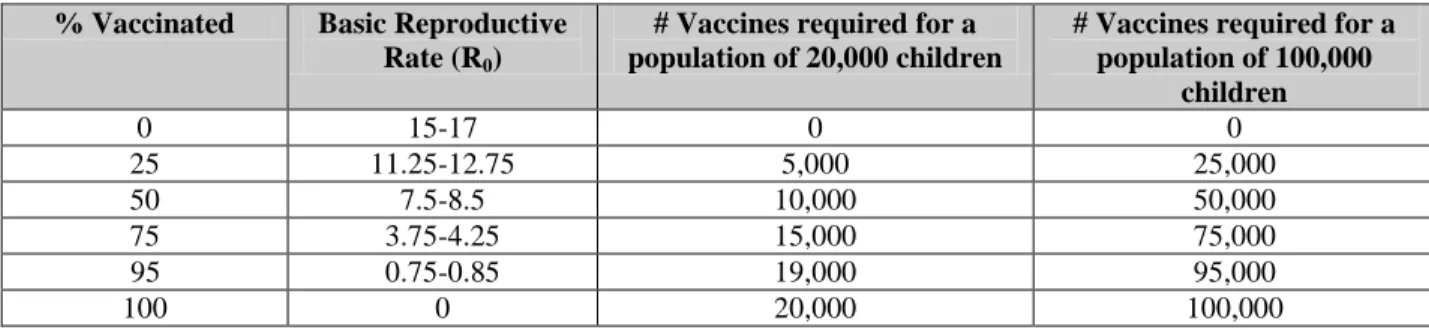
provide a rough goal for immunization. Table 3 demonstrates the effect of varying levels of
vaccination on the R0 of measles, and the number of required child vaccinations in two
hypothetical cities with 20,000 and 100,000 children.
Table 3: Transmission dynamics for measles affected by vaccination
As can be seen in the table above, between 95% to 100% of a population’s children would
have to be vaccinated, or otherwise not susceptible to measles, in order to halt the spread of
the disease. Continued vigilance, not just a one-time mass vaccination campaign would be
required to maintain control, since the susceptible population is dynamic due to births,
deaths, infection, vaccination, and population movement in and out of an area. (Anderson &
May, 1985) For diseases with smaller R0, such as polio, the critical vaccination percentage is
much lower due to the fact that each primary case spawns fewer secondary cases, thus
allowing R0 to fall below one at a lower level of population non-susceptibility. (Scherer &
% Vaccinated Basic Reproductive
Rate (R0)
# Vaccines required for a population of 20,000 children
# Vaccines required for a population of 100,000
children
0 15-17 0 0
25 11.25-12.75 5,000 25,000
50 7.5-8.5 10,000 50,000
75 3.75-4.25 15,000 75,000
95 0.75-0.85 19,000 95,000
McLean, 2002) The R0 of a disease can fall below one without the entire population being
immune, thus allowing control, due to herd immunity.
Mixing of the population is required for transmission of infectious disease. Therefore,
a population with enough non-susceptibles (such that Rt falls below one), transmission of a disease can halt since a susceptible person’s likelihood of being exposed to the disease is low
due to the decreased chance of mixing with carriers since so much of the population is not
susceptible. However, persons should be educated to not rely on herd immunity, since if too
many people assume they will be protected by herd immunity and do not receive a
vaccination, the susceptible population may be large enough to allow the disease to become
an epidemic.
VACCINE SAFETY CONCERNS
While vaccines provide an invaluable service to society, there is a heightened
expectation of their safety, especially in children. (R. T. Chen, Davis, & Sheedy, 2004)
Any adverse events related to vaccines must be minimal to ensure compliance and use.
Additionally, children have the decision to get vaccinated made for them, either by their
parents or the government. There have been numerous reports and studies completed to
explore the adverse events of vaccination, including allergic reactions (Offit & Hackett,
2003), sudden infant death syndrome (Vennermann, Butterfass-Bahloul, Jorch, & et al,
2007), Guillain-Barré syndrome (Souayah et al., 2009), Multiple Sclerosis, (Demicheli,
Rivetti, Di Pietrantonj, Clements, & Jefferson, 2003) thrombocytopenia, (Rajantie, Zeller,
Treutiger, & Rosthoj, 2007) and autism (Honda, Shimizu, & Rutter, 2005). Though little or
still of concern to both parents and medical practitioners. Recent news has revealed that
Wakefield’s 1998 study that first linked vaccination to autism, published in The Lancet, used
falsified data and was retracted. (Triggle, 2010) The concern for adverse events comes from
both the immunologic reaction that vaccines cause and the additives used in vaccines. The
additives, namely thimerosal, aluminum hydroxide, and mercury, have been identified as
potential catalysts for many of the adverse events purported to be caused by vaccines, most
famously autism. (Ball, Ball, & Pratt, 2001; Gherardi, Coquet, Cherin, & et al, 2001;
Pichichero, Cernichiari, Lopreiato, & Treanor, 2002; Stehr-Green, Tull, Stellfeld, Mortenson,
& Simpson, 2003)
Thimerosal is a mercury-containing organic compound used to prevent microbial
contamination of vaccines. Thimerosal has been either removed completely from or reduced
to trace amounts in all vaccines for children, with the exception of the influenza vaccine.
(United States Food and Drug Administration, 2010) Although FDA found that no harm was
done by thimerosal in vaccines, it was recommended that thimerosal be removed from
vaccines as a precaution due to parental concerns of the purported link between mercury,
thimerosal, and autism. (United States Food and Drug Administration, 2010)
Aluminum hydroxide is currently used as an adjuvant in the hepatitis A, hepatitis B,
DTaP, and Hib vaccines. (Centers for Disease Control and Prevention, 2010b) Although
there were concerns that aluminum-containing vaccine additives could cause conditions such
as macrophagic myofasciitis, studies have confirmed both the safety and efficacy of
aluminum hydroxide use in vaccines. (Centers for Disease Control and Prevention, 2010b;
Due to the potential for adverse events, an infrastructure was established in the United
States specifically for monitoring vaccine safety and reporting any adverse events. The
Vaccine Safety Datalink project is a joint venture between the CDC and eight managed care
organizations (MCOs), allowing data that includes both vaccination information and medical
outcomes to be collected and analyzed by the CDC. (DeStefano & Vaccine Safety Datalink
Research Group, 2001) The MCOs involved in the collaboration are: Group Health
Cooperative of Puget Sound in Seattle, Washington; Kaiser Permanente Northwest in
Portland, Oregon; Kaiser Permanente Medical Care Program of Northern California in
Oakland, California; Southern California Kaiser Permanente Health Care Program in Los
Angeles, California; HealthPartners Research Foundation in Minneapolis, Minnesota;
Marshfield Clinic Research Foundation in Marshfield, Wisconsin; Kaiser Permanente
Colorado in Denver, Colorado; and Harvard Pilgrim Health Care in Boston, Massachusetts.
(Centers for Disease Control and Prevention, 2010d) The Vaccine Adverse Event Reporting
System (VAERS) is a product of the collaboration between the CDC and the Food and Drug
Administration (FDA). It is a passive system, meaning that reports of adverse events must be
reported by vaccine manufacturers, parents, patients, or health care providers. (Zhou, Pool,
Iskander, & et al, 2003) Since 1990, VAERS has received over 200,000 adverse event
reports, and currently receives about 30,000 adverse event reports annually, with thirteen
percent of those reports being serious. (Centers for Disease Control and Prevention, 2010a)
NEED FOR IMMUNIZATION REGISTRIES
Due to the large number of recommended vaccines for infants, which total greater
2010c), the need for immunization registries is greater than ever. Data show that providers
often overestimate the percentage of their patients that are fully vaccinated (Linkins, 2001)
due to: not being able to easily access the information; parents often do not know the
immunization status of their children; most providers not using an immunization registry do
not send out immunization reminders to their patients; and that by age two, twenty percent of
children have been seen by more than one medical provider, not counting the hospital in
which they were born. (Linkins & Feikema, 1998) Due to these issues, vaccination benefits,
and the setting of a Healthy People 2010 goal of having greater than 95% of children under
six years of age enrolled in an immunization registry (Centers for Disease Control and
Prevention, 2006), the Robert Wood Johnson Foundation and the National Immunization
Program (NIP) of the CDC initiated funding programs to facilitate the introduction of
immunization registries. Starting in 1991, the All Kids Count Project (AKC) of the Robert
Wood Johnson Foundation, in conjunction with other private foundations, funded 24 vaccine
registry projects. NIP awarded $42.5 million to 64 registry sites in 1996 alone. (Linkins,
2001)
CURRENT STATUS OF IMMUNIZATION REGISTRIES
All 50 states, six individual cities, and three United States territories received either
AKC or NIP funding and have either built or are building Healthy People 2010 compliant
immunization registries. (Linkins, 2001) However, recent federal and state budgets have
limited the amount of startup funding available to state and local immunization registries. A
management organizations (HMOs) to secure continued funding for their registries. (Linkins,
2001)
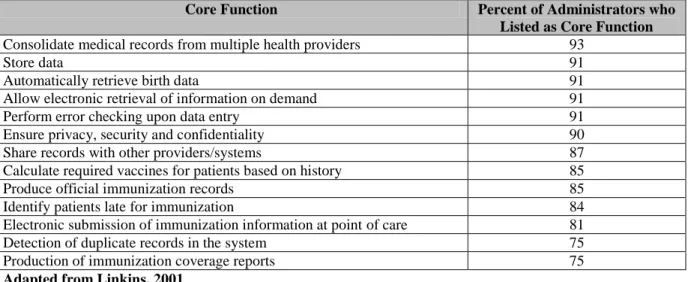
In 1997, NIP conducted surveys of the registry site funding grantees to compile a list
of what registry administrators consider core functions of an immunization registry. Table 4
summarizes the core functions, in order of descending importance as judged by the registry
administrators. (Linkins, 2001)
Table 4: Core Functions of Immunization Registries as Described by Registry Managers
Core Function Percent of Administrators who
Listed as Core Function Consolidate medical records from multiple health providers 93
Store data 91
Automatically retrieve birth data 91
Allow electronic retrieval of information on demand 91
Perform error checking upon data entry 91
Ensure privacy, security and confidentiality 90
Share records with other providers/systems 87
Calculate required vaccines for patients based on history 85
Produce official immunization records 85
Identify patients late for immunization 84
Electronic submission of immunization information at point of care 81
Detection of duplicate records in the system 75
Production of immunization coverage reports 75
Adapted from Linkins, 2001
Of note, sixteen percent of administrators named adverse event reporting as a core
function, and thirteen percent named vaccine inventory management as a core function.
(Linkins, 2001) Having vaccine inventory management as a low priority was somewhat
surprising, since this feature would be complementary to other practice time-saving features
such as: record consolidation, electronic information retrieval, and patient reminder
generation. The inventory management feature would be easy to implement and maintain,
since it could be implemented by the registry administrator, potentially using CDC source
code, and given to all participating sites at once by adding the vaccine management system to
In 2000, 21% of children had at least two immunizations entered in an immunization
registry. Twenty-six states, four cities, and two United States territories had operational
registries covering their entire target areas, and the rest of the states’ registries were either
partially up and running or being developed. (Saarlas, Edwards, Wild, & Richmond, 2003)
By 2005, 56% of children nationwide were enrolled in an immunization registry, and by
2006, the percentage increased to 65%. (Urquhart, Rasulnia, & Kelly, 2008)
Even after successful implementation of an immunization registry, there is still much
work to be done. Specifically, registries must remain current and compatible with relevant
technologies, consider full integration with electronic medical records systems, be dynamic
for future updates such as immunization recommendation changes, and perhaps most
importantly, be able to communicate with other registry systems and databases. Due to
children seeing different providers and moving from one immunization registry target area to
another, it is vital for inter-system communication to become the norm so that the efficacy of
the registries are not lost. Interfacing with other databases will continue to be important to
ensure complete coverage, such as automatic importing of birth records, targeting high-risk
or underserved populations, and linking with external federal data. NIP allotted $1 million in
funding to link the Special Supplemental Nutrition Program for Women, Infants, and
Children (WIC) (Linkins, 2001), and linking registry systems to Medicaid data will become
more important as more Medicaid recipients receive their immunizations at private providers
rather than at local health departments.
Nationally, progress in the development and adoption of immunization registries has
increased greatly since 1999, and toward the Healthy People 2010 goals. For instance, the
64% in 2008, an increase of six percent from the previous year, with over six million client
records. (Schauer et al., 2009) It was in use by 15,000 persons, 1,200 organizations, and
3,500 facilities. It is estimated that 77% of providers statewide are using the system. (Schauer
et al., 2009) This is similar to the national average of 65% completeness, even though ten
registry sites reported completeness rates of 81%-94%. (Urquhart et al., 2008) The North
Carolina Immunization Registry (NCIR) is in use by all of North Carolina’s public health
departments, as well as 600 private practices which account for more than 50% of providers
in the state. (North Carolina Department of Health and Human Services, 2010b) The NCIR
is currently being integrated into hospital neonatal care units across the state. In the city of
Philadelphia, this immunization registry, which is populated from city birth records, 92% of
children were found to be entered; however significant difference in vaccination coverage
rates were found when data from the immunization registry were compared to patient’s paper
records kept at providers’ offices. (Kolasa, Chilkatowsky, Clarke, & Lutz, 2006)
BENEFITS OF IMMUNIZATION REGISTRY USE
With widespread adoption of immunization registries, many realize benefits from
their widespread implementation. Health care providers such as physicians and nurses, office
managers, parents, patients, and society at large all benefit from having a functional
immunization registry. Many benefits of immunization registries have already been realized,
including reduced extra immunization, which could lead to fewer reactions and adverse
events and less wasted vaccine. (Kempe, Steiner, Renfew, & et al, 2001) Use of an
immunization registry can lead to reduced costs and staff time for practices by: providing
generating official immunization records needed for school or daycare entry; keeping track of
patients who are overdue for an immunization; and generating reminders to patients who are
due for immunization. (Every Child By Two Foundation, 2010; Glazner, Beatty, Pearson, &
et al, 2004) This more efficient handling of vaccine records can have real benefits to
individual children and whole communities, since more than 25% of children between 19 and
35 months old are not up to date on immunization, and more than ten percent of children
between nineteen and 35 months have received at least one extra, unnecessary dose of
vaccine. (Kolasa et al., 2006) Further, the savings in staff time can also be significant, since
registries reduce staff time in finding vaccination records at other providers, managing
vaccine inventory, and consolidating billing information. (Every Child By Two Foundation,
2010; Glazner et al., 2004) In an analysis of time spent on certain immunization-related
activities at private practices in Colorado, it was found that time spent per shot on nonroutine
immunization activities, which includes vaccine management and providing immunization
records, decreased from 3.1 minutes to 2.3 minutes after implementation and use of a vaccine
registry. (Glazner et al., 2004) While the time savings per shot may seem small, if dozens or
hundreds of shots are given at a practice per day, hours of nursing staff time per day could be
saved.
Consolidation of immunization records from multiple providers has been hailed as
one of the greatest benefits of an immunization registry. (Glazner et al., 2004; Kempe et al.,
2001; Kolasa et al., 2006; Schauer et al., 2009) One-fifth of children have been seen by more
than one provider by the time they are age two (Linkins & Feikema, 1998), necessitating
communication between providers. This communication may not be possible at the moment
immunization record. Instead of spending time trying to piece together a child’s
immunization record or just giving the child a potential extra dose to be sure, consolidation
of records via an immunization registry can save time, vaccines, and reduce the chance of
adverse events by reducing extra immunization.
The ability of an immunization registry system to identify patients who are behind in
vaccinations, due for vaccinations, as well as generate reminder and recall notices for
patients, has been proven to increase overall vaccination rates (Tickner, Peman, &
Woodcock, 2006) and well as save time for the practice staff. Generation of data regarding
vaccination coverage could be facilitated with optimal immunization registry systems that
have complete current and historical data. Currently, the National Immunization Survey
compiles data from paper-based records, a tedious and time-consuming process. (Khare,
Picinino, Barker, & Linkins, 2006) Implementing an automated process based on an
electronic immunization registry would save time and increase accuracy.
BARRIERS TO IMMUNIZATION REGISTRY ADOPTION
Despite the benefits that use of an immunization registry can bring to health care
practices, patients, and the general population, registry use is still well below Healthy People
2010 targets of 95% coverage. Research into providers who do not participate in
immunization registries shows that financial cost and staff time are the largest barriers to
entry. (Glazner et al., 2004)
The direct cost to a provider for participating in an immunization registry is
comprised of labor and equipment expenses. Both cost and accuracy can be affected
nurses who actually performed the immunizations, led to the highest costs. Entry into the
registry by a data entry specialist and automatic transfer from electronic medical records cost
significantly less. (Rask, Wells, Kohler, Rust, & Cangialose, 2000) Time spent training to
use the registry system must also be considered, along with troubleshooting and maintenance
tasks. A major barrier to immunization registry adoption is the fact that many providers
would have to maintain the regular medical record and then manually enter the immunization
into the registry. This takes extra time, and may be done at irregular intervals long after the
shot was given, thereby inhibiting the usefulness of a registry system to provide the most
up-to-date data to providers. (Rask et al., 2000) Additionally, the cost of necessary equipment,
such as computers, printers, or internet access must be taken into account if these items are
not already present at the provider site.
Besides direct costs to providers, incomplete immunization registry data result in
incomplete or inaccurate immunization statistics that can adversely affect larger policy and
financial decisions. A 2006 analysis of the city of Philadelphia’s immunization registry
found that while 92% of the city’s children were entered into the registry, differences in
documentation of up to eighteen percent were found between registry data and paper records
for DTaP, polio, MMR, and Hib vaccinations. (Kolasa et al., 2006) Incomplete data could
lead to missed immunization opportunities or extra immunizations if the record was not
properly recorded.
Incomplete registry data also means that the National Immunization Survey must rely
on paper records and random digit dialing surveys to conduct the nation’s immunization
status survey. (Smith et al., 2005) However, recent studies have shown that combining
nation’s true immunization status. (Khare et al., 2006) Having a registry system with
complete data would allow updated immunization status reports to be generated and updated
quickly, allowing for potential annual or semi-annual immunization statistics, allowing
public health professionals to quickly target deficient areas or better cope with unexpected
outbreaks of disease.
The true usefulness of an immunization registry cannot be realized if the current
registries remained isolated from each other. In a mobile society such as in the United States,
it is not uncommon to move out of a target area of one immunization registry into the target
area of another. Persons who live near state borders may get medical care in more than one
state. Sharing information across state lines, however, may require special legislation to
allow private medical information to be transmitted to out-of-area providers. The Every
Child By Two organization and the George Washington University have drafted sample
legislation for use by public health officials to facilitate passage of data-sharing legislation.
(Every Child By Two Foundation, 2010)
OVERCOMING BARRIERS TO IMMUNIZATION REGISTRY USE
While the barriers to entry for a practice to participate in an immunization registry
can be high in both cost and logistical issues, and there are current limitations to registry
usefulness, it is important for providers, patients, and policymakers to realize the importance
of having functional, accurate immunization registries. Overcoming these barriers and
limitations will not have a one-size-fits-all approach; in order to be effective and efficient,
To ensure both time savings for staff and accuracy when entering data into the
registry, the method of data entry should be integrated into records systems that the provider
already uses. In a review of the city of Boston’s immunization registry, researchers found
that 59% of records contained at least one error in data entry, and 38% of all errors were
vaccines that had not been entered into the registry. (Samuels, Appel, Reddy, & Tilson,
2002) Whether these errors are due to lack of time to complete data entry at the time of
immunization, lack of training, or a myriad of other reasons, these errors and the burden of
duplicating recordkeeping could be eliminated if the immunization registry accepted data
from a provider’s existing recordkeeping method. In a survey of Atlanta’s immunization
registry, a provider with automated data entry had a per shot cost of participating in the
registry of $0.24, while a provider with manual data entry by clinic nurses had a per shot cost
of participation of $3.24. (Rask et al., 2000) While some providers may think that the initial
cost of setting up an automated data interface may be expensive, it would soon become cost
effective in the long term. Specifically, saving $3.00 per shot would add up quickly if many
shots are given per day. Additionally, an automated data interface would also free nurses to
do more medically-oriented tasks, such as patient education or administering more
immunizations. Additionally, allowing the immunization registry data entry to be integrated
with a provider’s existing recordkeeping method could also automate billing procedures for
immunizations and vaccine inventory management.
One method for increasing usage of immunization registries in a community is to
involve parents. Educating parents to the benefits of an immunization registry can help
recruit a strong ally that could help secure funding or local impetus for creation or further
policymakers. In a survey of parents, it was found that they generally believe that
immunization registry costs should be paid by the government, vaccine companies, or
insurance companies. (Linkins et al., 2006) Despite Healthy People 2010 goals of 95%
immunization registry coverage and increasing uptake of immunization registries nationwide,
parents are woefully undereducated when it comes to knowledge of their local immunization
registry. In a study conducted of parents whose children were enrolled in an immunization
registry in central New York State, only 29% were aware of the existence of the registry.
(Callahan, Reed, Meguid, Wojcik, & Reed, 2004) In a survey of parents in four states, fewer
than ten percent were aware of immunization registries, and among those that were, only
26.5% had enrolled their children in a registry where active enrollment of children is
necessary. (Callahan et al., 2004) Interestingly, among parents who chose not to get their
children vaccinated and were aware of the registry, 65% had enrolled their children in the
registry. (Linkins et al., 2006) Parents were also generally unaware of legislation regarding
immunization registries with less than seven percent reporting knowledge of such legislation,
which could appropriate additional funding for registries and facilitate sharing of data
between immunization registries in different areas. (Linkins et al., 2006) Educating parents
about the dangers of vaccine preventable diseases, the ease of obtaining immunization
records and ensuring that their children receive proper immunization may also be helpful in
rallying support for immunization registries. The American Immunization Registry
Association provides advocacy materials and examples of patient education materials on its
website (http://www.immregistries.org) (American Immunization Registry Association,
2010) and many states, including North Carolina, have immunization registry websites.
In order for immunization registries to be truly useful, isolated systems must be
linked with others and allowed to share data between themselves as well as link with other
health care databases such as WIC and Medicaid. The Every Child By Two organization has
drafted legislation (Every Child By Two Foundation, 2010) to help public health officials
present legislation to their governing bodies that permit sharing of health data between
systems, which may facilitate integration of or communication between registries in different
jurisdictions. This inter-database sharing will become increasingly important as more
Medicaid recipients receive immunizations at private providers, (Linkins & Feikema, 1998)
and to facilitate registry usefulness for children who move from one registry area to another,
or receive care in one state but lives in another.
Having an immunization registry that is adaptable in various provider settings will
increase its usefulness and encourage participation. The CDC has made available several
open-source registry computing codes, technical protocols, and guides that will facilitate
future expansion ability, as well as foster compatibility with many other databases as
possible. (National Center for Immunization and Respiratory Diseases, 2010) Future modules
that would allow providers to customize their vaccine registry system to meet their individual
needs while maintaining compatibility with other systems would be helpful.
CONCLUSION
With the support of the CDC and the targets set by the Healthy People 2010 goals,
support for and uptake of immunization registries has risen dramatically throughout the last
decade. Immunization registries are present in all 50 states, six major cities, and three United
reducing extra immunization, ensuring that children receive up-to-date and proper
immunizations, save medical costs by preventing vaccine-preventable diseases, and save
providers time and money. The limitations of immunization registries are being worked
through, and automating data entry and ensuring communication between different systems
will be of paramount importance to continue the momentum. Officials should proactively
ensure that legislation is in place to facilitate data sharing between systems, and registry
designers should ensure that the systems are adaptable, expandable, and nationally
compatible with protocols developed by the CDC. Parents should be educated and involved
with all aspects of registry use, as they can be powerful allies. Finally, steps should be taken
to ensure that vaccine registries are seamlessly and cost-effectively integrated with providers’
existing recordkeeping systems to facilitate implementation, increase compliance, ease data
entry, and ensure accuracy.
We are well on our way to meeting the Healthy People 2010 goal of having 95% of
children less than six years of age enrolled in an immunization registry. With these
registries, we can ensure healthier children, lower provider costs, improve recordkeeping,
References
American Immunization Registry Association. (2010). AIRA - American Immunization Registry Association. Retrieved March 13, 2010, from http://www.immregistries.org/
Anderson, R. M. (1992). The concept of herd immunity and the design of community-based immunization programmes. Vaccine, 10(13), 928-935.
Anderson, R. M., & May, R. M. (1985). Vaccination and herd immunity to infectious diseases. Nature, 318, 323-329.
Atkinson, W., Wolfe, S., Hamborsky, J., & McIntyre, L. (Eds.). (2009). Epidemiology and prevention of vaccine-preventable diseases (11th ed.). Washington, DC: Public Health Foundation.
Ball, L. K., Ball, R., & Pratt, R. D. (2001). An assessment of thimerosal use in childhood vaccines. Pediatrics, 107, 1147-1154.
Callahan, J. M., Reed, D., Meguid, V., Wojcik, S., & Reed, K. (2004). Utility of an
immunization registry in a pediatric emergency department. Pediatric Emergency Care, 20(5), 297-301.
Centers for Disease Control and Prevention. (1999a). Impact of vaccines universally
recommended for children - United States, 1990-1998. Morb Mortal Wkly Rep, 48(12), 243-248.
Centers for Disease Control and Prevention. (1999b). Ten great public health achievements - United States, 1900-1999. Morb Mortal Wkly Rep, 48(12), 241-243.
Centers for Disease Control and Prevention. (2006). 14: Immunization and infectious diseases. Healthy People 2010 web site.
http://www.healthypeople.gov/document/HTML/Volume1/14Immunization.htm#_Toc4 94510239
Centers for Disease Control and Prevention. (2010a). About the VAERS program. Retrieved March 13, 2010, from http://vaers.hhs.gov/index/about/index
Centers for Disease Control and Prevention. (2010b). General questions and answers about adjuvants. Retrieved March 11, 2010, from
http://www.cdc.gov/vaccinesafety/Concerns/adjuvants.html
Centers for Disease Control and Prevention. (2010c). Recommendations and guidelines: 2010 child & adolescent immunization schedules for persons aged 0-6 years, 7-18 years, and "catch-up schedule". Retrieved February 5, 2010, from
Centers for Disease Control and Prevention. (2010d). Vaccine safety datalink (VSD) project. Retrieved March 11, 2010, from http://www.cdc.gov/vaccinesafety/Activities/VSD.html
Chen, R. T., Davis, R. L., & Sheedy, K. M. (2004). Safety of immunizations. In S. A. Plotkin, W. A. Orenstein & P. A. Offitt (Eds.), Vaccines (4th ed., pp. 1557-81). Philadelphia, PA: Saunders.
Chen, W., Landau, S., Sham, P., & Fombonne, E. (2004). No evidence for links between autism, MMR and measles virus. Psychol Med, 34, 543-553.
Clark, H. F., Glass, R. I., & Offit, P. A. (1999). Rotavirus vaccines. In S. A. Plotkin, & W. A. Orenstein (Eds.), Vaccines (3rd ed., pp. 987-1005). Philadelphia, PA: W.B. Saunders Company.
Demicheli, V., Rivetti, A., Di Pietrantonj, C., Clements, C. J., & Jefferson, T. (2003). Hepatitis B vaccination and multiple sclerosis: Evidence from a systematic review. J Viral Hepat, 10, 343-344.
DeStefano, F., & Vaccine Safety Datalink Research Group. (2001). The Vaccine Safety Datalink Project. Pharmacoepidemiol Drug Saf, 10(5), 403-406.
Duclos, P. (2003). Safety of immunization and adverse events following vaccination against Hepatitis B. Expert Opin Drug Saf, 2, 225.
Edwards, K. M., Decker, M. D., & Mortimer, E. A. (1999). Pertussis vaccine. In S. A. Plotkin, & W. A. Orenstein (Eds.), Vaccines (3rd ed., pp. 293-344). Philadelphia: W.B. Saunders Company.
Every Child By Two Foundation. (2010). Every child by two. Retrieved February 5, 2010, from http://www.ecbt.org/index.cfm
Fedson, D. S., Musher, D. M., & Eskola, J. (1999). Pneumococcal vaccine. In S. A. Plotkin, & W. A. Orenstein (Eds.), Vaccines (3rd ed., pp. 553-607). Philadelphia, PA: W.B. Saunders Company.
Feinstone, S. M., & Gust, I. D. (1999). Hepatitis A vaccine. In S. A. Plotkin, & W. A. Orenstein (Eds.), Vaccines (3rd ed., pp. 650-671). Philadelphia, PA: W.B. Saunders Company.
Gershon, A., Takahashi, M., & White, C. J. (1999). Varicella vaccine. In S. A. Plotkin, & W. A. Orenstein (Eds.), Vaccines (3rd ed., pp. 475-507). Philadelphia, PA: W.B. Saunders Company.
Glazner, J. E., Beatty, B. L., Pearson, K. A., & et al. (2004). Using an immunization registry: Effect on practice costs and time. Ambul Pediatr, 4, 34-40.
Griffin, M. R., Ray, W. A., Livengood, J. R., & Schaffner, W. (1988). Risk of sudden infant death syndrome after immunization with the diphtheria-tetanus-pertussis vaccine. New England Journal of Medicine, 319, 618-623.
Hall, A., Kane, M., Roure, C., & Meheus, A. (1999). Multiple sclerosis and Hepatitis B vaccine? Vaccine, 17, 2473.
Hoffman, H. J., Hunter, J. C., Damus, K., Pakter, J., Peterson, D. R., van Belle, G., et al. (1987). Diphtheria-tetanus-pertussis immunization and sudden infant death: Results of the national institute of child health and human development cooperative
epidemiological study of sudden infant death syndrome risk factors. Pediatrics, 79, 598-611.
Honda, H., Shimizu, Y., & Rutter, M. (2005). No effect of MMR withdrawal on the
incidence of autism; a total population study. J Child Psychol Psychiatry, 46, 572-579.
Kempe, A., Steiner, J. F., Renfew, B. L., & et al. (2001). How much does a regional
immunization registry increase documented immunization rates at primary care sites in rural colorado? Ambul Pediatr, 1, 213-216.
Khare, M., Picinino, L., Barker, L. E., & Linkins, R. W. (2006). Assessment of immunization registry databases as supplemental sources of data to improve ascertainment of
vaccination coverage estimates in the national immunization survey. Archives of Pediatrics & Adolescent Medicine, 160(8), 838.
Kilbourne, E. D., & Arden, N. H. (1999). Inactivated influenza vaccines. In S. A. Plotkin, & W. A. Orenstein (Eds.), Vaccines (3rd ed., pp. 531-552). Philadelphia, PA: W.B. Saunders Company.
Kolasa, M. S., Chilkatowsky, A. P., Clarke, K. R., & Lutz, J. P. (2006). How complete are immunization registries? the Philadelphia story Ambulatory Pediatrics, 6(1), 21.
Last, J. M. (Ed.). (2007). A dictionary of public health (1st ed.). Oxford: Oxford University Press.
Linkins, R. W. (2001). Immunization registries: Progress and challenges in reaching the 2010 national objective. J Public Health Manage Pract, 7, 67-74.
Linkins, R. W., Salmon, D. A., Omer, S. B., Pan, W. K. Y., Stokley, S., & Halsey, N. A. (2006). Support for immunization registries among parents of vaccinated and unvaccinated school-aged children: A case control study. BioMed Central Public Health, 6, 236.
Mahoney, F. J., & Kane, M. (1999). Hepatitis B vaccine. In S. A. Plotkin, & W. A. Orenstein (Eds.), Vaccines (3rd ed., pp. 158-183). Philadelphia: W.B. Saunders Company.
Marshall, H. S., Gold, M. S., Gent, R., & et al. (2006). Ultrasound examination of extensive limb swelling reactions after diphtheria-tetanus-acelluar pertussis or reduced antigen content diphtheria-tetanus-acellular pertussis immunization in pre-school-aged children. Pediatrics, 118, 1501-1509.
National Center for Immunization and Respiratory Diseases. (2010). Immunization information systems. Retrieved February 5, 2010, from
http://www.cdc.gov/vaccines/programs/iis/
North Carolina Department of Health and Human Services. (2010a). N.C. immunization branch - hepatitis B programs home. Retrieved March 11, 2010, from
http://www.immunizenc.com/HepatitisB_home.htm
North Carolina Department of Health and Human Services. (2010b). NCIR - N.C. immunization registry. Retrieved February 9, 2010, from
http://www.immunizenc.com/NCIR.htm
North Carolina Department of Health and Human Services. (2010c). North carolina immunization rules. Retrieved February 9, 2010, from
http://www.immunizenc.com/NCRulesandLaws.htm
Offit, P. A., & Hackett, C. J. (2003). Addressing parents' concerns: Do vaccines cause allergic or autoimmune diseases? Pediatrics, 111, 653-659.
Peltola, H., Patja, A., Leinikki, P., Valle, M., Davidkin, I., & Paunio, M. (1998). No evidence for measles, mumps, and rubella vaccine associated inflammatory bowel disease or autism in a 14-year prospective study. Lancet, 351, 1327-8.
Pichichero, M. E., Cernichiari, E., Lopreiato, J., & Treanor, J. (2002). Mercury
concentrations and metabolism in infants receiving vaccines containing thiomersal: A descriptive study. Lancet, 360, 1737.
Plotkin, S. L., & Plotkin, S. A. (1999). A short history of vaccination. In S. A. Plotkin, & W. A. Orenstein (Eds.), Vaccines (3rd ed., pp. 1-13). Philadelphia: W.B. Saunders
Company.
Rajantie, J., Zeller, B., Treutiger, I., & Rosthoj, S. (2007). Vaccination associated thrombocytopenic purpura in children. Vaccine, 25, 1838-1840.
Rask, K. J., Wells, K. J., Kohler, S. A., Rust, C. T., & Cangialose, C. B. (2000). The cost to providers of participating in an immunization registry. American Journal of Preventative Medicine, 19(2), 99-103.
Redd, S. C., Markowitz, L. E., & Katz, S. L. (1999). Measles vaccine. In S. A. Plotkin, & W. A. Orenstein (Eds.), Vaccine (3rd ed., pp. 222-266). Philadelphia, PA: W.B. Saunders Company.
Saarlas, K. N., Edwards, K., Wild, E., & Richmond, P. (2003). Developing performance measures for immunization registries. J Public Health Manage Pract, 9, 47-57.
Samuels, R. C., Appel, L., Reddy, S. I., & Tilson, R. S. (2002). Improving accuracy in a computerized immunization survey. Ambul Pediatr, 2, 187-192.
Schauer, S. L., Maerz, T. R., Hurie, M. B., Gabor, G. W., Flynn, J. M., & Davis, J. P. (2009). The use of an immunization information system to establish baseline childhood
immunization rates and measure contract objectives. Journal of Public Health Management and Practice, 15(5), E6.
Scherer, A., & McLean, A. (2002). Mathematical models of vaccination. British Medical Bulletin, 62, 187-199.
Sekaran, N. K., & Edwards, K. M. (2006). Extensive swelling reaction associated with diphtheria and tetanus toxoids and acellular pertussis vaccine. Pediatr Infect Dis J, 25, 374-375.
Smith, P. J., Hoaglin, D. C., Battaglia, M. P., Khare, M., Barker, L. E., & Centers for Disease Control and Prevention. (2005). Statistical methodology of the national immunization survey, 1994-2002. Vital Health Stat 2, 2005(138), 67-74.
Souayah, N., Nasar, A., Suri, M. F., & Qureshi, A. I. (2009). Guillain-barré syndrome after vaccination in United States: Data from the centers for disease control and
Prevention/Food and drug administration vaccine adverse event reporting system (1990-2005). Journal of Clinical Neuromuscular Disease, 11(1), 1.