Draft Australian Curriculum:
Technologies
February 2013
Draft Australian Curriculum: Technologies – February 2013 1
DRAFT AUSTRALIAN CURRICULUM – TECHNOLOGIES
Rationale
Technologies enrich and impact on the lives of people and societies globally. Australia needs enterprising individuals who can make discerning decisions about the development and use of technologies. It needs people who can independently and collaboratively develop innovative solutions to complex problems and contribute to sustainable patterns of living. Technologies, in their development and use, are influenced by – and can play an important role in transforming, restoring and sustaining – our societies and our natural, managed, constructed and digital environments.
The Technologies learning area draws together the distinct but related subjects of Design and Technologies and Digital Technologies. The Australian Curriculum: Technologies will ensure that all students benefit from learning about and working with traditional,
contemporary and emerging technologies that shape the world in which we live. The ubiquity of digital technologies provides new ways of thinking, collaborating and communicating for people of all ages and abilities. A comprehensive education in Technologies provides opportunities for students to progress from creative and directed play through to the consolidation of knowledge, understanding and skills. This learning area provides
opportunities for students to apply practical skills and processes when using technologies and resources to create innovative solutions that meet current and future needs.
All young Australians should develop capacity for action and a critical appreciation of the processes through which technologies are developed and how technologies can contribute to societies. They need opportunities to shape and challenge attitudes to the use and impact of technologies. They will do this by evaluating how their own solutions and those of others affect users, equity, sustainability, ethics, and personal and social values. In creating solutions, as well as responding to the designed world, they will contribute to sustainable patterns of living for themselves and others.
Draft Australian Curriculum: Technologies – February 2013 2
Aims
The Australian Curriculum: Technologies aims to develop the knowledge, understanding and skills to ensure that, individually and collaboratively, students:
• are creative, innovative and enterprising when using traditional, contemporary and emerging technologies, and understand how technologies have developed over time
• effectively and responsibly select and manipulate appropriate technologies, resources, materials, data, systems, tools and equipment when designing and creating products, services, environments and digital solutions
• critique and evaluate technologies processes to identify and create solutions to a range of problems or opportunities
• investigate, design, plan, manage, create, produce and evaluate technologies solutions
• engage confidently with technologies and make informed, ethical and sustainable decisions about technologies for preferred futures including personal health and wellbeing, recreation, everyday life, the world of work and enterprise, and the environment.
Draft Australian Curriculum: Technologies – February 2013 3
Organisation
The Australian Curriculum: Technologies Foundation to Year 10 is written on the assumption that all students from Foundation to Year 8 will study two subjects: Design and Technologies and Digital Technologies.
At Years 9 to 10, the Australian Curriculum: Technologies is written on the assumption that school authorities will decide whether students can choose to continue in one or both subjects and/or if technologies specialisations that do not duplicate these subjects will be offered.
The curriculum for each of Design and Technologies and Digital Technologies describes the distinct knowledge, understanding and skills of the subject and, where appropriate, highlights their similarities and complementary learning. This approach allows students to develop a comprehensive understanding of the nature of traditional, contemporary and emerging technologies. It also provides the flexibility – especially in the primary years of schooling – for developing integrated teaching programs that focus on both Technologies subjects and other learning areas.
Content structure
Strands
Knowledge, understanding and skills in each subject are presented through two related strands:
• Knowledge and understanding • Processes and production skills.
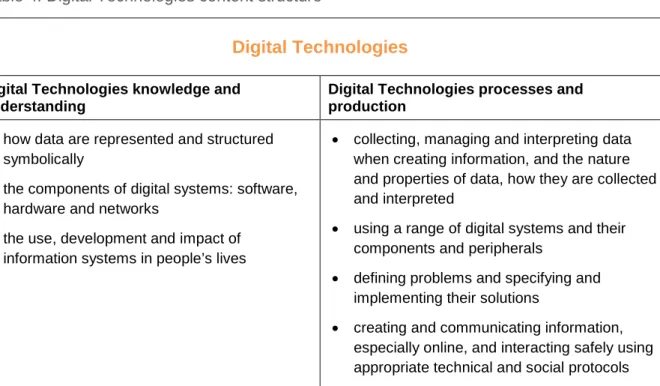
Within each strand, key concepts and processes as outlined in Table 1 provide the focus for presentation of expected knowledge, understanding and skills across F–10.
Draft Australian Curriculum: Technologies – February 2013 4 Table 1: Design and Technologies and Digital Technologies content structure
It is intended that when implementing the curriculum, teachers will select technologies-specific content from the Knowledge and understanding strand and ask students to apply the skills in the Processes and production skills strand to that content.
The common strand structure provides an opportunity to highlight similarities across the two subjects that will facilitate integrated approaches to teaching. While the content descriptions are different for each subject there are clear relationships between the two strands in each subject. For example, ‘the use, development and impact of technologies/information systems in people’s lives’.
Key ideas of the Technologies learning area
Systems thinking and the overarching idea: Creating preferred futures
The Technologies curriculum focuses on systems thinking to develop the technologies knowledge, understanding and skills to provide a method for identifying and moving towards ethical, socially responsible and sustainable patterns of living. Systems thinking is a holistic approach where parts of a system are analysed individually to see the whole, the
interactions and interrelationships between the parts and how these parts or components influence the system as a whole.
In both Design and Technologies and Digital Technologies this provides opportunities for students to engage in predicting outcomes and impacts of technological decisions for current and future generations and their environments. Students creatively and actively design solutions to meet present needs without compromising the ability of future generations to meet their needs. Both subjects acknowledge the strong connection with the Australian Curriculum: Sustainability cross-curriculum priority.
Design and Technologies
Digital Technologies
Design and Technologies knowledge andunderstanding
Digital Technologies knowledge and understanding
• the use, development and impact of technologies in people’s lives
• design concepts across a range of technologies contexts
• how data are represented and structured symbolically
• the components of digital systems: software, hardware and networks
• the use, development and impact of information systems in people’s lives
Design and Technologies processes and production skills
Digital Technologies processes and production skills
• critiquing, exploring and investigating needs or opportunities
• generating, developing and evaluating design ideas for designed solutions • planning, producing (making) and
evaluating designed solutions
• collecting, managing and interpreting data when creating information, and the nature and properties of data, how it is collected and interpreted
• using a range of digital systems and their components and peripherals
• defining problems and specifying and implementing their solutions
• creating and communicating information, especially online, and interacting safely using appropriate technical and social protocols
Draft Australian Curriculum: Technologies – February 2013 5
Project management
The Technologies curriculum ensures that students are explicitly taught how to manage projects. This includes planning; evaluating processes; considering constraints; risk assessment and management; decision-making strategies; quality control; developing resource, finance, work and time plans; and collaborating and communicating with others at different stages of the process. Every technologies project involves the use of resources and it is critical that there is planning for sustainable use of resources when managing projects. Technologies projects involve ethical, health and safety considerations. They are designed for the different needs (including consideration of personal and social beliefs and values) of consumers and clients, and for commercial realities. Students learn that when they and others engage in design thinking and technologies processes, they are responsible and accountable for their designs and solutions.
Project management is an essential element in building students’ capacity to successfully innovate in both Technologies subjects. Project work and project management occur as a part of everyday life and are critical to many fields of technologies employment.
Technologies education allows students to develop skills to manage projects from
identification of need or opportunity through conception to realisation. Project management is addressed in all years of schooling as individuals and groups of students plan how they will work to bring a design idea to fruition.
Assessing and managing risk in Technologies learning addresses the safe use of technologies and the risks that can impact on project timelines. It covers all necessary aspects of health, safety and injury prevention at any year level and in any technologies context when using potentially dangerous materials, tools and equipment. It includes
ergonomics, safety including cyber safety, data security, and ethical and legal considerations when communicating and collaborating online.
Band level descriptions
The curriculum for each Technologies subject is written in bands of year levels: • Foundation to Year 2
• Years 3 and 4 • Years 5 and 6 • Years 7 and 8 • Years 9 and 10.
Band level descriptions provide an overview of the content at each level. They also
emphasise the interrelated nature of the two strands and the expectation that planning will involve integration of content from across the strands.
Content descriptions
The Australian Curriculum: Technologies includes content descriptions at each band level. These describe the knowledge, understanding and skills that teachers are expected to teach and students are expected to learn. Content descriptions do not prescribe approaches to teaching in the Technologies subjects. The content descriptions have been written to ensure that learning is ordered appropriately and that unnecessary repetition is avoided. However, a
Draft Australian Curriculum: Technologies – February 2013 6 concept or skill introduced in one band level may be revisited, strengthened and extended in later band levels.
Content descriptions are grouped to illustrate the clarity and sequence of development of concepts through and across the band levels. They support the ability to see the connections across strands and the sequential development of concepts from Foundation to Year 10.
Content elaborations
Content elaborations are provided for Foundation to Year 10 as support material to illustrate and exemplify what is to be taught and to assist teachers in developing a shared
understanding of the content descriptions. They are not intended to be comprehensive content points that all students need to be taught nor do they encompass every aspect of a content description.
Glossary
A glossary is provided to support a common understanding of key terms used in the draft curriculum.
Draft Australian Curriculum: Technologies – February 2013 7
Achievement standards
Across Foundation to Year 10, achievement standards indicate the quality of learning that students should typically demonstrate by a particular point in their schooling.
The sequence of achievement standards in each Technologies subject describes progress in the learning area, demonstrating a broad sequence of expected learning. This sequence provides teachers with a framework of growth and development in each Technologies subject.
An achievement standard describes the quality of learning (the depth of conceptual
understanding and the sophistication of skills) that would indicate the student is well-placed to commence the learning required at the next level of achievement.
The achievement standards for Technologies reflect the distinctive practices of each subject along with aspects of learning that are common to all Technologies subjects.
Subject-specific terminology and organisation reflect the essential characteristics of learning in each subject.
The achievement standards also reflect differences in the nature and scope of the learning in each Technologies subject, as well as the relationship between the interrelated strands:
Knowledge and understanding and Processes and production skills.
Achievement standards will be accompanied by portfolios of annotated student work samples that illustrate the expected learning and help teachers to make judgments about whether students have achieved the standard.
Draft Australian Curriculum: Technologies – February 2013 8
Technologies across Foundation to Year 10
The Australian Curriculum: Technologies is based on the principle that all young Australians are entitled to engage fully in a range of technologies and to be given a balanced and substantial foundation in the knowledge and skills base of each subject.
Complementing the band level descriptions of the curriculum, this section describes the nature of learners and the curriculum across the following year-groupings:
• Foundation to Year 2: typically students from 5 to 8 years of age • Years 3 to 6: typically students from 8 to 12 years of age
• Years 7 to 10: typically students from 12 to 16 years of age.
Foundation to Year 2
Students bring to school diverse backgrounds and a range of experiences in Technologies. The Technologies curriculum builds on these as rich resources for further learning about each of the technologies subjects.
In Foundation to Year 2, the Technologies curriculum builds on the Early Years Learning Framework and its key learning outcomes: children have a strong sense of identity; children are connected with, and contribute to, their world; children have a strong sense of wellbeing; children are confident and involved learners; and children are effective communicators. In the early years play is important in how students learn; it provides a form of engagement and a sense of purpose to their activities. In Technologies, students have opportunities to learn through purposeful and directed play to develop attitudes of care in relation to the places and resources they use. Through these processes they identify relationships between imagined and virtual worlds and the real world, between people and products, and between resources and environments. They explore materials and technologies and use drawing and modelling to communicate their design ideas. Students will learn about and experience connections between technologies and the designed world. They will begin to learn the importance of preparing precise instructions when solving problems using digital systems, creating ideas and information and sharing them online with known people.
Years 3 to 6
Through the primary years, students draw on their growing experience of family, school and the wider community to develop their understanding of the world and their relationships with others. During these years of schooling, students’ thought processes become more complex and consistent, and they gradually become more independent. Students also develop their capacity to work in teams. They develop a sense of social, ethical and environmental
responsibility and are interested in and concerned about the future. Students may talk about changes in their own thinking and making, giving reasons for their actions and explaining and demonstrating their organisation and sequence of ideas. They begin to recognise, appreciate and value the different ways in which others think and respond to problems and situations, including those with a regional perspective. They respond resourcefully to a range of design and computing problems and situations using creative and innovative ideas to realise solutions. They communicate and record their ideas in diagrams and drawings using manual and digital technologies. They explain the main functions of their solutions and the materials, systems and technologies which could be used.
Draft Australian Curriculum: Technologies – February 2013 9 In these years, learning in Technologies occurs both through integrated curriculum and Technologies subject-specific approaches. Students’ motivation to play in the early years develops into an interest in learning technologies thinking, processes and production. Students in these years increasingly recognise the connections between Technologies and other learning areas.
Years 7 to 10
As students move into adolescence, they undergo a range of important physical, cognitive, emotional and social changes. Students often begin to question established community conventions, practices and values. Their interests extend well beyond their own communities and they develop their concerns about wider social, ethical and sustainability issues.
Students in this age range increasingly look for and value learning they perceive as relevant, consistent with personal goals, and leading to important outcomes. Increasingly they are able to work with more abstract concepts and are keen to examine evidence and ideas. In the Technologies learning area, students use technologies knowledge and understanding, technologies processes and production skills and design, systems and/or computational thinking to solve and produce creative solutions to problems, needs or opportunities. They communicate and record their ideas using a range of media and technologies. These specialised problem-solving activities will be sophisticated, acknowledge the complexities of contemporary life and may make connections to related specialised occupations and further study.
Increasingly, students develop a global perspective, with opportunities to understand the complex interdependencies involved in the development of technologies and between the developer and user in their technologies solutions, and how these can contribute to preferred futures. Students will develop an understanding of the interdependence of technologies development, values, beliefs and environment. Through undertaking technologies processes students develop design, computational and systems thinking; and organisational and project management skills.
Draft Australian Curriculum: Technologies – February 2013 10
Student diversity
ACARA is committed to the development of a high-quality curriculum for all Australian students that promotes excellence and equity in education.
All students are entitled to rigorous, relevant and engaging learning programs drawn from the Australian Curriculum: Technologies. Teachers take account of the range of their students’ current levels of learning, strengths, goals and interests and make adjustments where necessary. The three-dimensional design of the Australian Curriculum, comprising learning areas, general capabilities and cross-curriculum priorities, provides teachers with flexibility to cater for the diverse needs of students across Australia and to personalise their learning.
More detailed advice has been developed for schools and teachers on using the Australian Curriculum to meet diverse learning needs. It is available under Student Diversity on the Australian Curriculum website.
Students with disability
The Disability Discrimination Act 1992 and the Disability Standards for Education 2005
require education and training service providers to support the rights of students with disability to access the curriculum on the same basis as students without disability.
Many students with disability are able to achieve educational standards commensurate with their peers, as long as the necessary adjustments are made to the way in which they are taught and to the means through which they demonstrate their learning.
In some cases curriculum adjustments are necessary to provide equitable opportunities for students to access age-equivalent content in the Australian Curriculum: Technologies. Teachers can draw from content at different levels along the Foundation to Year 10 sequence. Teachers can also use the extended general capabilities learning continua in Literacy, Numeracy and Personal and social capability to adjust the focus of learning according to individual student need.
English as an additional language or dialect
Students for whom English is an additional language or dialect (EAL/D) enter Australian schools at different ages and at different stages of English language learning and have various educational backgrounds in their first languages. While many EAL/D students bring already highly developed literacy (and numeracy) skills in their own language to their learning of Standard Australian English, there are a significant number of students who are not literate in their first language, and have had little or no formal schooling.
While the aims of the Australian Curriculum: Technologies are the same for all students, EAL/D students must achieve these aims while simultaneously learning a new language and learning content and skills through that new language. These students may require
additional time and support, along with teaching that explicitly addresses their language needs. Students who have had no formal schooling will need additional time and support in order to acquire skills for effective learning in formal settings.
A national English as an Additional Language or Dialect: Teacher Resource has been
developed to support teachers in making the Australian Curriculum: Foundation to Year 10 in each learning area accessible to EAL/D students.
Draft Australian Curriculum: Technologies – February 2013 11
Gifted and talented students
Teachers can use the Australian Curriculum: Technologies flexibly to meet the individual learning needs of gifted and talented students.
Teachers can enrich student learning by providing students with opportunities to work with learning area content in more depth or breadth; emphasising specific aspects of the general capabilities learning continua (for example, the higher-order cognitive skills of the Critical and creative thinking capability); and/or focusing on cross-curriculum priorities. Teachers can also accelerate student learning by drawing on content from later band levels in the
Australian Curriculum: Technologies and/or from local state and territory teaching and learning materials.
Draft Australian Curriculum: Technologies – February 2013 12
General capabilities
In the Australian Curriculum, the general capabilities encompass the knowledge, skills, behaviours and dispositions that, together with curriculum content in each learning area and the cross-curriculum priorities, will assist students to live and work successfully in the twenty-first century.
There are seven general capabilities: • Literacy (LIT)
• Numeracy (NUM)
• Information and communication technology (ICT) capability • Critical and creative thinking (CCT)
• Personal and social capability (PSC) • Ethical understanding (EU)
• Intercultural understanding (ICU).
In the Australian Curriculum: Technologies, general capabilities are identified wherever they are developed or applied in content descriptions. They are also identified where they offer opportunities to add depth and richness to student learning through content elaborations. Initials or abbreviations of titles indicate where general capabilities have been identified in Technologies content. Teachers may find further opportunities to incorporate explicit teaching of the capabilities depending on their choice of activities. Students may also be encouraged to develop capabilities through personally relevant initiatives of their own design.
The following descriptions provide an overview of how general capabilities are addressed in the Australian Curriculum: Technologies, noting that the emphasis on each general
capability will vary from one Technologies subject to another. Detailed general capabilities materials, including learning continua, can be found on the Australian Curriculum website.
Literacy (LIT)
Students become literate as they develop the knowledge, skills and dispositions to interpret and use language confidently for learning and communicating in and out of school and for participating effectively in society. Literacy involves students in listening to, reading, viewing, speaking, writing and creating oral, print, visual and digital texts, and using and modifying language for different purposes in a range of contexts.
Students develop literacy capability as they learn how to communicate ideas, concepts and detailed proposals to a variety of audiences; recognise how language can be used to
manipulate meaning; read and interpret detailed written instructions for specific technologies, often including diagrams and procedural writings such as software user manuals, design briefs, patterns and recipes; prepare accurate, annotated engineering drawings, software instructions and coding; write project outlines, briefs, concept and project management proposals, evaluations, engineering, life cycle and project analysis reports; and prepare detailed specifications for production.
Draft Australian Curriculum: Technologies – February 2013 13 By learning the literacy of Technologies students understand that language varies according to context and they increase their ability to use language flexibly. Technologies vocabulary is often technical and includes specific terms for concepts, processes and production. Students learn to understand that much technological information is presented in the form of drawings, diagrams, flow charts, models, tables and graphs. They also appreciate the importance of listening, talking and discussing in technologies processes, especially in articulating, questioning and evaluating ideas.
Numeracy (NUM)
Students become numerate as they develop the knowledge and skills to use mathematics confidently across other learning areas at school and in their lives more broadly. Numeracy involves students in recognising and understanding the role of mathematics in the world and having the dispositions and capacities to use mathematical knowledge and skills
purposefully.
The Technologies curriculum provides opportunities for students to interpret and use
mathematical knowledge and skills in a range of real-life situations. Students use number to calculate, measure and estimate; interpret and draw conclusions from statistics; measure and record throughout the process of generating ideas; develop, refine and test concepts; and cost and sequence when making products and managing projects. In using software, materials, tools and equipment, students work with the concepts of number, geometry, scale, proportion, measurement and volume. They use three-dimensional models, create accurate technical drawings, work with digital models and use algorithmic thinking in decision-making processes when designing and creating best-fit solutions.
Information and Communication Technology (ICT) capability
Students develop ICT capability as they learn to use ICT effectively and appropriately to access, create and communicate information and ideas, solve problems and work
collaboratively, and in their lives beyond school. The capability involves students in learning to make the most of the digital technologies available to them. They adapt to new ways of doing things as technologies evolve, and limit the risks to themselves and others in a digital environment.
While much of the explicit teaching of ICT occurs in the Digital Technologies subject, key ICT concepts and skills are strengthened, complemented and extended in Design and Technologies as students engage in a range of learning activities with ICT demands. In Digital Technologies, students create solutions that consider social and environmental factors when operating digital systems with digital information. They develop and apply an understanding of the characteristics of data, digital systems, audiences, procedures and computational thinking. They apply this when they investigate, communicate and create purpose-designed information solutions. Students learn to formulate problems, logically organise and analyse data and represent it in abstract forms. They automate solutions through algorithmic logic. Students determine the best combinations of data, procedures and human and physical resources to generate efficient and effective information solutions. In Design and Technologies students learn how to operate specific software tools and digital hardware to assist them to realise their design ideas. This occurs when they investigate, research and analyse information and evaluate design ideas. They communicate and
Draft Australian Curriculum: Technologies – February 2013 14 collaborate online. Students develop innovative and creative design ideas; generate plans and diagrams to communicate their designs and produce solutions using digital
technologies, for example creating simulations, drawings and models and manufacturing solutions (from basic drawing programs to computer-aided design/manufacture and rapid prototyping).
Critical and creative thinking (CCT)
Students develop capability in critical and creative thinking as they learn to generate and evaluate knowledge, clarify concepts and ideas, seek possibilities, consider alternatives and solve problems. Critical and creative thinking are integral to activities that require students to think broadly and deeply using skills, behaviours and dispositions such as reason, logic, resourcefulness, imagination and innovation in all learning areas at school and in their lives beyond school.
Students develop capability in critical and creative thinking as they imagine, generate, develop, produce and critically evaluate ideas. They take into account sustainability and changing economic, environmental and social needs and concerns. They develop reasoning and abstract thinking capabilities through challenging problems that do not have
straightforward solutions. Students analyse problems, refine concepts and reflect upon the decision-making process by engaging in computational, design and systems thinking. They identify, explore and clarify technologies information and use that knowledge in a range of situations and challenges.
Students think critically and creatively about possible, probable and preferred futures. They consider how technologies, data, information, materials and systems (past and present) impact upon our lives, and how these elements might be better designed and managed. Experimenting, drawing, modelling, designing and working with digital tools, equipment and software assists students to build their visual and spatial thinking and to create solutions, products, services and environments.
Personal and social capability (PSC)
Students develop personal and social capability as they learn to understand themselves and others, and manage their relationships, lives, work and learning more effectively. The
capability involves students in a range of practices including recognising and regulating emotions; developing empathy for others and understanding relationships, establishing and building positive relationships; making responsible decisions; working effectively in teams, handling challenging situations constructively and developing leadership skills.
Students develop personal and social capability as they engage in project management. They direct their own learning, plan and carry out investigations, and become independent learners who can apply design thinking, technologies understanding and skills to decisions they will have to make in the future. Through collaborating with others, students develop their social and employability skills. They learn to work cooperatively in teams, make group decisions, resolve conflict and show leadership. Designing and innovation involve a degree of risk-taking and resilience, as students work with the uncertainty of sharing new ideas they develop resilience.
The Technologies learning area enhances personal and social capability by developing students’ social awareness. This includes awareness of diversity, which students gain
Draft Australian Curriculum: Technologies – February 2013 15 through researching and identifying user needs. Students consider past and present impacts of decisions on people, communities and environments. They develop social responsibility through understanding, tolerance of and empathy and respect for others and themselves.
Ethical understanding (EU)
Students develop ethical understanding as they identify and investigate the nature of concepts, values, character traits and principles, and understand how reasoning can assist ethical judgment. Ethical understanding involves students in building a strong personal and socially oriented, ethical outlook that helps them to manage context, conflict and uncertainty, and to develop an awareness of the influence that their values and behaviour have on others.
Students develop the capacity to understand and apply ethical and socially responsible principles when collaborating, creating, sharing and using technologies, materials, data, processes, tools and equipment. Using an ethical lens, they investigate past, current and future local, national, regional and global technological priorities. They evaluate their findings against the criteria of legality, environmental sustainability, economic viability, health, social and emotional responsibility and social awareness. They explore complex issues associated with technologies and consider possibilities. They are encouraged to develop informed values and attitudes.
Students learn about their own roles and responsibilities as discerning citizens, including detecting bias and inaccuracies. Understanding the protection of data, intellectual property and individual privacy in the school environment assists students to become ethical digital citizens. Students learn about safe and ethical procedures for investigating and working with data, materials, people and animals. They consider the rights of others and their
responsibilities in using sustainable practices that protect the planet and its life forms.
Intercultural understanding (ICU)
Students develop intercultural understanding as they learn to value their own cultures, languages and beliefs, and those of others. They come to understand how personal, group and national identities are shaped, and the variable and changing nature of culture. The capability involves students in learning about and engaging with diverse cultures in ways that recognise commonalities and differences, create connections with others and cultivate mutual respect.
In the Technologies learning area students consider how technologies are used in diverse communities at local, national, regional and global levels. This includes their impact and potential to transform people’s lives. Students explore ways in which past and present practices enable people to use technologies to interact with one another across cultural boundaries. Students investigate how cultural identities and traditions influence the function and form of solutions, products, services and environments designed to meet the needs of daily life.
In their interactions with others, students consider the dynamic and complex nature of cultures, including values, beliefs, practices and assumptions. They recognise and respond to the challenges of cultural diversity. Students take responsibility for securing positive outcomes for members of all cultural groups including those faced with prejudice and misunderstanding.
Draft Australian Curriculum: Technologies – February 2013 16
Cross
-curriculum priorities
There are three cross-curriculum priorities in the Australian Curriculum: • Aboriginal and Torres Strait Islander histories and cultures • Asia and Australia’s engagement with Asia
• Sustainability.
The cross-curriculum priorities are embedded in the curriculum and will have a strong but varying presence depending on their relevance to each of the learning areas.
Aboriginal and Torres Strait Islander histories and cultures
In the Australian Curriculum: Technologies the priority of Aboriginal and Torres Strait
Islander histories and cultures provides creative, engaging and diverse learning contexts for students to value and appreciate the contribution by the world’s oldest continuous living cultures to past, present and emerging technologies.
Students identify and explore the rich and diverse knowledge and understandings of
technologies employed by Aboriginal and Torres Strait Islander peoples in past, present and future applications. They understand that the technologies of the world’s first and most continuous culture often developed through intimate knowledge of Country/Place and Culture.
Students identify, explore, understand and analyse the interconnectedness between
technologies and Identity, People, Culture and Country/Place. They explore how this intrinsic link guides Aboriginal and Torres Strait Islander people in sustaining environments, histories, cultures and identities. Students apply this knowledge and understanding within Design and Technologies and Digital Technologies to create appropriate and sustainable products, services and environments to meet personal, local, national, regional and global demands. In this learning area, students explore how Aboriginal and Torres Strait Islander Peoples’ capacity for innovation is evident through the incorporation and application of a range of traditional, contemporary and emerging technologies and practices to purposefully build and/or maintain cultural, community and economic capacity. Students apply this knowledge and understanding throughout the processes of observation, critical and creative thought, action, experimentation and evaluation.
Asia and Australia’s engagement with Asia
In the Australian Curriculum: Technologies the priority of Asia and Australia’s engagement with Asia provides diverse and authentic contexts to develop knowledge and understanding of technologies processes and production and related cultural, social and ethical issues. It enables students to recognise that interaction between human activity and the diverse environments of the Asia region continues to create the need for creative solutions and collaboration with others, including Australians, and has significance for the rest of the world. The Australian Curriculum: Technologies provides opportunities for students to explore traditional, contemporary and emerging technological achievements in the countries of the Asia region. Students apply this knowledge and understanding to create appropriate and sustainable products that reflect intercultural, creative and critical thinking to meet identified needs. In this learning area, students appreciate the diversity of the Asia region. They
Draft Australian Curriculum: Technologies – February 2013 17 examine contributions that the people of the Asia region have made and continue to make to global technological advances. They consider the contributions that Australia has made and is making to the Asia region. Students explore Australia’s rich and ongoing engagement with the peoples and countries of Asia to create appropriate products and services to meet personal, community, national, regional and global needs.
Sustainability
In the Australian Curriculum: Technologies the priority of sustainability provides authentic contexts for creating preferred futures. When identifying and critiquing a need or opportunity, generating ideas and concepts, and producing solutions, students give prime consideration to sustainability by anticipating and balancing economic, environmental and social impacts. The Australian Curriculum: Technologies prepares students to take action to create more sustainable patterns of living. The curriculum focuses on the knowledge, understanding and skills necessary to design for effective sustainability action. It reflects on human need and equity of access to limited resources. The curriculum recognises that actions are both individual and collective endeavours shared across local and global communities. The curriculum provides a basis for students to explore their own and competing viewpoints, values and interests. Students work with complexity, uncertainty and risk; make connections between disparate ideas and concepts; self-critique; and propose creative and sustainable solutions.
In this learning area, students focus on the knowledge, understanding and skills necessary to choose technologies and systems with regard to costs and benefits. They evaluate the extent to which the process and designed solutions embrace sustainability. Students reflect on past and current practices, and assess new and emerging technologies from a
Draft Australian Curriculum: Technologies – February 2013 18
Links to the other learning areas
Learning in Technologies involves the use of knowledge, understanding and skills learned in other learning areas, particularly in English, Mathematics, Science, Geography, The Arts and Health and Physical Education.
English
In schools across Australia there is strong support for linking learning in Technologies with learning literacy skills. Learning in Technologies places a high priority on accurate and unambiguous communication. The Australian Curriculum: Technologies is supported by and in turn reinforces the learning of literacy skills. Students need to describe objects and events; interpret descriptions; read and give instructions; generate and explore ideas with others; write design briefs and specifications, marketing texts, evaluation and variation reports; and participate in group discussions.
Mathematics
The Technologies curriculum provides contexts within which Mathematics knowledge, understanding and skills may be applied and developed. In Technologies, students process data using simple tables, lists, picture graphs, simple column graphs and line graphs. In Mathematics, students' data analysis skills will develop to include scatter plots, linear graphs and the gradient of graphs. This will enhance their ability to analyse patterns and trends in data as part of technologies investigations.
Students develop their use of metric units in both the Mathematics and Technologies curriculums. The ability to convert between common metric units of length and mass and their use of decimal notation in Mathematics will enable them to represent and compare data in meaningful ways in Technologies. Technologies provide tools for automating
mathematical processes which reinforce Mathematics concepts. In Mathematics, students learn statistical methods that may be applied to the quantitative analysis of data required in Technologies. Students apply knowledge of geometry, shapes and angles in Technologies. When considering systems at a vast range of scales in Technologies, students use their mathematical knowledge of timescales and intervals. Students’ mathematical ability to solve problems involving linear equations can be used in Technologies when investigating
quantitative relationships and designing algorithms. The development of computational thinking skills in Digital Technologies will complement the problem-solving and reasoning proficiency strands in Mathematics.
Science
The Technologies curriculum closely complements the Science curriculum. Design and Technologies draws upon concepts from biological, chemical and physical sciences to solve problems and design solutions to meet human needs and opportunities. Links with the Science curriculum allow for applications of scientific concepts through designing real-world solutions that are meaningful to students. An example would be applying scientific concepts when designing in an engineering context. Students apply knowledge of material properties and characteristics and do appropriate scientific tests of materials, processes and
Draft Australian Curriculum: Technologies – February 2013 19 engagement with authentic projects. It allows for critiquing, applying prior knowledge and evaluating outcomes.
The Digital Technologies curriculum provides many techniques and technologies for automating the collection, storage and analysis of authentic scientific data in the Science curriculum. Digital technologies such as data loggers, spreadsheets, databases, simulations and imaging technologies are central to modern science. They are used to collect and organise scientific measurements and to derive information by filtering, analysing and visualising large volumes of numerical, categorical and structured data. Digital Technologies provides students with the skills to represent data in ways that enable computational
analysis. Scientists use digital technologies to develop software for simulating and modelling natural systems and phenomena. Digital technologies give students the skills to implement simple simulations and gain a deeper understanding of Science concepts and models by interacting with simulations.
History
History provides another avenue to understand how technologies develop and how their developments are a source of historical facts and artefacts. In the Knowledge and understanding strands students will develop increasingly sophisticated knowledge and understanding, drawn from contemporary and historical sources. It is important that students learn that technologies have developed through the gradual accumulation of knowledge over many centuries; that all sorts of people – including people like themselves – use and
contribute to the development of technologies. Historical studies of technologies in a range of societies including the peoples and countries of Asia and Aboriginal and Torres Strait Islander cultures extending to modern times will help students understand the contributions of people from around the world.
Geography
The Geography curriculum provides a range of opportunities for students to consolidate their Technologies knowledge, understanding and skills. From the early years students sort information, find patterns and interact with digital systems as they develop spatial
understandings, particularly as they create, interpret and use maps. They use directional language; understand scale and distance; and record data related to weather. They create products and systems that measure and further develop their understanding of the
influences of climate and weather conditions. They use digital tools to collect and sort information and data and there is a significant emphasis on digital and spatial technologies. Students strengthen their Technologies understanding and skills as they study the
environmental characteristics of places, processes and human significance. During their investigations they collect and convert data into useful forms using spreadsheets, graphs and distribution maps. Students consolidate their understandings of sustainability as they investigate human significance of the biophysical environment and design and manage projects that enhance their understanding of the fine balance between the environment and human endeavour.
Through Design and Technologies, concepts and learning that are addressed in Geography are contextualised through the design and production of products, services and
environments through specific targeted projects that relate to sustainability, the environment and society. They critique, design and produce solutions for managed and constructed
Draft Australian Curriculum: Technologies – February 2013 20 environments. Learning is further enhanced through authentic activities that focus on
enterprising and innovative solutions to perceived needs.
The Arts
The Technologies curriculum complements The Arts curriculum, particularly in the
application of the elements and principles of design in Visual Arts and in the use of digital technologies in Media Arts. Through the Technologies curriculum aspects of aesthetics such as line, shape, form, colour, texture, proportion and balance are incorporated into the design processes in Technologies learning activities. This occurs when students design products and environments. Knowledge of materials, tools and equipment and the ways they can be used to create designed solutions provides links between Technologies and two and three-dimensional design in Visual Arts. Skills developed in Visual Arts such as representing and exploring creative ideas through sketching and drawing complement processes used in Design and Technologies to generate ideas to create solutions.
Students learn about multimedia across the Australian Curriculum. In Digital Technologies the focus is on the technical aspects of multimedia, and privacy and intellectual property concerns. In Media Arts students use digital technologies to tell stories, represent and communicate ideas and explore concepts. Making in Media Arts involves designing, planning, producing, capturing and recording, choosing, combining and editing, and representing and distributing.
Health and Physical Education
The Australian Curriculum: Technologies will take account of what students will learn in Health and Physical Education. Students will explore how systems work together to produce energy and movement and be able to apply this in technologies contexts. They will develop and practise technical skills which will assist students in developing manipulative skills in Technologies and apply learning particularly in relation to nutrition.
Food and nutrition in the Australian Curriculum
In the Australian Curriculum students may be taught about food and nutrition in both Health and Physical Education and in the Technologies learning area through Design and
Technologies. The focus in the Health and Physical Education curriculum is on
understanding healthy choices in relation to nutrition, understanding the range of influences on these choices, and developing and applying the knowledge, understanding and skills to make healthier choices in relation to food and nutrition. In Technologies students will learn how to apply nutrition knowledge through the preparation of food. Beyond Year 8 students may choose to study a food-related subject offered by states and territories.
Draft Australian Curriculum: Technologies – February 2013 21
Implications for implementation
In the Australian Curriculum: Technologies the two strands, Knowledge and understanding
and Processes and production skills, are interrelated and inform and support each other. When developing teaching and learning programs, teachers combine aspects of the strands in different ways to provide students with learning experiences that meet their needs and interests. There are opportunities for integration of learning between Technologies subjects and with other learning areas.
Engaging learning programs will provide opportunities for students to:
• develop skills and dispositions such as curiosity, imagination, creativity and evaluation
• engage all aspects of perception: sensory, emotional, cognitive, physical and spiritual
• work individually and collaboratively.
Although the individual Technologies subjects of Design and Technologies and Digital Technologies form the basis of the Australian Curriculum: Technologies, students explore how Aboriginal and Torres Strait Islander peoples’ capacity for innovation is evident through the critical processes of observation, action, experimentation and evaluation. These
processes reflect traditional, contemporary and emerging technologies which produce a range of products, services and environments. This learning involves exploration of
traditional, contemporary and emerging technologies from different societies, including from Aboriginal and Torres Strait Islander cultures. Such technologies might:
• include the incorporation of a range of introduced technologies within existing practices to purposefully build or maintain social, community and economic capacity
• involve other learning areas • exist in physical or virtual spaces
• be created individually or collaboratively.
While content descriptions do not repeat key skills across the band levels, it should be noted that many aspects of Technologies curriculum are recursive, and teachers need to provide ample opportunity for revision, ongoing practice and consolidation of previously introduced knowledge and skills.
Students learn at different rates and in different stages. Depending on each student’s rate of learning or the prior experience they bring to the classroom, not all of the content
descriptions for a particular band level may be relevant to a student in those year levels. Some students may have already learned a concept or skill, in which case it will not have to be explicitly taught to them in the band level stipulated. Other students may need to be taught concepts or skills stipulated for earlier band levels. The content descriptions in the Australian Curriculum: Technologies enable teachers to develop a variety of learning experiences that are relevant, rigorous and meaningful and allow for different rates of
development, in particular for younger students and for those who require additional support. Some students will require additional support to develop their skills in specific Technologies subjects.
Draft Australian Curriculum: Technologies – February 2013 22 In the Australian Curriculum: Technologies it is expected that appropriate adjustments will be made for some students to enable them to access and participate in meaningful learning, and demonstrate their knowledge, understanding and skills across the Technologies subjects. To provide the required flexibility teachers need to consider the abilities of each student and adopt options for curriculum implementation that allow all students to participate. This might involve students using modified tools, materials or equipment to create solutions. Teachers use the Australian Curriculum content and achievement standards first to identify current levels of learning and achievement and then to select the most appropriate content (possibly from across several year levels) to teach individual students and/or groups of students. This takes into account that in each class there may be students with a range of prior achievement (below, at or above the year level expectations) and that teachers plan to build on current learning. Organisation of the curriculum in band levels provides an additional level of flexibility that supports teachers to plan and implement learning programs that are appropriate for all students and make best possible use of available resources.
Teachers also use the achievement standards at the end of a period of teaching to make on balance judgments about the quality of learning demonstrated by the students – that is, whether they have achieved below, at or above the standard. To make these judgments, teachers draw on assessment data that they have collected as evidence during the teaching period. These judgments about the quality of learning are one source of feedback to
students and their parents and inform formal reporting processes.
If a teacher judges that a student’s achievement is below the expected standard, this suggests that the teaching programs and practice should be reviewed to better assist individual students in their learning in the future. It also suggests that additional support and targeted teaching will be needed to ensure that students are appropriately prepared for future studies in specific Technologies subjects.
Assessment of the Australian Curriculum: Technologies takes place at different levels and for different purposes, including:
• ongoing formative assessment within classrooms for the purposes of monitoring • learning and providing feedback to teachers to inform their teaching, and for
students to inform their learning
• summative assessment for the purposes of twice-yearly reporting by schools to parents and carers on the progress and achievement of students.
Draft Australian Curriculum: Technologies – February 2013 23
DRAFT CURRICULUM – DESIGN AND TECHNOLOGIES
Rationale
Learning in Design and Technologies involves the creative processes through which products, services and environments are designed and developed. Students learn that the design, development and use of technologies are influenced by and can play a role in enriching and transforming societies and our natural, managed, constructed and digital environments.
The Australian Curriculum: Design and Technologies actively engages students in producing quality designed solutions to identified problems or opportunities across a range of
technologies contexts. In doing so, students consider social, economic, environmental, ethical, legal, aesthetic and functional factors. Through Design and Technologies students manage projects independently and collaboratively from conception to realisation. They develop a sense of pride, satisfaction and enjoyment from their ability to develop innovative designed solutions. They have the opportunity to contribute to the development of futures that provide sustainable patterns of living.
Design and Technologies develops students' knowledge and confidence to analyse critically and respond creatively to the challenges of a highly technological and complex future. They learn to design, produce and evaluate innovative technological designed solutions. Through the practical application of technologies, students develop manual dexterity and coordination through hands-on activities. The subject engages and motivates young people and provides them with learning experiences to develop skills that are transferable to family and home, constructive leisure activities, community contribution and the world of work.
Draft Australian Curriculum: Technologies – February 2013 24
Aims
In addition to the overarching aims for the Australian Curriculum: Technologies, Design and Technologies more specifically aims to develop the knowledge, understanding and skills to ensure that, individually and collaboratively, students:
• document design ideas and communicate these to a range of audiences • select and manipulate a range of materials, components, tools and equipment
creatively, competently and safely in the development of designed solutions suitable for a range of technologies contexts
• explore, investigate, create and critique innovative, ethical and sustainable designed solutions for preferred futures using a range of technologies
• develop confidence as critical users and designers and producers of technologies and designed solutions
• understand the roles and responsibilities of designers, technologists and those in related occupations.
Draft Australian Curriculum: Technologies – February 2013 25
Organisation
Content structure
The Australian Curriculum: Design and Technologies comprises two related strands: • Design and Technologies knowledge and understanding – the use, development
and impact of technologies and design ideas across a range of technologies contexts
• Design and Technologies processes and production skills – the skills required to design, produce and evaluate designed solutions.
Within each strand, key concepts and processes as outlined in Table 2 provide the focus for content and present a sequence of development of knowledge, understanding and skills across the bands.
Table 2: Design and Technologies content structure
Relationship between the strands
Together, the two strands provide students with knowledge, understanding and skills through which they can safely and ethically design, plan, manage, produce and evaluate products, services and environments taking into account the needs of individuals, society, the economy and the environment. Students take action and make ethical decisions about technologies, considering social, economic, environmental, ethical, legal, aesthetic and functional factors. Teaching and learning programs should balance and integrate both strands. Students learn about technologies and society as well as different technologies contexts (knowledge and understanding). They design, produce and evaluate designed solutions using technologies processes and production involving their hands, tools,
equipment and digital technologies, using natural and fabricated materials (processes and production skills).
Design and Technologies knowledge and understanding
The Design and Technologies knowledge and understanding strand focuses on investigating and developing the underpinning knowledge and understanding of technologies, materials, systems, tools and equipment across a number of technologies contexts, some of which are
Design and Technologies
Design and Technologies knowledge andunderstanding
Design and Technologies processes and production skills
• the use, development and impact of technologies in people’s lives
• design concepts across a range of technologies contexts
• critiquing, exploring and investigating needs or opportunities
• generating, developing and evaluating design ideas for designed solutions
• planning, producing (making) and evaluating designed solutions
Draft Australian Curriculum: Technologies – February 2013 26 prescribed. It also includes understanding of the relationship between technologies and society.
Technologies and society
The Technologies and society content descriptions focus on how people use and develop technologies taking into account social, economic, environmental, ethical, legal, aesthetic and functional factors and the impact of technologies on individuals, families, local, regional and global communities, the economy and the environment.
Technologies contexts
The Technologies contexts content descriptions provide a framework within which students can gain knowledge and understanding about design concepts across a range of
technologies contexts. These content descriptions focus on the properties and
characteristics of technologies, materials, components, tools and equipment and how they can be used to create innovative designed solutions.
These technologies contexts provide a progression of learning from Foundation to Year 8 and lead to more specialised Technologies subjects in Years 9 and 10. They also reflect current national priorities including food security and sustainable food and fibre production, workforce demand, and health and wellbeing priorities.
The technologies contexts for Foundation to Year 8 are:
• Materials and technologies specialisations. For example:
- materials, including composites, metal, plastics, wood, smart materials, textiles
- an area of specialisation (for example, architecture, electronics, graphics technologies, fashion) (See content descriptions 2.2, 4.2, 6.2, 8.3 and 10.3) • Food and fibre production (includes Food technologies from F–4)
(See content descriptions 2.3, 4.3, 6.3 and 8.4) • Engineering principles and systems
(See content descriptions 2.4, 4.4, 6.4 and 8.5)
• Food technologies (combines with Food and fibre production from F–4) (See content descriptions 2.2, 4.2, 6.5 and 8.6).
Across each band from Foundation to Year 8, students will study each of these contexts and design, produce and evaluate at least three types of designed solutions (product, service or environment). The combination of contexts and types of designed solutions is a school decision. Table 3 outlines the requirements for contexts and designed solutions. Table 3: Technologies contexts and designed solutions
Technologies contexts
(each context studied within a band) produced as
Designed solutions (product, service or environment)
(each type of solution created within a band)
Draft Australian Curriculum: Technologies – February 2013 27
Design and Technologies processes and production skills
The Design and Technologies processes and production skills are based on the major aspects of design thinking and design and technologies processes.
The Design and Technologies processes and production skills strand focuses on: • Critiquing, exploring and investigating
• Generating, developing and evaluating ideas
• Planning, producing and evaluating designed solutions.
In each band of the curriculum, one content description focuses on each of these processes. The processes are described below and further detailed in the bands. Students will spend a substantial amount of time engaged in developing processes and production skills.
Critiquing, exploring and investigating
Critiquing, exploring and investigating involve students as creators and consumers critically reflecting on the intention and purpose and operation of technologies and designed
solutions. Critiquing encourages students to examine values, analyse, question and review processes and systems and reflect on how decisions they make may have implications for the individual, society and the local and global environment. Students explore and
investigate technologies, products, systems, services and environments as they consider the needs of society. They progressively develop effective investigation strategies and consider the contribution of technologies to their lives and make judgments about them.
Generating, developing and evaluating ideas
Generating and developing ideas involves students in embracing change, making choices, weighing up options, considering alternatives and documenting various design ideas and possibilities. Students use critical and creative thinking strategies to generate, evaluate and document ideas to meet needs or opportunities that have been identified by an individual, group or wider community. Generating creative and innovative ideas involves thinking differently; it entails proposing new approaches to existing problems and identifying new design opportunities. Generating and developing ideas involves identifying various competing factors that may influence and dictate the focus of the idea. Students will evaluate, justify and synthesise what they learn and discover. They will use graphic
representation skills when they draw, sketch, model and create innovative ideas that focus on high-quality designed solutions.
Planning, producing and evaluating designed solutions
Planning, producing and evaluating designed solutions involve students in making a sequence of general, intentional and operational decisions based on initial exploration and investigation of information. Students increasingly engage in an extensive range of planning and managing approaches, including strategic, program and operational planning. When planning and managing projects, students focus on the project’s scope, aims and objectives, its development, the roles and responsibilities of those involved, and the time and cost estimates for completion.
Producing (making) involves developing products, services or environments designed to meet specific purposes and users. Students learn a variety of skills and techniques. They apply knowledge about components, materials and their properties and characteristics to
Draft Australian Curriculum: Technologies – February 2013 28 ensure their suitability for use. They learn about the benefits of adopting safe work practices. They develop accurate production skills to achieve quality designed solutions. Students develop the capacity to select and use appropriate materials, components, tools and equipment; and use sustainable work practices. The use of modelling and prototyping to accurately develop simple and complex physical models supports the production of successful designed solutions.
Students evaluate and make judgments about the quality and effectiveness of their designed solutions and those of others throughout a design process. They consider the implications and consequences of actions and decision-making. They determine effective ways to test and judge the appropriateness of their designed solutions.