An efficacy trial of an electronic health record-based strategy to
inform patients on safe medication use: The role of written and
spoken communication
Laura M. Curtisa,*, Rebecca J. Mullena, Allison Russella, Aimee Fataa, Stacy C. Baileyb, Gregory Makoulc, and Michael S. Wolfa
aHealth Literacy and Learning Program, Division of General Internal Medicine and Geriatrics,
Northwestern University, Chicago, USA
bDivision of Pharmaceutical Outcomes and Policy, University of North Carolina, Chapel Hill, USA
cPatientWisdom, New Haven, USA and Connecticut Institute for Primary Care Innovation,
Hartford, USA
Abstract
Objective—We tested the feasibility and efficacy of an electronic health record (EHR) strategy that automated the delivery of print medication information at the time of prescribing.
Methods—Patients (N = 141) receiving a new prescription at one internal medicine clinic were recruited into a 2-arm physician-randomized study. We leveraged an EHR platform to
automatically deliver 1-page educational ‘MedSheets’ to patients after medical encounters. We also assessed if physicians counseled patients via patient self-report immediately following visits. Patients’ understanding was objectively measured via phone interview.
Results—122 patients completed the trial. Most intervention patients (70%) reported receiving MedSheets. Patients reported physicians frequently counseled on indication and directions for use, but less often for risks. In multivariable analysis, written information (OR 2.78, 95% CI 1.10– 7.04) and physician counseling (OR 2.95, 95% CI 1.26–6.91) were independently associated with patient understanding of risk information. Receiving both was most beneficial; 87% of those receiving counseling and MedSheets correctly recalled medication risks compared to 40% receiving neither.
Conclusion—An EHR can be a reliable means to deliver tangible, print medication education to patients, but cannot replace the salience of physician-patient communication.
Practice implications—Offering both written and spoken modalities produced a synergistic effect for informing patients.
Keywords
Prescription medications; Patient education; Physician counseling
HHS Public Access
Author manuscript
Patient Educ Couns
. Author manuscript; available in PMC 2017 September 01.Published in final edited form as:
Patient Educ Couns. 2016 September ; 99(9): 1489–1495. doi:10.1016/j.pec.2016.07.004.
A
uthor Man
uscr
ipt
A
uthor Man
uscr
ipt
A
uthor Man
uscr
ipt
A
uthor Man
uscr
1. Introduction
In 2012, 2.3 billion prescriptions were ordered in ambulatory care and 67.2% of visits involved drug therapy [1]. Approximately 1.5 million preventable adverse drug events occur each year, with more than one-third taking place in outpatient settings at a cost approaching $1 billion per year [2]. Recent studies have repeatedly highlighted the alarming prevalence of patient misunderstanding and misuse of prescription medications [2-6]. Patients often lack sufficient information pertaining to medication indications, dosing instructions, side effects, and important risks and warnings. Limited understanding of these aspects of prescription medications can lead to improper use, underreporting of adverse drug events (ADEs) and non-adherence, ultimately resulting in poor health outcomes [2,3,7,8]. This is a concern for both healthcare quality and patient safety, as these individuals may not optimize the benefits of drug therapy, and/or have a higher risk of adverse drug events.
1.1. Insufficient counseling could be a potential reason for patients being inadequately informed about prescribed medicines
Prior studies indicate patient-provider spoken communication about medications is inadequate; both physicians and pharmacists frequently fail to discuss the safe use of prescribed medications with patients [9-14]. When counseling does occur, providers may overestimate the clarity of instructions they give to patients [15]. Some physicians are admittedly reluctant to discuss side effects, as they may be worried this will result in non-adherence, or they may assume pharmacists will convey this information [16,17]. However, patients indicate they would like to know about the associated side effects of their new medications and are frequently not provided with this information from their physician [18]. Low quality or non-existent communication about medications from prescribers has been linked to patient misunderstanding, lack of awareness of risks, and/or non-adherence [19-22]. Ineffective verbal communication by both prescribers and pharmacists can also influence whether a prescription will be initiated or remain unfilled or unused [23-25].
In addition to suboptimal counseling, evidence also suggests that the tangible, written materials distributed to patients at the pharmacy are neither understandable nor actionable [26-30]. Whether it be a perceived lack of importance or their complex nature, these medication educational materials more often are neglected by patients, further contributing to the problems of misunderstanding and medication errors.
Subsequently, we developed an electronic health record (EHR) strategy to ensure patients would receive understandable, actionable information at the point of prescribing to support safe medication use. Our objective was to test the feasibility of this strategy, examine naturally occurring provider communication, and test the impact of each on the understanding and proper use of newly prescribed prescription medications.
2. Methods
2.1. Participants and procedure
Study participants were recruited between September 2009 and February 2012 from the Northwestern Medical Faculty Foundation (NMFF) general internal medicine (GIM) clinic
A
uthor Man
uscr
ipt
A
uthor Man
uscr
ipt
A
uthor Man
uscr
ipt
A
uthor Man
uscr
in Chicago, IL. Participants were deemed eligible if they were 1) English-speaking, 2) without cognitive, vision, or hearing impairment, 3) without any significant, acute health condition, 4) between the ages of 18–80, and 5) received one or more new or changed prescriptions for the 50 study medications on the day of recruitment. Patients with
prescription refills only were not eligible. Clerical and medical staff were made aware of the project, flyers were distributed in patient folders and at checkout, and trained study research assistants (RAs) were in the clinic during high volume periods to invite participants deemed eligible for the study. Immediately after a scheduled patient visit, patients were approached at checkout by an RA to assess interest, confirm eligibility, and obtain consent. Once consented to the study, patients completed a brief baseline battery including an assessment of provider communication. Upon completion of the in-person interview, participants were given $10 in cash. An RA then administered a follow-up phone call two weeks later to determine if medications were filled, and if so, to assess patient understanding on proper use of the new medication(s). The Northwestern University Institutional Review Board approved the study.
2.2. Intervention
2.2.1. Creation of ‘MedSheets’—We consulted the literature, patients, and clinicians (physicians, nurses, and pharmacists) to gain perspective on a prototype for providing clear, understandable, and actionable information to patients receiving a new medication. Topics were logically sequenced from a patient’s perspective: drug name, purpose, benefit, length of treatment, instructions, safe use, important side effects and warnings, when to call your doctor, discussion points, relevant follow-up instructions, and where to get more
information. The prototype was vetted and approved by the study team, including clinicians, health literacy and health communication experts, and two patient representatives. The top 500 prescribed medicines for NMFF GIM were reviewed, and ‘MedSheets’ were developed for 305 medications covering the previously approved topics. Further revisions to specific content and wording were conducted by the team. An outside panel of 3 pharmacists and 1 physician did an ultimate review to confirm accuracy. Lexile analyses were performed on all final MedSheets, confirming that each met a <8th grade readability standard. Two sample MedSheets are shown in Fig. 1.
2.2.2. Delivery of ‘MedSheets’—Code was written within Epic’s EHR platform (Epic Systems Corporation; Verona, Wisconsin) to link pdf versions of the MedSheets to new or changed medication orders. The intervention was designed to print one of 50 MedSheets when the particular medication was ordered. Due to limited programming resources, only the 50 most frequently prescribed medications in NMFF’s GIM clinic were included. The intervention was beta tested for two weeks prior to enrolling participants to monitor the reliability and delivery. Minor modifications were made at the clinic’s request for the MedSheets to print at the check-out desk rather than at nurse’s stations. This was done as to not disrupt clinicians’ workflow and to increase the likelihood the patients would actually receive the MedSheets with their after visit summaries.
A
uthor Man
uscr
ipt
A
uthor Man
uscr
ipt
A
uthor Man
uscr
ipt
A
uthor Man
uscr
2.3. Randomization
A simple 1:1 randomization scheme was not possible, as the EHR function to generate the ‘MedSheets’ could not be applied at the individual patient level. Rather, Epic did allow us to turn the intervention components on or off by prescriber. Therefore, attending physicians were randomized to either the intervention or usual care arm by first stratifying them by clinical effort (full time, half time), then randomly assigning physicians within each stratification to study arm. Residents were not able to be randomized due to frequent turnover and they were not directly linked with their assigned attending within the EHR, so eligible patients who were prescribed medications by a resident were all assigned to the control group.
2.4. Measures
2.4.1. Patient characteristics—Interview questions included self-report of
sociodemographic information (age, gender, race/ethnicity, education, income, work status, marital status) and total number of chronic conditions including diabetes, chronic obstructive pulmonary disease, coronary vascular disease, coronary heart failure, asthma, hypertension, hypercholesterolemia, stroke, arthritis, cancer, depression (0–11). Participants were asked how many prescription and over-the-counter medications they were currently taking. Patient literacy was also assessed using the Rapid Estimate of Adult Literacy in Medicine
(REALM), a word-recognition test where patients are asked to read aloud as many words as they can from a list of 66 health related terms [31]. Scores are based on the total number of words pronounced correctly and interpreted as low (0–44), marginal (45–60), or adequate (61–66) literacy.
2.4.2. Medication characteristics—Medications were categorized based on typical prescribing patterns. Medications typically prescribed chronically for regularly scheduled use (e.g., cardiovascular, antidiabetic, and antidepressant medications) were labeled as ‘chronic.’ Those which may be typically used for a time limited period (e.g. anti-infective agents, corticosteroids), or used as needed for symptoms (e.g., analgesics), were classified as non-chronic.
2.4.3. Provider communication—At the baseline interview, participants were asked whether their doctor talked to them (yes/no) about the indication, benefits, possible side effects, risks and warnings, how long they should take the medication, and exactly how to take the medication for each new medication prescribed. Specific questions are listed in Fig. 2.
2.4.4. Prescription understanding and proper use—At follow-up, patients were asked if they filled their medication and if so, questions were asked to assess understanding and proper use of their new prescriptions. Questions parallel to the provider communication items were asked per new medication. This included patients being asked what the medicine was for, to name any risks and benefits of the drug, how long they should take the drug, and to describe how they take the medicine, similar to prior. Participants were allowed to refer to their MedSheets during this assessment. Specific questions that were asked are listed in Fig. 2. Answers to each question were coded (correct or incorrect) by four RAs based on
A
uthor Man
uscr
ipt
A
uthor Man
uscr
ipt
A
uthor Man
uscr
ipt
A
uthor Man
uscr
previously defined criteria, and discrepancies were reconciled by a Pharm D. In reviewing participant responses to questions asking them to name any possible side effects, risks, or warnings, it was clear many were unable to distinguish the difference. Therefore, this component was coded correct if the participant was able to name at least one side effect, risk, or warning. Participants were asked to indicate the correct number of pills they take at a time, the correct number of times a day they take the medicine, and the total number of pills they take each day. Each was coded as correct/incorrect according to their bottle’s
instructions and considered to have demonstrated proper use of their medications if all three were correct. This has served as a common outcome in previous studies [6,32-36]. The instructions prescribed for each new medication were obtained from the patients’ medical records, but also confirmed with patients on the phone call to ensure similar instructions were printed on the bottle.
2.4.5. Patient receipt and preferences of intervention—At follow-up, patients in the intervention arm were asked if they received any written information about their new medication with their after-visit summary. Those who reported receiving the sheets, were asked if they looked at them since receiving and whether they looked at any other sources of information about their medications. Those who reported looking at the MedSheets were asked if they contained too much information, too little, or about the right amount. They were also asked to rate the information on the sheets on a scale from 1 to 10 with 1 being not at all clear and 10 being very clear. Helpfulness was similarly assessed.
2.5. Analysis
Patient characteristics including age, sex, race/ethnicity, education, income, literacy level, number of comorbid conditions, and total number of prescription and OTC medications taken were summarized. These characteristics along with whether their physician counseled them on either of their new prescriptions (yes or no) were compared by study arm using t-tests and Pearson Chi-Square t-tests, as appropriate, to ensure adequate balance in the two arms.
Generalized linear models with a binomial distribution and logit link function were used to model patient understanding and proper use of newly prescribed medications (correct, incorrect). A generalized estimating equation (GEE) approach was used with medication as the unit of analyses, adjusting model coefficients and standard errors for within-patient correlation. Separate models were run for each aspect of understanding and proper use: indication, benefits, risks and warnings, duration of use, and specifically how they take their medication over the course of a day. Unadjusted GEE models were first run to examine associations between potential patient and medication level covariates described above and patient understanding. For each multivariable model, the primary independent variables of interest were arm (usual care, intervention) and whether physician counseling occurred for each particular outcome (yes, no). Other covariates included any variables found to differ by arm or patient understanding in preliminary analyses (p <0.05). Then, to examine the isolated and combined effects of the written materials (MedSheets) and physician counseling on each outcome, adjusted probabilities were examined in each of the following groups: intervention only, counseling only, both, or neither. This study was analyzed as
intent-to-A
uthor Man
uscr
ipt
A
uthor Man
uscr
ipt
A
uthor Man
uscr
ipt
A
uthor Man
uscr
treat despite some of the patients not receiving the intervention. Statistical analyses were performed using STATA 13.1 (College Station, TX).
3. Results
3.1. Study population
Of the 1097 patients RAs approached, 68 declined and 865 were ineligible, leaving 164 consented patients. The majority of ineligible patients did not receive a new prescription, received a refill, or received a new medication other than one of the 50 study medications. There were 141 completed baseline interviews and 127 (90%) of those patients also completed the follow-up phone call. Patients were prescribed 137 new medications and the majority (97%) were filled. The 122 patients that filled at least one medication were included in this analysis.
3.2. Participant characteristics
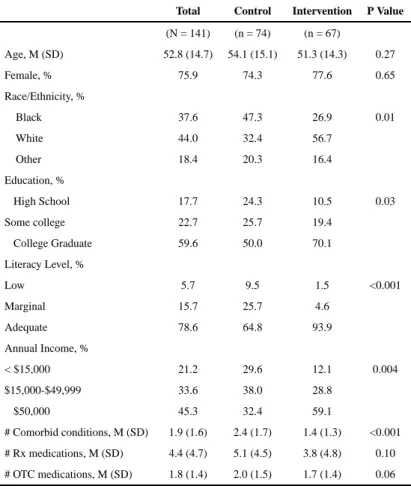
Patients had a mean (SD) age of 53 (15) years, were 76% female, 38% African American, 44% White, highly educated with over half having a college education, and had an average of 2 chronic conditions. Despite randomization, intervention participants were more likely to be White, have a college degree, higher literacy levels and income, and fewer chronic conditions (see Table 1). Physician counseling did not differ by any of these characteristics.
3.3. Fidelity of the intervention
Intervention participants reported receiving information for their medicines with their after-visit summary 70% of the time. Clinic staff indicated some MedSheets were not received due to printer malfunctioning, unrelated to the programming of the intervention. Of those who reported receiving the sheets (n = 44), 75% reviewed them at some point since their visit. Fourteen (32%) reported looking at other information about their medications including information from the pharmacy (8/14), online (5/14), and television (1/14). Of those who reported looking at the sheets (n = 33), 91% found the amount of information to be about adequate (3% too much, 6% too little). The majority (79%) rated the MedSheets as a 9 or 10 on a scale from 0 to 10 for being clear, and 73% rated them a 9 or 10 for being helpful.
3.4. Provider communication
Overall, patient-reported communication by providers about new prescriptions about indication, benefits, and directions for use was very high (98%, 90%, and 82%, respectively) and counseling about duration of use was moderate (68%). However, only 47% of patients reported that the providers counseled on the side effects, risks or warnings of newly prescribed medications. Counseling on duration of use was less likely to occur for chronic medications (57%, p = 0.01) compared to non-chronic medications (78%).
3.5. Patient understanding and proper use
Patient understanding of indication and benefits were also high (87% and 84%,
respectively). The majority of patients were able to identify at least 1 side effect, risk, or
A
uthor Man
uscr
ipt
A
uthor Man
uscr
ipt
A
uthor Man
uscr
ipt
A
uthor Man
uscr
warning (79%) with those in the intervention being more likely to do so than those in the usual care group (87% vs 71%, p = 0.03). Patients in the intervention group were also more likely to know the duration of their new prescription than those in usual care. There were no differences by arm in any of the other components (see Table 2).
Multivariable models adjusting for age, race, income, literacy level, total number of chronic conditions, and medication type (chronic, non-chronic) are shown in Table 3. Doctors discussing duration of use was associated with better understanding of this component (OR 8.04, 95% CI 2.35–27.48, p = 0.001). Both being assigned to the intervention arm (OR 2.78, 95% CI 1.10–7.04, p = 0.03) and receiving communication from their doctor (OR 2.95, 95% CI 1.26–6.91, p = 0.01) were independently associated with recall. When looking at adjusted probabilities of understanding each component, those that received information about side effects or risks either from the MedSheets only (65%) or from the physician only (66%) were similar in reporting at least one while 87% of patients were able if they received both. Very few knew this information if it was not communicated at all (40%). Similar results were found regarding duration of use: 87% physician only, 74% MedSheet only, 97% both, and 53% neither.
4. Discussion and conclusion
4.1. Discussion
Our study, conducted at one general internal medicine clinic, demonstrated moderate feasibility and reliability of leveraging an electronic health record to deliver low literate, actionable information to patients about the safe use of newly prescribed medications at the point of prescribing. Importantly, this function did not require any modifications to clinician workflow as MedSheets were automatically generated with after-visit summaries once a medication was ordered. The only change to clinic processes was asking clerical staff to hand the Medsheet to patients along with their after visit summary, which patients reported to occur 70% of the time. Findings also suggest that giving medication information at the point of prescribing does hold some significant benefits, particularly in improving patient understanding of side effects, risks, and warnings associated with medicines. Yet perhaps most telling was the greater knowledge in those who received this information when counseled in parallel by their physician during the medical encounter on the safe use of their medication.
Patients reported that physicians frequently communicated indication, benefits, and directions for use, but infrequently counseled about risks and warnings when prescribing a medication for the first time. Prior studies found similar, if not lower, rates of physicians counseling patients on side effects and risks compared to other medication attributes in both audiotaped encounters [10] and when counseling was self-reported by patients [11,37]. Evidence has reported upon clinicians’ reservations to discuss associated medication side effects as it may potentially negatively impact adherence [16,38]. In a study looking at risk information provided when prescribing NSAIDS by Schmitt et. al., patients reported counseling occurred less than one third of the time and was linked to limited understanding of the risks [19].
A
uthor Man
uscr
ipt
A
uthor Man
uscr
ipt
A
uthor Man
uscr
ipt
A
uthor Man
uscr
In our study, overall rates of patient understanding of both indications and benefits were relatively high, so it is not surprising that neither our intervention nor patient report of physician counseling about these components improved understanding. Yet both strategies, alone and in combination, did manage to remedy noted knowledge deficits in recall of side effects, risks and warnings as well as knowledge about duration of use. However, we were unable to examine whether or not improved knowledge translated to any influence—good or bad—on a patient’s adherence and/or clinical outcomes.
The intervention did ensure the majority of patients were given clear, understandable written information as they left the clinic. Our strategy was intentionally designed not to change what doctors discussed with patients during their encounters; changing physician behavior is known to be challenging, especially in the U. S. among primary care physicians given the pressures of managed care, workflow, and the number of patients to be seen daily. We sought to ensure that patients, regardless of the extent and quality of counseling received at the time of a medication order, received tangible written information without affecting physicians’ routine. Patients have indicated preferring to receive this information about their medications from their doctor rather than at the point of dispensing a medication (pharmacy) [17]. This is not surprising, as information received at the pharmacy is written at a level that is difficult for most patients to understand [26-28,30]. In addition, Schmitt et al. found written
information received from the pharmacy did not benefit patient knowledge of important risk information [19]. Yet our discovery of a synergistic effect between receipt of written and spoken risk communication, compared to either alone, supports evidence that we should not rely on the passive delivery of the MedSheets alone to adequately inform patients on safe medication use and expectations to have when initiating a new prescription [38].
To that end, the hard work of seeking an effective means to prompt and support physician-patient communication at the time of a new prescription should be a logical next step. The MedSheets described in this study can be used as a ‘plain language script’ for physicians to standardize what a doctor might convey to a patient with a new prescription during the encounter. An electronic view of the MedSheet can be easily retrieved via a prompt for medications as the physician enters the order. Ideally, such a system would respond to our study findings by creating a unified system of written and spoken communication as recommended by experts in the field [38]. Our team has already taken action and is
designing a means to leverage the EHR to prompt and track physician counseling for higher risk medications. In addition, electronic versions of the sheets could easily be delivered to patients via additional modalities (e.g. patient portal, website).
Our study was done in a small sample in one general internal medicine clinic in one EHR platform, therefore we cannot generalize our findings to broader populations. We analyzed our study as an intent-to-treat analysis when approximately 30% of participants reported not receiving the intervention. However, we expect results would be stronger if everyone in that study arm received the intervention. The quality and extent of counseling was also not assessed. Whether or not provider counseling occurred was self-reported by the patient soon after their medical encounter. It is possible there was error due to recall of the patient and counseling did occur. However, Tarn 2006’s results assessing the same aspects of provider counseling from audiotaped sessions were similar, if not lower [10]. Even if counseling did
A
uthor Man
uscr
ipt
A
uthor Man
uscr
ipt
A
uthor Man
uscr
ipt
A
uthor Man
uscr
occur and patients were unable to recall this information immediately after their
appointment, this provides further justification for the need to also provide tangible print information.
Due to the diffuse nature of the intervention being programmed in the EHR, randomization needed to occur at the physician level, rather than at the patient level. This makes it more difficult to ensure patient characteristics are completely balanced by study arm, as evidenced in Table 1. Our study arms differed significantly by age, race, literacy level, income, and number of comorbid conditions. These factors were adjusted for in analyses, but it raises the question as to whether groups differed by other important unmeasured covariates. Finally, assigning all residents to the control arm could have introduced bias in our estimates.
4.2. Conclusion
This EHR-based intervention was promising in terms of feasibility of delivering patient education through the EHR without affecting clinician workflow, as well as efficacious in addressing certain deficits in patient understanding of their newly prescribed medications. This is one example of an efficient and sustainable means to educate patients on newly prescribed medications. We also found patient self-report of physician counseling to be low, particularly for side effect, risk, and warning information; however, when counseling did occur, patients demonstrated better understanding. The combined effect of the written and spoken communication conceivably is a rational finding, and herein we offer a model for assuring the former, while stressing the need to promote the latter.
4.3. Practice implications
The majority of primary care practices in the U.S. now house an EHR system, yet may continue to struggle to harness its potential for patient education and engagement functions. The use of MedSheets in our intervention were a simple upload that provided assurances of informing patients on new medication, while having little to no impact on workflow. More importantly, our findings underscore the need to further engage physicians and support their capability to have meaningful discussions with patients when prescribing medications. This may necessitate the use of decision aids, strategies like EMC2, medical education, or quality improvement efforts to hardwire opportunities to adequately counsel patients.
Acknowledgments
The authors would like to acknowledge Jennifer Webb and Dr. Joseph Feinglass for their involvement in the design, data collection, and preliminary analyses for this study. We would also like to acknowledge the Agency for Healthcare Research and Quality (R18HS017220) and the National Cancer Institute (R21CA132771).
References
1. National Center for Health Statistics. National Ambulatory Medical Survey: 2012 Summary Tables. Hyattsville, Maryland: 2012.
2. Institute of Medicine. Preventing Medication Errors. National Academy Press; Washington DC: 2006.
3. Institute of Medicine. Health Literacy: A Prescription to End Confusion. National Academy Press; Washington DC: 2004.
A
uthor Man
uscr
ipt
A
uthor Man
uscr
ipt
A
uthor Man
uscr
ipt
A
uthor Man
uscr
4. Institute of Medicine. The Future of Drug Safety: Promoting and Protecting the Health of the Public. National Academies Press; Washington, DC: 2007.
5. Wolf MS, Davis TC, Tilson HH, Bass PF, Parker RM 3rd. Misunderstanding of prescription drug warning labels among patients with low literacy. Am J Health Syst Pharm. 2006; 63(11):1048–1055. [PubMed: 16709891]
6. Davis TC, Wolf MS, Bass PF III, Thompson JA, Tilson HH, Neuberger M, Parker RM. Literacy and misunderstanding prescription drug labels. Ann Intern Med. 2006; 145(12):887–894. [PubMed: 17135578]
7. Persell SD, Heiman HL, Weingart SN, Burdick E, Borus JS, Murff HJ, Bates DW, Gandhi TK. Understanding of drug indications by ambulatory care patients. Am J Health Syst Pharm. 2004; 61(23):2523–2527. [PubMed: 15595226]
8. Lenahan JL, McCarthy DM, Davis TC, Curtis LM, Serper M, Wolf MS. A drug by any other name: patients’ ability to identify medication regimens and its association with adherence and health outcomes. J Health Commun. 2013; 18(Suppl. 1):31–39. [PubMed: 24093343]
9. Stevenson FA, Cox K, Britten N, Dundar Y. A systematic review of the research on communication between patients and health care professionals about medicines: the consequences for concordance. Health Expect. 2004; 7(3):235–245. [PubMed: 15327462]
10. Tarn DM, Heritage J, Paterniti DA, Hays RD, Kravitz RL, Wenger NS. Physician communication when prescribing new medications. Arch Intern Med. 2006; 166(17):1855–1862. [PubMed: 17000942]
11. Morris LA, Tabak ER, Gondek K. Counseling patients about prescribed medication: 12-year trends. Med Care. 1997; 35(10):996–1007. [PubMed: 9338526]
12. Metlay JP, Hennessy S, Localio AR, Han X, Yang W, Cohen A, Leonard CE, Haynes K, Kimmel SE, Feldman HI, Strom BL. Patient reported receipt of medication instructions for warfarin is associated with reduced risk of serious bleeding events. J Gen Intern Med. 2008; 23(10):1589– 1594. [PubMed: 18618191]
13. Sleath B, Roter D, Chewning B, Svarstad B. Asking questions about medication: analysis of physician-patient interactions and physician perceptions. Med Care. 1999; 37(11):1169–1173. [PubMed: 10549619]
14. Makoul G, Arntson P, Schofield T. Health promotion in primary care: physician-patient communication and decision making about prescription medications. Soci Sci Med. 1995; 41(9): 1241–1254.
15. Howard T, Jacobson KL, Kripalani S. Doctor talk: physicians’ use of clear verbal communication. J Health Commun. 2013; 18(8):991–1001. [PubMed: 23577746]
16. McGrath JM. Physicians’ perspectives on communicating prescription drug information. Qual Health Res. 1999; 9(6):731–745. [PubMed: 10662256]
17. Tarn DM, Paterniti DA, Williams BR, Cipri CS, Wenger NS. Which providers should communicate which critical information about a new medication? Patient, pharmacist, and physician
perspectives. J Am Geriatr Soc. 2009; 57(3):462–469. [PubMed: 19175439]
18. Tarn DM, Wenger A, Good JS, Hoffing M, Scherger JE, Wenger NS. Do physicians communicate the adverse effects of medications that older patients want to hear? Drugs Ther Perspect: Rration Drug Sel Use. 2015; 31(2):68–76.
19. Schmitt MR, Miller MJ, Harrison DL, Farmer KC, Allison JJ, Cobaugh DJ, Saag KG.
Communicating non-steroidal anti-inflammatory drug risks: verbal counseling, written medicine information, and patients’ risk awareness. Patient Educ Couns. 2011; 83(3):391–397. [PubMed: 21129892]
20. Tarn DM, Flocke SA. New prescriptions: how well do patients remember important information? Fam Med. 2011; 43(4):254–259. [PubMed: 21499998]
21. Vermeire E, Hearnshaw H, Van Royen P, Denekens J. Patient adherence to treatment: three decades of research. A comprehensive review. J Clin Pharm Ther. 2001; 26(5):331–342. [PubMed: 11679023]
22. Bull SA, Hu XH, Hunkeler EM, Lee JY, Ming EE, Markson LE, Fireman B. Discontinuation of use and switching of antidepressants influence of patient-physician communication. Am Med Assoc. 2002:1403–1409.
A
uthor Man
uscr
ipt
A
uthor Man
uscr
ipt
A
uthor Man
uscr
ipt
A
uthor Man
uscr
23. Bauer AM, Parker MM, Schillinger D, Katon W, Adler N, Adams AS, Moffet HH, Karter AJ. Associations between antidepressant adherence and shared decision-making, patient-provider trust, and communication among adults with diabetes: diabetes study of Northern California
(DISTANCE). J Gen Intern Med. 2014; 29(8):1139–1147. [PubMed: 24706097]
24. Butow P, Sharpe L. The impact of communication on adherence in pain management. Pain. 2013; 154(Suppl. 1):S101–S107. [PubMed: 23928026]
25. Leguelinel-Blache G, Dubois F, Bouvet S, Roux-Marson C, Arnaud F, Castelli C, Ray V, Kinowski JM, Sotto A. Improving patient’s primary medication adherence: the value of pharmaceutical counseling. Med (Baltim). 2015; 94(41):e1805.
26. Wolf MS, King J, Wilson EA, Curtis LM, Bailey SC, Duhig J, Russell A, Bergeron A, Daly A, Parker RM, Davis TC, Shrank WH, Lambert B. Usability of FDA-approved medication guides. J Gen Intern Med. 2012; 27(12):1714–1720. [PubMed: 22566170]
27. Wolf MS, Davis TC, Shrank WH, Neuberger M, Parker RM. A critical review of FDA-approved medication guides. Patient Educ Couns. 2006; 62(3):316–322. [PubMed: 16884888]
28. Wallace LS, Keenum AJ, DeVoe JE. Evaluation of consumer medical information and oral liquid measuring devices accompanying pediatric prescriptions. Acad Pediatr. 2010; 10(4):224–227. [PubMed: 20605545]
29. Wallace LS, Keenum AJ, Roskos SE, Blake GH, Colwell ST, Weiss BD. Suitability and readability of consumer medical information accompanying prescription medication samples. Patient Educ Couns. 2008; 70(3):420–425. [PubMed: 18178363]
30. Wallace LS, Roskos S, Weiss BD. Readability characteristics of consumer medication information for asthma inhalation devices. J Asthma. 2006; 43(5):375–378. [PubMed: 16801142]
31. Davis TC, Long SW, Jackson RH, Mayeaux EJ, George RB, Murphy PW, Crouch MA. Rapid estimate of adult literacy in medicine: a shortened screening instrument. Fam Med. 1993; 25(6): 391. [PubMed: 8349060]
32. Davis TC, Federman AD, Bass PF, Jackson RH, Middlebrooks M, Parker RM, Wolf MS.
Improving patient understanding of prescription drug instructions. J Gen Intern Med. 2009; 24:57– 62. [PubMed: 18979142]
33. Wolf MS, Davis TC, Curtis LM, Webb JA, Bailey SC, Shrank WH, Lindquist L, Ruo B, Bocchini MV, Parker RM, Wood AJ. Effect of standardized, patient-centered label instructions to improve comprehension of prescription drug use. Med Care. 2011; 49(1):96–100. [PubMed: 21150800] 34. Bailey SC, Wolf MS, Lopez A, Russell A, Chen AH, Schillinger D, Moy G, Sarkar U. Expanding
the universal medication schedule: a patient-centred approach. BMJ Open. 2014; 4(1):e003699. 35. Bailey SC, Sarkar U, Chen AH, Schillinger D, Wolf MS. Evaluation of language concordant,
patient-centered drug label instructions. J Gen Intern Med. 2012; 27(12):1707–1713. [PubMed: 22451015]
36. Sahm LJ, Wolf MS, Curtis LM, Behan R, Brennan M, Gallwey H, Mc Carthy S. What’s in a label? An exploratory study of patient-centered drug instructions. Eur J Clin Pharmacol. 2012; 68(5): 777–782. [PubMed: 22127619]
37. Ledford CJ, Childress MA, Ledford CC, Mundy HD. The practice of prescribing: discovering differences in what we tell patients about prescription medications. Patient Educ Couns. 2014; 94(2):255–260. [PubMed: 24183710]
38. Raynor DK, Blenkinsopp A, Knapp P, Grime J, Nicolson DJ, Pollock K, Dorer G, Gilbody S, Dickinson D, Maule AJ, Spoor P. A systematic review of quantitative and qualitative research on the role and effectiveness of written information available to patients about individual medicines. Health Technol Assess (Winchester Engl). 2007; 11(5):1–160. iii.
A
uthor Man
uscr
ipt
A
uthor Man
uscr
ipt
A
uthor Man
uscr
ipt
A
uthor Man
uscr
Fig. 1.
Examples of chronic and non-chronic MedSheets.
A
uthor Man
uscr
ipt
A
uthor Man
uscr
ipt
A
uthor Man
uscr
ipt
A
uthor Man
uscr
Fig. 2.
Physician communication and patient understanding measures per new medication.
A
uthor Man
uscr
ipt
A
uthor Man
uscr
ipt
A
uthor Man
uscr
ipt
A
uthor Man
uscr
A
uthor Man
uscr
ipt
A
uthor Man
uscr
ipt
A
uthor Man
uscr
ipt
A
uthor Man
uscr
ipt
Table 1
Participant characteristics by study arm.
Total Control Intervention P Value
(N = 141) (n = 74) (n = 67)
Age, M (SD) 52.8 (14.7) 54.1 (15.1) 51.3 (14.3) 0.27
Female, % 75.9 74.3 77.6 0.65
Race/Ethnicity, %
Black 37.6 47.3 26.9 0.01
White 44.0 32.4 56.7
Other 18.4 20.3 16.4
Education, %
≤ High School 17.7 24.3 10.5 0.03
Some college 22.7 25.7 19.4
≥ College Graduate 59.6 50.0 70.1
Literacy Level, %
Low 5.7 9.5 1.5 <0.001
Marginal 15.7 25.7 4.6
Adequate 78.6 64.8 93.9
Annual Income, %
< $15,000 21.2 29.6 12.1 0.004
$15,000-$49,999 33.6 38.0 28.8
≥ $50,000 45.3 32.4 59.1
# Comorbid conditions, M (SD) 1.9 (1.6) 2.4 (1.7) 1.4 (1.3) <0.001
# Rx medications, M (SD) 4.4 (4.7) 5.1 (4.5) 3.8 (4.8) 0.10
A
uthor Man
uscr
ipt
A
uthor Man
uscr
ipt
A
uthor Man
uscr
ipt
A
uthor Man
uscr
ipt
T ab le 2 Pre valence of P
atient Understanding and Proper Use of Ne
w Medications by Study Arm and Receipt of Counseling.
Study arm
Ph
ysician Counseling (per component)
Components
T
otal (n = 122)
Usual Car
e (n = 61)
Inter
v
ention (n = 61)
P V alue Y es No P V alue Indication 86.9 83.6 90.2 0.28 87.4 50.0 0.12
Risks and benef
its Benef it 84.0 80.3 86.9 0.33 86.0 66.7 0.08 Side ef
fects and w
arnings 78.7 70.5 86.9 0.03 71.9 52.3 0.03
Directions for use
Duration of use
61.5 50.8 72.1 0.02 90.2 52.6 <0.001 Ho
w to tak
A
uthor Man
uscr
ipt
A
uthor Man
uscr
ipt
A
uthor Man
uscr
ipt
A
uthor Man
uscr
ipt
T ab le 3 Multi variable GEE Models of P
atient Understanding and Proper Use of Ne
wly Prescribed Medications.
V
ariable
Indication
Benef
it
Side effects and war
nings
Ho
w to tak
e
Duration of use
OR (95% CI)
P V
alue
OR (95% CI)
P V
alue
OR (95% CI)
P V
alue
OR (95% CI)
P V
alue
OR (95% CI)
P V alue Study Arm Interv ention 1.73 (0.46–6.50) 0.42 1.54 (0.44–5.39) 0.50 2.78 (1.10–7.04) 0.03 0.92 (0.35–2.44 0.87 2.53 (0.70–9.17) 0.16 Usual Care -Counseling occurred Y es * 2.04 (0.32–12.82) 0.45 2.95 (1.26–6.91) 0.01 0.62(0.18–2.21) 0.46 8.04 (2.35–27.48) 0.001 No
-Models control for age, race, income, literac
y, number of chronic conditions and medication type.
* V
ariable dropped out due to predicting success perfectly (i.e. e
v
eryone who reported being counseled by their ph
ysician on indication kne
w what their medication w
as for). GEE Generalized Estimating
Equation, OR Odds Ratio, CI Conf
idence Interv