SMALL LATECOMERS INTO THE GLOBAL MARKET
POWER CONFLICT AND INSTITUTIONAL CHANGE IN CHILE AND URUGUAY
Juan Ariel Bogliaccini
A dissertation submitted to the faculty of the University of North Carolina at Chapel Hill in partial fulfillment of the requirements for the degree of Doctor of Philosophy in the Department of Political Science.
Chapel Hill 2012
ii [Typ e a
© 2012
iii [Typ e a
Abstract
JUAN ARIEL BOGLIACCINI: Small latecomers into the global market: Power conflict and institutional change in Chile and Uruguay
(Under the direction of Evelyne Huber)
iv [Typ e a
v [Typ e a
vi [Typ e a
Acknowledgements
My interest in the models of capitalism in Latin America grew out of an intuition concerning the shortcomings of attempts in the literature to understand regional differences and their importance for cross-regional comparison. This work is my contribution to the analysis of production regimes and the struggle for redistribution between business, labor and the state that takes place during the productive process. The analysis is based on two premises. First, that the creation and evolution of market institutions are political and historical processes; and second, that our comparative efforts should not be limited to regionally based classifications. Rather, we should at least try to engage in higher levels of generalization that enable us to transcend regional specificities. I have had the good fortune of watching two great scholars Evelyne Huber and John D. Stephens at work from up close and have even had opportunities to assist them. In the best American tradition, I got “two for the price of one.” I have been able to learn a
vi
i
[Typ e a
Many bright and generous people helped me improve this dissertation. The list is long, but my indebtedness is deep. First and foremost, I thank Evelyne Huber, my advisor and mentor, for her extreme generosity and patient advice. John D. Stephens, Jonathan Hartlyn and Lars Schoultz also have been extremely generous with their advice and help during my years of graduate study and each read various drafts of the different chapters. Fernando Filgueira has been extremely generous and helpful in reviewing at length several of the chapters, and in particular I owe him for his insights when crafting Chapter 2. Graeme Robertson, Maurizio Ferrara, Juan Pablo Luna, Rafael Piñeiro, Diego Hernandez, Federico Rodriguez, Santiago Cardoso, Sara Niedzwiecki, Santiago Anria, Cecilia Rossel, Lucia Monteiro and Diego Gianelli also read drafts of the chapters and offered me invaluable comments and suggestions.
I am also thankful to the participants in several workshops where I presented some chapter drafts for their comments and suggestions. In particular, I received extremely useful comments from a workshop at the Political Science Institute at the Catholic University in Chile and another one at the IPES Institute at the Catholic University of Uruguay, both held in 2010 during my fieldwork. In 2011, I presented a draft of Chapter 3 at the ‘Dualization in Europe and Latin America’ workshop held in Chapel Hill; and in 2012 I presented Chapter 4 the at the Universidad Diego Portales’ Political Science School. I am thankful to participants in these events as well.
vi
ii
[Typ e a
Summer Top-ups). Evelyne Huber and John D. Stephens also offered me Research Assistantships that helped fund my work during this period. I am thankful to all these institutions and scholars.
I thank in particular Lars Schoultz, David Schwartz and Alicia Nin for their impressive editing. I am most indebted to Lars Shoultz in this respect. Maria Marta Sobico and David Schwartz have supported me all through the graduate school and dissertation process. The administrative staff at the UNC Political Science Department has been exceptionally kind and patient with me all these years. I am particularly grateful to Chris Reynolds, Shannon Eubanks and Carol Nichols.
I am indebted to Mr. Manuel Jose Guzman, the Chilean Senate’s Archive Director, for his extremely helpful assistance with the search of parliamentary documents. I also want to thank my friend Maria de Lourdes Velasquez for her generous involvement in carrying some of these documents from Valparaiso to Santiago, and to Fernando Filgueira, Cecilia Rossel, Jaime Laso, Francisca Donoso and Maria de Lourdes Velasquez for their involvement in making some of the interviews possible. I am thankful to the Political Science Institute at the Catholic University in Chile for hosting me during the fieldwork. In particular, I am thankful to Juan Pablo Luna. Rafael Piñeiro and Felipe Monestier were very generous also in lending me their library cards in order to allow me to use the library. The IPES Institute at the Catholic University in Uruguay hosted me during the fieldwork. I particularly want to recognize the support of IPES director, Federico Rodriguez, during the fieldwork stage. Last but not least, I have had in Cecilia Giambruno an excellent and dedicated research assistant during the dissertation’s
ix [Typ e a
My family and friends have generously tolerated my occasional moods and frustrations. Writing a dissertation can be a very gratifying process as well as a frustrating one. However, I have not shared my gratification as readily as I shared my frustration. I am thankful for their patience and understanding.
My wife has been supportive and patient during my graduate years at Chapel Hill and particularly so during the fieldwork and writing processes, at great cost to herself. Her support, however, included continually exhorting me to balance my obstinate preference for work with the other good things of life. Although I have not always appreciated this exhortation, I am lovingly thankful to Lucia, with whom I am as fortunate as one can wish to be.
x [Typ e a
Table of Contents
List of Tables ... xiv
List of Figures ... xvi
List of abbreviations ... xvii
Introduction ...1
Outline ... 4
Methodological contributions ... 6
Theoretical contributions... 7
Chapter 1. A market coordination framework and methodological approach ...10
Literature: agreements and disagreements ... 10
The proposed Hierarchical model for Latin America ... 18
A Market Coordination Framework ... 23
Step One: Classifying forms of market coordination ... 24
Step Two: Understanding conflict dynamics... 31
Step Three: Explaining Chilean and Uruguayan routes to the global market ... 35
Methodological approach ... 40
Chapter 2. Into the global market: models of capitalism in Chile and Uruguay ...44
Institutional complementarities in LMEs and CMEs ... 45
Institutional spheres of relations ... 45
xi [Typ e a
Spheres of relations complementarities in Chile and Uruguay ... 58
Southern Cone political economies performance ... 75
Conclusions ... 76
Chapter 3. Business and labor organizational and coalitional patterns during the 20th century in Chile and Uruguay ...79
Contestation in industrial relations (1900-1929) ... 82
Organization and power of labor movements... 83
Business organization ... 87
Coalitional formation and political activity ... 91
Between neo-corporatism and pluralistic contestation (1930-1958) ... 98
Organization and power of labor movements... 98
Business organization ... 102
Coalitional formation and political activity ... 105
Polarization, violent contestation, and exclusion (1959-1982) ... 110
Organization and power of labor movements... 111
Business organization ... 113
Coalitional formation and political activity ... 116
The democratic transition and economic opening since the 1990s ... 123
Conclusions ... 124
Chapter 4. Political coalitions and market institutions in post-neoliberal Chile and Uruguay...128
Political strategy capability of labor and business at the onset of the reforms ... 131
Tax and labor reforms in Chile and Uruguay ... 133
xi
i
[Typ e a
Tax reform in Chile during the Lagos administration (Law 19753) ... 151
Tax reform in Uruguay during the Vasquez administration (Law 18083) ... 155
Market spheres of relations: institutions and conflict over distribution ... 161
Labor relations and labor markets ... 161
Corporate Governance ... 165
Skills Formation ... 169
Redistributive effort by the state ... 170
Institutional complementarities in Chile and Uruguay ... 174
Chapter 5. Conclusion ...178
Principal Findings and Contributions ... 178
Improvement of the typology about models of capitalism ... 179
Context and boundary conditions for historical causality ... 180
Different routes into the global market... 185
Comparative analysis of both cases: similarities and differences ... 188
Implications ... 190
Methodological implications ... 190
Implications for the study of market institutions ... 191
Envoi ...193
Appendix One: Documentation on tax and labor reforms ...194
Chilean Labor Reform (Law 19759) ... 194
Parliamentary Process and Related News ... 194
Groups Lobby in Parliament... 204
xi
ii
[Typ e a
Parliamentary Process and Related News ... 217
Groups Lobby in Parliament... 223
List of news ... 225
Chilean Tax Reform (Law 19753) ... 229
Parliamentary Process and Related News ... 229
Groups Lobby in Parliament... 232
List of News... 233
Uruguayan Tax Reform (Law 18083) ... 235
Parliamentary Process and Related News ... 235
Groups Lobby in Parliament... 249
List of News... 256
Appendix Two: Documentary sources and Interviews ...263
Chile ... 263
Uruguay ... 264
Personal Interviews ... 267
xi
v
[Typ e a
List of Tables
Table 1. Selected typologies for market economies in the literature ... 15
Table 2. Varieties of labor markets in liberal, coordinated and hierarchical models. Median trends. ... 20
Table 3. Ideal types and subtypes of market economies ... 29
Table 4. Comparative chart on spheres of relations analysis ... 31
Table 5: Liberal Economies ... 50
Table 6: Segmented-Corporatist-Coordinated Economies ... 50
Table 7: Corporatist-Coordinated Economies ... 51
Table 8: Statist-Coordinated Economies ... 52
Table 9: Group-Coordinated Economies ... 52
Table 10: Liberal and Coordinated Market Economies ... 54
Table 11: Southern Cone Economies ... 76
Table 12. Distributive coalitions during the democratic breakthrough ... 92
Table 13. Distributive coalitions during the ISI and sectoral corporatism period ... 106
Table 14. Distributive coalitions during the ISI crisis and democratic breakdown ... 117
Table 15. Labor and business political strategy capability at the onset of reforms ... 132
Table 16. Sectoral organization atomized lobbying strategies ... 157
Table 17. Labor conflicts 2005-2009 ... 167
xv [Typ e a
Table A3. Uruguay: Press releases on labor reform ... 217
Table A4. Uruguay: Lobby in Labor Commission for labor reform ... 223
Table A5. Chile: Press releases on tax reform ... 229
Table A6. Chile: Lobby in Hacienda Commission for tax reform ... 232
Table A7. Uruguay: Press releases on tax reform ... 235
xvi [Typ e a
List of Figures
Figure 1. Political foundations of market coordination mechanisms ... 33
Figure 2. Political strategy capability dimensions ... 39
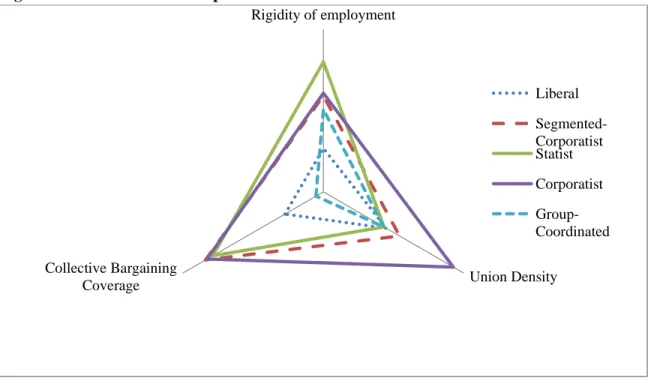
Figure 3. Industrial relations sphere... 46
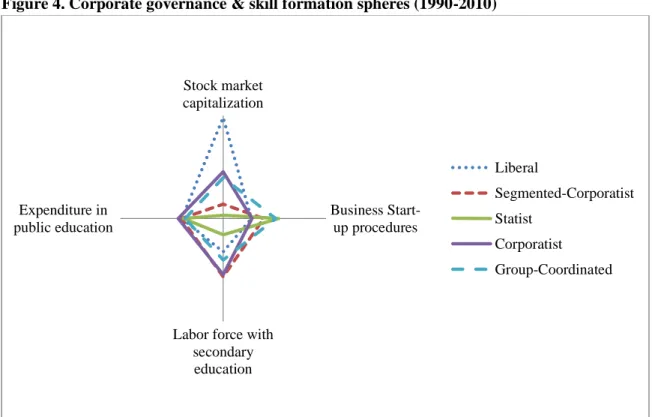
Figure 4. Corporate governance & skill formation spheres (1990-2010) ... 47
Figure 5. Redistributive effort by the State sphere (1990-2010) ... 48
Figure 6. Union Density and Collective Bargaining Coverage (1990-2010) ... 60
Figure 7. Employment Rigidity and Stock Market Capitalization ... 62
Figure 8: Productivity, Unemployment & Annual average real wages ... 64
Figure 9: Productivity, Unemployment & Annual average real wages ... 65
Figure 10. Unemployment and Stock Market Capitalization (average 1990-2010) ... 66
Figure 11. Labor force w/secondary and w/tertiary education (1990-2010) ... 68
Figure 12. Labor force w/secondary education & Employment Rigidity (1990-2010) .... 69
Figure 13. Revenue (% of GDP) & Welfare State Generosity (1990-2010) ... 72
Figure 14. Welfare State Generosity & Inequality (1990-2010) ... 74
xvi
i
[Typ e a
List of abbreviations
AGB – Labor Batllista Action (Acción Gremial Batllista) ARU – Rural Association (Asociación Rural del Uruguay) BRIC – Brazil, Russia, India and China
CAT – Autonomus Workers Central
CCU – Construction Chamber (Cámara de Construcción del Uruguay)
CGTU – Uruguayan General Labor Confederation (Confederación General del Trabajo del Uruguay)
CIE – Import and Export Control Commission (Contralor de Importaciones y Exportaciones)
CIU – Industry Chamber (Cámara de Industria del Uruguay) CME – Coordinated Market Economy
CMPP – Merchants Chamber (Cámara Mercantil de Productos del País) CNC – National Chamber of Commerce (Cámara Nacional de Comercio)
CNCS – National Chamber of Trade and Services (Cámara Nacional de Comercio y Servicios)
CNT – National Workers Convention (Convención Nacional de Trabajadores) COPRIN – Council on Wages and Prices (Comisión de Productividad, Precios e
Ingresos)
CORFO – Corporation of Production Promotion (Corporación de Fomento de la Producción)
xvi
ii
[Typ e a
COTIACh – Turism and related service sectors Confederation (Confederación Nacional de Federaciones, Sindicatos de Trabajadores de la Industria Alimenticia, el Turismo, la Gastro-Hotelería)
CPC - Production and Commerce Confederation (Confederación de la Producción y del Comercio)
CSLA – Confederación Sindical Latinoamericana
CTCh – Chilean Labor Confederation (Confederación de Trabajadores de Chile) CVE – Economic Vigilance Committee (Comité de Vigilancia Económica) DC – Christian Democracy Party
DINACOPRIN – National Direction for Costs, Prices and Income (Dirección Nacional de Costos, Precios e Ingresos)
ECLAC – Economic and Social Commission for America Latina and the Caribbean FA – Broad Front (Frente Amplio)
FA – Frente Amplio Party FDI – Foreign direct investment
FOCh – Chilean Worker Federation (Federación Obrera Chilena)
FORU – Uruguayan Regional Workers Federation (Federación Obrera Regional Uruguaya)
FP – Popular Front (Frente Popular) FR – Rural Federation (Federación Rural) GDP – Gross Domestic Product
IFI – International Financial Institution IMF – International Monetary Fund IRAE – Corporate Tax
xi
x
[Typ e a
LME – Liberal Market Economy
MAPU – Popular United Action Movement (Movimiento de Acción Popular Unido) MLN – National Liberation Movement – Tupamaros (Movimiento de Liberación
Nacional)
MME – Mixed Market Economies
MPP – Popular Participation Movement (Movimiento de Participación Popular) PAL – Agrarian Labor Party (Partido Agrario Laborista)
PIT – CNT – Workers Intersectorial Plenary – National Convention of Workers PC – Colorado Party (Partido Colorado)
PN – Nacional Party (Partido Nacional)
PNI – Independent National Party (Partido Nacional Independiente) RN – National Renovation (Renovación Nacional)
RUT – Tributary Identification Number
SNA – National Agriculture Association (Sociedad Nacional de Agricultura) Sofofa – Manufacturing Promotion Society (Sociedad de Fomento Fabril) Sonami – Mining National Society (Sociedad Nacional de Minería)
UDI – Independent Democratic Union (Unión Democrática Independiente) UGT – General Union of Workers (Unión General de Trabajadores)
UGT – General Workers Union (Unión General de Trabajadores) UIU – Uruguayan Industrial Union (Unión Industrial del Uruguay) UNT – National Workers Union (Unión Nacional de Trabajadores) UP – Popular Unity (Unidad Popular)
xx [Typ e a
Introduction
This dissertation is about the development of complementarities among market institutions in order to compete in a global market during and after the neoliberal period, roughly from 1998 to today1. The analysis focuses on Chile and Uruguay, the two small political economies in the Southern Cone of Latin America but it also offers a running comparison with Argentina, Brazil and a pool of developing and advanced political economies. The findings are relevant for understanding models of capitalism in other developing countries around the globe.
The core argument is that Latin American political economies developed different models of capitalism during and after the neoliberal period. This contradicts the conventional argument that Latin American political economies are converging on a single and coherent model, generally labeled “Hierarchical.”. As proposed by Soskice and Schneider (2009), this model is different from the liberal (competitive form of coordination) and coordinated (strategic form of coordination) ones proposed by Hall and Soskice (2001).
The study of Chile and Uruguay provides extensive evidence about the existence of different models of capitalism in Latin America and sheds light on cross-regional similarities that have been understudied. It also helps understand why and how market
1
2 [Typ e a
institutions differ from one country to another. Chile and Uruguay are two excellent cases in Latin America to analyze the process of market institutions formation in developing political economies. There are several reason why these are excellent cases for engaging in a cross-regional comparative effort. First, in spite of having political and economic institutional instability during the 20th century, Chile and Uruguay are two of the strongest democracies in the region. This allows the analysis of power conflict among business and labor actors habituated to negotiate in reasonably stable contexts.
Second, organized business and labor remained independent from the state during the 20th century, unlike their counterparts in Argentina and Brazil, where business and labor were coopted by populist governments during the 1930s and 1940s. This difference is relevant because non-coopted actors develop autonomous strategies in order to fulfill autonomous interests. Thus Chile and Uruguay are more suitable for a comparison of the process of formation of market institutions with the processes of formation of the models of capitalism in the developed world.
Third, Chile and Uruguay have the most different post-neoliberal market institutions arrangements, allowing us to observe different institutional configurations and their positive and negative complementarities. Post-neoliberal labor organization is different in both countries and when compared to the pre-authoritarian period. In Chile, labor is divided, without strong ties to the left-of-center parties except for the Communist Party and union density is low, while in Uruguay labor strengthened its centralized organization and its coalition with the left of center Frente Amplio Party during the post-authoritarian period.
3 [Typ e a
organized labor since the return to democracy. Labor Day proclamations are a landmark for organized labor’s yearly political activity. Each May 1st
(Labor Day in Latin America and Europe), central labor organizations issue a demand platform directed at governments and the political system. In 2010, Labor Day in Chile and Uruguay were the first ones for the newly inaugurated governments. While in Chile the left-of-center Concertación coalition had stepped down from office for the first time since 1990, in Uruguay the left-of-center Frente Amplio Party initiated its second consecutive term in office. In Montevideo, a packed “Chicago’s Martyrs” Square (right across from the National
Parliament building) had President Mujica and his entire cabinet sitting in the first row (El País, May 2nd 2010, front page), and the May 1st proclamation made its way into the front page of most newspapers.
In contrast, in Santiago, the rally organized by the Central Unitaria de Trabajadores (CUT, United Labor Federation) in May 1st ended with riots and the police dispersing the rioters. From the few members of the Concertación attending the event, the President of the Socialist Party and four members of the Partido Por la Democracia (PPD, Party for Democracy) were insulted and spit upon. Only a former Labor Minister, Osvaldo Andrade from the Socialist Party, was allowed to march with the CUT because “he is among the few that comes every year” (La Tercera, May 2nd
4 [Typ e a
integration into the global market of these countries has been done under very different models of capitalism.
Organized business has also evolved in different ways in Chile and Uruguay. In the case of Chile, the Pinochet regime also shifted the pattern of business organization inherited from the Import Substitution Industrialization model (ISI). The encompassing organization for Chilean business, the Corporación para la Producción y el Comercio (CPC), has been the epicenter of business political activity since the early 1980s. In Uruguay, on the contrary, the 24 principal business organizations in the country have been unable and unwilling to form a united federation.
This dissertation identifies the effects of institutional discontinuities that alter the previous institutional paths; but it also analyzes long term processes that transcend these discontinuities. Institutional discontinuity is not the only mechanism by which market institutions change. In analyzing the transition from the ISI to the open market model of capitalism in Chile and Uruguay, the dissertation finds that the mechanism of institutional layering -- that is, the introduction of new rules on top of or alongside existing ones -- is
an important one (Mahoney and Thelen 2010).
Outline
Chapter 1 provides the theoretical and methodological approaches. Building on the literature on varieties of capitalism, the dissertation amends and enriches Hall and Soskice’s classification criteria, improving the linkage between the forms of coordination
5 [Typ e a
Chapter 2 introduces the two pillars on which the analysis is based. First, market institutional spheres of relations in Chile and Uruguay come together in qualitatively different forms. Second, the Chilean model of capitalism closely resembles the liberal model; while the Uruguayan model resembles the Statist subtype of coordinated market economies. The chapter has two parts. The first part analyzes the pool of advanced political economies in terms of four institutional spheres of relation; classifying them in the typology proposed in Chapter 1. In the second part, Chile and Uruguay are analyzed and integrated into the typology. The analysis of Chile and Uruguay includes a running comparison with Brazil and Argentina.
The third and fourth Chapters analyze the formation and evolution of distributive coalitions in Chile and Uruguay, identifying the mechanisms by which these coalitions shape productive systems and market opportunities. Chapter 3 compares the historical processes of institutional building. Both countries modernized under a conservative pattern that resembles the Continental and Mediterranean European modernization path. Neither Chile nor Uruguay had a liberal-laboral type of coalition (Luebbert 1993).
The argument developed in Chapter 3 is that the historical balance of power among labor, business, political parties and even the military are important to understand the divergent market institutional paths both countries followed during and after the neoliberal period. In addition, the historical evolution of the relationship between labor and business is also relevant in order to understand the post-neoliberal one.
6 [Typ e a
reform (2001) and the social security reform (2008) in Chile; the wage bargaining institutions reform (2005) and the tax reform (2006) in Uruguay.
The argument developed in this chapter is that the neoliberal period produced a complete change of Chilean market institutions, while in Uruguay the re-foundation attempt was rejected by center and left coalitions. In Chile’s case, the path toward a Liberal Market Economy (LME) type, initiated by the military government, was not modified during the post-neoliberal period. In Uruguay, the most important legacy of the neoliberal period was to produce a greater emphasis upon markets, but the model of capitalism embarked upon during the post-neoliberal period towards the Coordinated Market Economy (CME) type. Evidence suggests that the nature of class coalitions in the post-authoritarian period is the principal cause of the evolution of the Chilean and Uruguayan models of capitalism.
The conclusion discusses how studying Latin America from a comparative perspective provides an opportunity to understand how distributional coalitions form and evolve in the new context of open market capitalism. The conclusion also states the principal theoretical and methodological contributions of this work as well as the implications for the study of varieties of capitalism.
Methodological contributions
7 [Typ e a
of quantitative and qualitative tools has been underutilized by the literature on varieties of capitalism, and it is the first methodological contribution of the dissertation.
The second methodological contribution is to offer a historical analysis of the processes of the formation of market institutions and their evolution in Chile and Uruguay. As we will see, an historical comparative analysis is necessary to understand long-term patterns.
Theoretical contributions
The argument and findings advances in this work challenge the argument advanced in the varieties of capitalism literature about the convergence of Latin American political economies in a single model of capitalism, the “hierarchical” model. The evidence produced below demonstrated that there is no convergence. Building on this principal finding, this dissertation offers three theoretical contributions to our knowledge of market institutions formation and evolution.
First is a conceptually solid classification criterion by means of a new typology that builds on Hall and Soskice’s (2001) proposed types and conceptualizing subtypes for
8 [Typ e a
Second, the dialectic dynamics of coalition formation and conflict dynamics as process concepts are integrated into the analysis of varieties of capitalism in developing political economies. Underlying this integration is a conviction that our comparative understanding of models of capitalism should consider more carefully the processes of power conflict in order to understand distributive coalition formation and change, a conviction held by other scholars (Howell 2003; Watson 2003; Kinderman 2005; Pontusson 2005). In the effort for overcoming the many shortcomings of the corporatist literature in the attempt for understanding why there exist different varieties of capitalism across the globe, we have thrown away the baby with the bathwater. Market coordination forms and institutional complementarities cannot be understood without analyzing the conflict among classes and cross-class coalitions.
The third theoretical contribution comes from a conviction that the understanding of models of capitalism should not end at the firm level. Processes at the firm, which are the core of the literature on varieties of capitalism, should be combined with those at the industry (or sector) and country levels, which are of the most importance to understanding coalition formation and power conflicts in coordinated varieties of capitalism, given the corporatist nature of the actors. This claim is supported by two ideas that stem from the mainstream literature: first, “varieties of capitalism” literature adopts the neo-corporatist classification for Scandinavian cases. Second, the firm centered approach has not succeeded in explaining Mediterranean Europe or Japanese market institutions (Pontusson 2005; Hancke et al. 2007).
9 [Typ e a
and Soskice (2001) that companies are crucial actors in a capitalist economy, I argue that they primarily adapt to the political economies they operate in, while also lobbying for changes in the context or exceptions for themselves. Hall and Soskice argue that “in any
national economy, firms will gravitate towards the mode of coordination for which there is institutional support” (2001:9). Thus, it is important to focus on sectoral and national level organizations to understand distributive coalitions.
The literature on varieties of capitalism recognizes this problem, at least tacitly, and has produced important knowledge from country-level studies as well as from firm-level ones (Huber 2002; Pontusson 2005; Hancke et al. 2007; Becker 2011). But I argue that it has not taken full advantage of some insights the neo-corporatist approach (Schmitter and Lehmbruch, 1979, Goldthorpe 1984).
Fourth, it re-conceptualizes Latin American models of capitalism based on the new proposed typology. Acknowledging the qualitative differences in terms of market institutions’ complementarities in Latin America generates insights that facilitate more
Chapter 1. A market coordination framework and methodological approach
This chapter begins by presenting the principal features of the analysis of models of capitalism in advanced political economies and then reviews several attempts to incorporate developing political economies into the theoretical framework. Following that, I construct a typology that classifies models of capitalism in developing political economies. Once that classification is complete, I outline a theoretical path for understanding the formation and evolution of models of capitalism.
The principal purpose of this study is to show that the conflict over power and distribution among the main actors in the productive system define the model of capitalism a political economy follows. The dissertation combines a cross-regional analysis of market institutions spheres of relations and their complementarities using quantitative data; a historical comparison of conflict over power and distribution for Chile and Uruguay; and a process tracing analysis of coalitional formation and bargaining over two initiatives that embody the abovementioned conflict for the post-neoliberal period: the tax and labor reforms.
Literature: agreements and disagreements
11 [Typ e a
but with different results in terms of social welfare, as seen, for example, in the divergent paths taken by Germany, the United States, or Sweden.
The study of the varieties of capitalism has been a recurrent topic for more than a decade. This is not surprising given the collapse of the socialist bloc twenty years ago and the pace at which most countries in the western world have embraced open market capitalism. What thirty years ago were socialist political economies, autarchic political economies or import substitution industrialization (ISI)-oriented political economies are now economies oriented toward market competition around the globe. Since the 1990s, the study of models of capitalism in advanced democracies made possible to distinguish from the convergence process towards open market capitalism from the route political economies were following for integrating into the global market.
12 [Typ e a
Soskice and Hall (2001) found two relevant clusters among advanced industrial democracies: liberal market economies (LME) from coordinated market economies (CME). According to the authors, nations converge on complementary practices across different spheres such as labor market, corporate finance, education and training, inter-firms relations and labor-business coordination.
Hall and Soskice define the liberal type as the one in which firms coordinate primarily via hierarchies and competitive market arrangements. Soskice (1999) and others had previously referred to this type as uncoordinated. Formal contracting is at the base of the goods and services exchange system, with market prices the main signal followed by firms for adjusting their supply and demand functions.
The coordinated type is as one in which firms depend more strongly on non-market arrangements, or “strategic” coordination, to coordinate their production and activities with other actors. These arrangements are more relational than formal, contracts being more flexible than in a liberal economy. Coordinated systems generate monitoring and private information exchange networks among well-defined circles, and collaboration dominates competition in inter-firm relations. Equilibriums are the result of strategic interaction between firms and other actors as the state, and business and labor organizations.
13 [Typ e a
strategic complementarities, but positive spillovers, and public goods provision are inhibited by power asymmetries, organizational fragmentation, and class conflict. Even then, however, such economies (e.g. France, Italy or Spain) are nonetheless stable. The authors argue that the state provides that element of stability by compensating for weakness elsewhere.
Hall and Soskice’s typology has frequently been criticized, and three criticisms
are especially relevant for this study, which seeks to integrate peripheral political economies into the typology. First, scholars have argued that the typology leads to an institutional determinism, and neglects underlying power structures, including social class (Thelen 2003; Crouch and Farrell 2004; Coates 2005; Pontusson 2005; Jackson and Deeg 2006). Second, other authors have stressed that it is “apolitical” and equilibrium-biased, and therefore downplays social and political conflict (Howell 2003; Watson 2003; Kinderman 2005; Pontusson 2005). Third, other studies have argued that it neglects the role of the state (Schmidt 2002, 2003; Regini 2003; Watson 2003). As a result of these criticisms, we now understand the need to refine our understanding of the conflicts generated by political-economic change, as well as the need to analyze economies beyond the basic liberal/coordinated archetypes.
14 [Typ e a
Italy, Spain, Portugal, Greece and Turkey) did not fit either the liberal or coordinated model, suggesting that they may constitute a separate “Mediterranean” type of capitalism. This third type was said to be characterized as marked by a large agrarian sector and a recent history of extensive state intervention that had led to specific kinds of capacities for non-market coordination in the sphere of corporate finance but more liberal arrangements in the sphere of labor relations (Rhodes 1997). In general, however, this set of countries was not fully explored, and the Mediterranean model remained simply an untested hypothesis.
Nonetheless, other scholars soon began to think of models of capitalism in terms of a larger group of political economies. Table 1 summarizes the principal attempts to build typologies for different regions. Pontusson (2005) moves the analysis from the firm (or micro) to national (or macro) level. He also identifies two spheres of coordination: business, and labor markets/welfare states. Analyzing only the pool of advanced industrial democracies and building on Katzenstein (1985), Esping-Andersen (1990) and Soskice (1999), Pontusson identifies two types of capitalism: first, social market economies and liberal market economies. Social market economies are characterized by non-market strategic coordination, and within this category are two subtypes: Nordic and Continental. In contrast, liberal market economies are characterized by market coordination. Pontusson’s work takes into account the institutional legacies of conflicts
15 [Typ e a
Pontusson’s work helps us better understand important cases such as Japan,
France or Italy. In particular, he argues that the literature has largely under-theorized production regimes while focusing upon considerations about efficiency and coordination over conflicts of interests and the exercise of power. Similar critiques have come from individual country studies, especially Italy (Molina and Rhodes 2007) and Spain (Royo 2008). In addition, by identifying the Nordic and Continental models as subtypes of the coordinated type, Pontusson underscores how strategic coordination allows for different patterns.
Table 1. Selected typologies for market economies in the literature Hall & Soskice (2001) Hall and Gingerich (2004) Pontuson (2005) Amable (2007) Hancke et al. (2007) Schneider & Soskice (2009) Becker (2011)**
Liberal Liberal Liberal Market
Based
Liberal Liberal Liberal
Coordinated Coordinated Nordic Social
Social-democratic
Coordinated Coordinated Corporatist
Mediterra-nean*
Mixed Continental Social
Continental European
Etatisme Hierarchical Statist
Southern European Compensa-ting State Meso- Communita-rian
Asian
Patrimonia-list *Hall and Soskice suggest this model exists but do not analyze it in depth.
**Two more relevant studies have analyzed production regimes from the welfare state literature. Huber (2002) argues that there are two post-neoliberal emergent models: neoliberal model and social-democratic model. Sheahan argues that there are two models with three subtypes each (market-oriented and state-led models). The literature on varieties of capitalism, in particular Schneider and Soskice, has failed to discuss the problem considering these two approaches.
16 [Typ e a
Instead of two models of capitalism, Amable argues that there are five. Amable’s typology includes a liberal type as well as other four types: a social-democratic model (with high collective bargaining coverage and high union density, a social state, but liberal features with respect to corporate financing and labor market regulation), a continental model (similar to Hall and Soskice’s coordinated model), a Mediterranean
model (low union density but with high impact on wages determination, high labor market rigidity but high informality, and a labor force with general skills and low innovation capability) and an Asian model (where the bureaucracy and familiar based forms of coordination are important; unions only operate at the firm level).
Hancke et al. (2007) analyze patterns of variation in market institutions from a national level and consider the role of the state in institutional developing and evolution, proposing four types of market institutions (Table 1). The analysis is limited to the pool of advanced industrial democracies.
Becker (2011) proposes a typology that includes the analysis of peripheral political economies, focusing on the relationship between capital and labor and between politics and the economy. He identifies five ideal types: Liberal, Statist, Corporatist, Meso-communitarian and Patrimonial. Becker’s work is important because it adds a consideration of patrimonialism, which previous conceptualizations have not done.
17 [Typ e a
economy. This analysis is based on Schneider’s research on business in Latin America (Schneider 2004a, 2004b and 2009). Schneider and Karcher (2010) have reinforced this idea by analyzing labor markets in the region.
This idea of a hierarchical Latin American model is opposed to Huber’s (1996 and 2002) and Sheahan’s (2002) analyses. Huber’s institutionalist approach understands a
model of capitalism as a set of core economic and social policies in the context of market economies (Huber 2002:2). Her analysis is centered on policymaking, under the premise that a distributive outcome of a model of capitalism is a function of policy models and political and institutional conditions under which policymakers operate. Huber also emphasizes how space and time constrain policymaking. Contrary to Schneider and Soskice (2009), Huber suggests that Latin American countries followed different paths of adjustment to debt crisis and the ISI model crisis by developing different export strategies. While some countries opted for higher levels of protection and competed in the international market on the basis of more sophisticated manufactured products, others competed in the international market on the basis of raw materials and cheap labor. These different responses to adjustment also affected the degree of state retrenchment, particularly in labor and social policy areas.
Sheahan’s analysis of Latin American models of capitalism (2002) is based on the modernization approach, particularly following Shonfield’s (1965) insight about the
18 [Typ e a
America, and the structural characteristics of the region, both economic and political. Sheahan’s two-type classification –“liberal” and “state-led”- with three subtypes each,
takes into account both cross-national differences and changes over time within countries.
To sum up, the literature on varieties of capitalism has greatly expanded since Hall and Soskice’s initial work. However, in its attempt to incorporate other regions into
the analysis, the conceptual core of their distinction among capitalist systems of institutions and the complementarities they produce (or do not produce) has been lost in the process. The problem can be identified as a classic case of conceptual stretching (Sartori 1970; Collier and Mahon 1993). In the next section I seek to address this problem by proposing a typology for classifying models of capitalism that is grounded on the main theoretical type-concept: the form of market coordination.
The proposed Hierarchical model for Latin America
Soskice and Schneider propose that Latin American political economies fit a single and coherent model of capitalism: the Hierarchical model. The authors argue that “despite the shifts away from import-substituting industrialization (ISI) and authoritarian rule, neither of the two advanced country models (liberal or coordinated) fits Latin American political economies” (2009:32). They argue that the region fits a single and coherent model of
19 [Typ e a
regulation, unstable employment records with high unemployment and high long-term unemployment, high informality and low levels of formal education.
However, while some of these characteristics, such as the high levels of labor market regulation and low levels of formal education are the legacy of the previous ISI model and either unstable or authoritarian political institutions; other characteristics are the consequence of the transition towards the global market economy. In this second group are the low labor unionization rates, unstable employment records with high unemployment and high long-term unemployment, and high informality. Soskice and Schneider’s analysis of market institutions in the region is a static one, a picture of the 1990s. The evidence presented in their work does not capture the long term trend (Table 2) in terms of the evolution of market institutions in a context of stabilizing political democratic institutions and open market economy institutions.
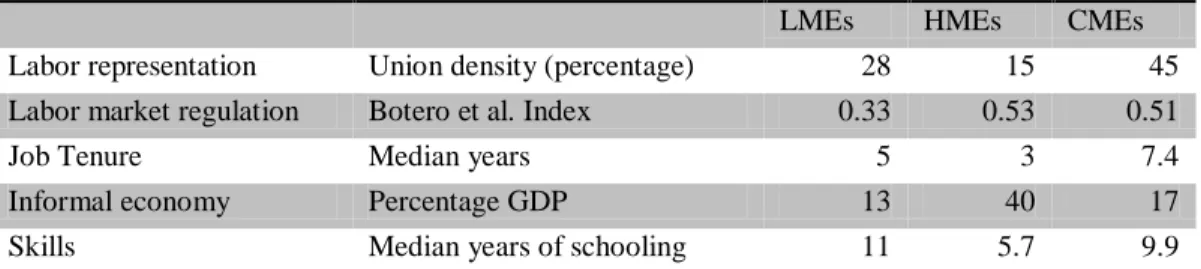
20 [Typ e a
main critique of the Hierarchical model presented here is that it fails to acknowledge these diverse long-term trends among Latin American political economies.
Table 2. Varieties of labor markets in liberal, coordinated and hierarchical models. Median trends.
LMEs HMEs CMEs
Labor representation Union density (percentage) 28 15 45
Labor market regulation Botero et al. Index 0.33 0.53 0.51
Job Tenure Median years 5 3 7.4
Informal economy Percentage GDP 13 40 17
Skills Median years of schooling 11 5.7 9.9
Source: Soskice and Schneider 2009. LME = Liberal model, HME = Hierarchical model, CME = Coordinated model
As Schneider and Karcher (2008) recognizes, it is hard to obtain a longitudinal perspective on the evolution of some of these figures for the region. This poses the problem of basing the analysis in data belonging to a period of instability in which long term processes are disturbed. In Chapter 2 I discuss the Southern Cone political economies models of capitalism at length, analyzing secondary data for the period 1990-2010, in which I discuss, closely following a set of market institutional spheres of relations, the evolution of these political economies and compare them with the set of developed political economies. In particular, I show that the conceptualization of the hierarchical model fails to consider the short term duration of some of the effects that the neoliberal period had on Latin American market institutions and are at the core of the model; portraying an inexact and misleading picture of the region’s long term trends. In
21 [Typ e a
chapters I build the case for considering that the concept of a Heirarchical model may not fit the Latin American political economies varieties of capitalism.
In terms of the labor market, Soskice and Schneider are correct in describing a labor force segmented between the public and private sectors; the former one enjoying high levels of labor protection, high access to welfare benefits relative to the private sector workers, medium-high unionization rates and long job tenure. The private sector workers, on the contrary, and mostly after the process of deindustrialization that accompanied the transition from the ISI model to the open economy model, have experimented a lowering in unionization rates, shortening of employment duration periods, longer unemployment duration periods and a growth of the informal economy (Morley 2001; Lora 2001; Bogliaccini 2012).
In the post-neoliberal period, however, unionization rates, unemployment rates, employment rates, and the size of the informal economy have had diverging trends across the region. Just taking the two cases analyzed in depth in this work, while in Chile unionization rates have remained at around 11% of the labor force during the period, in Uruguay it increased in the post-neoliberal period since 2004 from 14% in 2002 to 37% of the labor force in 2011, similarly to what the rate was in 1985. The policy transformations in the labor relations institutions in Uruguay during the 2000s, analyzed in Chapter 4, suggest this divergence with respect to the Chilean path is meaningful and useful for understanding the hypothesized difference in their models of capitalism.
22 [Typ e a
and median years of schooling in the region between the mid-1990s, when most of the regional educational reforms were launched, and the early 2010s. While in Chile both the median and average years of schooling have improved as the country has reached secondary education completion rates close to 90%; Uruguay has universalized pre-primary education but failed to augment secondary education completion levels. Labor market regulations have changed extensively in the region, adapting to the requirements of an open economy subject to compete in the global market, but this change has not been uniform across the region. In Chapter 4, these important differences in terms of models of capitalism evolution are analyzed for the cases of Chile and Uruguay.
Chapter 2 also analyzes other meaningful differences in terms of market institutions not considered by Soskice and Schneider, as for example in terms of corporate governance. Although Soskice and Schneider describe the regional firms organization patterns as one of horizontal diversification as a strategy for coping with regional market instability, they fail to analyze corporate finance patterns, which have developed in different directions in Latin America as while firms in some countries increased their reliance in stock markets to finance their endeavors, firms others have deepened their reliance in the banking system. I analyze such differences in Chapter 2.
23 [Typ e a
decades or so. Therefore, this characteristic of Latin American political economies is also probably subject to differentiation.
To sum up, Soskice and Schneider build their case for the hierarchical model relying on a snapshot of the region taken at a time of high instability due to the transition from the ISI model to the open economy model, which portrayed profound changes in the productive matrix of the region in terms of deindustrialization and the growth of the service economy. Their analysis lack an assessment of the long term evolution of market institutions, which this work provides in the historical comparison done in Chapter 3, and the analysis of post-neoliberal institutional change, which this work provides in the process tracing of the labor and tax reforms in Chapter 4.
A Market Coordination Framework
24 [Typ e a
Step One: Classifying forms of market coordination
Hall and Soskice’s (2001) distinction between liberal and coordinated models is based on
how different political economies coordinate their productive systems. The core concept that defines ideal types for Hall and Soskice is the form of coordination– that is, the mechanisms that coordinate production. There is no uncoordinated political economy in the sense of random institutional behavior. Hall and Soskice argue that complementarities are not random, but that patterns can be found and those patterns are important.
Since all political economies are coordinated in some form, the distinction is about the form of coordination. Hall and Soskice identify two main forms of coordination: competitive and strategic. Competitive coordination is described as in the classic economic literature (Williamson 1985); where “in response to price signals
generated by markets, actors adjust their willingness to supply and demand good and services, often on the basis of the marginal calculations stressed by neoclassical economics” (Hall and Soskice 2001:8). This form of coordination corresponds to the
liberal type. Strategic coordination is “heavily dependent on non-market relationships to coordinate endeavors and construct core competencies.” As Hall and Soskice state (2001:8), “coordination equilibrium results from the strategic interaction between firms
and other actors”.
Hall and Soskice’s two types are ideal -- no political economy completely fulfills
25 [Typ e a
of type-concepts) that highlights meaningful differences among constellations of attributes.
A typology therefore is not right or wrong, but is more or less adequate for identifying useful and relevant types. Types themselves become useful if they allow the observer to better understand political and institutional processes. There is no good explanation without a convincing classification of the phenomena at hand. But classifications are rarely rigid in social science, and we should expect cases to move from box to box, as we shall see in the case of Chile during the neoliberal period. Nevertheless, to classify is to highlight which characteristics of a case identify it with respect to other cases, without which it is hardly possible to explain why a certain case has evolved in certain direction or why it has moved from one box to another box at a given time.
Hall and Soskice state that “liberal market economies and coordinated market economies constitute ideal types at the pole of a spectrum along which many nations can be arrayed” (2001:8). This implies that differences between CMEs and LMEs are of
degree, where a political economy is more or less coordinated, more or less liberal.
Perhaps a more suitable approach is to focus on differences between strategic and competitive coordination as differences of kind, not of degree (Sartori 1970). Hall and
Soskice’s typology is based on the identification of the liberal type, which is consistent
26 [Typ e a
This logical treatment is different from the one Hall and Soskice give to the typology. At this point it should be taken into account that the proposed difference is of treatment, not ontological. Why is it more suitable? As I shall discuss, it is better equipped to incorporate a broader array of cases. Before going further with the analysis, however, it is important to acknowledge that most of the work scholars have done on the topic since Hall and Soskice has been tacitly linked with a per genus et differentiam treatment. Hall and Soskice themselves state that there may exist “another type of capitalism, sometimes described as Mediterranean” (2001:21). This is inconsistent with
their logical treatment of the CME-LME continuum. Albeit proposing a slightly different conceptualization, Pontusson (2005) discusses the existence of liberal market economies and social (instead of coordinated) market economies. In their analysis of Latin American political economies, Schneider and Soskice (2009) define a Hierarchical type that is different from both CMEs and LMEs, and even the Mediterranean type. Overall, the literature has tacitly built on the idea of types of capitalism form a per genus et differentiam logical treatment.
A second conceptual step is to allow for the existence of subtypes among LMEs and CMEs, as Pontusson suggests for the pool of advanced industrial democracies. This would be particularly important in the case of CMEs, given that it is reasonable to assume that strategic coordination should be done by different sets of complementarities among spheres of relations. In other words, there are different logically consistent alternative strategies to competitive market arrangements (i.e., Nordic and Continental in Pontusson’s work). In what follows I propose that these subtypes should relate to the
27 [Typ e a
resemblance structures have sufficiency conditions without necessity requirements. This approach is suitable because it assumes that categories generated by concepts may not have clear boundaries. The family resemblance approach to the classification of models of capitalism implies that different combinations of complementarities among institutional spheres create different subtypes of the coordinated type of capitalism.
Why is it important to conceptualize subtypes of CMEs? As the pool of analyzed political economies has grown, scholars began proposing other models that not require competitive coordination but should not be clustered with the original set of CMEs, either. Therefore, in order to differentiate within the CME type, I propose to take one step down in the ladder of abstraction. Subtypes of CMEs are qualified by a larger set of attributes, thereby making them more discriminating.
28 [Typ e a
The pages that follow seek to demonstrate that there are four subtypes of CMEs: Corporatist-centralized, Corporatist-sectorial, Statist and Group-Coordinated. Table 3
presents the types and subtypes and briefly describes the principal attributes of each model with respect to four spheres of relations: labor relations and labor market, corporate governance and finance, skills formation, and redistributive effort by the state.
The labor relations and labor markets sphere coordinate bargaining over wages and working conditions. It includes the analysis of inter-firm relations at the national level throughout encompassing organizations. The corporate governance and finance sphere is primarily related to the ability to access to finance and investors. The skills formation sphere relates to the issue of labor force skills formation. The redistributive
effort dimension encompasses the extractive policies from the state and the level of redistribution via social expenditure. This dimension is relevant because once tax structures, tax levels and social expenditure levels are established; they impose certain conditions for the development of the productive system.
29 [Typ e a
Table 3. Ideal types and subtypes of market economies
Liberal (& Chile) Coordinated Corporatist (Nordic) Sectorial-Corporatist (Continental) Statist (Mediterranean & Uruguay) Group-Coordinated (Asian) Labor relations and labor market Decentralized wage bargaining, price competition, low employment protection. Weak unions. Hostile environment for unions. Highly centralized wage bargaining, high quality competition, low labor mobility. High employment protection. Strong and centralized unions, high union density. Centralized wage bargaining, quality competition in some sectors, moderate price competition in other sectors. Strong unions, moderately centralized, low union density. Centralized wage bargaining, price competition, few sectors competing on quality. Strong unions, moderately centralized, low union density. Conflictive coordination with strong state intermediation. Decentralized wage bargaining, weak unions at national level. High
coordination at firm level. High quality competition, low labor mobility. High employment protection. Corporate governance and finance High sophistication of financial markets, high reliance on stock market for corporate finance. Low barriers for business entry. High ownership concentration, medium reliance on stock market for corporate finance. Low barriers for business entry. High ownership concentration, bank based finance. Low barriers for business entry. High ownership concentration, low reliance on stock market for corporate finance; bank based finance. High barriers for business entry.
High ownership concentration, low reliance on stock market for corporate finance; bank based finance. High barriers for business entry. Skills formation Emphasis on general skills, medium public expenditure, weak vocational training. High tertiary education enrollment rates. Emphasis on specific skills, high public expenditure, strong vocational training. High enrollment rates in tertiary education. Emphasis on specific skills, medium public expenditure, vocational training. Medium enrollment rates in tertiary education. Emphasis on general skills, medium public expenditure, weak vocational training. Low enrollment rates in tertiary education. Emphasis on specific skills, company based training. Low public expenditure. Medium enrollment rates in tertiary education. Redistribu-tive effort by the state
Weak, low involvement of the state. Mean-tested benefits, poverty alleviation.
High level of taxation, high state involvement. High generosity of universally oriented welfare state.
High level of taxation, high involvement of the state. Employment based welfare state (contributory), segmented.
Medium levels of taxation, high involvement of the state. Employment based welfare state, segmented, with market mechanisms at the top.
Low levels of taxation, high levels of tariffs on imports. Low state participation in social protection. Low public expenditure in welfare, firm based protection Sources: Based on Katzenstein 1985; Esping Andersen 1990 and 1999; Rhodes 1997; Soskice 1999; Huber and Stephens 2001; Hall and Soskice 2001; Huber 2002; Pontusson 2005; Hancke et al. 2007; Amable 2007; Schneider and Soskice 2009; Becker 2011.
30 [Typ e a
The names of the four CME subtypes are related to the framework in which the conflict for power and distribution takes place. Therefore, Nordic political economies constitute the Corporatist subtype, following the neo-corporatist tradition, while the Segmented-Corporatist subtype is named by adapting the concept of Sectorial-Corporatism proposed by Lehmbruch (1984) to distinguish between corporatist arrangements that operate within a particular industry or sector and such arrangements as they may operate trans-sectorally in the Nordic type of corporatism, so as to concert the policies and strategies of major economic interests and of government.
In Statist coordinated market economies, the state is the main coordinator, and the relationship between labor and business is usually conflictive and without a history of successful long-term coordination. In most such situations either labor, or business or both have been historically weak. Hancke et al. (2007) propose using this term, although unlike them I argue that France should be also included in it instead of constituting a group by itself (etatism).
31 [Typ e a
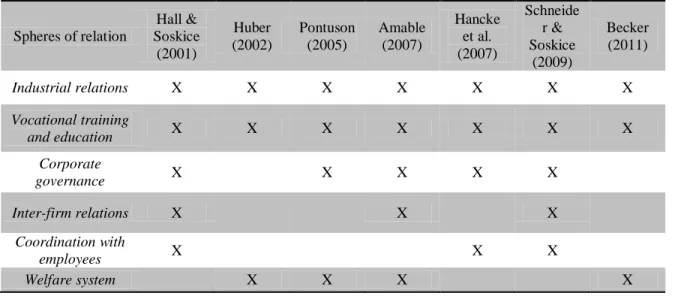
Table 4. Comparative chart on spheres of relations analysis
Spheres of relation
Hall & Soskice (2001) Huber (2002) Pontuson (2005) Amable (2007) Hancke et al. (2007) Schneide r & Soskice (2009) Becker (2011)
Industrial relations X X X X X X X
Vocational training
and education X X X X X X X
Corporate
governance X X X X X
Inter-firm relations X X X
Coordination with
employees X X X
Welfare system X X X X
As Table 4 suggests, the literature on varieties of capitalism has combined studies at the firm level and at the national level. Hall and Soskice (2001) argue that a firm-centered analysis allows for understanding how different actors seek to advance their interests in strategic interaction with others. Given that capitalist model building involves mechanisms that are observed in the power struggle among business, labor and parties at the national level (via institutional shaping and coalitional bargaining), a country level analysis is better suited to the analysis of these mechanisms and their outcomes.
Step Two: Understanding conflict dynamics
32 [Typ e a
analyzing the political economy’s underlying power structure. The different kinds of
market coordination emerge from different institutional configurations that respond to long-standing class and cross-class coalitional bargaining. In other words, there is a political foundation of market coordination mechanisms which is to be understood only by analyzing these coalitions.
To understand why different political economies diverged in their capitalist paths required the analysis of process concepts (Sartori 1970). These process concepts are the dialectic processes of class and cross-class coalitional bargain over institutional shaping; while reshaped institutions also provide new incentives for these actors and their coalitions. Figure 1 illustrates the political foundations for the formation of market institutions and market coordination mechanisms.
Business, labor, parties and other organized groups form coalitions in order to advance their interests. Governments react to the interests and power of domestic groups, and to constraints and incentives provided by the international context (Rogowsky 1989). This dialectic process is continuous, and under stable political and economic conditions it strengthens the existing equilibrium (Olson 1962). However, political or economic turmoil may trigger qualitative changes in market institutions because of an alteration of coalitions and their relative power. The 1929 crisis and the 1982 debt crisis triggered the most important processes of institutional discontinuation in market institutions in the Southern Cone of Latin America. While the first directed the region towards the ISI model, the second triggered the process of reintegration into the global market.
33 [Typ e a
have suggested that the exposure to the global market encouraged articulation among business sectors. In Western Europe (Crouch 1991, Luebbert 1993) and the Southern Cone, political economies followed a similar path until the 1929 crisis provoked a transition towards the ISI model. The institutions of European and Latin American production systems then diverged. While Western European countries began a process of integration into the global market fueled first by the Marshall Plan then by the European Economic Community, Latin America followed a heavily protected model with minimum integration to the global market or even regional coordination.
Figure 1. Political foundations of market coordination mechanisms
In heavily protected economies, the state becomes a powerful bargainer with the ability to protect domestic sectors from global market perils. Moreover, the state can choose and pick which sectors to protect and for how long to do so. Therefore, in a context of finite resources, sectors prefer to pursue individualistic strategies in order to obtain special benefits. In other words, the importance of remaining at the margin of the global market economy depends upon whether the state has the economic resources or administrative
Market coordination mechanisms
Change in
institutions Institutional spheres of relations complementarities Policy
reform Business
political strategy capability
Labor political strategy capability
and
Conflict over power and distribution
Competitive (Liberal)
Strategic (Coordinated)
34 [Typ e a
capability to offset the effect that adverse market changes would have on certain sectors of the economy.
High levels of protection from external perils, as well as subsidies from government, pose no incentives for business and labor to cooperate. The rationale for this is that the protected environment provides an opportunity to dilute distributive conflicts via subsidies and additional protections. Only when the protective structure begins to collapse and the state becomes weaker does cooperating become relevant. However, in contexts with unstable institutional frameworks, the history of previous conflicts in which one actor successfully outflanked the other would favor new attempts to either alter or repress the institutional framework, or both.
The lack of cooperation between business and labor reflects the preference for corporatist arrangements based upon the actors’ success during the conflictive process in which unions and employers try to outflank each other by gaining political leverage and legislative influence. In other words, long-term cooperation strategies are inversely related to the ability of the groups to achieve privileged access to government or to extract special benefits from it. Unstable institutional settings and a heavily protected economy are two factors that make it easier for those groups to achieve such privileged access.