Livestock-Associated, Antibiotic-Resistant
Staphylococcus aureus Nasal Carriage and
Recent Skin and Soft Tissue Infection among
Industrial Hog Operation Workers
Maya Nadimpalli1, Jill R. Stewart1, Elizabeth Pierce1, Nora Pisanic2, David C. Love2,3, Devon Hall4, Jesper Larsen5, Karen C. Carroll6,7, Tsigereda Tekle7, Trish M. Perl8,9, Christopher D. Heaney2,9*
1 Department of Environmental Sciences & Engineering, Gillings School of Global Public Health, University of North Carolina at Chapel Hill, North Carolina, United States of America, 2 Department of Environmental Health & Engineering, Johns Hopkins Bloomberg School of Public Health, Baltimore, Maryland, United States of America, 3 Johns Hopkins Center for a Livable Future, Johns Hopkins University, Baltimore, Maryland, United States of America, 4 Rural Empowerment Association for Community Help, Warsaw, North Carolina, United States of America, 5 Microbiology and Infection Control, Statens Serum Institut, Copenhagen, Denmark, 6 Division of Medical Microbiology, Johns Hopkins University School of Medicine, Baltimore, Maryland, United States of America, 7 Microbiology Laboratory, Johns Hopkins Hospital, Baltimore, Maryland, United States of America, 8 Division of Infectious Diseases, Department of Medicine, Johns Hopkins University School of Medicine, Baltimore, Maryland, United States of America, 9 Department of Epidemiology, Johns Hopkins Bloomberg School of Public Health, Baltimore, Maryland, United States of America
Abstract
Swine production work is a risk factor for nasal carriage of livestock-associated (LA-)
Staphylococcus aureus and also for skin and soft tissue infection (SSTI). However, whether
LA-S. aureus nasal carriage is associated with increased risk of SSTI remains unclear. We aimed to examine S. aureus nasal carriage and recent (3 months prior to enrollment) SSTI symptoms among industrial hog operation (IHO) workers and their household con-tacts. IHO workers and their household contacts provided a nasal swab and responded to a questionnaire assessing self-reported personal and occupational exposures and recent SSTI symptoms. Nasal swabs were analyzed for S. aureus, including methicillin-resistant
S. aureus (MRSA), multidrug-resistant-S. aureus (MDRSA), absence of scn (livestock
association), and spa type. S. aureus with at least one indicator of LA was observed among 19% of 103 IHO workers and 6% of 80 household members. Prevalence of recent SSTI was 6% among IHO workers and 11% among 54 minor household members (0/26 adult household members reported SSTI). Among IHO workers, nasal carriers of MDRSA and
scn-negative S. aureus were 8.8 (95% CI: 1.8, 43.9) and 5.1 (95% CI: 1.2, 22.2) times as
likely to report recent SSTI as non-carriers, respectively. In one household, both an IHO worker and child reported recent SSTI and carried the same S. aureus spa type (t4976) intranasally. Prevalence of scn-negative S. aureus (PR: 5.0, 95% CI: 1.2, 21.4) was ele-vated among IHO workers who reported never versus always wearing a face mask at work.
a11111
OPEN ACCESS
Citation: Nadimpalli M, Stewart JR, Pierce E,
Pisanic N, Love DC, Hall D, et al. (2016) Livestock-Associated, Antibiotic-Resistant Staphylococcus aureus Nasal Carriage and Recent Skin and Soft Tissue Infection among Industrial Hog Operation Workers. PLoS ONE 11(11): e0165713. doi:10.1371/journal.pone.0165713
Editor: Tara C Smith, Kent State University,
UNITED STATES
Received: July 28, 2016
Accepted: October 17, 2016
Published: November 16, 2016
Copyright:©2016 Nadimpalli et al. This is an open access article distributed under the terms of the
Creative Commons Attribution License, which permits unrestricted use, distribution, and reproduction in any medium, provided the original author and source are credited.
Data Availability Statement: An anonymized
(de-identified) dataset has been included in the Supplemental Materials showing sufficient variables to reproduce the analysis.
Funding: Funding for this study was provided by
Although few SSTI were reported, this study of IHO workers and their household contacts is the first to characterize a relation between nasal carriage of antibiotic-resistant LA-S.
aureus and SSTI. The direction and temporality of this relation and IHO workers’ use of
face masks to prevent nasal carriage of these bacteria warrant further investigation.
Introduction
Over the past decade, animal-adapted strains of antibiotic-resistantStaphylococcus aureushave emerged globally among food-producing animals, as well as among people who have contact with food-producing animals [1]. TheseS.aureus, which include methicillin-resistant (MRSA) and multidrug-resistantS.aureus(MDRSA) strains, are commonly referred to as livestock-associated (LA-)S.aureus. LA-S.aureusmay spread from animals to humans through direct contact and through contact with animal dander, particles from decomposing waste [2], and aerosols generated by animal activity (e.g. movement, coughing, and/or sneezing) [3]. Clonal complex (CC) 398 is the most widely described strain, although CC9 is increasingly reported in Asia [4,5] and the United States [6,7]. Nasal carriage and infection with LA-S.aureushas increased among individuals without livestock exposure in several European Union countries, suggesting that human-to-human transmission may now be occurring in the community, albeit at a lower rate than typical community-associatedS.aureusCCs [8–10].
Despite high prevalence of LA-S.aureusnasal carriage among individuals occupationally-exposed to livestock [1] and increasing prevalence among some non-exposed populations [8,11], it remains unclear whether LA-S.aureusnasal carriage is a risk factor for skin and soft tissue infection (SSTI). Nasal carriage of hospital and community-associatedS.aureus, which occurs among 20–40% of the general United States population, is an established risk factor for infection in the clinical setting [12]. However, LA-S.aureusappear to differ from hospital and community-associated strains in that they typically lack genetic factors associated with human infection, including Panton-Valentine leukocidin- (PVL-) encoding genes, enterotoxin-pro-ducing genes, and human immune evasion complex (e.g.,scn) genes [13–15]. Their capacity for human-to-human transmission also appears to be lower than many widespread commu-nity- and hospital-associatedS.aureusCCs [16,17]. Most LA-S.aureusinfections present as SSTI, which are of concern to IHO workers who can experience lacerations, abrasions, and other skin injuries through their daily work activities [18,19]. Associations between LA-S.
aureusnasal carriage and SSTI are difficult to investigate through studies in clinical settings because many livestock workers lack regular access to medical care [20], and because nasal screening forS.aureusis not typically conducted for clinical SSTI cases [21,22]. To date, pro-spective cohort studies of healthy volunteer hog production workers have not identified risk factors for SSTI other than livestock exposure [21,23,24]. Identifying an association between SSTI and nasal carriage, which can be managed through decolonization interventions [25], could help efforts to preventS.aureusexposure and associated infections among livestock workers and their household and community contacts.
In the present study, we assessed nasal carriage of LA-S.aureusamong industrial hog opera-tion (IHO) workers and their household members in North Carolina and estimated associaopera-tions with self-reported SSTI symptoms. Using data from the baseline enrollment visit of a four-month repeated-measures study ofS.aureusnasal carriage, we examined: (a) baseline prevalence and distribution ofS.aureusnasal carriage patterns; (b) associations betweenS.aureusnasal car-riage patterns and reports of recent (in the three months prior to the baseline visit) SSTI symp-toms; and (c) associations betweenS.aureusnasal carriage patterns and IHO work exposures. Center for Environmental Infectious Diseases
Discovery Program at the Johns Hopkins University, School of Medicine, Department of Medicine, Division of Infectious Diseases, and NSF grant 1316318 as part of the joint NSF-NIH-USDA Ecology and Evolution of Infectious Diseases program. NP was supported by National Institute of Environmental Health Sciences award no. 5T32ES007141-30. MN was supported by a Royster Society fellowship and an EPA Science to Achieve Results fellowship. DL was supported by a gift from the GRACE Communications Foundation. JL was supported by the National Institute of Allergy and Infectious Diseases grant 1R01AI101371-01A1. CDH was supported by NIOSH grant 1K01OH010193-01A1. The funders had no role in study design, data collection and analysis, decision to publish, or preparation of the manuscript.
Competing Interests: DH is Program Manager and
Materials and Methods
Data Collection
Data were collected between October 2013 and February 2014 by community organizers from the Rural Empowerment Association for Community Help (REACH) with researchers from the Johns Hopkins Bloomberg School of Public Health (JHSPH) and the Gillings School of Global Public Health at the University of North Carolina at Chapel Hill (UNC). Community organizers recruited volunteer livestock workers who fit the following inclusion criteria: cur-rently worked at an industrial hog operation (IHO), resided in North Carolina, could speak English or Spanish, and were at least 18 years of age. Only individuals employed in production of live pigs were considered IHO workers for the purposes of this study; individuals employed in other types of food animal production or meat processing (e.g. slaughterhouses, processing plants, rendering facilities) were not included in the study. Up to three individuals living in the same household as an IHO worker were eligible to participate if they were at least seven years old and spoke English or Spanish. Because enrolled participants were encouraged to refer IHO workers in their social networks to participate, it was not possible to determine the total num-ber of IHO workers who learned about this study, or the percent who were not interested in contacting community organizers for further information about participating. Before partici-pating, adults provided written informed consent. Written parental permission and informed assent were collected for participants seven to 17 years of age (hereafter referred to as
“minors”). The JHSPH Institutional Review Board (IRB) approved this study (IRB00004608). The UNC Non-Biomedical IRB approved reliance on the JHSPH IRB.
Each participant attended a baseline enrollment session at the REACH office or in a com-munity meeting space (e.g. a local church). Each enrollment session lasted between 2–3 hours. Participants responded to a baseline questionnaire which assessed demographic information, household characteristics, work activities, risk factors for exposure toS.aureus, and symptoms of SSTI and doctor-diagnosedS.aureusinfection during the three months prior to the enroll-ment session. Participants also provided a self-collected BBL CultureSwab (BD, Sparks, MD) from both of their anterior nares, under supervision and using illustrated diagrams and verbal instruction. Nasal swabs were self-collected rather than collected by investigators based on prior experience in a repeated-measuresS.aureusnasal carriage study in which participants demonstrated consistent and repeatable nasal swabbing technique [6]. Self-collected nasal swabs can be as effective in recovering pathogens from the anterior nares as investigator-col-lected swabs in a supervised setting [6,26–28]. Participants were provided with a monetary incentive after completing study tasks (approved by the JHSPH IRB).
Detection of S. aureus and MRSA
Baseline swabs were transported to UNC at 4°C within 12 hours of collection. A trip blank was included with each shipment to confirm lack of contamination during transport. Within three days of arrival, each swab was clipped into one ml of phosphate-buffered saline and vortexed for 60 seconds. One hundred μL of this eluate was plate spread on CHROMagar™ Staph aureus (BD, Franklin Lakes, NJ) (CSA) while the remaining eluate and swab were refrigerated at 4°C. After incubation at 37°C for 24 hours, at least two colonies with morphology characteristic of
aureuson either media were then streaked on quadrants of a new CSA plate. In total, presump-tiveS.aureuscolonies were isolated within two to four days of nasal swab collection. Presump-tive colonies were archived at -80°C in brain heart infusion broth with 15% (w/v) glycerol.
A crude DNA extraction was performed on each isolate using a protocol adapted from Reischlet al. [30]. Multiplex PCR was used to amplify thespa,scn,mecA, andmecC genes [31]. Strain LGA251 was used as an extraction and PCR control forspaandmecC, while a clinical MRSA isolate was used as an extraction and PCR control forspa,scn, andmecA. Sterile water was used as a negative control. PCR products were visualized on 2% agarose gels stained with ethidium bromide. Colonies positive forspa, aS.aureus-specific gene, were classified asS.
aureus. Singleplex PCR was used to evaluate the presence ofpvl-encoding genes among allS.
aureusisolates [32].
All isolates were characterized byspatyping using the Ridom StaphType software and the Ridom SpaServer (http://spa.ridom.de/index.shtml) [33].S.aureusCCs, including CC398 and CC9, are traditionally inferred through multi-locus sequence typing (MLST), which we did not perform. However,spatypes associated with CC398 and CC9 have been described by other studies in which both MLST andspatyping were performed [15,34,35]. Thus, we assigned putative CC398 or CC9 to isolates in this study based onspa type, the literature, and the Ridom SpaServer, as others have done [6,36].
Assessment of antibiotic susceptibility
One isolate from eachS.aureus-positive nasal swab was assessed for susceptibility to a panel of antibiotics (S1 Table), using the Phoenix Automated Microbiology System (BD Diagnostic Sys-tems, Sparks, MD). Testing was completed by the Clinical Microbiology Laboratory at the Johns Hopkins Hospital. Isolates for testing were shipped from UNC to JHU between January and February, 2014. MRSA were defined asS.aureusisolates resistant to cefoxitin and positive for eithermecA ormecC [37]. MDRSA were defined asS.aureusisolates resistant to three or more classes of antibiotics. MRSA isolates meeting the definition of MDRSA were classified as multidrug-resistant MRSA. However, MRSA and MDRSA did not necessarily overlap by these definitions.
Indicators of livestock association
There is currently no consensus marker for LA-S.aureus. We examined four indicators of live-stock association amongS.aureusisolates: strain type CC398, strain type CC9, absence ofscn, and tetracycline resistance. We have used CC398, absence ofscn, and tetracycline resistance as indicators of livestock association in previous work [6,38]. CC9 has been identified as a marker of LA-S.aureusamong livestock workers in Asia [39], and has been observed among livestock herds and people in contact with these herds in the Midwestern US [7], and in the same geo-graphic region as the present study [6,38].
Definition of recent SSTI outcome
the Centers for Disease Control and Prevention [CDC] and Dr. Tara Smith, Kent State Univer-sity). Hereafter, we refer to this outcome as “recent SSTI.”
Statistical analysis
We compared the distributions of potential individual (e.g. use of antibiotics, participation in contact sports) and household risk factors (e.g. number of household members, pets, home located on a hog operation) forS.aureusnasal carriage between workers and household mem-bers. For analyses in which prevalence ofS.aureusnasal carriage was evaluated as an outcome, results for adult and minor household members were combined for sample size considerations. We calculated the prevalence of nasal carriage ofS.aureus, MRSA, and MDRSA among work-ers and their household membwork-ers, including livestock-associated classifications of the above.
We used log-binomial regression models to estimate crude prevalence ratios (PR) and 95% confidence intervals (CI) for associations between participant type (worker versus household member) andS.aureusnasal carriage outcomes,S.aureusnasal carriage outcomes and recent SSTI, and occupational exposures andS.aureusnasal carriage outcomes. We used generalized estimating equations with an exchangeable correlation matrix to account for the non-indepen-dence of observations within-household [40]. Individual and household-level risk factors that were associated with both participant type and nasal carriage patterns were included in log binomial regression models where sample size allowed. However, adjusted PRs are not pre-sented because inclusion of these covariates did not change the magnitude or precision of effect estimates. All analyses were performed using SAS 9.3 (Cary, NC). An anonymized (de-identi-fied) dataset has been included in the Supplemental Materials showing sufficient variables to reproduce the analysis (S1 Appendix).
Results
Participant and household characteristics
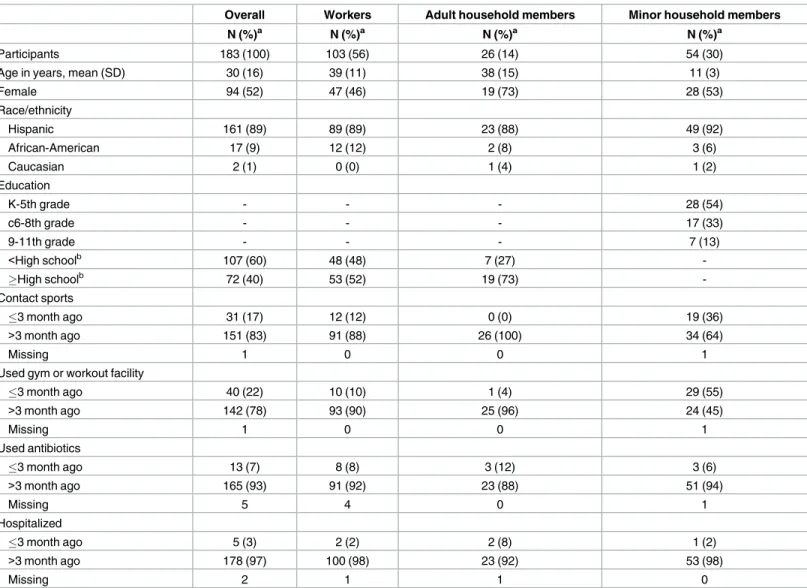
One hundred eighty-three participants, comprising 103 workers (56%), 26 adult household members (14%), and 54 minor children (30%) completed a baseline questionnaire and pro-vided a baseline nasal swab (Table 1). All but two participants identified as Hispanic or Afri-can-American. Traditional risk factors for nasal carriage of antibiotic-resistantS.aureuswere uncommon among IHO workers and adult household members (e.g. hospitalization, use of antibiotics, use of a gym or workout facility, and/or playing contact sports within the past three months; among adult household members, working in a medical facility was also uncommon). Among minors, recently playing contact sports (36%) and using a gym or workout facility (55%) were more common, but using antibiotics was uncommon (6%) (Table 1).
In total, the 183 participants comprised 81 households (S2 Table). Most households com-prised three to five individuals (73%) and 45% reported having children under seven in the home. Over half reported having no health insurance (58%). Care from a private doctor was most common (44%) but 32% reported seeking care at an urgent care or emergency depart-ment for medical care (S2 Table).
Prevalence of S. aureus, MRSA, and MDRSA
Forty-five of 103 workers (44%) and 31 of 80 household members (39%) carriedS.aureusat baseline and MRSA was observed in only one worker (Table 2). Twenty-one workers (20%) and eight household members (10%) carried MDRSA (Table 2).S.aureuscarried by IHO workers exhibited a larger diversity of antibiotic resistance patterns (10 distinct patterns observed) thanS.
We observed elevated prevalence of MDRSA (PR: 2.0, 95% CI: 1.0, 4.0),scn-negativeS.
aureus(PR: 2.9, 95% CI: 1.3, 6.5), tetracycline-resistantS.aureus(PR: 3.3, 95% CI: 1.3, 8.5), tet-racycline-resistant MDRSA (PR: 5.2, 95% CI: 1.1, 23.8), andscn-negative, tetracycline-resistant
S.aureus(PR: 3.3, 95% CI: 1.1, 10.3) among workers compared to household members (Table 2). PutativeS.aureusCC9 was only observed among workers (9/103) but putativeS.
aureusCC398, including CC398 with additional indicators of livestock association, was observed among both workers and their household members (Table 2). We did not observe
pvl-encoding genes among anyS.aureusisolates in this study.
Prevalence of and risk factors for recent SSTI
Six of 103 IHO workers (6%) reported recent SSTI (Table 3). Three IHO workers reported a swol-len skin bump, two reported a skin boil, and one reported a spider bite that was itchy. One of the
Table 1. Baseline characteristics of 183 industrial hog operation workers and household members participating in a cohort study of S. aureus nasal carriage in North Carolina, 2013–2014.
Overall Workers Adult household members Minor household members
N (%)a N (%)a N (%)a N (%)a
Participants 183 (100) 103 (56) 26 (14) 54 (30)
Age in years, mean (SD) 30 (16) 39 (11) 38 (15) 11 (3)
Female 94 (52) 47 (46) 19 (73) 28 (53)
Race/ethnicity
Hispanic 161 (89) 89 (89) 23 (88) 49 (92)
African-American 17 (9) 12 (12) 2 (8) 3 (6)
Caucasian 2 (1) 0 (0) 1 (4) 1 (2)
Education
K-5th grade - - - 28 (54)
c6-8th grade - - - 17 (33)
9-11th grade - - - 7 (13)
<High schoolb 107 (60) 48 (48) 7 (27)
High schoolb 72 (40) 53 (52) 19 (73)
-Contact sports
3 month ago 31 (17) 12 (12) 0 (0) 19 (36)
>3 month ago 151 (83) 91 (88) 26 (100) 34 (64)
Missing 1 0 0 1
Used gym or workout facility
3 month ago 40 (22) 10 (10) 1 (4) 29 (55)
>3 month ago 142 (78) 93 (90) 25 (96) 24 (45)
Missing 1 0 0 1
Used antibiotics
3 month ago 13 (7) 8 (8) 3 (12) 3 (6)
>3 month ago 165 (93) 91 (92) 23 (88) 51 (94)
Missing 5 4 0 1
Hospitalized
3 month ago 5 (3) 2 (2) 2 (8) 1 (2)
>3 month ago 178 (97) 100 (98) 23 (92) 53 (98)
Missing 2 1 1 0
a
Totals for each characteristic may not sum to the total number of participants due to missing information.
b
“Overall” column includes results from minors.
IHO workers with a swollen skin bump reported this symptom was a doctor-diagnosedS.aureus
infection. Six of 80 household members (8%) reported recent SSTI, and all of these household members were minors (6/54; 11%) (Table 3). Three minors (10, 11, and 12 years old) reported a swollen skin bump and two minors (7 and 8 years old) reported a spider bite that was itchy. One minor reported a doctor-diagnosedS.aureusinfection, but did not describe its presentation.
Among all participants, we observed that those who carriedS.aureus(PR: 4.5, 95% CI: 1.4, 14.9) and MDRSA (PR: 3.1, 95% CI: 1.2, 7.8) (Table 3) intranasally were more likely to report a recent SSTI. Among IHO workers, we observed a higher prevalence of recent SSTI among individuals carrying versus not carrying MDRSA (PR: 8.8, 95% CI: 1.8, 43.9) andscn-negative
S.aureus(PR: 5.1, 95% CI: 1.2, 22.2); associations between recent SSTI and nasal carriage of
S.aureusand tetracycline-resistantS.aureuswere positive but not statistically significant (Table 3).
Table 2. Prevalence and distribution of characteristics of baseline S. aureus nasal carriage among 183 industrial hog operation workers and household members in North Carolina, 2013–2014.a
Overall Workers Household members PR (95% CI)b
N (%) N (%) N (%)
Participants 183 (100) 103 (100) 80 (100)
S. aureus 76 (42) 45 (44) 31 (39) 1.1 (0.8, 1.5)
MRSA 1 (1) 1 (1) 0 —
MDRSA 29 (16) 21 (20) 8 (10) 2.0 (1.0, 4.0)
scn-negative
S. aureus 25 (14) 20 (19) 5 (6) 2.9 (1.3, 6.5)
MRSA 1 (1) 1 (1) 0 —
MDRSA 18 (10) 14 (14) 4 (5) 2.6 (1.0, 6.7)
tetracycline-resistant
S. aureus 21 (12) 17 (17) 4 (5) 3.3 (1.3, 8.5)
MRSA 1 (1) 1 (1) 0 (0) —
MDRSA 15 (8) 13 (13) 2 (3) 5.2 (1.1, 23.8)
CC398c
S. aureus 10 (6) 6 (6) 4 (5) 1.2 (0.3, 4.2)
MRSA 1 (1) 1 (1) 0 (0) —
MDRSA 8 (4) 6 (6) 2 (3) 2.0 (0.5, 12.0)
CC9d
S. aureus 9 (5) 9 (9) 0 —
MRSA 0 0 0 —
MDRSA 6 (3) 6 (6) 0 —
scn-negative, tetracycline-resistant
S. aureus 16 (9) 13 (13) 3 (4) 3.3 (1.1, 10.3)
MRSA 1 (1) 1 (1) 0 —
MDRSA 13 (7) 11 (11) 2 (3) 4.4 (1.0, 20.3)
Note. MRSA = methicillin-resistant S. aureus. MDRSA = multidrug-resistant S. aureus. PR = prevalence ratio.
aAll S. aureus isolates with phenotypic resistance to methicillin (characterized by resistance to cefoxitin) were mecA positive. b“Household Members” is referent category.
cAll S. aureus CC398 isolates from workers were tetracycline-resistant and scn-negative. Three of four S. aureus CC398 isolates from household members
were tetracycline-resistant and scn-negative. All MRSA CC398 and MDRSA CC398 isolates were tetracycline-resistant and scn-negative.
dAll S. aureus CC9 isolates were scn-negative. Four of nine S. aureus CC9 were resistant. Three of six MDRSA CC9 were
tetracycline-resistant.
Characteristics ofS.aureusisolates recovered from the anterior nares of workers and minors who reported recent SSTI are described inTable 4. One IHO worker-minor pair in the same household who reported recent SSTI wereS.aureusnasal carriage positive and carried the sameS.aureus spatype (t4976), although the minor’s isolate was tetracycline-susceptible (Table 4). One additional IHO worker-minor pair in the same household who reported a doc-tor-diagnosedS.aureusinfection wereS.aureus-nasal carriage negative. None of the six IHO workers who reported recent SSTI carriedS.aureusCC398 but two carriedscn-negativeS.
aureusCC9, one carriedscn-negative, resistant t002, and one carried tetracycline-resistant t4976 (Table 4).
Occupational risk factors for nasal carriage
Among the 103 participating IHO workers, working between 51–60 hours per week was most common (40/99) (S4 Table). Almost all workers (96%) reported always wearing boots or other foot protection while at work, but always wearing gloves (86%), and always wearing long sleeves and pants or coveralls (86%) were somewhat less common. Only 37% of IHO workers reported always wearing a face mask at work. A higher nasal carriage prevalence of MDRSA (PR: 3.9, 95% CI: 1.0, 15.2), scn-negativeS.aureus(PR: 5.0, 95% CI: 1.2, 21.4), and tetracycline-resistantS.aureus(PR: 4.1, 95% CI: 0.9, 17.7) was observed among workers who reported
Table 3. Association of baseline S. aureus nasal carriage patterns with recent skin and soft tissue infection (SSTI) among industrial hog opera-tion workers and their child household members in North Carolina, 2013–2014.a
Overall IHO worker Childbhousehold member
Total Nc
Recent SSTIbN
(%)
PR (95% CI)
Total Nc
Recent SSTIbN
(%)
PR (95% CI)
Total Nc
Recent SSTIbN
(%)
PR (95% CI)
S. aureus
Carrier 72 9 (13) 4.5 (1.4,
14.9)
42 5 (12) 6.8 (0.9,
53.0)
25 4 (16) 2.2 (0.4,
11.2)
Non-carrier 104 3 (3) ref 57 1 (2) ref 27 2 (7) ref
MDRSA
Carrier 25 4 (16) 3.1 (1.2,
7.8)
18 4 (22) 8.8 (1.8,
43.9)
5 0 —
Non-carrier 151 8 (5) ref 81 2 (2) ref 47 6 (13) ref
scn-negative S. aureus
Carrier 22 3 (14) 2.4 (0.5,
10.7)
17 3 (18) 5.1 (1.2,
22.2)
2 0 —
Non-carrier 154 9 (6) ref 82 3 (4) ref 50 6 (12) ref
tetracycline-resistant S.
aureus
Carrier 18 2 (11) 1.6 (0.5,
4.9)
14 2 (14) 3.0 (0.6,
13.8)
1 0 —
Non-carrier 158 10 (6) ref 85 4 (5) ref 51 6 (12) ref
Note. MDRSA = multidrug-resistant S. aureus. SSTI = skin and soft tissue infection. PR = prevalence ratio. CI = confidence interval. Ref = referent category
for regression with categorical predictor variable.
a
No adult household member reported symptoms of a S. aureus infection at baseline. Child household member participants were between 7 and<18 years of age.
b
SSTI comprises individuals who reported “Yes, in the past three months” to any of the following: doctor-diagnosed S. aureus infection; skin boil; pus-filled abscess; red, painful, swollen skin bump; or spider bite that is itchy. Participants were shown pictures of S. aureus infections with each of these
presentations prior to answering this question.
c
Totals do not sum to N = 183 (Overall), N = 103 (IHO worker), or N = 54 (Child household members) because some participants did not report whether or not they had recent SSTI.
never wearing a face mask versus those who reported always wearing a face mask at work (Table 5). Examination of statistical associations between IHO workers’ occupational exposures and recent SSTI was limited due to small numbers. But we did observe increasing prevalence of recent SSTI as IHO workers’ reported frequency of face mask usage decreased (S4 Table).
Discussion
In this study population of IHO workers and their household contacts, we found that nasal car-riage ofS.aureuswas associated with recent symptoms of SSTI. Among IHO workers specifi-cally, we observed positive associations between nasal carriage of eachS.aureus-related outcome we examined (S.aureus, MDRSA,scn-negativeS.aureus, tetracycline-resistantS.
aureus) and recent SSTI. Only associations with MDRSA andscn-negativeS.aureuswere sta-tistically significant; however, the direction and similar magnitude of these associations indi-cates that nasal carriage may be associated with SSTI outcomes in this study population. Overall, the twelve participants who reported recent SSTI included two IHO worker-minor
Table 4. Characteristics of S. aureus recovered from the anterior nares of industrial hog operation workers and minors who reported recent skin and soft tissue infection (SSTI) in North Carolina, 2013–2014.a
Household ID Participant Type S. aureus or MDRSA spa type Characteristics of livestock association scn-negative tet-resistant CC398 CC9
A Worker MDRSA t4976 x
Minor S. aureus t4976
B Worker MDRSA t002 x x
C Worker MDRSA t337 x x
D Worker S. aureus t3446 x x
E Workerb MDRSA t008
F Minor S. aureus t688
G Minor S. aureus t233
H Minor S. aureus t031
Note: SSTI = skin and soft tissue infection. MDRSA = multidrug-resistant S. aureus.
a
Six workers and six minors reported recent symptoms of SSTI. Five of six workers and four of six minors carried S. aureus in their nares at baseline. One worker-minor pair who reported recent SSTI lived in the same household but both did not carry S. aureus in their nares at baseline.
b
Worker’s recent SSTI was doctor-diagnosed as a S. aureus infection.
doi:10.1371/journal.pone.0165713.t004
Table 5. Associations between frequency of protective face mask usage and nasal carriage of MDRSA, scn-negative S. aureus, and tetracycline-resistant S. aureus among industrial hog operation workers in North Carolina, 2013–2014.
MDRSA scn-negative S. aureus tetracycline-resistant S. aureus Na(%) N (%) PR (95% CI)b N (%) PR (95% CI)b N (%) PR (95% CI)b
Frequency of mask use
Never 18 (17) 6 (6) 3.9 (1.0, 15.2) 4 (4) 5.0 (1.2, 21.4) 4 (4) 4.1 (0.9, 17.7)
Sometimes 45 (44) 11 (11) 0.7 (0.3, 1.8) 11 (11) 1.6 (0.5, 5.8) 9 0.9 (0.3, 2.5)
Always 37 (36) 2 (2) Ref 3 (3) ref 2 (2) ref
Note. MDRSA = multidrug-resistant S. aureus. PR = prevalence ratio. CI = confidence interval. ref = referent category for regression with categorical
predictor variable.
a
Total does not sum to N = 103 because some workers did not report frequency of mask use.
b
PR estimated using log-binomial regression model using a generalized estimating equation with an exchangeable correlation matrix to account for the non-independence of observations within households. Nasal carriage was modeled as a binary outcome.
pairs; one of these worker-minor pairs reported that a doctor had confirmed their SSTI symp-toms as aS.aureusinfection. This is one of the first reports in the United States of an associa-tion between nasal carriage of livestock-associatedS.aureusand SSTI among individuals with frequent and intensive exposure to industrial hog production, as well as of SSTI prevalence among their minor child household members. This finding warrants further investigation to assess the directionality of the relation betweenS.aureusnasal carriage and SSTI in this population.
Few studies have surveyed SSTI among individuals employed in livestock production. In this cross-sectional analysis, we observed a SSTI prevalence of 6.6% (12/183). A retrospective analysis of reported injuries among pork meatpacking and poultry processing workers from 2004–2009 determined average annual SSTI prevalence to be 33% and 12%, respectively [41]. A cross-sectional online and paper-based survey of US pork producers identified a self-reported MRSA infection prevalence of 5/135 (3.7%) [42]. In one other published study of SSTI among hog farm owners and operators that we are aware of, Wardynet al. observed an incidence of 6.6 cases/1,000 person-months [7]. The present study differed from Wardynet al. in several ways. First, Wardynet al. only examined farm owners and operators, for whom exposure to animals and the confinement barn environment may be less intensive than for hired laborers whose job tasks primarily involve direct contact with livestock. Second, partici-pants in Wardynet al.’s study were primarily Caucasian (98.9%), while participants in this study were primarily Hispanic (89%). Hispanic livestock production workers are believed to significantly underreport occupational injuries compared to Caucasian workers [43]. Third, Wardynet al. ascertainedS.aureusinfections using prospectively-collected skin swabs, while we only assessed SSTI through participants’ recall of recent symptoms. Participants’ recall of SSTI symptoms may have included infections prior to the three months before enrollment, skin afflictions that were not related to a bacterial infection, and/or SSTIs with a bacterial etiol-ogy other thanS.aureus. In order to minimize the possibility of reporting errors, we showed participants pictures ofS.aureusSSTI (provided by the CDC and Dr. Tara Smith, Kent State University) prior to asking them to report SSTI symptoms. In our study, any potential misclas-sification due to recall was non-differential with respect toS.aureusnasal carriage status since participants were blinded to their lab result at enrollment. However, whether recent SSTI pre-ceded or was a consequence of participants’S.aureusnasal carriage could not be investigated with our study design. Fourth, Wardynet al. did not describeS.aureusnasal carriage status among individuals who reported SSTI. Thus, any association between antecedentS.aureus
nasal carriage and SSTI in their study population is not known. The results presented here pro-vide some of the first insights into the association between nasal carriage ofS.aureuswith mul-tiple indicators of livestock association and prevalence of SSTI among IHO workers and their household contacts in the United States.
Because we asked participants about SSTI during the three months prior to and including the enrollment session, we were unable to assess whether theS.aureuspresent in participants' nares were the same strains responsible for recent SSTI. However, we observed associations between nasal carriage ofS.aureus, MDRSA, andS.aureuswith indicators of livestock associa-tion (absence ofscn) and self-reported SSTI. Additionally, risk factors for community-associ-ated and healthcare-associcommunity-associ-ated antibiotic-resistantS.aureusinfection (e.g. recent use of antibiotics, playing contact sports, recent use of a gym) were uncommon among IHO workers and their household members. Some risk factors were more common among minors (specifi-cally, playing contact sports and recent use of a gym).
individuals who shared the sameS.aureus spatype at baseline (S6 Table). Seven of these ten were worker-household member pairs, two of ten were worker-worker pairs, and one of ten was a household member-household member pair. Sharedspatypes included: t094, t233, t337, t4976, t5739, t645, t659, t701 and t7226.S.aureusstrains that were concordant between work-ers and their household membwork-ers generally did not have characteristics of livestock association (CC398, CC9, tetracycline resistance or absence ofscn). One worker-household member pair shared a tetracycline-resistantspatype (t701) and one worker-worker pair shared aS.aureus spatype associated with CC9 (t337), which was alsoscn-negative. One worker-household member pair shared the samespatype (t4976), but only the worker carriedS.aureuswith an indicator of livestock association (tetracycline resistance).
Although ten of 59 households contained participants who shared the sameS.aureus spa
type, we observed little evidence of household transmission of livestock-associatedS.aureus. Other studies have detectedS.aureusCC398 transmission between occupationally-exposed individuals (i.e. livestock veterinarians) and their household members [44]. We may not have observed transmission of livestock-associatedS.aureusin this study population because it does not occur, or because of limitations in our study design. First, we examined transmission events in the context of a cross-sectional analysis. Since transmission events may be infrequent [16], a longitudinal study design might be better suited to capture transmission events. Further, we only examined oneS.aureusisolate per nasal swab forspatype and indicators of livestock asso-ciation. Since a portion (~7%) ofS.aureus-colonized individuals carries multiple strain types simultaneously [45], it is possible we missed some instances of concordance. Finally, we assessed transmission events based on sharedspatypes between household members. How-ever, recent whole genome sequencing studies have demonstrated that sharedspatypes may not indicate true transmission events; both false positives and false negatives are possible [46,47].
There were several limitations to our assessment ofS.aureus-related carriage outcomes. First, because we directly plated nasal swabs, our sensitivity to detect MRSA may have been lower than if we used an antibiotic-supplemented enrichment broth [48]. However, MRSA prevalence among IHO workers in this study (1%) was comparable to a previous study of IHO workers we conducted in this same region (3%) [38], in which an antibiotic-supplemented enrichment broth was used. Second, since ~7% ofS.aureus-colonized individuals carry multi-pleS.aureusstrains simultaneously[45], as mentioned previously, we may not have captured the true distribution ofS.aureus-related outcomes in this population. Third, we only assessed
S.aureusnasal carriage to maximize participant acceptability. However,S.aureuscolonization has been documented at additional body sites [49]. It is possible that we underestimatedS.
systems and thus may be difficult to capture via medical records-based or passive surveillance studies.
Additional research is needed to establish the direction and temporality of the association between nasal carriage of livestock-associated, antibiotic-resistantS.aureusand SSTI. In this study population, we observed that nasal carriage ofS.aureus, including MDRSA, andscn -neg-ativeS.aureus, was more common among individuals who reported recent symptoms of SSTI. This association is in accordance with previously observed associations betweenS.aureusnasal carriage and infection in clinical settings [12], and provides some of the first evidence in the United States of a potential link between nasal carriage of livestock-associatedS.aureus(a modifiable potential risk factor for infection) and SSTI. Because few cases of SSTI were reported, future studies should examine this association in a larger cohort and over time to assess its repeatability and directionality. Overall, this study adds to the growing body of evi-dence suggesting that individuals exposed to livestock-associated, antibiotic-resistantS.aureus, MRSA, and MDRSA via hog production work in the United States could be at risk for SSTI.
Supporting Information
S1 Appendix. Analysis dataset for baseline study of 183 industrial hog operations workers and household members in North Carolina, 2013–2014.
(XLSX)
S1 Table. Antibiotics used for susceptibility testing ofS.aureusisolates.
(DOCX)
S2 Table. Baseline characteristics of 81 households participating in a cohort study ofS.
aureusnasal carriage in North Carolina, 2013–2014.
(DOCX)
S3 Table. Antibiotic resistance patterns ofS.aureusrecovered from the anterior nares of industrial hog operation workers and household members in North Carolina, 2013–2014.
(DOCX)
S4 Table. Summary of industrial hog operation worker exposures and recent SSTI in past three months in North Carolina, 2013–2014.
(DOCX)
S5 Table. Distribution ofS.aureus spatypes recovered from the anterior nares of industrial hog operation workers and household members in North Carolina, 2013–2014.
(DOCX)
S6 Table. Characteristics ofS.aureus spatypes shared within participant households in North Carolina, 2013–2014.
(DOCX)
Acknowledgments
Author Contributions
Conceptualization: DH CDH JRS TMP.
Data curation: MN CDH EP NP.
Formal analysis: MN CDH EP JL NP.
Funding acquisition: CDH JRS DCL.
Investigation: MN EP NP DH KC TT CDH.
Methodology: DH CDH JRS NP MN DCL.
Project administration: DH CDH JRS.
Resources: JRS CDH DH KC TT.
Software: MN CDH.
Supervision: CDH DH EP MN TMP KC.
Validation: MN EP JL NP CDH.
Visualization: MN CDH.
Writing – original draft: MN.
Writing – review & editing: MN JRS NP DCL DH JL KC TT CDH TMP EP.
References
1. Smith TC, Pearson N. The emergence of Staphylococcus aureus ST398. Vector-Borne Zoonotic Dis. Mary Ann Liebert, Inc. 140 Huguenot Street, 3rd Floor New Rochelle, NY 10801 USA; 2011; 11: 327– 339. doi:10.1089/vbz.2010.0072PMID:20925523
2. Nehme B, Le´tourneau V, Forster RJ, Veillette M, Duchaine C. Culture-independent approach of the bacterial bioaerosol diversity in the standard swine confinement buildings, and assessment of the sea-sonal effect. Environ Microbiol. 2008; 10: 665–75. doi:10.1111/j.1462-2920.2007.01489.xPMID: 18237302
3. Cole D, Todd L, Wing S. Concentrated swine feeding operations and public health: a review of occupa-tional and community health effects. Environ Health Perspect. Naoccupa-tional Institute of Environmental Health Science; 2000; 108: 685–99. Available:http://www.ncbi.nlm.nih.gov/pubmed/10964788 4. Patchanee P, Tadee P, Arjkumpa O, Love D, Chanachai K, Alter T, et al. Occurrence and
characteriza-tion of livestock-associated methicillin-resistant Staphylococcus aureus in pig industries of northern Thailand. J Vet Sci. 2014; 15: 529–536. doi:10.4142/jvs.2014.15.4.529PMID:25530702
5. Ye X, Fan Y, Wang X, Liu W, Yu H, Zhou J, et al. Livestock-associated methicillin and multidrug resis-tant S. aureus in humans is associated with occupational pig contact, not pet contact. Sci Rep. Macmil-lan Publishers Limited; 2016; 6: 19184. Available:http://dx.doi.org/10.1038/srep19184doi:10.1038/ srep19184PMID:26755419
6. Nadimpalli M, Rinsky JL, Wing S, Hall D, Stewart J, Larsen J, et al. Persistence of livestock-associated antibiotic-resistant Staphylococcus aureus among industrial hog operation workers in North Carolina over 14 days. Occup Environ Med. BMJ Publishing Group Ltd; 2015; 72: 90–99. doi: 10.1136/oemed-2014-102095PMID:25200855
7. Wardyn SE, Forshey BM, Farina SA, Kates AE, Nair R, Quick MK, et al. Swine Farming Is a Risk Fac-tor for Infection With and High Prevalence of Carriage of Multidrug-Resistant Staphylococcus aureus. Clin Infect Dis. Oxford University Press; 2015; civ234.
9. Lekkerkerk WSN, van de Sande-Bruinsma N, van der Sande MAB, Groenheide A, Haenen A, Timen A, et al. Emergence of MRSA of unknown origin in the Netherlands. Clin Microbiol Infect. Wiley Online Library; 2012; 18: 656–661. doi:10.1111/j.1469-0691.2011.03662.xPMID:21967090
10. van Rijen MML, Bosch T, Verkade EJM, Schouls L, Kluytmans JAJW, Group CAMS. Livestock-associ-ated MRSA carriage in patients without direct contact with livestock. 2014;
11. Becker K, Ballhausen B, Kahl BC, Ko¨ck R. The clinical impact of livestock-associated methicillin-resis-tant Staphylococcus aureus of the clonal complex 398 for humans. Vet Microbiol. Elsevier; 2015; 12. Wertheim HFL, Melles DC, Vos MC, van Leeuwen W, van Belkum A, Verbrugh HA, et al. The role of
nasal carriage in Staphylococcus aureus infections. Lancet Infect Dis. Elsevier; 2005; 5: 751–762. doi: 10.1016/S1473-3099(05)70295-4PMID:16310147
13. Argudı´n MA, Tenhagen B-A, Fetsch A, Sachsenro¨ der J, Ka¨sbohrer A, Schroeter A, et al. Virulence and resistance determinants in German Staphylococcus aureus ST398 isolates from non-human origin. Appl Environ Microbiol. Am Soc Microbiol; 2011;
14. Ballhausen B, Jung P, Kriegeskorte A, Makgotlho PE, Ruffing U, von Mu¨ller L, et al. LA-MRSA CC398 differ from classical community acquired-MRSA and hospital acquired-MRSA lineages: Functional analysis of infection and colonization processes. Int J Med Microbiol. Elsevier; 2014; 304: 777–786. doi:10.1016/j.ijmm.2014.06.006PMID:25034858
15. Price LB, Stegger M, Hasman H, Aziz M, Larsen J, Andersen PS, et al. Staphylococcus aureus CC398: host adaptation and emergence of methicillin resistance in livestock. MBio. Am Soc Microbiol; 2012; 3: e00305–11.
16. Bootsma MCJ, Wassenberg MWM, Trapman P, Bonten MJM. The nosocomial transmission rate of animal-associated ST398 meticillin-resistant Staphylococcus aureus. J R Soc Interface. The Royal Society; 2010; rsif20100349.
17. Hetem DJ, Bootsma MCJ, Troelstra A, Bonten MJM. Transmissibility of livestock-associated methicil-lin-resistant Staphylococcus aureus. Emerg Infect Dis. Centers for Disease Control and Prevention; 2013; 19: 1797. doi:10.3201/eid1911.121085PMID:24207050
18. Donham KJ, Rubino M, Thedell TD, Kammermeyer J. Potential health hazards to agricultural workers in swine confinement buildings. J Occup Med. 1977; 19: 383–7. Available:http://www.ncbi.nlm.nih. gov/pubmed/559729PMID:559729
19. Cai C, Perry MJ, Sorock GS, Hauser R, Spanjer KJ, Mittleman MA, et al. Laceration injuries among workers at meat packing plants. Am J Ind Med. 2005; 47: 403–10. doi:10.1002/ajim.20157PMID: 15828076
20. LeJeune J, Kersting A. Zoonoses: an occupational hazard for livestock workers and a public health concern for rural communities. J Agric Saf Health. 2010; 16: 161–79. Available:http://www.ncbi.nlm. nih.gov/pubmed/20836437PMID:20836437
21. Smith TC, Wardyn SE. Human Infections with Staphylococcus aureus CC398. Curr Environ Heal Reports. Springer; 2014; 2: 41–51.
22. Goerge T, Lorenz MB, van Alen S, Hu¨bner N-O, Becker K, Ko¨ck R. MRSA colonization and infection among persons with occupational livestock exposure in Europe: Prevalence, preventive options and evidence. Vet Microbiol. 2015; doi:10.1016/j.vetmic.2015.10.027PMID:26658156
23. Van Cleef BA, Van Benthem BH, Verkade EJ, Van Rijen MM, Kluytmans-Van Den Bergh MF, Gravel-and H, et al. Health Gravel-and health-related quality of life in pig farmers carrying livestock-associated methi-cillin-resistant Staphylococcus aureus. Epidemiol Infect. 2016; 1–10.
24. Benito D, Lozano C, Rezusta A, Ferrer I, Vasquez MA, Ceballos S, et al. Characterization of tetracy-cline and methicillin resistant Staphylococcus aureus strains in a Spanish hospital: Is livestock-contact a risk factor in infections caused by MRSA CC398? Int J Med Microbiol. Elsevier; 2014; 304: 1226– 1232. doi:10.1016/j.ijmm.2014.09.004PMID:25444568
25. Fritz SA, Camins BC, Eisenstein KA, Fritz JM, Epplin EK, Burnham C-A, et al. Effectiveness of mea-sures to eradicate Staphylococcus aureus carriage in patients with community-associated skin and soft-tissue infections: a randomized trial. Infect Control Hosp Epidemiol. NIH Public Access; 2011; 32: 872–80. doi:10.1086/661285PMID:21828967
26. Akmatov MK, Gatzemeier A, Schughart K, Pessler F. Equivalence of self- and staff-collected nasal swabs for the detection of viral respiratory pathogens. PLoS One. Public Library of Science; 2012; 7: e48508. doi:10.1371/journal.pone.0048508PMID:23155387
27. Ip DKM, Schutten M, Fang VJ, Fung ROP, Dutkowski RT, Chan K-H, et al. Validation of self-swab for virologic confirmation of influenza virus infections in a community setting. J Infect Dis. Oxford Univer-sity Press; 2012; 205: 631–4. doi:10.1093/infdis/jir803PMID:22198963
Testing. J Clin Microbiol. American Society for Microbiology; 2010; 48: 3340–3342. doi:10.1128/JCM. 02235-09PMID:20610685
29. Nadimpalli M, Heaney C, Stewart JR. Identification of Staphylococcus aureus from enriched nasal swabs within 24 h is improved with use of multiple culture media. J Med Microbiol. Soc General Micro-biol; 2013; 62: 1365–1367. doi:10.1099/jmm.0.058248-0PMID:23764742
30. Reischl U, Linde H-J, Metz M, Leppmeier B, Lehn N. Rapid identification of methicillin-resistantStaphy-lococcus aureus and simultaneous species confirmation using real-time fluorescence PCR. J Clin Microbiol. Am Soc Microbiol; 2000; 38: 2429–2433. PMID:10835024
31. Stegger M, Andersen PS, Kearns A, Pichon B, Holmes MA, Edwards G, et al. Rapid detection, differ-entiation and typing of methicillin-resistant Staphylococcus aureus harbouring either mecA or the new mecA homologue mecALGA251. Clin Microbiol Infect. Wiley Online Library; 2012; 18: 395–400. doi: 10.1111/j.1469-0691.2011.03715.xPMID:22429460
32. Lina G, Pie´mont Y, Godail-Gamot F, Bes M, Peter M-O, Gauduchon V, et al. Involvement of Panton-Valentine leukocidin—producing Staphylococcus aureus in primary skin infections and pneumonia. Clin Infect Dis. Oxford University Press; 1999; 29: 1128–1132. doi:10.1086/313461PMID:10524952 33. European Union Reference Laboratory for Antimicrobial Resistance. Protocol for spa Typing [Internet].
Kongens Lyngby, Denmark; 2009. Available: http://www.crl-ar.eu/data/images/tc_april-2009/7-protocols for spa typing.pdf
34. Lozano C, Rezusta A, Go´mez P, Go´mez-sanz E, Ba´ez N, Martin-saco G, et al. High prevalence of spa types associated with the clonal lineage CC398 among tetracycline-resistant methicillin-resistant staphylococcus aureus strains in a Spanish hospital. J Antimicrob Chemother. 2012; 67: 330–334. doi: 10.1093/jac/dkr497PMID:22127589
35. Hasman H, Moodley A, Guardabassi L, Stegger M, Skov RL, Aarestrup FM. spa type distribution in Staphylococcus aureus originating from pigs, cattle and poultry. Vet Microbiol. 2010; 141: 326–331. doi:10.1016/j.vetmic.2009.09.025PMID:19833458
36. Lewis HC, Molbak K, Reese C, Aarestrup FM, Selchau M, Sorum M, et al. Pigs as source of methicil-lin-resistant Staphylococcus aureus CC398 infections in humans, Denmark. Emerg Infect Dis. 2008; 14: 1383–1389. doi:10.3201/eid1409.071576PMID:18760004
37. Clinical and Laboratory Standards Institute. Performance Standards for Antimicrobial Suceptibility Testing: Twenty-third Informational Supplement. 2013.
38. Rinsky JL, Nadimpalli M, Wing S, Hall D, Baron D, Price LB, et al. Livestock-Associated Methicillin and Multidrug Resistant Staphylococcus aureus Is Present among Industrial, Not Antibiotic-Free Livestock Operation Workers in North Carolina. PLoS One. Public Library of Science; 2013; 8: e67641. Avail-able:http://dx.doi.org/10.1371%252Fjournal.pone.0067641doi:10.1371/journal.pone.0067641PMID: 23844044
39. Ye X, Wang X, Fan Y, Peng Y, Li L, Li S, et al. Genotypic and Phenotypic Markers of Livestock-Associ-ated Methicillin-Resistant Staphylococcus aureus CC9 in Humans. Bjo¨rkroth J, editor. Appl Environ Microbiol. American Society for Microbiology; 2016; 82: 3892–3899. doi:10.1128/AEM.00091-16 PMID:27107114
40. Royall RM. Model robust confidence intervals using maximum likelihood estimators. Int Stat Rev Int Stat. JSTOR; 1986; 221–226.
41. Kyeremateng-Amoah E, Nowell J, Lutty A, Lees PSJ, Silbergeld EK. Laceration injuries and infections among workers in the poultry processing and pork meatpacking industries. Am J Ind Med. 2014; 57: 669–682. doi:10.1002/ajim.22325PMID:24800900
42. Leedom Larson KR, Smith TC, Donham KJ. Self-reported methicillin-resistant Staphylococcus aureus infection in USA pork producers. Ann Agric Environ Med. 2010; 17: 331–4. Available:http://www.ncbi. nlm.nih.gov/pubmed/21186779PMID:21186779
43. Culp K, Brooks M, Rupe K, Zwerling C. Traumatic Injury Rates in Meatpacking Plant Workers. J Agro-medicine. 2008; 13: 7–16. doi:10.1080/10599240801985373PMID:19042688
44. Bosch T, Verkade E, van Luit M, Landman F, Kluytmans J, Schouls LM. Transmission and Persistence of Livestock-Associated Methicillin-Resistant Staphylococcus aureus among Veterinarians and Their Household Members. Appl Environ Microbiol. Am Soc Microbiol; 2015; 81: 124–129. doi:10.1128/ AEM.02803-14PMID:25326300
45. Cespedes C, Saïd-Salim B, Miller M, Lo S-H, Kreiswirth BN, Gordon RJ, et al. The clonality of Staphy-lococcus aureus nasal carriage. J Infect Dis. Oxford University Press; 2005; 191: 444–452. doi:10. 1086/427240PMID:15633104
47. Price JR, Golubchik T, Cole K, Wilson DJ, Crook DW, Thwaites GE, et al. Whole-genome sequencing shows that patient-to-patient transmission rarely accounts for acquisition of Staphylococcus aureus in an intensive care unit. Clin Infect Dis. Oxford University Press; 2014; 58: 609–618. doi:10.1093/cid/ cit807PMID:24336829
48. Wertheim H, Verbrugh HA, Van Pelt C, De Man P, Van Belkum A, Vos MC. Improved Detection of Methicillin-ResistantStaphylococcus aureus Using Phenyl Mannitol Broth Containing Aztreonam and Ceftizoxime. J Clin Microbiol. Am Soc Microbiol; 2001; 39: 2660–2662. doi: 10.1128/JCM.39.7.2660-2662.2001PMID:11427589
49. Yang ES, Tan J, Eells S, Rieg G, Tagudar G, Miller LG. Body site colonization in patients with commu-nity-associated methicillin-resistant Staphylococcus aureus and other types of S. aureus skin infec-tions. Clin Microbiol Infect. Blackwell Publishing Ltd; 2010; 16: 425–431. doi:10.1111/j.1469-0691. 2009.02836.xPMID:19689469
50. Census of Agriculture. 2007 Census of Agriculture [Internet]. Washington D.C.; 2007. Available:http:// www.agcensus.usda.gov/Publications/2007/Full_Report/Volume_1,_Chapter_1_State_Level/North_ Carolina/st37_1_062_062.pdf
51. United States Department of Agriculture. 2010 National Agricultural Statistics Service. [Internet]. 2010. Available:http://usda.mannlib.cornell.edu/MannUsda/viewDocumentInfo.dojsessionid=
F154BA78C7C50C021C8CA924EDB72FD5?documentID=1063