Smad7 enables STAT3 activation and promotes
pluripotency independent of TGF-
β
signaling
Yi Yua,b, Shuchen Gua, Wenjian Lia, Chuang Sunb,c,d,1, Fenfang Chena, Mu Xiaoa, Lei Wanga, Dewei Xua, Ye Lia, Chen Dinge,f, Zongping Xiaa, Yi Lic,g, Sheng Yea, Pinglong Xua, Bin Zhaoa, Jun Qine,h, Ye-Guang Cheni, Xia Linb,c,d, and Xin-Hua Fenga,b,c,d,2
aLife Sciences Institute and Innovation Center for Cell Signaling Network, Zhejiang University, Hangzhou, Zhejiang 310058, China;bMichael E. DeBakey
Department of Surgery, Baylor College of Medicine, Houston, TX 77030;cDepartment of Molecular & Cellular Biology, Baylor College of Medicine, Houston,
TX 77030;dDepartment of Molecular Physiology and Biophysics, Baylor College of Medicine, Houston, TX 77030;eState Key Laboratory of Proteomics,
Beijing Proteomics Research Center, Beijing 102206, China;fState Key Laboratory of Genetic Engineering, College of Life Sciences, Fudan University,
Shanghai 200032, China;gBaylor Breast Center, Baylor College of Medicine, Houston, TX 77030;hDepartment of Biochemistry & Molecular Biology, Baylor
College of Medicine, Houston, TX 77030; andiState Key Laboratory of Membrane Biology, College of Life Sciences, Tsinghua University, Beijing
100084, China
Edited by Melanie H. Cobb, University of Texas Southwestern Medical Center, Dallas, TX, and approved July 31, 2017 (received for review April 12, 2017)
Smad7 is a negative feedback product of TGF-βsuperfamily signaling and fine tunes a plethora of pleiotropic responses induced by TGF-β ligands. However, its noncanonical functions independent of TGF-βsignaling remain to be elucidated. Here, we show that Smad7 activates signal transducers and activators of transcription 3 (STAT3) signaling in maintaining mouse embryonic stem cell pluripo-tency in a manner independent of the TGF-βreceptors, yet depen-dent on the leukemia inhibitory factor (LIF) coreceptor glycoprotein 130 (gp130). Smad7 directly binds to the intracellular domain of gp130 and disrupts the SHP2–gp130 or SOCS3–gp130 complex, thereby amplifying STAT3 activation. Consequently, Smad7 facili-tates LIF-mediated self-renewal of mouse ESCs and is also critical for induced pluripotent stem cell reprogramming. This finding il-lustrates an uncovered role of the Smad7–STAT3 interplay in main-taining cell pluripotency and also implicates a mechanism involving Smad7 underlying cytokine-dependent regulation of cancer and inflammation.
Smad7
|
gp130|
STAT3|
TGF-β|
pluripotency|
differentiationM
embers of the TGF-β superfamily, including TGF-β, Activin, Nodal, and BMP, play a major role in maintaining pluripotency in stem cells and controlling cell fate determination during development (1–4). In cell culture, BMP4 and leukemia inhibitory factor (LIF) are required to maintain pluripotency (5). BMP induces Id proteins to suppress differentiation and sustain embryonic stem cell (ESC) self-renewal (6). Although being in-dispensable for ESC propagation, TGF-β/Activin/Nodal induce differentiation of ESCs in the absence of LIF (7). During mouse fibroblast reprogramming into ES-like cells by Oct4, KLF4, c-Myc, and Sox2 or alternatives (8), BMP enhances reprogram-ming into induced pluripotent stem cells (iPSCs) (9, 10), while TGF-βsignaling exerts an inhibitory effect on iPSC induction (11, 12). Thus, in response to morphogen gradients of the TGF-β superfamily ligands, the cellular outcome is determined by in-tegration of their balanced signaling activities.Signals of the TGF-βsuperfamily are transduced by intracellular R-Smads, i.e., BMP-activated Smad1, Smad5, and Smad8, and TGF-β/Activin/Nodal-activated Smad2 and Smad3. Smad7, in-duced by all ligands of the TGF-βsuperfamily, can act as a negative feedback product to inhibit TGF-βsignaling (13, 14). Smad7 can compete with R-Smads for binding to the type I receptor (e.g., TβRI) (15–17), recruit the HECT E3 ubiquitin ligases to promote proteasomal degradation of the receptor proteins (18), or recruit protein phosphatase 1 to inactivate the type I receptor (19, 20). In addition, Smad7 also disrupts the association of functional R-Smad–Smad4 complexes as well as binding of R-Smads complex to DNA in the nucleus (21). Certain cytokines such as IFN-γ in-duce expression of Smad7 to suppress TGF-β/BMP signaling (22). Although it modulates NF-κB, c-Jun N-terminal kinase (JNK)/p38,
and Wnt signaling (23–25), Smad7 has been thought to function primarily through its inhibitin on both TGF-βand BMP signaling. It has been reported that Smad7 directly converts human ESCs to telencephalic fate (26) and promotes self-renewal of mouse he-matopoietic stem cells (27). In mouse ESCs, an increased level of Smad7 due to loss of its E3 ligase RNF12 impairs both activin-induced anterior mesoderm formation and BMP-mediated re-pression of neural induction (28). Despite all these studies on Smad7, it remains elusive whether Smad7 acts through a non– TGF-βpathway to impact ESC pluripotency.
LIF and related cytokines signal through the glycoprotein 130 (gp130) and signal transducers and activators of transcription 3 (STAT3) (29–34). Following the engagement of LIF to its re-ceptor complex containing gp130, Janus kinases (JAKs) become catalytically activated. Activated JAKs phosphorylate tyrosine residues in the intracellular domain of gp130, which serves as docking sites for the Src homology 2 (SH2) domains of STATs (35, 36). When bound to gp130 and JAK, STATs are phos-phorylated, translocate to the nucleus, and then bind to the STAT-binding elements in the target genes. Termination of the gp130–STAT3 signaling is effectuated by several mechanisms,
Significance
TGF-βand related growth factors critically regulate cell potency and functions. Smad7 is induced by TGF-βs and inhibits the physiological functions of TGF-βsignaling. This study describes an unexpected finding that Smad7 promotes self-renewal of embryonic stem cells (ESCs) in a manner independent of its inhibition on TGF-βsignaling. Instead, Smad7 acts to induce activation of transcription factor signal transducers and acti-vators of transcription 3 (STAT3) in ESCs. Smad7 activates STAT3 through its direct binding to the cytokine receptor up-stream of STAT3 activation. In agreement with the role of STAT3 in maintaining ESC pluripotency, Smad7 promotes ESC self-renewal and induced pluripotent stem cell reprogramming. This finding illustrates a regulatory mechanism for Smad7 in maintaining pluripotency, and likely in cancer and inflammation.
Author contributions: Y.Y., Y.-G.C., X.L., and X.-H.F. designed research; Y.Y., S.G., W.L., L.W., D.X., C.D., Z.X., and X.L. performed research; Y.Y., S.G., W.L., F.C., L.W., D.X., C.D., Z.X., S.Y., P.X., B.Z., J.Q., Y.-G.C., and X.-H.F. analyzed data; Y.Y., Y.-G.C., X.L., and X.-H.F. wrote the paper; C.S., M.X., Ye Li, and X.L. carried out initial immunopurification of Smad7 complexes from mouse ESC; and F.C., Yi Li, L.W., and B.Z. provided essential experimental materials.
The authors declare no conflict of interest.
This article is a PNAS Direct Submission.
1Present address: Department of Microbiology and Immunology, University of North
Car-olina at Chapel Hill, Chapel Hill, NC 27599.
2To whom correspondence should be addressed. Email: [email protected].
This article contains supporting information online atwww.pnas.org/lookup/suppl/doi:10. 1073/pnas.1705755114/-/DCSupplemental.
CELL
including dephosphorylation of gp130 by the SH2-containing phosphatase (SHP2) (37) and negative feedback inhibition by the suppressor of cytokine signaling (SOCS) proteins (38).
In regulating ESC pluripotency, LIF-activated STAT3 functions through its cooperation with the core pluripotency transcription factors such as Oct4, Nanog, and Sox2 (39). Smad1/5/8 also co-operate with Oct4, Nanog, and Sox2 as well as STAT3 to maintain pluripotency (39). In addition, STAT3 can promote expression of TGF-β1 (40) and Smad7 (41, 42). STAT3 also selectively interacts with Smad3 to antagonize TGF-βsignaling (43), whereas Smads attenuate the STAT3 signaling through an inhibition of STAT3 binding to DNA and cooperation with p300 (44). However, it re-mains unknown whether Smad7, induced by both TGF-β and STAT3 signaling, directly cross-talks with STAT3 signaling to in-fluence ESC pluripotency. In this study, we identified and char-acterized a direct interaction between Smad7 and gp130 that leads to Smad7-mediated amplification of the gp130–STAT3 signaling and maintenance of embryonic pluripotency. This unexpected ac-tion of Smad7 is independent of its inhibitory effect on
TGF-β/BMP signaling. Our findings elucidate a mechanism underlying the modulation of the gp130–STAT3 axis by Smad7 and identify the essential role of Smad7 as a critical cell fate regulator.
Results
Smad7 Attenuates Mouse ESC Differentiation. Smad7 has been
identified as a STAT3 target gene, and it is abundantly expressed in mouse ESCs (41, 42). We first investigated whether the ex-pression of Smad7 changes during embryoid body (EB) differ-entiation derived from mouse ESCs. During cell differdiffer-entiation, we observed an apparently gradual decrease in expression of Smad7, which was accompanied by the decrease of pluripotency markers including Oct4, Nanog, and Sox2 (Fig. 1AandFig. S1A),
whereas expression of differentiation markers such as Brachyury/T, Foxa2, and Cxcl12 profoundly increased (Fig. S1B). These results
indicate a high expression level of Smad7 may be required for the undifferentiated state of ESCs.
To further investigate whether Smad7 regulates ES cell fate determination, stable and inducible expression of Smad7 was estab-lished in the mouse ES cell line CGR8 using the
tetracycline-inducible (tet-on) system, designated as SFB–Smad7–tet-on cells. Doxycycline (Dox) treatment induced a moderate expres-sion of Smad7 in SFB–Smad7–tet-on cells (Fig. S1 C and D).
During EB differentiation, Oct4, Nanog, and Sox2 as well as endogenous Smad7 were reduced at day 4 of differentiation, yet Dox-induced expression of Smad7 maintained high expression levels of these pluripotency markers (Fig. 1BandFig. S1E). In
contrast, induced expression of Smad7 markedly decreased ex-pression of differentiation markers of all three germ layers, in-cluding ectodermal markers (i.e., Cxcl12 and SOX17), mesodermal markers (i.e., Brachyury/T and BMP5), and endodermal markers (i.e., Foxa2 and Gata4) at day 4 of EB differentiation (Fig. 1C). These results imply that Smad7 promotes self-renewal of mouse ESCs.
Smad7 Is Essential in Promoting ESC Self-Renewal and iPSC
Reprogramming.We next determined whether loss of Smad7
ex-pression could enhance ESC differentiation. In mESCs, stably expressed shSmad7 (Fig. S2A) reduced the mRNA and protein
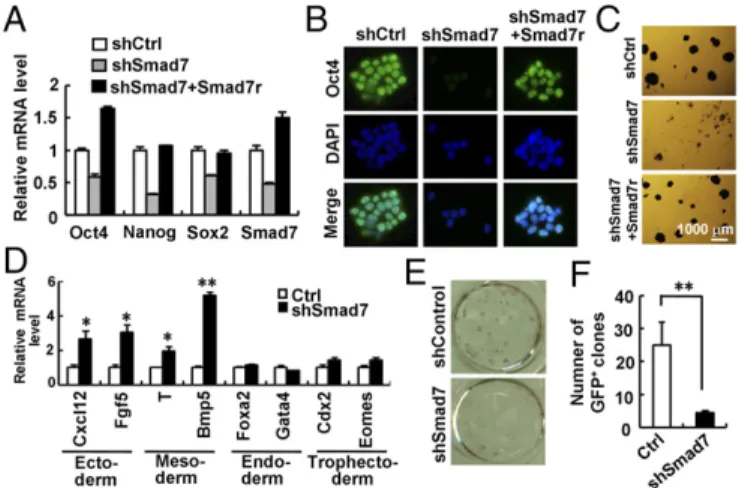
levels of Oct4, Nanog, and Sox2 (Fig. 2AandFig. S2B). By using
immunofluorescence, a profound loss of Oct4 expression was observed in shSmad7-expressing cells (Fig. 2B). Consistently, shSmad7 resulted in low alkaline phosphatase (AP) activ-ity (Fig. 2C). Notably, an shRNA-resistant variant of Smad7 (FLAG-tagged Smad7r,Fig. S2C and D) completely rescued
the effect of shSmad7 on ESC differentiation (Fig. 2A–Cand
Fig. S2B), demonstrating the specific on-target effect of
shSmad7. In addition, shSmad7 induced the mRNA and pro-tein levels of ectodermal markers (i.e., Cxcl12 and Fgf5) and mesodermal markers (i.e., Brachyury/T and BMP5), but not endodermal or trophectodermal markers (Fig. 2DandFig. S2E).
Furthermore, transient knockdown of Smad7 exhibited the same effect on ESC self-renewal and differentiation (Fig. S2F). Thus,
our results strongly support a direct role of Smad7 in maintaining ESC self-renewal.
Given the positive role of Smad7 in promoting ESC self-renewal, we were interested in determining whether Smad7 has a critical role in iPSC reprogramming. We used four conventional reprogramming factors, i.e., Oct4, Sox2, KLF4, and c-Myc (OSKM), to induce pluripotency in mouse embryonic fibroblasts (MEFs).
Accompanied by the increased expression of OSKM, we observed an increase in the expression of Smad7 (Fig. S2G). We then
further determined the role of Smad7 in iPSC reprogramming. While OSKM could produce as high as 25% reprogramming efficiency in Oct4–GFP MEFs, as indicated by AP- and GFP-positive iPSC colonies, shSmad7 markedly reduced the number of OSKM-induced iPSC colonies (Fig. 2EandF). Our results indicate that depletion of Smad7 profoundly blocks OSKM-mediated reprogramming into iPSCs.
Smad7 Regulates Pluripotency Independent of TGF-β/BMP Signaling.
We next attempted to determine whether Smad7 regulates plu-ripotency through canonical inhibition of TGF-β/BMP signaling. We first examined the effects of small molecule inhibitors SB431542 against TGF-β type I receptor or Dorsomorphin against BMP type I receptor, named TGFBRi and BMPRi, re-spectively. Dox-induced expression of Smad7 could suffice to moderately increase expression of pluripotency markers, espe-cially Oct4 and Nanog, which was further increased by addition of exogenous LIF (Fig. 3A). It is not surprising that TGFBRi or BMPRi had no effects on Smad7-induced up-regulation of Nanog, Oct4, and Sox2 (Fig. 3A) as Smad7 itself is a potent in-hibitor of TGF-β/BMP signaling. Remarkably, the effect of Smad7 depletion on expression of pluripotency markers, as ei-ther measured by Western blotting analysis (Fig. 3B) or immu-nofluorescence (Fig. S3A) or AP activity (Fig. S3B), remained
unchanged after treatment with TGFBRi or BMPRi. Further-more, the Smad7 mutant K401E, which was defective in binding to the type I receptor (45), failed to effectively inhibit TGF-βor BMP signaling (Fig. S3CandD) and notably retained its ability
to promote expression of ESC pluripotency markers (Fig. S3E).
These findings clearly demonstrated that the function of Smad7 in controlling ESC pluripotency may not rely on its negative regulation of TGF-β–Smad signaling.
Smad7 Activates STAT3 Independent of TGF-β Receptor Signaling.
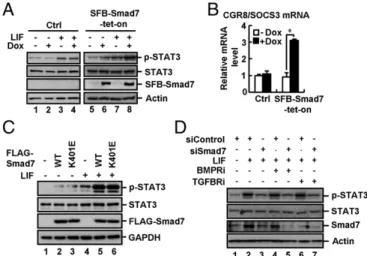
Smad7 is not only induced by TGF-β signaling, but also by JAK–STAT signaling (41, 42, 46). We sought to determine whether increased expression of Smad7 could affect STAT3 activation. In CGR8 SFB–Smad7–tet-on cells, Dox induced ex-pression of SFB-tagged Smad7 (Fig. 4A, lanes 6 and 8) and promoted LIF-induced STAT3 phosphorylation at Y705 (p-STAT3), indicative of STAT3 activation (Fig. 4A, lane 8). Smad7 ap-parently enabled ESCs to be more sensitive to LIF (short time or low dosage) in STAT3 activation and Oct4 expression (Fig. S4AandB). As a consequence, Dox induced a higher
level of endogenous SOCS3 mRNA (a STAT3 target gene) (Fig. 4B) and also a significantly higher level of LIF-induced M67-luc reporter activity (Fig. S4C). In sharp contrast,
Dox did not alter the levels of p-STAT3, SOCS3 mRNA, and M67-luc activity in control (Ctrl) cells (Fig. 4 A andB andFig. S4C).
We then determined whether Smad7-enabled STAT3 activa-tion requires TGF-β receptor signaling. We found that the Smad7 mutant K401E, defective in binding to the type I re-ceptor, was as potent as wild-type Smad7 in activating STAT3 (Fig. 4C). TGFBRi or BMPRi had no effects on Smad7-induced STAT3 activation (Fig. S4D). Notably, TGFBRi or BMPRi
could not reverse the effect of shSmad7 on LIF-mediated STAT3 activation (Fig. 4D). Thus, our results suggest that Smad7 potentiates STAT3 signaling independent of its inhibitory effects on TGF-βsignaling.
Smad7 Directly Binds to gp130 and Disrupts the SHP2/SOCS3 Binding
to gp130.Because Smad7 promotes LIF-induced STAT3
activa-tion, we speculated that Smad7 might interact with the LIF– gp130–STAT3 pathway. Indeed, we found that Smad7 bound to gp130, a coreceptor for LIF in transfected cells in coimmuno-precipitation (co-IP) assays (Fig. S5A). Further, Smad7 could
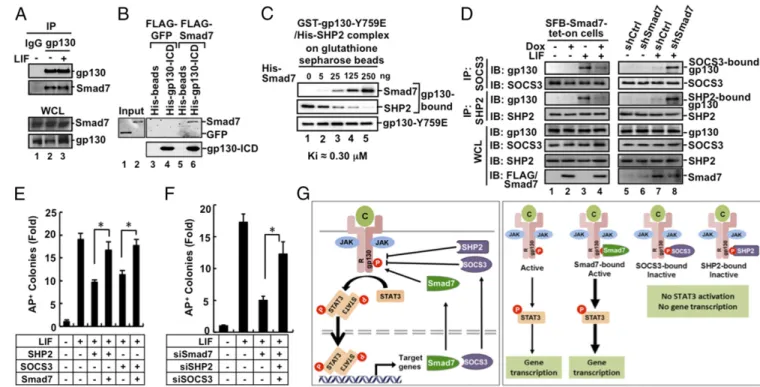
interact with gp130 at the endogenous levels (Fig. 5A). We also conducted an in vitro binding assay using purified recombinant proteins. As shown in Fig. 5B, His-tagged gp130–ICD protein (the cytoplasmic domain of gp130) could bind to Smad7, but not GFP protein, indicating that Smad7 directly binds to the cyto-plasmic domain of gp130.
To determine the structural features for the Smad7–gp130 interaction, we first mapped the domain of Smad7 for gp130 binding. Our co-IP assay revealed that both wild-type and the MH2 or C domain (aa 228–426) of Smad7, but not the N domain Fig. 2. Smad7 is essential in maintenance of pluripotency. (A–C) Depletion
of Smad7 down-regulates expression of pluripotency markers and induces differentiation in ESCs. CGR8 cells stably expressing shSmad7 were estab-lished as described inSupporting Information. Smad7r is a RNAi-resistant variant of Smad7. (A) qRT-PCR analysis of Oct4, Nanog, Sox2, and Smad7. Data are shown as mean±SEM;n=3. (B) Immunofluorescence analysis of Oct4. DNA was stained with DAPI. (C) AP staining of CGR8 cells stably expressing shSmad7 and/or Smad7r. (D) Depletion of Smad7 enhances ESC differentiation into ectoderm and mesoderm, but not endoderm or tro-phectoderm. qRT-PCR was used to examine mRNA levels of indicated dif-ferentiation markers. Data are shown as mean±SEM;n=3. *P<0.05, **P< 0.01. (EandF) Smad7 depletion inhibits the reprogramming efficiency in reprogrammable MEFs. Reprogrammed iPSC colonies were identified by AP staining (E) and quantitation of GFP-positive clones (F) at day 14. Data are shown as mean±SEM;n=3. **P<0.01.
Fig. 3. Smad7 promotes pluripotency independent of canonical TGF-β/Smad signaling. (A) Smad7 promotes ESC self-renewal independent of TGF-β/BMP signaling. SFB–Smad7–tet-on cells were pretreated with 5 μM SB431542 (TGFBRi) or 10μM Dorsomorphin (BMPRi) for 12 h and then cultured in in-dicated medium for another 3 d. qRT-PCR was used to analyze expression of indicated pluripotency markers. Data are shown as mean±SEM;n=3. (B) Inhibition of TGF-β/BMP signaling does not reverse the effect of siSmad7 in ESC pluripotency. CGR8 cells were transfected with 40 pM Smad7 siRNA or control siRNA and cultured with TGFBRi or BMPRi for 2 d. Cell lysates were subjected to Western blot analysis.
CELL
(amino acids 1–228), bound to gp130 (Fig. S5B). On the
gp130 side, a series of HA-tagged deletions in gp130–ICD were tested for their interactions with FLAG–Smad7 in HEK293T cells (Fig. S5C). The mutant containing amino acids 616–918, 616–889, or 616–764 retained the ability to interact with Smad7, whereas the amino acids 616–734 and 616–646 mutants did not bind to Smad7 (Fig. S5C), indicating that residues 734–764 could be potentially critical for the Smad7 binding.
The 734–764 aa region of gp130 has a critical phosphotyrosine-759 (pYphosphotyrosine-759). SHP2 and SOCS3 are recruited to the pYphosphotyrosine-759 residue to block STAT3 activation (37, 38). We then asked whether Smad7 blocks the binding of SHP2/SOCS3 to gp130. GST–gp130– Y759E (mimicking Y759 phosphorylation) and His–SHP2 were coexpressed in Escherichia coli and the preformed complex be-tween gp130–Y759E and SHP2 was retrieved using glutathione beads (Fig. S5D). Interestingly, when added to the purified gp130–
Y759E/SHP2 complex in vitro, increasing amounts of recombinant His–Smad7 protein competitively replaced His–SHP2 for binding to GST–gp130–Y759E with an approximateKiof 0.30μM (Fig. 5C). These results demonstrate that Smad7 directly competes with SHP2 for gp130 binding.
We further assessed the effect of Smad7 on endogenous gp130–SHP2 or gp130–SOCS3 interactions in CGR8 cells. Lentiviral expression of exogenous Smad7 profoundly blocked binding of endogenous SHP2 or SOCS3 to gp130 (Fig. 5D, lane 4). Fur-thermore, shSmad7 markedly increased the physiological in-teraction of either SHP2 or SOCS3 with gp130 in CGR8 cells (Fig. 5D, lane 8). Collectively, our data suggest that Smad7 promotes gp130-mediated STAT3 signaling by overriding SHP2/SOCS3-mediated inhibition.
Smad7 Promotes Pluripotency Through Blocking SHP2 and SOCS3. Having established the molecular antagonism between Smad7 and SHP2 or SOCS3 during STAT3 activation, we further assessed the relationship among Smad7, STAT3, and SHP2/SOCS3 in
maintaining ESC pluripotency. While Dox-induced expression of Smad7 could induce formation of AP-positive colonies and enhanced expression of pluripotency markers, knockdown of STAT3 markedly attenuated the effect of Smad7 (Fig. S6Aand
B). Conversely, whereas Smad7 depletion reduced the mRNA levels of pluripotency markers and abolished production of LIF-induced AP-positive colonies, overexpression of STAT3C (a constitutively active mutant of STAT3) completely rescued pluripotency in Smad7-depleted cells (Fig. S6 C and D).
Moreover, JAK inhibitor Filgotinib also strongly attenuated the effect of Smad7 in ESC pluripotency (Fig. S6E). These
results suggest that Smad7 stimulates stemness through JAK-dependent STAT3 activation.
Although overexpression of SHP2 or SOCS3 reduced ESC colony formation, ectopic expression of Smad7 could reverse the action of SOCS3 or SHP2 to rescue ESC colony formation (Fig. 5EandFig.
S6F), STAT3 activation, and expression of Oct4, Sox2, and Nanog
(Fig. S6G). Conversely, knockdown of Smad7 alone attenuated
STAT3 activation and ESC pluripotency (Figs. 4Dand 5FandFig.
S6CandH). Notably, simultaneous double knockdown of SHP2 and
SOCS3 in Smad7-depleted ESCs could restore AP-positive colony formation (Fig. 5F and Fig. S6H) and expression of pluripotency
markers (Fig. S6I). Collectively, our findings illustrate that Smad7
antagonizes the negative role of SHP2 and SOCS3 in LIF/STAT3 signaling in pluripotency maintenance (Fig. 5G).
Discussion
Numerous investigations have elucidated the function of Smad7 in differentiated cells and adult stem cells. It is generally thought that the primary function of Smad7 is to negatively impact TGF-β/BMP signaling. However, Smad7 actions outside of the TGF-β/BMP signaling have rarely been explored. A previous study reported that Smad7 is highly expressed in undifferenti-ated ESCs (41). Consistently, we found that expression of Smad7 decreases during ESC differentiation (Fig. 1AandFig.
S1A), implying a possible function of Smad7 in maintaining
ESC pluripotency. Here we report that Smad7 promotes ESC self-renewal and attenuates ESC differentiation and identify the direct role of Smad7 in maintaining pluripotency through a gp130–STAT3-dependent yet TGF-β/BMP-independent sig-naling pathway. In the current study, we not only reveal a function of Smad7 in controlling pluripotency, but also offer an underlying mechanism for previously unexplained signaling interplays.
A few lines of experimental evidence convincingly demon-strate the role of Smad7 in controlling pluripotency. First, in-duced expression of Smad7 up-regulates expression of the core pluripotency markers, whereas it down-regulates expression of differentiation makers of all three germ-layer lineages (Fig. 1). As a result, Smad7 promotes ESC colony formation. Second, depletion of Smad7 severely attenuates expression of the core pluripotency markers and colony formation and markedly en-hances expression of differentiation makers in the ectoderm and mesoderm lineages (Fig. 2 A–D and Fig. S2 B, E, and F). In
addition, we failed to generate complete knockout of the Smad7 gene in mouse ESCs using the CRISPR/Cas9 technology, implying the critical function of Smad7 in maintaining pluri-potency. Third, depletion of Smad7 in MEFs drastically reduces the reprogramming efficiency (Fig. 2EandF). Together with the molecular actions and interactions of Smad7 with the gp130– STAT3 pathway, these findings support the important function of Smad7 in maintaining pluripotency.
Although Smad7 is a well-established negative regulator in TGF-β/BMP signaling, our study has clearly revealed that Smad7 does not require TGF-β/BMP signaling to enable STAT3 activation and maintenance of pluripotency (Fig. 3 and
Fig. S3). Small molecule inhibitors against TβRI or BMPRI fail to reverse the effect of Smad7 depletion on attenuating STAT3 Fig. 4. Smad7 potently activates gp130-mediated STAT3 signaling. (A)
activation and pluripotency. Moreover, Smad7 mutants deficient in binding to TβRI and BMPRI retain the ability to activate STAT3 signaling and expression of pluripotency markers. These results support the notion that Smad7 promotes STAT3 activation independently of TGF-β/BMP signaling.
Instead, our work has revealed that Smad7 specifically pro-motes pluripotency through the LIF–gp130–JAK–STAT3 pathway. STAT3 depletion or JAK1 inhibitor blocks Smad7-mediated pro-motion of ESC self-renewal. Moreover, constitutively activated STAT3 completely reverses the effect of shSmad7 on ESC differ-entiation. These results strongly suggest that Smad7 promotes LIF-induced STAT3 activation to stimulate ESC pluripotency. Our work has further revealed the molecular mechanism underlying Smad7-induced STAT3 signaling in pluripotency. Smad7 directly interacts with the cytoplasmic domain of gp130 (Fig. 5AandBand
Fig. S5A) and blocks the binding of SHP2 or SOCS to gp130,
thereby ensuring the maintenance or amplification of STAT3 ac-tivation (Fig. 5CandD). Indeed, ectopic expression of Smad7 can override the negative action of SOCS3 or SHP2 to rescue ESC pluripotency (Fig. 5EandFig. S6FandG), whereas the destructive
effect of Smad7 depletion on STAT3 activation and ESC pluri-potency can be counterbalanced by simultaneous knockdown of SHP2 and SOCS3 (Fig. 5FandFig. S6HandI). Collectively, our
findings illustrate that Smad7-mediated disruption of the SHP2/
SOCS3-dependent negative impact in LIF/STAT3 signaling is an essential regulatory means in pluripotency maintenance (Fig. 5G). Our study also implicates that TGF-β/BMP signaling may regu-late pluripotency through various mechanisms. Previous reports mostly attribute the actions of TGF-β/BMP signaling in controlling pluripotency to their direct role in regulating cell proliferation and differentiation. For example, Activin/Nodal/TGF-βis indispensable for ESC propagation (7), while BMP induces Id proteins to sup-press differentiation and sustain ESC self-renewal (6). Providing the fact that Smad7 is induced by TGF-β/BMP signaling, it is plausible that Smad7 can act as an effector in mediating TGF-β/BMP sig-naling likely in promoting STAT3 activation. In addition, the BMP– Smad signaling and LIF–STAT3 pathways collaboratively control the maintenance of mouse ESC self-renewal (5). Smad1/5/8 can cooperate with the core pluripotency factors to maintain pluri-potency (39). BMP increases LIF responsiveness in epiblast stem cells through a p300-bridged complex between Smad1 and STAT3 (47). Our study adds another layer of signaling cross-talk that BMP4-induced Smad7 may act to sensitize ESCs to respond to LIF in activating STAT3. Thus, as a transcriptional product in response to TGF-β/BMP ligands, Smad7 may positively effectuate certain TGF-β/BMP-induced responses such as pluripotency control.
Therefore, in addition to its well-established role in blocking canonical TGF-β–Smad signaling via binding to the TGF-β/BMP type I receptor, Smad7 can exert its cellular function through Fig. 5. Smad7 directly competes with SHP2/SOCS3 for gp130 binding and enables STAT3 signaling in maintaining pluripotency. (A) Smad7 interacts with gp130 under physiological conditions. Immunoprecipitation and Western blot analysis were done as described inSupporting Information. (B) Smad7 directly interacts with gp130. In vitro binding was carried out with purified His–gp130–ICD and in vitro translated Smad7. Experimental details are described in
Supporting Information. (C) Smad7 displaces SHP2 on gp130. Increasing concentrations of purified His–Smad7 proteins were added to the gp130Y759E–
SHP2 complex, and followed by Western blot analysis with indicated antibodies. (D) Smad7 competes with endogenous SHP2 and SOCS3 for gp130 binding in CGR8 cells. Cell lysates were immunoprecipitated with anti-SOCS3 antibody or anti-SHP2 antibody. Cell culture, LIF treatment, immunoprecipitation, and Western blot analysis were done as indicated and described inSupporting Information. (Left) SFB–Smad7–tet-on cells treated with or without Dox; (Right) CGR8 cells with shCtrl and shSmad7. In the bottom blots, FLAG/Smad7 means the use of anti-FLAG in lanes 1–4 and anti-Smad7 in lanes 5–8. (E) Smad7 overcomes SHP2- or SOCS3-mediated suppression of ESC colony formation. CGR8 cell transfection and AP staining were performed as described in
Supporting Information. The bar graph represents the fold change of numbers of uniform AP+colonies inFig. S6F. Data are shown as mean±SEM;n=3. *P< 0.05. (F) SiSmad7 inhibition of ESC self-renewal is reversed by simultaneous knockdown of SHP2 and SOCS3. Experiments and data analysis were done as described in Fig. 5EandSupporting Information. The bar graph represents the fold change of numbers of uniform AP+colonies inFig. S6H. Data are shown as mean±SEM;n=3. *P<0.05. (G) A working model for Smad7 potentiating STAT3 activation. (Left) LIF and related cytokines (C) bind to the gp130 receptor complex. Receptor-associated JAK kinases phosphorylate STAT3 leading to STAT3 accumulation in the nucleus, where STAT3 controls expression of target genes, including Smad7 and SOCS3. SOCS3 and SHP2 bind to gp130 to inhibit STAT3 activation. Smad7 can compete for the gp130 binding, maintaining STAT3 activation. (Right) Active and inactive forms of the cytokine-receptor–gp130 complex are shown.
CELL
direct binding to a cytokine receptor and enhancement of downstream STAT3 signaling. Because the interplay between TGF-βand gp130–STAT3 signaling exists in various physiolog-ical contexts, it is conceivable that through its interaction with the gp130–STAT3 axis, Smad7 may have a broader role in bridging the collaborative functions of the TGF-β–Smad and gp130–STAT3 signaling pathways in other pathophysiological processes such as inflammation and tumorigenesis.
Materials and Methods
Cell Culture, Transfection, Immunoprecipitation, Immunofluorescence, qRT-PCR,
and Western Blotting.Culture and transfection of CGR8, HEK293T, C2C12, and
HaCaT cell lines, and subsequent molecular analysis were done as described in
Supporting Information.
Secondary Colony Formation Assay and Alkaline Phosphatase Staining.
Es-tablishment of CGR8 and its stable lines with Dox-induced expression or knockdown of Smad7, cell transfection, LIF treatment, colony formation, and alkaline phosphatase staining were carried out as described in
Supporting Information.
Full materials and methods are outlined inSupporting Information.
ACKNOWLEDGMENTS. This research was partly supported by various current and past grants, including National Natural Science Foundation of China (NSFC) Grants NSFC 91540205, NSFC 31571447, and NSFC 31090360; Ministry of Sciences and Technology of China (MOST) Grants 2015CB553800 and 2013CB966600; Department of Defense Grant 1W81XWH-15-1-0650; NIH Grants R21CA209007, R01AR053591, and R01DK073932; and the Fundamental Research Funds for the Central Universities.
1. Derynck R, Miyazono K (2007)The TGF-βFamily(Cold Spring Harbor Lab Press, Cold Spring Harbor, NY).
2. Beyer TA, Narimatsu M, Weiss A, David L, Wrana JL (2013) The TGFβsuperfamily in stem cell biology and early mammalian embryonic development.Biochim Biophys Acta1830:2268–2279.
3. Sakaki-Yumoto M, Katsuno Y, Derynck R (2013) TGF-βfamily signaling in stem cells.
Biochim Biophys Acta1830:2280–2296.
4. Watabe T, Miyazono K (2009) Roles of TGF-beta family signaling in stem cell renewal and differentiation.Cell Res19:103–115.
5. James D, Levine AJ, Besser D, Hemmati-Brivanlou A (2005) TGFbeta/activin/nodal signaling is necessary for the maintenance of pluripotency in human embryonic stem cells.Development132:1273–1282.
6. Ying QL, Nichols J, Chambers I, Smith A (2003) BMP induction of Id proteins suppresses differentiation and sustains embryonic stem cell self-renewal in collaboration with STAT3.Cell115:281–292.
7. Ogawa K, et al. (2007) Activin-Nodal signaling is involved in propagation of mouse embryonic stem cells.J Cell Sci120:55–65.
8. Takahashi K, Yamanaka S (2006) Induction of pluripotent stem cells from mouse embryonic and adult fibroblast cultures by defined factors.Cell126:663–676. 9. Samavarchi-Tehrani P, et al. (2010) Functional genomics reveals a BMP-driven
mesenchymal-to-epithelial transition in the initiation of somatic cell reprogram-ming.Cell Stem Cell7:64–77.
10. Li R, et al. (2010) A mesenchymal-to-epithelial transition initiates and is required for the nuclear reprogramming of mouse fibroblasts.Cell Stem Cell7:51–63. 11. Ichida JK, et al. (2009) A small-molecule inhibitor of tgf-Beta signaling replaces sox2 in
reprogramming by inducing nanog.Cell Stem Cell5:491–503.
12. Maherali N, Hochedlinger K (2009) Tgfbeta signal inhibition cooperates in the in-duction of iPSCs and replaces Sox2 and cMyc.Curr Biol19:1718–1723.
13. Yan X, Chen YG (2011) Smad7: Not only a regulator, but also a cross-talk mediator of TGF-βsignalling.Biochem J434:1–10.
14. Briones-Orta MA, Tecalco-Cruz AC, Sosa-Garrocho M, Caligaris C, Macías-Silva M (2011) Inhibitory Smad7: Emerging roles in health and disease.Curr Mol Pharmacol4: 141–153.
15. Hayashi H, et al. (1997) The MAD-related protein Smad7 associates with the TGFbeta receptor and functions as an antagonist of TGFbeta signaling.Cell89:1165–1173. 16. Nakao A, et al. (1997) Identification of Smad7, a TGFbeta-inducible antagonist of
TGF-beta signalling.Nature389:631–635.
17. Kavsak P, et al. (2000) Smad7 binds to Smurf2 to form an E3 ubiquitin ligase that targets the TGF beta receptor for degradation.Mol Cell6:1365–1375.
18. Ebisawa T, et al. (2001) Smurf1 interacts with transforming growth factor-beta type I receptor through Smad7 and induces receptor degradation. J Biol Chem 276: 12477–12480.
19. Shi W, et al. (2004) GADD34-PP1c recruited by Smad7 dephosphorylates TGFbeta type I receptor.J Cell Biol164:291–300.
20. Valdimarsdottir G, et al. (2006) Smad7 and protein phosphatase 1alpha are critical determinants in the duration of TGF-beta/ALK1 signaling in endothelial cells.BMC Cell Biol7:16.
21. Zhang S, et al. (2007) Smad7 antagonizes transforming growth factor beta signaling in the nucleus by interfering with functional Smad-DNA complex formation.Mol Cell Biol27:4488–4499.
22. Park SH (2005) Fine tuning and cross-talking of TGF-beta signal by inhibitory Smads.
J Biochem Mol Biol38:9–16.
23. Hong S, et al. (2007) Smad7 binds to the adaptors TAB2 and TAB3 to block re-cruitment of the kinase TAK1 to the adaptor TRAF2.Nat Immunol8:504–513. 24. Edlund S, et al. (2003) Transforming growth factor-beta1 (TGF-beta)-induced
apo-ptosis of prostate cancer cells involves Smad7-dependent activation of p38 by TGF-beta-activated kinase 1 and mitogen-activated protein kinase kinase 3.Mol Biol Cell
14:529–544.
25. Guo X, Wang XF (2009) Signaling cross-talk between TGF-beta/BMP and other pathways.Cell Res19:71–88.
26. Ozair MZ, Noggle S, Warmflash A, Krzyspiak JE, Brivanlou AH (2013) SMAD7 directly converts human embryonic stem cells to telencephalic fate by a default mechanism.
Stem Cells31:35–47.
27. Blank U, et al. (2006) Smad7 promotes self-renewal of hematopoietic stem cells.Blood
108:4246–4254.
28. Zhang L, et al. (2012) RNF12 controls embryonic stem cell fate and morphogenesis in zebrafish embryos by targeting Smad7 for degradation.Mol Cell46:650–661. 29. Kishimoto T (2005) Interleukin-6: From basic science to medicine–40 years in
immu-nology.Annu Rev Immunol23:1–21.
30. Yamanaka Y, Nakajima K, Fukada T, Hibi M, Hirano T (1996) Differentiation and growth arrest signals are generated through the cytoplasmic region of gp130 that is essential for Stat3 activation.EMBO J15:1557–1565.
31. Wu YY, Bradshaw RA (1996) Induction of neurite outgrowth by interleukin-6 is ac-companied by activation of Stat3 signaling pathway in a variant PC12 cell (E2) line.
J Biol Chem271:13023–13032.
32. Minami M, et al. (1996) STAT3 activation is a critical step in gp130-mediated terminal differentiation and growth arrest of a myeloid cell line.Proc Natl Acad Sci USA93: 3963–3966.
33. Fukada T, et al. (1996) Two signals are necessary for cell proliferation induced by a cytokine receptor gp130: Involvement of STAT3 in anti-apoptosis.Immunity 5: 449–460.
34. Takeda K, et al. (1998) Stat3 activation is responsible for IL-6-dependent T cell pro-liferation through preventing apoptosis: Generation and characterization of T cell-specific Stat3-deficient mice.J Immunol161:4652–4660.
35. Murakami M, et al. (1991) Critical cytoplasmic region of the interleukin 6 signal transducer gp130 is conserved in the cytokine receptor family.Proc Natl Acad Sci USA
88:11349–11353.
36. Murakami M, et al. (1993) IL-6-induced homodimerization of gp130 and associated activation of a tyrosine kinase.Science260:1808–1810.
37. Anhuf D, et al. (2000) Signal transduction of IL-6, leukemia-inhibitory factor, and oncostatin M: Structural receptor requirements for signal attenuation.J Immunol
165:2535–2543.
38. Babon JJ, et al. (2012) Suppression of cytokine signaling by SOCS3: Characterization of the mode of inhibition and the basis of its specificity.Immunity36:239–250. 39. Chen X, et al. (2008) Integration of external signaling pathways with the core
tran-scriptional network in embryonic stem cells.Cell133:1106–1117.
40. Ogata H, et al. (2006) Loss of SOCS3 in the liver promotes fibrosis by enhancing STAT3-mediated TGF-beta1 production.Oncogene25:2520–2530.
41. Bourillot PY, et al. (2009) Novel STAT3 target genes exert distinct roles in the in-hibition of mesoderm and endoderm differentiation in cooperation with Nanog.
Stem Cells27:1760–1771.
42. Luwor RB, et al. (2013) Targeting Stat3 and Smad7 to restore TGF-βcytostatic regu-lation of tumor cells in vitro and in vivo.Oncogene32:2433–2441.
43. Wang G, et al. (2016) STAT3 selectively interacts with Smad3 to antagonize TGF-beta.
Oncogene35:4388–4398.
44. Zauberman A, Lapter S, Zipori D (2001) Smad proteins suppress CCAAT/enhancer-binding protein (C/EBP) beta- and STAT3-mediated transcriptional activation of the haptoglobin promoter.J Biol Chem276:24719–24725.
45. Mochizuki T, et al. (2004) Roles for the MH2 domain of Smad7 in the specific in-hibition of transforming growth factor-beta superfamily signaling.J Biol Chem279: 31568–31574.
46. Bitzer M, et al. (2000) A mechanism of suppression of TGF-β/SMAD signaling by NF-κB/ RelA.Genes Dev14:187–197.
47. Onishi K, Tonge PD, Nagy A, Zandstra PW (2014) Local BMP-SMAD1 signaling in-creases LIF receptor-dependent STAT3 responsiveness and primed-to-naive mouse pluripotent stem cell conversion frequency.Stem Cell Rep3:156–168.
48. Lin X, et al. (2003) Smad6 recruits transcription corepressor CtBP to repress bone morphogenetic protein-induced transcription.Mol Cell Biol23:9081–9093. 49. Scheich C, Kümmel D, Soumailakakis D, Heinemann U, Büssow K (2007) Vectors for
co-expression of an unrestricted number of proteins.Nucleic Acids Res35:e43. 50. Zawel L, et al. (1998) Human Smad3 and Smad4 are sequence-specific transcription
activators.Mol Cell1:611–617.
51. Korchynskyi O, ten Dijke P (2002) Identification and functional characterization of distinct critically important bone morphogenetic protein-specific response elements in the Id1 promoter.J Biol Chem277:4883–4891.