© The Author 2015. Published by Oxford University Press on behalf of the Society for Research on Nicotine and Tobacco. All rights reserved. For permissions, please e-mail: [email protected].
976
doi:10.1093/ntr/ntv165 Brief report Advance Access publication August 5, 2015
Introduction
The home is often the primary source of secondhand smoke expo-sure (SHS) for children and nonsmokers, particularly among those living with a smoker.1–5 Although prevalence of smoke-free homes
has increased dramatically over the past two decades, almost half of households with a smoker still allow smoking in the home.3,6–8
This suggests that, although smoke-free homes are becoming the norm, it still remains either challenging or a low priority for many households.
Brief report
Challenges in Enforcing Home Smoking Rules
in a Low-Income Population: Implications for
Measurement and Intervention Design
Michelle C. Kegler DrPH
1, Regine Haard
ӧ
rfer PhD
1, Carla Berg PhD
1,
Cam Escoffery PhD
1, Lucja Bundy EdM
1, Rebecca Williams PhD
2,
Patricia Dolan Mullen DrPH
31Department of Behavioral Sciences and Health Education, Rollins School of Public Health, Emory University, Atlanta,
GA; 2Cancer Prevention and Control Research Network, Lineberger Comprehensive Cancer Center, University of
North Carolina, Chapel Hill, NC; 3Center for Health Promotion and Prevention Research, Department of Health
Promotion and Behavioral Sciences, University of Texas School of Public Health, Houston, TX
Corresponding Author: Michelle C. Kegler, DrPH, Department of Behavioral Sciences and Health Education, Rollins School of Public Health, Emory University, 1518 Clifton Road NE, Atlanta, GA 30322, USA. Telephone: 404-712-9957; Fax: 404-727-1369; E-mail: [email protected]
Abstract
Introduction: Smoke-free homes reduce exposure to secondhand smoke, contribute to lower lev-els of consumption, and help smokers to quit. Even when home smoking rules are established however, they may not be consistently enforced.
Methods: This study uses data from a randomized controlled trial of a brief intervention to create smoke-free homes among callers to the United Way of Greater Atlanta 2-1-1. Participants with partial or full home smoking bans at 6-month follow-up were asked about enforcement challenges, rooms where smoking occurred, and exceptions to the rules. Air nicotine monitors were placed in a subset of homes. Results: Participants (n = 286) were mostly female (84.6%) and African American (84.9%). Most were smokers (79.0%) and reported at least half of their friends and relatives smoked (63.3%). Among those with a full ban, 4.3% reported their rules were broken very often whereas 52.6% stated they were never broken. Bad weather and parties were the most common exceptions to rules. Among nonsmokers with full bans, 16% reported exposure to secondhand smoke in the home 1–3 days in the past week. In multivariate analyses, having a partial ban, being a nonsmoker, and living with three or more smokers predicted higher levels of enforcement challenges.
Conclusions: Findings suggest the majority of households with newly adopted smoke-free rules had no or rare enforcement challenges, but about one-fifth reported their rules were broken some-times or very often. Interventions to create smoke-free homes should address enforcement chal-lenges as newly adopted rules may be fragile in some households.
Even when home smoking rules are established, they may not be consistently enforced. One study using annual data from the Tobacco Use Supplement of the US Current Population Survey esti-mated prevalence rates of discordant/concordant parental smoking ban reports by survey period.3 Overall, the percentage of households
in which two parents gave discordant reports on a full home smok-ing ban decreased significantly from 12.7% to 2.8% from 1995 to 2007. These discrepancies, while decreasing over time, suggest possi-ble enforcement challenges in these homes. Discordant reports were more likely to be obtained from households with current smokers. It is possible that while one parent reports a rule, the other may disregard it.
Several factors may make the enforcement of these rules diffi-cult such as having visitors who smoke, being uncomfortable asking visitors to refrain from smoking in the home, and resistance from smokers living in the home.9–11 Concern over leaving young children
alone inside the home may be another barrier, as may outdoor con-ditions such as bad weather or darkness.9,12–14 The purpose of the
present study is to describe exceptions to household smoking rules and enforcement challenges and to examine predictors of enforce-ment challenges.
Methods
Participants and Procedures
The sample for these analyses is from a randomized controlled trial testing the efficacy of a brief intervention to increase house-hold smoking rules.15 Three waves of data collection included
base-line, 3 months, and 6 months, with data collected from June 2012 through July 2013. This study was approved by Emory University’s Institutional Review Board.
Participants were recruited by line agents at United Way of Greater Atlanta 2-1-1, a referral hotline that connects callers to needed social services (eg, utilities assistance).16 Eligible
par-ticipants were 18 years of age or older, had at least one smoker and one nonsmoker residing in the home, spoke and understood English, and did not have a full smoking ban at baseline. Line agents collected baseline data through an online tracking tool that provided scripts about the purpose of the study, informed con-sent information and data entry fields for the surveys. University staff collected follow-up data via telephone interviews using the same online tool. Participants received a $25 gift card for each telephone interview. Those with three waves of data who reported either a partial or a full smoking ban in their home at 6 months were included in these analyses (N = 286), as the proportion of participants with home smoking rules was highest at this time point (212 excluded).
Measures
Measures below were collected at 6 months unless otherwise noted below.
We assessed household smoking rules by asking, “Which state-ment best describes the rules about smoking inside your home: smoking is not allowed anywhere inside my home; smoking is allowed in some places or at some times; smoking is allowed any-where inside my home; or there are no rules about smoking inside my home.17 To assess Enforcement challenges, we asked, “How often
are your smoking rules broken by someone?”18 The responses were
dichotomized to enforced (rules are never broken) and not enforced
(broken rarely, sometimes, or very often) for some analyses. Based on our prior qualitative work, we asked “In what room or rooms does smoking sometimes occur? and “Even with a rule, there are some-times exceptions where people smoke inside. Do you allow people to smoke inside the home: when the weather is bad, when it is dark outside, when there is a party or celebration inside the home, when a special guest is visiting, and any other exceptions?”9,19Household opposition was assessed with an open-ended question, “Who in your household was against or opposed to establishing rules on smok-ing in your current home?”18 We also asked about the proportion of relatives and friends who smoked,20 and exposure to SHS in the
home in the past 7 days.”21 Smokers were also asked their intention
to quit and how long after waking they have their first cigarette.22
Our neighborhood safety measure asked, “How safe from crime is your neighborhood?”23
Air Nicotine
After the 3-month interview, a passive air nicotine monitor was mailed to all participants who reported a full ban, and half of partici-pants who reported a partial ban (n = 171); participants placed the monitors with guidance via telephone.24,25 Participants were asked
to place the monitor 2–4 feet above the floor and 2–4 feet away from windows or mechanical ventilation, in the room where they and household members spend most of their time, for a period of 7 days.25 The monitors were purchased from and analyzed via gas
chromatography by the Johns Hopkins Bloomberg School of Public Health Secondhand Smoke Exposure Assessment Laboratory using previously described methods.2,26
Statistical Analysis
Bivariate associations between ban status, smoking characteristics, demographics, and enforcement challenges were examined using Wilcoxon sign-ranked test for ordinal variables, chi-square tests for categorical variables, and independent t tests for continuous varia-bles. We then conducted binary logistic regression with enforcement as the outcome and variables with significant bivariate associations as the independent variables. All analyses were conducted in SAS 9.3 (SAS Institute, Cary, NC).
Results
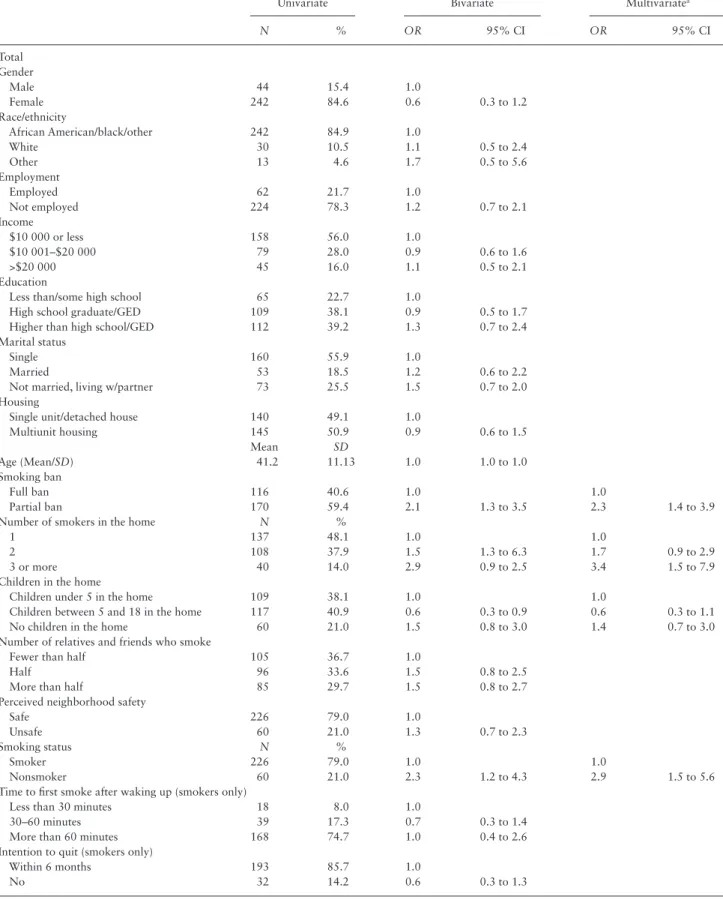
The sample was mostly female (84.6%), African American (84.9%), not employed (78.3%), and lived on an annual household income of $10 000 or less (56.0%; Table 1). Most were smokers (79.0%) who intended to quit smoking within the next 6 months (85.4%). Almost half of the households had just one smoker (48.1%), and the majority reported at least half of their friends and relatives smoked (63.3%). About half lived in multiunit housing (50.9%). More (59.4%) par-ticipants reported that smoking is allowed at some places or at some times (ie, partial ban) than reported a full ban (40.6%).
Table 1. Description of Study Participants and Correlates of Enforcement Challenges
Univariate Bivariate Multivariatea
N % OR 95% CI OR 95% CI
Total Gender
Male 44 15.4 1.0
Female 242 84.6 0.6 0.3 to 1.2
Race/ethnicity
African American/black/other 242 84.9 1.0
White 30 10.5 1.1 0.5 to 2.4
Other 13 4.6 1.7 0.5 to 5.6
Employment
Employed 62 21.7 1.0
Not employed 224 78.3 1.2 0.7 to 2.1
Income
$10 000 or less 158 56.0 1.0
$10 001–$20 000 79 28.0 0.9 0.6 to 1.6
>$20 000 45 16.0 1.1 0.5 to 2.1
Education
Less than/some high school 65 22.7 1.0
High school graduate/GED 109 38.1 0.9 0.5 to 1.7 Higher than high school/GED 112 39.2 1.3 0.7 to 2.4 Marital status
Single 160 55.9 1.0
Married 53 18.5 1.2 0.6 to 2.2
Not married, living w/partner 73 25.5 1.5 0.7 to 2.0 Housing
Single unit/detached house 140 49.1 1.0
Multiunit housing 145 50.9 0.9 0.6 to 1.5
Mean SD
Age (Mean/SD) 41.2 11.13 1.0 1.0 to 1.0
Smoking ban
Full ban 116 40.6 1.0 1.0
Partial ban 170 59.4 2.1 1.3 to 3.5 2.3 1.4 to 3.9
Number of smokers in the home N %
1 137 48.1 1.0 1.0
2 108 37.9 1.5 1.3 to 6.3 1.7 0.9 to 2.9
3 or more 40 14.0 2.9 0.9 to 2.5 3.4 1.5 to 7.9
Children in the home
Children under 5 in the home 109 38.1 1.0 1.0
Children between 5 and 18 in the home 117 40.9 0.6 0.3 to 0.9 0.6 0.3 to 1.1 No children in the home 60 21.0 1.5 0.8 to 3.0 1.4 0.7 to 3.0 Number of relatives and friends who smoke
Fewer than half 105 36.7 1.0
Half 96 33.6 1.5 0.8 to 2.5
More than half 85 29.7 1.5 0.8 to 2.7
Perceived neighborhood safety
Safe 226 79.0 1.0
Unsafe 60 21.0 1.3 0.7 to 2.3
Smoking status N %
Smoker 226 79.0 1.0 1.0
Nonsmoker 60 21.0 2.3 1.2 to 4.3 2.9 1.5 to 5.6
Time to first smoke after waking up (smokers only)
Less than 30 minutes 18 8.0 1.0
30–60 minutes 39 17.3 0.7 0.3 to 1.4
More than 60 minutes 168 74.7 1.0 0.4 to 2.6 Intention to quit (smokers only)
Within 6 months 193 85.7 1.0
No 32 14.2 0.6 0.3 to 1.3
CI = confidence interval; OR = odds ratio; GED = General Educational Development.
For those with full bans, exceptions were most commonly made for bad weather (11.2%) and for a party (12.9%). Those who were living in multiunit housing were more likely to report making excep-tions when there was a party (19.3% vs. 6.9%, P = .048) than those living in a single unit or detached house.
Although perhaps inappropriate to classify as exceptions among those with partial bans (ie, their rules may have allowed for these cir-cumstances), bad weather (69.4%) or having a party (52.9%) were commonly reported as reasons to allow smoking in the home. Being dark outside and special guests were also common reasons to allow smoking in the home, at 46.5% and 40%, respectively.
Participants with a partial ban reported higher rates of smoking in all rooms except children’s bedrooms compared with those who reported a full smoking ban. The most common rooms where smoking occurred among those with a partial ban were bathrooms (68.2%), family/living rooms (56.5%), and participants’ bedrooms (51.8%). Among those reporting a full ban, the relative frequency of the rooms was similar, but the rates were lower than in homes with partial bans.
Those with full bans reported SHS exposure on 0.66 days (SD = 1.73) in the past week, in contrast to those with partial bans who reported exposure on 3.1 days (SD = 2.71) in the past week (Table 2). The majority of those with a full ban reported no days of exposure at
home (78%), but 16% reported exposure on 1–3 days. Air nicotine levels were assessed in a subset of the households at 3 months, with a significant difference between households with a full ban (0.80 μg/m3, SD = 1.43) and a partial ban (4.03 μg/m3, SD = 7.22).
Predictors of Enforcement Challenges
In bivariate analyses, enforcement challenges were related to hav-ing a partial smokhav-ing ban, behav-ing a nonsmoker, and livhav-ing with three or more smokers (Table 1). In contrast, participants with “children between the ages of 5 and 18 in the home” reported fewer challenges.
In the multilevel model of factors associated with enforcement challenges, having children between the ages of 5 and 18 was not associated with fewer challenges, but the other relationships remained significant. Having a partial ban (OR = 2.3, CI = 1.4–3.9), being a nonsmoker (OR = 2.9, CI = 1.5–5.6) and living with three or more smokers (OR = 3.4, CI = 1.5–7.9) predicted higher levels of enforcement challenges.
Discussion
This study found that a relatively high proportion of households with newly established rules had at least occasional enforcement Table 2. Description of Full and Partial Home Smoking Bans, Including Exceptions and Secondhand Smoke Levels
Full ban, N = 116 Partial ban, N = 170 P
Frequency of rules broken
Never 52.6% 34.1%
Rarely 27.6% 34.7%
Sometimes 15.5% 21.8%
Very often 4.3% 9.4% .01
Reason for exceptions
Bad weather 11.2% 69.4% <.0001
Dark outside 4.3% 46.5% <.0001
Party 12.9% 52.9% <.0001
Special guests 4.4% 40.0% <.0001
Room where smoking sometimes occurs
Family/living room 12.1% 56.5% <.0001
Kitchen 6.9% 34.7% <.0001
Bathroom(s) 18.1% 68.2% <.0001
Participant’s bedroom 12.1% 51.8% <.0001
Other adult’s bedroom(s) 4.3% 23.6% <.0001
Children’s bedroom(s) 0.0% 0.6% .40
Most opposed to having total ban
Participant 11.2% 14.7% .39
Spouse 13.8% 11.8% .61
Child 9.5% 13.0% .36
Parent 3.5% 2.9% .81
Sibling 4.3% 2.4% .35
Roommate 3.5% 3.0% .82
Other resident 1.7% 4.1% .25
Other nonresident 2.6% 4.1% .49
Number of days exposure to SHS at home in past week, nonsmokers only
N = 50 N = 39
Mean, SD 0.66 (1.73) 3.10 (2.71) <.0001
0 days 78.0% 18.0%
1–3 16.0% 46.2%
4–6 0% 10.3%
7 6.0% 25.6% <.0001
Mean nicotine concentration, μg/m3 N = 79 N = 92
Mean (SD) 0.80 (1.43) 4.03 (7.22) <.0001
challenges. The situations that made it difficult to enforce bans were similar to those reported in our past qualitative research and other studies, including parties, bad weather, and special guests.9,10,19,27
Future research should examine whether exceptions to rules are com-mon as rules are newly integrated into family norms or if they indi-cate a household likely to return to former indoor smoking practices. Similar to legislative policies to ban SHS in public areas and work-sites, it is important for homes instituting bans to identify and han-dle exceptions or enforcement challenges.28 Prior qualitative research
examining enforcement issues has produced conflicting results across studies, with some reporting few enforcement challenges and oth-ers reporting that difficulties with enforcement were fairly com-mon.9,10,14,19 These studies have generally not examined households
with newly adopted rules and varied considerably in terms of local tobacco control context. Two reviews of interventions to reduce exposure to SHS smoke in the home demonstrated that many did not address enforcement challenges beyond when visitors smoke.29,30
Our finding suggest it is important for interventions to identify situ-ations when exceptions to home bans may occur and problem-solve potential solutions.
Our findings that households with three or more smokers, a non-smoker or a partial ban had greater difficulties with enforcement are not surprising. The number of smokers in the home is associated with the likelihood of rules,31 thus when rules are established, it is
likely that with more smokers in the home, at least one of them will resist the new rules. Nonsmokers are often the initiators of household smoking rules and may negotiate a tenuous rule not fully accepted by the smoker.19
Our findings serve as a reminder that asking about household smoking rules is not equivalent to assessing SHS exposure in the home. If the goal of a study is to assess SHS exposure, asking only about a household smoking rule may be less valid than ask-ing directly about exposure and/or measurask-ing exposure objectively through air nicotine monitors or biomarkers.32 If a more complete
assessment of household smoking practices is desired, a series of questions will provide more nuanced information.33
There are limitations to this study. The study sample was com-prised mostly of women and African American households who agreed to take part in an intervention study, which limits generaliz-ability to other populations. The data about exceptions to the home smoking ban is based on self-report from one respondent per house-hold. Finally, none of the participants had a full ban at baseline and the study had a follow-up period of 6 months. It is possible that recent ban adopters may still be working through exceptions and how to handle them.
Further research could explore strategies for successful enforce-ment of household smoking rules over a longer timeframe. Intervention support that continues for a period after initial estab-lishment of a household smoking rule may be useful in helping fami-lies to fully and permanently implement smoke-free home rules with no exceptions.
Funding
This publication was also supported by grant number U01CA154282 from the National Cancer Institute. This trial is registered with http://ClinicalTrials.gov number: NCT01625468.
Declaration of Interests
None declared.
References
1. U.S Department of Health and Human Services, Centers for Disease Control and Prevention. The Health Consequences of Involuntary
Exposure to Tobacco Smoke: A Report of the Surgeon General. Atlanta,
GA: U.S Department of Health and Human Services, Centers for Disease Control and Prevention; 2006. www.surgeongeneral.gov/library/reports/ secondhandsmoke/fullreport.pdf. Accessed November 15, 2014. 2. Wipfli H, Avila-Tang E, Navas-Acien A, et al. Secondhand smoke
expo-sure among women and children: evidence from 31 countries. Am J Public
Health. 2008;98(4):672–679. doi:10.2105/AJPH.2007.126631.
3. Zhang X, Martinez-Donate AP, Kuo D, Jones NR. “How is smok-ing handled in your home?”: agreement between parental reports on home smoking bans in the United States, 1995–2007. Nicotine Tob Res. 2012;14(10):1170–1179. doi:/10.1093/ntr/nts005
4. Centers for Disease Control and Prevention. Vital signs: nonsmokers’ exposure to secondhand smoke—United States, 1999–2008. MMWR
Morb Mortal Wkly Rep. 2010;59(35):1141–1146. www.cdc.gov/mmwr/
preview/mmwrhtml/mm5935a4.htm. Accessed November 15, 2014. 5. Centers for Disease Control and Prevention. Disparities in secondhand
smoke exposure—United States, 1988–1994 and 1999–2004. MMWR
Morb Mortal Wkly Rep. 2008;57(27):744–747.
www.cdc.gov/mmwr/pre-view/mmwrhtml/mm5727a3.htm. Accessed November 15, 2014. 6. Cheng KW, Glantz SA, Lightwood JM. Association between
smoke-free laws and voluntary smokesmoke-free-home rules. Am J Prev Med. 2011;41(6):566–572. doi:10.1016/j.amepre.2011.08.014.
7. Mills AL, White MM, Pierce JP, Messer K. Home smoking bans among US households with children and smokers. Opportunities for intervention.
Am J Prev Med. 2011;41(6):559–565. doi:10.1016/j.amepre.2011.08.016.
8. King BA, Dube SR, Homa DM. Smoke-free rules and secondhand smoke exposure in homes and vehicles among US adults, 2009–2010. Prev
Chronic Dis. 2013;10:E79. doi:10.5888/pcd10.120218.
9. Escoffery C, Kegler M, Butler S. Formative research on creating smoke-free homes in rural communities. Health Educ Res. 2009;24(1):76–86. doi:10.1093/her/cym095.
10. Glover M, Kira A, Johnston V, Walker N, Brown N, Thomas D. Australian and Newe Zealand indigenous mothers report respect for smoking bans in homes. Women Birth. 2015;28(1):1–7. doi:10.1016/j.wombi.2014.09.004. 11. Hood NE, Ferketich AK, Klein EG, Wewers ME, Pirie P. Smoking behav-iors and cessation interests among multiunit subsidized housing tenants, Columbus, Ohio, 2011. Prev Chronic Dis. 2013;10:E108. doi:10.5888/ pcd10.120302.
12. Halterman JS, Fagnano M, Conn KM, Lynch KA, DelBalso MA, Chin NP. Barriers to reducing ETS in the homes of inner-city children with asthma.
J Asthma. 2007;44(2):83–88. doi:10.1080/02770900601180545.
13. Robinson J, Kirkcaldy AJ. Disadvantaged mothers, young children and smoking in the home: mothers’ use of space within their homes. Health
Place. 2007;13(4):894–903. doi:10.1016/j.healthplace.2007.03.001.
14. Bottorff J, Johnson J, Carey J, et al. A family affair Aboriginal women’s efforts to limit second-hand smoke exposure at home. Can J Public Health
Revue. 2010;101(1):32–35. www.jstor.org/stable/41996097?seq=1#page_
scan_tab_contents. Accessed June 11, 2015.
15. Kegler MC, Bundy L, Haardorfer R, et al. A minimal intervention to promote smoke-free homes among 2-1-1 Callers: a randomized con-trolled trial. Am J Public Health. 2015;105(3):530–537. doi:10.2105/ AJPH.2014.302260.
16. Kreuter MW, Eddens KS, Alcaraz KI, et al. Use of cancer control referrals by 2-1-1 callers: a randomized trial. Am J Prev Med. 2012;43(6)(suppl 5):S425–434. doi:10.1016/j.amepre.2012.09.004.
17. Centers for Disease Control and Prevention. Behavioral Risk Factor Surveillance System. 2008. www.cdc.gov/brfss/questionnaires/pdf-ques/2008brfss.pdf. Accessed November 15, 2014.
18. Hovell MF, Adams MA, Hofstetter CR, et al. Complete home smoking bans and antitobacco contingencies: a natural experiment. Nicotine Tob Res. 2014;16(2):186–196. doi:10.1093/ntr/ntt130.
smoking restrictions. Fam Community Health. 2007;30(4):328–341. doi:10.1097/01.FCH.0000290545.56199.c9.
20. Norman GJ, Ribisl KM, Howard-Pitney B, Howard KA. Smoking bans in the home and car: do those who really need them have them? Prev Med. 1999;29(1, pt 6):581–589. doi:10.1006/pmed.1999.0574.
21. CDC/WHO. Global Youth Tobacco Survey Core Questionnaire with Optional Questions. July 2012. http://nccd.cdc.gov/GTSSData/Ancillary/ Documentation.aspx?SUID=1&DOCT=1. Accessed August 11, 2015. 22. Fava JL, Velicer WF, Prochaska JO. Applying the transtheoretical model to
a representative sample of smokers. Addict Behav. 1995;20(2):189–203. doi:10.1016/0306-4603(94)00062-X.
23. Blazer DG, Sachs-Ericsson N, Hybels CF. Perception of unmet basic needs as a predictor of mortality among community-dwelling older adults. Am J Public Health. 2005;95(2):299–304. doi:10.2105/ AJPH.2003.035576.
24. Hudmon KS, Mullen PD, Nicol L, et al. Telephone-guided placement and removal of nicotine monitors for the assessment of passive exposure to environmental tobacco smoke. Toxicol Ind Health. 1997;13(1):73–80. http://europepmc.org/abstract/med/9098952. Accessed November 15, 2014.
25. Berg CJ, Bundy L, Escoffery C, Haardörfer R, Kegler MC. Telephone-assisted placement of air nicotine monitors to validate self-reported smoke-free home policies. Public Health. 2013;127(4):342–344. doi:10.1016/j. puhe.2013.01.002.
26. Navas-Acien A, Peruga A, Breysse P, et al. Secondhand tobacco smoke in public places in Latin America, 2002–2003. JAMA. 2004;291(22):2741– 2745. doi:10.1001/jama.291.22.2741.
27. Wakefield M, Banham D, Martin J, Ruffin R, McCaul K, Badcock N. Restrictions on smoking at home and urinary cotinine levels among chil-dren with asthma. Am J Prev Med. 2000;19(3):188–192. doi:10.1016/ S0749-3797(00)00197-5.
28. Callinan JE, Clarke A, Doherty K, Kelleher C. Legislative smoking bans for reducing secondhand smoke exposure, smoking prevalence and tobacco consumption. Cochrane Database Syst Rev. 2010;(4):CD005992. http://onlinelibrary.wiley.com/doi/10.1002/14651858.CD005992.pub2/ pdf/. Accessed November 15, 2014.
29. Priest N, Roseby R, Waters E, et al. Family and carer smoking control programmes for reducing children’s exposure to environmental tobacco smoke. Cochrane Database Syst Rev. 2008;(4):CD001746. http://onlineli-brary.wiley.com/doi/10.1002/14651858.CD001746.pub2/pdf/. Accessed November 15, 2014.
30. Gehrman CA, Hovell MF. Protecting children from environmental tobacco smoke (ETS) exposure: a critical review. Nicotine Tob Res. 2003;5(3):289– 301. doi:10.1080/1462220031000094231.
31. Kegler MC, Malcoe LH. Smoking restrictions in the home and car among rural Native American and white families with young children. Prev Med. 2002;35(4):334–342. doi:10.1006/pmed.2002.1091.
32. Avila-Tang E, Elf JL, Cummings KM, et al. Assessing secondhand smoke exposure with reported measures. Tob Control. 2013;22(3):156–163. doi:10.1136/tobaccocontrol-2011-050296.