Proceedings of the
Third International Workshop on
Foundations and Techniques for
Open Source Software Certification
(OpenCert 2009)
Model-based Testing and Analysis of Coordinated Components
Gabriel Ciobanu and Dorel Lucanu
11 pages
Guest Editors: Luis Barbosa, Antonio Cerone, Siraj Shaikh
Managing Editors: Tiziana Margaria, Julia Padberg, Gabriele Taentzer
Model-based Testing and Analysis of Coordinated Components
Gabriel Ciobanu1and Dorel Lucanu2
Institute of Computer Science, Romanian Academy and A.I.Cuza University of Ias¸i, Romania
Faculty of Computer Science, A.I.Cuza University Ias¸i, Romania
Abstract: Software components are common in the open source community. These components can be specified in model languages like AsmL or JML by using contracts (preconditions, postconditions). Starting from an integrated specification (components, coordinating process, wrapper), a model program is defined and used to define the formal semantics of the whole system. The relationship between co-ordinator and components are expressed as a bisimulation. The model program can be used for conformance testing and generating test case suites when working with closed systems, and for scenario-based testing when working with reactive systems.
Keywords: components, coordination, process algebra, model program, testing
1
Introduction
We refer to components interacting with each other and with their environment according to a coordinating process. Languages like Java can model this kind of coordination at a low level of abstraction (threads communicate through shared variables). Such a low level approach does not allow the composition of different coordination policies without changing the implementation of the coordinated entities. If the level of abstraction is higher, the integration of the coordina-tion and computacoordina-tion modules becomes non-trivial, and only few good programmers are able to handle it. These difficulties are triggered by no separation of concerns (expressing coordination abstraction is difficult because the code of coordination is strongly tied to the implementation of the coordinated objects), by the absence of abstraction (no declarative means to specify coordi-nation), and by the lack of compositionality and flexibility.
de-fined a formal framework for systems of components coordinated by a process. The components (objects) are specified in hidden algebra [10], the coordinating process is described in process algebra [11], and a wrapper is expressed as a function mapping the coordinating process actions to sequences of method calls. The integrated semantics of the components, coordinating process and wrapper is given by a bisimulation relation which exhibits how the transitions of the coor-dinating process are related to the transitions between the configurations given by components. Such an approach is independent of the way how the components are specified.
This paper describes formal methods that can be used to the certification of component-based software systems; we consider components specified in a modelling language like AsmL1(see
http://www.codeplex.com/AsmL) or JML (seehttp://sourceforge.net/projects/jmlspecs), both sidered as open source tools. An advantage of a modelling language is given by the use of con-tracts (preconditions, postconditions). Such a contract establishes both the obligations of the method caller (precondition) and what a method guarantees for a correct call (postcondition). The design by contracts of the object oriented systems also uses the class invariants. In order to keep the presentation as simple as possible, the invariants are not considered in this paper. We specify the components via pre- and post-conditions on object methods, a coordination process via a CCS process algebra, and the wrapper as a mapping of (parameterized) pairs of actions to sequences of components methods.
We use a notion of wrapper to express the coordination, and build formally a model program defining the state variables and the update rules of an abstract state machine. The model program can be used for conformance testing and generating test case suites for closed systems, and for scenario-based testing for reactive systems. The synchronization between components and the coordinator can be defined as a bisimulation by using the labelled transition systems described as coalgebras. The model together with the way how the components can work concurrently under the coordination of a process expressed in a process algebra style are illustrated by an example describing the interaction between an ATM (Automatic Teller Machine) and a bank.
2
Specification of Coordinated Components
We deal with systems consisting of three main parts: coordinated components, a coordinator, and a means by which the coordinator controls the activity of the coordinated components. We model the coordinator as a term of process algebra, the coordinated components as objects, and the means of coordination as a wrapper.
We consider an example where the interaction between an ATM and a bank is described. The interaction between a customer and an ATM is not included here; we abstractly represent a customer by a card, a user PIN (personal identification number) and a user amount. Using an ATM, customers can access their bank accounts in order to make cash withdrawals and check their account balances. Typically, a user inserts into the cash machine a card encoded with information on a magnetic strip. To prevent unauthorized transactions, a PIN must be entered by the user. If the account is accessible, the bank and the ATM complete the transaction; most ATMs can dispense cash, and provide information on account balances.
2.1 Components Specified by Contracts
The component specification includes information about how to use the component, and what it does from the clients viewpoint. These aspects could be described by a collection of attributes and methods. The attributes are represented by a collection of variables, and the methods are specified by preconditions and postconditions.
We start by specifying an ATM component. An ATM has five attributes: availAmount = the amount of money available in the machine, isCardInserted= a boolean attribute which is true if and only if a card is inserted in the ATM,cardPIN= the PIN number of the inserted card (if any), cardNumber= the number of the inserted card (if any), and amount = the amount of money introduced by a customer (if any). Another possible attribute is given by the messages displayed on the ATM screen. The interface with a customer is specified by five methods. A method readCard describes the action performed by the machine when a card is inserted; its precondition is given by therequireexpression, and its postcondition is given by the conjunction ofensureexpressions. A card is represented by a structure with two fields: PINand number. The other methods of the interface with a user areenterPIN(), askBalance(),enterAmount(), and releaseCard(). The full specification of these methods is omitted here. On the other hand, the interface with a bank is specified by means of four methods. Since in what follows we describe the interaction between an ATM and a bank, we provide a full specification for these methods−their description using the AsmL syntax is almost self-explanatory.
class ATM
var availAmount as Integer var insertedCard as Card? var enteredAmount as Integer var enteredPin as Integer isCardInserted() as Boolean
return insertedCard <> null // interaction with a user readCard(newCard as Card)
require isCardInserted() = false
ensure resulting insertedCard = newCard readPin(newPin as Integer)
... wrongPin()
...
askBalance() ...
displayBalance() ...
readAmount(newAmount as Integer) ...
releaseCard() ...
// interaction with a bank
displayMessage(msg as MessageType) require isCardInserted() = true displayBalance(bal as Integer)
cash()
require isCardInserted() = true require enteredAmount <= availAmount
ensure resulting availAmount = availAmount - enteredAmount
A bank is abstractly specified as a set of accounts. The specification of an account is given by a structure with three fields: the card number, the balance, and a boolean attributeisAccessible which is true if and only if the account is not blocked or closed. The value of this attribute can be changed by the interaction with other components (not included here).
The interface of a bank with an ATM uses an auxiliary function getAccountwhich re-turns the bank account corresponding to a given card number. The first two methods are rather constraints than operations: they can be executed only if their preconditions are satisfied by the current state. They do not change the state, and neither return a value.
class Bank
var accounts as Set of BankAccount // auxiliary methods
getAccount(aCardNumber as Integer) as BankAccount
return the A | A in accounts where A.number = aCardNumber // interface with an ATM
notAccessible(aCardNumber as Integer)
require getAccount(aCardNumber).isAccessible = false notEnoughMoney(aCardNumber as Integer, anAmount as Integer)
require getAccount(aCardNumber).balance < anAmount getBalance(aCardNumber as Integer) as Integer
require getAccount(aCardNumber).isAccessible = true ensure result = getAccount(aCardNumber).balance grantMoney(aCardNumber as Integer, anAmount as Integer)
require getAccount(aCardNumber).balance >= anAmount and getAccount(aCardNumber).isAccessible = true ensure resulting getAccount(aCardNumber).balance =
getAccount(aCardNumber).balance - amount
Preconditions and postconditions describe properties of individual methods. Additional infor-mation is necessary with respect to the global properties or the interaction between objects.
2.2 Coordinating Process Specification
The state of the art in coordination models for systems of agents is presented in [3, 13]. Our model is a channel-based coordination model; Manifold [1] is a prototype for this class. Manifold is based on the Ideal Worker Ideal Manager (IWIM) model, and it has basically two kinds of processes: manager and worker. The manager coordinates the workers and the communications among them. The workers are computational processes which are not aware of who needs the results of their work, or to whom they communicate to. Manifold is also event-driven: managers wait for some specific event to trigger some actions; these actions determine the manager to change its state.
some equations, as you can see in Figure1. Process A corresponds to an arbitrary ATM. Inter-action is started by inserting the card, i.e. by an equation A=ins.A1meaning that an action ins
is followed by a process expression A1. A1is a nondeterministic choice rel.A+ep.A2, where the
first expression is releasing the card (when the user decides to press “Cancel” button) followed by starting a new process A, and the second expression describes the action ep of entering a PIN followed by a process A2. A2represents a nondeterministic choice between na.A, rel.A, wp.A1,
ab.A3 and ea.A4. This means that it is possible to get either a non-accessible account message
(na), or to cancel the whole process (rel), or to enter a wrong pin (wp), or to ask balance (ab), or to enter an amount in order to cash it (ea). Both actions na and rel are followed by A, while ab is followed by an action gb of getting the balance and then executing process A2again. Finally ea is followed by a nondeterministic choice between either nem action of receiving a message “Not Enough Money” or getting money (gm). A local action act can involve the existence of its
A=ins.A1 and B=na.B+gb.B+nem.B+gm.B
where
A1=rel.A+ep.A2 A2= (na+rel).A+wp.A1+ab.A3+ea.A4
A3=gb.A2 A4=nem.A2+gm.A5 , A5=rel.A
Figure 1: Coordinating process for an ATM and a bank
complementary local action denoted by act (also, the complementary action of act is act). These two complementary local actions establish a synchronization between components. Process B represents a bank. In our description, a bank can either send a ”Not Accessible” message (na), offering the balance (gb), send a message “Not Enough Money” (nem), or offering the required amount (gm).
The interaction between an arbitrary ATM and an arbitrary bank is described by A|B. We prefer to see the above process specification rather as a parametric one. Given a concrete ATM denoted by atm and a concrete bank bank, then their interaction is given by Ahatmi |Bhbanki. A coordinating process specification is finally given by equations of parametric process expres-sions. For example, the specification of A=ins.A1 related to a specific cash machine atm is
given by Ahatmi=inshatmi.A1hatmi. This allows to extend the specification of many ATMs
and one bank by Ahatm1i |Ahatm2i |. . .|Bhbanki. The case of two banks and their ATMs can
be described as(Ahatm1i |. . .|Bhbanki) + (Ahatm
′
1i |. . .|Bhbank
′i). Assuming that we have a specification for an arbitrary user U , then the interaction between a specific user, a specific atm, and a specific bank is given by Uhuseri |Ahatmi |Bhbanki. The evolution of such a system is described by a labelled transition system defined by the operational semantics of the process algebra [11].
2.3 Wrapper
separation of concerns, offering a suitable abstract level for designing large component-based systems without losing the details of low level implementation of components. Such a spec-ification has similarities with an orchestra, where independent players are synchronized by a conductor. The link between the players and the coordinating conductor is given by certain en-try moments and orchestral scores. The wrapper instructs the players according to the scores in order to implement the desired resulting music. Therefore the wrapper instructs the components by using necessary information for their executions in order to realize a coordinated interaction. An interaction realized by two complementary actions is denoted byτ. For instance, we denote byτ(gb(atm),gb(bank))the interaction between an action gb of getting the balance at atm and its complementary action gb of providing the balance by bank. For instance, the wrapper w for the system of coordinated components described previously has the following definitions for the interactions between atm and bank:
w[τ(gb(atm),gb(bank))] =atm.displayBalance(bank.getBalance))
w[τ(na(atm),na(bank))] =bank.notAccessible(); atm.displayNotAccessible();
atm.release()
w[τ(nem(atm),nem(bank))] =atm.displayNotEnoughMoney()
w[τ(gm(atm),gm(bank))] =bank.grantMoney(); atm.cash()
Formally, a wrapper w(c1, . . . ,cn)for a process P(c1, . . . ,cn) =P1hc1i | |P2hc2i |. . .|Pnhcni
as-sociates a program w[act]for each action label act such that there is a labelled transition p−→act q in the operational semantics of P(c1, . . . ,cn). The program w[act]is expressed in terms of the
components involved in such a transition (they do not depend on the particular processes p and q). Recall that act is either of the form ahcii (action a of component ci) or of the form τ(ahcii,ahcji)(interaction between components ci and cjaccording to their complementary
ac-tions a and a). Such a wrapper provides a computational meaning to each action of the coor-dinating process. According to the computational meaning behind each action, an interaction between two components can be a synchronization or a communication. A synchronization is provided by the sequential or concurrent executions of methods from the two components, and a communication consists in using the attributes of a component as parameters for methods of the other component (it appears as an interaction between a method and an attribute). Essen-tially the wrapper binds the actions of the coordinating process to the components methods. For instance, w[τ(gm(atm),gm(bank))] corresponds to the sequence of method calls, namely the method grantMoney()of the component bank, followed by cash()and release()of the compo-nent atm.
2.4 Formal Semantics
state s′ where some state variables have changed. A model program can be written using a high level program language as AsmL (http://www.codeplex.com/AsmL). A model program M defines a labelled transition systemLTS(M)obtained by unwinding M (see [16] for more details). A simple example is given by a model program M(c)for a component c. The state variables are given by the component attributes, and the action methods by (a subset of) the component methods. Pre(c.m)is the precondition of the method m, and Update(c.m)includes the updates
of the attributes according to the postconditions. For instance, the postcondition of ATM::cash()
produces the updateavailAmount := availAmount - enteredAmount. We assume that the postconditions of the methods can be expressed as updates of the attributes; modelling languages like AsmL are powerful enough to satisfy this requirement for many practical cases. We consider the specification of a component as a non-modal class, i.e., the only constraints over the methods calls sequences are those given by the methods preconditions. In other words, the call of a method is allowed in any state satisfying its precondition.
Another example is given by a model program M(w,c1, . . . ,cn)given by a wrapper w[c1, . . . ,cn].
The state variables are given by c1, . . . ,cn, and the action methods are given by the guarded
programs corresponding to w[act]. Pre(w[act]) is given by either the weakest precondition wp(w[act],true) or by a verification condition [12, 14]. Update(w[act]) modifies the individ-ual state of each ci according to postconditions of the involved methods. Let us assume that w[act]is written using method calls, parallel composition kand sequential composition ; . For a method call ci.m(z), Update(ci.m(z))is the same as that for the model defined by component
ci. For a parallel composition, Update(S1kS2) =Update(S1)kUpdate(S2), and for a sequential composition, Update(S1; S2) =Update(S1); Update(S2).
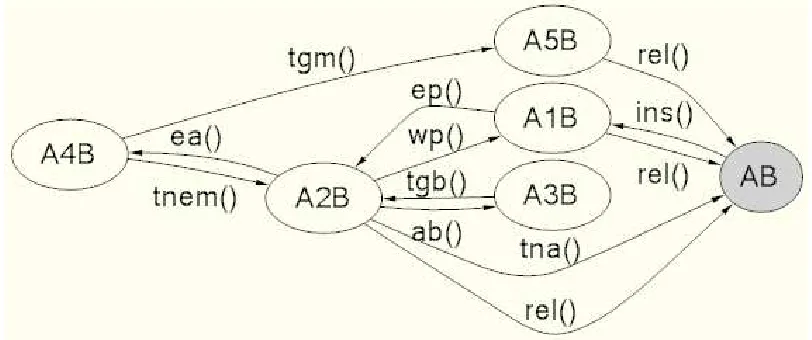
Figure 2: Transition graph for the coordinating process
We describe now the model program M=M(C,P,w,c1, . . . ,cn)defined by a specificationC
of components, a coordinating process P(c1, . . . ,cn)for the components c1, . . . ,cn, and a wrapper
w for P(c1, . . . ,cn)withC. We proceed in a reversed order: first we define a labelled transition
systemLTS, and then we build the model over the skeleton of thisLTS. The specification of a process P(c1, . . . ,cn)defines a finiteLTS(P) [8]. The transition graph corresponding to the
A1B to A1hatmi |Bhbanki, and so on. The transition tgm() corresponds toτ(gm(atm),gm(bank)); similar for tgb(), tna(), and tnem().
LTS(P) can be easily described as a model program M(P) with a single state variable vp
ranging over the states (as an enumerating type), and with the action methods correspond-ing to the ones in P. If act is such an action, Pre(act) is∨p∈Src(a)vp= p and Update(act) is
+q∈Tar(a)vp := q, where Src(act) ={p|p−→act q∈LTS(P)}, Tar(act) ={q|p−→act q∈LTS(P)}, and+denotes the nondeterministic choice operator. The state variables of M(C,P,w,c1, . . . ,cn)
are those from M(w,c1, . . . ,cn) together with vp. The action methods are the ones of M(P)
enriched with the preconditions and updates of the corresponding action from M(w,c1, . . . ,cn):
PreM(act) =PreM(P)(act)∧Pre(w[act]), and UpdateM(act) =UpdateM(P)(act)kUpdate(w[act]).
The relationship between M, M(P)and M(w,c1, . . . ,cn)can be expressed in terms of
bisimu-lations, as it is also presented in [4]. We just mention here the main construction and result. We consider the labelled transition systems as coalgebrasγ: X→TLTS(X), where
• TLTS:Set→Setis the functor given byTLTS(X) ={Y ⊆A×X|Y finite},
• Setis the category of sets,
• A is the set of action names,
• γis the labelled transition system given by x−→act y iff (a,y)∈γ(x).
The fact that M is a bisimulation between M(P) and M(w,c1, . . . ,cn)is expressed by the
com-mutativity of the following diagram:
State ←−−−−π1 State×Proc −−−−→π2 Proc
LTS(M(w,c1,...,cn)) y y
LTS(M)
y
LTS(P)
TLTS(State) ←−−−−−
TLTS(π1)
TLTS(State×Proc) −−−−−→
TLTS(π2)
TLTS(Proc)
We exemplify the construction of M by considering the action tgm. Recall that w[tgm] =
bank.grantMoney(); atm.cash(). The method action tgm() in M is obtained from the
correspond-ing one given in M(P):
[Action] tgm()
require (vp = A4B) vp := A5B
by adding the conjunction of the preconditions of the methodsBank::grantMoney()and ATM::cash()together with the updates given by their postconditions.
The new obtained method is:
tgm()
// precondition require (vp = A4B)
require atm.enteredAmount <=
bank.getAccount(atm.insertedCard.number).balance require atm.enteredAmount <= atm.availAmount
require bank.getAccount(atm.insertedCard.number).isAccessible = true // updates
getAccount(atm.insertedCard.number).balance :=
getAccount(atm.insertedCard.number).balance - atm.enteredAmount atm.availAmount := atm.availAmount - atm.enteredAmount
In order to respect the encapsulation principle, we may include the updates of the balance and available amount in the two methods Bank::grantMoney()and ATM::cash(), respec-tively. Then, we replace the two updates in the action tgm()with the calls of the two methods.
3
Testing and Analysis
A systemS = (C,P,w,c1, . . . ,cn)of coordinated components is called closed if the specification
of P does not include global actions. This means that theLTSof P(c1, . . . ,cn)has only decorated silent transitionsτ(a,a). The corresponding action methods in M are called controllable [2,16].
In other words, in a closed system we have only controllable actions. For instance, the system described in our examples becomes closed if a component User is added. The coordinator indi-cating how a user can interact with an ATM is
U=ins.U1 U1=rel.U+ep.U2
U2=rel.U+wp.U1+ab.U2+ea.U3 U3=rel.U
The wrapper gives a model program for each interaction (e.g,τ(rel(atm),rel(user)). For these closed systems, the model program M=M(C,P,w,c1, . . . ,cn)can be used for conformance
test-ing and generattest-ing test case suites. Both tests are lytest-ing on the same basic technique: define a subset of acceptance states in M, and compute all the paths connecting the initial state with an acceptance state. Such a path is called a trace. An example of such a trace is tins()(insert a card), tep()(enter a pin), tea()(enter an amount), tnem()(the bank sends “not enough money”), trel()(release the card). In conformance testing, the implementation under test (IUT) is checked if it is able to follows all the traces. Of course, we consider only implementations built with components satisfying the specification C. To generate a test case suite, we have to find for
each trace suitable instances for components c1, . . . ,cn such that IUT having as “input” these
instances follows exactly the corresponding trace. For the trace mentioned above, the test case must include a user, an atm, and a bank such that the user has correctly introduces the pin, has an account at the bank, but the balance is less than the required amount. This can be reached by computing the path condition [15] for the trace, and then using an automated prover for finding a satisfiability witness for this condition.
Given some components c1, . . . ,cn,LTS(M(C,P,w,c1, . . . ,cn)is usually a subsystem ofLTS(P)
because of the methods preconditions. Thus the traces are defined according to LTS(P). A problem appears when for each trace we can find suitable c1, . . . ,cn such that the trace is in
LTS(M(C,P,w,c1, . . . ,cn). We refer to this problem as a consistency problem between the
spec-ificationC of the components and the specification of the coordinating process P, because it is
equivalent to checking whether the components are able to perform all the interactions specified by the coordinator. This problem can be solved in a similar way to that of the test case generation.
A systemS = (C,P,w,c1, . . . ,cn)of coordinated components is a reactive system if the
actions. The model M(C,P,w,c1, . . . ,cn)for a reactive system could be used for scenario-based
testing using the technique described in [16]. For instance, the scenario suggested above must be explicitly given by describing the “reactions” of the user by setting the values for enteredPin and enteredAmount.
4
Conclusion and Related Work
The paper presents a technique that can be used to apply formal methods to the certification of component-based software systems, e.g. for conformance testing and generation of test case suites. A model for a given specification is defined by the components contracts, a specifica-tion of the coordinating process, and a wrapper binding the coordinaspecifica-tion acspecifica-tion to sequences of the components method calls. We use a notion of wrapper in order to express the coordination between components. The formal semantics is given by a model program, and the relationship between coordinator and components can be expressed as a bisimulation. Such a model can benefit from the practical model-based testing tools. The model program can be used for confor-mance testing and generating test case suites for closed systems, and for scenario-based testing for reactive systems. We exemplify our approach by a system consisting of an ATM and a bank.
Previously the authors have introduced and used hiddenCCS in [5,6] as a formal specification framework based on hidden algebra and CCS. Such a specification extends the object specifica-tion with synchronizaspecifica-tion and communicaspecifica-tion elements associated with methods and attributes of the objects. Then hiddenCCS is extended in [4] to a specification language with a syntax closer to object-oriented languages. We use Maude in [4] to give an algebraic semantics of this specification language, and show how this semantics can be used to verify the system against temporal properties. The specification of the components for a communication protocol by using a language having strong features of the object-oriented programming is presented in [9]. We also describe the extraction of a Kripke structure from the specification of a system of coordi-nated objects, and we use it to verify the correctness of a communication protocol.
Bibliography
[1] F. Arbab, I. Herman, P. Spilling. An Overview of Manifold and its Implementation. Con-currency: Practice and Experience 5(1), pp.23–70, 1993.
[2] E. B ¨orger, R. St¨ark. Abstract State Machines A Method for High-Level System Design and Analysis, Springer, 2003.
[3] N. Busi, P. Ciancarini, R. Gorrieri, G. Zavattaro. Coordination Models: A Guided Tour. Coordination of Internet Agents: Models, Technologies, and Applications, Springer, pp.6– 24, 2001.
[4] G. Ciobanu, D. Lucanu. A Specification Language for Coordinated Objects. ACM SIG-SOFT Software Engineering Notes 31(2), ACM Press, 2006.
[6] G. Ciobanu, D. Lucanu. Communicating Concurrent Objects in HiddenCCS. Electronic Notes in Theor. Comp. Sci. 117, pp.353–373, 2005.
[7] E.M. Clarke, O. Grumberg, D.A. Peled. Model Checking. MIT Press, 2000.
[8] R. Cleaveland, J. Parrow, B. Steffen. The Concurrency Workbench: a semantics-based tool for the verification of concurrent systems. ACM TOPLAS 15(1), ACM Press, pp.36–72, 1993.
[9] M. Danes¸, G. Ciobanu, D. Lucanu. Specification of Coordinated Objects and Verification of Their Temporal Properties. 7th SYNASC, IEEE Computer Society, pp.259–266, 2005.
[10] J. Goguen, G. Malcolm. A Hidden Agenda. Theoretical Computer Science 245(1), pp.55– 101, 2000.
[11] R. Milner. Communicating and Mobile Systems: theπ-calculus. Cambridge University Press, 1999.
[12] G. Nelson. A Generalization of Dijkstra’s Calculus. ACM Transactions on Programming Languages and Systems, 11(4)m pp. 517-561, 1989.
[13] G.A. Papadopoulos. Models and Technologies for the Coordination of Internet Agents: a Survey. Coordination of Internet Agents: Models, Technologies, and Applications, Springer, pp.25–56, 2001.
[14] C. Pierika, F. S. de Boer A Proof Outline Logic for Object-Oriented Programming. Theo-retical Computer Science 343(3), pp.413–442, 2005.
[15] G. Snelting , T. Robschink , J. Krinke. Efficient Path Conditions in Dependence Graphs for Software Safety Analysis. ACM Transactions on Software Engineering and Methodology 15(4), pp.410–457, 2006.