Volume 73 (2016)
Graph Computation Models
Selected Revised Papers from GCM 2015
Conditions, constraints and contracts: On the use of annotations for
policy modeling
Paolo Bottoni, Roberto Navigli, Francesco Parisi Presicce
20 pages
Guest Editors: Detlef Plump
Managing Editors: Tiziana Margaria, Julia Padberg, Gabriele Taentzer
Conditions, constraints and contracts: On the use of annotations for
policy modeling
Paolo Bottoni1, Roberto Navigli1, Francesco Parisi Presicce1
1Universit`a di Roma “Sapienza”
Abstract: Organisational policies express constraints on generation and process-ing of resources. Application domains, however, rely on transformation processes, which are in principle orthogonal to policy specifications, so that domain rules and policies may evolve in a non-synchronised way. In previous papers, we proposed annotations as a flexible way to model aspects of some kinds of policy. Annotations could be used to imposeconstraintson domain configurations, and we showed how to derive applicationconditions on transformations, and how to annotate complex patterns. We extend the approach here in different directions: we allow domain model elements (individual resources or collections thereof) to be annotated with collections of elements; we propose an original construction to solve the problem
of orphan annotations, when annotated resources are consumed; we introduce a
notion ofcontract, used by a policy to impose additional pre-conditions and post-conditions on rules for deriving new resources. We also show how contracts for refined rules can be derived from contract schemes defined on some rule kernel. We discuss a concrete case study of linguistic resources, annotated with information on the licenses under which they can be used. The annotation framework allows forms of reasoning such as identifying conflicts among licenses, enforcing the presence of licenses, or ruling out some modifications of a licence configuration.
Keywords:Contracts, Annotations, Licenses, Policies
1
Introduction
Organisational policies express constraints on generation and processing of resources which are accepted by agents subject to, or anyway acknowledging, the organisation authority. Agents, however, retain the ability to operate on such resources according to their own strategies, as long as the results of these operations conform to the policy, or are used in areas not subject to it.
In [BP13a,BP13b] we proposed the usage of annotations as a flexible way to indicate the as-pects for which domain model elements can fall under some policy, and showed how annotations can be used to imposeconstraintson configurations of domain resources, how to derive appli-cationconditionson their transformations, and how to annotate complex patterns. In particular, this allows the management of situations in which access policies change, or different policies have to be applied simultaneously. Annotations are indeed a way of flexibly associating elements of different domains, and a number of techniques have been developed to express the constraints imposed on transformations modeling the evolution of elements in anapplicationdomain, when they are subject to constraints depending on annotations with elements of acontextualdomain.
We extend the notion of annotation in four directions: first we propose an original construction for transformations of annotated models, which solves the problem oforphan annotations, i.e., dangling annotation when annotated resources are consumed. Second, we allow domain model elements to be annotated withcollectionsof elements from the annotations domain, which can be collectively applied to individual elements or collections thereof. Third, we consider violations of constraints induced by the creation of elements for which an annotation must be provided and defineconstraint repair actionsto solve such situations. Finally, we introduce a notion of
contract, by which a policy imposes additional pre- and post-conditions on rules for deriving new
resources. Contracts are naturally generalised to be viewed ascontract schemes, which allows the derivation of contracts on rules refining a kernel rule to which the original contract applied.
Again, the use of contracts and contract schemes leads to an original notion of transformation under contracts. In all the considered cases, the definition of transformations relies on the specific features of annotations and classical categorial constructions.
Paper organisation.After recalling fundamental notions in Section2, we provide a construction for avoiding orphan annotations in Section3and introduce a motivational case study, concerning linguistic resources annotated with licenses, in Section4. This is used in Section5to illustrate the model for rewriting under annotation constraints and contracts. Section6presents the extension to contract schemes. After revising related work in Section7, Section8concludes the paper.
2
Preliminaries
Graphs and morphisms.We recall classical notions from graph transformation theory (see [EEPT06]).
Definition 1(Graph) A (directed)graphis a constructG= (VG,EG,s,t), whereVGis a set of
nodes,EGis a set ofedges,s:EG→VGandt:EG→VGare thesourceandtargetfunctions.
Definition 2(Graph morphism) Given two graphs G1 andG2 a morphism µ:G1→G2 is a
pair of functionsµV:VG1 →VG2, µE:EG1→EG2 such thatµE preserves the images of sources and targets, i.e. fore∈Ewe have:s2(µE(e)) =µV(s1(e))andt2(µE(e)) =µV(t1(e)).
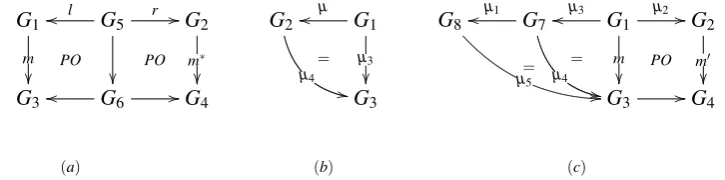
We use morphisms for a number of purposes, some of which exemplified through Figure1.
Typing. ForG1a graph, andGT atype graph(such thatVG1∩VGT =/0,EG1∩EGT =/0),µT:G1→
GT is atyping morphismifµ is total. GivenG1andG2 typed on the sameGT,µ:G1→
G1
m
PO
G5
l
o
o r //
PO
G2
m∗
G2
µ4
,
,
=
G1
µ
o
o
µ3
G8
µ5
.
.
=
G7
µ1
o
o
µ4
,
,
=
G1 µ2 //
µ3
o
o
m
PO
G2
m′
G3oo G6 //G4 G3 G3 //G4
(a) (b) (c)
Figure 1: (a) DPO Derivation, (b) satisfaction of constraint, (c) SPO derivation with AC.
extended to attributed typed graphs defining specific sets of attributes for them. A node of a certain type will be associated with a value for each of the attributes defined by the type.
Transformation rule. One (as in the Single Pushout Approach, SPO, see Figure1(c)) or two (as in the Double
Pushout Approach, DPO, see Figure1(a)) type-preserving morphisms are used to define rules. In either case, a rulepidentifies a graphG1and the applicability ofpto a graphG3
depends on the existence of a total type-preserving morphismm:G1→G3. If a rulepis
applied to a graphG3to produce graphG4, we write(G3,G4)∈=⇒p.
Constraint. µ:G1→G2defines aconstrainttogether with a satisfaction relation∣=. For any graphG3,
G3∣=µ iff for each morphismµ3:G1→G3, there exists a morphismµ4:G2→G3such
that the triangle of Figure1(b) commutes1. Anegativeconstraint, denoted by¬µ:G1→ G2, is satisfied by G3 if no such morphism µ4 exists for some µ3. The particular case
¬µ:G1→G1, defines aforbidden graphand is represented by the single graphG1.
Application condition. Given a (DPO or SPO) rule pwith identified graphG1, µ1:G7→G8 is anapplication
condition (AC) for p if it restricts the relation =⇒p to pairs (G3,G4) for which there
exist morphismsµ3:G1→G7,µ4:G7→G3andµ5:G8→G3 such that the triangles in
the diagram of Figure1(c) commute (in the SPO approach the square in it is a pushout, analogously for the two squares in Figure1(a)). The requirement that no suchµ4exists is
called anegative application condition(NAC).
All of the above is naturally extended to sets of rules and to attributed type graphs, so that graph constraints and application conditions can include constraints on the values that attributes of the matched nodes must have. Rules can require updates on the values associated with preserved nodes, or assignment of values for the created nodes.
Annotations. Annotations of elements of a domainD1with nodes of a domainD2 are defined
via nodes of types derived from AnnotationNodeType. We call A the domain of such annotation nodes. Each annotation nodea∈A participates in exactly one instance of the pattern πa=x←−e1 a−→e2 y, wherex∈D1,y∈D2,e1is an edge of an application-dependent type ande2
is an edge of typeannotatesWith. We work on type graphsT Gresulting from the disjoint union of the type graphs definingD1(T G1) andD2(T G2), together with the relevant annotation
node and edge types, and we consider two types of constraints related to annotations, assuming that all the constraints on the application domain are preserved by the domain rules.
1G
Constraints of the first type have the formµ:A→X ←−e1 A−→e2 Y , forX some type inT G1, Y some node type inT G2,Aan annotation node type ande1ande2as described before, with
pos-sible restrictions on the association ofX andY, and they are derived fromπa. Well-formedness results from conformance with the disjunction of all such constraints. Given a type graphT G,
Lπa(T G)is the language consisting of all the graphs typed onT Gwhich are well-formed with
respect to the individual domains and the annotation pattern. Note that, according to the meta-model presented in [BP13b],X can be an edge type, since associations result to be annotatable entities. To be precise, we should enrich our model of annotated graphs so that the codomains of thesandtfunctions include the setEfor the subgraphs in theT G1component.
The second type of constraints expresses specific policies via morphisms of the formµ:G1⇀ G2 whereG1 is typed on theT G1 andT G2 components ofT G,G2 is typed onT Gwith well-formed annotations, and its projection on the disjoint union ofT G1 andT G2 is isomorphic to G1. In other words, there exists two subgraphs, G11∈D1andG21∈D2, with jointly surjective
immersions in G1, such that G11 includes all the elements which receive an annotation in G2, in the context in which the annotation is required. The discrete graphG21contains all and only the nodes reached by anannotatesWithedge inG2. We call constraints of the latter form
annotation constraints. All the constraints considered in the paper are annotation constraints,
while all the rules in the paper are typed only onT G1.
In Section5we will introducecontractsbased on morphisms involving graphs typed onT G.
3
Annotations and collections
Definition3from [BP13b] extends graphs and morphisms to include the notion ofbox.
Definition 3(B-graph) A (directed)graph with boxes(orB-graph) is a tupleG= (V,E,B,s,t,cnt), where: (1)V andEare as in Definition1; (2)Bis a set ofboxes, such thatB∩(V∪E) =/0; (3)s
andt extend their codomains toV∪B; (4)cnt:B→℘(V∪B) is a function associating a box with itscontent2with the property that ifx∈cnt(b1)andb1∈cnt(b2), thenx∈cnt(b2).
Atype B-graph includes a set of box typesBT which are sources or targets for edge types.
Moreover, a functioncntT :BT →℘(VT∪BT)associates each type of box with the set of types of elements it can contain. Similarly, a (total) morphism onB-graphs was defined in [BP13b] by adding a componentµB, preserving the content function, i.e. for allx∈V∪B,b∈B, one has
x∈cnt1(b) =⇒ µV∪B(x)∈cnt2(µB(b)), withµV∪Bthe (disjoint) union ofµVandµB. In [BP13b] total morphisms allowed DPO transformations of B-graphs.
Based on these notions, annotation nodes can be used not just with reference to individual nodes in T G1 and values inT G2, but also to collections in either domain, i.e. a collection of annotation values can be used in an atomic way to annotate some resource or collection thereof. However, in the original formulation of rewriting with boxes in [BP13b], removing an annotated element from a modelG′∈Lπa(T G) would create dangling annotation edges, forbidding rule application in the DPO form. The situation is no better if the SPO form is employed: in this case, if the annotation edges were removed, there would beorphan annotations, i.e. annotation nodes
2Here and elsewhere
to which no annotation edge is attached, resulting in a graph not inLπa(T G). Hence, we devise
an original mechanism, based on Construction 1, to complement a transformation performed according to the DPO appproach inT G1so that well-formedness is preserved.
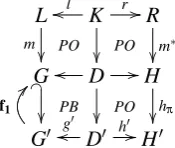
Construction 1. With reference to Figure 2, let its top two rows depict the usual DPO ap-plication of a rule L← K → R to a graph G obtained by applying to G′ the morphism f1
L
m
PO
K
l
o
o r //
PO
R
m∗
G_
PB
D
o
o //
PO
H
hπ
G′
f1
?
?
D′
g′
o
o h′//
H′
Figure 2: Avoiding orphan annotations. induced by the forgetful functor given by the
restric-tion ofT GtoT G1. The unique morphism induced by
the immersion of the image of f1(G′) into G′ is also derived. ThenD′ is the unique (up to isomorphisms) graph inLπa(T G), i.e. with well-formed annotations,
which is maximal w.r.t. the occurrences of the annota-tion pattern and for which the left square at the bottom of the diagram in Figure2is a pullback (hence its re-striction to the elements typed onT G1is isomorphic to D). Finally,H′ and morphismsh′ andhπ are obtained by calculating the pushout ofHandD′alongD.
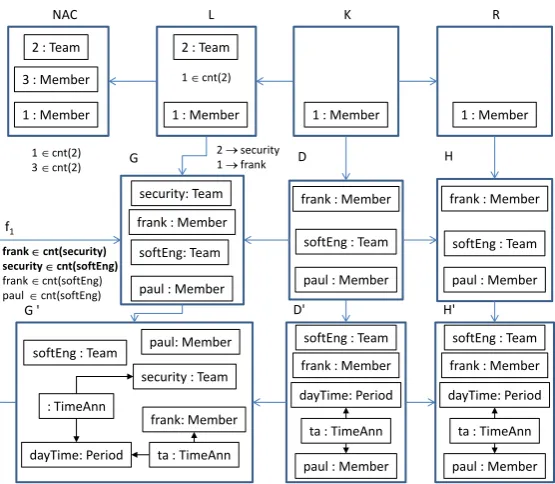
Figure 3 illustrates Construction 1 with a model example where teams in an organisation temporarily gather members for specific tasks [BP13b]. G′ describes a configuration where
frank- a member, together withpaul, of the softEngteam - is also the only member of
thesecurityteam. For bothfrankandsecurity, time annotations indicate that they can
operate within the organisation only at daytime. The DPO rule at the top, removing a team with only one member, is applied toG, the projection according tof1ofG′, by identifyingsecurity
andfrankwith1:Teamand2:MemberinL, respectively. As a consequence, the annotation
on securityand the edges touching it are removed, updating thecnt function accordingly,
while the one forpaulis preserved. Note that Construction 1 applies to removal of the applica-tion domain elements, not of contextual ones. Actually, we assume here that contextual domains are fixed. The correctness of Construction 1 is expressed by Proposition1.
Proposition 1 For G′∈Lπa(T G) and a rule L←K→R, the graph H
′ generated following
Construction 1 is inLπa(T G). Moreover, Ann(H′)⊆Ann(G′), where Ann(X)denotes the set of annotation nodes in a graph X .
Proof. We first observe that Ann(H′) =Ann(D′) since H, which is typed on T G1, does not
present any new annotation. . HenceAnn(H′)⊆Ann(G′). SinceD′is well-formed by definition, alsoX′, the pushout object ofD′andH, does not have orphan annotations.
4
Case study:linguistic services and licenses
Alicensespecifies admissible forms of access, usage and redistribution of resources and of the
im-2 : Team
1 : Member L
1 : Member K
1 : Member R
2 : Team
1 : Member NAC
3 : Member
security : Team
frank: Member G '
paul : Member
D' H'
: TimeAnn
dayTime: Period
1 cnt(2) 3 cnt(2)
frank cnt(security) security cnt(softEng) frank cnt(softEng) paul cnt(softEng)
security: Team
paul : Member G
paul : Member D
paul : Member H
softEng : Team softEng : Team
softEng: Team softEng : Team softEng : Team f1
ta : TimeAnn
dayTime: Period
ta : TimeAnn
paul : Member softEng : Team
dayTime: Period
ta : TimeAnn
2 security 1 frank 1 cnt(2)
paul: Member
frank : Member frank : Member frank : Member
frank : Member
frank : Member
Figure 3: An example of Construction 1 for the removal of an annotated team.
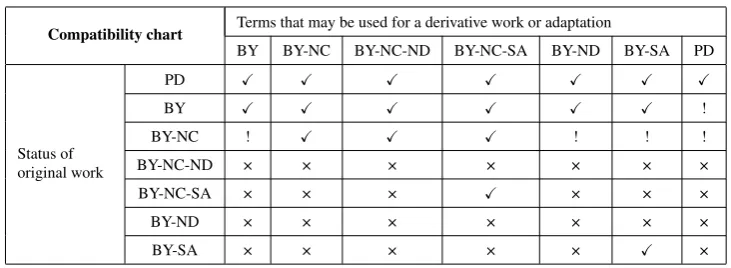
poses some form of compatibility among licenses, deciding whether a certain usage is admitted may become complex. As an example, elements published under aCreative Commons,CC, scheme (hence ofPublicDomain(PD)) can be associated with combinations of the following licenses: NCforNonCommercial(the resource cannot be used for commercial purposes),BY
forAttribution(credit to the author is acknowledged),SAforShareAlike (derived
re-sources must be redistributed preserving the original licenses), andNDforNoDerivatives (remixing, transforming, or building upon the resource may not grant redistribution).
BabelNet3[NP12] is a multilingual semantic network of semantically related millions of con-cepts (e.g. theapple fruitconcept) and named entities (e.g. theApple Inc. entity). A single node in the network is called a Babelsynsetand contains a set of terms which express a given concept or named entity in different languages. For instance, theapple fruitconcept is repre-sented by the synset{apple EN,pomme FR,mela IT,. . .,manzana ES}. A term in a synset is calledsense(e.g.,apple ENin the above synset is the fruit sense of the ambiguous wordapple). BabelNet itself is obtained as the result of the automatic mapping (considered in turn a kind of resource unique to BabelNet) and integration of several, publicly available, knowledge repos-itories, each providing resources (e.g. synsets and senses) under different licenses. For exam-ple, WordNet [Fel98], Wikidata4 and parts of the OMWN project [BP12a] are released under a permissive license, allowing any use, whether commercial or non-commercial, of the data; Wikipedia and Wiktionary are released with aCC-BY-SAlicense; OmegaWiki and other word-nets in OMWN are released under CC-BY; the Basque Wordnet in OMWN is released under
CC-BY-NC-SAand so is the BabelNet mapping Unfortunately, not all of the licenses are com-patible with one another, as shown in the compability chart for CC licenses in Table1, where✓ indicates compatibility,×incompatibility, and ! that usage is not recommended. For instance, Wikipedia, whose license isCC-BY-SA, cannot be merged with data from the Basque Wordnet or the BabelNet mapping. Interestingly, some mergings can be done in one direction only, e.g. from a resource in aCC-BYrepository, such as OmegaWiki, one can derive a new resource with a more restrictiveCC-BY-SAlicense, thereby making it compatible with, e.g., Wikipedia.
Table 1: The compatibility chart for Creative Commons licenses.
Compatibility chart Terms that may be used for a derivative work or adaptation
BY BY-NC BY-NC-ND BY-NC-SA BY-ND BY-SA PD
Status of original work
PD ✓ ✓ ✓ ✓ ✓ ✓ ✓
BY ✓ ✓ ✓ ✓ ✓ ✓ !
BY-NC ! ✓ ✓ ✓ ! ! !
BY-NC-ND × × × × × × ×
BY-NC-SA × × × ✓ × × ×
BY-ND × × × × × × ×
BY-SA × × × × × ✓ ×
However, the opposite is not possible, as aSAlicense is not modifiable. Hence, some licenses, such asCC-BY-NC-SAandCC-BY-SA, are inherently and mutually incompatible. To solve this problem, BabelNet is viewed as a collection of knowledge resources with heterogeneous licenses. For instance, it is possible to consider a subset of resources which can be used commer-cially, e.g. Wikipedia, WordNet and others. However, resources withNClicense (e.g. the Basque Wordnet and the BabelNet mapping) cannot be used commercially. As the mapping is the en-abling technology for interconnecting the various resources into a whole unified, multilingual network, any commercial use requires a suitable license from the BabelNet’s authors.
To represent the management of licenses and languages in BabelNet, we model synsets, senses, etc. as nodes (or boxes) of specific types from a domain, R, ofResources. Similarly, licenses are modeled as nodes of typeLicense, from the domain ofLicenses,L, with an at-tribute nameranging over strings identifying the different kinds of license, and languages are modeled as nodes of typeLanguage, from the domain ofLanguages,K, withnameranging over the available languages. We considerR as the application domain, andL andK as con-textual domains, typing the annotation edges accordingly. Thus, forxxxa type inR, edges of typesxxxLicAnnotationandxxxLangAnnotationallow its annotation with elements of
L andK, through edges of typeannotatesWith.
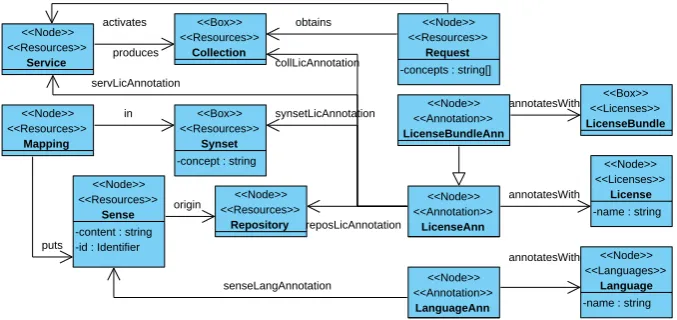
Figure 4 presents the type graph T G for BabelNet. Stereotypes indicate whether an ele-ment is of the Node or Box sort, and if it comes from the domain R, L or K, or is an
AnnotationTypeNode. InR, aSensehas an attributecontent, with values in the sort of
strings. Moreover, the three types of box,Synset,CollectionandLicenseBundle, can contain only elements of suitable types, namelySense,SynsetandLicense, respectively.
ASynsethas aconceptrepresented by a collection of senses.LicenseBundleAnnis of
withLicenseBundle. However, as it inherits fromLicenseAnn, one can annotate any ele-ment in the resource domain with single licenses or with license bundles. ARequesttoobtain
aCollectioncan be annotated with both license and language information (not indicated to
avoid cluttering) andactivatesaServiceproducingthe collection.
-concept : string <<Box>> <<Resources>>
Synset
<<Node>> <<Annotation>>
LicenseAnn
<<Node>> <<Annotation>>
LanguageAnn
-name : string <<Node>> <<Licenses>>
License
-name : string <<Node>> <<Languages>>
Language
<<Node>> <<Annotation>>
LicenseBundleAnn
<<Box>> <<Licenses>>
LicenseBundle
<<Node>> <<Resources>>
Repository
-content : string -id : Identifier
<<Node>> <<Resources>>
Sense
<<Node>> <<Resources>>
Mapping
<<Node>> <<Resources>>
Service
<<Box>> <<Resources>>
Collection
-concepts : string[] <<Node>> <<Resources>>
Request
annotatesWith
senseLangAnnotation synsetLicAnnotation
annotatesWith annotatesWith
reposLicAnnotation in
origin
collLicAnnotation produces
puts
activates obtains
servLicAnnotation
Figure 4: The type graph for modeling the running example.
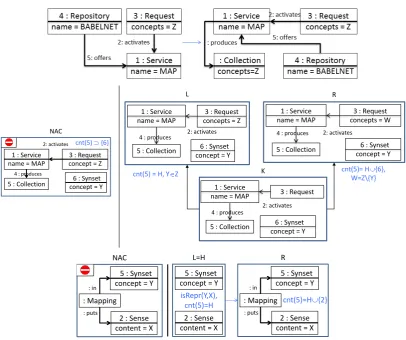
The basic working of BabelNet services is modeled via increasing rules in theResources do-main. RulecreateCollectionin Figure5(top) creates an initially empty collection to be served in response to a query to define the concepts in a setZ. Two rules allow the inclusion in the collection of a synset for a concept in the request. RuleaddSynsetin Figure5(middle) is used to add an already available synset to the collection if it is not already there, as indicated by the NAC. The other one, not shown, creates and adds a synset for a concept, if it does not exist al-ready. RulecreateMappingin Figure5(bottom) populates synsets with senses representing the concept, according to a mapping, with a NAC to avoid including a sense twice.
In all these cases, the bundle of licenses associated with the invoked service must be associated with the produced collection, as will be discussed in Section5.2. Moreover, requests can be fur-ther characterised, for example by annotating them with particular licenses or languages, so that only senses annotated with those licenses or languages are included in the obtained collection, as per suitable application conditions, following the constructions in [BP13a].
5
Maintaining consistency with constraints and contracts
While the result of applying a rule is guaranteed to produce a correctly typed graph, it might be the case that such a graph does not conform to further conditions imposed on the model at hand. We identify two dimensions along which conditions can be distinguished: one pertaining to the identification of the domain for which the condition is defined (whether the application domain or the domain resulting from the annotation process) and one relative to the scope of the condition (whether global to the domain or local to specific transformations).
6 : Synset concept = Y 1 : Service
name = MAP
3 : Request concept = Z
5 : Collection 4 : produces
2: activates cnt(5) {6} NAC
1 : Service name = MAP
6 : Synset concept = Y 3 : Request
concepts = Z
1 : Service name = MAP
3 : Request concepts = W
5 : Collection
cnt(5)= H {6}, W=Z\{Y}
2: activates 4 : produces
5 : Collection
4 : produces 2: activates
cnt(5) = H, Y Z
6 : Synset concept = Y
L R
1 : Service
name = MAP 3 : Request
2: activates
5 : Collection 4 : produces
6 : Synset concept = Y K
2 : Sense content = X
: Mapping
: in
: puts
isRepr(Y,X), cnt(5)=H
2 : Sense content = X 5 : Synset concept = Y 5 : Synset
concept = Y
cnt(5)=H{2}
: Mapping
: in
: puts
2 : Sense content = X
5 : Synset concept = Y
NAC L=H R
Figure 5: RulecreateCollection prepares a container for serving a request (top). Rule
addSynsetsets up a synset for a requested concept (middle). RulecreateMappingrelates
a sense to a synset (bottom). Vertical lines separate NACs from rule morphisms.
In [BP13b], we have presented some constructions to derive application conditions for rules from annotation constraints. By leaving the rule morphism alone, we maintain a form of sepa-ration of concerns, making rule reuse simpler when different forms of annotation are involved. Intuitively, those constructions work when a rule adds elements related to elements matched by the left-hand side, but the annotation constraint imposes these relations to exist only between elements annotated in specific ways. An application condition ensures that such an annotation context already exists in the host graph when the rule is applied.
simple morphisms (called µ1orµ2in the following diagrams), and denote by α the morphism induced by the application of such a pbetween two graphsG7andG8with(G7,G8)∈⇒p.
We consider that graphs can be associated with information on values from some algebraic structureD, as is typical for attributed graphs, and assume that types enforce constraints on the set of attributes which can be associated with their instances together with possible constraints on their admissible values. The morphisms defining constraints and rules from Section2 can therefore be enriched to express constraints on the values of these attributes. In order to treat with these values, we follow the approach of symbolic attributed graphs [OL10b], which are pairs⟨G,D⟩whereGis a graph labelled with values from theΣ-algebraD, forΣsome signature, using constraint satisfaction to evaluate conditions and attributes. To be precise, attributes are here represented as variables and constraints refer to the values of these labels.
In particular, we consider the use of delayed constraint solving for symbolic graphs [OL10a], which allows the evaluation of constraints when all the required context is available. DPO rules therefore assume the form⟨p,Γ⟩, where p=L←K→Ris a DPO rule on graphs labelled with variables with values inDandΓis a collection of constraints on all the variables inp.
We also define a version of symbolic graphs for B-graphs, by including constraints on values of thecntfunction for boxes. To this end, we supplement the algebraDwith the Boolean algebra on the setV∪E. We can then use additional constraints using the algebra operators∪,∩, and¬. The shortcuta∈X for some elementaand some setX is used to denote the constraint{a} ⊂X. The pushout construction is then complemented by taking the conjunction of such constraints, while the pullback construction by taking their disjunctions (as in classical symbolic graphs).
In the graphical representation of rules and constraints, we will use the traditional UML-like representation of types and attributes, and present separately the constraints on the variables.
5.1 Management of constraints
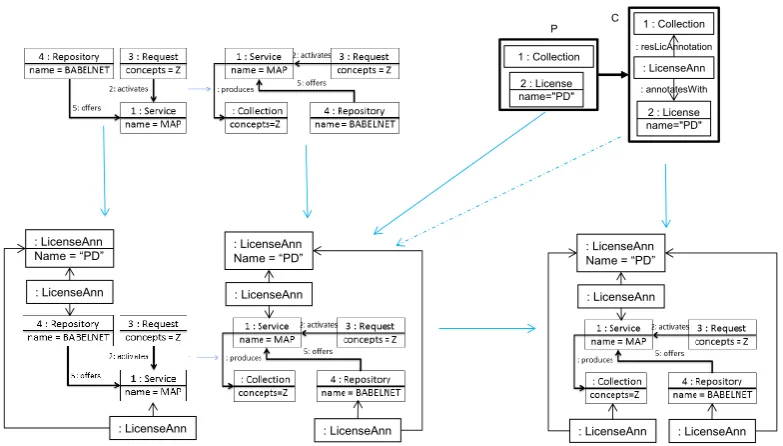
As shown in Table 1, licenses can require or forbid the presence of one another. While the first case can be modelled by a positive constraint5, we model the second via forbidden graphs. Figure6(left) shows the forbidden graph expressing that no resource can be annotated with both licensesSAandND. An analogous graph will forbid the presence of both licenses in the same bundle. The constraint on the right requires that each resource bePD, where we use the generic type nameResourceto refer to any of the types from theResourcedomain.
The application of a rule may disrupt a constraint, typically by not creating the proper anno-tations. Hence, given a constraint µ, constraint repair actions are automatically inferred and applied, which modify the derivation relation so that the result satisfiesµ.
Definition 4(Constraint repair action) Letµ1: G1→G2be a rule andµ2:G3→G4an
anno-tation constraint. We define the relation=⇒µ1,µ2 with reference to Figure7. For any two graphs
G5 andG6 such that (G5,G6)∈=⇒µ1 as witnessed by the leftmost square, andG6∕∣=µ2 (i.e.
there exists a morphism µ5i:G3→G6 but no morphism µ6: G4→G6 for which the triangle
formed byµ2, µ5i andµ6commutes), we have(G5,G7)∈=⇒µ1,µ2, where G7is constructed as
the colimit of all the diagrams constructed by taking the pushout ofµ5i andµ2alongG3for each
: Resource
: LicenseAnnotation
: License name="SA" : License
name="ND" : LicenseAnnotation
FG
L'Aquila, July 20, 2015 GCM 2015 18
1 : Resource
1 : Resource
: LicenseAnn
2 : License name="PD" : resLicAnnotation
: annotatesWith
P C
2 : License name="PD"
Figure 6: A graph forbidding the simultaneous presence of licenses SA and ND (left) and a positive constraint assessing that each resource isPD.
µ5i via the morphismsµ7i:G4→Gi7andµ4i:G4→Gi7. The set of all theµ4i is called aconstraint
repair action.
G1
µ1 //
m
PO
G2
m∗
G3
µ5i
~
~
~~~~~~
~~
µ2 //
PO
G4
µ6
S
µ7i
=
G5 α //G6
µ4i //
Gi7 CL //G7
Figure 7: Direct Derivation Diagram for a rule with constraint repair action.
Figure8illustrates the construction needed to repair the violation of the constraint of Figure6 (right) as a consequence of the application of rulecreateCollectionin Figure5.
Following Proposition2a repair action produces a graph compliant withµ2.
Proposition 2 Given G7andµ2as in Definition4we have G7∣=µ2.
Proof. We know thatG3has a match inG5, so that the constraint is violated by the presence of
some element without proper annotation, which is added in eachGi7as an effect of the pushout. Since we only deal with annotation constraints, eachGi7does not present violations ofµ2which
were not in G4, but actually presents one less violation. By taking the colimit, no violation
appears inG7.
Proposition3allows the cumulative application of repair actions.
Proposition 3 Let G6be as in Definition4and M2={µ2j:G3j →G4j∣G6∕∣=µ2j}. Then, let G′7
the colimit of all the graphs G7constructed as in Definition4for eachµ
j
2∈M2. Then G′7∣=µ
j
2 for eachµ2j∈M2.
Proof. Since the premise of eachµ2j does not contain annotation elements, noG7 constructed
An example
: LicenseAnn : LicenseAnn Name = “PD”
: LicenseAnn
: LicenseAnn : LicenseAnn Name = “PD”
: LicenseAnn : LicenseAnn
: LicenseAnn : LicenseAnn Name = “PD”
: LicenseAnn
1 : Collection
1 : Collection
: LicenseAnn
2 : License name="PD"
: resLicAnnotation
: annotatesWith
P C
2 : License name="PD"
GCM 2015 20
L'Aquila, July 20, 2015
Figure 8: Applying the repair construction to ensure that each new collection is annotated with thePDlicense.
5.2 Contracts
Contracts define situations in which the application of a rule requires the production of some annotation, but only in situations in which elements in its left-hand side are associated with specific annotations.
Definition 5(Contract) Given a ruleµ2:G3→G4, acontract onµ2,γ, is given by a morphism
µ1: G1→G2 (G1 andG2 typed onT G) together with spansG1
µ3
←G5→µ4 G3,G4←µ5 G6→µ6 G2
(formed by total injective morphisms) and a morphismµ7:G5→G6, (G5andG6typed onT G1),
such that all the closed paths in the upper part of Figure9commute.
G1
µ1
(
(
µ10
.
.
G5
? _ µ3
o
o µ4 //
µ7
*
*
=
G3 µ2 //
m
PO
G4
m∗
G6
? _ µ5
o
o µ6 //
PO
G2
µ8n n
n n
v
v
n nn n
µ9
G7 α //G8 µ11 //G9
Figure 9: Direct Derivation Diagram for a rule with contract enforcement action.
G6 andG2 identified via the morphismsµ3, µ4, and µ2, as well as the induced identifications
through morphisms µ1,µ5, andµ6; primed numbers are the residual elements identified inG6, G4andG2via the morphismsµ5andµ6; letters denote residual elements inG1andG2identified
via the contract morphism µ1; finally, anonymous elements are those only present in G2, i.e.
additional elements required by the contract, or additional elements introduced by the rule but not considered in the contract.
4’ : Collection 3’ : produces
1 : Service 3 : Request
2: activates
b : LicenseBundleAnn f : servLicAnnotation g : annotatesWith
a: LicenseBundle
1 : Service 3 : Request
2: activates
b : LicenseBundleAnn f : servLicAnnotation
g : annotatesWith a: LicenseBundle
: LicenseBundleAnn : collLicAnnotation
: annotatesWith
2': Resource
e: LicenseBundle 1 : Resource
b : LicenseBundleAnn d: License
name="SA"
c : License name=X
f : resLicAnnotation
a: LicenseBundle g : annotatesWith d cnt(a),
c cnt(a)
1 : Resource
b : LicenseBundleAnn d: License
name="SA"
c : License name=X
f : resLicAnnotation
a: LicenseBundle g : annotatesWith d cnt(a),
c cnt(a)
: LicenseBundleAnn
: annotatesWith : resLicAnnotation d cnt(e),
c cnt(e)
Figure 10: A contract stating that each collection comes with the license of the service which generated it (top) and a contract specifically modeling theSAlicence (bottom).
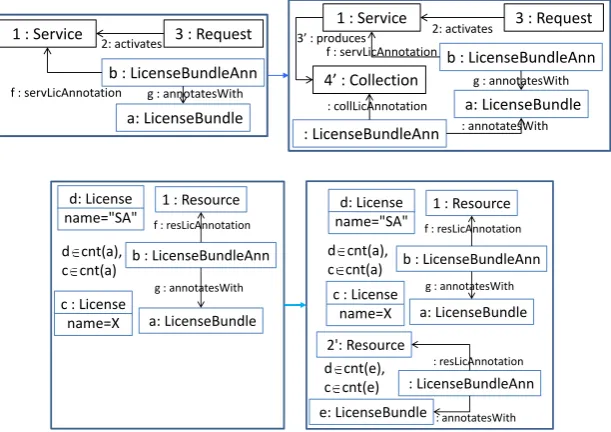
We can now model the asymmetry in license extension described in Section4with reference to the contract in Figure10(bottom): if a copy of a resource6annotated with a bundle including theSAlicense is generated, the bundle annotating the new resource must preserve all the original licenses. This forbids the possibility of contracts which remove some license whenSAis present, while it allows adding more licenses to the bundle, if not in contrast with others already present. In this case, we have used the e identifier in order to write the constraint on the presence of licenses in the new bundle. Analogous contracts can be devised for multiple annotations with single licenses, rather than with a bundle of licenses. It is important to note that the directionality inherent to this contract would not be expressible via constraints, which would either impose or forbid the presence of annotations in the bundles both before and after rule application.
The application of a domain rule creating new elements typically violates contracts requiring that they be annotated in certain ways. Hence, actions must be taken, as specified in Definition6.
Definition 6(Contract enforcement action) Letµ2:G3→G4 andγ be as in Definition5. A derivation(G7,G8)∈=⇒µ1 fulfillsthe contractγiff for each morphismµ10:G1→G7such that
the leftmost square in the diagram of Figure9commutes, and for each morphismµ5i:G6→G4
there exists at least one morphism µ8i: G2→G8 so that the trianglem ∗∘
µ5i∘µ7:G5→G8,
µ1∘µ3:G5→G2andµ8i:G2→G8commutes. If the above does not hold, the pair(G7,G8)is
said tobreachthe contractµ1. A breach can be repaired by acontract enforcement actionµ11
forµ1,µ2 onG7 by constructingG8
µ11 →G9
µ9
←G2 as the pushout of the spanG8
α∘µ10 ← G1
µ1 →G2,
under the assumptions of Definition5on the commutative properties of the closed paths in the upper row of Figure9. We denote the derivation thus obtained by(G7,G9)∈=⇒µ2,µ1. Note that if noµ10exists, then(G7,G8)also fulfills the contract.
Whenever multiple contracts apply to µ2, the final graph to be obtained for its application
is represented by the colimit of all the diagrams thus formed, noting that in all such diagrams the pushout formed byG7←G3→G4andG7→G8←G4 remains the same. Notice also that by a straightforward application of the associativity and commutativity of colimits, the same result can be obtained by successively applying the above construction to individual contracts, regardless of the order. The proof of Proposition4is then straightforward.
Proposition 4 For a ruleµ2and a contractµ1on it, each derivation in=⇒µ2,µ1 fulfillsµ1.
Theorem1states that applying the enforcement action is equivalent to applying a rule resulting from the composition ofµ2andµ1.
Theorem 1 Given a ruleµ2:G3→G4and a contractµ1:G1→G2onµ2, there exists a rule
µ2′ such that for each pair(G7,G9)∈=⇒µ2,µ1, we have(G7,G9)∈=⇒µ2′.
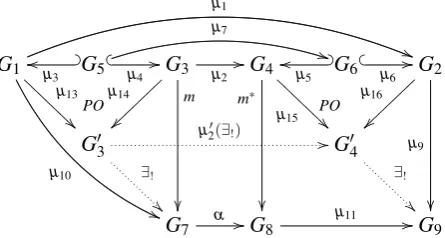
Sketch. Referring back to the diagram in Figure9, the new left-hand side is constructed as the
pushout of the spanG1
µ3 ←G5
µ4
→G3, while the right-hand side as the pushout of the spanG4
µ5 ←
G6
µ6
→G2. Shown in Figure 11 are the induced matching morphismG′3 →G7, the new rule
µ2′: G′3 →G4′, and the result G9 of applying µ2′ to G ′
7 via the induced matching. Since G ′ 4
already ”contains”G2, there is no need for a subsequent enforcement action.
G1 µ1 ( ( µ10 ( ( µ13 A A A A A A
Aoo µ3 ? _G5 µ4 //
µ7
*
*
PO
G3
µ2 // m µ14 ~ ~ }}}} }}} G4 m∗
µ15 AAA
A A A
Aoo µ5 ? _G6 µ6 //
PO G2 µ9 µ16 ~ ~ }}}} }}}
G′3 ∃!
µ2′(∃!) //
G′4 ∃!
G7 α //G8
µ11 //
G9
Figure 11: Direct Derivation Diagram for composition of rule and contract.
case, a further transformation step may mapG9to a canonical B-graphG10in the family defined
byG9, where each box contains exactly its minimal required content. We can also definenegative contracts, indicated asµ1:G1
¬
→G2such that(G5,G6)∈=⇒µ1,µ2 only ifG6∕∣=µ2. This prevents the application, to the sameµ1, of other contracts of the form
µ1′ :G′1→G′2withG1′ ,→G1andG2,→G′2.
The constructions above can be adapted to general, i.e. not only increasing, DPO rulesG3← G10→G4by considering contracts in the form of spansG1←G11→G2andG5←G12→G6,
together with an additional spanG10←G12→G11, such that all closed paths in the upper rows of Figures9and11commute. In all these cases, we consider morphisms which are injective in the restrictions toD1 of the involved graphs, as well as in the immersion ofD1 intoD, while
they can be non-injective in the restriction toD2.
6
Extending contracts to contract schemes
Contracts can be used ascontract schemesto automatically derive specialised contracts for rules whichextendthe originalkernelrule to which the scheme applied (see Definition7). In the rest of the section we will use the term contract scheme for the contract associated with the kernel rule and derived contract for the one associated with the extended rule.
Definition 7 (Derived contract) With reference to Figure 12, let µ2: G3→G4 be a kernel
rule and letγa contract scheme onµ2. Letµ2′:G′3→G′4be a rule with two collections of total injective morphismsM3={µj:G3→G′3}andM4={µi:G4→G′4}. Thenγ(µ2′)is thecontract
onµ2′ derivedfromγdefined as follows:
1. defineGˆ5→G5as the equalizer of the morphismsµ′j∘µ4:G5→G3→G′3(Gˆ5represents the ”context” not affected by the addition of the differentµ′jtoG3);
2. defineG5j =µ′j(µ4(G3))for eachµ′j∈M3;
3. letG′5be the colimit object of the diagramGˆ5→G5→G
j
5(the ”union” of the different copies
ofµ′j(µ4(G3))inG′3identifying only the ”common context”Gˆ5);
4. letµ4′ :G′5→G′3be the unique morphism induced by the universal property ofG′5with respect to the obvious inclusionsG5j→G′3;
5. defineG1→G1j ←G5j as the pushout ofG1←G5→G5j andG′1as the colimit of theG
j
1with
respect toGˆ5. By the universal property of the construction ofG′5, there is a uniqueµ3′:G′5→G′1 (a mono sinceG5→G1is);
6. the same procedure on the right hand side of the diagram producesG′4←G′6→G′2 and the morphismGˆ5→Gˆ6by the universal property of equalizers;
7. finallyµ1′ andµ2′ are the unique morphisms induced by the universal property of the construc-tion ofG′1andG′5(and the use ofµ1andµ2for the required commutativity).
A contract schemeγproduces immediately a contract for the ruleµ2for each isomorphism of G3into itself, with the property illustrated by Theorem2.
Theorem 2 Letµ2be a kernel rule,µ2′ an extended rule,γa contract onµ2andγ′the contract
G1 µ1 * * G5 ? _ µ3 o
o µ4 //
µ7
,
,
G3 µ2 //
M3 G4 M4 G6 ? _ µ5 o
o µ6 //
G2
G1j
G5j
o o ) ) S S S S S S S S S S S S S S S ˆ G5 d d IIIIII * * ˆ G6 : : u u u u u u
Gi6
u u kkkkkkkkkk kkkkk # # H H H H H H /
/Gi
2
G′1
µ1′
4
4
G′5
? _ µ3′
o
o µ4′ //
µ7′
2
2
G3′ µ2′ //G′4oo µ5′ ? _G6′ µ6′ //G′2
Figure 12: Construction of a contract from a contract scheme.
Figure 13: A kernel rule and an extended rule for creating users.
be a graph typed on T G s.t. G′3and G′1have matches m andµ10′ in G7and let G9be the graph
obtained by the contract enforcement action forγ′. Then there exists a set, Mk, of matches of G3
into G7with∣M3k∣=∣M3∣and a bijection b:M3k→M3s.t. mki =m∘b(mki)for mki ∈Mk. For each
match mki ∈Mklet Gi8be the result of the application ofµ2via mki and G i
9the graph obtained by
the contract enforcement action forγ. Then G9is isomorphic to the colimit of the Gi9.
Sketch. The proof derives from the universal properties of the equalisers, pushouts and colimits
used in the construction, for the existence and uniqueness of the needed morphisms, the commu-tativity of colimits, and the independence in the applications ofµ2.
We illustrate the notion of schemes with an example taken from the organisational domain, as licenses do not seem to require them. Figure13presents a kernel rulecreateUser, allowing an administrator to create users with inferior, with respect to a partial order <r roles, and an extended ruletwoAdminswhich requires two administrators to create a user.
pe-riods of validity of the administrator roles. Here we have used annotations on edges, as allowed by the metamodel for annotations. By using boxes, we could also achieve the same effect by annotating a box containing only the edge to be annotated.
Figure 14: A contract scheme on rulecreateUserfor time annotations on administrators.
1 : User
1 : User
2 : Role name = "admin"
7’ : User
4 : Role Name = X
[ X <r "admin" ] 3: role
2 : Role name = "admin"
3 : role
role a : TimeAnn
d : timeAnnotation
c : Period value = Y b: annotatesWith
a : TimeAnn
c : Period Value = Y b: annotatesWith d : timeAnnotation
4 : Role Name = X
5 : User 6: role
h : TimeAnn e : timeAnnotation
f : annotatesWith g : Period value = Z
5 : User 6: role
h : TimeAnn e : timeAnnotation
f : annotatesWith
g : Period value = Z
: annotatesWith : TimeBundleAnn
e : TimeBundle c cnt(e) g cnt(e) : timeAnnotation
Figure 15: A contract on ruletwoAdminsderived from the scheme of Figure14.
7
Related Work
A number of approaches have considered the management of inconsistencies in the field of graph transformations. In particular, mechanisms for ensuring that invariants are maintained through-out transformations have lead to the identification of mechanisms for the generation of pre- or post-application conditions to be associated with rules, or for manipulation of the left-hand or right-hand side of a rule. This topic was started in [HHT96] and extensively explored in [HP09]. In [BP13a,BP13b], we have shown how the separation of the application and contextual domains allows some simplified constructions for such a generation.
explicit transformations can be associated with guidelines to repair violations [ALSS08]. We consider here only inconsistencies involving annotations, again leveraging domain separation.
Contracts were introduced in the form of pairs of graphs indicating pre- and post-conditions of operations [HHL05], defining rule schemes which are typically instantiated by setting some parameters [ELSH06]. One can then consider satisfaction of conditions for service composi-tion [NHOH10] or generate tests against these schemes to check correctness of model evolu-tions [RKH13]. We allow the definition of multiple contracts for a single rule and enforce cor-rectness on a local basis, as opposed to corrections required by violations of global constraints.
Annotations are a relatively new concept in the graph transformation field, although they are largely used in modeling, human computer interaction, information retrieval and the Semantic Web. Koenig [Koe05] develops an extensive theory of annotated hypergraphs, where a hyper-graph annotation is a morphism from a (typed) hyperhyper-graph to a (complete) lattice and morphisms can also be annotated by functions. In our approach the structure of annotations is embedded in the construction of a typing system relating different domains, and annotations become first class elements, associated with domain elements through specific types of edges, so that, rather than using morphisms for single annotation, we model annotation and de-annotation processes via functors, thus allowing a flexible usage of annotations [BP12b].
This kind of flexibility may be related to the notion of partial attribution, where it is not re-quired that all nodes are equipped with attribute edges connecting them with labels on which computations can be performed [FKTV99,FKB00]. However, to the best of our knowledge, the notion of partial attribution was developed in the framework of attributed graphs, although its lifting to typed attributed graphs would be quite straightforward. Moreover, our approach sup-ports the annotation of annotation nodes, while partial attribution relies on attribution operations, for which a specific notion of annotation should be defined.
A formalisation of licenses has been advocated for services, whose composition has to take into account that different services may run under different licenses, as part of service level agreement, focusing mostly on service behaviour [GD11]. As for data, work on the definition of ontologies for the management of digital rights have been conducted by Garciaet al. [GGD07] and Rodr´ıguez-Doncel et al. [RVG14]. Graph transformations have been employed in the closely related field of access control, using similar techniques to those proposed here (see e.g. [KP06]).
8
Conclusions and Future Work
For the application domain of licenses, tools from graph transformation theory could be used to define a generic framework for managing them possibly from different licensing schemes, by which declarative specifications of resource usages could be checked for verification of confor-mance to licenses. Analysis tools could also verify the internal consistency of license bundles.
Bibliography
[ABK+07] S. Auer, C. Bizer, G. Kobilarov, J. Lehmann, R. Cyganiak, Z. Ives. DBpedia: A Nucleus for a Web of Open Data. InThe Semantic Web. LNCS 4825, pp. 722–735. Springer, 2007.
[ALSS08] C. Amelunxen, E. Legros, A. Sch¨urr, I. St¨urmer. Checking and Enforcement of Modeling Guidelines with Graph Transformations. In Proc. AGTIVE 2007. LNCS 5088, pp. 313–328. Springer, 2008.
[BGL10] P. Bottoni, E. Guerra, J. de Lara. A language-independent and formal approach to pattern-based modelling with support for composition and analysis.Information &
Software Technology52(8):821–844, 2010.
[BP12a] F. Bond, K. Paik. A survey of wordnets and their licenses. InProc. GWC 2012. Pp. 64–71. 2012.
[BP12b] P. Bottoni, F. Parisi Presicce. Modeling context with graph annotations.ECEASST
47, 2012.
[BP13a] P. Bottoni, F. Parisi Presicce. Annotation processes for flexible management of con-textual information.JVLC24(6):421–440, 2013.
[BP13b] P. Bottoni, F. Parisi-Presicce. Annotations on Complex Patterns. ECEASST 58, 2013.
[EEPT06] H. Ehrig, K. Ehrig, U. Prange, G. Taentzer. Fundamentals of Algebraic Graph
Transformation. Springer, 2006.
[ELSH06] G. Engels, M. Lohmann, S. Sauer, R. Heckel. Model-Driven Monitoring: An Ap-plication of Graph Transformation for Design by Contract. In Proc. ICGT 2006. LNCS 4178, pp. 336–350. Springer, 2006.
[Fel98] C. Fellbaum (ed.).WordNet: An Electronic Lexical Database. MIT Press, 1998.
[FKB00] I. Fischer, M. Koch, M. Berthold. Attributed Graph Transformation with Partial At-tribution. InProc. GraGra 2000. Pp. 171–178. Berlin: Technical University, 2000.
[FKTV99] I. Fischer, M. Koch, G. Taentzer, V. Volle. Distributed Graph Transformation with Application to Visual Design of Distributed Systems. InHandbook of Graph
Gram-mars and Computing by Graph Transformation. Pp. 269–340. World Scientific
[GD11] G. Gangadharan, V. DAndrea. Service licensing: conceptualization, formalization, and expression.Serv. Orient. Comp. and Appl.5(1):37–59, 2011.
[GGD07] R. Garca, R. Gil, J. Delgado. A web ontologies framework for digital rights man-agement.Artificial Intelligence and Law15(2):137–154, 2007.
[HHL05] J. H. Hausmann, R. Heckel, M. Lohmann. Model-Based Development of Web Ser-vices Descriptions Enabling a Precise Matching Concept.Int. J. Web Service Res.
2(2):67–84, 2005.
[HHT96] A. Habel, R. Heckel, G. Taentzer. Graph Grammars with Negative Application Con-ditions.Fundam. Inform.26(3/4):287–313, 1996.
[HP09] A. Habel, K.-H. Pennemann. Correctness of high-level transformation systems rel-ative to nested conditions.MSCS19(2):245–296, 2009.
[Koe05] B. Koenig. A general framework for types in graph rewriting. Acta Informatica
42(4/5):349–388, 2005.
[KP06] M. Koch, F. Parisi Presicce. UML specification of access control policies and their formal verification.Software and System Modeling5(4):429–447, 2006.
[MTR07] T. Mens, G. Taentzer, O. Runge. Analysing refactoring dependencies using graph transformation.Software and System Modeling6(3):269–285, 2007.
[NHOH10] M. Naeem, R. Heckel, F. Orejas, F. Hermann. Incremental Service Composition Based on Partial Matching of Visual Contracts. InProc. FASE 2010. LNCS 6013, pp. 123–138. Springer, 2010.
[NP12] R. Navigli, S. P. Ponzetto. BabelNet: The Automatic Construction, Evaluation and Application of a Wide-Coverage Multilingual Semantic Network.Artificial
Intelli-gence193:217–250, 2012.
[OL10a] F. Orejas, L. Lambers. Delaying Constraint Solving in Symbolic Graph Transfor-mation. InProc. ICGT 2010. Pp. 43–58. Springer, 2010.
[OL10b] F. Orejas, L. Lambers. Symbolic Attributed Graphs for Attributed Graph Transfor-mation.ECEASST 30, 2010.
[RET12] O. Runge, C. Ermel, G. Taentzer. AGG 2.0 - New Features for Specifying and Analyzing Algebraic Graph Transformations. InProc. AGTIVE 2011. LNCS 7233, pp. 81–88. Springer, 2012.
[RKH13] O. Runge, T. A. Khan, R. Heckel. Test Case Generation Using Visual Contracts.
ECEASST58, 2013.
[RVG14] V. Rodr´ıguez-Doncel, S. Villata, A. G´omez-P´erez. A Dataset of RDF Licenses. In