ISSN: 2147-611X
www.ijemst.com
An
Examination
of
a
Pre-service
Mathematics
Teacher's
Mental
Constructions of Relationships in a Right
Triangle
Melike Yigit Koyunkaya Dokuz Eylul University
To cite this article:
Yigit Koyunkaya, M. (2018). An examination of a pre-service mathematics teacher's mental
constructions of relationships in a right triangle.
International Journal of Education in
Mathematics, Science and Technology (IJEMST)), 6(1), 58-78. DOI: 10.18404/ijemst.328344
This article may be used for research, teaching, and private study purposes.
Any substantial or systematic reproduction, redistribution, reselling, loan, sub-licensing,
systematic supply, or distribution in any form to anyone is expressly forbidden.
Authors alone are responsible for the contents of their articles. The journal owns the
copyright of the articles.
Volume 6, Number 1, 2018
DOI:
10.18404/ijemst.328344
An Examination of a Pre-service Mathematics Teacher's Mental
Constructions of Relationships in a Right Triangle
Melike Yigit Koyunkaya
Article Info
Abstract
Article History
Received:
19 September 2016
Students need to construct strong knowledge of angles as well as relationships between angles and side lengths in a triangle to succeed in geometry. Although many researchers pointed out the importance of angles and angle-related concepts, students and teachers have had limited knowledge of these concepts. This study is a part of a larger study, and examines pre-service secondary mathematics teachers‘ (PSMTs) mental constructions of relationships between angles and side lengths in a right triangle (RASR). The Action-Process-Object-Schema (APOS) learning theory was used as the theoretical lens and clinical interview methodology was used as the methodology in the study. The study was conducted with four PSMTs, but it focuses on one of PSMTs, Linda, who revealed evidence of schema for RASR. As a result of fine-grained analysis of Linda‘s responses to the tasks, this article reports the mental constructions enough to develop a schema for RASR. The model describes that schema for 2-line angles, right triangles and relationships between opposite angles and side lengths and process level for some relationships including ‗Pythagorean Theorem‘, ‗The hypotenuse is always the longest side in a right triangle‘, ‗Special right triangles‘, ‗Complementary Angles‘, and ‗Triangle inequalities‘ are enough to construct a schema for RASR.
Accepted: 25 January 2017
Keywords
Concept of angles Right triangles The APOS theory Relationships in right triangles
Introduction
Learning geometry should begin with the most basic of geometric tasks such as drawing, playing with geometric shapes, and naming geometric shapes (Browning, Garza-Kling, & Sundling, 2008), and then students might learn more advanced concepts such angles and relationships between an angle and side lengths in a triangle which are also central to the development of geometric knowledge (Browning et al., 2008; Keiser, 2000, 2004; Mitchelmore & White, 1998, 2000; Moore, 2013, 2014; Yigit, 2014a, 2014b; Yigit Koyunkaya, 2016). Students need to construct strong knowledge of angles as well as relationships between angles and side lengths in a triangle to succeed in geometry. Although many researchers and the National Council of Teachers of Mathematics (NCTM) Standards (2000) stress the importance of these concepts in mathematics curriculum, they remain difficult concepts for students and teachers to grasp (Clements & Battista, 1989, 1990; Keiser, 2000, 2004; Mitchelmore & White, 2000; Yigit, 2014a, 2014b; Yigit Koyunkaya 2016).
their mental constructions of angles are related to their learning of right triangles, but the author did not specifically look for the PSMTs‘ mental constructions of RASR. Therefore, there is need to expand the research in mathematics education concerning students‘ mental constructions of RASR. This study is designed to provide new knowledge regarding the question, ―What relationships do pre-service teachers construct between angles and side lengths in a right triangle?‖ In detail, the main goal of this study is to explore PSMTs‘ mental constructions of RASR. In addition, this study explains how PSMTs use their existing knowledge of angles to learn more advanced concept, RASR. In order to enlarge the research related to the relationships, I adapted the Action-Process-Object-Schema (APOS) theoretical perspective (Arnon et al., 2014; Asiala et al., 1996; Clark et al., 1997; Dubinsky, 1991, 2010; Dubinsky & McDonald, 2001). Dubinsky and other researchers (Arnon et al., 2014; Asiala et al., 1996; Clark et al., 1997; Dubinsky, 1991, 2010; Dubinsky & McDonald, 2001) have built cognitive models of students‘ schema of several mathematical concepts by using the APOS theoretical framework. I used the APOS framework to construct a model to explain what relationships PSMTs have built between angles and side lengths in a right triangle using their observable or non-observable mental constructions.
Study of the proposed research question expanded the literature on the learning of angles, triangles (right triangles), and RASR. These explanations can—hypothetically—be acquired through developing a model, which explains how PSMTs develop their schema of RASR. Particularly, the model could help researchers better understand PSMTs‘ learning patterns—in terms of their mental actions, processes, objects, and schema— of RASR, which leads to research-based curricula for improving the teaching and learning of angles, triangles (right triangles), and RASR as well as more advanced concepts such as trigonometry. Ideally, the model could be useful to understand and explain the difficulties that students encounter, to suggest possible strategies, and to design a lesson plan to help students and teachers in learning of angles and RASR who are cognitively similar to the pre-service teacher in this study.
Background
Even though the concept of angles is a fundamental concept to be successful in the discipline, existing studies indicated that students and teachers have difficulties or limited knowledge in learning of the concept (Browning et al., 2008; Clements & Battista, 1989, 1990; Keiser, 2004; Mitchelmore & White, 1998; Yigit, 2014a, 2014b; Yigit Koyunkaya, 2016). All these researchers claimed that students and teachers‘ difficulties are based on (1) learning of the multifaceted definition of an angle, (2) describing angles, (3) measuring the size of angles, and (4) conceiving different types of angles such as 0-line, 1- line, and 2-line angles.
An angle can be defined in many different ways. Mitchelmore and White (2000) indicated that three common representations are used to define an angle in mathematics education: an amount of turn point between two lines—rotation; a pair of rays with a common point—wedge; and the region formed by the intersection of two-half planes—interior region between the intersection of two lines. Keiser (2004) also claimed that sixth grade students‘ difficulties with angles were related to different representations. In her study, she compared sixth-grade students‘ definitions of angles to historical definitions of angles. She specifically used the historical comparison to emphasize the complexity of the concept and to discuss the students‘ difficulties with the complexity of angles. Based on her analysis, Keiser (2004) found that the definition of angles has changed over the centuries, which indicates the multiple definitions of the concept. According to Keiser (2004), the multifaceted nature of the definition of an angle creates confusion for students as they try to learn the basic concepts of angles. Keiser stated, ―all definition put limitations on the concept by focusing more heavily on one facet more than any of the others‖ (2004, p. 289). Keiser recommended that the representation of an angle as two rays with a common point initially might prohibit students from further exploration of the concept.
Clements and Battista (1989, 1990) suggested using a computer-based instructional method to teach the concept of angles. In order to help third and fourth grade students develop and improve their learning of the concept of angles, they specifically investigated the effects of computer programming in Logo in which students learn geometrical concepts by directing a turtle‘s movement. Clements and Battista claimed that the program might be helpful ―to elaborate on, and become cognizant of, the mathematics and problem-solving processes implicit in certain kinds of intuitive thinking‖ (1990, p. 356), and to improve their understanding of the concept of angle. Browning et al. (2008) also developed activities that include hands-on activities, graphing calculator applications, and computer software, Logo. Specifically, the researchers suggested technology-based activities helped sixth grade students to develop their knowledge of multiple representations of angle concept.
Moore (2013, 2014) examined pre-calculus students‘ learning of angle measurement and trigonometry, and he looked for the role of quantitative and covariational reasoning in learning of angle measurement and trigonometry. Particularly, Moore (2013, 2014) stated that quantitative reasoning is involved in learning angle measurement. According to Moore (2014), students can be taught to connect angle measure to measuring arcs and conceive of the radius as a unit of measure. Specifically, he indicated that students‘ learning of arc measure, which is also related to measuring 0-line and 1-line angles, is related to reasoning about right triangle contexts. Specifically, he indicated that ―Developing meaning for angle measure and trigonometric functions that entail measuring arcs and lengths in a specified unit can also form important ways of reasoning for right triangle context‖ (2014, p. 110). He illustrated that if students have arc meanings for angle measure, which is related to measuring 0-line and 1-line angles, they could easily name the angle in the right triangle by relying on the family of arcs and circles centered at the vertex of the angle. In summary, Moore (2014) suggested that in order to learn more advanced concepts such as unit circle and right triangle, students needed to construct strong concepts of angles and angle measurement to conceptualize these advanced concepts.
Yigit (2014a, 2014b) also examined the role of the concept of angles in learning more advanced concepts. In addition to PSMTs‘ mental constructions of angles, she also examined what kind of mental constructions of angles is needed in the right triangle context. Yigit (2014a, 2014b) found that PSMTs did not struggle to operate with angles in a right triangle where both sides were visible. Additionally, she indicated that PSMTs‘ mental constructions of 2-line angles and angle measurement schema was sufficient to operate with and reasoning about the tasks in right triangle context. Similar to Moore‘s (2013, 2014) studies, she concluded that the concept of angles have a key role in learning of more advanced concepts such as right triangles.
All these existing studies indicated elementary and secondary students‘ limited understanding of the concept of angles and angle measurement. The researchers suggested that students should be taught using multiple definitions of an angle as well as integrating multiple representations into instructional activities rather than simply giving a static definition of an angle so that they will acquire and develop more comprehensive knowledge of angles (Keiser, 2004; Mitchelmore & White, 2000). Additionally, it is also suggested that the well-designed technology activities greatly facilitate students‘ development and exploration of angles and angle measurement (Browning et al., 2008; Clements & Battista, 1989, 1990; Yigit, 2014a, 2014b; Yigit Koyunkaya, 2016). All these previous studies illustrated a need to gain better insight into students‘ learning of more advanced concepts which are directly related to angles and angle measurement. Therefore, this study illustrates PSMTs‘ mental constructions of RASR which is related to their learning of the angles and angle measurement.
Theoretical Perspective
Dubinsky (1991) indicated that learning occurs in a student‘s mind through the construction of certain cognitive mechanisms, which includes mental actions, processes, objects and organizing them into schemas. According to Asiala et al. (1996):
An individual‘s mathematical knowledge is her or his tendency to respond to perceived mathematical situations by reflecting on problems and their solutions in a social context and by constructing or reconstructing mathematical actions, processes and objects and organizing these in schemas to use in dealing with situations (p. 7).
Dubinsky and his colleagues stated that students recall their existing mental constructions of a specific physical or mental object to attempt to learn a new action. In order to learn a new concept, students carry out transformations by making connections with external cues that give exact details of which steps to take to perform an operation. Therefore, action is defined as any transformation of a physical or mental mathematical object to obtain other objects. Then, an action could be interiorized into a process when an action is repeated, reflected upon, and/or combined with other actions. The interiorization can be defined by the progressive reconstruction and organization of actions, and students have an ability to call these actions as mental constructions (Thompson, 1994). At the process level, students perform the same sort of transformations that they did at the action level, but the process level is an internal construction. Once students are able to reflect upon actions in a way that allows them to think about the process as an entity, they realize that transformations can be acted upon, and they are able to construct such transformations. In this case, the process is encapsulated into a cognitive object (Asiala et al., 1996). Arnon et al. (2014) defined the mechanism of encapsulation as, ―when an individual applies an action to a process, that is, sees a dynamic structure as a static structure to which actions can be applied‖ (p. 21). Once the process is encapsulated into its own object, students are able to reflect upon different representations of the concept described or identified within the encapsulated process. Students then combine and organize the actions, processes, and objects, as well as prior schema, into a new schema that accurately accommodates the new knowledge discovered from the mathematical problem.
Preliminary Model of PSMTs’ Mental Constructions of RASR
A model— a genetic decomposition—constructed to describe an individual‘s schema through the coordination and interactions among actions, processes, objects, and other schemas (Arnon et al., 2014; Asiala et al., 1996). A model is a unique model for any given concept and participants, and it is useful to investigate how an individual‘s schema emerges and is developed (Asiala et al., 1996). The preliminary model used in this study represents my hypothesis of PSMTs‘ schema of RASR. The preliminary model was used specifically to design a series of interviews as well as to develop or design the tasks that were used to collect the data of the study. There is no research into an individual‘s schema of RASR; therefore, my hypothesized preliminary model was formed from my informal observations and mathematics education literature, which have focused on the concept of angles, angle measurement and right triangles (Clements & Battista, 1989, 1990; Keiser, 2004; Mitchelmore & White, 1998, 2000; Moore, 2013). The preliminary model evolved as the study progressed based on evidence of PSMTs‘ mental constructions gathered during the clinical interviews.
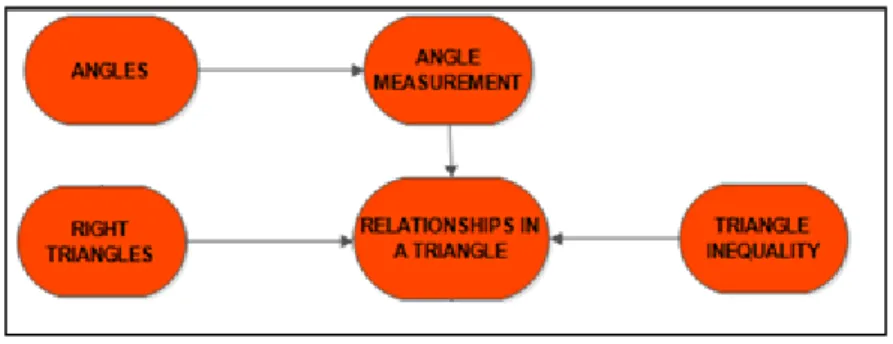
In the model, I anticipated that PSMTs‘ existing schema of an angle, angle measurement, right triangles, and the triangle inequality (the sum of the lengths of any two sides of a triangle is greater than the length of the remaining side) could be used as schema to identify PSMTs‘ schema of RASR. The model was the coordination and interactions of the existing schema that make up the schema (See Figure 1). Based on Dubinsky and McDonald‘s (2001) description, I anticipated that each schema could be described as an action, a process, or an object to construct a schema for RASR. In detail, when these existing schema are used together in a particular way for a particular type of task, the schema of RASR should be observable through interactions of these existing schema.
(Thompson, 2008). PSMTs‘ mental constructions of angle and angle measurement should then be used as an action to construct a schema for RASR.
Figure 1. The preliminary model
In addition, to develop this knowledge, I anticipated that PSMTs must have already developed knowledge of right triangles, and be able to define adjacent, opposite sides in a right triangle, as well as the hypotenuse. PSMTs must also know and reason through the basic relationships in right triangles, such as ―the hypotenuse is always across from the right triangle and the longest side in a right triangle‖ and ―the square of the hypotenuse is equal to the sum of the squares of the adjacent and opposite sides—Pythagorean Theorem‖. They must use those facts as a process to develop the schema of RASR. It is also important for PSMTs to have knowledge of relationships; ―the shortest side is always opposite the smallest interior angle,‖ and ―the longest side is always opposite the largest interior angle.‖ As well as, they must develop the knowledge of the triangle inequality. Based on Asiala et al.‘s (1996) descriptions, PSMTs‘ mental structures of RASR indicate that they are at the process level.
To progress further, PSMTs must be able to explain the relationships using more than memorized rules and must be able to use their knowledge to reason through more complex tasks. This demonstrates the object level of the schema development has been achieved by those PSMT‘s. In order to reach the object level of RASR, PSMTs must act on the dynamic right triangle. For instance, PSMTs must be able explain why an increase in the base angle of a right triangle changes all of the side lengths in a predictable manner (Yigit Koyunkaya, Kastberg, Quinlan, Edwards, & Keiser, 2015). Being able to explain why the increase of one angle results in changes to the other angles and sides requires PSMTs to synthesize their knowledge of an angle, angle measurement, right triangles, or triangle inequality; it is also reveals that PSMTs are performing from object conception.
Based on Asiala et al. (1996) and Dubinsky‘s (1991) studies, I hypothesized that a schema for RASR might occur from the coordination of all these actions, processes, objects, and other schemas, and it could be organized in a structured form. The schema was built when PSMTs coordinated and combined their constructed knowledge of an angle, angle measurement, right triangles, and triangle inequality. When the interconnections among these mental constructions were constructed into an organized structure, a fully functioning schema for RASR might occur. I anticipated that PSMTs must also unpack their constructed schema to respond to complex, non-routine tasks to learn more advanced concepts such as trigonometric ratios. PSMTs, who could unpack their constructed schema and whose knowledge fit this description, are at the schema level of the RASR.
Methodology
To collect the data of the study, I used the clinical interview methodology (Clements, 2000; Goldin, 2000) that is derived from Piaget‘s (1975) work. The methodology was a flexible and open-ended interviewing process that was designed to encourage participants to reflect on their ways of thinking, operating, and reasoning (Goldin, 2000). As such, the clinical interview methodology was helpful to gather evidence of PSMTs‘ thinking and mental processes at the level of their authentic ideas and meanings. Questioning was used to expose hidden structures and processes in PSMTs‘ thoughts and ideas as the interviews progressed (Clements, 2000).
Participants and Settings
PSMTs‘ were selected based on their interests and their willingness to explain and articulate their thought processes, their experience with learning and teaching with technology, and their computer abilities. This paper explains a part of this large study by describing the initial interview and five explanatory interviews, and focuses on one of the participants‘, Linda‘s, knowledge of RASR.
Both the initial interview and explanatory interviews were conducted in one-on-one sessions. Two different video cameras were used to record the interviews. One of the cameras was focused on Linda and the researcher to capture the interactions; the other camera was zoomed in on the computer screen to record the Linda‘s responses more closely.
Data Collection
The data collection included two separate parts: initial interview and five explanatory interviews. In initial interview, Linda was interviewed for half an hour, and she was given the same interview questions and tasks related to her ability and willingness to explain her mathematical thinking and ideas and to use computer, specifically GeoGebra. Linda was selected to attend the five explanatory interview sessions based on her ability to explain her mathematical thinking as well as to use GeoGebra software. All the explanatory interview sessions were conducted one-on-one interviews for 60-minutes. The goal of the explanatory interviews was to identify evidence of Linda‘s ways of reasoning, thinking, and current mental constructions of an angle, angle measurement, right triangles, RASR, trigonometric expressions, and trigonometric ratios which were used as evidence to investigate the her mental actions, processes, objects, and schema for specific mathematical concept in each task. For instance, she was asked about her definition of an angle, she was given some figures related to angles, triangles and right triangles and was asked to identify the relationships between angles and side lengths. The interview questions and tasks were provided in the following sections along with Linda‘s responses to these questions and tasks.
The main goal of the first and the second explanatory interview was to gain evidence of Linda‘s existing level of mental constructions in terms of angles and angle measurement. To explore evidence of her existing level of the mental constructions of angles, she were given tasks that were adapted from Clements and Battista (1990), Keiser (1997), and Moore (2010), and I re-constructed these tasks in a dynamic geometry software, GeoGebra. The goal of the third interview was to gain evidence of Linda‘s current level of mental constructions in regards to RASR, and how she was connecting and combining her schema for the concepts of angles and angle measurement to construct knowledge of RASR. In the third interview, the tasks were adapted from Kendal and Stacey‘s (1998) study and I re-constructed those tasks in GeoGebra. The goal of the fourth and fifth interviews was to gain evidence of how Linda might reflect her knowledge of RASR to response the more advanced tasks, such as trigonometric ratios.
This paper only focuses on Linda‘s mental constructions of angles and RASR; other aspects of the study are given in detail elsewhere (Yigit, 2014a), including an examination of all PSMTs‘ conceptions of angles. Some researchers (Moore, 2014; Norton, 2008) focused on a single participant to illustrate this single subject exploration, which allows more detail in reporting and more focus in the investigation in their studies. I have selected one participant, Linda, to explain her thought processes of RASR in detail. Linda was selected because I was immediately impressed by her ability to explain and articulate her thought processes and reasoning. She was not a typical pre-service teacher according to the pre-service secondary mathematics teachers‘ landscape; she developed and revealed effective ways of operating with RASR over the clinical interviews. In other words, her case was special since she revealed evidence of the process level of RASR in the third interview, and she revealed evidence of the schema level of RASR in the last interview. She took technology-related courses and learned how to use educational tools in mathematics education in those courses, so she could effectively use GeoGebra.
Data Analysis
trigonometric ratios in a special 30o-60o-90o right triangle while she was speaking herself. Then, I scripted the transcript to find evidence of Linda‘s mental actions, processes, objects, or schema for a particular concept. In this process, four-column table was used. In this table, the first column listed the code I assigned to an observed piece of evidence (as an action, a process, an object, or a schema), the second column contained my descriptions and reasons for my interpretations, the third column contained the original transcript of the event that leaded to my inferences, and the fourth column contained any extra notes (See Table 1 for an example).
Table 1. Scripting the transcripts for Linda for trigonometric ratios
CODES
INFERENCES, REASONS, AND
EVIDENCE
INTERVIEW - TRANSCRIPT NOTES
Process
The mnemonic SOH-CAH-TOA is her way
to find the
trigonometric ratios. She told that she initially memorized it, and then she used it intuitively.
She GENERALIZED the mnemonic to select a trigonometric expression and find trigonometric ratios for EVERY CONDITION, which shows the process level.
I: As you know, there are different ways to solve trigonometry problems, so how do you remember whether to use sin, cosine, or tangent? Or which way are you using?
L: Umm… For like knowing the difference, knowing like which ratios goes to which one?
I: Yes.
L: If I had the triangle, this is my angle A, then I would have sin would be opposite over hypotenuse, so I wanna do the SOH-CAH-TOA.
I: Every time you use the SOH-CAH-TOA?
L: That‘s, I think originally how I knew it, now just kind of instinct of… I just know it, sin is opposite over the hypotenuse.
ROWS 1444-1453
Applying the mnemonic is the evidence that she is in the process level. She indicated that she did not go each step of the mnemonic anymore. She directly applied it to the tasks to select the correct trigonometric expression and find a trigonometric ratio. She interiorized her action into a process. She did not rely on an external cue, anymore.
I assigned the codes based on the evidence that emerged from Linda‘s responses to the tasks, in accordance to the requirements I outlined for each concept in the data collection section. After scripting the transcribed data, I started to build a model for Linda based on my interpretation of her levels of mental constructions at the actions, processes, objects, or schema levels associated with each concept: angles, right triangles, and RASR. The preliminary model was used as bases for constructing her model of RASR. Linda‘s model evolved based on my interpretation of her mental constructions for a particular concept. In the model, I investigated the evidence of how the actions, processes, objects, and schema of a particular concept played a role in constructing a schema for RASR.
In order to ensure the reliability of the inferences of mental constructions, I discussed the results of the interview data and my interpretation of Linda‘s mental constructions as well as her APOS levels of a particular concept with a volunteered mathematic educator/researcher who was unrelated to this study. I shared a list of all of the evidence I used to make my interpretations and inferences, including all of the tables with her. I asked her to determine whether the indicated mental actions, processes, objects, or schemas are relevant or not. If the mental constructions identified by the researcher matched the mental constructions identified by me, I moved to the next level of analyses. Otherwise, I revised the model based on her feedback.
Results
Linda was a 24-year-old female pre-service secondary mathematics teacher enrolled in a course ―The Teaching of Mathematics in Secondary Schools‖. Linda was the participant in the STEM Goes Rural Project, and she was awarded ―The Woodrow Wilson Fellowship‖ for her work with this project. While this study was being conducted, she was also completing her student teaching. In high school, she took geometry and first year calculus. Throughout her undergraduate education, she took Calculus 1, Calculus 2, Calculus 3, and Linear and Differential Equations. She consistently earned a B or better in all of these courses. Linda described herself as an explorer in her learning of mathematics.
Linda’s Knowledge of the Concept of Angles and Angle Measurement*
The first and the second explanatory interviews were designed to identify Linda‘s APOS level of the concept of angles and angle measurement. In addition, the aim was to investigate impacts of the concept of angles and angle measurement on Linda‘s knowledge of RASR. Specifically, the interviews were designed to determine Linda‘s definitions and descriptions of an angle, specifically 0-line, 1-line and 2-line angles, as well as her knowledge of angle measurement. In these interviews, I asked her definition of an angle, she was given a bunch of figures related to 0-line, 1-line and 2-line angles and was asked to identify angles in these figures. The interview questions and tasks were discussed in the following part in detail along with Linda‘s responses. Moore (2014) suggested that arc measure, which is related to 0-line and 1-line angles, is related to reasoning about right triangle contexts. Therefore, even the right triangle was constructed using 2-line angles, the tasks related to 0-line and line angles were also asked Linda in order to see how her APOS levels of 0-line and 1-line angles were related to her APOS levels of RASR. The first interview was started with the question regarding the definition of an angle, and Linda defined the angle as ―an angle is distance between two intersecting rays, so this could be viewed as line segments that would continue pass the points.‖ Throughout the interviews, when Linda needed to use or recall her knowledge regarding angles, she revealed that she was considering the space between two lines—which was her description of an angle.
Linda’s Mental Constructions of 2-line Angles
Throughout the interviews, Linda revealed the evidence for schema level for 2-lines angle and angle measurement. Linda was asked to define angle and to measure the angle she drew. To respond the question, she was able to draw two intersecting line segments to define an angle and measure that angle, which revealed that she was at the action level. In order to determine whether Linda reached the process level for 2-line angles, she was asked to draw an angle whose measure was greater than the angle that she previously drew. Linda successfully drew a greater angle, and explained why the angle measure was greater. She also had an ability to identify every angle whose two rays were visible. In detail, when she saw two segments or rays in a given figure, she could easily identify where the angle was, as well as she measured the angle. These were the evidence that she was performing at process level. She could reflect on and generalized her action in the context of thinking about all possible angles.
In order to identify whether Linda reached the object level, she asked to compare the angles in a pair and explain how one angle could be described as a transformation of another angle. Linda was able to act on 2-lines angle; for instance, she was able to describe an angle as a transformation of another 2-lines angle as well as she could compare those angles based on their measurements. Therefore, it was inferred that Linda was at the object level. Evidence of schema level for 2-line angles is the use of action, process, and object levels. Linda was also able to recall and unpack her knowledge related to the 2-lines angle and angle measurement when she needed to apply them to more advance topics such as RASR. For instance, when Linda needed to use her 2-line angles schema to solve the task regarding right triangle context as it is mentioned in the following sections, she unpacked her schema to the action, process, or object levels to operate on the tasks.
Linda’s Mental Constructions of 1-line Angles
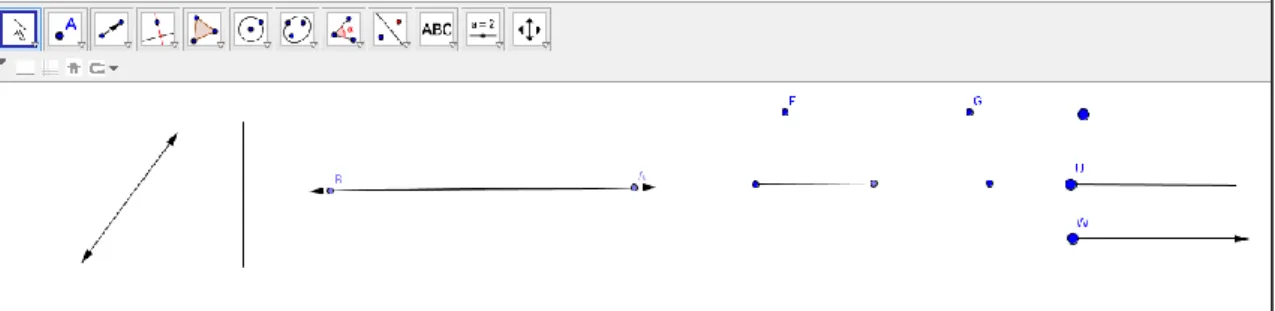
Keiser (2004) indicated that when students faced with 1-line angles, they particularly looked for a vertex point where the two lines connect and, not finding a vertex, conclude there is no angle. In order to see how her current knowledge of 1-line angles was related to her current knowledge of RASR, Linda was given couple of tasks related 1-line angles. However, when Linda was asked about the tasks related to 1-line and 0-line angles, she remained at the process level. She was first asked whether there was an angle in any of the given figures (See Figure 2). Pointing to the line segments such as FG, Linda proposed ―I am gonna say that these are simply line segments because [of] the way they were drawn, there are not multiple pieces intersecting. Her reasoning was consistent with her definition of an angle as ―a distance between two intersecting rays or line segments.‖ She reasoned that there were no angles in line segments since ―the line segment stopped at two points.‖ Linda revealed the evidencer that she needed to act on a physical object such as 2-line angles in order to identify whether there is an angle. In addition, Linda put a middle point on the line segment to define an angle, so it showed that she was at the action level by relying on an external cue and physical object—a middle point. After that, she generalized that we need a middle point or three points as reference points on line or line segment to define an angle. Her response revealed that she was at the process level by generalizing her response and reflecting her action for every 1-line angle.
Figure 2. The task which included 1-line angles
Linda’s Mental Constructions of 0-line Angles
0-line angles were more complicated for Linda to reasoning about the context (Keiser, 2004; Mitchelmore & White, 2000). Linda was asked to define 0-line angles, and she indicated that she only described 0-line angle as an angle when she saw two lines in the 0-line angles (See Figure 3). Linda indicated, ―I am gonna stick with if you had two line segments or two rays, it is going to be the distance between them.‖
Figure 3. Linda‘s 0-line drawing
Figure 4. The task which included 0-line angles
In conclusion, even she was performing schema level for 2-line angles, she could not measure and act on 1-line and 0-line angles without representations—middle point, three points or two lines. Therefore, she remained at the process level and did not reach the object level since she was relying on external cues by generalizing her ideas. It was inferred that her struggle with 1-line and 0-line angles stemmed from her descriptions of an angle. She defined and described an angle using two lines intersecting in a point, and she could easily determine angles where two rays were visible. However, when she was asked to find an angle in a given line segment or circle, she did not imagine two rays, and responded that there was no angle. As it was aimed, these tasks revealed the relationships between her knowledge of angles and RASR. In detail, the research results show that her constructions of 1-line and 0-line angles and angle measurement were not required in right triangles, and the schema level for 2-line angles was sufficient to construct a schema related to the RASR.
Linda’s Mental Constructions of RASR
Linda always used her 2-line angles and angle measurement schema when working with RASR. In the following section, I described Linda‘s mental constructions of RASR from the APOS learning theory perspective. Throughout the interviews, she provided evidence of the following knowledge of RASR:
The relationships between opposite angles and side lengths
The shortest side is always opposite the smallest interior angle;
The longest side is always opposite the biggest interior angle;
The Pythagorean Theorem (The square of the hypotenuse is equal to the sum of the squares of the other two sides in a right triangle);
The hypotenuse is always across from the right angle and is the longest side; Special right triangles (such as the 45o-45o-90o triangle);
Acute angles in right triangles are complementary;
Triangle inequality (the sum of the lengths of any two sides of a triangle is greater than the length of the remaining side).
The following table (See Table 2) represents Linda‘s APOS levels of mental constructions for RASR. The table was created based on the evidence of her mental constructions drawn from interviews, and I provide insight using the evidence of her APOS levels of RASR.
Table 2. Evidence of summary: Linda‘s level of her mental constructions related to RASR that she demonstrated through interviews
Relationships Evidence Summary*
A P O S
The relationships between opposite angles and side lengths
Int. 3 Int. 3 Int. 5 Int. 5
Pythagorean Theorem Int. 3 Int. 3
The hypotenuse is always the longest side in a right triangle
Int. 3 Int. 3
Special right triangles Int. 3 Int. 3 Int. 4, 5
Complementary Angles Int. 3 Int. 3
Triangle inequalities Int. 3 Int. 3
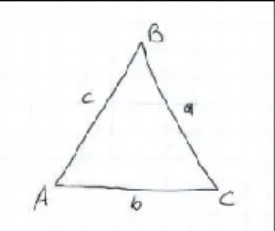
The third interview was specifically designed to gather evidence of Linda‘s level of RASR. I anticipated that Linda‘s level of RASR was a special case of her ideas of relationships between angles and side lengths in any triangle, since right triangles are a subset of all triangles. Therefore, to investigate Linda‘s mental constructions about RASR, she was asked to explain ―what relationships she knew about angles and side lengths in a triangle.‖ She immediately responded the question by drawing a triangle (see Figure 5) and describing the relationships she saw using the triangle:
Linda: Ok, so you have your triangle, you… It is composed of three angles, so each side on the triangle is actually a ray to two of the angles [meaning that two angles shared a common side in a triangle]. So, this side here [pointing to side c] is one of the rays of this angle [pointing to angle A] and of the top angle [pointing to angle B]. And so, the side length would be determined by how the angles are put together.
This approach to tasks, namely physically drawing a triangle involving three angles comprised of rays to operate on and look for the relationships, was one she used consistently in tasks. Since the action level is characterized by the use of physical objects to act upon (Asiala et al., 1996), Linda‘s use of a drawn triangle was evidence of the action level in terms of relationship between angles and side lengths in a triangle.
Figure 5. Reconstruction of Linda‘s initial drawing of a triangle
She also directly referred to an imagined triangle when she was asked to explain the relationships in detail. When I prompted her to explain the relationships, she drew the triangle she imagined. Her approach revealed that she could move between using a physical object and a mental one. Her control over the mental triangle showed that she reached the process level for relationships between angles and side lengths in any triangle. Linda could act on a physically drawn triangle or an imagined triangle to explain the relationships between angles and side lengths in any triangle. Later in the interview she demonstrated the same reasoning for the right triangle. In the following subsections, I discuss evidence of Linda‘s APOS levels for RASR derived from my interpretation of interview data. Each of the relationships listed above is discussed. I explained how she demonstrated her mental constructions of RASR from the perspective of APOS learning theory.
The Relationships between Opposite Angles and Side Lengths
After Linda drew a triangle to explain the relationships she knew between angles and side lengths in a triangle, , she explained the relationships between opposite angles and side lengths. She pointed out that, ―the shortest side is always opposite the smallest interior angle,‖ and ―the longest side is always opposite the biggest interior angle.‖ Linda explained the relationships between angles and side lengths by explaining how to construct a triangle. To explore whether her action of relationships between opposite angles and side lengths in the triangle was applicable in any triangle, I asked her whether she could apply these rules in any triangle or not . Based on her explanations, she drew another triangle on the original triangle that she drew as shown in Figure 5, by increasing the angle A (See Figure 6). Linda went further, saying:
L: Umm… So, you have the relationship between… If this is your triangle, we have these three angles, this side length, here is related to this angle.
Interviewer: How is it related?
Figure 6. Linda‘s drawing to explain the relationships
Her reasoning demonstrated that she was at the action level because she used facts to draw the triangle by relying on a physical object. She went on to demonstrate that she was at the process level because she explained that these relationships are applicable for any triangle, which indicated that she understood the generalizability of the relationships (Arnon et al., 2014).
To determine if she had reached the object level, she was given more tasks that included the dynamic aspect of right triangles (Arnon et al., 2014). If she had been able to see the modified triangle as a transformation of the previous triangle and explained the modified triangle as such, it would have been assumed that she reached the object level. To investigate whether Linda had reached the object level for RASR, she was given a 30o-60o-90o ABC triangle and asked to increase the 30o angle to 35o and identify the corresponding changes using paper and pencil (Yigit Koyunkaya et al., 2015). In response to the question, Linda moved the point A (indicates the point on the 30o angle) horizontally to increase the angle to 35o (See Figure 7), and she preserved the right triangle and interpreted that other base angle decreased to 55o. However, when she was asked to explain how a change to one of the base angles in a right triangle affects the other angles and side lengths in the newly transformed triangle. However, she again applied previously developed and used mental constructions, which were unconventional to reach the object level of RASR. She relied on the relationships between opposite side lengths and angles in a triangle. Because she saved the right angle in the triangle, she assumed that the opposite side lengths of the right angle would not change. Furthermore, she indicated that the opposite side of the increased angle would increase as well as the opposite side of the decreased angle would decrease (See Figure 7). She explained:
L: So, I assumed that you still want to keep the right triangle. So, I knew this angle, here [pointing to the angle C], is gonna be 90°, and if this one [pointing to the angle A] is gonna be 35°, then I need this space to be larger, and I knew this angle [pointing to the angle B] is going to be decreasing. So, when an angle decreases, it is easier for me to think about decreasing this angle, there is… this one [pointing to the angle A] is certainly increasing because of decreasing this angle [pointing to the angle B]… I knew that [pointing to the point A] is going to be pulled in. So, the point… This side [pointing to the side length AC] is going to be a smaller, here.
She advanced incorrect prediction since she considered the relationship between opposite angles and side lengths; she did not identify the changes in the triangle. She explained that she used the relationships between opposite side lengths and angles to reason about the changes in the side lengths. Even though she was aware of needing the space to be larger when she increased the angle, she could not act on the side lengths to identify the corresponding changes. Her mental constructions constrained her to reach the object level for RASR in the third interview.
Figure 7. Linda‘s response to the task in pencil on paper
between angles and side lengths in a triangle when she was provided a visual and dynamic task. Linda was not directly asked to increase or decrease the angles to find the height of the castle, but she was allowed to drag the points in the given sketch in GeoGebra. This task was intentionally given to Linda, and she was expected to increase or to decrease the measure of an angle I (or angle H) to construct special right triangles to calculate the height of the castle because she was not allowed to use any tool such as calculator to find a trigonometric ratios. She was expected to drag the points in the triangles and to construct special right triangles in order to find the height of the castle.
Figure 8. The task to find the height of the castle
As it was expected, Linda dragged point I to the left to decrease the angle to 30 and dragged the point H to the right to increase the angle to 60 in GeoGebra. She indicated that she intentionally dragged the points, explaining:
L: Umm… Because it is a number [referring to the 30 or 60 degrees] that I can find the sine and cosine for easily, because it is one of the special ones.
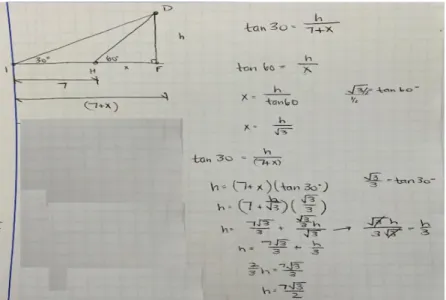
In order to calculate the height of castle and using 30-60-90 right triangle, she also drew the triangle using paper and pencil (See Figure 9). In this special right triangle, RASR seemed helpful for Linda to reason about the trigonometric ratios. Specifically, Linda initially considered the relationships between the DFI and DFH right triangles by identifying trigonometric expressions in those triangles, and then she constructed the relationships between those trigonometric ratios to find the height of the castle (See Figure 9). She again used the hand rule, and explained:
L: Yes, yes sorry. I used the left hand trig, so I have got my sine on the bottom, and cosine on the top. I can just kind of… So, I did sine over cosine, so it was square root of 3 over 2, over ½, so it is just square root of 3. So, x is going to be h over the square root of 3, I can substitute that in tangent of 30 equals h over 7 plus x. This one, I am gonna solve for h, so 7 plus x times tangent of 30 which is going to be square root 3 over 3. So, here 7 plus h over square root 3 times square root 3 over 3.
Linda substituted the x value in the equation to find the height of the castle. Her approach to the task was evidence of the process level. She used the special right triangle as a representation, and applied the mnemonic—(SOH-CAH-TOA [Sine= Opposite / Hypotenuse, Cosine= Adjacent / Hypotenuse, Tangent= Opposite / Adjacent])— to find the trigonometric ratios. This task in particular revealed that she was composing RASR and special right triangles to find the height of the castle.
After Linda was asked many tasks (such as finding the height of the castle) using paper and pencil or acting on GeoGebra to explore and reveal her APOS level of RASR, in the fifth interview, she again was intentionally asked to increase the angle in a different, but similar, right triangle in GeoGebra that she was asked to increase the angle using paper and pencil in the third interview (See Figure 10). She stated that ―Well this length stays the same [pointing to the AD], Umm, the hypotenuse is shorter, so if ED is shorter while the angle E increased, angle D decreased. AD stayed the same.‖ Linda increased the angle and identified the corresponding changes between angles and side lengths in the triangle. I interpreted this as evidence that she was seeing the right triangle as an entity and described the right triangle with the AED of 35 as a transformation of the right triangle with the AED of 30. Linda treated RASR as an object since she transformed attributes of a triangle, and she reached the object level. Throughout the third, fourth and fifth interview, working with GeoGebra and solving non-routine tasks might help her to realize the dynamic aspect of the right triangle as well as to reach the object level.
Figure 10. The task to find the attributes and changes if we increase the angle
Arnon et al. (2014) indicated that when learners construct a schema as a coherent collection and connection between the actions, processes, objects and other schema structures, the schema can be used as a dynamic structure. Linda displayed evidence of constructing schema of RASR. I asked Linda to solve a word problem that involved finding of the height of the Empire State Building in Figure 11 (Adapted from Moore (2010)). This task was intentionally given to Linda. She was expected to construct the triangle, so that she was not given any image or figure. Specifically, instead of giving 60 degrees angle, she was given 56 degrees angle since Linda was not allowed to use an electronic calculator to calculate tangent 56. Particularly, she was expected to imagine to increase the 56 degrees angle to 60 degrees angle as she practiced and did many tasks throughout the study and made predictions regarding the approximate value of the height of the Empire State Building. Her response was the same as the expectations. Initially, she drew a right triangle (See Figure 12) as an action that was part of her right triangle schema. Linda explained that x/1000 would be equal to tangent 56. By drawing a right triangle and directly applying the mnemonic (SOH-CAH-TOA) without going through each step, she revealed that she had generalized her reasoning for any triangle at this point in the task. She was using her mental constructions of right triangle as well as applying the mnemonic as a process.
Figure 11. Empire State Building task (Adapted from Moore (2010))
Figure 12. Linda‘s response to find the Empire State Building
Although she was not asked to increase the angle, she unpacked and applied her knowledge of RASR to represent the side length in a right triangle as a transformation of another one. Linda first unpacked her schema of RASR at the process level and indicated that, ―I would like to find the value of tangent 60o.‖ By reflecting on her knowledge related to the 30o-60o-90o special right triangle, she found that tangent 60o instead of tangent 56o since she increased the angle to 60o, which is easier to act on for her. She then moved to the object level and acted on the triangle as a whole by indicating that the value of the height of the building would be less than ―(tangent 60). 1000.‖ Linda‘s response showed that she had reached the schema level regarding RASR since she unpacked her schema to the process and object level to solve the problem.
Pythagorean Theorem and Hypotenuse is the Longest Side
To investigate her mental constructions of RASR, I asked Linda to explain what relationships she knew about the angles and side lengths in a right triangle. She immediately drew a physical right triangle, and she explained:
L: … We have, like, Pythagorean Theorem, right. You have three sides and the angles. I: What is that theorem?
L: a2+b2=c2, and here your c2 is always hypotenuse which is opposite the right angle.
The process level is characterized by repeating and reflecting on the mental constructions for every condition; therefore Linda‘s approach, particularly applying the Pythagorean Theorem to a generalized right triangle, revealed the evidence of process level regarding the theorem. Throughout the subsequent interviews, when Linda was asked about the tasks regarding the trigonometric ratios, she continued to recall and apply the Pythagorean Theorem. Additionally, when she was given any right triangle and asked about the RASR in the triangle, she immediately stated, ―the hypotenuse is always going to be the longest side.‖ I inferred that Linda did not use any visual interpretation to reason about the longest side in a right triangle, and she made this statement without any obvious analysis or reasoning. When she was asked to explain why it is always the longest side, she responded:
L: Umm… the right angle, since you know the angles and side of triangle add up 180 degrees, and right angle is 90 degrees, so you know that the two other angles, each has to be less than 90 degrees, it makes it the largest. And so, it makes [the] side opposite it, it has to be (the) largest or longest side.
Linda reasoned through the relationships regarding the hypotenuse by relying on the relationship between opposite angles and side lengths in a right triangle. Her approach, particularly generalizing the relationship for any right triangle, was evidence of her process level (Asiala et al., 1996). Throughout the interviews, she applied the relationship to the tasks. For instance, when she was asked to find possible values for side lengths in a right triangle, she directly applied the relationship by indicating the value of the hypotenuse would be the upper bound for the side length since it is always the longest side.
Special Right Triangles and Complimentary Angles
Figure 13. The task to find the shortest and longest side in a right triangle
Linda immediately said that, ―OK, so side AB is going to the shortest side.‖ I asked her to explain her reasoning, and she responded:
L: Because, it [pointing to the AB] is obviously shorter than this one [pointing to the AC]. I: So, did you just visualize it?
L: Yes. And, the hypotenuse is going to be longest.
Her initial response was again based on visualizing the triangle. Since action level is characterized by using a physical object to act on it, her use of a physical object to reason about the given task was evidence of action level as Arnon et al. (2014) stated.
Linda was then asked to explain her reasoning using more than just visualization, for which she used a 45o-45o -90o special right triangle as a representation to explain the relationship between the shortest side and the smallest angle in a right triangle:
L: So, this one here [pointing to the side length AB] would be the shortest side. I: Because?
L: Because… Since this angle is 90 degrees (angle A), and I know that the sum of angle C and angle B has to be 90 degrees, and the total is 180 degrees. And, that would mean, if they were equal [referring to the side lengths BA and CA], they would be 45 degrees each, and this is less than 45 degrees [referring to the angle C], so I know that the other one [referring to the angle B] is just larger.
During this particular task, she revealed evidence of using two different relationships in her reasoning. Linda also used the relationship within a 45o-45o-90o triangle and the relationship, ―acute angles of the right triangles are complementary.‖ She used an imagined 45o
-45o-90o right triangle as a representation to reason about the relationships. Her approach, namely using an imagined special right triangle to act on and look for the relationships, revealed that she applied her constructions regarding the special triangles and complementary angles to any condition. This evidence showed that she reached the process level regarding the relationships of the special right triangles and complementary angles in a right triangle.
Triangle Inequality Theorem
I hypothesized that to build mental constructions of RASR, PSMTs must be able to understand the triangle inequality theorem. Even though Linda took many mathematics courses, she did not specifically explain what the inequalities of or the meaning of the triangle inequality theorem was. However, based on the given tasks, she revealed evidence of different levels of processing of the triangle inequality theorem throughout the third interview. To investigate Linda‘s mental constructions regarding right triangles as well as the triangle inequality theorem, I asked her whether any three measurements would construct a triangle, she responded:
Linda did not specifically know what the triangle inequality theorem was, but she reasoned through her answer using a physical representation. Linda used a physical object and gave a counter example to explain why any three measurements cannot construct a triangle. Her approach to the task, namely relying on a physical object, showed that she had completed the action level in terms of the triangle inequality. To investigate whether she interiorized her action and reached the process level (Arnon et al., 2014), I prompted her to apply the triangle inequality to any triangle. I gave Linda two side lengths and asked her to determine the possible length for the third side of the triangle. She used reasoning consistent with knowledge of the triangle inequality. Her approach indicated that she had reached the process level for the triangle inequality theorem.
To investigate how she would use triangle inequality to construct RASR, I asked her whether it was possible to construct a triangle given one angle measurement and two side lengths measures, and she was given a task that was constructed in GeoGebra (See Figure 14). To find the third length, she used the same two mental constructions she had before:
L: So, since this angle would be the largest of the triangle, and that is going to be the longest side, so I know it has to be value less than 18 [she meant 18 by adding 10+8 that the triangle inequality requires], it has to be a value less than the sum of the two legs.
To find the possible length of the third side of the triangle and construct a process, she composed her two processes together. Linda specifically combined the fact that, ―the longest side is always opposite side of the biggest angle,‖ and her intuitive notion of the triangle inequality theorem to reason about the possible value for the third side of any triangle. This evidence further supported the conclusion that she had reached the process level in regards to the triangle inequality theorem.
Figure 14. Constructing a triangle by using 2 line segments and 1 angle measurement
Discussion - Linda’s Model of RASR
Figure 15. Linda‘s model of RASR
Linda initially used physical objects to explain her constructions in regards to RASR. She first found, interpreted, or estimated the unknown sides in a triangle visually, and she did not initially consider any relationships. When Linda was asked about her reasoning, she provided evidence that she could operate with physical objects and had internal control over them by repeating and reflecting on the actions for every triangle (Arnon et al., 2014). Linda was also able to see a right triangle as a transformation of another right triangle by acting on it and considering the changes in side lengths and angles. Moreover, Linda used her mental constructions of RASR as a dynamic structure. When she needed to use it, she was able to recall and unpack her mental constructions to the action, process and objects levels. In other words, she displayed evidence of constructing schema for RASR.
The preliminary model was my initial model for the construction schema of RASR based on my own experiences with the topics and the extant literature related to the concept of angles. The preliminary model was taken as a template to construct her model, and her model of RASR evolved based on her responses to the tasks and her mental constructions in Figure 15 that represents the highest level of mental structures that she reached to construct a schema of RASR. In the preliminary model, I proposed that PSMTs must reach schema level in angle, angle measurement, right triangles, and the triangle inequality to construct schema for RASR. However, based on the data analysis, it is interpreted that reaching the schema level for 2-lines angles and angle measurements, triangles, specifically right triangles and the relationships between opposite angles and side lengths as well as reaching the process level in some relationships including ‗Pythagorean Theorem‘, ‗The hypotenuse is always the longest side in a right triangle‘, ‗Special right triangles‘, ‗Complementary Angles‘, and ‗Triangle inequalities‘ were enough to construct a schema for RASR.
As it is explained, Linda reached the schema level for 2-line angles and angle measurement while she operated at the process level in regards to 1-line and 0-line angles and angle measurement schema, which were not necessary for constructing schema for RASR. Linda specifically used her 2-line angle and angle measurement schema as an action to reasoning about all these relationships, and she demonstrated the process level regarding all these relationships throughout the interviews. For instance, when Linda was asked to increase angle AED to 35° and identify the changes in the right triangle, she increased the angle using her constructed 2-line angle and angle measurement schemas. Then, she drew the newly constructed triangle to identify the changes in the right triangle. Linda used her mental constructions of 2-line angles and angle measurement as an action to construct a schema for RASR.
another one, which showed her object level of RASR. Merely being at the process or object level for right triangles was not enough to reach the schema level of RASR. She needed to unpack their schema for right triangles to process and object levels to reason about the tasks and explain the relationships in the right triangles. Then, she coordinated her mental constructions for angles, right triangles and relationships in the right triangles.
Furthermore, she organized all these actions, processes, objects and schema in a structured form. When she was asked to find the height of the Empire State Building, Linda specifically used her mental constructions for special right triangles as well as relationships between opposite angles and side lengths in a right triangle. She thought about the dynamic aspects of the triangle. Instead of using the original triangle, she used a special right triangle and found the height of the building. She specifically unpacked her schema of 2-line angles, right triangles and relationships between opposite angles and side lengths to the process and object levels to reason about the task. By using the newly transformed triangle, she described the trigonometric ratios for a given triangle as transformations of another trigonometric ratios defined in the special right triangles. In other words, she was able to unpack all these relationships to action, process, and object level in Empire State Building task, which is the evidence of her schema level.
If learners provide evidence of flexible schema for RASR, it can be assumed that they can reason about and solve complex, non-routine tasks related to RASR. Ideally, fully developed schema can be recalled and unpacked so that portions of the schemas can be applied to other contexts as Linda applied her schema of RASR to trigonometric ratios. Unpacking allows learners to parse out the needed actions, processes, or objects within a schema, which will lead them to construct a higher-level schema (Arnon et al., 2014; Asiala et al., 1996).
To sum up, the proposed model explains how a PSMT develop her/his schema of RASR, so the model could be helpful to understand students‘ learning patterns of angles, right triangles and RASR. It also suggests significant insights to improve teaching and learning of angles, triangles (right triangles), and RASR as well as more advanced concepts such as trigonometry. Specifically, this model would be helpful to examine students‘ difficulties in learning of angles, right triangles and RASR by suggesting possible strategies.
Conclusion and Suggestions
The work described in this study has focused on the mental constructions enough for developing a schema for RASR. The results show that schema for 2-line angle and angle measurement, right triangles and relationships between opposite angles and side lengths and process level for some relationships including ‗the Pythagorean Theorem‘, ‗The hypotenuse is always the longest side in a right triangle‘, ‗Special right triangles‘, ‗Complementary Angles‘, and ‗Triangle inequalities‘ are enough to construct a schema for RASR. Even though Linda was less flexible on constructions of 1-line and 0-line angles and angle measurement as the participants in Mitchelmore and White (1998) and Keiser‘s (2004) studies, she was able to reach the schema level for RASR. In other words, even though Linda did not have a full schema for 0-line and 1-line angles and angle measurement, her mental constructions of 0-line and 1-line angles and angle measurement were not required to develop a schema for RASR.
Additionally, Moore (2014) indicated that students‘ learning of arc measure is related to reasoning about right triangle contexts. However, the finding of this study regarding 0-line and 1-line angles is different from Moore‘s conclusion. Although Linda did not reveal any evidence for measuring arcs and lengths; she provided evidence for schema level for RASR. In other words, Linda‘s mental constructions of 2-line angles were enough to reasoning about the tasks and reached the schema level for RASR. In particular, the level of mental constructions of 0-line angles might connect the findings of this study and Moore‘s (2014) findings. For instance, one could look for the relationships between a level of mental constructions or APOS levels of 0-line and 1-line angles that might lead to measuring arc and arc lengths could support important ways to reasoning about relationships in right triangle context as well as unit circle context, but it remains an open question for the new studies.
worked with tasks that were constructed in DGS, GeoGebra. For example, in the third interview, when asked to increase one of the base angles in a right triangle using paper and pencil, Linda revealed that she could not act on the triangle as an entity. Yet, in the fifth interview, she shared evidence that a new triangle was a transformation of the previous one even she was not given a visual context of a word problem. She further identified changes associated with changes in angles and side lengths in a right triangle, which was evidence of object level of RASR. Moreover, when she was asked to reason about the changes in trigonometric ratios, she recalled and applied those RASR to identify the changes in trigonometric ratios, which revealed the evidence of her schema level of RASR. Using GeoGebra, and seeing how dragging affects the relationships between angles and side lengths in non-routine tasks, would have been helpful for seeing a right triangle as a transformation of another right triangle. In other words, Linda‘s results support the suggestion that posing non-routine tasks and working with GeoGebra would help her reason about the dynamic objects and reach the schema level. But, all these suggestions remain open questions for future studies. One could look for the roles of novel tasks in GeoGebra in construction schema for RASR and trigonometric ratios.
To sum up, many researchers, teachers and standards suggest the importance of the role of right triangles and relationships between angles and side lengths in a triangle in advanced mathematical learning, but very little is known about students‘ learning of these concepts. This study provides a pre-service secondary mathematics teacher‘s mental constructions of RASR. Linda‘s model might help researchers better understand students‘ learning patterns—in terms of their mental actions, processes, objects, and schemas—of RASR. The researchers and the teachers might use the model to design lesson plans. For instance, they might focus on the specific structures to teach the RASR. The model also might lead to research-based curricula suggestions for improving the learning and teaching of RASR. There is still much more that needs to be investigated about complexities of students‘ learning of RASR and the effects of RASR in learning more advanced concepts. One might research how learners‘ knowledge of RASR is related to their knowledge of more advance topics such as trigonometric ratios and trigonometric functions.
Acknowledgment
I would like to thank Dr. Signe KASTBERG for the comments and suggestions to write this paper, and most of all the encouragement she has given me to complete my Ph.D. education.
References
Arnon, I., Cottrill, J., Dubinsky, E., Oktac, A., Roa Fuentes, S., Trigueros, M., & Weller, K. (2014). APOS theory: A framework for research and curriculum development in mathematics education. New York, NY: Springer.
Asiala, M., Brown, A., Devries, D., Dubinsky, E., Mathews, D., & Thomas, K. (1996). A framework for research and curriculum development in undergraduate mathematics education. In J. Kaput, A. Schoenfeld, & E. Dubinsky (Eds.), Research in Collegiate Mathematics Education II, CBMS Issues in Mathematics Education (Vol 2, pp. 1-32). American Mathematical Society, Providence, RI.
Browning, C. A., Garza-Kling, G., & Sundling E. H. (2008). What‘s your angle on angles? Teaching Children Mathematics, 14(5), 283-287.
Clark, J. M., Cordero, F., Cottrill, J., Czarnocha, B., DeVries, D. J., St. John, D., Tolias, T., & Vidakovi´c, D. (1997). Constructing a schema: The case of the chain rule. Journal of Mathematical Behavior, 16, 345– 364.
Clements, D. H., & Battista, M. T. (1989). Learning of geometrical concepts in a Logo environment. Journal for Research in Mathematics Education, 20(5), 450-467.
Clements, D. H., & Battista, M. T. (1990). The effects of Logo on children‘s conceptualizations of angle and polygons. Journal for Research in Mathematics Education, 21(5), 356-371.
Clements, J. (2000). Analysis of clinical interviews: Foundations and model viability. In R. Lesh & A. Kelly (Eds.), Handbook of research design in mathematics and science education (pp. 547-589). Hillsdale, NJ: Erlbaum.
Dubinsky, E. (1991). Reflective abstraction in advanced mathematical thinking. In D. Tall (Ed.), Advanced mathematical thinking (pp. 95-126). Boston, MA: Kluwer Academic Publishers.