Address for correspondence Dr. Sudhir Nayak U.K. MD, DDVL Assistant Professor,
Department of Dermatology, Kasturba Medical College,
Manipal University, Manipal-576104, India Email: [email protected]
Original Article
Open comparative study of efficacy and safety of
ketoconazole soap and oral ketoconazole in
tinea versicolor
Raviteja Innamuri, Sudhir Nayak UK, Shrutakirthi D Shenoi
Department of Dermatology, Kasturba Medical College and Hospital, Manipal University, Manipal, India
Abstract Objective To compare the efficacy and safety of 2% ketoconazole soap in treatment of tinea
versicolor (TV) and to compare it with stat 400mg dose of ketoconazole.
Methods Patients of TV confirmed by potassium hydroxide (KOH) mount were divided by block randomization into 2 groups. Group 1 received 400mg of oral ketoconazole single dose and a non-medicated soap for daily bath. Group 2 received 2% ketoconazole soap for daily bath. The lather from the soap while bathing was to be left on the skin for 3 minutes. Patients were assessed at the end one month and KOH repeated from index lesion.
Results Twelve patients out of 25 completed the study, 6 in each group. Four patients (66%) were mycologically cured in group 1 while two patients (34%) were mycologically cured in group 2. All these patients were compliant with the usage of soap.
Conclusion Ketoconazole soap is at best an adjunct in the treatment of TV. It might however be useful in the prophylactic management of patients with chronic TV as bathing is almost a daily routine in most patients especially in tropics. Further studies are required in this aspect.
Key words
Pityriasis versicolor, ketoconazole soap, ketoconazole tablet. Introduction
Pityriasis versicolor or tinea versicolor (TV) is a superficial, often chronic infection of the skin caused by Malassezia species which is characterized by the formation of hypopigmented, hyperpigmented and/or erythematous macules predominantly on the trunk and upper arms, although other body parts can be involved sometimes. The treatment
consists of antifungals like ketoconazole, fluconazole, clotrimazole, salicylic acid etc. The choice of preparation is often dictated by the extent of the disease and any underlying comorbidity. In extensive disease, oral preparations are preferred whereas in limited disease topical preparations. The various topical formulations available in the treatment of TV include creams, solutions, lotions and gels. Recently anti-fungal soaps have also been introduced in the market. Ketoconazole is one of the commonest antifungal used in the management of TV.
ketoconazole 400mg in the management of pityriasis versiscolor.
Methods
This was an open study and ethical clearance was obtained from the hospital ethical committee prior to commencement. Patients willing to give informed written consent were chosen. Patients less than 14 years, pregnant and lactating females, those with severe hepatic insufficiency or who had used antifungal treatment in the preceding month were excluded. The study was conducted over two months’ period (May and June 2011). All patients with a clinical diagnosis of TV were selected and a potassium hydroxide (KOH) mount was done from an index lesion. Only patients in whom the scraping was positive were included in the study.
The subjects were divided by block randomization into two groups. In group 1, cases received oral ketoconazole 200mg 2 tablets stat and were advised daily bath with a standard non-medicated soap once a day for one month. In group 2, patients were treated with 2% ketoconazole soap only for one month. Patients were advised to use the soap for bathing and to leave the lather for 3 minutes before washing off with water.
At the end of one month study period, all were evaluated clinically and a repeat KOH mount was done from the index lesion. Those who had not come for follow-up were considered as drop-outs. A patient was considered as cured if the index lesion on KOH mount was negative for fungus. Patients who reported an increase in the number of lesions were also considered as treatment failures or ‘not cured’. The person performing the KOH mount was blinded with regards to the randomization and treatment
undertaken by the patient. Adverse effects if any were recorded.
Results
Twenty five patients were recruited for the study and were randomized into group 1 (13 patients) and group 2 (12 patients). Of the 25 patients only 12 patients, 6 in each group, completed the study (Table 1). The average age group of group 1 was 25.7+6.4 years and of group 2 was 27.3+14.9 years. The median duration of disease in-group 1 was 3.8 months with an inter Quartile range (1.8, 15) and group 2 was 1 month with an inter Quartile range (0.7, 22.5).
In group 1, four patients (66%) had resolution of lesions, whereas one (17%) had no change in lesions and one patient (17%) had considerable residual lesions. In group 2, resolution of lesions was noticed in 2 patients (34%), while 3 patients (50%) showed considerable residual lesions and one patient (17%) had no change (chi square test
p=0.122).
Mycological cure was noticed in four patients (66%) in group 1 and two (34%) patients in group 2 (chi square test p=0.248).
No side effects were noticed in patients of both the groups. The non-responders to treatment in both groups suffered from diabetes.
Table 1 Comparative results group 1 (oral ketoconazole) and group 2 (ketoconazole soap).
Group 1 Group 2
Enrolled 13 12
Drop outs 7 6
Successfully completed
6 6
Cured 4 (66%) 2 (34%)*
Not cured 2 (34%) 4 (66%)
Discussion
Tinea versicolor is one of the commonest fungal infections seen in tropical countries like India. Though perennial, increased incidence is noted in the summer months in view of increased temperature and sweating which tend to promote the growth of Malassezia. The high incidence of TV in summer prompted us to conduct the study in the month of May and June at the peak summer season in this part of the country.
Various antifungals have been used in the management of TV with varying success rate. The success rate of clearance depends upon the preparation of antifungal, duration and dose of treatment. Ketoconazole is one of the common drugs used in the management of TV. Ketoconazole was first used in the treatment of TV in 1980.1 It is available in various formulations making it one of the most preferred medications in treatment of TV. The various formulations of ketoconazole available are tablet, cream, lotion, and shampoo base. Ketoconazole soap has been introduced in the market and is considered as an adjuvant in the management of TV. In order to avoid any bias due to the drug, the efficacy of ketoconazole soap was compared with oral ketoconazole. Oral ketoconazole has been used in different doses and for varying duration in various studies. Ketoconazole in a single dose of 400mg is one of the preferred regimens in the treatment of TV.2,3 Patients on oral ketoconazole were given a non-medicated soap to use for one month, so as to avoid any accidental use of any over the counter medicated soaps which could interfere with the study results especially ayurvedic or antifungal containing soaps.
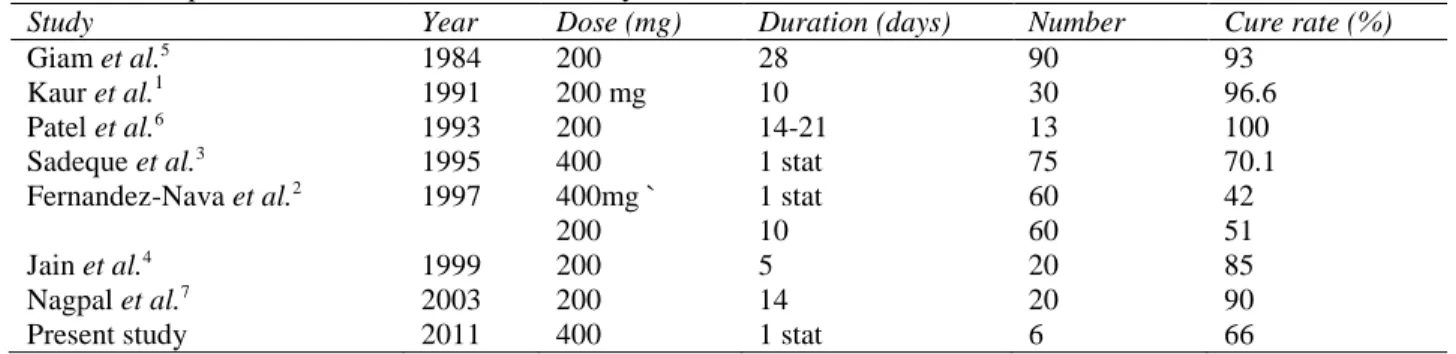
The success rates of ketoconazole in the treatment of TV in varying studies are summarized in Tables 3 and 4.
The lower response rate in both groups could be due to the fact that the non-responders in either group were diabetics. Patients with diabetes may require a longer duration of treatment in view of the immunosuppression and predisposition to fungal infection. Even though the formulation of ketoconazole soap was 2%, subsequent to creating lather with water, there may be a significant reduction in the available concentration which may account for the lower cure in this group. The shorter contact time of 3 minutes of a diluted concentration of active ingredient may also account for the lower cure rate.
Single dose of ketoconazole is very popular in the management of TV in view of better compliance and economics. The cure rate of 66% with oral ketoconazole 400mg is also comparable with that of Sadeque et al..3 who reported a cure rate of 70.1% with 400mg stat of ketoconazole. Another study with 400mg of ketoconazole by Fernandez-Nava reported a cure rate of 42%.2 Other studies which have quoted a higher cure rate have utilized ketoconazole for a prolonged duration of treatment varying from 5 days to 4 weeks and with a higher cumulative dose.4,5,6,7
Table 2 Comparison of various studies on efficacy of ketoconazole tablet
Study Year Dose (mg) Duration (days) Number Cure rate (%)
Giam et al.5 1984 200 28 90 93
Kaur et al.1 1991 200 mg 10 30 96.6
Patel et al.6 1993 200 14-21 13 100
Sadeque et al.3 1995 400 1 stat 75 70.1
Fernandez-Nava et al.2 1997 400mg ` 1 stat 60 42
200 10 60 51
Jain et al.4 1999 200 5 20 85
Nagpal et al.7 2003 200 14 20 90
Present study 2011 400 1 stat 6 66
Table 3 Comparison of various studies on efficacy of topical ketoconazole therapies.
Study Year Type of preparation Duration of application Number Cure rate (%)
Savin et al.12 1986 Cream (2%) 11-22 51 84
Patel et al.6 1993 Not mentioned (2%) 14-21 days 15 100
Balwada RP et al.13 1996 Cream (2%) 14 days 20 90
Lange et al.9 1998 Shampoo (2%) 1 day and 3 days (5 minute contact)
103 and 106 69 and 73
el Euch et al.14 1999 Foaming gel (2%) 30 days 48 87.5
Chopra et al.15 2000 Cream (2%) 14 days 25 88
Rathi et al.8 2003 Shampoo (2%) 3 days (10 minute contact) 27 90 Aggarwal et al.10 2003 Shampoo (2%) Once a week for 3 weeks
(5 minutes contact)
20 95
Nagpal et al.16 2003 Cream (2%) 14 days 20 80
Muzaffar et al.11 2008 Gel (2%) 5 days (5 minutes contact) 25 92
Present study 2011 Soap (2%) 30 days 6 34
for longer time. Studies which have quoted a lower contact time with ketoconazole have reported a cure rate between 69% and 95%.8,9,10,11
Daily bath is almost a norm in India. By incorporating medications in soaps, the compliance can be ensured. All patients in both the groups were compliant in the usage of soap for the entire duration of the study. Allergic or irritant reactions to soaps are minimal and there are no systemic adverse effects from usage of soaps. No side effects were noticed in any patients in both groups.
The main shortcoming of our study was the smaller number of patients and the high drop-out rate. This may be in view of the patients not coming either due to cure of the condition or in view of summer vacation during study period. This was designed as a study of two months duration with recruitment over a month and
follow-up after a month. The other limitation was that patients were not followed up for recurrence.
The main advantage of the method of treatment was the compliance with all patients reporting daily use of soap (in both arms of the study).
Acknowledgement
This study was granted short term studentship stipend by the Indian Council of Medical Research (ICMR), New Delhi, India
References
1. Kaur I, Kumar B, Sharma VK. Oral ketoconazole in tinea versicolor. Indian J Dermatol Venereol Leprol. 1991;57:157-8.
2. Fernandez-Nava HD, Laya-Cuadra B,
Tianco EAV. Comparison of single dose 400 mg versus 10-day 200 mg daily dose ketoconazole in the treatment of tinea
versicolor. Int J Dermatol. 1997;36:64-6.
3. Sadeque JB, Shahidullah M, Shah OR et al.. Systemic ketoconazole in the treatment of tinea versicolor. Int J Dermatol. 1995;34:504-5.
4. Jain VK, Aggarwal K. Comparative study of ketoconazole and itraconazole in pityriasis versicolor. Indian J Dermatol Venereol Leprol. 1999;65:267-9.
5. Giam YC, Rajan VS. Oral ketoconazole- A new treatment for tinea versicolor. Singapore Med J. 1984;25:157-60.
6. Patel KB, Vora NS, Dave JN et al.. Comparative study of oral versus topical ketoconazole therapy in pityriasis versicolor. Indian J Dermatol Venereol Leprol. 1993;59:279-80.
7. Nagpal VB, Jain VK, Aggarwal K. Comparative study of oral and topical ketoconazole therapy in pityriasis versicolor. Indian J Dermatol Venereol Leprol.
2003;69:287-8.
8. Rathi SK. Ketoconazole 2% shampoo in pityriasis versicolor: An open trial. Indian J Dermatol Venereol Leprol. 2003;69:142-3.
9. Lange DS, Richards HM, Guarnieri J et al.. Ketoconazole 2% shampoo in the treatment of tines versicolor: A multicentre randomized, double-blind, placebo controlled trial. J Am Acad Dermatol. 1998;39:944-50
10. Aggarwal K, Jain VK, Sangwan S. Comparative study of ketoconazole versus selenium sulphide shampoo in pityriasis versicolor. Indian J Dermatol Venereol Leprol. 2003;69:86-7.
11. Muzaffar F, Ejaz A, Mahmood K. Determination of cost effective topical therapy for pityriasis versicolor. J Pak Assoc Dermatol. 2008;18:159-64.
12. Savin RC, Horwitz SN. Double blind comparison of 2% ketoconazole cream and placebo in the treatment of pityriasis versicolor. J Am Acad Dermatol. 1986;15:500-3.
13. Balwada RP, Jain VK, Dayal S. A double-blind comparison of 2% ketoconazole and 1% clotrimazole in the treatment of pityriasis versicolor. Indian J Dermatol Venereol Leprol. 1996;62:298-300.
14. el Euch D, Riahi I, Mokni M et al.. Ketoconazole gel moussant a` 2% dans le traitement du pityriasis versicolor (a` propose de 60 cas). Tunis Med. 1999;77:38-40.
15. Chopra V, Jain VK. Comparative study of topical terbinafine and topical ketoconazole in pityriasis versicolor. Indian J Dermatol Venereol Leprol. 2000;66:299-300.