ECONSPEAK: A Journal of Advances in Management IT & Social Sciences, Vol.5, Issue 12, December 2015 Impact Factor 5.132 ISSN: (2231-4571)
www.skirec.org Email Id: [email protected]
An International Double-Blind, Peer Reviewed, Refereed Open Access Journal - Included in the International Indexing Directories Page 1
STUDY OF DC-AC BOOST CONVERTER & ITS CONTROLLING IN POWER ELECTRONICS
AIJAZ MD1, DR. SUCHI JAIN2
Department of Electrical and Electronics Engineering
1,2
OPJS University, Churu (Rajasthan), India
ABSTRACT
A key issue for control electronic converters is the ability to deal with intermittent flags in electrical
power getting ready to precisely and adaptably change over and coordinate electrical power. This
paper gives complete examination and mix strategies for occasional control structures. It covers the
control, compensation, and isolating of intermittent flags in control electronic flag taking care of and
proposes a united structure for hotel occasional control for control converters, giving a general
relative fundamental subordinate control respond in due order regarding occasional flag pay in
expansive planning applications – an immaculate occasional control respond in due order regarding
power electronic change. It gives different unequivocal sensible instances of the usage of occasional
control to: free reliable voltage-consistent repeat (CVCF) single-organize Pulse Width Modulation
(PWM) inverters; autonomous CVCF single-arrange High Frequency Link (HFL) inverters; free CVCF
three-organize PWM inverters; system related organize inverters; organize related
single-organize "Cycloconverter" sort HFL rectifiers; cross section related three-arrange PWM inverters;
programmable AC control sources; shunt dynamic power channels; and UPS structures. Occasional
Control of Power Electronic Converters is of key essentialness for researchers and in the field of
energy electronic converter structures and their applications, for control stars exploring new uses of
control speculation in power electronics.
ECONSPEAK: A Journal of Advances in Management IT & Social Sciences, Vol.5, Issue 12, December 2015 Impact Factor 5.132 ISSN: (2231-4571)
www.skirec.org Email Id: [email protected]
An International Double-Blind, Peer Reviewed, Refereed Open Access Journal - Included in the International Indexing Directories Page 2
1. INTRODUCTION
DC-DC power converters have a substantial nearness in all sort of electronic circuits, from industrial
applications (rocket power frameworks, DC engine drives, media transmission prepare to individual
applications (PCs, office hardware, electrical machine). These frameworks give a managed DC
voltage level (Vo) from an unregulated DC voltage level (Vin).[2]
High productivity is the most vital necessity for DC-DC converters in an extensive variety of load
power, since it specifically influences the battery lifetime. It can be accomplished utilizing
`switched-mode'. A switched-mode power converter (SMPC) is portrayed by quickly turning on and off a few
devices, exchanging a rate of vitality from the contribution to the yield. This rate of vitality is
controlled by an obligation cycle1 to limit the scattered vitality. The exchanging impact is
accomplished by transistors, which disperses little power when it is outside of its dynamic area.
What's more, SMPCs have an inductor, whose principle work is to restrain the present slew rate
through the power switch. This activity helps to confine the generally high pinnacle current. In
addition, the inductor stores the vitality, which can be recouped in the release stage. This approach
is additionally utilized as a part of substituting current (AC) applications.
The fundamental parts of the exchanging circuit can be adjusted to frame a:
1. Buck converter. It is a stage down: the yield voltage is lower than the info voltage.
2. Boost converter. It is a stage up: the yield voltage is bigger than the information voltage.[3]
3. Buck-boost converter. It can be a stage down or a stage up. Its fundamental trademark is that it
upsets the extremity of the voltage.
4. Cuk converter. It has similar components that a buck-help converter, with other diverse
configuration.
5. SEPIC converter. It can be a stage down or a stage up, however it doesn't upset the voltage
extremity.
From these topologies different converters can be acquired A buck or lift topology, independent
from anyone else, cannot accomplish rotating current. Physical reasons keep the yield current signal
from going through zero. Thus, a few topologies have been proposed keeping in mind the end goal
to get the exchanging current condition [6].
Generally, DC-AC converters (or inverters) depend on the buck topology. Nevertheless, this sort of
configurations get an AC yield volt age brings down in sufficiency than the information voltage. In
applications that require a boosting yield, this issue is settled by utilizing two-stages. One-phase to
ECONSPEAK: A Journal of Advances in Management IT & Social Sciences, Vol.5, Issue 12, December 2015 Impact Factor 5.132 ISSN: (2231-4571)
www.skirec.org Email Id: [email protected]
An International Double-Blind, Peer Reviewed, Refereed Open Access Journal - Included in the International Indexing Directories Page 3
the downside of requiring more space and disseminating more vitality since they utilize more
segments [4].
In, another inverter was proposed made out of two lift converter. It is known as lift inverter. This
inverter has as primary preferred standpoint that it creates an AC yield voltage from a lower DC
voltage in a solitary stage. As symptom, it has a higher effectiveness and a superior signal quality
concerning the customary buck inverters these pleasant properties are just accomplished with an
appropriate controller. Henceforth, to plan a suitable control law has an essential importance for
these sorts of circuits [5].
The lift inverter might be utilized as a part of various applications, as in photovoltaic framework
advertise. The sun based cells can accuse a battery up of a DC voltage of 48V. When they are utilized
as a part of household establishments, a standard residential AC power is required as power supply
.Subsequently; a lift inverter gives in these sorts of applications a superior advantage. Its structure
permits to seclude and also to increase the voltage. Besides, it guarantees that the power change is
finished with lessened vitality misfortunes [7].
2. BOOST INVERTER
A lift circuit is normally utilized as a DC-DC converter, being particularly fascinating be-cause it
produces a yield voltage bigger than its information voltage, i.e., it is a voltage lift. In, there is a
recommendation of utilizing this lift circuit as an approach to convert DC volt-age into a swaying
voltage [8]. Be that as it may, rotating current can't be produced with this converter, since the yield
current can't change its sign. For this, an inverter is yielded by copying the lift circuit.
Figure 1: Domestic photovoltaic installation.
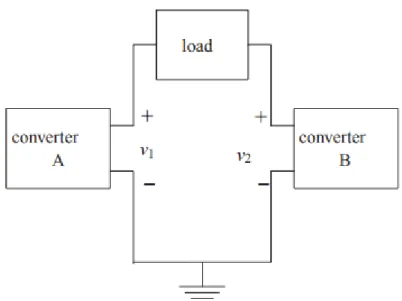
The lift inverter is comprised of two DC-DC converters and a heap associated contrast initially
DC-one-ECONSPEAK: A Journal of Advances in Management IT & Social Sciences, Vol.5, Issue 12, December 2015 Impact Factor 5.132 ISSN: (2231-4571)
www.skirec.org Email Id: [email protected]
An International Double-Blind, Peer Reviewed, Refereed Open Access Journal - Included in the International Indexing Directories Page 4
sided sine wave yield, v1 and v2, so each source produces a unipolar voltage [9]. Voltages v1 and v2
should display a stage move equivalent to 180◦, to boost the voltage excursion over the heap. Along
these lines, to produce an oscillatory signal without inclination is conceivable. Keeping in mind the
end goal to streamline the examination, a piece of the lift inverter is supplanted by a consistent
voltage source. Once the coveted outcomes are acquired, they are extrapolated to the full inverter
[10]. Note that, this substitution demonstrates all the more plainly the bidirectional current of each
lift DC-DC converter.
Figure 2: Basic representation of the boost inverter.
3. OBJECTIVES
The general control destinations for the lift inverter, which are basic in exchanging gadgets
converters, are:
1. To produce a steady yield voltage with a plentifulness equivalent to the coveted voltage.
Besides, in specific applications, it is required that the yield voltage has a pre-indicated stage;
2. To guarantee the execution for obscure or/and gradually factor loads;
3. In the case that the control law does not ensure worldwide security, to think about a fascination
domain made out of every single introductory condition that guarantee a convergence to the
framework right execution [11]. This estimation of the district of fascination is vital for the
outline of the beginning stage.
4. NORMALIZED AVERAGE MODEL
Expect system is just subject to a resistive load. Keeping in mind the end goal to streamline the
control examine, a known difference in factor is utilized, with a specific end goal to accomplish a
ECONSPEAK: A Journal of Advances in Management IT & Social Sciences, Vol.5, Issue 12, December 2015 Impact Factor 5.132 ISSN: (2231-4571)
www.skirec.org Email Id: [email protected]
An International Double-Blind, Peer Reviewed, Refereed Open Access Journal - Included in the International Indexing Directories Page 5
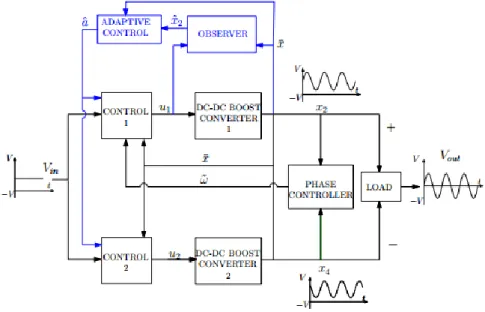
Figure 3: Controlled boost inverter with PHC.
X1=
√
iL1 (4.1)
X2 =
(4.2)
5. SYNCHRONIZATION PROBLEM
The controllers created above for boost inverters don't synchronize the two sections of the circuit
with a stage move of 180◦ since every one controls autonomously a DC-DC converter. In this way, in
the above plan, the voltage signal did not present the stage move said some time recently [12].
Keeping in mind the end goal to get the coveted output voltage, it is important to synchronize these
signals, such that they show a stage move to 180◦. In this segment, a stage controller (PHC),
motivated by the configuration of a stage lock loop (PLL), is included. The PHC enables us to
accomplish the coveted stage move between the output of the two DC-DC converters and in
addition to synchronize the boost inverter output concerning a predetermined voltage signal, as on
account of synchronization with the electrical grid [13].
6. DESIGN OF AN ADAPTIVE CONTROL
An adaptive law (or a load observer) is proposed to adapt to load variations as well as load
instabilities. This observer is composed construct just in light of an uneven circuit, which contains
ECONSPEAK: A Journal of Advances in Management IT & Social Sciences, Vol.5, Issue 12, December 2015 Impact Factor 5.132 ISSN: (2231-4571)
www.skirec.org Email Id: [email protected]
An International Double-Blind, Peer Reviewed, Refereed Open Access Journal - Included in the International Indexing Directories Page 6
circuit is stayed away from because of symmetry contemplations [14].
Figure 4.1: Controlled boost inverter with observer
7. ESTIMATION OF THE ATTRACTION DOMAIN
Evaluating an attraction domain might be included if there are physical system limitations. This issue
may show a high degree of trouble because of the system and control-law nonlinearities, including
immersion like imperatives [15]. The term immersion like imperatives is utilized for non-linear
functions γ(u) that show up in the system model and they turn into the personality, γ(u) in specific
areas of the state space that incorporate the coveted behavior, (those districts are alluded to locales
in which such limitations are not dynamic). Functions of this sort incorporate common control signal
immersion and additionally others, for example, rate limiters, for instance. Different requirements
on the state factors can be considered too [16].
There exist many distributed techniques to gauge the area of attraction A sort of such techniques
depends on Lyapunov hypothesis: shut Lyapunov-work level surfaces encase (preservationist)
estimations for the district of attraction. These strategies frequently utilize polynomial systems [17].
There exist capable scientific devices that can be utilized as a part of the calculation of the
maxi-mum adequate level for polynomial systems. Some of these devices could be additionally produced
ECONSPEAK: A Journal of Advances in Management IT & Social Sciences, Vol.5, Issue 12, December 2015 Impact Factor 5.132 ISSN: (2231-4571)
www.skirec.org Email Id: [email protected]
An International Double-Blind, Peer Reviewed, Refereed Open Access Journal - Included in the International Indexing Directories Page 7
8. CONCLUSION
The issue considered in this part is the estimation of the attraction domain for the boost inverter
with the control law proposed, which does not present a global steadiness because of certain
physical limitations [18]. For this a strategy for the estimation of the attraction locale considering
general physical imperatives is introduced. This approach can be connected to systems with a global
Lyapunov strength accomplished without considering saturations and other sort of limitations. This
is typical since, saturations are dismissed in numerous steadiness investigations. The thought is to
exploit the Lyapunov level sets, finding the most extreme Lyapunov level such that requirements are
satisfied inside it. This makes the figured attraction domain is a `conservative' estimation. This
technique is helpful notwithstanding when the degree and unpredictability of the equations is high.
For use of the strategy, capable computational apparatuses exist when the system is polynomial, for
example, SOS. Thusly, the shut loop system should be polynomial or normal (be that as it may, there
exist situations where SOS programming have been connected to trigonometrically and different
terms. Thusly, the issue is changed in a whole of squares advancement issue. Conservativeness of
the technique has additionally been talked about.
In the application to the boost inverter the system as the limitations are modified in a polynomial
frame, as the technique requires. For effortlessness reasons neither stage controller nor has
ECONSPEAK: A Journal of Advances in Management IT & Social Sciences, Vol.5, Issue 12, December 2015 Impact Factor 5.132 ISSN: (2231-4571)
www.skirec.org Email Id: [email protected]
An International Double-Blind, Peer Reviewed, Refereed Open Access Journal - Included in the International Indexing Directories Page 8
REFERENCES
1. P. Sanch´ıs, A. Ursua, E. Gubia, and L. Marroyo. Design and experimental operation of a control
strategy for the buck-boost DC-AC Inverter. In Proc. IEEE Electric Power Applications, 152(3):660–
668, 2005.
2. M. Seno, Nakai, S. Akuii, K. Seno, T. Meguro, T. Seki, Hashiguchi A. Kondo, T, H. Kumano, and M.
Shimura. Dynamic Voltage and Frequency Management for a Low-Power Embedded
Microprocessor. IEEE Journal of Solid-State Circuits, 40(1), 2005.
3. A. Seuret, F. Michaut, J.P. Richard, and T. Divoux. Networked control using GPS synchronization.
Page 6, 2006.
4. L.F. Shampine, J. Kierzenka, and M.W. Reichelt. Solving boundary value problems for ordinary
differential equations in Matlab with bvp4c. Manuscript available at http://200.13.98.241/
martin/irq/tareas1, 2000.
5. Y.B. Shtessel, A.S.I. Zinober, and I.A. Shkolnikov. Sliding mode control of boost and buck-boost
power converters using method of stable system Centre. Automatica, 39(6):1061–1067, 2003
6. O. Silven, T. Rintaluoma, and K. Jyrkka. Implementing energy efficient embedded multimedia.
Future, 2000(3000):700–1000, 2010.
7. H. Sira-Ram´ırez. DC-to-AC power conversion on a'boo st'converter. International Journal of
Robust and Nonlinear Control, 11(6):589–600, 2001.
8. H. Sira-Ram´ırez and M. R´ıos-Bol´ıvar. Sliding mode control of DC-to-DC power converters via
extended linearization. IEEE Trans. on Circuits and Systems I: Funda-mental Theory and
Applications, 41(10):652–661, 1994.
9. H. Sira-Ram´ırez, M. R´ıos-Bol´ıvar, and A.S.I. Zino ber. Adaptive Dynamical Input-Output
Linearization of DC to DC Power Converters: A Backstepping Approach. Robust and Nonlinear
Control, 7(3):279–296, 1997.
10. D.C. Snowdon, S. Ruocco, and G. Heiser. Power management and dynamic voltage scaling:
Myths and facts. 2005.
11. J.A. Solomon and G. Sperling. Full-wave and half-wave rectification in second-order motion
perception. Vision Research, 34(17):2239–2257, 1994.
12. S. Song, J.K. Kim, C.H. Yim, and H.C. Kim. H control of discrete-time linear systems with
time-varying delays in state. Automatica, 35:1587–1591, 1999.
ECONSPEAK: A Journal of Advances in Management IT & Social Sciences, Vol.5, Issue 12, December 2015 Impact Factor 5.132 ISSN: (2231-4571)
www.skirec.org Email Id: [email protected]
An International Double-Blind, Peer Reviewed, Refereed Open Access Journal - Included in the International Indexing Directories Page 9
1995.
14. A. Srivastava, S. Shah, K. Agarwal, D. Sylvester, D. Blaauw, and S. Director. Accurate and efficient
gate-level parametric yield estimation consi dering power/performance correlation. In Proc. of
Austin Center for Advanced Studies, 2005
15. A.J. Stratakos, R.W. Brodersen, and S.R. Sanders. High-efficiency low-voltage DC-DC conversion
for portable applications. Pages 105–110, 19 94.
16. A.J. Stratakos, S.R. Sanders and R.W. Brodersen. A low-voltage CMOS DC-DC converter for a
portable battery-operated system. pages 619–619, 199
17. A.J. Stratakos, S.R. Sanders and R.W. Brodersen. A low-voltage CMOS DC-DC converter for a
portable battery-operatedsystem. In Proc. IEEE Power Electronics Specialists Conference (PESC),
pages 619–626, 1994.
18. J.F. Sturm. Using SeDuMi 1.02, a MATLAB toolbox for optimization over symmetric cones.