ZigBee Healthcare Monitoring System for Ambient
Assisted Living Environments
Bongisizwe E. Buthelezi, Maredi Mphahlele, Deon DuPlessis
, Solly Maswikaneng, Topside Mathonsi
Department of Information Technology, Tshwane University of Technology, South Africa
Abstract: Healthcare Monitoring Systems (HMSs) use Wireless Sensor Networks to monitor patients in hospitals and elderly people living in Ambient Assisted Living environments. HMSs assist in monitoring chronic diseases such as Heart Attacks, High Blood Pressure and other cardiovascular diseases using Wireless Local Area Network such as ZigBee/802.15.4. Wearable and implanted devices are types of Body sensors that collect human health related data and transmit it over Personal Area Networks (PANs) such as ZigBee. However, PANs are facing the challenge of increasing network traffic due to the increased number of IP-enabled devices connected in Healthcare Monitoring Systems to assist patients. ZigBee technology is an IEEE 802.15.4 standard designed to address network traffic issues in PANs. To route traffic, ZigBee network use ZigBee Tree Routing (ZTR) protocol and Ad hoc On-demand Distance Vector (AODV). ZTR however suffers a challenge of network latency caused by end to end delay during packet forwarding. This paper is proposing a New Tree Routing Protocol (NTRP) for Healthcare Monitoring Systems to collect Heart Rate data signals from a human’s body. NTRP uses Kruskal’s minimum spanning tree to find shortest routes on a ZigBee network which improves ZTR. Neighbor tables are implemented in NTRP instead of parent–child mechanism implemented in ZTR. To reduce end to end delay, NTRP groups’ nodes into clusters and the cluster heads use neighbor tables to forward heart rate data to the destination node. NS-2 simulation tool is used to evaluate NTRP performance.
Keywords: NTRP, ZTR, Healthcare Monitoring Systems, Ambient Assisted Living.
1.
Introduction
ZigBee is a Low-Power Personal Area Network (PAN) that is good in wireless control where two or more nodes are connected together in a multi-hop mesh network. Healthcare Monitoring Systems for Ambient Assistive Living are designed to monitor the physiological status of elderly people using technologies such as ZigBee, Bluetooth, Wi-Fi etc. AAL area can be a smart home that is equipped with sensors and actuators that connects together through a Personal Area Network (PAN) such as a ZigBee network. According to [1], AAL uses ambient technologies such as data sensing, data processing, data transmission, and artificial intelligence, to enable new products, services, and processes.
These technologies provide health assistance to elderly and disable people. Due to aging, elderly people are immune to cardio vascular diseases such as heart attack, high blood pressure, stroke etc. In the near future, the society will face a serious demographic change known as aging society [2]. The World Health Organization (WHO) predicted that the total global population for people aged 60 years and above will grow from 900 million to 2 billion between 2015 and 2050 [3]. The course of this growth is the extended life expectancy
for humans that are projected to reach 80 years. These numbers are projected to grow from 12% to 22% for the total global population. On top of the chronic diseases drawback, extended life expectancy for humans require more support for daily life operations.
In response to these challenges, Ambient Assisted Living sector promise to offer great opportunities for healthcare services, products and systems through ICT innovation. In Ambient Assisted Living (AAL) areas for senior citizens, remote real-time systems for monitoring and notifying of any abnormal change due to any cardio vascular disease such as Heart failure is of high priority. ZigBee Healthcare Monitoring System for Ambient Assisted Living Environment collects heart rate data signal using implanted or wearable devices equipped with sensors. Wearable biosensors such as smart watches for heart rate bits, electroencephalogram (EEG), electromyogram (EMG), electrocardiogram (ECG), body temperature and oxygen saturation (SpO2) sensors can be connected in a Body Sensor Network (BSN). BSN obtain real time measurement of physiological signals and forward the obtained signals to the Personal Area Network. In AAL the integration of biosensors, wireless mobile devices, and wireless communication protocols that monitors physiological data for elderly people is called Healthcare Monitoring Systems (HMSs). The role of HMSs is to acquire, transmit, record and display physiological data from a human body to a remote server for further diagnosis.
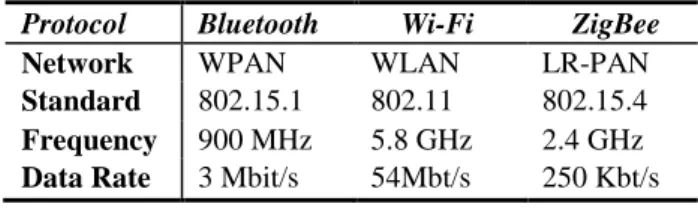
Table 1 Summary of the communication protocols
Protocol Bluetooth Wi-Fi ZigBee
Network WPAN WLAN LR-PAN
Standard 802.15.1 802.11 802.15.4
Frequency 900 MHz 5.8 GHz 2.4 GHz
Data Rate 3 Mbit/s 54Mbt/s 250 Kbt/s As seen from the above table, ZigBee communication technology aims to transmit slow speed rate of data while other communication protocols in the table above strive for faster speed transfers. It uses a frequency of 2.4 GHz to transmit low rate data. In this paper, ZigBee Healthcare Monitoring System for Ambient Assisted Living is implemented with the focus on improving ZigBee Tree Routing protocol. A New Tree Routing Protocol is implemented as a proposed protocol to transmit heart rate data signals. The rest of the paper is as follows:
Section 2, provide related work, Section 3 gives details about the proposed NTRP, Section 4 provide the results and discussions while section provide the conclusion.
2.
Related Work
ZigBee is a low-power network that uses a classical Tree routing algorithm as one of its routing protocols. Routing techniques in ZigBee wireless networks falls into two main categories; the reactive routing protocol such as Ad hoc On-demand Distance Vector (AODV) [4] and ZigBee hierarchical or ZigBee Tree Routing (ZTR) [5] protocol. AODV is a ZigBee reactive routing protocol that uses an on demand routing discovery to allow communication between the source and the destination. With AODV, only valid routes are maintained, this technique saves energy by avoiding other routes while it only retains the information for the next hop node. If there is breaking of signal in the connected links, this technique can notify the affected nodes and render them invalid. In addition, AODV is capable of avoiding fast convergent and infinite computational problems. However, the main challenge with AODV is the bottleneck. AODV needs a route discovery procedure to be repeated for each pair of nodes participating in the communication process. Overhead of route discovery and the high memory consumption increases the number of traffic sessions which result to a lot of redundancy on a network. The whole network can be affected by a bottleneck problem when all nodes are flooding their route discovery messages; therefore, this technique needs to be optimized to address the bottleneck problem. ZigBee Tree Routing (ZTR) is one of the proposed solutions to the bottleneck caused by the AODV protocol.
The main advantage of ZigBee Tree Routing is its ability to operate without route discovery overload. ZTR attempted to address the problem of route discovery which also include high bandwidth usage and high memory consumption by proposing a distributed block addressing scheme (DBAS). With DBAS, every node’s position is in a hierarchical design network topology. A parent node device setup a unique specific network address during the entrance of a child node in a network. During network initialization a special node device called coordinator allocates a definite sub-block of address space to all main parent node devices on a ZigBee network. DBAS is defined by the following network parameters; (Cm) referred to a maximum number of children
any parent has, (Rm) a maximum number of routers a packet has as its children, (Lm) maximum depth in the spanning-tree network. Therefore, Cskip(d)denotes the address sub-blocks size and depth d, can be computed as follows:
1 Lm ..., 0,1,... d
Where
otherwise Rm
CmRm Rm Cm 1
1 Rm d Lm Cm
d Cskip
1 d Lm
− =
− − − +
= −
− +
= −−
1 ) 1 (
1
) (
(1)
A Cskip(d) value greater than zero denotes the ability of a node for allocating addresses and permitting other nodes to associate with the network. However, ZigBee Tree Routing suffers a problem of hop redundancy and traffic concentration [6], this leads to end to end delay of packets that traverse the network. Regardless, of how far or close is the location of the destination node, the packets from the source node always follows the tree topology in ZTR technique. ZTR algorithm utilizes the parent-child relationship mechanism to establish possible routes between the nodes. A parent-child mechanism has an end to end delay problem due to a number of hops a packet has to pass through before reaching the destination node.
In response to this problem, a Shortcut Tree Routing (STR) algorithm that use neighbor tables to reduce the routing cost of ZigBee Tree Routing is proposed in [7] . The technique considers neighbor nodes by calculating local shortest path to the destination and the node with the shortest value is chosen as the next hop node. It also maintains the advantages of the classical ZigBee Tree Routing protocol such as no route discovery overhead and low memory consumption. STR uses 1-hop neighbor information. Source node selects the next node having the smallest remaining tree hops to the destination regardless of whether it is a parent, child, or neighbor node. Routing path selection in STR is decided by the individual node in a distributed manner by calculating the remaining hops from a source to the destination using the hierarchical addressing scheme. Instead of calculating route dynamically by using control packets a set of predefined paths can be used for forwarding packets. Each source forwards a packet to the neighbor node with the smallest remaining hops in its neighbor table. Therefore, STR claims to significantly improve the ZTR algorithm in ZigBee network. However, there is a shortcoming associated with the STR technique. The overall lifetime of the participating nodes is not considered; in addition load balancing over nodes is not evaluated.
information. The 2-hop neighbor information mechanism determines the optimal path to the destination node. However, if all nodes broadcast their neighbor’s address, many packets can be broadcasted to ensure that all nodes could receive the packets. This increases the cost overhead and the end to end delay as the packets are being broadcasted to many intermediary devices before reaching the destination device.
ZBR-M is an improvement of ZigBee Tree Routing protocol to reduce end to end delay [10]. ZBR-M protocol allows a horizontal exploration of the tree and more vertical exploration of the links between parent and child nodes. It increases the likelihood of finding an alternate path from the destination without achieving a common parent node. However, this algorithm introduces an additional energy cost compared to the basic hierarchical routing. Another study [11], proposed an analytical model to predict communication delay and lifetime for ZigBee Wireless Sensor Networks. The proposed model considers packet retransmitions, overhearing, and collisions due to interference, idle listening and overheads. An average number of failed transmissions were compared according to packet error and collision propabilities. Perfomance evaluation on NS-2 simulation tool shows that the proposed model predicts the communication delay and network life time better than other approaches. However, this model ignores the energy waste caused by collisions due interference.
The authors [12] proposed a new mechanism called Reliable and Energy Efficient Routing (REER) to reduce the packets drop during data communications. In WSNs, this is an adaptive mechanism to ensure high routing reliability if failures occur due to the movement of the sensor nodes or when sensor nodes energy depletion. The proposed new method creates alternative paths together with the routing information obtained during the route detection stage. The goal is to enhance the performance of packet delivery and energy efficiency through determining multiple possible paths which increase reliability of the entire WSN.
A study was conducted to improve tree routing protocol by implementing a cluster-tree algorithm [13]. The proposed solution is a control overhead based on ZigBee cluster tree architecture. It uses Cluster Tree parameter of ZigBee network and network address of destination nodes to restrict its transmission direction and control transmission range. Z-MHTR (ZigBee Multipath Hierarchical Tree Routing) is proposed by [14] to enhance the performance of the ZTR protocol. Z-MHTR uses simultaneous multipath routing as a solution. The proposed Z-MHTR is a node disjoint multipath routing extension for the ZigBee tree routing protocol in Cluster-Tree wireless sensor networks. To make its forwarding decisions, Z-MHTR relies on a ZigBee Tree structure based on parent child established relationships. Another study [15] conducted based on Cluster-Tree algorithm proposed to improve the ZigBee Tree Routing protocol by introducing a neighbor table forwarding mechanism. An Improved Tree Routing (ImpTR) protocol picks the shortest path to the sink node depending based on the neighbor table information instead of following the tree topology. In this mechanism, packets are forwarded to the neighbor node only if the path to the destination through neighbor node is shorter than the path through PAN coordinator. Simulation results show that the proposed
algorithm provides shorter average end-to-end delay. In addition, the results show an increase throughput and decrease the energy consumption from the network when compared to the original Tree Routing protocol. It is claimed that the proposed algorithm finds better paths to forward data packets to the destination. A mesh routing protocol for a ZigBee network called ZigBee Cluster label (ZiCL) is proposed [16]. ZiCL routing protocol aims to reduce end to end delay and packet delivery ratio. ZiCL divides the ZigBee network into one or more logical clusters. To identify each cluster, a cluster head in each logical cluster assigns a unique Cluster Label to cluster numbers. Clustering encourages nodes to share routing information and it reduces numerical potential route discoveries. To effectively exploit the logical network, ZiCL provides an algorithm to calculate the cluster label of a node and encourage nodes within each cluster to share routing information.
In this paper [17], a Velocity Energy-efficient and Link-aware Cluster-Tree (VELCT) scheme for data collection in WSNs is proposed which would effectively mitigate the problems of coverage distance, mobility, delay, traffic, tree intensity, and end-to-end connection. The designed VELCT scheme minimizes the energy exploitation, reduces the end-to-end delay and traffic in cluster head in WSNs by effective usage of the DCT. The strength of the VELCT algorithm is to construct a simple tree structure, thereby reducing the energy consumption of the cluster head and avoids frequent cluster formation. An algorithm for enhancing coverage and network is proposed [18] to optimize network lifetime and network coverage in a cluster based Wireless Sensor Network. The proposed algorithm is integrated with clustering routing protocols such as DEC, DBEA-LEACH, DB-LEACH, EBCM, and LEACH-E. The performance results display that the integrated protocols in terms of energy consumption and network coverage.
In this paper, a New Tree Routing Protocol (NTRP) [19] is used to reduce delay in ZigBee Healthcare Monitoring System. Studies in [20], [21], [22] are some of the works that were conducted based on ZigBee routing algorithms. The findings for the mentioned surveys show that ZTR have a potential end to end delay problem due to the parent child mechanism it uses for packet forwarding. In response to overcome end to end problem, NTRP is proposed.
3.
Proposed solution based on a New Tree
Routing Protocol (NTRP)
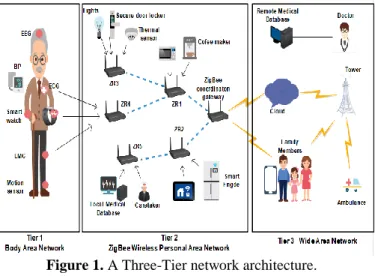
A New Tree Routing Protocol (NTRP) is an algorithm that attempts to improve ZigBee network performance metrics such as end to end delay, packet delivery, energy consumption and network throughput. NTRP merges the original ZTR and Kruskal’s minimum spanning tree protocol to discover shortest paths in ZigBee network. In addition, neighbor table and clustering sensor nodes into different groups enhance the NTRP performance. This study is adopting a Three-Tier Remote Healthcare Monitoring System architecture to improve the performance of the ZigBee Personal Area Network.
• First tier (BAN)
In Ambient Assisted Living, elderly people can be monitored using implanted or wearable body sensors. This work focuses in heart rate signals; therefore, wearable sensors are used to collect signals. The collected signals are sent to second tier.
• Second tier (PAN)
The second tier is composed of ZigBee Personal Area Network. The types of devices in second tier are ZigBee router nodes including a special node called ZigBee coordinator. The rest of the devices are end nodes. Heart rate signals transmitted from router to another until they are sent to the WAN tier.
• Third tier (WAN)
WAN tier allow signals to be transmitted to the remote locations such as remote servers. This connection can also connect the patients with remote healthcare professionals.
Figure 1. A Three-Tier network architecture.
3.1 A New Tree Routing Protocol
In wireless sensor networks the spanning tree is usually used as a routing structure to collect data. Kruskal's algorithm is an algorithm in graph theory that finds a minimum spanning tree for a connected weighted graph. This means it finds a subset of the edges that forms a tree that includes every vertex, where the total weight of all the edges in the tree is minimized. It uses greedy forwarding decisions using only information about a router’s immediate neighbours in the network topology. This study is proposing to integrate the ZigBee Tree Protocol with Kruskal’s MSTP algorithm which will allow the nodes to be clustered, in order to reduce end to end delay, and the neighbour table is utilized to find the shortest route to the destination node. NTRP proposes to implement neighbour table based on a spanning tree protocol to reduce end to end delay. By default ZigBee devices transit to sleeping mode to save energy when they are inactive for a long period of time. With NTRP algorithm, nodes are divided into multiple clusters. For each cluster, one special node named cluster head which also acts a bridge to other clusters. Figure 2 below, is the illustration of a ZigBee network that is divided into four clusters with cluster heads labelled 1, 2, 3, and 4. Cluster head is the node that has the smallest hop account to the coordinator. However, we consider the coordinator as a cluster head for the entire ZigBee network as it controls the whole network.
To comply with the ZigBee specification standard, the 16-bit network address is divided into two parts, cluster ID and the node ID. The network address of a node
n
is thus expressedas
(
Cl
n,
Nd
n)
whereCl
n andNd
naren
’s cluster ID andnode ID respectively. As it is discussed in the related studies section above, ZTR uses a parent-child mechanism to forward packets in a tree hierarchical topology. Parent-child mechanism forwards packets to the coordinator first before they are relayed to the destination.
0
1
3 4
2
2
COORDINATOR CLUSTER HEAD
(CH)
CH to CH LINK NORMAL LINK
NODE DESTINATION
NODE SOURCE NODE CLOUD WAN LINK
CLUSTER 1
CLUSTER 2
CLUSTER 3 CLUSTER 4
Figure 2. Route Path for the proposed NRTP algorithm. Using ZTR to forward a packet from the source node to destination node in Figure 2 above, the packets will take the following path: source node
→
2→
1→
0→
4→
3→
destination node. ZTR suffers from end toend delay due to parent-child that allows packets to pass through many hops before reaching the destination. In response to this challenge, the proposed NTRP minimises end to end delay by reducing a number of hops a packet can pass through. NTRP uses neighbour communication and clustering mechanism to pass messages between neighbour cluster heads. An example of a route path a packet can take from source to destination node using NTRP algorithm will be: source node
→
2→
3→
destination node.In this proposed routing algorithm, a graph is formed by vertices and edgesconnecting the vertices which create the short cut from source to destination device. Formally, a graph is a pair of sets
(
1V,
E
1)
, whereV
1is the set of verticesandE
is the set of edges, formed by pairs of vertices [36]. In graph theory, a graph is an ordered pair
)
E
;
(V
G
1=
1 1 comprising a set of vertices or nodes togetherwith a set of edges. Edges are 2-element subsets of
V
1 whichrepresent a connection between two vertices. Edges can either be directed or undirected and they can also have a weightattribute.
The graph
G
1=
(
V
1,
E
1)
,
where
V
1=
v
1,...,
v
n
&
E
1=
e
1,...,
e
m
, satisfies (2)
( )
v
2m.
d
n
i
i
=
=1 (3)
Therefore, for a graph
G
1=
(
V
1,
E
1),
the spanning tree is 11
'
E
E
such that:1 1
1
1
:
(
u
,
v
)
E
'
(
v
,
u
)
E
'
v
V
V
u
(4)number of children in each cluster head and the maximum depth of the tree have to be fixed in order to better control the ZigBee network topology.
3.2 Neighbor Discovery Mechanism
Start
Timer = 0
Receive Response
Compare cluster ID In Neighbor table
Duplicate record ?
Add data to Neighbor table
Broadcast Message
Timer ++
Timer > 5
End
NO
YES
NO
YES
NO
Figure 3. Neighbour discovery flow chart.
A coordinator is responsible to perform the neighbour discovery procedure. The aim of using neighbour discovery in this study is to establish the neighbour tables for the neighbouring cluster heads. The coordinator scans neighbour by sending hello broadcast message. The aim is to establish a neighbour table to store the information of the neighbours. As depicted in Figure 3 above, at the beginning of the neighbour discovery, the coordinator establishes a neighbour table to store the information of the neighbour cluster heads. Firstly, the timer is set to 0, and then a broadcast message is sent to find the neighbours. A neighbour cluster head that receives this hello message responds with an acknowledgement message. An acknowledgement message contains the information of the responding node such as cluster ID, and the cluster head ID. If the coordinator receives an acknowledge message from a neighbour cluster head, it checks for duplicate data. If there are no data duplicates, data is added to the neighbour table and the timer is increased to 5. After completing the neighbour discovery procedure, neighbour cluster heads have the information with a minimum delay to reach other neighbour cluster heads as
well as their child end devices.
3.3 Routing Rules for NTRP
Hello messages allow nodes on a network to collect their neighbour information such as addresses. Assuming that node
d
N
at a logical depth
(
d
)
receives a packet with a source and a destination address of(
N
src,
N
dst)
. If the packet is intended forN
d, thenN
d simply accepts the packet,otherwise it performs the following steps:
• If the destination node is a neighbour of
N
d , thend
N
directly send the packet to the destination node.
• If
N
src=
Cl
n, then the destination node is within thesame cluster.
• If
Cl
n=
N
srcand the value ofNd
n−
N
dst issummarized, node
N
dcan find its descendent nodein its neighbour table and forward a packet to
N
d.• If
N
srcis an ancestor cluster ofCl
nsuch that1
)
(
)
1
+
−
+
dest
Cl
rC
rC
d
Cl
n n m skip, then
N
d looks if it has a neighbourN
d that meetsthe conditions of
.
1
)
1
(
)
1
(
−
+
+
+
N
Cl
rC
rC
d
Cl
n src n m skipIn a circumstance where multiple candidates satisfy the above condition, the one with the smallest
dst
n
N
Nd
−
is selected. Otherwise
N
d looks fora neighbour node in the same cluster that has a maximum node address and the packets are forwarded to that node.
• For other cases
N
srcmust be a parent cluster ofN
d.Then
N
dchecks its neighbour table to check if ithas a neighbour that satisfy
.
1
)
1
(
)
1
(
(
Cl
n
Cl
n+
rC
m−
rC
skipd
−
+
• Otherwise
N
d finds local neighbour in the samecluster that has a minimum nodes and forwards packets to
N
d .The following is the New Tree Routing Protocol algorithm;
A Proposed New Tree Routing Protocol NTRP algorithm
} i; return 32. } i Nd i i Nd Nd [i] Nd { i i (Nd while { 28. i); (int root int } x [x] Nd 26. x); MAX x 0; x int for { 25. () initialize void } then; R 1 rR rR rC rC d accomodate be cannot node // else Y Nd rR Y Nd rC Addr(Y) 21. address following the allocate node, child a as node ng accomodati // 1 Y Nd Y Nd 20. then; (Y).rC Nd & & 1 rL Dep(Y) if else Y (Nd (Dep(Y)) rC Addr(Y) 18. address following the allocate router, parent ZigBee a as node ng accomodati // 1 Y Nd (Y) Nd then rR (Y) Nd & & 1 rL Dept(Y) & & FFD an is Nd if { } if end abnormal; ondition Status_c 1 100); max_HR & & 100 (min_HR if else . 1 abnormal; tion atus_condi St . 1 60); max_HR & & 0 (min_HR if else normal; dition Status_con 100); max_HR & & 60 min_HR if { 0,0); , (Dest_Node rAddr Find_maxPa e h_Dest_Nod Max_Dept . NTR_Addr HR_pulse Dest_Node Src_Node, nodes MAX Nd int 7. 5; 1e4 MAX int const 6. std; namespace using 5. algorithm include # 4. utility include # vector include 2. iostream include n n n n n n m d rL m m m Skip(d) c m p skip c c m c m p skip p p m n m n n m . 33 . 31 ]; [ . 30 ]]; [ [ . 29 ); ! ] [ . 27 ; . 24 . 1 . 23 . 22 ); ( )) ( ) ( ) ( . 19 ; 1 ) 1 ) ( ) ( . 17 . 16 . 15 . 4 3 2 . 11 . 10 ( 9 8 ; , , , ], [ . 3 # # . 1 1 = = = = + + = − − + = + + + − + − + + − = = = = + = − −
4.
Results and discussions
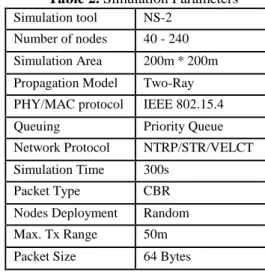
After the NTRP performance is compared with the two algorithms based on shortest path selection. The two algorithms are Shortest Tree Routing (STR) and Velocity Energy-efficiency and Link-aware Cluster Tree (VELCT). STR overcomes the overheard problem occurred when ZigBee packets follow the tree topology. It reduces routing cost of ZigBee tree routing by using neighbor table. STR follows ZigBee tree routing algorithm but it chooses neighbor nodes as next hop nodes. NS-2 network simulator is used to evaluate the performance results of STR algorithm. On the other hand, VELCT constructs Data Collection Data (DCT) based on cluster head location. Data collection node collects data packet from the cluster head and delivers it to the sink node. The usage of DCT minimizes energy consumption, end to end delay and network traffic. NS-2 tool was used to test the performance overall of the proposed VELCT. Therefore, NTRP used NS-2 simulation to evaluate its results, this also makes it easier to compare the results of NTRP, STR and VELCT as they all used NS-2 simulator. Simulation parameters for NTRP algorithm are depicted in
Table 2 below. However, in this paper, NTRP simulation results were based on the following network parameters; end to end delay, network throughput, packet delivery ratio, and energy consumption.
Table 2. Simulation Parameters Simulation tool NS-2
Number of nodes 40 - 240 Simulation Area 200m * 200m Propagation Model Two-Ray PHY/MAC protocol IEEE 802.15.4
Queuing Priority Queue
Network Protocol NTRP/STR/VELCT Simulation Time 300s
Packet Type CBR
Nodes Deployment Random Max. Tx Range 50m Packet Size 64 Bytes
4.1 End to end Delay
In this study end to end delay is calculated as time taken by a packet to move from a source to a destination node on a network. Average end to end delay is measured in seconds.
Figure 4. Average End to end delay.
40 nodes drops the delay to 1.7s. This shows that NTRP is good for a number of nodes that are equal to 100 or below and STR is good for a network with a number of nodes greater 100.
4.2 Packet Delivery Ratio
Packet delivery ratio is defined as the ratio of data packets received by the destinations to those generated by the sources. Packet delivery ratio percentage is calculated based on mobility speed in m/s. The average percentage of packet delivery ratio is 94.5% for NTRP, 94% for VELCT and 82,9% for STR. The packet delivery ratio also shows that when the mobility speed is increased, percentage packet delivery ratio decreases. For a mobility speed of 5ms in NTRP, packet delivery ratio is 98% but when mobility speed is increased 15ms, packet delivery ratio drops to 95% and an additional mobility speed of 15ms drops the packet delivery ratio to 93%. This pattern continues as long as the mobility speed is increased.
Figure 5. Packet Delivery Ratio.
With the initial mobility speed of 5ms in VELTC, packet delivery ratio is 100% however, with the mobility speed of 15ms delivery ratio drops to 95% and the mobility speed of 30ms drops the delivery to 90%. STR is better than both NTRP and VELCT in terms of packet delivery ratio. With a mobility speed of 5ms, delivery is 90%, additional 10ms drops delivery ratio to 95% and when the speed is 30ms delivery ratio drops to 75%.
4.3 Energy Consumption
To measure energy consumption, energy is calculated in joules and the time is measured in seconds. NTRP shows strength with an average of 1.79% followed by the STR with an average of 1.9% and VELCT has an average of 2%. All protocols have low energy consumption initially but as more time added for the simulation, more energy is consumed. With 50s of time, NTRP has energy consumption less than 0.5 joules however, with 300s of time NTRP has energy conservation of 2.6 joules. VELTC has also the same amount of less than 0.5 joules with the 50s time but with the 300s it goes as high as 3.2 joules. STR has slightly higher energy consumption 0.5 joules during the initial stage of 50s. With
simulation time of 300s STR can consume above 3 joules of energy.
Figure 6. Energy consumption. 4.4 Network Throughput
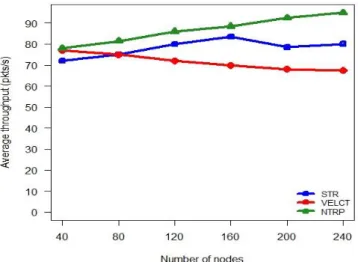
This is the amount of data successfully transferred from one place to another in a given time period, and it is measured in bits per second (bps), megabits per second (Mbps) or gigabits per second (Gbps).
Figure 7. Average Network Throughput Average throughput is measured based on the number of packets transmitted in comparison to the number of nodes. NTRP has an average network throughput of 86.91%, followed by the STR with 78.1% and the VELCT has network throughput of 71.55 %.
Based on the results presented above, it is observed that NTRP outperforms VELCT and STR.
5.
Conclusion
Systems. NTRP is validated on NS-2 network simulation tool and the results show that end to end delay problem is minimized in a ZigBee network when using NTRP. However, challenges such as security and privacy remain a problem in Healthcare Monitoring Systems. Future studies will look at protecting health data for Healthcare Monitoring Systems.
6.
Acknowledgement
The authors would like to acknowledge Tshwane University of Technology for the support.
References
[1] J. J. P. C. Rodrigues, S. Misra, H. Wang and Z. Z. Zhu, ""Ambient assisted living communications [Guest Editorial]," IEEE Communications Magazine, vol. 53, no. 1, pp. 24-25, 2015.
[2] P. Flores and F. Viadero, New Trends in Mechanism and Machine Science: From Fundamentals to Industrial Applications, Switzerlad: Springer, 2014.
[3] WHO, World report on ageing and health, Switzerland: World Health Organization, 2015.
[4] S. Tao, W. Wei, L. Xu-Dong and L. Jian-Wei, "AODVjr routing protocol with multiple feedback policy for ZigBee network," in IEEE 13th International Symposium on Consumer Electronics, 2009. ISCE'09., 2009.
[5] Y.-l. BAN, Q.-l. CHAI and C. WANG, "ZigBee tree routing algorithm based on energy balance," Journal of Computer Applications, vol. 11, 2008.
[6] Y. Yao, Z. Zhang, Z. Ren and S. Shi, "Neighbor-information-assisted tree routing for zigbee networks," in International Conference on Computer Science and Electronics Engineering (ICCSEE), 2012 , 2012. [7] T. Kim, S. H. Kim, J. Yang, S.-e. Yoo and D. Kim,
"Neighbor Table Based Shortcut Tree Routing in ZigBee Wireless Networks," IEEE Transactions on Parallel and Distributed Systems, vol. 25, no. 3, pp. 706 - 716, 2014.
[8] H. J. A. Nasir, K. R. Ku-Mahamud and E. Kamioka, "Enhanced ant-based routing for improving performance of wireless sensor network," International Journal of Communication Networks and Information Security (IJCNIS), vol. 9, no. 3, pp. 386-392, 2017. [9] S. Feng, M. Wang, Q. Yu and Z. Li, "Improved
neighbor table-based tree routing strategies in ZigBee wireless networks," in 5th International Conference on Information Science and Technology (ICIST), , Changsha, 2015 .
[10] M. Kasraoui, A. Cabani and J. Mouzna, "ZBR-M: A New Zigbee Routing Protocol," International Journal on Computational Science & Applications (IJCSA), vol. 10, no. 2, pp. 15-32, 2013.
[11] S. Ouni and Z. T. Ayoub, "Predicting communication delay and energy consumption for IEEE 802.15. 4/ZigBee wireless sensor networks," International Journal of Computer Networks & Communications, vol. 5, no. 1, 2013.
[12] A. Saleh, "Bio-Inspired Technique: An Adaptive Rοuting fοr Reliability and Energy Efficiency Method in Wireless Sensοr Netwοrks," International Journal of
Communication Networks and Information Security (IJCNIS), vol. 9, no. 2, pp. 247-252, 2017.
[13] Z. Bidai, M. Maimour and H. Haffaf, "Multipath Extension of the ZigBee Tree Routing in Cluster-Tree Wireless Sensor Network.," International Journal of Mobile Computing and Multimedia Communications (IJMCMC), vol. 4, no. 2, p. 19, 2012.
[14] F. Meng, B. Jiang and C. Wang, "An improvement of ZigBee cluster tree routing protocol," in International Conference on Advances in Mechanics Engineering, 2012.
[15] M. Al-Harbawi, M. Rasid and N. Noordin, "Improved tree routing (ImpTR) protocol for ZigBee network.," International Journal of Computer Science and Network Security, vol. 9, no. 10, pp. 146-152, 2009. [16] K. K. Lee, S. H. Kim, Y. S. Choi and H. S. Park, "A
mesh routing protocol using cluster label in the ZigBee network," in Mobile Adhoc and Sensor Systems (MASS), 2006.
[17] R. Velmani and B. Kaarthick, "An efficient cluster-tree based data collection scheme for large mobile wireless sensor networks," IEEE sensors journal, vol. 15, no. 4, pp. 2377-2390, 2015.
[18] W. Osamy and A. M. Khedr, "An algorithm for enhancing coverage and network lifetime in cluster-based Wireless Sensor Networks," International Journal of Communication Networks and Information Security (IJCNIS), vol. 10, no. 1, pp. 1-9, 2018.
[19] B. E. Buthelezi, T. E. Mathonsi, S. Maswikaneng and M. Mphahlele, "A New Tree Routing Protocol for ZigBee Healthcare Monitoring Systems," in 2018 International Conference on Intelligent & Innovative Computing Applications (ICONIC) , Mauritius, 2018. [20] P. P. Saraswala, "A survey on routing protocols in
zigbee network," International Journal of Engineering Science and Innovative Technology (IJESIT), vol. 2, no. 1, pp. 471-476, 2013.
[21] B. E. Buthelezi, T. E. Mathonsi, S. Maswikaneng and M. Mphahlele, "Routing Schemes for ZigBee Low-Rate Power Personal Area Network: A Survey," in 11th International Conference on Data Mining, Computers, Communication and Industrial Applications (DMCCIA-2017), Kuala Lumpur, 2017.