MEASURING THE SHOCKS AND DYNAMICS OF MACRO ECONOMIC VARIABLES TO INSURANCE PERFORMANCE IN NIGERIA, 1981 – 2016. USING
ENGEL-GRANGER RESIDUAL BASED APPROACH
Ezema Clifford Anene
Department of Insurance and Risk Management, Faculty of Management Sciences, Enugu State University of Science and Technology, (ESUT), Enugu, Enugu State Nigeria
Ann Eche
Department of Insurance, School of Financial Studies, Institute of Management and Technology, (IMT) Enugu, Enugu State Nigeria
Abstract:
The study measured the shocks and dynamics of macroeconomic variables to financial performance of insurance companies in Nigeria For the period 1981 to 2016 using empirical evidence from Nigeria. The Engel-Granger two-step cointegration procedures and Error Correction Model (ECM) were used as the method of estimation. The analyses of residuals of the OLS regression showed evidence in favour of cointegration between macroeconomic variables and financial performance of insurance companies in Nigeria. Similarly, estimates from the error correction model provide evidence to show that macroeconomic variables and financial performance of insurance companies in Nigeria converge to a long-run equilibrium at a reasonably slow rate. The result points to the fact that the macroeconomic variables and financial performance of insurance companies in Nigeria if well managed can engineer the Nigerian economy to greater growth.
Keywords: Insurance performance; Broad Money Supply, Credit, Private Sector, Real Effective, Exchange Rate, Cointegration, Error Correction Model,
I Introduction
Insurance industry we are seeing today passed through many eras before now. This era
accounted for the growth and development of insurance in Nigeria. According to Nwite
(2004) pre-colonial insurance has been existing in the country before the modern insurance we are having today. Before the advent of British merchants in Nigeria, Nigerian has been practicing crude form of insurance which still existed in the rural villages today. Aneke (2006) supported the pre-colonial era of insurance by saying that before the arrival of British merchants, there existed an informal way of risk sharing base on extended family system, age grade association, town union benevolence and other form of assistance where many contributes to compensate the few who were unfortunate to be involved in loss. Mordi (1990) concluded pre-colonial era by explaining how the traditional society system has shown sympathy to their members who suffered some misfortunate like death, ill-health, fire ravages or court cases.
Banjo (1995) recorded the advent of the modern insurance in Nigeria using colonial penetration of insurance through British Merchants who established trading post on the West coast of Africa. This is how insurance started in Nigeria from 1880. Ujadu (1985) expressed
that during the 19th century, British Merchants arranged insurance for their trading concerns
on the London Insurance market as early as 1900. The Royal Exchange Assurance and Tobacco insurance company limited as at 1910 appointed two insurance agents who underwrites business in Nigeria and process it in London. In 1921, Royal Exchange Assurance decided to appoint a resident insurance officer in Lagos. This company according to Jegede (2005) became the first recognized insurance company from 1921 to 1949 when three other insurance companies were established. These companies were the legal and general assurance society limited and the Norwich union and fire insurance society which merged with an unregistered indigenous insurance company called guinea insurance company limited.
Falegan (1991) recorded that it was in 1958 that the first insurance company in Nigeria otherwise called the first indigenous insurance company was established called the African insurance company limited and that is why our insurance system was patterned according to British insurance setting.
Falegan (1991) also opined that during the 1960 political independence of Nigeria, the outcome of British domination in insurance sector created proliferations of many insurance companies. Companies like the Great Nigeria Insurance Company, The Nigeria General Insurance Company Ltd., and The Popular Universal Insurance Company Limited (UNIC) was founded.
Irukwu (1991) posits that immediately after 1960 political independence, by 1961, the number of insurance companies increased from 4 to 23 and to further 66. This lead to the vision of controlling insurance activities in Nigeria. This resulted to the creation of marine insurance act of 1961. This act led the foundation of insurance regulation where the insurance companies existing in Nigeria were ask to recapitalize to the sum of £50,000 for the first time in the Nigeria insurance history.
Adeyemi (2005) records that amendment of insurance act of 1961 lead to the increase of insurance capital base to £500,000 in 1964 which is referred to 1964 marine insurance act. This act helps to regulate the already flogged insurance market with mushroom insurance activities. Besides, the 1964 insurance act laid foundation for legal statutory deposit to be kept with the central bank of Nigeria.
Nwite (2004) further expressed the marine insurance act of 1964 harnessed the dwindling image of insurance in Nigeria by regulation the activities of other insurance intermediaries. It was not until 1976 that a new insurance decree was enacted to further improve insurance image. Hence, the new capital base was moved to #5million. This arrested the level of flagrant abuse of insurance by the practionniers because many of the players left the industry. In 1991 a new insurance act was re-enacted to fine-tune the on-going reform in the insurance industry where three categories of capital base were instituted. The capital base for life assurance was, Nonlife, composite; reinsurance.
within the period, oil and gas insurance, marine and Aviation insurance and Engineering all risk were introduced on the basis of risk transfer. This laid the foundation of local content initiative in insurance sector in Nigeria.
Based on the level of global development and international financial market growth, in 2003, a new insurance act was passed into law by the government of Chief Olusegun Obasanjo that increased geometrically the capital base of insurance companies that still failed to meet global trends. Hence life assurance capital base was N150m, non-life: N200m, composite: N350m and Re-insurance; N350m, (insurance digest, 2010). This resulted in 107 out of 117 insurance companies in Nigeria surviving the new wave of new capital base. This equally made insurance companies to be active participant in Africa and other continent.
Aneke (2012) opined that between 2003 to 2005, there were reorganization in the financial industry where banks were ask to capitalize to the sum of N25 billion. Also, the insurance were made to increase their capital base for life: N2billion, Non-life N3billion while Re-Insurance: 10billion. It was here that the remaining 107 insurance companies were reduced to 49 players of 23 life offices and 26 non-life officers. With one certified re insurance company called Nigerian Re.
However, after the last recapitalization exercise that recorded the highest rate of increase in Nigeria, Aneke (2012) recorded that insurance industry has been totally reform driven. Despite the global economic meltdown of 2008, NIA (2014) recorded that the gross premium income of insurance companies by average rose form 18% to 36.5%.
Currently, with the introduction of local content initiative in the insurance sector in 2012, there is a forecast that in order for insurance industry in Nigeria to continue to grow, they must improve their capital base based on their risk portfolio.
Over the years, insurance industry in Nigeria has not been doing well as reflected in the numbers of insurance reforms. Okeke (2010) attributed these failures to the problems created by indigenization policy of 1977. Madukwe and Obi Nweke (2014) opined that insurance failure to meet global and emerging trends was driven by low image of insurance companies, Osakwe (2015) expressed that the slow pace of insurance in Nigeria was grossly caused by delay in claims settlement, issues relating to rate cutting, round tripping, window dressing and other unethical practices in the insurance system. Chikeleze (2010) poist that insurance industry in Nigeria has been confronted with a disease that refuses to die called inadequate awareness of people about insurance and also the activities of econometric variables in Nigeria. All these identified issues have contributed to the low financial performance of insurance companies in Nigeria.
Beside, foreign exchange rate, broad money supply, and inflation on investment portfolios are other exogenous variables that are strongly affecting the financial performance of insurance industry in Nigeria.
Hence, following historical antecedent and various instability in the insurance industry over the years, the study wants to measure the effect of some selected macro-economic variables on financial performance of insurance companies. This is carried out by measuring the shocks and dynamics macro-economic variables to financial performance of insurance companies in Nigeria.
Over the years, there has been a lot of empirical review that establishes exchange rates and its related micro economic variables as well as insurance contribution to economic growth. 80% of the empirical work posits that exchange rate has a negative influence on economic growth but insurance has a positive influence on GDP. All the empirical reviewers are unidirectional meaning that they move in the same direction. The following are the empirical review used in this work.
II Brief Review of Empirical Literature
Obi Obada and Abu (2010) estimated the link between insurance and other key macroeconomic varieties in Nigeria using using ordinary least square. Regression model. They observed that the interest rate is statistically and economically significant in explaining exchange rate. They argue that interest rate has a link with exchange rate and suggested that policy should be crated to ensure that exchange rate stability should also try capture interest rate.
Dada and oyeranti (2012) studied the link between broad money supply and insurance sector development in Nigeria using cointegration model .Result shows that M2 variability causes a positive reaction to insurance variable and also cointegrates at both in the short run and long run equilibrium. They conclude that transparent policies that will pave way for stability of exchange rate is better option for insurance acculturation in Nigeria
Azeez, Kolapo and Ajayi (2012) examined the effect of Insurance business on macro-economic performance of Nigeria from 1986 – 2010. Using ordinary least square regression model. The model used real GDP as dependent variable while Insurance business, exchange rate, balance of payment and oil revenue was used as independent variable Result reveals that oil revenue and BOP exert a negative effect on insurance activities in Nigeria while exchange rate variability and Real GDP in Nigeria contributes positively to insurance business in long run. They recommended that monetary authorities should pursue policies that would curb inflation and ensure stability of exchange rate.
Mudakiet (2012) studied the extent to which operational factors affect the performance of insurance firms in Jordan. The study adopted a descriptive census survey design and a sample 40 registered insurance company. The study collected data using questionnaire and the data collected was analyzed using descriptive statistics and inferential statistic. Using regression analysis the study found that operational factors have positive and significant impact with organizational performance.
Njau (2013) investigated the effect of selected macroeconomic variable on the financial performance of private equity firms in Kenya from 2005 to 2012. Using multiple linear regressions. The study established that the financial performance of private firms in Kenya was heavily influenced by the selected macro-economic variable with GDP having the largest influence and systematic risk having the least impact. The study also established positive correlation between the dependent and independent variable where gross domestic product, inflation and bank lending interest were found to have the greatest positive effect on private equity firms financial performance while exchange rate of the dollar against the Kenya shilling showed a negative relationship albeit to a small extent.
in Ghana. The study also found that the performance of insurance firms had a statistically insignificant relation with firms’ size age, GDP and exchange.
Muiruri and Bosire (2015) investigated the determinants of capital structure decision of listed insurance company. The study carried out a census of the six listed insurance firms in Kenya and collected data from a sample of 50 respondent using questionnaires. Using descriptive statistics and inferential statistics, the study concluded that profitability was the main determinant of capital of capital structure decision in listed insurance companies followed by the size of the firm. The study recommended that listed insurance companies should expand their project, new product lines and acquisitions of other firms.
Kaya (2015) investigated the firm-specific factors affecting the profitability of non-life insurance companies operating in Turkey. The study used secondary data of 24 non-life insurance profitability in terms of technical profitability ratio and sales profitability ratio. The findings of the study established that the firms specific factors affecting the profitability of Turkish non-life insurance companies are the size of the company, age of the company, loss ratio, current ratio and premium growth rate.
Simiyu and Ngile (2015) examined the effect of macro-economic variables on financial profitability of listed commercial banks in the Nairobi Securities Exchange from 2001 to 2012. Using panel data analysis and the fixed effects model the study established that real GDP growth rate had positive but insignificant effect to profitability of commercial banks. The study also found that real interest rates had a significant negative influence on profitability of listed commercial banks in Kenya. Finally, the study found that exchange rates had a positive significant effect on the profitability of listed commercial banks on Nairobi Security Exchange and variables on financial performance of deposit taking
microfinance institution in Kenya.
Gap to Knowledge
Looking at the empirical reviews above, some of the review differs by location; all seem to center on the impact of econometric variables on financial performance of financial institutions. None of the literatures worked on the response of some selected macro-Economic variables on the Financial Performance of Insurance Companies in Nigeria. Hence, we want to fill the gap so as to contribute to knowledge
III. Data and Model Specification
The study adopted the ex-post facto and analytical research design. The data is of secondary
nature represented by annualized time series drawn from the Central Bank of Nigeria Statistical Bulletin covering the period under study. It used a combination of descriptive statistics and regression, and Philip and Peron (PP) test used for unit root test. Also diagnostic tests were carried out on the regression model to ensure that the key assumptions underlying the Classical Linear Regression Model (CLRM) were not violated.
Model Specification: The study adopts the Engel Granger Two ways Based Approach to model shocks and Dynamics of Macroeconomic variables on the financial performance of insurance companies in Nigeria for the period under study. The proxy used for Insurance performance is the annual income of insurance companies in Nigeria while Macroeconomic variables is proxied by four key variables namely money supply (M2), credit to private sector (CPS), Exchange rate and gross domestic product.
variable, then cointegration techniques can be used to model their long-run relationship. Philip and Peron (1988) test is used to examine the order of integration.
ΔYt = αo + βt + α1Yt-1 + Σ ɓ1ΔYt-1 ... ɓnΔYt-n + εt ……….……….… (1) The null hypothesis is that Yt contains unit root, which implies that α1 = 1, against the alternative that the series does not contain unit root, which implies that α1 < 1. The Philip-Peron test is preferred because it incorporates an automatic correction to the ADF test procedure to allow for auto correlated residuals (Brooks, 2008). If the computed absolute value of the coefficient of α1 is less than the PP critical tau values, reject the null hypothesis that α1 = 1, (in which case Yt does not contain unit root) otherwise, accept the null hypothesis (in which case Yt contains unit root).
Once the order of integration of the series are confirmed usually I(I), we estimate the long-run relationships, i.e., long-run regression on level series of the dataset following the Classical Linear Regression Model (CLRM) and save the regression residuals. The CLRM shall follow equation (2) as stated below:
FPIC = βo + β1CPS + β2M2 + β3REER + ………… Ut... (2) Where FPIC= Financial performance of insurance companies in Nigeria. CPS = credit to private sector, M2 = money supply ,
GDP = Gross domestic product. REER = Real effective Exchange rate
IV. Data Analyses and Interpretation
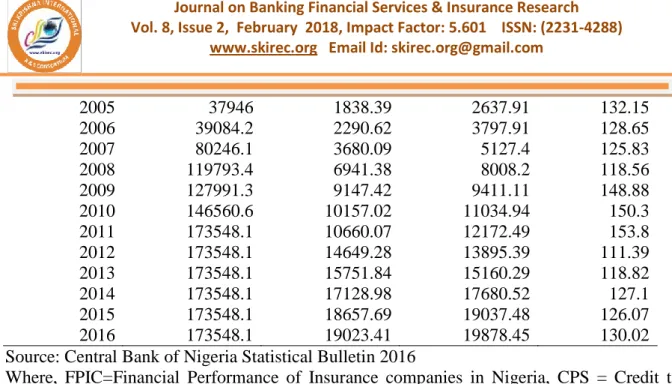
4.1 Data Presentation The datasets for the empirical analyses of this study is presented in Table 1
TABLE 1: Macro Economic variables and financial performance of insurance companies
YEAR FPIC CPS M2 REER
1981 66 8.57 14.47 0.61
1982 70 10.67 15.79 0.67
1983 15.3 11.67 17.69 0.72
1984 49.5 12.46 20.11 0.76
1985 8.4 13.07 22.3 0.89
1986 41.5 15.25 23.81 2.02
1987 149.3 21.08 27.57 4.02
1988 149.2 27.33 38.36 4.54
1989 124.4 30.4 45.9 7.4
1990 349.8 33.55 52.86 8.04
1991 376.4 41.35 75.4 9.91
1992 35.4 58.12 111.11 17.3
1993 -7.38 127.12 165.34 22.05
1994 10872.8 143.42 230.29 21.89
1995 9222.5 180 289.09 21.89
1996 7234.5 238.6 345.85 21.89
1997 10019.6 316.21 413.28 21.89
1998 10672.2 351.96 488.15 21.89
1999 4956.4 431.17 628.95 92.69
2000 8418 530.37 878.46 102.11
2001 12330.2 764.96 1269.32 111.94
2002 14087.9 930.49 1505.96 120.97
2003 27392.5 1096.54 1952.92 129.36
2005 37946 1838.39 2637.91 132.15
2006 39084.2 2290.62 3797.91 128.65
2007 80246.1 3680.09 5127.4 125.83
2008 119793.4 6941.38 8008.2 118.56
2009 127991.3 9147.42 9411.11 148.88
2010 146560.6 10157.02 11034.94 150.3
2011 173548.1 10660.07 12172.49 153.8
2012 173548.1 14649.28 13895.39 111.39
2013 173548.1 15751.84 15160.29 118.82
2014 173548.1 17128.98 17680.52 127.1
2015 173548.1 18657.69 19037.48 126.07
2016 173548.1 19023.41 19878.45 130.02
Source: Central Bank of Nigeria Statistical Bulletin 2016
Where, FPIC=Financial Performance of Insurance companies in Nigeria, CPS = Credit to Private Sector, M2 = Broad Money Supply, REER= Real effective exchange rate.
4.2 Basic Descriptive Statistics of FPIC and M E Indicators
CPS FPIC M2 REER
Mean 3901.777 49419.12 4237.651 69.38943
Median 431.1700 10672.20 628.9500 92.69000
Maximum 19023.41 173548.1 19878.45 153.8000
Minimum 8.570000 -7.380000 14.47000 0.610000
Std. Dev. 6206.226 68448.52 6298.763 60.14043
Skewness 1.433328 1.039518 1.356853 0.012180
Kurtosis 3.510640 2.309661 3.381843 1.168513
Jarque-Bera 12.36444 6.998487 10.95210 4.892616
Probability 0.002066 0.030220 0.004186 0.086613
Sum 136562.2 1729669. 148317.8 2428.630
Sum Sq. Dev. 1.31E+09 1.59E+11 1.35E+09 122973.6
Observations 35 35 35 35
Source: Eviews 7 Computation by the Authors
4.3 Tests for Stationarity
Table 3: Unit Root Tests for all the Variables using Philip Peron Stat Order of Integration
Variables PPSTAT CR@5% Prob.V INT REMARK
FPIC -3.4370 -2.9511 0.0164 I (1) stationary CPS -3.1602 -2.9511 0.0314 I (1) stationary M2 -3.5652 -3.5084 0.0045 I (1) stationary REER -5.5872 -3.5485 0.0003 1(1) stationary
Source: Own computation (2017)
Table 2 shows the results of the Philip-Peron Unit Root Tests of all the variables. The results are found to be integrated of the same order. At first difference, the p-values are found to be less than 5% which is the level of significance, and the Philip-Peron statistics are found to be more negative than the critical values. This is a precondition for the Engle and Granger residual based approach for cointegration tests. Having confirmed that the variables are integrated of the same order, the next step will be to run a cointegrating regression using all the variables on level series.
4.4 Tests for Cointegration
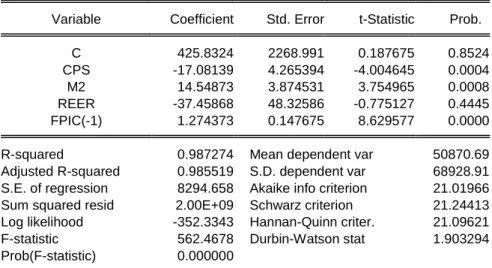
Table 4: The Cointegrating Regression Dependent Variable: FPIC
Method: Least Squares Date: 04/13/18 Time: 04:33 Sample (adjusted): 1982 2016
Included observations: 34 after adjustments
Variable Coefficient Std. Error t-Statistic Prob.
C 425.8324 2268.991 0.187675 0.8524
CPS -17.08139 4.265394 -4.004645 0.0004
M2 14.54873 3.874531 3.754965 0.0008
REER -37.45868 48.32586 -0.775127 0.4445
FPIC(-1) 1.274373 0.147675 8.629577 0.0000
R-squared 0.987274 Mean dependent var 50870.69
Adjusted R-squared 0.985519 S.D. dependent var 68928.91
S.E. of regression 8294.658 Akaike info criterion 21.01966
Sum squared resid 2.00E+09 Schwarz criterion 21.24413
Log likelihood -352.3343 Hannan-Quinn criter. 21.09621
F-statistic 562.4678 Durbin-Watson stat 1.903294
Prob(F-statistic) 0.000000
Source: Eviews 7 Computation by the Authors
Table 4 contains the regression of all the variables at levels having confirmed that they are integrated of the same order. The real test for a cointegrating relationship is based on the unit root test results of the residual of the regression in Table 4. The result is presented in table 5
Table 5: Residual Based Unit Root Test (Δµt = αµt-1 + ϵt)
Variables PPSTAT CR@5% Prob.V INT REMARK ECT -5.2036 -1.9517 0.0000 I (1) stationary** Source: Eviews 7 Computation by the Authors
Lag length on ADF chosen by Akaike Criterion. **indicates significance at 5% level of significance and * indicates significance at 5% level.
performed on the residuals and presented in Table 5, it can be seen that the test statistic is more negative than the 5% critical tau (ґ) value. Since the computed ґ value is less than the conventional critical tau values, we reject the null hypothesis of no cointegration in favour of the alternative. This result, therefore, indicates evidence of long-term relationship between FPIC and Micro economic variables in Nigeria. The speed of this pre-shock adjustment will however depend on error correction mechanism.
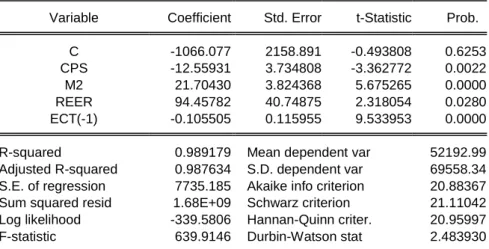
4.5 Estimating the Error Correction Mechanism (ECM) Table 6: Error Correction Model
Dependent Variable: FPIC
Method: Least Squares
ADate: 04/13/18 Time: 21:28 Sample (adjusted): 1982 2016
Included observations: 33 after adjustments
Variable Coefficient Std. Error t-Statistic Prob.
C -1066.077 2158.891 -0.493808 0.6253
CPS -12.55931 3.734808 -3.362772 0.0022
M2 21.70430 3.824368 5.675265 0.0000
REER 94.45782 40.74875 2.318054 0.0280
ECT(-1) -0.105505 0.115955 9.533953 0.0000
R-squared 0.989179 Mean dependent var 52192.99
Adjusted R-squared 0.987634 S.D. dependent var 69558.34
S.E. of regression 7735.185 Akaike info criterion 20.88367
Sum squared resid 1.68E+09 Schwarz criterion 21.11042
Log likelihood -339.5806 Hannan-Quinn criter. 20.95997
F-statistic 639.9146 Durbin-Watson stat 2.483930
Source: Eviews 7 Computation by the Authors
Table 6 presents the results of the ECM. The model of the ECM is of the form of equation 3 and the estimates of the short-run and long-run movements, as well as the error correction term, which proxies speed of adjustment, are provided in Table 5. The Table also shows useful long-run information. The equilibrium adjustment coefficient (-0.105505) enters with a correct sign (negative). This suggests that FPIC and Macro economic variables series in Nigeria converge to long-run equilibrium; deviations from this equilibrium relation as a result of shocks will be corrected over time. It can also be observed that the coefficient of the ECT(-1) tends to half, indicating that the speed of adjustment to equilibrium is slow. It follows that about 90% of the deviation from equilibrium path is corrected per annum. The ECM results, therefore, confirm the long-run relationship between FPIC and Macro economic variables series in Nigeria as observed from the residuals of equation 2.
V. Conclusion
also show that short-run changes in Macro economic variables in Nigeria have a positive and statistically significant impact on short-run changes in the financial performance of Insurance companies in Nigeria.
References
Adowole, A. (2010) Predicting Insurance investment. A factor Analytic Approach. Journal of
Mathematical Science Publication 6(3).
Adeyemi, M. (2005) An Overview of Insurance Act of 2003, Issues in Merger and
Acquisition for the Insurance Industry. NIA 2005 Merger and Acquisition Proceedings.
Akanro, B. (2008), The Insurance Industry and Nigerian Economy, Light does not Shine in
Light. Journal of Economic survey 22(3).
Aneke, S.I. (2006) Principle and Practice of Insurance, Hipuks Additional press, Enugu.
Aneke, J.I. (2012). The Position of Insurance Industry in Nigeria in the Consolidation Era.
Paper Presented during Insurance Student Dinner and Award night at universal hotel Enugu.
Azeez, B. A. Kolopa, F.J and Ajayi, I.B. (2012). Effect of Exchange Rate volatility on
Macro Economic Performance in Nigeria. Interdisplinary Journal of Co temporal
Research in Business 4(1) 149 – 155.
Banjo, K.A. ((1995) Principle and Practice of Insurance. Dekimban Ventures Ltd, Mushin
Lagos.
Berimadian, G.T. (2004) The role of Macro-economic variables on Non-oil Export of Russia.
International Journal of Economic Survey 6(4)
Brooks C (2008) Introductory Econometrics for Finance (New York) Cambridge University
Press 2nd Edition
Chilekeze L. (2010) Repositioning Insurance Industry for a Prosperous Future. Future
summit 2008, Transcorp Hilton Hotel Abuja.
Dada, A.E. and Oyerenti, O.A. (2012). Exchange Rate and Macro Economic Aggregates in
Nigeria. Journal of Economics and Sustainable Development 3(2) 91 – 101.
Falegan, J.I. (1991) Insurance; An Introductory text, University of Lagos Press. Lagos State.
Gatsi,J.G.and Gadzo,S.G(2013): Firms level and macroeconomic effect on financial
performance of insurance companies in Ghana. International Journal of Business
Administration and Management, 3(1), 1-9.
Irukwu, J.O. (1991) Insurance law and Practice in Nigeria. PTF Edition Ibadan, Canton
Kaya, E.O. (2015): The effect of firm-specific factors on the profitability of non-life insurance
companies in Turkey. International journal of financial studies, 3, 510-529.
Nwamba,C.B,(2012). Contending with the Challenges and Imperatives of Marketing
Insurance Services in a Sub-Sahara African Country: The case of Nigeria”. Journal of
Economics and Business Sciences, 1.December, 2012.
Nwite S.C. (2004) Element of Insurance. Immaculate publication ltd, Enugu
Madukwe D.O. and N.S. Obi-Nweke (2015) Empirical Evidence of Nigeria Insurance
Business Capital Market and Economic Growth. International Journal of Innovation and
Scientific Research vol. 64(2).
Mururi, J. W. and Bosire, N. (2015).Determinants of capital structure decisions of listed
insurance companies in kenya: A survey of insurance companies in Nakuru Town.
International journal of scientific engineering and research 3(5), 78-85.
Mudaki, A.L., Wanjere, D., Ochieg, I amdodera, O. (2012): Effect of operational factors on
organizational performance in Kenyan Insurance Industry. International Journal of
Business and Social Science, 3(17), 237-241.
Mordi, O. (1990) Marketing Insurance Industry towards better Public image. A paper
presented at 17th conference of the African Insurance Organisation, Abuja, Nigeria.
Njau D.K. (2013): The effect of selected macroeconomic variables on the financial
performance of private equity firm in Kenya. Unpublished MSC project university of
Nairobi.
Obada, A Obidi, M. N. and A. Abu (2010) .Overview of Exchange rate Movement in Nigeria
from 1986 – 2005 in a Dynamic CBN bulletin 30 (3) – 9.
Okonkwo, V.I. (2002) Basic Principles and Practice of Insurance, Hossana publication,
Enugu
Okeke, A. K. (2010). The Impact of Insurance Activities on Economic Growth in Nigeria,
Proceedings of International Conference on Research and Development. 2( 21),
Nov.24-27, 2010, University Nationale Du Benin Cotonou, Republic of Benin.
Osakwe, C.J. (2015) Effect of low Insurance image on the rural Dwellers. JEC publication .
3(6).
Simiyu, C. N and Ngile L. (2015): Effect of macro on profitability of commercial bank listed
in the Nairobi Securities Exchange, International Journal of Economics, Commence
Udoh, G.O. and Egwaoklinele I.N (2008) Exchange rate Depreciation, Budget deficit and
Inflation, Nigerian Experience, AERC Research Paper 26.
Ugadu, S.E (1985) Roles of Insurance in National Development. International Journal of