Journal homepage : www.Joires.com
Investigation and analysis of components affecting sidewalk in order to improve the social
interactions
Davoud Darvishi 1*, Farzin Charejo 2
1MS student in Architecture at Azad University of Sanandaj ,Kordestan, Iran. 2 Assistant Professor of Urban Planning at Azad University of Sanandaj ,Kordestan, Iran.
Abstract: This article describe show the shaping components of the walk ability concept affect the urban space in order to achieve an appropriate level of citizen participation to form the concept of the social interaction. We have discussed the subject background and its occurrence manner in different geographies and with the assumption of immediate effectiveness of environmental components in addressing the method of sidewalk construction and with reference to the pedestrian movement in the urban space, we discuss the occasions and limitations associated with occurrence place of the impact. This research aims to optimize the encountering manner with sidewalk concept and our approach toward the city as a fabric for urban life and its effectiveness on the kind of interaction and citizen participation. In the theoretical framework of our study, we have discussed different variables creating that and we have compared how these variables affect with the help of qualitative study method and factors comparison with each other .Ultimately, according to the methodology included in the structure of our research, we have addressed the comparison, description and interpretation of the most important raised issues, so that in our qualitative data analysis we can compare the role of key variables underlying the concept of sidewalk and have an output of all these cases.
Kay words: urban space, sidewalk, social interaction, spatial quality
1. Introduction
In urban planning, transportation and communication networks with residential land use have occupied the highest level of urban space and in addition to shaping the form and the structure of the city, play an important role in connecting the urban space and land uses to each other. The importance of communication networks in urban design and planning is in such a manner that they cannot be considered apart from each other, because all activities of the city inhabitants, including commercial, cultural, administrative and recreational activities are completely dependent upon communication networks. On the other hand, formation of a city context has a direct relation with its passages network [1]; so that the type of each of these contexts is influenced by formation of the streets inside the city. Development of wide streets governed by cars and ignoring the public open space has been included in the effects of modernism thoughts during the past decades. What are important at the transportation and traffic viewpoint in various contexts, are movement characteristics, accessibility and efficiency of various transportation systems, safety and the costs related to these systems [2, 3]. Transportation and traffic system as parts of urban activities indicates the dynamism and vitality of an urban collection. Main objective of this study is to investigate and provide effective strategies in order to optimize urban walking paths, in line with the citizens' social interactions.
The necessity and importance of the subject
Cities growth and development, population growth, people and government fascination in the face of industry and new technology and deliberate tendency to renewal, all are of the reasons that have brought destruction to modern cities. Inattention to the city's historical assets is yet another reason for the current situation. In Iran, despite the irreparable damages that have been inflicted on the city bodies and still the destruction continues, and in terms of the importance of urban space for the circulation of people within cities, the need to optimize the interaction of people in the cities increases. In the meantime, addressing the social participation and interaction from an economic standpoint will also have desirable results as an appropriate city for its inhabitants should contain buildings commensurate with human scale and low speed movement. Fast and machine movement is considered as the first and most important factor that destroys biological movement in the urban context. Design walking paths aimed to meet the psychosocial needs of the people in the city is including the measures which are involved as positive steps in keeping balance of the city and its inhabitants or as a supplement plan for developing urban context and establishing human interaction [4].
Subject background
The general concept of Pedestrian Street first appeared in European cities.
Since the middle decades of the twentieth century onwards, this idea was raised and has been implemented in European cities aimed at getting the valuable historical and urban areas out of the dominance of automobiles and for safe preserving the historical context and social interaction revival. In Eastern societies as compared with Europe, the sidewalk construction and human movement across the city has been less investigated and with a noticeable time lag and using the experiences gained from western countries in the form of urban improvement, modernization and renewal plans, actions undertaken [5]. In the United States this theme , has been implemented in the form of designing series of major trading under the name of "Mal" with the approach of considering different sidewalks paths creation and with dramatic differences with what occurred in Europe and in the East. The common point of all these plans is giving priority to the pedestrians across the city aimed to social interaction revival between individuals and allocating maximum space to the pedestrian and minimizing vehicles traffic space. The most important factor involved in designing and implementation of such projects is roadway movement deceleration which is introduced in the urban context as the implementation of urban axis [6].
Sidewalks are passages with the highest level of social role on which traffic has been removed. In other words, non-motorized traffic on these paths is an absolute priority. However, certain vehicles in an emergency can access to them and the service vehicles and load carrying during certain hours are allowed to commute. The history of the formation of sidewalk returns to Rome at the time of Julius Caesar. He prevented commuting of chariots into the city; due to the excessive congestion of streets and the constantly existence of rider and pedestrian in the city, except for the chariots related to construction works and several groups of governmental carriages, there was no possibility to commute [7] Also in London and in 1666, provisions such as obtaining a license for carts traffic and compulsion to use wide wheels for carts and a limited number of horses for chariots and wagons to appropriate traffic beside the people was considered [8] One of the earliest actions in order to separate the roadway from the sidewalk movements, was performed in 1858, by the American architect and urban planner; Olmsted when designing the New York's Central Park. He built a stone bridge on the roadway for pedestrians crossing. During the reconstruction of the European cities after World War II, construction of sidewalks inside cities along the neighborhood level in order to meet the residents’ needs was considered. After that in America that was heavily influenced by the machine life, the movement of pedestrian expansion became quite common. A space specific for crossing of children and their access to school at a local level as well as a bicycle crossing space were constructed. Commercial arias were also converted to sidewalks. Walking in the cities was so developed that the
contemporary urban planning movements such as New Urbanism put walkability in their priority principles and urban guidance documents in major cities put this issue at the top of their objectives.
Following this perspective toward the issue of pedestrians and pedestrian access to services, many sidewalks were developed around the world and these spaces as one of the most important public spaces in cities that provide the backgrounds of essential, selectively and social activities were placed at the forefront of the importance of the urban management institutions for continuous upgrading. Attempts to improve the quality of pedestrian spaces are now in such a way that these spaces are used as tourist attracting spaces. The pedestrian spaces such as Trafalgar Square, London, as known as one of the four attractive world locations and the role of pedestrian spaces in urban vitality and health clearly reveal the planning to develop and improve the quality of these spaces. Therefore, it can be said that a key step after the necessity of sidewalks formation is to improve their quality.
Theoretical framework
The space meaning and discussion, since a long time ago up to present has been reviewed and taken into consideration mainly in two fields of architecture and philosophy. Since Aristotle's analogues the space to container up to present that Lefebvre suggests the space monism theory a long time has passed and numerous comments in the field of space and urban space consequently has been done. From the typology aspects of urban space in the last two centuries in terms of theorists, several important trends such as culture-oriented, progress-oriented, achievement-oriented, and natural-oriented and human-natural-oriented trends can be noted. Since the 19th century up to the second half of the 20th century, ideologies such as "culture-oriented" with retrospect, relying on the historic sociological studies and ethnography, throwback again and identifying the medieval cities with formalistic logic in the 19th century addressed for the first time to providing a garden city plan and the necessity of street linear attraction in city and in the 20th century, discussed the destructive role of automobiles in shaping metropolises. Also progressivists "modernists" motivated to complete cessation from the past, looking forward to the future and the technological facilities and functional logic and superiority of given personal benefits over the social benefits followed the theory of enjoyment of specific hierarchy and classification them based on the location and volume of traffic.
Absolute and relational space
are endless expanded containers that encompass everything. All events and happenings are done within this container and it can somehow be assumed that space and time are real objects. The relational space was raised for the first time by Leibniz in opposition to the theory of absolute space. So that he believed that space merely consists of relationships between objects without a volume and memory. The argument that relation-oriented people pose is that the container is not logically distinct from the objects it contains.
Physical and social space
Another dissociation that occurs about space and urban space in particular is the contrast called the physical and social space. Physical space, in other words the built and artificial space is an issue that is of most interest to architects and appears more in the form of morphology. Social space is the spatial evoke of the social needs in relations between individuals and social groups. Perhaps we can consider the form and operation discussion, with two approaches of operation independent form and operation dependent form, as a sequence of encountering physical and social space. In the first approach, what ultimately obtains is the physical space that is of most interest to the urban planners and architects. In the second approach which is of most interest to sociologists and geographers, what is regarded as the foundation is social space and forms arise following the existing social relations and depending on them. Perhaps the modernists can be outlined as a product of the attitudes associating with social space, because at first sight function is preferable over form. Another manifestation of absolute and relational space topics, is discussing the subjective and objective concepts of space. According to Kant, space is a mental category and belongs to the structure of the human mind and hence space is not sensible and cannot be experienced, but in the other groups of definition, space is considered as objective and physical and hence it is sensible as well as it can be experienced. According to this definition, the objective space is the space that is perceived through the senses and is therefore experimental [9]. Our experience of space is a sensory event that requires movement, the movement that has created a wide range of variable impressionability, transitioning from a feeling of space to another feeling.
If we look at urban space from the perspective of absolute space, in fact we have seen urban space as independent of objects and events within it. It might be said that the method established in the wake of this thinking for designing urban spaces, as a whole, is beyond the components, therefore, we can say that this method is an imposed space on the available conditions. On the other hand, if we look at urban space as an absolute space, as it does not have any interactions with its components; it can be created in different circumstances that are a contrast with the current circumstances of each particular situation. What comes following this kind of attitude toward space is a space that its identity is not dependent upon its components and in other words an identity isn’t allowed
for it. Ultimately with such a view, urban space is a kind of placing objects in a range. Describing the urban space in physical form, is careful considering and reliance on formal issues and external appearances of volumes that surrounds the space and the components within it. Urban Space
City; the most obvious outcome of the human desire and need, is like a body that comes to life through the presence and movement of human and continues to exist. In fact, the city's total cultural-based body needs, activities and behaviors have been shaped of its inhabitants. In fact, city is a cultural-physical collection that has been shaped based on the needs, activities and behaviors of its inhabitants. Human beings act depending on their individual or group needs and present their own specific behavioral patterns. The city and its various spaces are a context or container for these events. Consequently, spaces and their characteristics are heavily dependent on activities and behavioral patterns of their users. In the public urban areas, most of contacts, relations and interactions between humans occur. These areas coverall parts of the urban context that people have physical and visual access to them. Urban space is a common context where people perform their functional activities and ceremonies that links members of the community, and is a scene on which the social life show is exposed to view. Urban space is a space which we share with strangers, people who are not our relatives, friends or colleagues. This space is for politics, religion, business and sports and for peaceful coexistence and non-personal treatments. In fact, urban spaces can also be described as public areas. So the basic requirement for a public space to be deemed an urban space is that social interact and social conflict take places within the public space. Artificial organized urban spaces are manicured and regular that acts as a context for the human activities and behaviors. The human is a part of these spaces and give the meaning to these spaces by their values and norms.
The Research Hypothesis
identifying the people social origins and their expectations of their biological context.
The Research Question
Will shaping the urban space and entering the default components into the biological life of people persuade them to participate in a built context?
By giving opportunities to the urban context and natural assets of a city for appearing in their specified locations, to what extent can we achieve to urban spaces which despite their independence from daily traffic route, may be the strength point of the interaction between human individuals to participate more in the city?
By examining and concentrating only on the identified components influencing the pedestrian movement in the city and by a comprehensive top-down view, can we achieve social interaction between people and public participation in the city?
By emphasizing on pedestrian’s low movement across the city and increasing people intervals across the public passages, what contributions could it have to development the social issues?
By considering an urban element in the form of a sidewalk and extending this major to the pre-built urban fabric, what uses and usefulness could it have in order to organize urban movement and interactivity between the city and the human?
Table 1. Spaces in the city Spaces in the city
1- Human 1-1-Physical Aspect, 1-1-1 Space Design System, 1-1-2 Physical
Needs 1-1-3- Space Fabric 1-1-4 Proportions, Standards, Design Regulations, 1-1-5 Urban Space
1-2 Mental Aspect, 1-2-1Emotional Needs 1-2-2 Space Perception 1-2-3 Security, Place Belonging Sense, Mental Comfort, Partnership 1-2-4 Space Meaning 1-2-5 Urban Space
Diagram 2.1: The relationship between urban space and human from physical and semantic aspects, source: [10, 11 and 12]
Classification of urban spaces
The spaces consist of a wide range of public and private spaces. In other words, every activity and behavior has its own privacy and exclusive domain and reciprocally each space also has its own privacy and respect. Both material and spiritual needs depending on their features in a private or public space and privacy are fulfilled. These spaces in our culture have their own specific hierarchy. Study of scholars ‘perspectives throughout the history firstly indicates that debates about space has been their
Spaces in the city Instruction to use
1. The sacred and non-sacred spaces
In general, the urban spaces represent the general order of the human world.Therefore, the general division of the world to the sacred and non-sacred phenomena that has been illustrated by Durkheim and Elides and in anthropological interpretation of that, is considered as the basic foundations of human religious thoughts, renews within the urban space. The city creates a set of spaces with different sacred and non-sacred degrees.
2. The public spaces The public space in a wider definition refers to all parts of the natural and artificial environment such as: public and private, domestic and foreign, urban and rural, and in general anywhere that the public can be free. However, the intended purpose is not unlimited freedom to have access to everything. The public space encompasses the following elements: all of the passages and streets, squares and all of the corners of streets, spaces associated with urban, social or commercial and residential using.
3. Private Spaces Those parts of the urban spaces that are privately under the possession or acquisition and are used by individuals. Spaces like houses, courtyards and private gardens are included in this category. 4.The semi-private spaces /
semi-public
Those spaces in the city that due to limitations of their land uses and purpose are used by a particular group of people; spaces like residential complexes and their facilities, stadiums and exhibitions. 5. The open and closed
spaces
Activities in the city are very diverse, as well as their contexts have large varieties. Any activity and behavior or a set of them is performed in an open or a covered range space, which commonly called a closed space. In another definition, "urban open spaces are places that provide possible presence of citizens together and increase the capabilities to establish relationships between them. Positive presence in the urban open space can improve the spirit of citizenship, cooperation and belonging to the space and each other.
6. The functional spaces The communal spaces as places in which the most actions and relations between the citizens occur, create the main context for citizens functional and ceremonial activities and is a key element in creating social bond between citizens as well as are a collective common memory between them. Urban spaces in functional terms can be divided into four areas that have normally dynamic relationships with each other:
Residential spaces, working spaces, leisure spaces and ultimately transport spaces.
favorite and attractive ones and secondly human attitude toward the space was initially imaginary and then this attitude has become realistic. In an era, the attitude may have completely been materialistic and in another era the attitude may have been spiritual. What matters is that the ideology of each period was very influential on the definition of space and the perspective of contemporary scholars of that period. And ultimately, since the space is a complex and multidimensional concept, thus it seems hardly to offer a consistent and coordinated definition for the space.
Semantics of the urban public arena
The public arenas, the main place of the citizens’ social life, are the knowledge - profession foundation of the urban design, hence they have key importance to the environment dynamics and civic life. For the urban public space, different definitions are presented and some of the most important ones will be mentioned below “generally meaning and in most definitions, is antonym of “private ".”As well as a definition concerns with or belongs to the people as a whole, has been also mentioned. In the latest edition of the Oxford dictionary, a similar definition has been proposed: “Belonging or according to the people as a whole or a subscription for all people and provided by local or central government." Based on this definition, for example, a public street belonging and relevant to all people is as a whole, is open to people, doesn’t have a limited entity, is provided on behalf of the government and is associated with the government.
Diagram (2-2): Factors, parameters and indicators of a successful public space, source: [15] .
2. Methodology
The present study investigates and analyzes the factors affecting the sidewalks in order to enhance the social interaction. In this section, using collected theoretical principles and studying previous references, we represent the research methodology [13]. In the analysis of subject matter at its content viewpoint, we emphasis on gathering and measuring the variables using relation-based analysis among the issue involved components. The upcoming method will help us answering the posed questions. The gathering method of primary data has a more prominent reasoning aspect. The most important part of the work is the conceptual analysis of the quantities involved in the study. The study begins with observation and examination of the case sample but in content analysis that concerns our subject matter, there is a documentary, writing, oral or pictorial observation unit and our subject variables converts into adjective. Based on the definition that has been made initially for research question and the subject characteristics has been addressed, one can definite the features of the topic, subjected to evaluating and studying, with accurate expressions and words. In conversion of former data into subdocuments and the possibility of controlling items related to our subject matter, we will
begin the initial judgment and analysis of subdocuments. Such scrolling may have either quantitative or qualitative aspect. After presenting questions we will gather possible and acceptable assumptions relating to subject matter. Converting documents to subdocuments will be the next step in the procedure so we may have converted the whole issue into its components –separated conceptual units. We will quantify data and draw conclusions from them. Quantitative conclusions will lead us to our qualitative findings. In the suitable methodology for the subject matter, precise definition of concepts and description of objectives method, questions and theories are important. During the analysis and judgment of the obtained quantitative data, the data processing must be done carefully to lead us to correct interpretation. Content and subject analysis must be objective and we should use a clear set of rules so that we can get to a reproducibility data. Result generalizability is also an important factor in the analysis of the content in question [14].
quantitative method. We need to take advantage of a method to focus on phenomenon that could occur in the context of the real world and doesn’t intrinsically accept numbers. We've posed a general question, so it is necessary until collection lots of necessary information and standards, only focus on integrating and organizing them. By providing an explanation about the status of the study and accurate depiction of how relevant the review cases are together, we can provide answers and correct assumptions about our observations during the study come to acceptable results and end the work at this stage. Upcoming template is the same process description, explanation and interpretation. Description stage has a processing-communicating nature and points out how to obtain and upgrade data. In the explanation stage, we will explore the reasons for the event occurrence and during the interpretation of the story we will be able to obtain the necessary information about the nature of special events and expand our new ideas. This allows us to obtain internal and hidden issues in the subject matter through a simple manner. It is required to be holistic at this stage and of based on the cause and effect system, investigate the phenomenon. The methods of questioning and interpretation during the work when required can be changed. During the study on the architecture subject we have asked about a human population that has more information relating to subject and we have done our best to act in a neutral manner and provide and analyze the results without any emotional interference, guess and prejudice. This looks impossible at the first step.
There searcher ability and intervention in the interpretation and reasoning is essential for understanding a qualitative phenomenon. Although achieve a real and ultimate single answer looks unlikely, but existence of multiple realities in studied fields from different points of view, is arisen itself as an appropriate answer to a specific question. The main requirement of this stage is to clarify the nature of different perspectives of addressing the research. During the study, depending on the work stage, one can treat in an objective-oriented, a component-oriented and a positivist manner. The study purpose is determined at any stage and variables involved in that stage are known beforehand. It is necessary, free from any attachment to the study subject, to search out the facts and to explain reasons. In some cases were quire to be subjectivist, holistic, and constructionist. Because sometimes we have to put aside the overall objectives of the study and due to the multiplicity of objectives we encounter such hypotheses that cannot be approved and solutions for them cannot be offered and we have to resort to our interpretative stances, so we can search for reality within the main theme. We will encounter with three scrolling areas of descriptive, communicative and experimental. The question arises at this stage of work is how can we evaluate qualitative data? Whereas, the value of our quantitative data can be inferred from their own. What are the distinctive features of the study we've done? During the study procedure, it has been avoided from putting qualitative and quantitative findings against each
other. We have not put resulting numbers and data opposite to the words and concepts. The revelation through the relationships between variables has been important for us and we have also tried to highlight perceived meanings. Because over both cases questioning has been a principle. Basic questions raised in analyzing the answers have been effective on getting from reasoning to induction. Either we have considered a flexible structure in the work or we have not considered the lack of flexibility in the numbers and information data as a methodology weakness.
Various procedures are important in the study of architecture because achievement to modern knowledge in construction the space and creation the geographical concept for people comfort is possible to researchers in various and different ways. Such knowledge and discipline will not be apart from the field of physical and non-physical placement of space architecture. Aesthetics and artistic concepts in regarding the making and performance technique are due to type and the general context governing society and environment which architecture have been produced in it and will be. Architecture of a space is in an elegant interaction with humans and the environment. On time flirting and explicitness of architecture should not be hesitated. When considering the architecture discussed in this article, carefully attention to the social and cultural context of architecture and the time and place of its occurrence is important. Therefore inquiring about architecture mostly has qualitative alphabet and achievement to its lean concepts is not possible except through interpretation and explanation.
Data analysis - the most important design elements for the pedestrian route:
The overall presented concept can be expressed as the revival of pedestrian role in the city which is discussed in the form of individual participation level within the circulation pathways of pedestrians in the city. Important cases that can be mentioned are included in followings:
-Relationship between man and man and relationship between man and a series of human’s demanding the revival of the civil life.
- Relationship between human and space that presents public arenas.
- Relationship between human and fabric that presents the conversation of shape and configuration.
-Relationship between human and time that presents historical continuity of culture, traditions, identity and memory.
-Relationship between human and place that presents mental history and imagery of the place and the actualization of the collective memory.
- Important common factors in this hypothesis including pedestrian, pedestrian passages, urban activities and uses and the historical assets in urban context are become unrepeatable values.
activities across the city. Presence of individuals in the city is permanent. This continuity can be named as resident or as pedestrian. On the other hand by meeting the human needs, this mode can have temporary form. The temporary presence of people in the city is an intervening factor in their security, comfort, safety and satisfaction within the city space and this for itself requires appropriate context and instrument for presence. Thus the concept of residence, leisure, recreation, security and comfort, privacy protection, separation and definition of scopes and other items in the framework of a common factor called social interaction and participation and citizen presence, can be named. Social participation without worries, concerns and dailiness and having the sense of interaction with people and an appropriate level of correlation, and social responsibility in the face of the individual, public and civil values. The human interactions based on his desirable presence within specified public arenas and organizing the existing urban spaces and creation tangible and persistent participation and interaction which is influential and impressible on the social and individual identity of humans.
Designing movement-accordant pedestrian routes in cities is subject to presence of individuals and due to its mismatch with the high rates participation in social interaction, requires flexibility, diversification to activities types and quantity of spaces and providing safety and security in the city and a belonging sense to space. All of the mentioned cases together lead to qualitative upgrading of footpaths and improving of social communications and prosperousness of urban life.
The necessity of attention to factors involved in this case, in both terms of quality and quantity is influenced by the human presence in the city as traverser of the city space and the time factor as the subject of traversing, which this variable factor can be explained in relation to the available mass and space. Defined location will provide suitable footpaths. Among these, common factors can be noted:
-Emphasis on different aspects of human biological space, like the individuals comfort, accepting the space by human, climatic protection, avoidance from auditory, visual and olfactory pollutions by providing human leisure spaces in combination with the natural factors happens in the city.
-Fixing the risks and obstacles in the path and creating secure path
-Requirement to respect the human scale and creating human spaces regarding to human five senses and how human is influenced by these senses in the perception of space and its welcoming feeling.
-Considering a certain level of individual’s ability in routing, navigation and pedestrian visibility.
-Considering the determined human capita the taxes and the given capacity to accept an urban space, the width of passages and obstacles.
- Considering the ongoing social and human type of activity in the path and the spatial dispersal.
-Considering the applied variety in footpaths in terms of the activity type in the space and creating medial spaces
with emphasizing on movement shaping in the space including the type of movement, stability and spatial mobility and the possibility of creating visual attractions.
- The determined level of readability and spatial perception so that one can choose the path and direction within the urban space.
Measures employed in urban spaces should prevent the complete elimination of the roadway movement. Modification of the roadway movement role and a stronger emphasis on public transportation beside the footpaths, quality of the correct and logical equalization of accessing the pedestrians and roadway, the method to equalize the pedestrian and roadway access to specific urban routs and the kind of servicing to these routes and defining hierarchy of the sidewalk and roadway networks are including the cases that could be possibly influential and impressible in redefining the roadway and pedestrian routes.
Investigation of variables influencing the study subject- variables influencing the spatial quality of data Vitality
Perhaps the diversity and activity acceptance may be two variables influencing the vitality of the urban spaces. One method to gain diversity is employment of urban symbols which are defined based on existing fabric and context values. Of other factors influencing vitality and sidewalk diversity are different uses commensurate with each sidewalk sequence, placement of service uses that leads to citizen presence.
Permeability Only places that are accessible to people gives them the right to choose. Since the permeability is one of the most important factors in achieving utility. A key element about the public domain is accessibility and permeability, access can be considered as the most important element and feature and the most basic function of sidewalks. Access is expressed in various formats: Access to people, access to activities, access to goods and resources, access to places and information. Scale walking is of such characteristics that makes the space more tangible and believable and provides the background for emergence of social interaction.
Readability: Normally a part of the choice levels that is offered by a place is associated with the readability. Sidewalks are public arenas that can offer people a variety of options to improve their quality of life, but when people can take advantage of other options that offer the same quality in order to make them be able to understand the spatial organization and what is happening within it, addressing the objective aspect of perspective at sidewalk converts it into a readable and qualified environment.
been noted that: urban planning ideas act in order to facilitate the visibility of offenders, natural supervision to maximize visibility of people, parking lots and the building entrances.
3. Research Findings
In this research, based on the related literature and documents of pedestrian master plans in some European and American cities we have come to a number of physical, cultural and social criteria of a favorable space for walking which by adoption these criteria to local parameters and the culture governing people in movement, such as habits and traditions of being together and the freedom to choose clothing etc. numbers of parameters have been proposed to evaluate the walkability that these parameters aiming to improve the physical quality of the environment are described separately in the following tables. By improving the attractiveness of urban space aiming at increasing walkability and improving citizen social participation, this goal could be achieved. Therefore in the last few years, the pedestrian contribution is placed
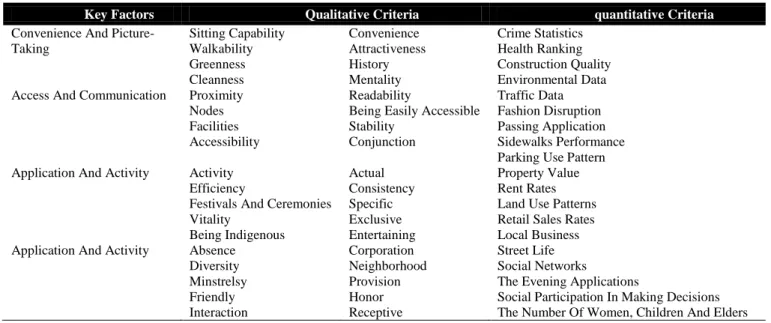
again on the agenda of city planners and managers. In this regard, the documents production of city’s master plan has confirmed that and up according to which improving the quality of the urban environment is possible and this factor encourages people and government to increase the walkability. In order to achieve this theme one can also take advantage of experiences worldwide and to improve the people presence in the public spaces can act considering the social-cultural factors of people participation. This factor is effective on the pedestrian movement and we can measure the pedestrian acceptance degree of the urban environment based on mentioned parameters. Thus it can be concluded that the level and the possibility of pedestrian acceptance in the urban spaces is in direct relevance to security, palatability and the environmental attractiveness, accessibility and conjunction and cultural and social issues and the relationship between urban use and public transportation system and other relevant items. After reviewing the theoretical principles of walkability and also examining the issues related to the urban public spaces and streets, we have achieved to results as follows:
Table 2. Criteria and parameters of a successful public space, source: author
Key Factors Qualitative Criteria quantitative Criteria
Convenience And Picture-Taking
Sitting Capability Walkability Greenness Cleanness
Convenience Attractiveness History Mentality
Crime Statistics Health Ranking Construction Quality Environmental Data
Access And Communication Proximity
Nodes Facilities Accessibility
Readability
Being Easily Accessible Stability
Conjunction
Traffic Data Fashion Disruption Passing Application Sidewalks Performance Parking Use Pattern
Application And Activity Activity
Efficiency
Festivals And Ceremonies Vitality
Being Indigenous
Actual Consistency Specific Exclusive Entertaining
Property Value Rent Rates Land Use Patterns Retail Sales Rates Local Business
Application And Activity Absence
Diversity Minstrelsy Friendly Interaction
Corporation Neighborhood Provision Honor Receptive
Street Life Social Networks
The Evening Applications
Social Participation In Making Decisions The Number Of Women, Children And Elders
Conclusions and Proposals
By investigating important cases affecting the study subject, we can mention to general principles and the necessary procedures in this area. Cases that lead to provide procedures are discussed below.
-Pedestrian route acts as a guideline, links the important point of the context and in introducing and describing the spaces acts as a guideline. Knowing what is happening within the context of the plan and considering the urban fabric surrounding the context of any plan for choosing the right walking path is an effective factor.
-The sidewalk route is considered an urban space. Its accessibility feature is one of its functions. The sidewalk route has intermediary role between the elapsed time and the social interaction factor among people due to the presence of the people and various social activities within it’s the sidewalk route is deemed to be a public arena and is the location of interaction among individuals of a micro or macro society.
route even more and it helps the sidewalk readability and makes the path to become an urban symbol.
-The sidewalk is considered to be a contributing factor in the space-time continuity and contributes in the definition of the urban privacy and the behavioral domain. -Creating appropriate and worthy various spaces due to stoppages and movements and its distinctive features, as pause points are required for walking paths. Also choosing walking path in terms of time and place is of particular importance. Time factor at walking path considers path length and characteristics of slowness of pedestrian movement. The place factor of sidewalk will be dependent on the context features and specific conditions of the people interaction in a place.
- Proper functioning of the pedestrian path is reviving the continuity of life in the city and the people presence beside the residential context which in addition to providing safety of access and using it, will help to the possibility of people interaction continuity in the city social context.
According to the concept of sidewalk space design adjacent to urban constructions, it can be noted that movement continuity is involved not only in people social life and human interactions but is also effective on the manifestation of its body and face and will be followed by quantitative and qualitative promotion of the urban space. Considering proportionalities in the design and coordination with adjacent context and creation a sense of humility and respect towards adjacent land uses and surrounding context will be effective both on social attraction and the environment receptivity. Attention to the
correlation between the entire city and the structural and functional component of sidewalk should also be considered. The separation occurrence of an urban element from the whole should not be allowed. Yet protection of the independence and architecture identity of each urban element in a physical-spatial whole discipline must be remembered. To achieve a walkable circulation according to the climate and the theme of occurrence place of the plan arises as a determinant factor that needs to be addressed.
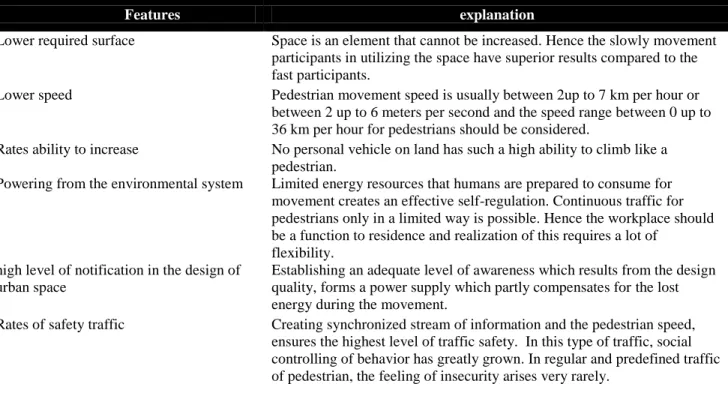
In conclusion we present a number of elements and issues affecting the design topic of sidewalk. By comparing them together, one can realize the importance of effective variables:
Table 3. Importance of effective variables
explanation Features
Space is an element that cannot be increased. Hence the slowly movement participants in utilizing the space have superior results compared to the fast participants.
Lower required surface
Pedestrian movement speed is usually between 2up to 7 km per hour or between 2 up to 6 meters per second and the speed range between 0 up to 36 km per hour for pedestrians should be considered.
Lower speed
No personal vehicle on land has such a high ability to climb like a pedestrian.
Rates ability to increase
Limited energy resources that humans are prepared to consume for movement creates an effective self-regulation. Continuous traffic for pedestrians only in a limited way is possible. Hence the workplace should be a function to residence and realization of this requires a lot of
flexibility. Powering from the environmental system
Establishing an adequate level of awareness which results from the design quality, forms a power supply which partly compensates for the lost energy during the movement.
high level of notification in the design of urban space
Creating synchronized stream of information and the pedestrian speed, ensures the highest level of traffic safety. In this type of traffic, social controlling of behavior has greatly grown. In regular and predefined traffic of pedestrian, the feeling of insecurity arises very rarely.
References
1) Amin Zadeh, Behnaz and Dai Nejad, Faramarz (2002) The environmental considerations in the design and improvement of city streets; Science and Research Journal of the fine arts, No. 11. 2) Bahrain, Sayed Hussain (2003), urban design
process, Tehran University press, Tehran. 3) Behzadfar, Mustafa and Ghorbanian, Mahshid (2008), Street design on the basis of environmental quality variables, Science and Research Journal of Armanshahr, No 1, year 1, Iran University of Science and Technology, Tehran.
4) Tavassoly, Mahmoud (1997), The principles and techniques of urban design and residential spaces in Iran, Volume 1, The Urban and Architecture Research Center, Tehran.
5) Tavassoly, Mahmoud and Bonyadi, Nasser (1992), the urban space Design, Volume 1, The Urban and Architecture Research Center, Tehran.
6) Saghafi Asl, Arash (2011), The importance of sidewalk in transport network of stable city, Analytical - Research Quarterly Journal of Urban Development Queries, Number 26 and 27, year 7.
7) Habibi, Seyed Mohsen (2001) Tourism pedestrian areas, Science and Research Journal of the fine arts, No 9.
8) Habibi, Seyed Mohsen (2015), from Shar to city, Tehran University Press, Tehran.
9) Habibi, Seyed Mohsen (1999), urban space, incidental life and collective memories, Science and Research Journal of Sofeh, No. 28.
10) Habibi, Seyed Mohsen (2008), the tourism walking routes, Science and Research Quarterly Journal of the fine arts, No. 9, Tehran University Press, Tehran.
11) Habibi, Mohsen, (2007), Maghsoudi, Maliha, urban restoration, Tehran University Press, third edition.
12) Rob Carrier (1996) the urban space, translated by Khosrow Hashemi-Nejad, Jahad Daneshgahi Press.
13) Ranjbar, Ehsan and Ismaili, Raeis (2010), Assessing the quality of the urban sidewalk in Iran (Case Study: Tehran Saf sidewalk), Science and Research Quarterly Journal of Fine Arts – Architecture and Urban Development, No. 42, Summer.
14) Zebardast, Esfandiar (2000) "Application of Analytical Hierarchy Process in Urban and Regional Planning", Science and Research Journal of Fine Arts, No. 10.
15) San Diego Regional Planning Organization (2012), planning and design for pedestrians (urban walkability design guidelines), translated by Reza Bassiri Mozhdehi, Tahan Press, Tehran.
Audio nuisance generated by pedestrian is usually ignored and in some cases if it could not be ignored, created noise intensity is lower than the automobile audio intensity.
lower Audio intensity (Less noise)
Pedestrian does not produce toxic gases. Deforestation is not as a result of pedestrian smoke and gas and never will be. Fundamental ecological threat does not arise by pedestrian.
environmental pollution
Sidewalk route can be optimally adapted to the environment and the surrounding landscapes. Required surface for the pedestrian to move level is not high.