Unman SinghAnd Akanksha Tripathi Page 315 SAVORING BELIEFS, RELATIONSHIP SATISFACTION AND SUBJECTIVE WELLBEING
AMONG MARRIED COUPLES
Unman Singh
Psychology Department, Panjab University, Chandigarh (India)
Akanksha Tripathi
Psychology Department, MCM DAV College for Girls, Chandigarh (India)
Abstract
Savoring beliefs (anticipation, savoring the moment and reminiscence) are the subjective perceptions of individuals regarding their ability to enjoy positive experiences. It is observed that individually people savor differently than when they are with others. Therefore, seeing the various benefits of savoring even more in terms of relationships, the present study aimed at digging deeper and tracing the correlates and predictors of relationship satisfaction and subjective wellbeing regarding savoring beliefs. The various beliefs of savoring were assessed using Savoring Beliefs Inventory by Bryant (2003). Relationship satisfaction was measured by the Couple Satisfaction Index (Funk and Rogge, 2007). For assessing subjective wellbeing, life satisfaction was measured using Satisfaction with Life Scale (Diener et al., 1985) and Positive and Negative Affect Schedule (Watson et al., 1988) measured positive and negative affect score. A sample of 100 couples (100 husbands and 100 wives) was taken for this purpose. Statistical analysis comprised of mean, SD, inter-correlation and stepwise multiple regression. Results revealed the significant relationship of couples’ satisfaction and subjective wellbeing with savoring. Stepwise multiple regression revealed that anticipation emerged as a significant predictor of relationship satisfaction and savoring the moment emerged as a significant predictor of subjective wellbeing in couples. In males, savoring the moment emerged as a significant predictor of subjective wellbeing and reminiscence emerged as a significant
predictor of relationship satisfaction. On the other hand, in females, savoring the moment emerged as a significant predictor of subjective wellbeing and anticipation emerged as a significant predictor of relationship satisfaction.
Keywords: Anticipation, Savoring the
moment, Reminiscence, relationship
satisfaction, subjective wellbeing
Introduction
Unman SinghAnd Akanksha Tripathi Page 316 the relish we have of them.” In the same vein,
positive psychologist have documented research evidences relating savoring with various positive outcomes via savoring beliefs and strategies.
Savoring beliefs are people’s self-evaluations of their ability to enjoy positive experiences. Savoring beliefs are of three types: anticipation (savoring the future), savoring the moment and reminiscence (savoring the past). It has been found that people feel more capable of savoring through reminiscence (Bryant, 2003, [3]), may be because of the easy recall and remembrance of positive events. However, savoring through anticipation can also bring about happiness in some cases. Nawijn et al. (2010),[4] found that before a trip, vacationers were happier as compared to non-vacationers (an indication of anticipation), though both the groups were equally happy after the vacation. Savoring in the present moment has been found to act as both a mediator and moderator on momentary happy mood in account of daily positive events (Jose et al., 2012),[5]. The Theory of Emotional Capital (Gottman, Driver, & Tabares, 2002, [6]) highlights the importance of shared positive emotional experiences in the upregulation of relationship success and growth. It is thus expected that mutual savoring of moments would be even greater among married couples, where in the husband and wife share the closest and most intimate relationship.
Bryant and Veroff (2007),[7] related that individuals can savor the moment through multiple means, like expressing positive emotions though smiling or laughing, expressing to others how much one is enjoying the current positive event, and reminding oneself of the transience of a positive moment and enjoying it while it lasts and engaging in this positive rumination is found to be associated with higher levels of positive affect, and higher levels of satisfaction with life (Quoidbach et al., 2010,[8]). Similarly, Individuals who use cognitive imagery to intensify reminiscence experiences have also
reported to experience the highest positive emotion savoring in daily life (Bryant, et al.(2005),[9]; Wildschut, et al.(2006),[10]. Correlational findings have also suggested that individuals most frequently reminiscence about recent experiences with family, friends, or romantic relationships (Bryant, et al., 2005). Also, positive mental time travel, a savoring strategy that involves imagining oneself enjoying a positive event that could happen in the future (anticipating), has been shown to increase positive emotions in healthy samples (Quoidbach, et al., 2010).
Relational savoring involves savoring of positive events with someone you are emotionally close to. Empirical support suggests that savoring is linked with eudaimonic wellbeing and quality of relationships (Borelli et al., 2015,[11]; Gable et al., 2004,[12]). Research has found that savoring influences relationship satisfaction and other positive outcomes like enhanced positive affect, and life satisfaction (Bryant 2003; Feldman et al. 2008,[13]; Quoidbach et al. 2010), and Jose et al. (2012), and and decreased negative affect (Hurley and Kwon,2011,[14]). However, specifically, which out of the three savoring beliefs is most robust in context of well being and satisfaction in long term relationship like marriage and especially in Indian context, has largely been unexplored. Therefore, considering the various benefits of savoring and even greater benefits of relational savoring, this study aims to dig deeper into the various savoring beliefs employed by married couples. The three temporal beliefs of savoring that have been studied are anticipation, savoring the moment and reminiscence.
Objectives
Unman SinghAnd Akanksha Tripathi Page 317 2. To trace the role of savoring beliefs in
relationship satisfaction and subjective wellbeing.
Hypotheses
1. All the three savoring beliefs i.e. reminiscence, anticipation and present moment are expected to be positively related to relationship satisfaction and subjective well being along with its dimensions i.e. positive affect, negative affect and life satisfaction. 2. It is further expected that all the three savoring beliefs will emerge as significant predictors of wellbeing and relationship satisfaction.
Method Sample
The sample for the study comprised of 100 married couples (100 males and 100 females), in the age range of 25-45 years. Couples who have been married for at least 5 years were included in the sample which was derived through random sampling technique from the tricity, that is, Mohali, Chandigarh and Panchkula. Married individuals suffering from psychopathology or deteriorated mental or physical health were excluded from the sample. Separated, divorced or remarried couples were excluded to maintain the homogeneity of the sample.
Procedure:
The study involved collecting information regarding the temporal domains of savoring, relationship satisfaction and subjective wellbeing of married couples. In addition, a questionnaire was administered to the participants to assess the socio demographic information such as age, educational qualification, annual income, working status and number of children. Informed consent was given to the participants prior to the study.
Measures:
1. Savoring Beliefs Inventory (SBI; Bryant, 2003)
The temporal beliefs of savoring were assessed using the Savoring Beliefs Inventory.
It is a 24-item scale where participants are asked to indicate their degree of agreement with each item on a 7-point likert scale ranging from 1 (strongly disagree) to 7 (strongly agree). The scale produced a total score and three subscores of the temporal beliefs of savoring: anticipation, savoring the moment and reminiscence. The SBI has consistently shown good internal consistency ranging from .88-.94.
2. Couple Satisfaction Index (CSI; Funk & Rogge, 2007, [15])
The Couple Satisfaction Index is originally a 32 item questionnaire designed to measure one’s satisfaction in a relationship. In this study, the shorter 16 item version of this scale has been used. It has a variety of items with different response scales and formats. The CSI-16 is found to possess higher effect sizes than other measures of satisfaction as well as higher levels of power and yielded a Cronbach‟s alpha of .98 (Funk & Rogge, 2007).
3. Satisfaction With Life Scale (SWLS; Diener, Emmons, Larsen, & Griffin, 1985,[16])
This scale examines the individual’s cognitive judgements regarding overall life satisfaction. It is a 4 item scale in which the respondents are asked to indicate their level of agreement with the statements on a 7 point-likert scale ranging from 1 (strongly disagree) to 7 (strongly agree).the total scores range from 5 to 35, where a score of above 20 is considered to indicate adequate satisfaction with one’s life. This scale shows good internal consistency with reliability ranging from .86 - .90.
Unman SinghAnd Akanksha Tripathi Page 318 Results
Table 1 shows means and standard deviation values of couples (males and females) on the three temporal beliefs of savoring (anticipation,
savoring the moment and reminiscence), relationship satisfaction and subjective wellbeing.
Table 1: Descriptive statistics of savoring beliefs, relationship satisfaction and
subjective wellbeing of couples (males and females)
S.no Variables
Males Females
n=100 n=100
Mean SD Mean SD
1 Anticipation 5.55 8.06 6.55 9.13
2 Savoring the moment 7.78 8.57 8.16 8.82
3 Reminiscence 6.84 8.86 9.02 9.79
4 Relationship satisfaction 65.4 12.13 65.46 11.52
5 Subjective wellbeing 46.02 14.19 44.87 13.56
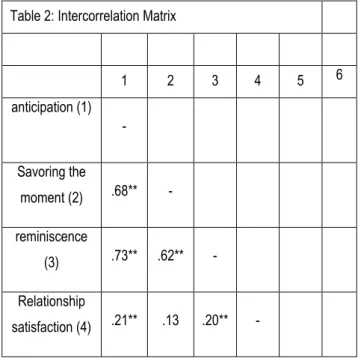
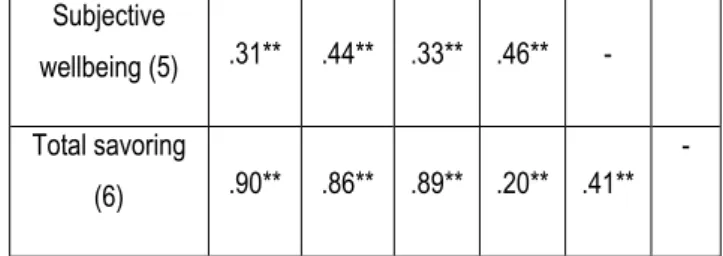
Table 2 shows the intercorrelations among the various savoring beliefs, relationship satisfaction and subjective wellbeing. As expected, savoring was significantly related to relationship satisfaction (r= .205, p<.01) and subjective wellbeing (r = .406, p <.01).
Table 2: Intercorrelation Matrix
1 2 3 4 5 6
anticipation (1) -
Savoring the
moment (2) .68** -
reminiscence
(3) .73** .62** -
Relationship
Unman SinghAnd Akanksha Tripathi Page 319
Subjective
wellbeing (5) .31** .44** .33** .46** -
Total savoring
(6) .90** .86** .89** .20** .41**
-
**. Correlation is significant at the 0.01 level (2-tailed). *. Correlation is significant at the 0.05 level (2-tailed).
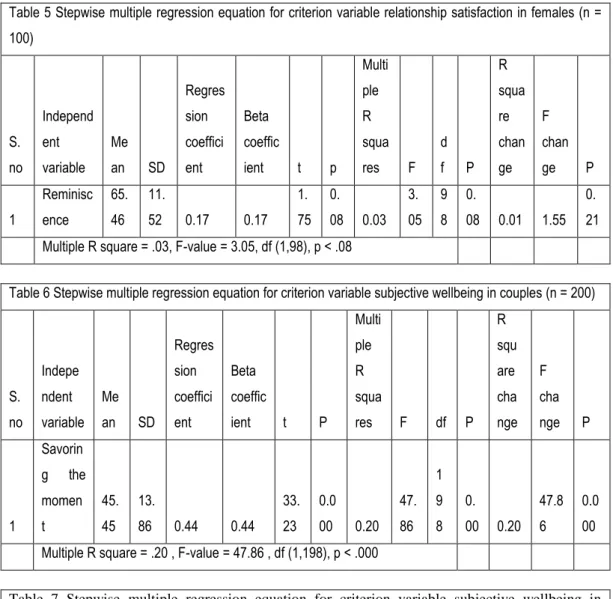
Stepwise linear regression (Table 3) revealed that anticipatory savoring emerged as the only significant predictor of relationship satisfaction in couples that explained 4% of the variance (R2=0.04) in the criterion variable. Reminiscence, explaining 7% variance (R2 = .07) emerged as the sole predictor of relationship satisfaction in males (Table 4) and in females too (R2 = .03), reminiscence emerged as a predictor of relationship satisfaction that explained 3 % variance (Table 5).
For subjective wellbeing as a criterion variable (Table 6), savoring the moment (R2=0.20) explaining 20% variance, emerged as significant predictor among couples. Savoring the moment (R2= 0.14) explaining 14% variance, emerged as the sole predictor of subjective wellbeing in females (Table 7). For subjective wellbeing as criterion variable (Table 8) in males, again savoring the moment (R2 = .26) explaining 26 % variance emerged as a significant predictor.
Table 3: Stepwise multiple regression equation for criterion variable relationship satisfaction in couples (n = 200)
S. no
Indepen dent variable
Me an
S D
Regres sion coeffici ent
Beta coeffic
ient t P
Multi ple R squa res
F df P
R squ are cha nge
F cha
nge P
1 Anticipation 65.43 11.8 .20 0.21 63.62 0.000 0.04 8.96 19
8 0.0
03 0.04 8.96
0.0 03
Multiple R square = .04, F-value = 8.96, df (1,198), p < .003
Table 4 Stepwise multiple regression equation for criterion variable relationship satisfaction in males (n = 100)
S. no
Indepen dent variable
Me an SD
Regres sion coeffici ent
Beta coeffic
ient t p
Multi ple R squa res
F d
f P
R squ are cha nge
F cha
nge P
1 Reminiscence 65.4 12.13 0.25 0.25 42.23 0.000 0.07 7.03 98 0.009 0.06 7.03 0.009
Unman SinghAnd Akanksha Tripathi Page 320
Table 5 Stepwise multiple regression equation for criterion variable relationship satisfaction in females (n = 100) S. no Independ ent variable Me an SD
Regres sion coeffici ent Beta coeffic
ient t p
Multi ple R squa
res F
d
f P
R squa re chan ge F chan
ge P
1 Reminisc ence 65. 46 11.
52 0.17 0.17
1. 75
0. 08 0.03
3. 05
9 8
0.
08 0.01 1.55 0. 21 Multiple R square = .03, F-value = 3.05, df (1,98), p < .08
Table 6 Stepwise multiple regression equation for criterion variable subjective wellbeing in couples (n = 200)
S. no Indepe ndent variable Me an SD
Regres sion coeffici ent Beta coeffic
ient t P
Multi ple R squa
res F df P
R squ are cha nge F cha
nge P
1
Savorin
g the
momen t
45. 45
13.
86 0.44 0.44
33. 23
0.0
00 0.20
47. 86 1 9 8 0. 00 0.20
47.8 6
0.0 00 Multiple R square = .20 , F-value = 47.86 , df (1,198), p < .000
Table 7 Stepwise multiple regression equation for criterion variable subjective wellbeing in
females (n = 100)
S. n o Independen t variable M ea n S D Regre ssion coeffi cient Beta coeff
icient t p
Mul
tiple
R
squa
res F
d
f P
R squ are cha nge F cha
nge P
1 Savoring the moment 44 .8 7 13 .5
6 0..37 0.37
23
.2
7 0.
00
0 0.14
16 .2 8 9 8 0. 00 0 0.1 4 16. 14 0. 00 0
Unman SinghAnd Akanksha Tripathi Page 321
Table 8 Stepwise multiple regression equation for criterion variable subjective wellbeing in males (n = 100)
S. no
Independent variable
Me an SD
Regre ssion coeffic ient
Beta coeffi
cient t p
Multi ple R squ ares F
d
f P
R squ are cha nge
F cha nge P
1
Savoring the moment
46. 02
14.
19 0.51 0.51
23. 75
0.0
00 0.26
34 .2
9 8
0.0
00 0.25 34.2
0.0 00 Multiple R square = .26, F-value = 34.203, df (1,98), p < .000
Discussion
There has been a lot of research on the coping mechanisms in married couples. This emphasizes the preoccupation with correcting the negatives in marriage and overlooking the positives which make marriage a beautiful, long lasting relationship. Bryant & Veroff (2007) opined that savoring, as a self regulatory process, may have a beneficial impact on long term relationships. The present study, therefore, aimed at delving into the positives of marriage by focusing on the beliefs of savoring that the couples employed in their married life.
The findings indicated that significant and moderate positive relationships emerged between savoring and subjective wellbeing and between savoring and relationship satisfaction. Anticipatory savoring emerged out to be the predictor of relationship satisfaction in couples (R2 = .04) explaining 4% variance and savoring the past (reminiscence) emerged as significant predictor in females (R2 = .03) explaining 3% variance and in males (R2 = .07) explaining 7% variance, which are not very impressive predictive values. Whereas, savoring the present moment predicted subjective wellbeing (R2 = .20) explaining 20% variance among couples, males and females both explaining 26% and 14% variance respectively. Therefore, it indicates that savoring the moment is an important aspect of
Unman SinghAnd Akanksha Tripathi Page 322 Therefore, the present research highlights that
savoring the moment in isolation is an important factor associated with positive outcomes in context of overall wellbeing among married couples, and this merits further research into elaborating the concept. Further, given that savoring is a more specific construct compared to mindfulness and emotional intelligence, it warrants more attention and can be molded into a brief intervention that teaches individuals specific strategies for enhancing their ability to savor the moment especially among couples. Seligman et al. (2006),[21]
reported that savoring the moment emerged as an effective positive psychological intervention technique that encouraged the participants to take the time to enjoy something that they would usually hurry through, once a day for a week and consequently it resulted in the decrease of depressive symptoms and increases in satisfaction with life and happiness.
Conclusion
Savoring the moment has numerous benefits individually and in the context of relationships as well. This has been validates in the present study as well. Gender perspectives throw light on the different ways of savoring employed by males and females, which can be further used in devising interventions accordingly. A recent study by Hurley and Kwon (2012),[22]
demonstrates the possibility that savoring can be trained. For example, their study used a group intervention involving education about techniques for savoring the moment in everyday positive events and it resulted in decreased depressive symptoms and negative affect when compared to a control group after two weeks. Such interventions have important implications for marriage/relationship counselors as well. A few limitations of the present study are also to be kept in mind i.e. a small sample that was restricted only to one region. Taking a diverse sample, from different regions and sections of society will further enrich the concept of savoring.
References
[1.] Bryant, F.B., & Veroff, J. (1984). Dimensions of subjective mental health in American men and women. Journal of Health and Social Behavior, 25, 116– 135. [2.] Bryant, F. B. (1989). A four-factor model of perceived
control: Avoiding, coping, obtaining, and savoring. Journal of Personality, 57, 773–797.
[3.] Bryant, F. B. (2003). Savoring Beliefs Inventory (SBI): A scale for measuring beliefs about savouring. Journal of Mental Health, 12, 175–196.
[4.] Nawijn, J., Marchand, M. A., Veenhoven, R., & Vingerhoets, A. J. (2010). Vacationers happier, but most not happier after a holiday. Applied Research in Quality of Life, 5, 35–47.
[5.] Jose, P. E., Lim, B. T., & Bryant, F. B. (2012). Does savoring increase happiness? A daily diary study. Journal of Positive Psychology, 7, 176–187.
[6.] Gottman, J. M., Driver, J., & Tabares, A. (2002). Building the sound marital house: An empirically derived couple therapy. In A. S. Gurman & N. S. Jacobson (Eds.), Clinical handbook of couple therapy (3rd ed., pp. 373–399). New York, NY: Guilford Press. [7.] Bryant, F.B., Veroff, J. (2007). Savoring: A new model
of positive experience. Mahwah, NJ: Lawrence Erlbaum Associates.
[8.] Quoidbach, J., Berry, E. V., Hansenne, M., & Mikolajczak, M. (2010). Positive emotion regulation and well-being: Comparing the impact of eight savoring and dampening strategies. Personality and Individual Differences, 49, 368–373.
[9.] Bryant, F. B., Smart, C. M., & King, S. P. (2005). Using the past to enhance the present: Boosting happiness through positive reminiscence. Journal of Happiness Studies, 6, 227–260.
[10.] Wildschut, T., Sedikides, C., Arndt, J., & Routledge, C. (2006). Nostalgia: content, triggers, functions. Journal of Personality and Social Psychology, 91(5), 975-993. [11.] Borelli, J.L., Rasmussen, H.F., Burkhart, M.L.,
& Sbarra, D.A. (2015). Relational savoring in long-distance romantic relationships. Journal of Social and Personal Relationships, 32(8), 1083-1108.
[12.] Gable, S. L., Reis, H. T., Impett, E. A., & Asher, E. R. (2004). What do you do when things go right? The intrapersonal and interpersonal benefits of sharing positive events. Journal of Personality and Social Psychology, 87, 228–245.
[13.] Feldman, G. C., Joormann, J., & Johnson, S. L. (2008). Responses to positive affect: A self-report measure of rumination and dampening. Cognitive Therapy and Research, 32(4), 507-525.
[14.] Hurley, D. B., & Kwon, P. (2011). Results of a study to increase savoring the moment: Differential impact on positive and negative outcomes. Journal of Happiness Studies, 13, 579–588.
Unman SinghAnd Akanksha Tripathi Page 323 [16.] Diener, E., Emmons, R. A., Larsen, R. J., & Griffin, S.
(1985). The satisfaction with life scale. Journal of Personality Assessment, 49, 71–75.
[17.] Watson, D., Clark, L. A., & Tellegen, A. (1988). Development and validation of brief measures of positive and negative affect: The PANAS scales. Journal of Personality and Social Psychology, 54, 1063–1070.
[18.] Hurley, D. B., & Kwon, P. (2007). Prediction of positive outcomes through savoring and positive events. Poster session presented at the annual meeting of the American Psychological Association (Division 8), San Francisco, CA.
[19.] Bryant, F. B., & Smith, J. L. (2015). Appreciating life in the midst of adversity: Savoring in relation to mindfulness, reappraisal, and meaning. Psychological Inquiry, 26, 315–321.
[20.] Hurley, D. B. (2007). Making the most of good times: Examination of savoring, attributional style, and positive events. Unpublished master’s thesis Washington State University, Pullman, Washington. [21.] Seligman, M. E. P., Rashid, T., & Parks, A. C. (2006).
Positive psychotherapy. American Psychologist, 61, 774–788.