262
ASSESSMENT OF PHENOTYPIC DIVERSITY FOR SOME RED ONION
LANDRACES FROM TIMIŞCOUNTY
SUMALAN R., DIANA ION, IOANA POPESCU , BRIGITTA SCHMIDT,SUMALAN RENATA, CAMEN D., CIULCA S.
Keywords: red onion, landraces, bulbs traits.
ABSTRACT
The study’s aim was to assess the phenotypic diversity of bulb traits (shape index, diameter, height and weight) in 15 red onion landraces grown in saline areas of south western TimişCounty. In this region growers use mostly red onion landraces with a high adaptability to specific environmental conditions determined by the abiotic stress factors, including soil salinity.
The obtained results showed that significant differences in bulb traits were present between the landraces. This study found that the diversity of the studied red onion landraces was distributed within, as well as among landarces from the same location. Some of the landraces like Sânmartinu S. 18, Livezile 151, PeciuNou 99 and Uivar 305 with favorable traits could be selected for further research and utilization.
INTRODUCTION
Red onions are low in calories and riche in fibers, which can make them suitable for a wide range of diets. Itstraditional cultureincludesespecially landraces, and to alesser extentimproved varieties.
Nowadays onions are cultivated almost worldwide at latitudes between 5-60° in both hemispheres. The crop includes hundreds of open-pollinated traditional and modern F1 hybrid varieties (Fritsch and Friesen, 2002). Genetic erosion is thought to have a major impact on the variation in this group, because of the widespread introduction of highly uniform and productive F1 hybrid varieties. Nonetheless, significant diversity can still be found (Astley et al., 1982; Bosch Serra and Currah, 2002).
Most landraces do not have the characteristics that determine the good quality and uniformity for the market (González et al. 2000). Nevertheless, landraces are well adapted to local edaphic and climatic conditions, resulting in high yields and better post-harvest storage ability in comparison with introduced cultivars. Landraces also have high genetic diversity and, consequently, are important raw material for plant breeding programs (Galván et al. 2005).
Onion landraces with high genetic diversity have potential in selection for development of cultivars with favorable agronomic and market traits, such as high number of skins and dark brown color of skin, round shaped bulbs, and high soluble solids and dry matter content (Porta et al., 2014).
This paper presents some of the results regarding the phenotypic diversity of some bulb traits of 15 red onion landraces collected from South-Western saline area of TimişCounty.
MATERIAL AND METHOD
263
The experimental design was a randomized complete block (RCB) with three replicates. From each plot 20 bulbs were evaluated for the following traits: bulb height (Ib); bulb diameter (Db); bulb weight (Gb); shape index (If).
The data were analyzed by Jaccard similarity coefficients, UPGMA cluster analysis (Fielding, 2007), principal components, ANOVA (Ciulca, 2006). The significance ofdifferenceswas expressedbased onletters, variantsmarked withdifferent letters beingconsidered as significantly different. The distance matrix was used for cluster analysis using the unweighted pair-group method with arithmetic averages (UPGMA), with the Neighbor program of the Phylip package, version 3.5c. To make possible the display in a single graph of the performance of each genotype for each of the five traits, the basic principle of the biplot technique developed by Gabriel (1971) and GGE biplot method developed by Yan et. al. (2000) was used.
RESULTS AND DISCUSSIONS
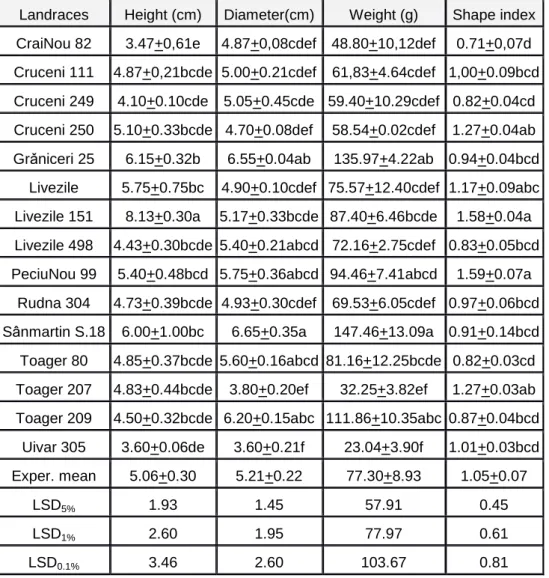
The height ofbulbsin red onionlandraces showed amiddle-high (21.70%), ranging from 3.47 for CraiNou and 8.13 for Livezile 151 landrace, under the conditionsof4.66cm amplitude. Thus,Livezile 151landraceshoweda heightofbulbssignificantly superior toall other landraces. High valuesof thistraithave beenalso observed in Grăniceri 25, Livezile, SânmatinuSârbesc 18, which have achievedsignificant increasescompared to Uivar 305 and CraiNou 82 landraces.
Table 1
Mean values of the studied bulb traits in red onion landraces from TimişCounty
Landraces Height (cm) Diameter(cm) Weight (g) Shape index
CraiNou 82 3.47+0,61e 4.87+0,08cdef 48.80+10,12def 0.71+0,07d
Cruceni 111 4.87+0,21bcde 5.00+0.21cdef 61,83+4.64cdef 1,00+0.09bcd
Cruceni 249 4.10+0.10cde 5.05+0.45cde 59.40+10.29cdef 0.82+0.04cd
Cruceni 250 5.10+0.33bcde 4.70+0.08def 58.54+0.02cdef 1.27+0.04ab
Grǎniceri 25 6.15+0.32b 6.55+0.04ab 135.97+4.22ab 0.94+0.04bcd
Livezile 5.75+0.75bc 4.90+0.10cdef 75.57+12.40cdef 1.17+0.09abc
Livezile 151 8.13+0.30a 5.17+0.33bcde 87.40+6.46bcde 1.58+0.04a
Livezile 498 4.43+0.30bcde 5.40+0.21abcd 72.16+2.75cdef 0.83+0.05bcd
PeciuNou 99 5.40+0.48bcd 5.75+0.36abcd 94.46+7.41abcd 1.59+0.07a
Rudna 304 4.73+0.39bcde 4.93+0.30cdef 69.53+6.05cdef 0.97+0.06bcd
Sânmartin S.18 6.00+1.00bc 6.65+0.35a 147.46+13.09a 0.91+0.14bcd
Toager 80 4.85+0.37bcde 5.60+0.16abcd 81.16+12.25bcde 0.82+0.03cd
Toager 207 4.83+0.44bcde 3.80+0.20ef 32.25+3.82ef 1.27+0.03ab
Toager 209 4.50+0.32bcde 6.20+0.15abc 111.86+10.35abc 0.87+0.04bcd
Uivar 305 3.60+0.06de 3.60+0.21f 23.04+3.90f 1.01+0.03bcd
Exper. mean 5.06+0.30 5.21+0.22 77.30+8.93 1.05+0.07
LSD5% 1.93 1.45 57.91 0.45
LSD1% 2.60 1.95 77.97 0.61
264
Regardingthe bulbs diameter, the red onionlandracesrecorded avariation amplitudeof 2.85cm with thelimitsbetween 3.60 for Uivar 305 and 6.65 cm in SânmartinuSârbesc 18, amid amediuminter genotypic variability. A frequency of40% of the landracesshowed abulbdiameterbelow 5cm, while six landraces achieved valuesbetween 5and 6cm, and for threelandracesthe bulbs diameterexceeding 6cm. The landraces SânmartinuSârbesc 18, Grăniceri and Toager 209 showedthe highestvalues of thistrait andsignificant increasescompared tolandraces: Uivar 305, Toager 207, Grăniceri 250.
Regarding to the bulbs weight, it is noted that thestudied landraces showed avery highvariability(39.85%), associated with amplitude of 115.21 g, with the limitsbetween 23.04 g in Uivar 305 and 147.46 g in SânmartinuSârbesc 18. This traithas aGaussian distribution, given that20% of the landracesachieved abulbweightbelow 50g, 60 % of the landraces registered values between 50 and 100 g, and 20 % exceeded 100 g. Like the bulb diameter, the landraces SânmartinuSârbesc 18, Grăniceri 25 andToager 209, who achieved values over 100 g, where significantly superior to Uivar 305 and CraiNou 82 landraces.
In terms ofbulb shape, the landraces are grouped into twocategorieswithclose frequencies, amid ageneral slightly elongated shape. Thusthe mostelongatedbulbswere recorded for PeciuNou 99 and Livezile 151 landraces, while atCraiNou 82, Toager 209 and Cruceni 249 landracesthe bulbshave hada moreround shape.
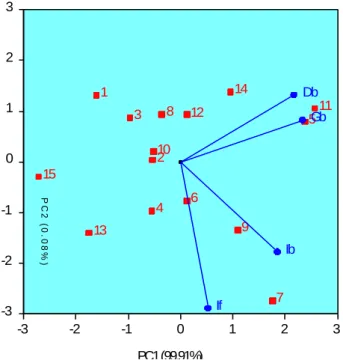
Fig. 1.Biplot for the studied red onion landraces and bulb traits
The biplot based on thefirst two principal componentsexpress99.99% of the variability for red onion landraces (Figure 1). Also, it is noted that at Grăniceri 25, SânmartinuSârbesc 18 and Toager 209 landraces, the highervalues of bulbdiameterare associatedwith highweight. For Liveziile 151 and PeciuNou 99, increased values ofthe bulb height are associated withan elongated shapeand a weightclose to the experience mean. Regardingthe cosine of theanglebetween thevectors related to different traits, assumptions
5
6
7 8
2
9 4
10
11
3 12
13
1 14
15
Db
Gb
Ib
If -2
-3 -1
-1 0
1 1
3 2
3
-3
0 2
-2
PC1 (99.91%)
P
C
2
(
0
.
0
8
%
265
about the correlations between these can be made. Thus, it is observed that the bulb height has ahigh influenceon its shape.
The highestphenotypic similarityin terms ofanalyzed traits was
recordedbetweenlandraces: Cruceni 111-Rudna 104 (99.84%); Grăniceri 25-Sânmartinu Sârbesc 18 (99.70%); Cruceni 249-Livezile 498 (99.28%). Ahighphenotypicdiversitywas registeredbetween landraces: SânmartinuSârbesc 18-Uivar 305 (56.96%); Grăniceri 25-Uivar 305 (51.63%); CraiNou 82-Livezile 151 (52.23%).
Fig. 2.UPGMA clustering of red onion landraces from TimişCounty for bulb traits
Based onthe phenotypicsimilarityforthe studied traits, the red
onionlandracesweregrouped into twomainclusters (Figure 2). The firstclusteris composed
fromLivezile 151 and PeciuNou 99 landraceswhich manifests a
phenotypicdiversityof9.57%.
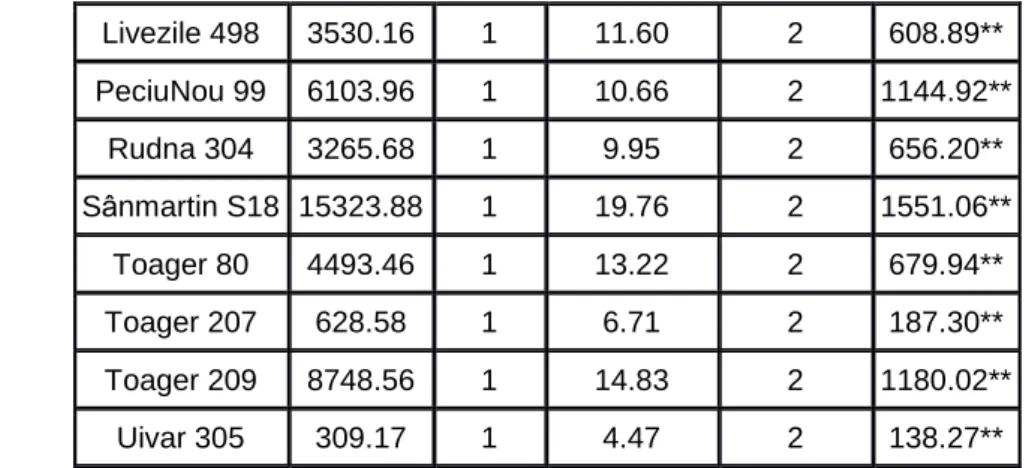
Table 2
Analysis of variance for red onion landraces concerning the bulb traits
Landraces Between groups Within groups F Test
SS DF SS DF
CraiNou 82 1572.09 1 8.96 2 350.87**
Cruceni 111 2541.01 1 10.33 2 491.90**
Cruceni 249 2358.44 1 9.85 2 478.81**
Cruceni 250 2256.51 1 8.88 2 507.95**
Grǎniceri 25 12954.07 1 19.59 2 1322.37**
Livezile 3848.14 1 11.87 2 648.34**
Livezile 151 5097.27 1 21.52 2 473.78**
Graniceri 25
Sanmartinu S.18
Livezile 151
Peciu Nou 99 Cruceni 249
Livezile 498
Toager 80
Livezile
1.00
Uivar 305
0.95
Toager 209
0.90 0.85
0.80
Crai Nou 82
0.75
Rudna 304
Toager 207 Cruceni 250 Cruceni 111
266
Livezile 498 3530.16 1 11.60 2 608.89**
PeciuNou 99 6103.96 1 10.66 2 1144.92**
Rudna 304 3265.68 1 9.95 2 656.20**
Sânmartin S18 15323.88 1 19.76 2 1551.06**
Toager 80 4493.46 1 13.22 2 679.94**
Toager 207 628.58 1 6.71 2 187.30**
Toager 209 8748.56 1 14.83 2 1180.02**
Uivar 305 309.17 1 4.47 2 138.27**
The secondclusterconsists ofseveralsub-clusterswhichexhibitdifferent levels ofthe phenotypicsimilarity. The firstsub-clusterincludes the landraces: CraiNou 82, Cruceni 249, Cruceni 111, Rudna 304, Livezile 498, Toager 80, between whichthere is an averagesimilarityof approximately97%. Cruceni 250 and Livezile landraces composethe secondsub-cluster, showing an average diversity of about 93% to the landraces of the firstsubgroup. The thirdsub-clusteriscomposed of two landraces, Toager 207 and Uivar 305 respectively, showing asimilarityof approximately 89% compared to the landracesofprevious sub-clusters. The lastsub-clusteris composed of Grăniceri 25, SânmartinuSârbesc 18 and Toager 209 landraces between whichthere is asimilarityof 95.5% andpresentedhighbulbsize.
Regarding theanalysis of variancefor red onion landraces in terms of bulbs traits (Table 2), highervalues of variance wererecorded for the landraces: SânmartinuSârbesc 18, Grăniceri 25 and Toager 209, whichshowedhigh values ofthe bulb size. Areduced variabilityof the analyzed traitswas observed at Uivar 305 and Toager 207 landraces. The greatest contributiontothe diversity withingroups(clusters) wasobserved in Liveziile 151, SânmartinuSârbesc 18 and Grăniceri 25 landraces, while thevariabilityof traitsat Uivar 305 landrace does not influencethe diversitybetween the landracesofthe secondcluster.
Table 3
Analysis of variance for bulb traits of red onion landraces
Trait Between groups Within groups F Test
SS DF SS DF
Bulbs height 0.90 1 17.73 13 0.66
Bulbs diameter 5.91 1 4.62 13 16.62**
Bulbs weight 11125.36 1 5632.35 13 25.68**
Shape index 0.08 1 0.95 13 1.06
Given the resultspresentedin Table 3, it is notedthat the bulb weight, generate the largest differencebetween landraces, havinghighcontributionstothe totalvariability. The lowestcontributionto the diversitybetween thelandracesof the twoclusterswasobserved for
shape index. The bulbs weight, followed bythe bulbheight generatesahigh
diversitybetweenthe landracesof the same group.
267
The results showed that significant differences in bulb traits were present between the landraces. The landraces: SânmartinuSârbesc 18, Grăniceri 25 andToager 209, whichshowedhigh values ofthe bulbs size have had a high contribution to the total diversity. Also areduced variabilityof the analyzed traitswas observed at Uivar 305 and Toager 207 landraces.
This study found that the diversity of the studied red onion landraces was distributed within, as well as among landraces from the same location. Some of the landraces like Sânmartinu S. 18, Livezile 151, PeciuNou 99 and Uivar 305 with favorable traits could be selected for further research and utilization.
ACKNOWLEDGEMENT
This work was supported by a grant of the Romanian National Authority for Scientific Research, CNDI-UEFISCDI project number PN-II-PT-PCCA-2011-3.1-0965. Special thanks to all persons from villages which were very kind to let us visit their gardens and supplied us with the necessary plant material.
REFFERENCES
Astley D., Innes N.L., Van der Meer, Q.P. 1982 - Genetic Resources of Allium Species, IBPGR secretariat, Rome, Italy, pp. 38;
Bosch Serra, A.-D., Currah L. 2002 - Agronomy of onions, in: Allium Crop Science: Recent Advances, H.D. Rabinowitch, and L. Currah, eds., CABI Publ.,Wallingford, UK, pp. 187-232;
Ciulca S. 2006 - Metodologii de experimentareînagriculturăşibiologie.Ed. Agroprint, Timişoara;
Fielding A.H. 2007 -Cluster and classification techniques for the biosciences.CambridgeUniversity Press;
Fritsch R.M., Friesen N. 2002 - Evolution, domestication and taxonomy, in: Allium Crop Science: Recent Advances, H.D. Rabinowitch, and L. Currah, eds., CABI Publ., Wallingford, UK, pp. 5-30;
Gabriel K.R.1971-The biplot graphic display of matrices with application to principal component analysis.Biometrika, 58: p. 453-467;
Galván G., González H., Vilaró F. 2005 - Estado actual de la investigaciónenpoblaciones
locales de hortalizasenUruguay y suutilizaciónen el mejoramiento. Agrociencia 9: 115-122;
González H., Zaccari F., Suarez C. 2000 - Conservación de bulbos de poblaciones
locales de cebolla. En: Presentación de resultados experimentales de ajo y cebolla. INIA Serie actividades de difusión 223: 41-46;
Porta Bettina, Rivas Mercedes, Gutiérrez Lucía, Galván G.A. 2014 - Variability, heritability, and correlations of agronomic traits in an onion landrace and derived S1 lines. Crop Breeding and Applied Biotechnology 14: 29-35;