Efficient Procedures to Enhance Answer Quality in Questions And
Answer Websites
1
U.Veera Ramesh,2Y.Jaya Babu 1,2
Dept. of CSE, Pragati Engineering College.,Surampallem, E.G.Dt,AP, India
ABSTRACT:
Question & answer system plays an important role to post questions and pick related answers to the questions in our day-to-day life, but it face trouble when the number of users and the number of questions increased . In this paper, we develop a question & answer system which forward the questions to the users who give high quality answers with a short answer wait time. In this system , identify an asker through friendship who are most likely to answer the questionby control the social network properties of common-interest and mutual-trust friend relationship and provide security by protecting user privacy and identifies, and retrieving
answers automatically for recurrent questions . The performance of a system is evaluated via simulations and the results show that our question & answer system analyze the Q&A behavior of real users and
questions to improve the answer quality and asker’s
waiting time and enhance security compared to existing methods.
KEYWORDS: social networks, communication, Question and answer
1 INTRODUCTION
In online social network, there has been a increased population to post the questions online. Then when a user wants to answer a question, he overwhelmed the huge volumes of questions and not encourage all users to provide answers and to answer questions quickly. To choose the answer providers, current Q&A systems allow users to choose tags (i.e., interest categories) for their questions. However, its difficult to find the appropriate tag(s) for a question. As a result, current Q&A systems may notprovide high
quality answer with a short answer wait time, but userswants to receive satisfactory answers quickly. To increase the quality of answers received and decrease the wait time for answers, In this paper develop an online social network based Q&A system, called SocialQ&A. By using social network properties, a question can forward to potential answer providers toreceives a high-quality answer for a question in a short period of time. It removes the burden of answer providers they searches a question in large collections by directly delivering them the questions based on interest categories of answer providers. In social Q & A, Bloom filtering technique and onion routing incorporated in social Q&A which encrypts the user information to enhance the security.
2 LITERATURE SURVEY
In social network to improve the quality of answer for the posted questions different existing methods exists. Questions can be categorized in to predefined categories [2-4] to locate previously asked questions and their related answers. Term weighting schemes [3] are proposed to categorize the questions and evaluated each scheme using a trace from Yahoo! Answers. Song et al. To provide quality of answers for a posted questions Text mining techniques are used[5, 5–9].[4] proposed a sequential process including topic-wise word identification and
weighting, semantic mapping, and similarity calculation. questions can be categorized using a
local and global features of questions and users’
relationship in order to route a classified question to its potential answerers [6]. Cao et al. [7] leveraged question category to enhance question retrieval in communitybased Q&A systems. Topic-based model [8] finds similarities between questions’ topics and
for questions based on keyword search and sometimes the required information may not be readily available in online.All the existing techniques not provide better quality answers in short period of time.
3 PROBLEM DEFINTION
In online social network, question and answer system plays an important role to answer the questions. Most existing techniques takes time for finding suitable answer providers to answer the questions. To locate appropriate answer providers, current Q&A systems allow users to choose tags (i.e., interest categories) for their questions. However, it is difficult to find the appropriate tag(s) for a question.As a result, current Q&A systems may not meet the requirement of providing high quality answer with a short answer wait time, though users wish to receive satisfactory answers quickly.
4 PROPOSED APPROACH
we have developed and prototyped an online social network based Q&A system, called SocialQ&A. By using social network properties forward a question to potential answer providersto recieve high-quality answer for a question in a short period of time. The bloom filter based enhancement methods encrypts the interest and friendship information exchanged between users to protect user privacy, and record all n-grams of answered questions to automatically retrieve answers for recurrent question. The onion routing based answer forwarding protects the identities of askers and answers.
5 SYSTEM ARCHITECTURE:
Social Network can be represented as network, each person can be considered as a node and the edge between nodes is treated as the friendship between the nodes. Same social community members can trust each other and share their common interest to answer the questions. SocialQ&A is developed and incorporates in to an online social network to improve the quality of answers and reduce the answer wait time.SocialQ&A system consists of
Q&A repository to stores users profiles and question & answers, User Interest Analyzer to analyze the users interest, Question Categorizer categories the questions into interest categories based on Category Synsets, and Question-User Mapper connects these two components to provide satisfactory answers.
Fig. 1.The architecture of SocialQ&A
6 PROPOSED METHODOLOGY
Social Q&A system provides the better quality answer in a short period of time and enhance security by using the following components.
User Interest Analyzer:
User Interest Analyzer uses each user’s profile
information in the social network and user interactions to find interest categories of users in which category he would like to answer or ask a question.
Question Categorizer:
Question Categorizer is to categorize a question into predefined interest categories based on the topic(s) of the question and also allow users to input tags for that questions which are analyzed in question parsing. UsingWordNetgenerate tokens to examine the tags and text of the question, and this tokens are compared
by SocialQ&A’sSynset to find which category the
question belongs.Interest weights are calculated to know the user intelligence to answer a question of Interest.
Question-User Mapper:
Question-User Mapper identifies the appropriate answerers for a given question. It chooses the answer
parameters are considered: i) the interest similarity between the interest vectors of the friend and the question ii) the social closeness between the friend and the asker.
7 USER INTEREST ANALYZER ALGORITHM:
Input:A user’s profile, questions and answers
step1: Parse the “interests” field to generate a token
stream
step2: Parse the“activities” field to generate a token
stream
step3: Use the inputs from the user’s selection from
the Music, Movie, Television and Book fields to generate token streams
step4: Check each token in the Synset
step5: if a matching interest category Ii exists then step6: Update interest weight: WIi++
step8: Keep updatingWIi based on questions asked and answered and profile update.
Step9: Periodically update The user’s interest vector.
QUESTION-USER MAPPER ALGORITHM:
Input: Interest vectors of a user, his/her friends and question
Step1: Find the similarity between their interest vectors for each friend
Step2: Compute asking and answering interaction frequency
Step3: Order the friends in descending order Step4: Notify the top N friends
Step5: A list of potential answer providers.
BLOOM FILTER TECHNIQUE:
SocialQ&A uses the counting bloomfilter technique
to encrypt information that is exchanged between friends for protection and also counts the common friends and interests.
INPUT:USERS INFORMATION
Step 1:Encrypts users information using K hash function for protection.
Step2:Encrypted information can stored in an integer array of t entries.
Step3: Each hash function encrypts the feed information into an integer m within [0; t], and the mth entry of the integer array is increased by 1. Step4: If for each hashed result m, the value at mth entry in the array is larger than 0.
Step5:users information item has a higher probability of being stored in the bloom filter.
Step6: otherwise, it is not stored in the bloom filter. Step7: Each user feeds friend IDs into a bloom filter for protection.
Step8: Exchange the bloom filter results instead of friendship information directly.
8 RESULTS
The results show that the proposedSocial Q&A enhance answer quality by examining the maximum rating that an answer received for a particular question and the highest rating answers can satify the askers, and also reduce answer wait time.
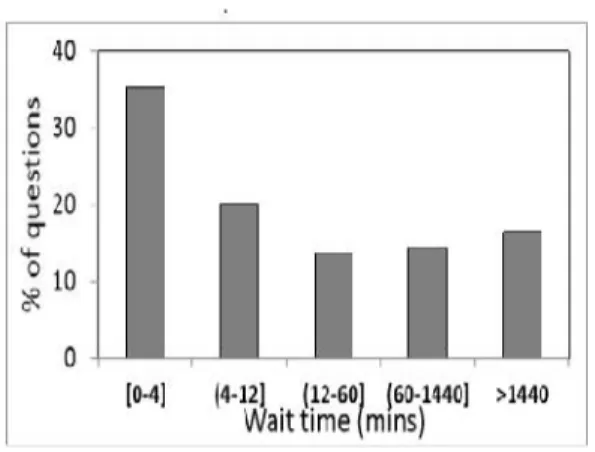
Figure 2 shows that distribution of wait time for an asker to receive a response to his/her question. We see that a large percentage of questions (around 50%) are answered within 8 minutes.
Fig.2: % of Resolved questions with different waiting time.
median is 10, the minimum is 1, and the maximum is 10. The results indicate that SocialQ&A provides satisfactory answers in most cases in this test.
Fig. 3: % of Questions vs maximum ratings
9 CONCLUSION
In this paper,we proposed a online social network based Q&A system, called SocialQ&A to improve the quality of answer and reduces the waiting time for answers. Bloom filtering technique and onion routing incorporated in social Q&A to enhance the security. The bloom filter technique encrypt the interest and
friendship information exchanged between users to protect user privacy, and record all n-grams of answered questions to automatically retrieve answers for recurrent question. The onion routing based answer forwarding protects the identities of askers and answers. The experimental results show that Social Q&A enhance answer quality and reduce answer wait time and also provide security in current Q&A systems.
10.REFERENCES
[1] M. R. Morris, J. Teevan, and K. Panovich. A Comparison ofInformation Seeking Using Search Engines and Social Networks.nInIn Proc. of ICWSM, 2010.
[2] A. Shtok, G. Dror, Y. Maarek, and I. Szpektor. Learning From the Past: Answering New Questions With Past Answers. In Proc. of WWW, 2012. [3] X. Quan, W. Liu, and B. Qiu.Term Weighting Schemes for Question Categorization.TPAMI, 2011.
[4] W. Song, W. Liu, N. Gu, X. Quan, and T. Hao. Automatic Categorization of Questions for User-Interactive Question Answering.Information Processing and Management, 2011.
[5] B. Li, I. King, and M. R. Lyu. Question Routing in Community Question Answering: Putting Category in its Place. In Proc. of CIKM, 2011.
[6] T. C. Zhou, M. R. Lyu, and I. King.A Classification-Based Approach to Question Routing in Community Question Answering.In Proc. of WWW (Companion Volume), 2012.
[7] X. Cao, G. Cong, B. Cui, C. S. Jensen, and C. Zhang.The Use of Categorization Information in Language Models for Question Retrieval.In Proc. of CIKM, 2009.
[8] J. Guo, S. Xu, S. Bao, and Y. Yu.Tapping on the Potential of Q&A Community by Recommending Answer Providers.In Proc. of CIKM, 2008.[36] L. Nie, Y. Zhao, X. Wang, J. Shen, and T. Chua.Learning to recommend descriptive tags for questions in social forums.TOIS, 2014.
[9] M. R. Morris, J. Teevan, and K. Panovich. What do People AskTheir Social Networks, and Why?: A Survey Study of StatusMessage Q&A Behavior. In Proc. of CHI, 2010.
[10] Z. Gyongyi, G. Koutrika, J. Pedersen, and H. Garcia-Molina.Questioning Yahoo! Answers.In Proc. of QAWeb, 2008.
[11] Yahoo!Answers Team. Yahoo! Answers BLOG.http://yahooanswers.tumblr.com/, [Accessed on 10/20/2014].
[12] S. Li, Q. Jin, X. Jiang, and J. Park. Frontier and Future Developmentof Information Technology in Medicine and Education: ITME 2013.Springer Science & Business Media, 2013.
[14] E. Pennisi. How Did Cooperative Behavior Evolve? Science, 2005.
[15] H. Shen, Z. Li, G. Liu, and J. Li. Sos: A distributed mobile q&asystembased on social networks. TPDS, 2014.
[16] A. Spagnolli and L. Gamberini.Interacting via sms: Practicesof social closeness and reciprocation.British Journal of SocialPsychology, 2007.
U.Veera Ramesh is a student of Pragati Engineering College, Surampallem. Presently he is pursuing his M.Tech [Computer Science&Engineering] from this college and he received his B.Tech from Pragati Engineering Colleges, affiliated to JNT University, Kakinada in the year 2013. His area of interest includes Big Data,Programming languages, all current trends and techniques in Computer Science.
Dr.Y.JayaBabu, well known excellent teacher ReceivedPh.D and from
Jawaharlal Nehru
Technological University,
Kakinada is working as