Gossiping using the Energy Map in
Wireless Sensor Networks
Max do Val Machado
1, Raquel A.F. Mini
2, Antonio A.F. Loureiro
1,
Daniel L. Guidoni
1and Pedro O.S.V. de Melo
11Federal University of Minas Gerais 2Pontifical Catholic University of Minas Gerais Belo Horizonte, Brazil Belo Horizonte, Brazil
{maxm, loureiro, guidoni, olmo}@dcc.ufmg.br [email protected]
ABSTRACT
A gossip protocol randomly decides the set of nodes that will forward a packet it received. Gossiping was proposed to be used in dynamic topology networks such as Wireless Sensor Networks (WSNs). This work proposes Gossiping using the Energy Map (GEM), a new gossiping-based pro-tocol to perform energy-aware broadcasting in WSNs. The key idea is to change the random selection of neighbors in a way that the selection process uses the energy map. In our protocol, the routing flow is directed to the nodes with the greatest energy reserves, balancing the network energy and preserving nodes localized inside low energy regions to perform sensing tasks.
Categories and Subject Descriptors: C.2.2 [Network
Protocols]: Routing protocols
General Terms: Algorithms, Experimentation,
Perfor-mance
Keywords: Wireless Sensor Networks, Gossiping,
Broad-casting, Energy Map
1.
INTRODUCTION
A gossip protocol randomly decides the set of nodes that will forward a packet it received. At each step of this proto-col, a random set of nodes is selected to forward the packet and thus continuing the routing process. Gossiping is imple-mented using two approaches: sender and received based. In the first one, when a node receives a packet, it randomly se-lects a subset of its neighbors to forward the packet. Sender-based gossiping uses the concept of epidemic spread in which a person who was infected with a disease can contaminate a random set of people. On the other hand, in received-based gossiping [5], when a node receives a packet, it randomly decides whether it forwards the packet. This work uses the term gossiping as its received-based version that was pro-posed to dynamic-topology networks. Sender-based gossip-ing is not an interestgossip-ing idea to route in dynamic-topology networks since in these networks a node does not know in
Permission to make digital or hard copies of all or part of this work for personal or classroom use is granted without fee provided that copies are not made or distributed for profit or commercial advantage and that copies bear this notice and the full citation on the first page. To copy otherwise, to republish, to post on servers or to redistribute to lists, requires prior specific permission and/or a fee.
MSWiM’07, O ctober 22-26, 2007, Chania, Crete Is land, G r eece. Copyright 2007 ACM 978-1-59593-851-0/07/0010 ...$5.00.
advance its neighbors and the protocol requires that nodes select a subset of their neighbors to forward packets.
An example of dynamic-topology networks are the Wire-less Sensor Networks (WSNs) [3, 7]. In WSNs, sensor nodes go to sleep to save energy and go out of service when the energy of the battery runs out or when a destructive event takes place. WSNs are characterized by sensors nodes with limited resources, mainly, limited energy. Data communica-tion is one of the main problems in a WSN since its energy expenditure can be up to three orders of magnitude higher when compared with data processing [4].
Received-based gossiping is often used to perform broad-casting in wireless networks. Broadbroad-casting is a data com-munication paradigm in which a node has an item of infor-mation that needs to be sent to everyone else. Other data communication paradigms are unicasting and multicasting, and gossiping can also be used to perform them.
Broadcasting is an important data communication para-digm in WSNs [4, 6] that happens when the monitoring node has to send a piece of information to all network nodes. In WSNs, the monitoring is a special node that often does not have resource restrictions and it is responsible for collecting network data and sending control data to sensors. Reliable broadcasting is crucial to WSNs since a monitoring has to perform some specific tasks, such as to change the opera-tional mode of part or the entire WSN, activate/deactivate one or more sensors, and send queries or new interests to the WSN. Moreover, broadcasting is crucial to the basic opera-tion of many protocols in WSNs such as localizaopera-tion discov-ery, identification of multiple paths, and establishment and maintenance of routes. Some data collection protocols, e.g., Directed Diffusion [7], depend on a broadcasting protocol.
This work proposes the algorithmGossiping using the En-ergy Map (GEM), a new gossiping-based protocol to per-form energy-aware broadcasting in WSNs. The key idea is to change the random selection of neighbors in a way that the selection process uses the energy map – the information about the amount of energy available at each part of the net-work [9]. Moreover, GEM has the ability to avoid obstacles, as low energy regions, in a way it eliminates the data flow inside these regions, balancing the WSN energy and pre-serving low energy nodes to perform sensing tasks. When the number of obstacles increases, GEM shows a robust and scalable behavior in which its performance is constant and independent of the number of obstacles. Simulation results revealed the efficiency of GEM in relation to the numbers of reached nodes and transmissions, computational cost and energy consumption when compared with other protocols.
The rest of this paper is organized as follows. Section 2, 3 and 4 describe the related work, show our protocol and ana-lyze its simulation results, respectively. Section 5 concludes this work and discusses some possible future directions.
2.
RELATED WORK
This section briefly discusses some work about gossiping and broadcasting in WSNs.
Gossiping received-based is a broadcasting protocol that was proposed in [5] to disseminate data in wireless net-works. In gossiping, when a node receives a packet, it ran-domly decides whether it forwards the packet. This decision is probability-based and, when a packet is received, the node relays it with a probabilitypand discards it with a proba-bility 1−p. If the node receives the same packet again, this is discarded. This version of gossiping is calledGossip1(p) and [5] proposes other versions:Gossip2,Gossip3 and Gos-sip4. Among them, the one that is more similar to GEM is Gossip3that uses retries to prevent the premature gossiping death.Gossip3 works as the Gossip1 except when a node does not relay a packet. In this case, when a node receives a packet but does not relay it because its coin toss landed “tails”, the node waits a timeout period. After this timeout,
if at leastmneighbors do not relay it, the node does. Dynamic Delayed Broadcasting (DDB) [6] is a broadcast-ing protocol that uses the forwardbroadcast-ing delay idea. Before re-laying a packet, a node waits a small time interval and, after this time, if no neighbor has relayed the packet, the node transmits it. DDB has two versions and the second one should be used in WSNs. In DDB2, the delay time is inversely proportional to the node initial energy less its cur-rent energy. Whenever a node receives a packet, it calculates its additional area, the area that this node transmission go-ing to cover and that has not been covered yet. If the size of this area is smaller than a predefined threshold, the node drops the packet. Otherwise, it calculates the delay time.
Trajectory and Energy-based Data Dissemination(TEDD) [4] is an algorithm that combines the concepts of “routing on a curve” with the information provided by the energy map to disseminate data in an energy-efficient manner in WSNs. “Routing on a curve” protocols use a forwarding scheme in which packets are routed along a predefined curve and then let the intermediate nodes forward the packet to those neigh-bors that lie close to the curve. TEDD is comprised of two parts. The first one is a technique for generating curves that pass through regions with higher energy reserves. The key idea is to select a set of nodes that are most suitable for disseminating data and to find the best set of curves pass-ing through or near these selected points. The latter is a packet forwarding policy that employs a receiver-based ap-proach in which when a node receives a packet, it decides locally whether it forwards the packet. This decision uses the forwarding delay idea.
This work compares GEM withGossip1 andGossip5 (an improved version ofGossip3 proposed in Section 4.1) since the former is the basic gossiping and the latter is its version that is more similar to GEM. Our protocol is compared with TEDD and DDB2 since they use a forwarding delay scheme and provides energy-aware broadcasting.
3.
GOSSIPING USING THE ENERGY MAP
This section proposes Gossiping using the Energy Map (GEM), a algorithm that changes the basic operation of gossiping to perform energy-aware broadcasting in WSNs. The rest of this section discusses the packet gossiping policy of GEM. Sections 3.1 and 3.2 show the basic operation of GEM and how it calculates the gossip probability, respec-tively. Section 3.3 shows how the monitoring calculates the cut energy – an energy parameter that is inserted into the packet by the monitoring and used by each sensor to deter-mine whether it is localized inside a low energy region. The cut energy is calculate based on the energy map.
3.1
Basic Operation
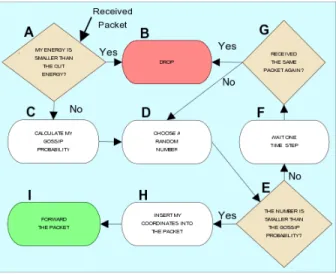
Figure 1 illustrates the basic operation of GEM that is a receiver-based approach to decide when a node should gossip packets. When a node receives a packet, it verifies whether its energy is smaller than the cut energy (Figure 1, pointA). If true, the packet is dropped (Figure 1, pointB), otherwise, the node calculates its gossip probability (Figure 1, pointC) as described in Section 3.2. In the following step, the node chooses a random number uniformly in the interval [0,1] (Figure 1, pointD). If this value is smaller than the gossip probability (Figure 1, pointE), it inserts its own geographic coordinates into the packet and forwards it (Figure 1, points H and I). Otherwise, the node uses the forwarding delay idea and waits exactly one time step (Figure 1, point F) – the time required to a node to transmit a packet and all of its neighbors to receive and process it. After this period of time, the node verifies whether some of its neighbors relayed the packet (Figure 1, pointG). If true, it drops the packet (Figure 1, pointB), otherwise, the process is repeated (Fig-ure 1, pointD). This technique in which nodes insert delays into the routing process is called forwarding delay.
Figure 1: Basic operation of GEM.
We highlight that the forwarding delay idea reduces the number of transmissions. When a node transmits a packet, its neighbors rarely transmit. This is important since data transmission has the greatest energy cost in WSNs.
3.2
Gossip Probability
The gossip probability is calculated to guarantee that some set of nodes forwards packets more (or less) frequently.
(a) No region. (b) 1 region. (c) 2 regions. (d) 4 regions. (e) 8 regions. (f) 16 regions. (g) 32 regions.
Figure 2: Energy maps with/without low energy regions. Light shaded areas represent regions with more remaining energy, and regions short of energy are represented by dark shaded areas.
This value can be a constant as the one used byGossip1 [5] or a two-threshold as used inGossip2. In this work, the gos-sip probability is dynamically defined to reduce the number of transmissions in a way that the most distant neighbor nodes of the previously node receive greater probabilities. Using this approach, nodes receive packets that were routed along a reduced distance (considering the number of hops). Equation (1) shows the gossip probability equation. The communication rangecorresponds to the maximum distance that a packet could be delivered by a single transmission, distanceis the distance between the node and the previously node andpmax is the maximum gossip probability. Dividing distanceperrange, the most distant neighbor nodes from the previous node have the greatest gossip probabilities. When the distance tends to the range, the division result tends to 1 and the gossip probability tends topmax. Otherwise, when the distance tends to 0, the division result tends to 0 and the probability tends to 0.
gossip probability= distance
communication range×pmax (1) An important point of the gossip probability is the tradeoff between the latency and the number of transmissions. It is possible to calibrate the probability to decrease the latency or the number of transmissions. The smaller the probability value is, the greater the latency and the smaller the number of transmissions are. On the other hand, the greater the probability value is, the smaller the latency and the greater the number of transmissions are.
3.3
Cut Energy
Before a transmission, the monitoring node uses the en-ergy map to calculate the cut enen-ergy that is inserted into the packet. The cut energy is a threshold used by each sensor node to determine whether it is localized inside a low energy region. If true, the node cannot forward the packet.
To calculate the cut energy, it is necessary to define what is a low energy region. We consider that this region is defined when the mean energy of all nodes that cover that region is smaller than the network mean energy (e) less than its stan-dard deviation (s). To obtain the cut energy, the monitoring node uses the energy map to calculatee and s. Then, for each nodei, the monitoring node calculates its energy co-efficient ei that corresponds to the sum of its energy with the energy of all itsnneighbors divided byn+ 1. Givene,s and eachei, the cut energy is equal to the highest coefficient that is smaller than (e−s). When such coefficient does not exist, the network does not have low energy regions, and, thus, the cut energy is zero.
4.
SIMULATION RESULTS
This section shows the behavior of GEM in data broad-casting scenarios. These scenarios are created with and with-out initial low energy regions as illustrated in Figure 2. Section 4.1 introduces the simulation parameters and Sec-tion 4.2 discusses the performance of GEM.
4.1
Scenarios
In all simulations, we consider a dynamic topology, where nodes are static but periodically go into a sleeping mode to save energy, which leads frequently to topology changes. Our WSN has 500 static and homogeneous nodes with a finite amount of energy where the battery replacement is in-feasible. The radio range of nodes is equal to 5 m and they are randomly deployed, forming a high-density flat topology in a 35×35 m2 sensor field. Our energy dissipation model is the State-based Energy Dissipation Model [9] since it is able to model a dynamic-topology WSN and the power con-sumption of sensors is based on the Mica2 node [1]. The initial energy of each node is set to 25 J, except nodes lo-calized inside a low energy region. Each low energy region is a circle whose center is a randomly selected point and the radius length depends on the number of regions inside the sensor field. To create a low energy region, we set the energy of nodes localized inside it to half of the initial energy. In all scenarios with low energy regions, the sum of the areas of these regions is constant and equal to 10% of the sensor field. Consequently, when the number of regions increases, their radius reduces. When the scenario has only one region, a broadcasting protocol should avoid this region that has the largest area. When it has 32 regions, the protocols should avoid many small regions like a “Swiss cheese”. We evaluated scenarios with low energy regions since a key requirement for routing protocol in WSNs is to avoid obstacles.
A monitoring node without resource restrictions is placed at the bottom left corner of the WSN and performs a se-ries of broadcasting periodically. During each simulation, it sends 200 messages, uniformly distributed along the simu-lation time, to perform data broadcasting. Moreover, it is assumed that each sensor knows its own location and the monitoring knows the coordinates of all sensors.
To obtain the energy map with a reduced cost, we used our prediction-based approach [9]. The cost of obtaining this map is considered in our simulation results, however, this cost could be distributed among different applications that use the energy map, reducing this energy cost from GEM.
GEM was implemented in the Network Simulator 2 [2] and it was compared with Gossip1, Gossip5, TEDD and DDB2. In this work, we observed that the performance of Gossip3 [5] can be improved for the requirements of WSNs
in which the energy consumption should always be reduced. Therefore, we are proposingGossip5, that works as the Gos-sip3, except after the timeout period when less than m neighbors (in Gossip5, m is always one) do not broadcast the message. In this case, whenGossip3 is used, the node broadcasts the packet. On the other hand, inGossip5, the node broadcasts the packet with probabilitypand waits an-other timeout period with probability 1−p. This process is repeated until the node or at least one of its neighbors transmits the packet. The disadvantage of this improvement is its latency. The values of the probabilities ofGossip1 and Gossip5 were chosen as 0.4 and 0.025, respectively.
All of our simulation results correspond to the arithmetic mean ofn simulations, wheren is the smallest sample size that provided the desired confidence [8]. In all the exper-iments, we use confidence levels of 95%. Furthermore, the T-Test [8] with 0.05 of significance was used to strong af-firm that a protocol is better, worse or equal to another one.
4.2
Data Broadcasting
This section evaluates scenarios of broadcasting where the monitoring sends data to all sensor nodes. Sections 4.2.1 and 4.2.2 present the behavior of the evaluated protocols for nodes localized inside and outside low energy regions, respectively. We highlight that when the scenario has no low energy regions the number of nodes inside them is zero and the number outside is equal to the total number of nodes.
4.2.1
Results Inside the Low Energy Regions
Our main goal in this section is to avoid transmissions inside low energy regions and maximize the number of nodes that receive packets per broadcasting. When a node localized inside a low energy region does not perform transmissions, its energy is preserved to perform sensing tasks.
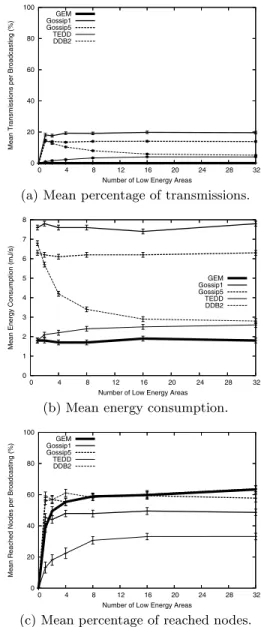
Figures 3-a and 3-b show, respectively, the percentage of nodes localized inside low energy regions that perform trans-missions per broadcasting and the mean energy consumption of these nodes. The energy consumption is influenced by the number of transmissions. In Figure 3-a, GEM has a robust and scalable performance since it always eliminates trans-missions inside these regions independent of the number of regions. Consequently, in Figure 3-c, GEM has the best re-sults. On the other hand, Gossip1 and Gossip5 transmit more packets since they do not consider energy to broad-cast. Gossip1 transmits more packets than Gossip5 since the latter uses the forwarding delay idea. TEDD performs less transmissions than DDB2 and when the network has ex-actly one low energy region, it consumes the same amount of energy as GEM. However, when the number of regions increases, the number of transmissions performed by TEDD increases and the one performed by DDB2 reduces.
Figure 3-c shows the percentage of nodes localized inside low energy regions that received packets per broadcasting. GEM,Gossip5 and DDB2 have a similar performance, ex-cept when the network has one or two low energy regions that Gossip5 and DDB2 have the best performance. This result is confirmed using theT-Test. GEM has a great per-formance when the number of low energy regions increases because when this happens, the radius of each region re-duces, increasing the number of nodes localized inside a low energy region that have at least one neighbor localized out-side it. When GEM is used, only nodes localized outout-side the regions perform transmissions. We highlight the
0 20 40 60 80 100
0 4 8 12 16 20 24 28 32
Mean Transmissions per Broadcasting (%)
Number of Low Energy Areas GEM
Gossip1 Gossip5 TEDD DDB2
(a) Mean percentage of transmissions.
0 1 2 3 4 5 6 7 8
0 4 8 12 16 20 24 28 32
Mean Energy Consumption (mJ/s)
Number of Low Energy Areas GEM Gossip1 Gossip5 TEDD DDB2
(b) Mean energy consumption.
0 20 40 60 80 100
0 4 8 12 16 20 24 28 32
Mean Reached Nodes per Broadcasting (%)
Number of Low Energy Areas GEM
Gossip1 Gossip5 TEDD DDB2
(c) Mean percentage of reached nodes.
Figure 3: Performance parameters for nodes inside low energy regions.
ity of GEM to efficiently skirt low energy regions since it completely eliminates the transmissions and reaches a good percentage of nodes independently of the number of regions.
4.2.2
Results Outside the Low Energy Regions
Our main goal in this section is to minimize transmissions, reduce the energy consumption, and maximize the number of nodes that received packets per broadcasting. Moreover, we evaluate the latency and the computational cost of the evaluated protocols. It is important to point out that this section does not differentiate the number of low energy re-gions since, for each protocol and each evaluated metric, the simulation results of the nodes localized outside the regions is almost the same when the number of regions increases.
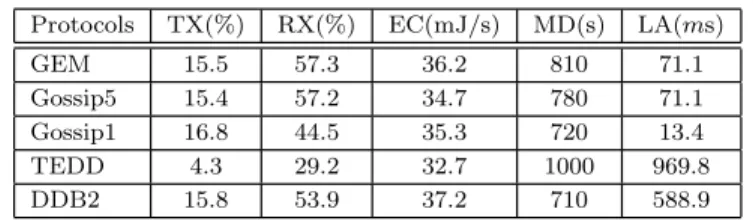
Table 1 shows percentages of transmissions (TX) and reached nodes (RX) and the energy consumption (EC) per-formed outside the low energy regions. Furthermore, it shows the monitoring disconnection time (MD) – that happens
when the nodes localized closer to the monitoring node die and, consequently, the monitoring cannot communicate with the sensors network – and the latency (LA) of each protocol.
Protocols TX(%) RX(%) EC(mJ/s) MD(s) LA(ms) GEM 15.5 57.3 36.2 810 71.1 Gossip5 15.4 57.2 34.7 780 71.1 Gossip1 16.8 44.5 35.3 720 13.4 TEDD 4.3 29.2 32.7 1000 969.8 DDB2 15.8 53.9 37.2 710 588.9
Table 1: Performance parameters for nodes outside low energy regions where: TX and RX are respec-tively the mean percentages of transmissions and reached nodes, EC is the mean energy consumption, MD is the monitoring disconnection time and LA is the latency.
In the first column, TEDD performs less transmissions and Gossip1 performs more. GEM, Gossip5, DDB2 have the same performance, what is confirmed using theT-Test. In the second column, GEM andGossip5 reached the great-est number of nodes, what is confirmed using theT-Test. In both columns, we also observe: (i) Since sensors sleep peri-odically, no protocol is able to cover the entire network. (ii) When TEDD is used, only the nodes localized closer to the curve transmit and receive packets and this is the reason of its reduced numbers of transmissions and reached nodes. (iii) GEM andGossip5 have the best tradeoff between mini-mizing the transmissions and maximini-mizing the reached nodes. In the two following columns, TEDD has the best perfor-mance since it transmitted less packets and DDB2 has the worst, since its basic operation allows a node to transmit a packet that was transmitted by other neighbors. When GEM is used, the routing flow is directed to the nodes with the greatest energy reserves and, consequently, the energy consumption of the nodes localized outside the low energy regions is greater than the one performed by TEDD,Gossip1 orGossip5. However, GEM is able to increase the network lifetime as shown in the fourth column. Moreover, we high-light that GEM is paying alone the entire cost of the energy map construction that is 1.5 mJ/s per node.
Despite of the advantages provided by using the energy map, in an integrated solution for WSNs, this cost is going to be distributed among different applications that use it. The last column shows the mean latency to deliver a packet at 35 m of distances of the monitoring. It can be seen that TEDD and DDB2 have a significantly greater latency than GEM since our protocol uses probability instead of timeout periods of the traditional forwarding delay idea. GEM and Gossip5 have the same performance and Gossip1 that does not use a delay scheme has the best latency.
Table 2 compares the average number of operations per-formed by nodes.Gossip1 has the smallest number of op-erations because of its simplicity, whereas DDB2 has the greatest number of operations due to the additional area calculus. The computational cost of DDB2 is about three orders of magnitude higher than GEM. Comparing GEM and TEDD, the former performs less assignments and arith-metic operations, although, it executes more comparisons. GEM andGossip5 have about the same performance.
Operations Compar- Assign- Sqrt Pow Protocols + − × / isons ments
GEM 0.1 0.8 12.5 1.0 – – Gossip5 0.1 0.4 11.5 1.0 – – Gossip1 0.1 – 7.1 – – – TEED 0.8 2.3 6.1 1.6 0.2 – DDB2 1737 870 1230 869 0.3 0.3
Table 2: Average number of operations per broad-casting.
5.
CONCLUSIONS AND FUTURE
DIRECTIONS
This paper proposes Gossiping using the Energy Map (GEM), a new gossiping-based protocol to perform energy-aware broadcasting in WSNs. The key idea is to change the random selection of neighbors of received-based gossiping in a way that the selection process uses the energy map. GEM is crucial to WSNs since the routing flow will be directed to the nodes with the greatest energy reserves avoiding obsta-cles, as low energy regions where it eliminates the data flow inside these regions, balancing the WSN energy and pre-serving low energy nodes to perform sensing tasks. When the number of obstacles increases, GEM shows a robust and scalable behavior in which its performance is constant and independent of the number of obstacles. Simulation results revealed the efficiency of GEM in relation to the number of reached nodes per broadcasting, number of transmissions, computational cost and energy consumption when compared with other proposed broadcasting protocols.
Future work includes the study of an analytical model for GEM and TEDD. Using an analytical model, we can define the upper and lower bounds of a protocol. We also plan to address another forwarding delay metrics to calculate the gossip probability, e.g., the number of neighbors of nodes or use the information provide by the energy map.
6.
REFERENCES
[1] Mts/mda sensor and data acquisition boards user’s manual. www.xbow.com, May 2007.
[2] The network simulator. www.isi.edu/nsnam/ns, May 2007. [3] D. Estrin, R. Govindan, J. Heidemann, and S. Kumar. Next
century challenges: scalable coordination in sensor networks. In
MOBICOM 99, pages 263–270, USA, 1999.
[4] O. Goussevskaia, M. do Val Machado, R. A. Mini, A. A. Loureiro, G. R. Mateus, and J. M. Nogueira. Data dissemination based on the energy map. InIEEE Communications Magazine, July 2005.
[5] Z. J. Haas, J. Y. Halpern, and L. Li. Gossip-based ad hoc routing. InIEEE/ACM Transactions on Networking, volume 14, June 2006.
[6] M. Heissenb¨uttel, T. Braun, M. W¨alchli, and T. Bernoulli. Optimized stateless broadcasting in wireless multi-hop networks. InIEEE Infocom 2006, Barcelona, Spain, April 2006.
[7] C. Intanagonwiwat, D. Estrin, R. Govindan, and J. Heidemann. Directed diffusion: a scalable and robust communication paradigm for sensor networks. InInternational Conference on Distributed Computing Systems (ICDCS), Vienna, Austria, 2002.
[8] R. Jain.The Art of Computer Systems Performance Analysis: techniques for experimental design, measurement, simulation and modeling. 1991.
[9] R. A. F. Mini, M. do Val Machado, A. A. F. Loureiro, and B. Nath. Prediction-based energy map for wireless sensor networks.Ad Hoc Networks Journal, 3(2):235–253, 2005.