C
apture planning is the process of identifying opportunities, assessing the environment, and implementing
winning strategies oriented toward capturing a specific business opportunity. Consistently successful
capture planning requires a written, action-oriented capture plan.
Capture Planning
1. implement a capture planning discipline to capture new business more
efficiently.
2. use a defined structure for capture plans: external analysis, internal analysis,
strategy development, execution, and monitoring.
3. Keep the process dynamic, flexible, interactive, and current.
4. Maintain a balance between planning and execution.
5. Complete the integrated prospect Solution Worksheet and the Bidder
Comparison Matrix, even when time is short.
6. gain and maintain senior management approval and support.
7. Commit the right people to the capture team.
8. assign specific measurable objectives, schedules, and completion dates to
department managers by name.
9. establish regular reviews to check progress, resolve conflicts, obtain feedback,
make adjustments, and reevaluate pursuit and bid decisions.
10. use the capture plan to jump-start the proposal planning process.
See Bid Decisions andprocess.
The aim of capture planning is to position the prospect to prefer your organization and your solution to the exclusion of all competitors or to at least prefer you prior to any proposals being submitted.
A majority of industry veterans across all markets agree that the prospect’s buying decision is 40 to 80 percent decided before any proposals are submitted.
The term “capture planning” originated in organizations that were primarily focused on large U.S. Department of Defense opportunities. At the same time, commercial organizations pursuing large, complex opportunities were developing more detailed account or sales planning disciplines. Both were pursuing complex opportunities with the following characteristics:
• High value (millions) • Buying committee
• Long sales cycle (months or years)
Some commercial organizations use the terms
capture plan and account plan interchangeably. However, many account plans are not opportunity specific and may be merely an allocation of the organization’s revenue objective.
A capture planning best practice is to prepare a written, action-oriented capture plan. While the length, complexity, and format may vary, a written plan offers reviewable evidence of the quality of thinking of the planners and the soundness of the plan.
The primary audience for a capture plan is each person who will either manage or execute the plan.
A good capture plan will be realistic and specific, detailing the objective, the action, who is responsible for the action, timing, and the frequency of review.
Organizations that use a formal capture planning discipline are helped in the following ways:
• More realistic understanding of each opportunity
• Improved bid decisions
• Improved solutions and capture strategies • Greater consensus and information
transfer among all individuals pursuing each opportunity
• Saved time, reduced capture cost, and improved win rates
Capture planning is initiated following the pursuit decision process milestone.
See Model Documents 16 and 17.
1
implement a capture planning discipline to capture new business more efficiently.
Capture planning offers benefits to everyone involved:
• Sales and business development
professionals who orchestrate organizational resources use the capture plan to specify the needed positioning actions.
• Senior managers have a mechanism to leverage limited business development resources to most efficiently win business. • Participants stay committed, knowing their
efforts are not being wasted.
• Employees keep their jobs, and stockholders make money.
Unlike the top-down, management driven corporate planning process, capture planning is opportunity specific. Capture plans are driven bottom-up by the opportunity and the customer, as illustrated in figure 1.
To meet the organization’s goals, sufficient specific business opportunities must be won. Thus, the discipline associated with “best-in-class” capture planning aligns organizational objectives and investment with high-probability opportunities within approved strategic business objectives.
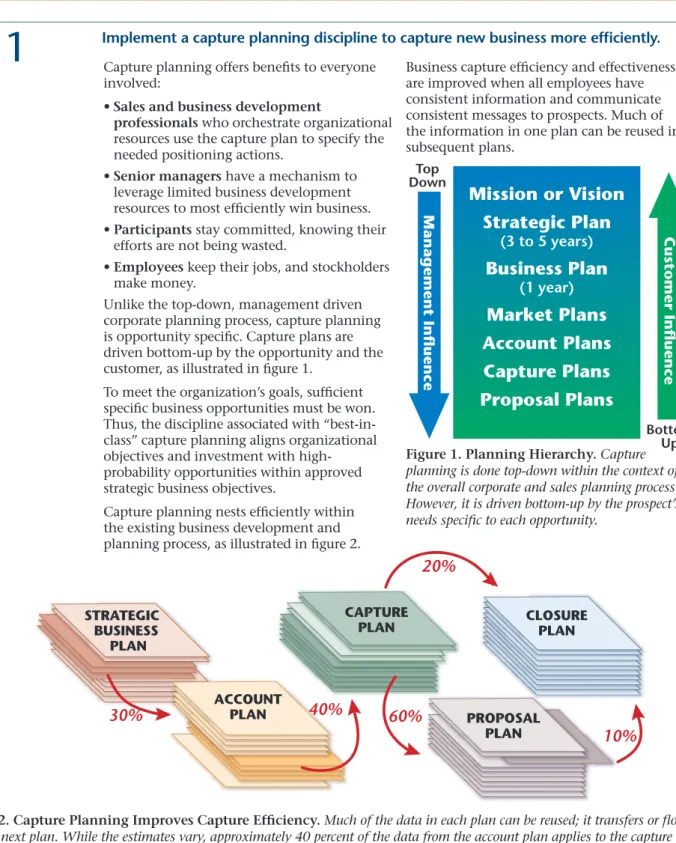
Capture planning nests efficiently within the existing business development and planning process, as illustrated in figure 2.
Business capture efficiency and effectiveness are improved when all employees have consistent information and communicate consistent messages to prospects. Much of the information in one plan can be reused in subsequent plans.
Mission or Vision
Strategic Plan
(3 to 5 years)
Business Plan
(1 year)
Market Plans
Account Plans
Capture Plans
Proposal Plans
Management Influence
Customer Influence
top Down
Bottom up
Figure 1. Planning Hierarchy. Capture planning is done top-down within the context of the overall corporate and sales planning process. However, it is driven bottom-up by the prospect’s needs specific to each opportunity.
Figure 2. Capture Planning Improves Capture Efficiency. Much of the data in each plan can be reused; it transfers or flows into the next plan. While the estimates vary, approximately 40 percent of the data from the account plan applies to the capture plan. Up to 80 percent of the capture plan data is needed in the proposal and closure plans.
2
use a defined structure for capture plans: external analysis, internal analysis, strategy
development, execution, and monitoring.
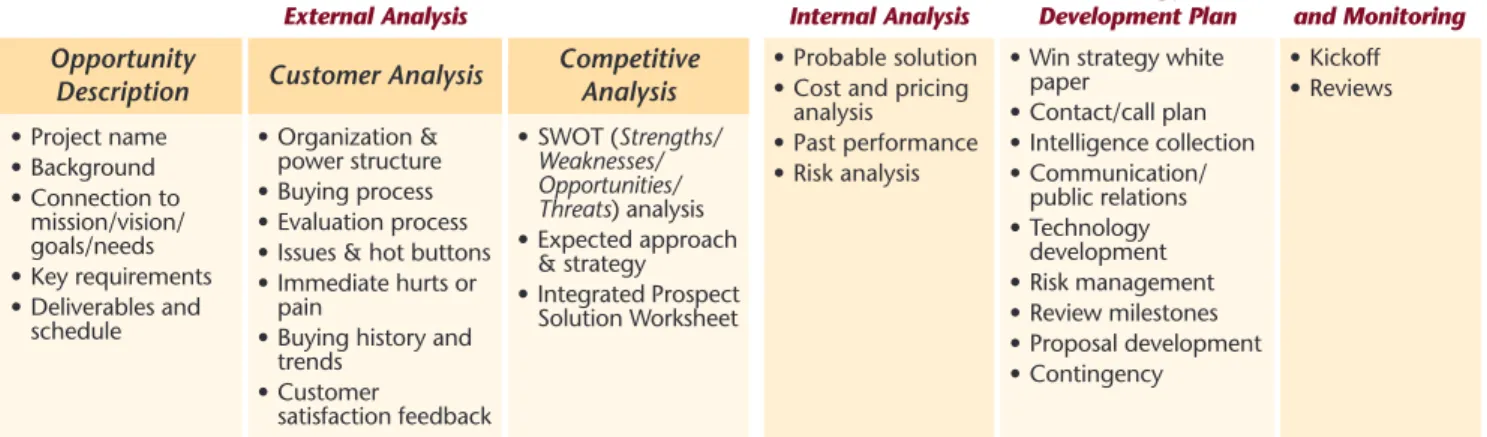
Each organization must establish a common framework for its capture plans. Figure 3 lists potential contents.
The capture plan structure can vary from a written document to briefing overheads. Written plans are favored by organizations with more formal management processes and longer sales
cycles. Overhead formats are best suited for organizations with less-formal, collaborative management processes and shorter sales cycles. Using the framework concept, collect and organize data against the topics deemed relevant. Store capture data in files or in a database to permit sharing within the capture team.
External analysis is done in the context of the corporate planning process, including or referencing only directly relevant data. Use the contents list to prompt more comprehensive analysis of the opportunity. Keep your language and terms consistent with established processes. Internal analysis is focused on early definition of a solution to enable you to influence the prospect’s requirements and specifications and to select the best teaming partners.
Strategy development is essentially a series of plans, all aimed at determining what actions will be taken to position your offering against the prospect’s needs.
Execution and monitoring are focused on making sure that positioning happens and that results are evaluated and adjustments made.
External Analysis Internal Analysis
Strategy Development Plan
Execution and Monitoring
Opportunity
Description Customer Analysis
Competitive Analysis
• Probable solution • Cost and pricing
analysis
• Past performance • Risk analysis
• Win strategy white paper
• Contact/call plan • Intelligence collection • Communication/
public relations • Technology
development • Risk management • Review milestones • Proposal development • Contingency
• Kickoff • Reviews • Project name
• Background • Connection to
mission/vision/ goals/needs • Key requirements • Deliverables and
schedule
• Organization & power structure • Buying process • Evaluation process • Issues & hot buttons • Immediate hurts or
pain
• Buying history and trends
• Customer
satisfaction feedback
• SWOT (Strengths/ Weaknesses/ Opportunities/ Threats) analysis • Expected approach
& strategy
• Integrated Prospect Solution Worksheet
Figure 3. Potential Capture Plan Contents. Specific contents of your capture plans will vary depending on the opportunity, your organization, and the value of the opportunity to your organization.
3
Keep the process dynamic, flexible, interactive, and current.
Keep your capture planning process flexible to permit adjustments depending on the importance of the opportunity to your
organization and the resources you can afford to commit.
Build the plan interactively to permit a fast start with reasonable effort and to encourage regular updates.
4
Maintain a balance between planning and execution.
Detailed plans without action waste of time because they fail to influence prospects’ perceptions.
Limit your plans to the resources available. If more resources are essential than your
organization will commit to win, reconsider your pursuit decision.
Effective capture planning requires a balance between action and planning.
5
Complete the integrated prospect Solution Worksheet and the Bidder Comparison
Matrix, even when time is short.
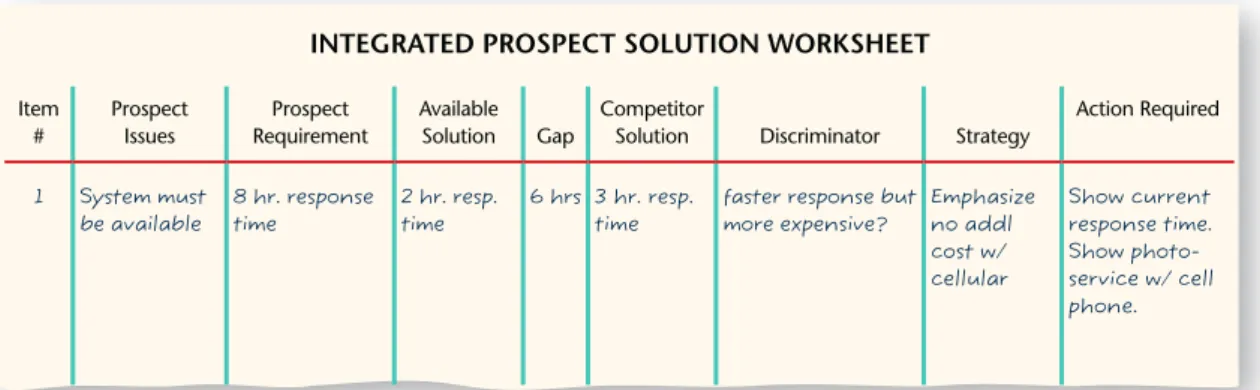
The Integrated Prospect Solution Worksheet, shown in figure 4, is a powerful analysis tool that should be applied throughout the capture process. Early in the process, use it to focus collaboratively with your prospect to define the issues and influence the requirements. If you discover an opportunity after requirements are defined, use it to define the underlying issues driving the prospect’s requirements.
Next, extend your analysis to outline your solution, outline your competitors’ solutions, identify discriminators, then develop your strategy and actions to better position your solution with the prospect.
The Bidder Comparison Matrix, shown in figure 5, is used to analyze the prospect’s current perception of how your solution compares to various competitors. Use it repeatedly throughout the capture process to measure the strength and effectiveness of your positioning. See Discriminators and
Strategy.
The “gap” is the difference between the prospect’s requirement and your available solution.
integrateD proSpeCt Solution WorKSheet
Item #
Prospect Issues
Prospect Requirement
Available Solution Gap
Competitor
Solution Discriminator Strategy
Action Required
1 System must be available
8 hr. response time
2 hr. resp. time
6 hrs 3 hr. resp. time
faster response but more expensive?
Emphasize no addl cost w/ cellular
Show current response time. Show photo- service w/ cell phone.
Figure 4. Integrated Prospect Solution Worksheet. Begin by filling down the “issues” column when you are early in the process. If the prospect has already drafted requirements, fill-down the “requirements” column. Then complete each row horizontally, carefully relating each item.
iSSueS Weight uS (SCore) CoMpany a CoMpany B Specific experience
30
25
20
15
low price20
5
10
15
Familiarity with Manager named20
15
10
10
ability to Meet Schedule30
25
21
15
total SCore 10070
61
55
Figure 5. Bidder Comparison Matrix. First list the prospect’s issues, then the relative importance of each issue as perceived by the prospect in the “weight” column. Note the total weight always equals 100. Then complete each row horizontally, indicating your estimate of the prospect’s perception of each competitor’s ability to satisfy that issue. Scores can range from 0 to the total number in the “weight” column.
6
gain and maintain senior management approval and support.
Top management must endorse and help communicate the plan to everyone managing and executing the plan as well as those impacted by the reassignment of individuals to the plan.
Management support must begin with the pursuit decision and continue through to a signed contract.
7
Commit the right people to the capture team.
Organizations pursuing competitive business assign their best people to capture teams. Organizations that assign only the people they can spare from other activities to participate on the capture team usually lose the sale.
The capture manager is normally a role rather than a position. In most organizations, the sales or business development lead is given the capture manager role. However, in organizations focused on large federal prospects, the capture manager role may be assigned to a person from program management, business development, or even line management.
The capture manager role requires a person with customer and market knowledge, sales savvy, proposal experience, leadership skills, broad technical understanding, knowledge of the organization, and positive enthusiasm. The proposal manager role, while not mutually exclusive to capture manager, requires different skills. Proposal managers lead a team focused on producing a persuasive document within tight deadlines.
Capture team members must be suited to the assigned action, whether direct prospect contact or internal development.
Additional uses for the Integrated Prospect Solution Worksheet and Bidder Comparison Matrix are discussed in
executive Summary, Strategy, and teaming.
See team Selection and Management.
8
assign specific measurable objectives, schedules, and completion dates to department
managers by name.
Most capture team action assignments are part time and for a limited duration. Only the department managers of the assigned individuals can ensure task completion.
Many capture efforts fail because the individuals assigned to the task are expected to complete the task in their spare time.
Either get serious about completing the task, eliminate the task, or no-bid due to lack of resources. The single biggest reason for losing competitive business is the failure to adequately position the prospect prior to proposal submittal.
9
establish regular reviews to check progress, resolve conflicts, obtain feedback, make
adjustments, and reevaluate the pursuit and bid decisions.
To keep reviews short and effective, focus on reviewing the actions taken, the results, and adjustments to future actions.
Recheck the underlying data, assumptions, and analysis only when objectives are not met or additional data is uncovered. Reviews that first focus on the data and analysis usually fail to get to the action.
Remember that changing a prospect’s perceptions requires action, not analysis. As more information becomes available, reevaluate your pursuit and bid decisions. Losing bids are the most costly. No-bid decisions let you apply limited resources to winnable opportunities. In most instances, the capture plan is the sole support for bid and bid validation decisions.
10
use the capture plan to jump-start the proposal planning process.
As shown earlier in figure 2, approximately 60 percent of the information needed to prepare the proposal management plan can be extracted from a current and complete capture plan. Relying on the capture plan to quickly prepare the initial proposal management plan both saves time and presents a consistent message to the prospect. In the absence of a capture plan, the newly assigned proposal manager
starts from scratch, often with little help and under severe time constraints.
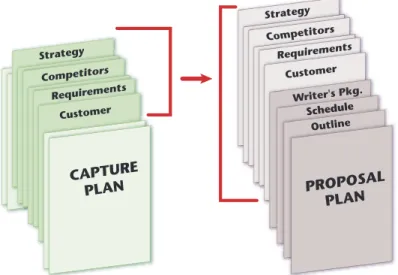
Capture plans and proposal plans have the common elements illustrated in figure 6. Information on the prospect, the requirements, and competitors transfers directly. The capture strategy needs to be extended or converted into a proposal strategy. Only the proposal outline, proposal preparation schedule, and the writer’s packages need to be created.
Figure 6. Capture Plans Evolve into Proposal Plans. A current capture plan effectively front-loads the proposal plan. With approximately 60 percent of the information transferring from the capture plan, you only need to add proposal-specific material. Because the proposal submittal date is set by the prospect, a shorter planning interval prior to kickoff leaves more time to develop a winning proposal.