1
Directors’ Remuneration Policy Summary
Effective Period
In accordance with the new regulations, the Directors’ Remuneration Policy (the “Policy”) which
is summarised below will operate from 1 January 2014 and be put to a binding shareholders
vote and become formally effective at the 2014 Annual General Meeting and will apply for the
period of 3 years from the date of approval.
Our Core Principles
The Remuneration Committee reviews Group remuneration policy on an annual basis to ensure
it remains appropriate. The Committee aims to ensure that remuneration for the executive
directors and senior management:
Enhances the achievement of Hikma’s
strategic aims
Takes account of
employment conditions
both inside and outside Hikma
Aligns the interests of all employees, management and directors
with those of
shareholders
Takes account of Hikma’s
Corporate Social Responsibility
program, including
environmental, social and governance issues
Is aligned with Hikma’s founding principle of
Business Integrity
The Remuneration Committee has oversight of the main compensation structures throughout
the Group. In addition, in respect of the Committee’s specific review for Executive Directors,
the Committee is satisfied that the Group’s incentive structures are consistent with the risk
profile of Hikma and encourage a long-term sustainable view to be taken by participants.
Hikma continues to encourage employees to increase share ownership throughout the Group,
using its share incentive plans.
Factors affecting Remuneration Policy
The Committee has been particularly sensitive to the external factors set out above affecting a
number of the countries in which it has operations and has ensured that throughout the Group
any short-term risks have appropriately been reflected in the remuneration structures.
Discretion
The Committee has discretion in several areas of policy as set out in this report. The
Committee may also exercise operational and administrative discretions under relevant plan
rules approved by shareholders as set out in those rules. In addition, the Committee has the
discretion to amend policy with regard to minor or administrative matters where it would be, in
the opinion of the Committee, disproportionate to seek or await shareholder approval. It is the
Committee’s intention that commitments made in line with its policies prior to the date of the
2014 AGM will be honoured, irrespective of when they are satisfied. This includes outstanding
awards under the Long-Term Incentive Plan (“LTIP”), which remain subject to the share plan
rules.
Our Group Remuneration Policy Changing Market Practice Recruitment Market in the Company’s Sector Institutional Shareholders and their Representative Bodies Current Economic Climate Market Conditions Affecting the Company2
Wider Employee Population
The Group aims to provide a remuneration package for all employees that is market
competitive and operates the same core structure as for the Executive Directors. The Group
operates share and bonus plans throughout the organisation, with pension provisions the same
for all Executives and employees.
Remuneration Policy for Executive Directors
Policy Overview
Salary Fixed Compensation Lower Quartile to Median TOTAL = Median to Upper Quartile Pension Benefits Cash EIP - Performance Based Compensation Upper Quartile Share Award -Deferred -Restricted The maximum that can be paid to each director are up to the median position for the Fixed Compensation elements and the Upper Quartile position for the Performance Based Compensation against the Comparator Group. The numerical values are disclosed in this report.
The Committee encourages executives to perform to the highest of their abilities through a strong bias on Performance Based Compensation.
The Committee benchmarks compensation against comparable companies (“Comparator Group”), which currently consists of:
Adcock Ingram Aspen AstraZeneca
BTG EGIS Endo Health Solutions
Forest Laboratories Gedeon Richter Grifols
Hospira Impax Laboratories Krka
Merck KGaA Mylan Novartis
Sanofi Shire Stada
UCB Watson (now Actavis)
The Committee has within the policy the discretion to amend this Comparator Group. The Group used will be set out in the section of the report dealing with the implementation of the policy for the future year on page [●]. The criteria taken into account when selecting the current Comparator Group included the:
Type of pharmaceutical specialism
International nature of Hikma’s operations
International nature of the executive team
Market capitalisation and turnover
Number of employees
Consolidation in the pharmaceutical industry affecting the number of comparable companies
UK listing environment.
The Committee is cognisant of the limitations of benchmarking. Whilst it forms the upper limit of compensation, other factors are taken into account when determining awards and rises.
The Comparator Group is used to assess the Total Shareholder Return (“TSR”) of Hikma in relation to the performance target for the Long Term Incentive Plan (“LTIP”).
3
Fixed Remuneration
The policy for fixed remuneration is that it should be sufficient to avoid executive distraction and
ensure retention, whilst not exceeding the median position compared to the Comparator Group.
The Committee wishes to encourage executives to focus on the Performance Based Compensation
and the delivery of the relevant targets.
Performance Based Remuneration
Executive Incentive Plan
The Hikma Pharmaceuticals PLC 2014 Executive Incentive Plan (“
EIP
”), which is being proposed
Element Purpose and
Link to Strategy
Operation Maximum Opportunity
Salary Provides a base
level of remuneration to support recruitment and retention of directors with the necessary experience and expertise to deliver the group’s strategy. Key element of core fixed remuneration
Salary reference points are reviewed annually and include:
Up to the median salary levels of the constituents of the Comparator Group
Size and growth path of the Group in relation to peers
Director’s role, experience and performance
Pay at Group and operational level
General economic environment
Group performance
The level of Benefits and Pension contributions payable to Directors
The Company will set out in the statement of implementation the salaries for that year for each of Executive Director (see page [●]).
Individuals who are recruited or promoted to the Board may, on occasion, have their salaries set below the targeted policy level until they become established in their role. In such cases subsequent increases in salary may be higher than the average until the target positioning is achieved.
Policy: Up to Median
The current median salaries of the Comparator Group are:
CEO - $1,155,000
Vice Chairman - $638,000
Maximum:-
In general rises will be linked to those provided to employees and/or local inflation.
The 2014 actual salaries will be:
CEO – $842,265 Vice Chairman – $620,172 Benefits Provides a minimum level of benefits to support a low fixed cost and highly
entrepreneurial remuneration policy
Benefits include healthcare, school fees, company cars and life insurance.
As the Company operates internationally it may be necessary for the Committee to provide special benefits or allowances. These would be disclosed to shareholders in the annual report on remuneration for the year in which the benefits or allowances were paid. The Committee recognises the need to maintain suitable flexibility in the determination of benefits to ensure it is able to support the objective of attracting and retaining personnel. Accordingly, the Committee would expect to be able to adopt benefits such as relocation expenses, tax equalisation and support in meeting specific costs incurred by directors to ensure the Company and the individuals comply with their obligations in the reporting of remuneration for tax purposes.
Policy: Up to Median
The maximum will be set at the cost of the benefits described. Benefits that are made available to the majority of the Group may be made available to Executive Directors. The current value of benefits paid is:
CEO – $10,536 Vice Chairman – $0 Pensions Provides a minimum level of pension contribution to support a low fixed cost and highly
entrepreneurial remuneration policy.
Executives participate on the same basis as Employees in the Hikma Pharmaceuticals Defined Contribution Retirement Benefit Plan (the “Benefit Plan”), which operates in accordance with the rules relevant to employees in Jordan. The Group matches employee contributions made to the Benefit Plan. These are up to a maximum of 10% of applicable salary. Participants are entitled to 30% of the Group’s contributions to the Benefit Plan after three years of employment with the Group, and an additional 10% in each subsequent year.
The Company does not provide an executive level pension or pension allowance.
Policy: Up to Median
The current median pension
contributions of the Comparator Group are:
CEO - $288,750
Vice Chairman - $95,700
The 2014 actual pension
contributions will be in line with previous years:
CEO – $11,381
4
for shareholder approval at the 2014 AGM, is currently the sole incentive arrangement used as
part of the normal remuneration policy for executive directors.
Summary
The EIP provides a significant incentive linked to delivering goals that are closely aligned with the
Company’s strategy and the creation of value for shareholders. In particular, the EIP supports the
Company’s objectives by allowing the setting of annual targets based on the businesses’ strategic
objectives at that time, meaning that a wider range of performance metrics can be used that are
relevant and suitably stretching. This provides the Remuneration Committee with the ability to
deal with the challenges facing the Company including:
the internal nature of the Company and its markets
the need to adapt to a rapidly changing business environment
Additionally, the EIP plan years are linked together through a substantial deferral in shares and an
ongoing risk adjustment which requires threshold level of performance to be achieved during the
deferral period. Amounts deferred in shares are also forfeitable on a director’s voluntary cessation
of employment which provides an effective lock-in.
The EIP provides a close alignment of shareholder and management interests because:
Outcome Detailed
: Detailed annual disclosure of the level of satisfaction of performance
conditions for the EIP should give shareholders greater control and visibility of how the
remuneration outcome was determined.
Strategic Guidance
: Disclosure of high-level, forward looking strategic targets should ensure
shareholders are aware of the strategic direction of the group and circumstances in which
awards will be made, without compromising our competitive position.
Financial Underpinning
: Combining the strategic targets with a significant proportion of the
award dependent on financial performance ensures underlying profitability and shareholder
returns.
Share Linkage
: Executive and shareholder interests are aligned to the long-term sustainable
performance of the Company due to:
o
substantial proportion of incentives earned are paid in shares
o
half of which must be retained for significant periods
o
a high underlying minimum shareholding requirement
Relevance and Simplicity
: The EIP is an enhanced version of on an existing management
level plan which has been highly successful due to:
o
Being simple to understand the likely outcome as the variable after award is chiefly
share price fluctuation
o
Awards being based on performance conditions which were tailored to the participant
and, therefore, the outcome is under the participant’s control
Operational Overview
The EIP is composed of three elements:
Maximum
Award %
of Salary
Payout
Mechanism
Vesting
Period
Risks after Award
Additional
Requirements
A
150%
Cash bonus
Immediate
None
None
B
150%
Deferred
Shares
2 years
Forfeiture/clawback
Share price
Employed
50% of the total
Share
Award
is
subject to a Holding
period after vesting.
These shares may
not be sold until 5
years after grant.
C
100%
Restricted
Shares
3 years
Clawback
Share price
Employed
The level of award made under the EIP depends on the achievement of performance conditions:
50% Profit Before Tax
40% Strategic and Operational Targets (sub-conditions apply)
10% Personal Targets (sub-conditions apply)
5
The Remuneration Committee is of the opinion that given the commercial sensitivity arising in
relation to the detailed financial, operational and strategic targets used for the EIP, disclosing
precise targets for the EIP in advance would not be in shareholders’ interests. This avoids the risk
of the Company inadvertently providing a profit forecast because profit targets are linked to
budgets and giving international competitors an unfair advantage because they are not required to
report to the same disclosure standard as a UK listed company. Actual targets, performance
achieved and awards made will be published at the end of the performance period so shareholders
can fully assess the basis for any pay-outs under the EIP.
For each condition or sub-condition four levels are established:
Forfeiture:
at which 0% is awarded in respect of the current year and 50% of outstanding
Element B Deferred Shares lapse
Threshold:
at which awards of up to 100% of salary may be granted
Target:
at which awards of up to 200% of salary may be granted
Maximum:
at which awards of up to 400% of salary may be granted
Design Factors
There are a number of specific factors which have had a material impact on the Remuneration
Committee’s proposed design for the new EIP and which are unusual for a FTSE 250 company:
Local Market Practice:
Approximately 47% of the Company’s business is located in the
MENA and 46% in the US, which requires the Company to compete with local practices
including:
o
US: to offer sufficient leveraging in the incentives to be reasonably competitive
compared to US pharmaceutical companies within the parameters possible for a UK
FTSE 250 company.
o
MENA: the
strong short-term remuneration focus by Executives in the MENA which
is partly reflective of the political and economic environment.
o
US and MENA: equity based incentives are generally subject to time based vesting
following grant, not multi-year performance conditions.
Prior Share Plan Experience
: The Company’s experience of the existing LTIP is that it
has not had the impact on the incentivisation and retention of Executives which would
have been expected given the level of historic payout. The current Management Incentive
Plan, for more junior management, has been a more successful incentive and retention
arrangement compared to the LTIP. The success of the MIP has largely been due to the
annual assessment of the performance conditions allowing participants to know the
payment they will receive and the value of the deferred element in shares, determined at
the end of each year ensuring the maximum retention impact. The Element A and Element
B of the proposed EIP are based on the MIP but with the addition of performance based
forfeiture for Element B under the EIP.
Business Dynamics
: The Company’s strategy is to operate with the majority of its
business in the MENA region. Political and economic change may cause a lack of visibility
of revenues and profits. As a result, the application of conventional metrics used by more
traditional incentive plans would likely fail to reward the successful execution of the
Company’s strategy, one that has been widely supported by investors. The Company has
experienced this in practice when dealing with the impact of the Arab Spring on the current
incentive arrangements and the constant change in key markets such as Egypt. Given such
evolving and in some cases highly volatile market conditions, it is difficult to establish
testing but realistic multi-year targets which the participant associates with their own
performance.
TSR
: Comparative total shareholder return targets are inappropriate as even other
industry comparators have a very different business mix in terms of product, geographic
spread and business model, implying very different risk exposure.
6
Element Purpose and
Link to Strategy Operation Opportunity Maximum / Performance Metrics
Cash Award
(A) & Deferred Shares (B)
See above. The Remuneration Committee
sets annual performance targets for awards under the EIP. At the end of each year the Committee determines the level of incentive earned for that year.
Element A (maximum
150% of salary p.a.) is paid immediately as an annual cash bonus
Element B (maximum of
150% of salary p.a.) is provided in the form of
deferred shares.
Element B Awards are subject to the following conditions:-
oa deferral period of two years;
orisk of performance based forfeiture each year of the deferral period of up to 50% of
the cumulative
deferred Element B shares which have not vested;
50% of Element B
shares earned by
Executive Directors will
have an additional
holding period of 2 years. The Committee retains the discretion to
both increase the
number of shares
awarded under Element B subject to the holding period and to change the length of the holding period. Policy: Upper Quartile Maximum 300% of salary p.a.. At Threshold 25% of the maximum is payable. At Target 50% of the maximum is payable. At Forfeiture 0% of the maximum is payable and 50% of unvested Element B lapse.
The Company will
set out in the
implementation of remuneration policy in the following financial year the nature of the targets and their weighting for each year (see page [●]). Details of
the performance
conditions, targets and their level of satisfaction for the year being reported on will be set out in
the Annual
Remuneration
Committee Report
(see page x).
The current performance conditions are Group Profit, Operational and/or Strategic Milestones and personal objectives. The Company operates in
a rapidly changing
market place and
therefore the Committee may change the balance of the measures, or use different measures, for
subsequent financial
years, as appropriate, to reflect this. Although currently there is no intention to do so. The Committee retains discretion in exceptional circumstances to change
the performance
measures and targets and their respective
weightings part way
through a performance year if there is a significant and material event which causes the Committee to believe the
original measures,
weightings and targets are no longer appropriate (an historic example
would be the Arab
Spring). Discretion may also be exercised in
cases where the
Committee believes that the bonus outcome is not a fair and accurate reflection of business performance.
Restricted
Shares (C) See above. The performance conditions and targets for Element C are the same as those for Element A and B.
At the end of each year the Committee determines the level of incentive earned for that year.
Element C – (maximum of 100% of salary p.a.) is provided in the form
of deferred shares.
Element C Awards are subject to the following conditions:- o a deferral period of three years; o continued employment on the 3rd anniversary of the date of grant; 50% of Element C shares earned by
Executive Directors will
have an additional
holding period of 2 years. The Committee retains the discretion to
both increase the
Policy: Upper Quartile Maximum 100% of salary. At Threshold 25% of the maximum is payable. At Target 50% of the maximum is payable.
See above in respect of Elements A and B.
7
number of shares
awarded under Element B subject to holding period and to change the length of the holding period.
Malus &
Clawback To Company protect and the shareholders from how targets may have been met.
The EIP has malus and clawback provisions on all Elements. In addition, there is a performance based threshold condition for Element B.
In the event of any of the following situations occurring, the Remuneration Committee would reduce or cancel the awards under the EIP and/or existing shares awarded under the EIP:-
Hikma’s financial statement or results being negatively restated; a participant having deliberately misled management or the market regarding Hikma’s performance; a participant causing significant damage to Hikma; a mistake in the
calculation of the level of satisfaction of the performance targets; and a participant’s actions amounting to serious misconduct. n/a n/a Shareholding
Requirement Ensures a long-term locked-in alignment between the Executive Directors and shareholders. The objective is for Key Executives to build up and maintain a minimum level of shareholding throughout their employment with the Company. The Committee believes that this is a more effective way of achieving this objective rather than attaching additional holding periods to specific grants under the Company’s share incentive
arrangements which may or may not vest.
The shareholding requirement will operate in the following manner:-
Only shares
unconditionally owned by the Key Executive will
count against the
requirement;
No shares may be sold by the Key Executive (with the exception of shares sold to the pay tax due on vesting / exercise) until his or her shareholding
requirement is met and no shares may be sold if the result of the sale is
to reduce the Key
Executive’s shareholding
below his or her
shareholding requirement. Policy: Upper Quartile Maximum shareholding requirement is 300% of salary. However, the Committee has
discretion to
increase this
maximum.
The Company will set out in the section headed statement of implementation of remuneration policy in the following financial year the minimum shareholding requirements (see page [●]). n/a
Dilution
In accordance with the guidelines set out by the Association of British Insurers (“ABI”) Hikma can
issue a maximum of 10% of its issued share capital in a rolling ten year period to employees under
all its share plans and a maximum of 5% of this 10% for discretionary share plans. The following
8
table summarises the current level of dilution resulting from Company share plans following the
Listing of Hikma in 2005:
Type of Plan Granted in a rolling Ten Year Period Granted during the Year
Discretionary Share Plans
(5% Limit) 4.02% 0.41%
Remuneration Policy for Non-Executive Directors
Element Purpose and Link to
Strategy Operation Opportunity / Maximum
Fees Provides a level of fees to
support recruitment and retention of non-executive directors with the necessary experience to advise and assist with establishing and
monitoring the Group’s
strategic objectives. The Board continues to believe that it is important to ensure that the fees paid to non-executives remain
competitive, that they
reflect the increasingly important role played by non-executives and allow the Nomination Committee to recruit non-executive directors of the appropriate calibre in accordance with
the requirements of
succession planning. The “Time Commitments” (see pages [●]) of the non-executive directors to Hikma are above those of an average non-executive, as each devotes between 30 and 60 days a year to his/her duties. The nature of
Hikma’s business is
international, requiring the non-executive directors to travel to the USA, Middle East, North Africa and
Europe. The Board is
therefore made up of non-executive directors with a wide range of experience
both in the UK and
internationally. Whilst the use of options for
non-executive directors is
prevalent in the US and also
to some extent
internationally, as a UK listed company it is not considered appropriate to grant options to Hikma’s non-executive directors. To ensure that Hikma remains
able to attract the
appropriate calibre of
candidate and to take
account of its inability to grant options, the Board has therefore set its fee policy at the upper quartile.
The non-executive fees are set by the
Board taking into account
recommendations from the Chief Executive Officer and Executive Vice Chairman and the limits set by the Articles of Association. In view of the non-executive succession process that the Company is undertaking, the Board is requesting that the limit of £750,000 in the Articles of Association is increased to £1,000,000.
When determining the fee
recommendations the Executive Directors take account of the following in determining the appropriate levels:-
the upper quartile position in the
Comparator Group used to
benchmark the Company’s executive remuneration;
the extensive travel required for undertake the role; and
the significant guidance and support required by the Executive Directors given the UK listing of the Company.
Non-executive directors’ fees are
structured into three elements:
Directorship: a base fee for
undertaking the duties of a director of Hikma, chiefly regarding board, strategy and shareholder meetings.
Committee membership: a one-off
fee for taking additional
responsibilities in relation to Committee membership. Usually non-executives are members of three committees.
Committee Chairmanship: committee
chairmen undertake additional
responsibilities in leading a
committee and are expected to act as a sounding board for the executive
that reports to the relevant
committee. The chairmanship fee is paid in addition to the membership fee with a higher fee paid to the Audit Committee chairman to reflect the significant demands of this position.
Policy:- Upper Quartile
The current upper quartile fees of the Comparator Group are:
Chairman £256,000
Non-Executive £156,000
Senior Independent
£178,000
Audit Committee Chair
£201,000
Remuneration Committee
Chair £181,000
Compliance Committee
Chair £177,000
The 2014 actual annual fees will be:
Chairman £210,000
Non-Executive £80,000
Senior Independent
£95,000
Audit Committee Chair
£102,500
Remuneration Committee
Chair £95,000
Compliance Committee
Chair £95,000
In general rises will be linked to those provided to employees and/or inflation.
The non-executive directors are not eligible to participate in the Group pension arrangements and do not
receive personal pension
contributions by the Group.
The Company will set out in the
section headed statement of
implementation of remuneration policy in the following financial year the fees applicable to that year (see page [●]).
9
Other Remuneration Policy Matters
Policy Transition
The LTIP expires in 2015 and it is the intention to make no further awards under this incentive
scheme following approval of the EIP at the 2014 AGM. On 11 March 2014, the Committee
approved a final grant of under the LTIP based on the total US$ values per director, subject to the
current performance conditions and targets. The award is subject to shareholder approval at the
AGM on 15 May 2014 and will be formally granted the following day. If targets are met, these LTIP
awards will vest in 16 May 2017, ensuring that there is no incentive gap before the first potential
awards under Element C of the EIP are capable of vesting in 2018.
Element Purpose and Link to
Strategy Operation Opportunity Maximum / Performance Metrics
LTIP 2014 Grant
To ensure that there is a smooth transition between the current LTIP and the new EIP proposed for approval at the 201 AGM.
LTIP awards vest after three years subject to the satisfaction of
stretching TSR
and financial
metrics (sales, EPS and ROIC) performance conditions. Plan maximum is 300% of salary. However, the Committee is setting the actual maximum grant at
200% of salary.
The LTIP award is subject to the following performance conditions:-
50% of the award is subject to
Comparative Total Shareholder
Return (see page [●] for constituents of the Comparator Group)
50% of the award is subject to the
following criteria in equal
proportions:- Element Threshold Requirement (average growth p.a.) Maximum Requirement (average growth p.a.) Sales Growth 9% 13% EPS Growth 15% 20% ROIC 10% 12%
For all conditions
o 20% vests for
median/threshold performance;
o 100% vests for upper
quartile/maximum performance.
o Straight line vesting
between points.
Recruitment Remuneration
Hikma’s principle is the remuneration of any new recruit will be assessed in line with the same
principles for the Executive Directors, as set out in the remuneration policy table above. The
Remuneration Committee’s approach to recruitment remuneration is to pay no more than is
necessary to attract candidates of the appropriate calibre and experience needed for the role from
the international market in which the Company competes.
The Remuneration Committee is mindful that it wishes to avoid paying more than it considers
necessary to secure the preferred candidate and will have regard to guidelines and shareholder
sentiment regarding one-off or enhanced short-term or long-term incentive payments made on
recruitment and the appropriateness of any performance measures associated with an award.
The table below summarises Hikma’s key policies with respect to recruitment remuneration for
Executive Directors:
Component Policy
Salary and benefits The salary level will be set taking into account a number of factors including market practice, the individuals experience and responsibilities and other pay structures within Hikma and will be consistent with the salary policy for Executive Directors.
The Executive Director shall be eligible to receive benefits in line with Hikma’s benefits policy as set out in the remuneration policy table.
Pension It should be noted that it is not the Remuneration Committee’s current policy for existing Executive Directors to provide executive level pension contributions or salary supplements.
10
However, the Committee retains the discretion if required on recruitment to be able to offer either a contribution to a personal pension scheme or cash allowance in lieu of pension benefits provided that this shall not exceed 25% of salary per annum.
Maximum Level of Variable
Remuneration
The maximum level of variable remuneration under the Company’s policy is 400% of salary p.a. In exceptional circumstances solely for the year of recruitment this may be increased to 550% if a sign-on award is made.
Incentives The Executive Director will be eligible to participate in the EIP as set out in the remuneration policy table.
Awards may be granted up to the maximum opportunity allowable in the remuneration policy table at the Remuneration Committee’s discretion.
Sign-on
payments/recruitment awards
The Committee’s policy is not to provide sign on compensation.
However, in exceptional circumstances where the Committee decides to provide this type of compensation it will endeavour to provide the compensation in equity, subject to a holding period during which cessation of employment will generally result in forfeiture and subject to the satisfaction of performance targets. In addition, where practical the Committee will endeavour to consult with its key shareholders prior to entering in to any commitment. The maximum value of this one-off compensation will be proportionate to the overall remuneration offered by the Company and in all circumstances is limited to 150% of salary which will only be provided in exceptional circumstances.
Share
buy-outs/replacement awards
The Committee’s policy is not to provide buy outs as a matter of course.
However, should the Committee determine that the individual circumstances of recruitment justified the provision of a buyout, the value of any incentives that will be forfeited on cessation of a director’s previous employment will be calculated taking into account the following:-
the proportion of the performance period completed on the date of the director’s cessation of employment;
the performance conditions attached to the vesting of these incentives and the likelihood of them being satisfied; and
any other terms and condition having a material effect on their value (“lapsed value”); The Committee may then grant up to the equivalent value as the lapsed value, where possible, under the Company’s incentive plans. To the extent that it was not possible or practical to provide the buyout within the terms of the Company’s existing incentive plans, a bespoke arrangement would be used.
The annual fees payable to newly recruited Non-Executive Directors will be in line with the fees
payable to existing Non-Executive Directors.
Terms of Appointment and Service
Service Contracts
Details of the service contracts of the Executive Directors of Hikma in force at the end of the year
under review, which have not changed during the year, are as follows:
The Executive Directors’ contracts are on a rolling basis, unless terminated by 12 months’ written
notice. This arrangement is in line with best corporate practice for listed companies. The
Committee’s policy for setting notice periods is that a maximum 12 month period will apply for
Executive Directors. The Committee may in exceptional circumstances arising on recruitment,
allow a longer period, which would in any event reduce to 12 months following the first year of
employment.
Letters of appointment
The non-executive directors do not have service contracts, but have letters of appointment with
Hikma. Each appointment is terminable on one month’s notice from either Hikma or the director,
but is envisaged to be for an initial period of up to 36 months. This period can be renewed and
extended for not more than two further three-year terms, unless exceptional circumstances exist.
Name Date of
Appointment Payment Notice
Samih Darwazah 17 July 2007 1 month
Michael Ashton 14 October 2005 1 month
Ali Al-Husry 14 October 2005 1 month
Name Company notice period Contract date Unexpired term of
contract Potential termination payment Said
Darwazah 12 months 1 July 2007 Rolling contract 12 months salary and benefits
Mazen
11
Breffni Byrne 14 October 2005 1 month
Ronald Goode 12 December 2006 1 month
Sir David Rowe-Ham 14 October 2005 1 month
Robert Pickering 1 September 2011 1 month
The Company follows the UK Governance Code requires that all Directors of FTSE 350 companies
be subject to annual election by shareholders.
Payment for Loss of Office
When considering termination payments, the Remuneration Committee takes account of the best
interests of Hikma and the individual’s circumstances including the reasons for termination,
contractual obligations and LTIPs and pension plan rules. The Remuneration Committee will ensure
that there are no unjustified payments for failure on an executive director’s termination of
employment. The Committee’s policy in relation to leavers can be summarised as follows:
In the normal course of events, the executive director will work their notice period and receive
usual compensation payments and benefits during this time.
In the event of the termination of an executive’s contract and Hikma requesting the executive
to cease working immediately, payment in lieu of notice equal to fixed pay, pension
entitlements, other benefits and, on a discretionary basis and only where it is in Hikma’s
interest, a pro-rated performance related bonus will be payable.
The executive director may also be considered for a variable pay award upon termination of
employment. However, the executive would not be entitled to any variable pay in situations
where the executive resigned or where Hikma has terminated the executive’s employment with
the contractual right to do so. The performance of Hikma in terms of finance and meeting of
operational targets is the prime driver for determining whether to make an award and
quantum.
In the event of termination for gross misconduct, neither notice nor payment in lieu of notice
will be given and the executive will cease to perform his services immediately.
In the event that the Committee exercises the discretion detailed in this section, the
Committee will provide an explanation in the next remuneration report.
The Committee will honour Executive Directors’ contractual entitlements. Service contracts do not
contain liquidated damages clauses. If a contract is to be terminated, the Committee will
determine such mitigation as it considers fair and reasonable in each case. There are no
contractual arrangements that would guarantee a pension with limited or no abatement on
severance or early retirement. There is no agreement between the Company and its directors or
employees, providing for compensation for loss of office or employment that occurs because of a
takeover bid. The Committee reserves the right to make additional payments where such
payments are made in good faith in discharge of an existing legal obligation (or by way of
damages for breach of such an obligation); or by way of settlement or compromise of any claim
arising in connection with the termination of an Executive director’s office or employment.
When determining any loss of office payment for a departing individual the Remuneration
Committee will always seek to minimise cost to the Company whilst seeking to address the
circumstances at the time.
Component Approach Application of Remuneration
Committee Discretion Base salary, benefits
and pension See above policy.
Executive Directors may be entitled to receive payment in lieu of notice. Payment in lieu of notice will be equivalent to the salary payments, benefit value and pension contributions that they would have received if still employed by the Company for a maximum of 12 months.
Discretion to make payments in lieu of notice to the same value.
EIP The Company only operates one incentive plan for the
Executive Directors, the EIP. The treatment of awards on cessation of employment is governed by the rules of the EIP.
The rules of the EIP provide that on termination of employment before the performance measurement date or prior to the relevant vesting date, no award will be granted in respect of the year of cessation and any subsisting entitlements will lapse; unless the following circumstances apply:-
injury or disability;
The Remuneration Committee has discretion to determine that the reason for termination is classified in the same manner as those described in the adjacent column.
The Remuneration Committee will only use its general discretion to determine that an Executive Director is a good leaver in exceptional circumstances and will provide a full explanation to shareholders, if possible in advance, of
12
redundancy;
retirement by agreement with the Company;
the participant being employed by a company which ceases to be a member of the Group;
the participant being employed in an
undertaking or part of an undertaking which is transferred to a person who is not a member of the Group; or
any other circumstances if the Remuneration Committee decides in any particular case. If an Executive Director leaves in one of the above circumstances the EIP rules provide for the following: Element A
The Remuneration Committee will calculate the amount of any payment pro-rated to the amount of the plan year completed on the Executive Director’s date of cessation and taking into account the level of satisfaction of the performance targets at the next performance measurement date. Any payment shall be made as soon as practicable after the determination of the level of satisfaction of the performance targets. Elements B & C
The Remuneration Committee will calculate the amount of any payment pro-rated to the amount of the plan year completed on the Executive Director’s date of cessation and taking into account the level of satisfaction of the performance targets at the next performance measurement date. Any payment shall be made as soon as practicable after the determination of the level of satisfaction of the performance targets. 50% of the shares awarded will be subject to the sales restrictions (five years from date of grant to date of sale).
Subsisting Element B and C awards will vest. The sale restrictions on 50% of the shares awarded will continue. It should be noted the performance conditions for the outstanding Element B and C awards will have been satisfied at the date of grant.
the basis for its determination.
LTIP The last award under the LTIP was made in 2014. The
rules of the LTIP provide that on termination of employment before the vesting date any subsisting entitlements will lapse, unless the following circumstances apply:-
injury or disability;
redundancy;
retirement by agreement with the Company;
the participant being employed by a company which ceases to be a member of the Group;
the participant being employed in an
undertaking or part of an undertaking which is transferred to a person who is not a member of the Group; or
any other circumstances if the Remuneration Committee decides in any particular case. If an Executive Director leaves in one of the above circumstances the LTIP rules provide for the LTIP to vest as adjusted by
Pro-rating for the proportion of the
performance period (3 years) that was served; and
The extent to which the Performance
Conditions were met.
The Remuneration Committee has discretion to determine that the reason for termination is classified in the same manner as those described in the adjacent column.
The Remuneration Committee will only use its general discretion to determine that an Executive Director is a good leaver in exceptional circumstances and will provide a full explanation to shareholders, if possible in advance, of the basis for its determination.
Other contractual
obligations There are no other contractual provisions agreed prior to 27 June 2012. n/a
Change of Control
Component Approach Application of Remuneration Committee
Discretion
EIP Element A
The Remuneration Committee will calculate the amount of any payment pro-rated to the proportion of the plan year
The Remuneration Committee has a discretion whether to pro-rate any element to time. It is the Remuneration Committee’s
13
completed on the change of control and taking into account the level of satisfaction of the performance targets at the date of the change of control. Any payment shall be made as soon as practicable after the determination of the level of satisfaction of the performance targets.
Elements B & C
In respect of the year of the change of control the Remuneration Committee will calculate any award pro-rated to the proportion of the plan year completed on the change of control and taking into account the level of satisfaction of the performance targets at the date of the change of control. Any award shall be made as soon as practicable after the determination of the level of satisfaction of the performance targets and shall not be subject to the sale restrictions. Shares subject to subsisting awards shall vest on the date of the change of control and the sale restrictions shall be removed. It should be noted that the performance targets for subsisting awards were satisfied at the date of grant.
policy in normal circumstances to pro-rate to time; however, in exceptional circumstances where the nature of the transaction produces exceptional value for shareholders and provided the performance targets are met the Remuneration Committee will consider whether pro-rating is equitable.
The Remuneration Committee has the same discretion in relation to Elements B and C as set out above for Element A and will operate it in the same manner.
LTIP If an Executive Director leaves due to a change of control the LTIP rules provide for the LTIP to vest as adjusted by the pro-rating for the proportion of the performance period (3 years) that was served.
The Remuneration Committee has a discretion whether to pro-rate any element to time. It is the Remuneration Committee’s policy in normal circumstances to pro-rate to time; however, in exceptional circumstances where the nature of the transaction produces exceptional value for shareholders and provided the performance targets are met the Remuneration Committee will consider whether pro-rating is equitable.
Illustration of Policy Application
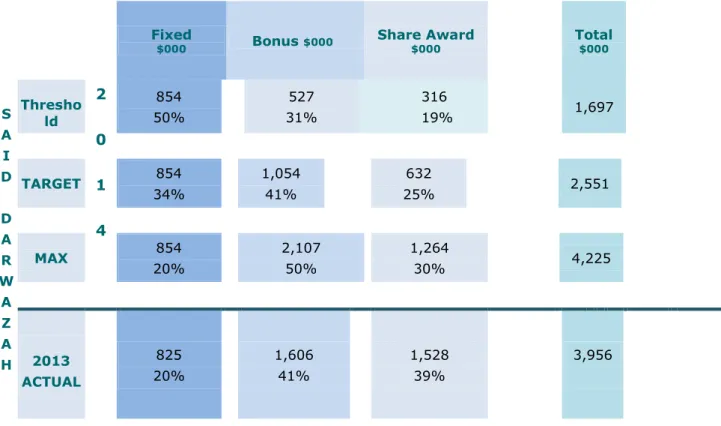
The following charts show the value of each of the main elements of the compensation package
provided to the executive directors during 2013 and the potential available for 2014 (dependent
upon performance).
Fixed
$000
Bonus
$000Share Award
$000Total
$000S
A
I
D
D
A
R
W
A
Z
A
H
Thresho
ld
2
0
1
4
854
50%
527
31%
316
19%
1,697
TARGET
854
34%
1,054
41%
632
25%
2,551
MAX
854
20%
2,107
50%
1,264
30%
4,225
2013
ACTUAL
825
20%
1,606
41%
1,528
39%
3,956
14
The information in the table above has been audited by Deloitte.
The following notes are applicable to the above calculations:
Salary, chairmanship fee, benefits and pension are fixed
Elements A and C of the EIP comprise the Bonus and element B comprises the Share
Award. The percentages of salary for each element are:
Performance Bonus
Share Award
Total Opportunity
Threshold
62.5%
37.5%
100%
Target
150%
100%
200%
Maximum
250%
150%
400%
For 2013 the Share Award comprises the LTIP vested during the year valued with the
share price at the vesting point.
Employment Conditions
The Committee ensures that employee’s remuneration across the Group is taken into consideration
when reviewing executive remuneration policy. There is a balance to be achieved with disclosure,
as this may give rise to ever greater remuneration demands increases across the whole of Hikma
and reduce the ability to reward for superior performance and in line with market practice. The
Committee reviews detailed internal data and is satisfied that the level of remuneration is
proportionate across the HR grades.
The pay of employees in the MENA region increased significantly during the year, chiefly as a
result of the Arab Spring. As the executive directors are based in this region, an element of this
rise was taken into account. The Committee does not directly consult employees on the policy
contained in this Report, but receives regular updates on employee feedback through the Group
HR department and the employee engagement survey which is conducted by an external
organisation and includes views on remuneration and other matters. However the Company does
not use any formal remuneration comparison measurements.
Fixed
$000Bonus
$000Share Award
$000Total
$000M
A
Z
E
N
D
A
R
W
A
Z
A
H
Thresho
ld
2
0
1
4
631
50%
389
31%
233
19%
1,253
TARGET
631
34%
775
41%
465
25%
1,872
MAX
631
20%
1,550
50%
930
30%
3,110
2013
ACTUAL
539
20%
1,078
41%
1,019
39%
2,646
15
The general policy is to ensure workers with lower levels of total remuneration have greater
certainty as to what they receive, whereas the compensation of executive employees is chiefly
based on performance related pay. This relationship is outlined below.
Salary
LowerQuartile
Chief Executive
Upper Quartile5% salary
increase
Salary
Performance
400% of salary
Worker
3% salary
increase
Salary
Perf
30% of salary
Upper
Quartile Median Quartile
Senior Management
The policy for senior management compensation is set in line with policy for the executive
directors, with a degree of discretion for the Committee to take into account particular issues
identified by the Chief Executive, such as the performance of a specific individual or business unit.
Management Incentive Plan
The 2009 Management Incentive Plan (“MIP”) was approved by shareholders at the 2010 Annual
General Meeting. The MIP operates on the same basis as Elements A and B of the EIP, other than
the MIP does not have a forfeiture threshold. The MIP is used widely to provide awards to
management across the Group below senior management level. Awards are subject to the
satisfaction of individual and group performance targets.
Performance Remuneration
The following table details the maximum performance remuneration available at each level within
the Group:
Maximum Award (% of salary) Element A
Cash Deferred Shares Element B Restricted Shares Element C
Executive Director 150 150 100 Executive Committee 100 100 100 Senior Management 75 75 - Management 50 50 - Other Employees 30 - -