Optimizing Business
Process Outsourcing –
Three Dimensions of Outsourcing Success
Quirijn van Engelen, Viktor Enlund & Arian Shwan
Supervisors: BUSM36 (ECTS 15)
Christer Kedström, PhD Master Thesis
Elisabeth Kjellström, CE Spring 2009
School of Economics
and Management
Lund University
‘Imagine the improvement in company performance – and in the economy as a whole – if all the energy expended in “pleasing the Street” were redirected toward the factors that create true economic value.’
Contact Information
School of Economics and Management, Lund University Department of Business Administration
Postal address:
PO-Box 7080, SE- 220 07 Lund, Sweden
Visiting address:
Ekonomicentrum, Tycho Brahes väg 1
Phone: +46-46-222 78 10
Fax: +46-46-222 44 37
Master Program:
Corporate and Financial Management
Program Director:
Niclas Andrén, PhD, [email protected]
Master Course:
BUSM36 – Degree Project in Corporate and Financial Management, D-Level
Course Professor:
Maria Gårdängen, PhD, [email protected]
Thesis Supervisors:
Christer Kedström, PhD, [email protected] Elisabhet Kjellström, CE, [email protected]
Thesis Authors:
Quirijn van Engelen, MSc, [email protected] Viktor Enlund, MSc, [email protected]
Abstract
Within inter-organizational relationships and governance the concept of risk management has become a key issue. The importance of generating and sustaining competitive advantage through inter-organizational relations has become more crucial, due to the emerging business model business process outsourcing (BPO). Nowadays, this business model facilitates companies’ attempts to improve and support their operational effectiveness and strategic position. Therefore, it is intended to elaborate if relational risk mitigation solely determines outsourcing success and how BPO engagements are optimized.
The outcome of this thesis will rest on the significance of relational risk mitigation to optimization of BPO efforts, which is approached through three case studies that incorporate different viewpoints. These perceptions represent the advisor perspective, the client perspective, and provider perspective that will triangulate the issues of BPO optimization and outsourcing success. We believe that looking beyond relational risk mitigation and contractual governance, and include integrated management control systems and strategic fit will result into a higher degree of outsourcing success and result in optimization of business process outsourcing.
Key words: Business Process Outsourcing, Optimization, Satisfaction, Operational Effectiveness, and Sustained
Preface
The presented thesis will answer for our Master’s dissertation at the Department of Business Administration within the School of Economics and Management, Lund University. This degree project in Corporate and Financial Management seeks to capture the very essence of Business Process Outsourcing from a strategic point of view, which gives insight in how outsourcing efforts are optimized.
The authors would like to acknowledge the representatives from the case companies for their valuable contribution in the form of qualitative interviews.
Extended acknowledgements are also given to our supervisors Christer Kedström, PhD, and Elisabeth Kjellström, CE, at the Department of Business Administration for their constructive discussions and insights throughout the process.
Lund, 29th of May 2009
Quirijn van Engelen
Viktor Enlund
Arian Shwan
Executive Summary
Course: BUSM36 – Degree Project in Corporate and
Financial Management
Level: Master, D-level
Title: Optimizing Business Process Outsourcing –
Three Dimensions of Outsourcing Success
Authors: Van Engelen, Q., Enlund, V. & Shwan, A.
Supervisors: Kedström, C. & Kjellström, E.
Statement of Purpose: The purpose of this thesis is to elaborate if relational risk mitigation solely determines outsourcing success and how BPO engagements are optimized. The intended outcome of this thesis will rest on the significance of risk mitigation to optimization of BPO efforts. Outsourcing perceptions that go beyond satisfaction may be in order to fully understand and grasp the nature of BPO optimization.
Research Questions: ✼✼✼✼Is solely relying on relational risk mitigation sufficient when optimizing business process outsourcing.
✼How are business process outsourcing efforts
Methodology: The research approach consists of three case studies that incorporate different viewpoints. The empirical data is derived from qualitative interviews with respondents that represent case study 1 the advisor perspective; case study 2 the client perspective; and case study 3 the provider perspective. The combined perceptions are intended to triangulate the issues of BPO optimization and outsourcing success.
Conclusion: Collectively viewing sustained competitive advantage, operational effectiveness, and satisfaction as the optimal outsourcing success means that outsourcing initiatives cannot solely focus on relational risk mitigation and contractual governance. Therefore looking beyond relational risk mitigation and contractual governance, and include integrated management control systems and strategic fit will result into a higher degree of outsourcing success and result in optimization of business process outsourcing.
Key Words: Business Process Outsourcing, Optimization, Satisfaction, Operational Effectiveness, and Sustained Competitive Advantage
Table of Content
I. Importance of Business Process Outsourcing ...11
1.1 Drivers of BPO Importance ...11
1.2 Optimization vs. Satisfaction ...13
1.3 Statement of purpose...14
1.4 Disposition ...14
II. Why Research Business Process Outsourcing ...15
2.1 Significance of Portraying BPO Reality ...15
2.2 Applied Research Approach ...16
2.3 Case Studies that Triangulate the Nature of BPO ...17
2.3.1 Case I – The Advisor Perspective ...19
2.3.2 Case II – The Client Perspective ...19
2.3.3 Case III – The Provider Perspective ...20
2.4 Qualitative Approach of Interpreting Existence ...20
2.5 Research Complications and Methodological Limitations ...21
III. Business Process Outsourcing ...22
3.1 Cliental Outsourcing Evaluation ...22
3.2 Providers Outsourcing Competency ...24
3.3 Business Value Creation as Outsourcing Outcome...26
3.4 Contractual Governance, Relational Quality and Outsourcing Success ...29
3.5 Measuring Relational Quality ...30
3.6 Mitigation of Outsourcing Risk through Relational Dimensions ...33
3.7 Issues of BPO Optimization ...35
4.1 Motives for Outsourcing ...39
4.2 Three Dimensions of Outsourcing Success...43
4.2.1 Dimension I – Satisfaction ...44
4.2.2 Dimension II – Operational Effectiveness...46
4.2.3 Dimension III – Sustained Competitive Advantage...48
4.3 BPO Optimization...50
V. The Reality of Business Process Outsourcing Optimization...51
5.1 Significance of Satisfaction as a Dimension of Outsourcing Success ...51
5.2 How to Optimize BPO Efforts ...52
5.3 Knowledge Contribution ...53
5.4 Future Research and Limitations ...53
References ...54
Appendix 1 – Case I: The Advisor Perspective...59
Appendix 2 – Case II: The Client Perspective ...70
Appendix 3 – Case III: The Provider Perspective ...77
Figures and Tables
Figure 3.1Complementary and contradictory perceptions of the RBV and TCE in outsourcing decisions ...23Figure 3.2 Twelve Capabilities of Outsourcing Providers...25
Figure 3.3 Achieving Innovation in an Outsourcing Relationship ...28
Figure 3.4 The Impact of Importance ...29
Figure 3.5 Perceived Service Quality...30
Figure 3.6 Relational Quality ...33
Figure 3.7 Relational Risk Mitigation...34
Figure 3.8 Effectiveness of Management Control Systems...36
Figure 3.9 The Three Dimensions of Outsourcing Success...38
Figure 4.1 Outsourcing Optimization and Outsourcing Success...50
Table 3.1 Scales for Measuring Service Quality ...31
Table 3.2 Conceptualization of Relational Quality ...32
Table 3.3 Strategic Fit Drives both Competitive Advantage and Sustainability...37
Table 4.1 Complementary and contradictory perceptions of the RBV and TCE in Outsourcing Decisions ...39
Table 4.2 Competencies of Outsourcing Providers ...41
I. Importance of Business
Process Outsourcing
The chapter will present the thesis’ problematical background in the course of describing the importance of BPO, which is narrowed down to the reason
for examining BPO optimization. This is then clarified within the statement of purpose and through our research question.
1.1 Drivers of BPO Importance
The extensive growth within the business process outsourcing (BPO) industry gives evidence that outsourcing has become increasingly important as an emergent business model. Inter-organizational relationships, such as business process outsourcing have become more intense and important in these last decades. With outsourcing and BPO we mean the following: breaking of large business processes from a company’s
value-chain, which are developed into independent entities with a client-provider relationship. The industry profile of the Global Data Processing and Outsourced
Services (2009) incorporates three industry segments, where 6.5 % represents electronic data processing (EDP), 50.4 % represents information technology outsourcing (ITO), and 43 % represents other business process outsourcing (BPO). The market value of the industry rose with 11.1 %, an increase from USD 365.1 billion in 2004 to USD 556.0 billion in 2008 (Global Data Processing & Outsourced Services 2009: 9-11). The appearance of this importance has become more visible due to the impact of the main drivers for this emerging business model. Globalization is one major contributor for the importance of inter-organizational dependency, thus resulting into inter-organizational relations becoming critical to achieve and maintain success. Fierce competition, customer shifts, and emerging markets have made outsourcing an important factor for corporations to position themselves differently, thus being more adaptable to changes through collaborations (Kraus & Lind 2007: 270-1). The increase in information technology development has changed information patterns and knowledge flows, resulting into rapid technological transformations, which is another driver for an intensification of inter-organizational relationships. This disables corporations to maintain in-house expertise and competitiveness through core-business activities because of lacking resources. Corporations are therefore motivated to outsource non-core activities so that resources could be reallocated to value adding activities instead (Kraus & Lind 2007: 271). The technical complexity of the products has also had its fair share on intensifying the importance of
inter-organizational relationships. This has given corporations the incentives to have closer ties with each other and jointly coordinating their efforts (Kraus & Lind 2007: 271-2).
BPO can improve and support a company’s operational effectiveness and strategy. As mentioned above, BPO is a rapidly growing business model between organizations that involves firms taking over other firms functional operations and providing them with benefits and advantages, which could not be achieved by providing it in-house. Operational effectiveness can be achieved through superior performance of similar activities compared to a company’s rivals, thus being able to utilize its resources better (Porter 1996: 61). Companies that outsource parts of their operations can gain operational effectiveness through: less expensive business process solutions; resources that can be allocated to core business processes; and superiority and effective performance (David 2007: 201). However, formulating a company’s
strategy the need of diversification becomes more significant (Porter 1996: 61-4).
Strategy means performing core activities differently than its rivals or performing similar activities in different processes: ‘Competitive strategy is about being different. It means deliberately choosing a different set of activities to deliver a unique mix of value’
(Porter 1996: 64). Strategically companies that engage in an inter-organizational relationship with a external outsourcing provider can gain advantages, such as: aligning with an expert provider that outperforms the special task; adaptation and flexibility towards shifts in customer needs; and most importantly concentrating on value creating activities that is critical to sustaining competitive advantage (David 2007: 201). Hence, a company that decides to outsource must be able to create a valuable position, which involve a different set of value adding activities.
1.2 Optimization vs. Satisfaction
Strategy should not only determine which activities to perform and how they are configured, but should also determine how activities are fit together. According to Porter (1996) this is because strategic fit drives both competitive advantage and sustainability. However, it can only be achieved when rivals have a complex system
of interlocked activities to match. A position that is built on a system of activities becomes harder for rivals to outmatch when the system rests on activities that are consistent, reinforcing and activities where efforts are jointly optimized. For instance, having a high coordination effort with external providers can eliminate the performance risks (Porter 1996: 70-4), which are often recognized when engaging an inter-organizational relationship with an external outsourcing provider.
Within inter-organizational relationships and governance the concept of risk management has become a key issue. This is due to the degree of involvement from external providers. Recent studies reveal that the relational dimension between a client and vendor is vital to outsourcing success, but can also mitigate risk and keep contracts mutually beneficial (Alpar & Saharia 1995; Aubert et al. 2005; Dibbern et
al. 2004; Klepper 1995; Lacity & Willcocks 1998, 2003; Lee & Kim 1999, 2003;
Willcocks et al. 2004; Willcocks et al. 1999; Willcocks & Lacity 1999; and Willcocks & Margetts 1994). However, the common denominator for measuring outsourcing success has been fulfilled within the academic field through the term ‘satisfaction’, thus meaning that: ‘(…) the level of fitness between the customer’s requirements and outsourcing outcomes’ (Lee & Kim 1999). The contradictory factor when measuring outsourcing success with satisfaction is that in some instances solvable decision problems that are complex in nature need optimal decisions. This means that when deciding on engaging in a BPO vendor it often rely on decisions that are optimal: ‘(… decisions) that maximizes the expected outcome’ (Encyclopædia Britannica 2009). It would therefore be of great significance within the studies of inter-organizational relationships and governance to elaborate on the significance of solely relying on relational risk mitigation to optimize BPO-engagements. The main theme within this thesis will be to contrast the optimization of BPO engagements and outsourcing success.
1.3 Statement of Purpose
The importance of gaining and maintaining competitive advantage through inter-organizational relations has intensified during the past decades. An emerging business model – BPO – has been composed to facilitate a solution to this effort that improves and supports a company’s operational effectiveness and competitive advantage. As
companies outsource whole business processes the risk of not achieving success becomes higher due to the degree of involvement from external outsourcing providers. It is therefore important to elaborate if relational risk mitigation solely determines outsourcing success and how BPO engagements are optimized. The intended outcome of this thesis will rest on the significance of risk mitigation to optimize BPO efforts. Applications of more elaborative models that go beyond satisfaction may be in order to fully understand and grasp the nature of BPO optimization. The statement of purpose is clarified in the following two research questions.
∗∗∗∗
Is solely relying on relational risk mitigation sufficient when optimizing business process outsourcing.∗∗∗∗
How are business process outsourcing efforts optimized?1.4 Disposition
Within this chapter we have now presented the thesis’ problematical background and statement of purpose, which has been clarified through our research questions. Next the thesis will put forward and present the methodological foundation and motivation of why research has been taken upon the field of inter-organizational governance. Afterwards, the theoretical framework will be presented where various theories, models and normative perceptions are clarified within the research of outsourcing and BPO. This is followed by the thesis’ analysis, which investigates motives for outsourcing and BPO optimization. Finally, the authors will present their main conclusions, knowledge contribution and limitations, followed by some suggestions on future research within the studies of inter-organizational relationships and governance.
II. Why Research Business
Process Outsourcing
This chapter will present why research is endured on the subject of BPO and how the research approach within outsourcing optimization is processed. Therefore a motivation on research significance and methods to take upon the research is augmented within this section.
2.1 Significance of Portraying BPO Reality
Influenced by the studies of corporate and financial management, we the authors were seeking a higher level of insight within the field of post-contractual (relational) governance within inter-organizational structures, such as those that are observable in outsourcing and BPO engagements. The considerable growth in the global data
processing and outsourced service-market and the emerging importance of the
business model had significance in the decision of choosing our research subject. Also previous academic experience and interest within the field of outsourcing in general resulted into the decision to deepen this knowledge.
After reviewing recent studies within the field that were relevant to our research theme it was founded suitable to decide on using these contemporary findings and examine if it had any bearing effect on the optimization of BPO engagements and outsourcing success. These new findings are referred to Wullenweber et al. (2008) research on mitigating outsourcing risk through relational dimensions and Blumenberg et al. (2009) research on the significance of contractual governance and its effect on relational quality and outsourcing success. The negligence to compute any considerations on how these findings may or may not optimize outsourcing and BPO outcomes incorporates the limitations of their research. Neither is aligning outsourcing success solely to cliental satisfaction sufficient enough. Not having any relation to operational effectiveness and sustained competitive advantage, which is created through integrated management control and strategic fit computes the credibility of their findings. This means that outsourcing efforts that only focus on satisfaction do not lead to operational effectiveness and sustained competitive advantage. Being the case outsourcing success cannot solely be relied on relational risk mitigation and contractual governance. The intention with examining this research subject is to portray the reality of the concepts and the models (see Lundahl & Skärvad 2009: 41) that is present within the field of BPO. Therefore
when researching the reality of BPO optimization we will be able to shed some light on outsourcing success.
2.2 Applied Research Approach
The research approach in our thesis is composed by an adductive relationship between
theory and empirics. Therefore defining what is treated, as theoretical and empirical
issues will be discussed first. According to Patel and Davidson (2003) the concept of experience can function as a synonym to empirics. Thus, what is characterized as empirical is the belief that knowledge is based on observing the reality (Patel & Davidson 2003: 18). The notion of theory is conceptualized as: ‘(…) a system of related concepts, which together portray an understanding. The theory exposes in which way the concepts are related to each other, which explains and foretells the understanding and the understanding of its significance’ (Translated from Patel & Davidson 2003: 22).
The configuration of integrating theory and empirics when choosing an adductive research process is therefore structured through both inductive and
deductive approaches. A deductive research process means that the research subject is
drawn from theory and confirmed by empirical findings when observing the reality (see Patel & Davidson 2003: 18, 22; Bryman & Bell 2005: 25; Bryman 2006: 22). Contemporary theories by Wullenweber et al. (2008) and Blumenberg et al. (2009) will be tested of their significance, when applied to companies’ attempts to generate and sustain competitive advantage. This is achieved through the construction of hypothesis that is related to the significance of relational risk mitigation. According to Patel & Davidson (2003) researchers can form a conducted investigation into a test of hypotheses if a problematic field is overwhelmed with theoretical knowledge. This will enable the following research to test if it constitutes a truthful description of reality. A hypothesis is: ‘(…) a linguistic proposition in which different concepts are related to each other’ (Translated from Patel & Davidson 2003: 20). By constructing a hypothesis, the approach can create an explanatory research by developing and testing propositions. Therefore this applied research approach or level of research is consistent with Carney’s (1990) Ladder of Analytical Abstraction. A research approach is sufficient if it is designed for testing a hypothesis and reducing the variety of the data for analysis of any tendency (Craney 1990; in Miles & Huberman 1994: 92). The thesis’ hypotheses are illustrated as followed.
∗∗∗∗
H0. Solely relying on relational risk mitigation is sufficient to optimize business process outsourcing.∗∗∗∗
H1. Solely relying on relational risk mitigation is not sufficient to optimize business process outsourcing.Nonetheless, the empirical findings are then tested if any disclosure can be done regarding the optimization of BPO engagements and outsourcing success. Thus, the inductive research process will be constructed through the integration where empirical observations of reality are exposed to explanations that foretell the understanding of BPO efforts, which result into the optimal outsourcing outcome (see Patel & Davidson 2003: 18, 22; Bryman & Bell 2005: 25; Bryman 2006: 22). This means that if the hypothesis H0. is rejected and H1. is confirmed, outsourcing success should not only incorporate one dimension, but also others. This way new knowledge will enable outsourcing parties to look beyond satisfaction as an outsourcing outcome.
2.3 Case Studies that Triangulate
the Nature of BPO
The strategy for applying our research approach is to study cases that facilitate conceptualized information on the outcome of outsourcing efforts and BPO engagements. Research that is based on case studies can be interpreted as:
‘investigation of a limited group. A case could be an individual, a group of individuals, an organization, or a situation’ (Translated from Patel & Davidson 2003: 54), which is also acknowledged by Lundahl and Skärvad (2003). However, their view on case studies is that the investigation only incorporates one or a few cases, which is or are, studied more in detail and with multiple dimensions (Lundahl & Skärvad 2003: 187). Three different representatives from three different organizations compose the case studies in this thesis. The representatives are chosen for their common interest for outsourcing and BPO, which is differentiated from their specific point of view and their organizations standpoint. These case studies are applied to gather the empirical material. To gain the empirical data, qualitative interviews have been chosen as the research method. This approach gains a deeper and more thorough knowledge base with a few respondents than other approaches, such as quantitative research methods e.g. questionnaire surveys. The main reason for choosing the empirical gathering
through qualitative case studies and in-depth interviews was to strengthen the relevant data from the respondents that facilitated conceptualized information that is embedded within the studied case companies modus operandi. Additionally the research method also enables the identification of concepts and patterns that are related to each different theoretical theme that are presented in the thesis. Meaning that focus on linguistic contexts of the gathered empirical data can be achieved, which constructs a tool that provides a higher possibility to investigate the subject in matter more deeply (Bryman & Bell 2005: 40).
Bearing in mind that every qualitative research is unique and may vary from one to another, Patel and Davidson (2003) recognize a general problem regarding validity. Problems can evolve within a qualitative approach when gathering information, analyzing information, communicating and presenting the result. The quality of validity is enhanced within a qualitative approach through the method of triangulation. Triangulation can be applied for gathering empirical data from various methods (Patel & Davidson 2003: 102-4). In some instances triangulated research strategies can result into contradictory results. Bryman and Bell (2005) present the two main arguments against a combined method strategy. First, there is a perception that different research methods are built on differing foundations. Second, there is a perception that quantitative and qualitative researches stand for different paradigms (Bryman & Bell 2005: 501). However, triangulation can create validity when research is applied to different empirical sources. Meaning that empirical data is gathered from different people, places or timeframes where the actual research subject is expressed (Patel & Davidson 2003: 104). Thus, using the same method fore the three different case studies, i.e. in-depth interviews, the effect of contradictory results from the triangulated approach is minimized. Validating the research from different empirical sources is another advantage when approaching the research question and the constructed hypothesis through a triangulated research strategy. Names omitted for privacy reasons, however short descriptions of the representatives in our case studies are presented next.
2.3.1 Case I – The Advisor Perspective
The advisor case company (Company A) is an organization of 70 associate firms that has a global reach and is operating in nearly 150 countries. Company A provides a
broad range of professional services including audit, tax, consulting and financial advisory services. The company provides its services to all major sectors and targets national and middle market enterprises, public institutions, privately owned companies and public sector organizations. The consulting division is engaged in providing services to clients across the world within strategy, operations, technology, human resources and outsourcing consulting services.
Company A’s representative that was interviewed (2009-05-07) is a Senior
Manager within the company’s subsidiary that is located in Stockholm, Sweden. The
representative has been a consultant for 10 years, where the representative has worked with shared services, outsourcing advisory, change issues and transformation
challenges regarding finance functions and with some focus on other business
processes. This expert representative has been chosen to facilitate the advisor perspective regarding outsourcing and BPO issues. Before working as a consultant the representative worked within finance related functions, such as a controller and other operational functions for major international companies. However, the representative has been with Company A since 2002.
2.3.2 Case II – The Client Perspective
The client case company (Company C) is the holding company for one of the world’s largest electronics companies and has subsidiaries in over 60 countries across Europe, Africa, North America and Asia Pacific. The company’s business is separated into three major segments, which are consumer electronics, medical systems, and lighting. Company C has also joint ventures and alliances with various companies around the world. The company was established in 1891 where the founder started manufacturing incandescent lamps and other electrical products.
Company C’s representative that was interviewed (2009-05-12) is a member of
the executive management board, which is located in the Amsterdam, Netherlands.
The representative joined Company C in 1973 and has worked for the company around the world in a number of key management positions. This expert representative has been chosen to facilitate the client perspective regarding outsourcing and BPO issues. The client representative entered the position in 2006, but is currently retired.
2.3.3 Case III – The Provider Perspective
The provider case company (Company P) is one of the leading providers of consulting and outsourcing services through a global delivery network of over 53 centers in the world. The company’s business is structured around five operating groups, which incorporates products, communications and high tech, financial services, resources, and public service. Company P has experience and capabilities across most of the industries, business functions and operates in more than 52 countries. Their offerings fall under three segments, such as consulting, systems integration and outsourcing.
Company P’s representative that was interviewed (2009-04-27) is Chief
Operating Officer for the System Integration and Technology organization at
Company P’s subsidiary located in Copenhagen, Denmark. The provider representative coordinate, assures project quality, and allocates resources to projects regarding IT consulting, application maintenance and application outsourcing issues. This expert representative has been chosen to facilitate the provider perspective regarding outsourcing and BPO issues.
2.4 Qualitative Approach of Interpreting
Existence
The research method to gather the empirical data, as previously mentioned by means of qualitative interviews, has been conducted in a semi-structured approach. This facilitates a combination of predetermined questions and spontaneous remarks relating to a respective subject. Further, the interviews will aspire to identify unfamiliar characteristics and phenomena on the subject (Kvale 1997: 36) of outsourcing and BPO. The aim of the interviews is to gather qualitative empirical data regarding if outsourcing success can or cannot solely be relied on relational risk mitigation and contractual governance. These interviews will enable us to shed some light on the nature of outsourcing success. Accordingly, this approach will give room for both the interviewer and the respondent to talk freely and come with insightful knowledge within the research subject (Bryman & Bell 2005: 363).
The qualitative empirical data must also be studied, interpreted and understood in a scientific manner. The perspective of hermeneutics or interpretivism enables researchers to understand other human beings and real situations through interpretation of existence that comes to exist in speech, script, human behavior, and
perception (Patel & Davidson 2003: 29; Bryman & Bell 2005: 29). This perspective will function as the fundamental foundation for qualitatively approaching the research subject and interpret its existence, which is primarily achieved through interpreting the subjective perceptions that are derived from the respondent’s interpretation of theoretical models, statements, and experiences during the interviews. Thus, resulting into a conceptualization of BPO and outsourcing that is aligned with the specific organizations opinion and their way to handling BPO in practice, thereby achieving significant level of objectivity.
2.5 Research Complications and
Methodological Limitations
In some instances a hermeneutic perspective can generate complications that are essential for the research process and the research outcome of this thesis. We as authors and researchers face complications regarding the mutual understanding of the theoretical models and statements in our interview discussions and sessions between the representatives and us. Complications can also arise when we interpret the interview respondent’s replies. Nevertheless, because of the importance to understand and interpret through a hermeneutic perception within a qualitative research approach (see Patel & Davidson 2003: 29; Bryman & Bell 2005: 29), we as researchers deliberately must interpret the existence in a truthful manner by understanding the interviews in the most reliable way as possible. To minimize these critical complications an open communication between the interview respondents and a consistent interpretation regarding outsourcing and BPO issues is needed. This is facilitated through conducting our interviews in a semi-structured manner (Bryman & Bell 2005: 363). Meaning that the open discussion with the representatives can straighten misunderstandings when conducting the interviews, thus resulting into the generation of insightful empirical data.
III. Business Process Outsourcing
In this chapter we will finish off with a discussion on relational risk mitigation and management control systems from a strategic point of view
to give a theoretical insight on what proportions BPO optimization is based on. Nevertheless, we will commence with the determinants that outsourcing decisions are based on and follow with measurements of outsourcing success.
3.1 Cliental Outsourcing Evaluation
Reasons to outsource are currently discussed from two influential theories,
transaction cost economics (TCE) and resource based view (RBV) (McIvor 2009).
The TCE-approach determines what constitute the most efficient governance structure from the properties of the transaction, such as BPO transactions between external outsourcing provider and outsourcing client. The focus on governance structure is mainly concerned with cost reducing mechanisms associated with contractual hazards, such as opportunism, rationality, and so forth, meaning that the BPO engagement is decided from a cost management point of view. The TCE-approach argues that the transaction specific cost should determine if an economic exchange is to be managed internally or externally. Conversely, it ignores the complexity of organizations through too narrow assumptions regarding asset specificity, uncertainty and frequency (Williamson 1975, 1979, and 1985). The RBV-approach acknowledges the firm as a collection of different resources, assets and capabilities that can create competitive advantage if engaged distinctively. The RBV-approach has been criticized for its lack in determining value creation and is often used for complementary means (Priem & Butler 2001: 36). However, according to the RBV, for resources to become the capability that creates competitive advantage it must meet a number of criteria. This will determine if the resources are to be managed inside or outside the company. The criteria that the resource or capability must match up to be valuable, rare, un-imitable and fit the organization (Barney 1995, and 2001). In some instances the different approaches can be contradictory, which is illustrated in the following figure.
Figure 3.1: Complementary and contradictory perceptions of the RBV and TCE in outsourcing decisions (Retrieved and customized from McIvor 2009: 61)
Superior
Contradictory
RBV – Perform Internally TCE – Outsource
Complementary
RBV & TCE – Perform Internally
Weaker
Complementary
RBV & TCE – Outsource
Contradictory
RBV – Outsource TCE – Perform Internally
Lower Higher
Res
o
urce Pos
ition
Potential for Opportunism
According to the presented figure, the following propositions are offered regarding outsourcing decision. If an activity in which an organization has a superior resource position and where there is lower potential for opportunism, the RBV-approach would prefer to manage the activity internally whereas the TCE-approach would more likely prefer to outsource the activity. If an activity in which an organization has a weaker resource position and where there is higher potential for opportunism, the RBV-approach would advocate outsourcing whereas the TCE-RBV-approach would advocate internal management of that specific activity. In some instances both theoretical approaches are complementary to each other. Both the RBV- and TCE-approach would advocate outsourcing if an activity in which an organization has a weaker resource position and a lower potential for opportunism. Conversely, both approaches would prefer internal management if an activity in which an organization has a superior resource position and higher potential for opportunism (McIvor 2009: 60).
The above argument puts forward valuable criterions for clients that are considering BPO-engagements. However, no elaborative context on how outsourcing providers can be capable to strategically fit with an outsourcing client is taken into consideration. Neither are propositions on how business value can be created through strategic fit in an outsourcing relationship given. Hence, a discussion on business value enablers within outsourcing is needed to fully understand the nature of
outsourcing relationships between clients and providers. First we will discuss on what kind of capabilities outsourcing providers must have in order to optimize their outsourcing competency.
3.2 Providers Outsourcing Competency
To understand external outsourcing providers’ competencies, regardless of their specific areas of expertise they withhold three main key areas. These are delivery,
transformation, and relationship (Feeny et al. 2005). Delivery competencies include
the external outsourcing provider’s response to outsourcing client’s demands and therefore expose their service scope and service complexity. Transformation competencies signify the level of the provider’s responsiveness to the client’s anticipation that the processes they outsource will advance and help improve their operational effectiveness. One crucial advantage that external outsourcing provider experience is the growing post contractual bargaining power that builds up over time, by increasing the dependency of the outsourcing relationship. This creates an importance of relationship competencies, which refers to the outsourcing provider’s willingness to maintain a good relationship that creates mutual beneficial pre-contractual agreements where the bargaining power is higher for the outsourcing client (Feeny et al. 2005: 42).
The normative proposition is that outsourcing client’s demands and conditions will determine what bundle of capabilities they are looking for. Depending on the degree of operational service needs, service improvement needs and long-term viability needs, outsourcing clients may select valuable capabilities or characteristics from the external outsourcing provider that will lead to different outcomes of the BPO. External outsourcing providers can incorporate twelve unique capabilities that differ in relevance for the client (Feeny et al. 2005: 43). These key competencies and relevant capabilities are presented in the figure 3.2.
Figure 3.2: Twelve Capabilities of Outsourcing Providers (Retrieved and customized from Feeny et al. 2005: 45)
The above figure illustrates the different capabilities that are necessary for outsourcing providers. Domain Expertise refers to the external outsourcing provider’s capability to apply and retain sufficient knowledge and skills of the target process that is required of the outsourcing client. Business Management is related to the provider’s capability to meet the service level of the agreement with the client and its own business plans. Behavior Management relies on the provider’s qualitative side, such as moral, motivational ability and people skills. Sourcing refers to the provider’s capacity to fill the resources required to meet the client’s targets. Technology
Exploitation is related to the ability of the provider in deploying technology to
improve and support outsourcing service targets. Process Re-Engineering relies on the provider’s ability to design and implement changes to the business process that meet the improvement targets of the client. Customer Development refers to capabilities that ease the client’s need of user-to-costumer transition, meaning that customers are developed in order to facilitate any transformation of competency, which requires relational criteria e.g. developing trust. Planning and Contracting is related to the external outsourcing provider’s relationship competency regarding the ability to develop and execute mutual beneficial contracts and business plans.
Organization Design relies on the capability to execute business plans through
to jointly (with the client) review, evaluate and take corrective actions regarding the outsourcing outcome. Program Management refers to the capability of the provider’s project management and their level of prioritization, coordination, and mobility that is required when looking into the long-term relationship. Regardless of the perceived
leadership context that is linked to governance capabilities more effective providers
exercise leadership in a more direct fashion (Feeny et al. 2005: 43-7).
Bundled together in different ways these capabilities will result into the provider’s competency that is specifically relevant to the client. However, propositions on how business value can be created through strategic fit in an outsourcing relationship are still required for understanding the nature of outsourcing relationships between clients and providers.
3.3 Business Value Creation as
Outsourcing Outcome
The reasons for outsourcing have shifted from a cost management perspective to a business value perspective (Weeks & Feeny 2008), resulting in strategic fit becoming more significant in outsourcing relationships than before. The view of external outsourcing providers being able to infuse external perspectives and new knowledge to clients that may contribute to creating business value, drive decisions regarding outsourcing issues. Value creation is for that reason a critical issue for most companies, which result into business value and competitive advantage. Potentially the quest of value and innovation is categorized and incorporates issues in
operational-, business process-, and strategic levels where value-adding outputs can
be formed. The optimal outcome is to create a better business through outcomes such as new business value, partnership development, and exploration of new ideas (Weeks & Feeny 2008: 130-5).
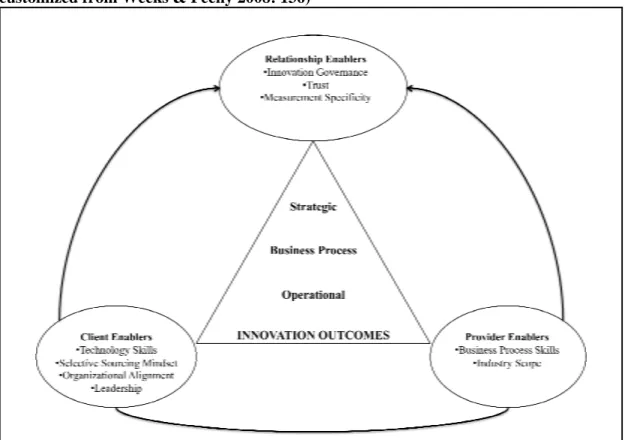
Understanding the key enablers of business value becomes an essential approach to determine outsourcing outcome. There are three critical enablers that determine the outsourcing outcome. These are client enabler, provider enabler and relationship
enabler. Client enablers are composed of different set of determinants for a successful
outsourcing outcome, such as technology skills (important to have a common base of prior related knowledge between partners, which is necessary for the transformation of new ideas), selective sourcing mindset (important to have the best breed of providers for an activity, thus enabling a client to recognize a portfolio of activities to decide from), organizational alignment (important to have a match between a specific business process and the corporate structure), and leadership (important to have a executive level of leadership to enable e.g. organizational alignment) (Weeks & Feeny 2008: 135-8).
Provider enablers are composed of two sets of categories, although basic ones, such as technology and management skills, and operational innovative applications are taken for granted. Business process design knowledge is important for the provider to create a platform so that prior related knowledge can result into a higher level of transformation regarding new ideas and innovation. Client-industry scope of the provider determines what external knowledge that is brought to innovation initiatives (Weeks & Feeny 2008: 139).
The relationship enablers are composed of three categories, such as a high
level of trust (important to have within an outsourcing relationship, both before and
after an outsourcing contract is signed creating personal trust, competence-based trust, and motivational trust becomes a critical issue), high levels of measurement specificity (important to have when monitoring detailed value adding activities), and effective
innovation governance (important to have when determining what ideas to invest in,
what processes should be used to mange implementation, and how success should be rewarded) (Weeks & Feeny 2008: 141-2). These key enablers of business value creation are important determinants for an outsourcing outcome, which is illustrated in figure 3.3.
Figure 3.3: Achieving Innovation in an Outsourcing Relationship (Retrieved and customized from Weeks & Feeny 2008: 136)
The figure highly illustrates how three key category sets of enablers determine outsourcing relationships potential to create innovations and business value. The relationship enablers are important factors for both client and provider that are engaged in a BPO, because it deliberately facilitates a level of alignment between clients and providers. First, the improvement of operational effectiveness is achieved through superior business process performance and superior operational performance. Second, it supports the strategy in ways where the outsourcing relationship results into the creation of business value through the alignment of reinforcing and optimizing activities. It could therefore seem that mitigating relational risk between organizations can improve and support key enablers from both parties when engaging in a BPO agreement. In doing so, a higher degree of outsourcing success can be experienced, due to the fact that all levels, such as strategic, business process, and operational outcomes are related to the quality of the relationship. However, we will therefore examine if relational risk mitigation solely is sufficient when striving to optimize the outsourcing outcome, later on in this chapter.
3.4 Contractual governance, Relational
Quality and Outsourcing Success
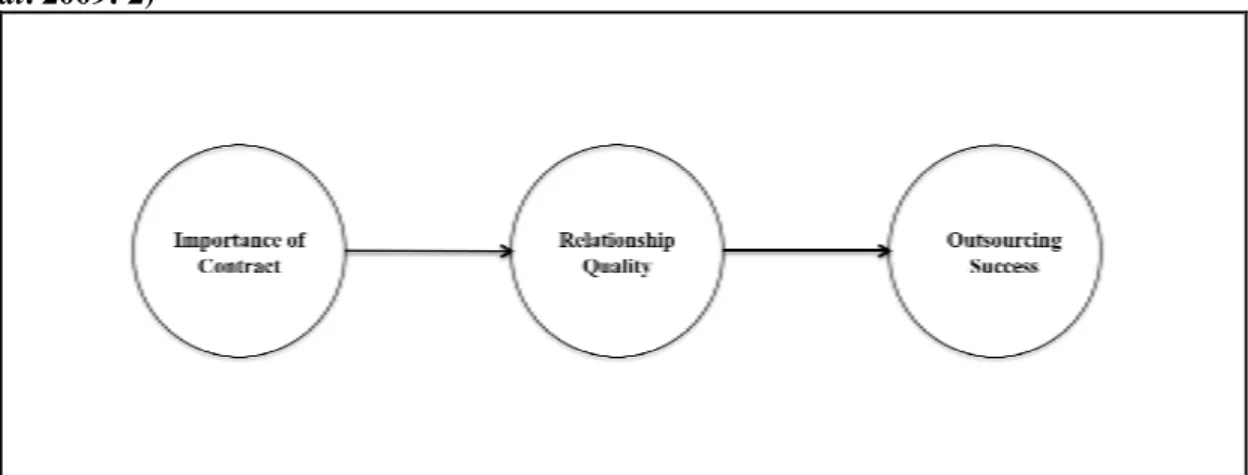
Until now we have conceptualized and elaborated on how outsourcing providers can be capable to strategically fit with an outsourcing client and how a mutual beneficial outsourcing relationship creates business value can result into a higher degree of outsourcing outcome. Nonetheless, it is important not to forget that pre-contractual agreements and contractual governance is important in BPO engagements. According to Blumenberg et al. (2009) the view on how important the outsourcing contract is will consequently determine the level of relationship quality. The relationship quality then determines how successful the outsourcing outcome will be. This triple correlation is illustrated in figure 3.4.
Figure 3.4: The Impact of Importance (Retrieved and customized from Blumenberg et
al. 2009: 2)
What is of importance in this recent study is that the quality of inter-organizational relationship have been related to the degree of outsourcing success and stipulates the importance of outsourcing has a positive impact on the quality of inter-organizational relationships (Blumenberg et al. 2009: 7-8). This does not mean that focus should either rest on contract design and governance, or on relationship development and governance, but rather cohesively considering how contractual issues will impact the outsourcing success through the level of relationship quality, which is indirectly formed when designing the contract.
A current report from Deloitte Consulting Outsourcing Advisory Services examined key dimensions of designing successful outsourcing. The proposed dimensions of that successful outsourcing design are concentrated in the following
five parts: rightsizing the deal; build a solid foundation; vendor selection now means something different; striking the deal; and after the deal is signed (Deloitte Development LLC. 2007: 7). The reports research overview is multi-sourced, meaning that outsourcing is analyzed through multiple perspectives, such as external outsourcing provider, outsourcing client, and outsourcing experts (advisors that have significant outsourcing knowledge). The last dimension that dealt with post-contractual agreements stipulates that problems within communications and relationship management were major factors that constrained outsourcing from becoming a competitive advantage for an outsourcing client. The proposed solution to this problem was to manage the relationship, monitor performance, and governance (Deloitte Development LLC. 2007: 23-5).
3.5 Measuring Relational Quality
When measuring the success of outsourcing multiple methods can be used to capture the outcome, such as realized outcomes, quantitative, economic, technological, and strategic dimensions (Lacity & Hirschheim 1993, Lacity & Willcocks 1998; and Grover et al. 1996). However, the common denominator for measuring outsourcing success has been fulfilled within the academic field through the term ‘satisfaction’, thus meaning that: ‘the level of fitness between the customer’s requirements and outsourcing outcomes’ (Lee & Kim 1999).
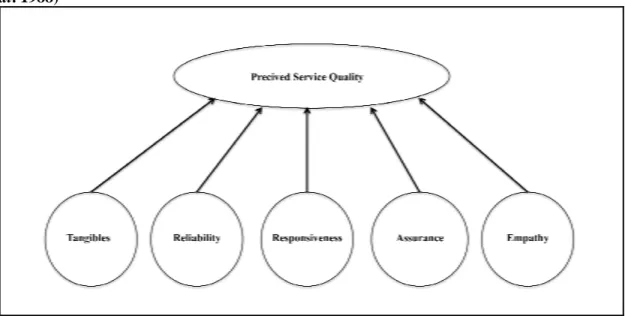
Figure 3.5: Perceived Service Quality (Retrieved and customized from Parasuraman et
According to Parasuraman et al. (1994) quality is measured through five major parameters, may it be outsourcing quality or service quality, which are displayed in the figure 3.5 and table 3.1. They state that service quality is also measured through satisfaction. This is composed by the service that is desired: ‘the level of service representing a blend of what customers believe “can be” and “should be” provided’, and the
adequate service: ‘the minimum level of service customers are willing to accept’ that is
expected. In between this zone of tolerance the performance that a customer would consider satisfactory is represented (Parasuraman et al. 1994: 202).
Table 3.1: Scales for Measuring Service Quality (Parasuraman et al. 1994)
Reliability
∗ Providing services as promised.
∗ Dependability in handling customers’ service problems.
∗ Performing services right the first time.
∗ Providing services at the promised time.
∗ Maintaining error-free records.
Empathy
∗ Giving customers individual attention.
∗ Employees who deal with customers in a caring fashion.
∗ Having the customer’s best interest at heart.
∗ Employees who understand the needs of their customers.
∗ Convenient business hours.
Responsiveness
∗ Keeping customers informed about
when services will be performed.
∗ Prompt service to customers.
∗ Willingness to help customers.
∗ Readiness to respond to customers’ request.
Tangibles
∗ Modern equipment.
∗ Visually appealing facilities.
∗ Employees who have a neat, professional appearance.
∗ Visually appealing materials associated with the service.
Assurance
∗ Employees who instill confidence in customers.
∗ Making customers feel safe in their transactions.
∗ Employees who consistently courteous.
∗ Employees who have the knowledge to answer customer questions.
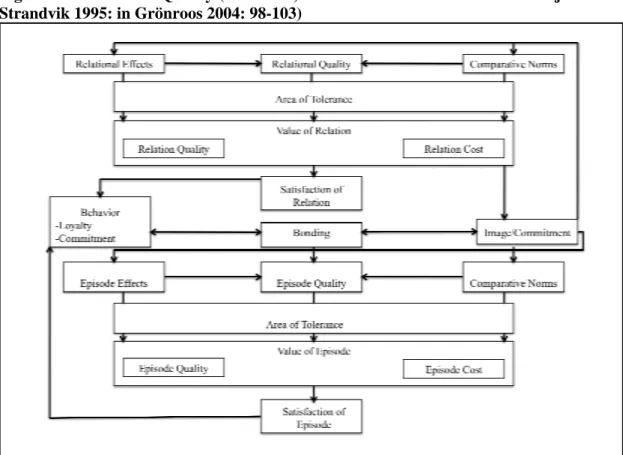
However, to capture the relational quality different models, and more longitude measurements must be taken into consideration. Liljanders and Strandviks (1995) model for relationship quality has four main characteristics (see figure 3.6. and table 3.2). First, it distinguishes between levels of interaction episode quality and levels of relational quality. Second, it comprises client satisfaction and the client’s experience of value within a quality frame. Third, it enables an expansion of the traditional verification concept that is used in statistical models of perceived quality, thus including an amount of comparative norms. Finally, it takes client behavior into consideration (Liljander & Strandvik 1995: in Grönroos 2004: 98-103).
Table 3.2: Conceptualization of Relational Quality (Translated from Liljander & Strandvik 1995: in Grönroos 2004: 98-103)
Concept Episode Relation
Comparative Norm ∗ All comparative norms. ∗ All comparative norms except of
predictive expectations.
Conformation ∗ Direct or indirect recognition
of the comparative norms.
∗ Direct or indirect recognition of the comparative norms except of predictive expectations.
Effect ∗ Experienced outcome of
episode.
∗ Experienced outcome of relationship.
Area of Tolerance ∗ Acceptable variety of
performance. Quality measurement.
∗ Total acceptable of service effect in the relationship.
Cost ∗ Perceived costs at level of
episodes compared with explicit comparative norm.
∗ Perceived cost of total episodes compared with explicit
comparative norm.
Value ∗ Episode quality compared to
episode costs.
∗ Relational quality compared to relational costs.
Satisfaction
∗ Client’s cognitive and emotive judgment of subjective experience of episode.
∗ Client’s cognitive and emotive judgment of subjective experience of total episode.
Image ∗ Holistic view of service supplier; filtering the performance and the
comparative norms. It also influences the component of attitude regarding commitment or engagement within a relation. All kind of bonding factors can color the firm positively and negatively. In particular the psychological bonding.
Commitment ∗ Refers to both parties’ intentions and purpose for engagement; and their
attitude toward their mutual inter play.
Behavior ∗ Client behavior and communication behavior (rumors, complains etc.).
Loyalty that is based on the client’s positive commitment is interpreted as having a strong relationship instead of basing it on continuing purchases. The bonding between provider and client also affects the behavior within the relationship. Using the same provider strengthens the bond between them.
Bonding ∗ Barriers that bonds a client to a provider, thus also establish the
relationship. Bonding can take the form of legal, economical, technological, geographical, time based, knowledge based, social, cultural, ideological, and psychological.
Figure 3.6: Relational Quality (Retrieved, customized and translated from Liljander & Strandvik 1995: in Grönroos 2004: 98-103)
Reviewing the measurements of the outsourcing outcome both from a service quality and relational quality perspective the conceptualization of outsourcing success, as means of satisfaction is sufficient. However, this more complex model has been disregarded within research of outsourcing satisfaction within inter-organizational relationships. This is mainly referred to the research conducted by Wullenweber et al. (2008) and Blumenberg et al. (2009). Their research is conducted through scales of service quality and not relational quality, which means that episode quality is measured instead of longitude measurements that represents relational quality more accurate.
3.6 Mitigation of Outsourcing Risk
through Relational Dimensions
Resent research show that relational processes can create risks that are critical for the outcome of outsourcing initiatives. This is an important factor for companies when deciding on BPO engagements. Previously stated, the concept of risk management has become a key issue within inter-organizational relationships, due to the degree of
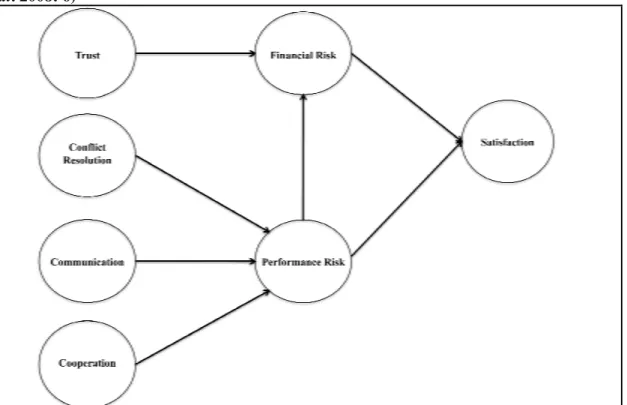
involvement from external providers. In this thesis the broad definition of risk will be used meaning that: ‘risk is understood as the potential for a negative outcome due to uncertainty about future developments, that has a known or estimated probability of occurrence’ (Wullenweber et al. 2008: 2). Many researchers suggest that relational dimensions between a client and vendor are vital to outsourcing success, which also can mitigate the risks and keep contracts mutually beneficial. These risks can either be categorized as financial risk or performance risk. According to Wullenweber et al. (2008) financial- and performance risk is mitigated through four relational dimensions. It is supposed that high level of trust diminishes the financial risk of the outsourcing engagement. To mitigate performance risk conflict resolution,
communication, and cooperation are significant factors, but are not equally important
when mitigating the risk in matter. Conflict resolution is particularly vital to performance risk mitigation (Wullenweber et al. 2008: 4-6). When mitigating outsourcing risk (financial and performance) through relational dimensions, it is believed that a higher level of satisfaction will be perceived and experienced by the client (see figure 3.7).
Figure 3.7. Relational Risk Mitigation (Retrieved and customized from Wullenweber et
However, according to Van der Meer-Kooistra and Vosselman (2000) parties should share risks by making joint investments to prevent opportunistic behavior during a cooperation in which companies have a close relationship to each other. Companies may also find ways to share gain or loss of any improvement or deterioration of the transaction and so reduce the risks of opportunistic behavior (Van der Meer-Kooistra & Vosselman 2000: 55) that affects the degree of financial risk and performance risk.
3.7 Issues of BPO Optimization
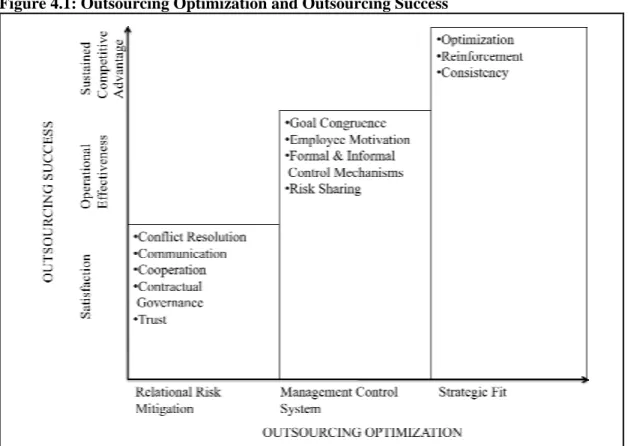
It is therefore alleged that assessing BPO-engagements that both consider pre-contractual governance and post-pre-contractual (relational) governance is essential if satisfaction is a desired outcome of an effort. Therefore efforts that diminish outsourcing risk will result into reduced complications when engaging in an inter-organizational relationship. However, this does not mean that diminished risk results into an optimal outsourcing outcome. If outsourcing optimization is a desired result, an outsourcing relationship should go beyond satisfaction measurements and also focus on management control and strategic fit.
Management control systems (MCS) will enable performance efficiency and
activity monitoring, which helps organizations to achieve their objectives. Control is some what described as: ‘Application of policies and procedures for directing, regulating and coordinating production, administration and other business activities in a way to achieve the objective of the enterprise’ (Otley & Berry 1980: 232). With MCS the ability to adapt to external changes; face the increased complexity within the organization; minimize the fallibility of organizational members; and filling managements need to delegate authority. However, there are some common attributes that an effective MCS should demonstrate. These factors are demonstrated in figure 3.8. Designing a superior management control systems that is aligned to business processes will result into effectiveness (Hoque 2003: 50-2; Anthony & Govindarajan 2007: 98-104). Meaning that operational effectiveness can be achieved through superiority in performance, such as being able to utilize its resources better than rivals (Porter 1996: 61).
Figure 3.8. Effectiveness of Management Control Systems (Retrieved and developed from Hoque 2003: 50-1)
According to Porter (1996) operational effectiveness can only improve the performance of organizations while generating and sustaining competitive advantage will only result from superior strategy formulation and position (Porter 1996: 61-4). Strategy means performing core activities differently than its rivals or performing similar activities in different processes: ‘Competitive strategy is about being different. It means deliberately choosing a different set of activities to deliver a unique mix of value’
(Porter 1996: 64). However, for a strategy to be successful the internal environment of a firm (goal and values, resources and capabilities, and structure and systems) must be consistent with the firm’s external environment. This brings us to the notion of
strategic fit and the basic framework for strategy, which is a link between the firm
and its external environment, e.g. including suppliers, providers and much more (Grant 2008: 13). Strategically companies that engage in an inter-organizational relationship with a external outsourcing provider can gain advantages, such as: aligning with an expert provider that outperforms the special task; adaptation and flexibility towards shifts in customer needs; and most importantly concentrating on value creating activities that are critical to sustaining competitive advantage (David 2007: 201).
As mentioned in the first chapter strategy should not only determine which activities to perform and how they are configured, but should also determine how activities are fit together.
Table 3.3. Strategic Fit Drives Both Competitive Advantage and Sustainability (Retrieved from Porter 1996: 70-2)
Strategic Fit
First-Order Fit ∗ Business activities and processes that are consistent among
each other within a value-chain.
Second-Order Fit ∗ Business activities and processes that are reinforced
among each other within a value-chain.
Third-Order Fit ∗ Business activities and processes that are optimized among
each other within a value-chain.
This is because strategic fit drives both competitive advantage and sustainability. However, it can only be achieved when rivals have a complex system of interlocked activities to match. A position that is built on systems of activities becomes harder for rivals to outmatch when the system rests on activities that are consistent, reinforcing and activities where efforts are jointly optimized (see table 3.3). For instance, having a high coordination and information exchange effort with external suppliers and providers can also eliminate the risks of unsuccessful outcome (Porter 1996: 70-4), within an inter-organizational relationship.
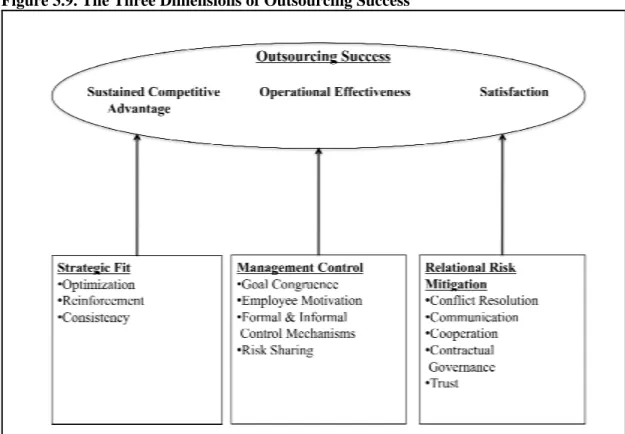
The interpretation is that sustained competitive advantage, operational effectiveness, and satisfaction collectively is the optimal outsourcing success. Instead of solely focusing on relational risk mitigations and pre-contractual governance, both outsourcing parties should include satisfaction but also look beyond it. This means that outsourcing success should incorporate three dimensions instead of only one, which is illustrated in figure 3.9.
Figure 3.9. The Three Dimensions of Outsourcing Success
IV. Optimization of Business
Process Outsourcing
In this chapter we will look deeper into the different outsourcing perspectives of selected outsourcing theory. This is related to the empirical data retrieved through conducted case studies of advisor, client, and provider perspectives. The combined perceptions are intended to triangulate the issues of BPO optimization and outsourcing success.
4.1 Motives for Outsourcing
‘(…) many organizations attempt to actively inject new perspectives by bringing the outside in’ (Hargadon 2003: 84)
According to McIvor (2009) motives for outsourcing – bringing the inside out – can be evaluated through two influential theories within the academic field of economics and management. The theories referred to are transaction cost economics (TCE) and
resource based view (RBV). As mentioned earlier these theories can in some
instances become contradicting and in other instances become complimentary. For clarification purposes these different situations are illustrated in table 4.1.
Table 4.1: Complementary and contradictory perceptions of the RBV and TCE in outsourcing decisions (Retrieved and customized from McIvor 2009: 60-1)
Resource Position
Potential for Opportunism
Differentiating results of outsourcing evaluation
Superior Lower ∗ The RBV-approach would prefer to manage the activity
internally whereas the TCE-approach would prefer to outsource the activity.
Weaker Higher ∗ The RBV-approach would advocate outsourcing whereas the
TCE-approach would advocate internal management of that specific activity.
Weaker Lower ∗ Both the RBV- and TCE-approach would advocate
outsourcing.
Superior Higher ∗ Both the RBV- and TCE-approach would prefer internal
Advisor perspective: Company A distinguishes that the main reason for outsourcing is
referred to as attempts of cost reduction. Through global research conducted by Company A, approximately 70 % of companies are recognized as engaging in outsourcing solutions for cost reduction reasons. Another reason is to leverage a certain technology, thus being able to increase effectiveness and improve processes with more enhanced technologies, but also to standardize an activity or a business process across a corporate group, in an attempt to become more consistent or transparent. A last critical issue that is becoming increasingly apparent within outsourcing deals is that companies want to optimize their processes and create effectiveness within their operations (Outsourcing Advisor Representative 2009).
Client perspective: Company C has exercised outsourcing efforts differently in
different divisions, some more than others, within the organization. Company C’s representative states that outsourcing becomes an important issue if the external provider has superior capabilities compared to your in-house capabilities (Outsourcing Client Representative 2009).
Provider perspective: Company P recognizes several different reasons for
companies when conducting outsourcing engagements. Most companies that engage in outsourcing efforts are looking at outsourcing as a solution for cost savings. Another reason for similar efforts in some cases is to gain control over a specific business process. Although this may initially seem like a paradox, the increase of control is caused by the larger number of levers you can pull in an outsourcing contract compared to internal leverage. Finally, outsourcing efforts can be engaged if the management of a client wants to focus attention on the core business activities (Outsourcing Provider Representative 2009).
Viewing the three different perspectives evidently acknowledges that outsourcing engagements becomes an effort if a company has a weaker resource position. This is mainly considered with the ambition of outsourcing attempts being motivated by leveraging a specific technology, rationalizing resource allocation, gain control, consistency, transparency or efforts of optimization, which is not achievable when doing it in-house. This means that a company who is considering outsourcing efforts is likely to engage if there are limited resources to perform that function or process effectively in-house. However, companies are not to forget issues regarding opportunism, if higher resource positions are desired outcomes within an outsourcing deal. This will be discussed later on in the chapter.