Final Report Spring 2020
Septal Closure Device
Kai Harrison, Hillal Jarrar, Olivia Welch
Executive Summary
The septal closure device was designed to seal defects in the atrial septum. To fully seal an atrial defect, the device was designed to consist of two circular seals to cover the defect in both the right and left atria, attached with a central rod. The materials were chosen for compressibility (for ease of insertion), biocompatibility, and tissue ingrowth. A CAD model was drafted in SolidWorks. Key
customer requirements include ease of implantation (specifications: adjustable sizing and clear directions for use), physician controlled (specifications: short implantation time and compatibility with current catheter/scope techniques), and a long lifetime (specifications: materials that will not excessively degrade over time and material will become ingrown in endothelium). Key data that demonstrates functionality is plastic deformation not exceeding 1 mm after 2E9 cycles, no adverse reactions with the native tissue, and becoming ingrown with the native tissue.
Statement of Work
I. EXECUTIVE SUMMARY
This Statement of Work outlines the prevalence of need for a septal closure device and the current products available. The objectives for the new product are described and the plan for product development is described.
II. INTRODUCTION / BACKGROUND
200,000 cases of atrial septal defects are diagnosed in the United States every year [1]. An atrial septal defect occurs when the foramen ovale fails to close after birth. This results in deoxygenated blood in the patient, as blood continues to bypass the lungs after birth. There are multiple devices currently on the market to treat these defects, such as the Amplatzer septal occluder (ASO), Figulla Flexible Occlutech septal occluder (FSO), and many other similar devices [2]. Current devices come with possible complications, such as thrombus formation, air embolization, device embolization, erosions, residual shunts, and nickel hypersensitivity. The issue of septal defects will continue to need to be treated; as a result, new and improved techniques and devices need to be developed.
III. OBJECTIVES
The septal closure device aims to provide a way to close the atrial septum of the heart in patients recovering from septal crossing procedures and/or suffering from atrial septal birth defects. The device should be able to be controlled by physicians throughout the implantation procedure, and be easy to use and understand. The implant post implantation should demonstrate effectiveness in preventing blood from overfilling in the lungs and heart. The device should be able to become ingrown in the endothelium tissue.
IV. PROJECT MANAGEMENT
V. CONCLUSION
The aim of this project is to develop a septal closure device that is controllable by physicians during implantation and becomes ingrown in the endothelium tissue. This Statement of Work will be followed by an analysis of quality specifications with the House of Quality and with the conjoint analysis, later this week. A project planning meeting will be conducted with Dr. Whitt, next week.
VI. REFERENCES / WORKS CITED
[1] “Atrial Septal Defect (ASD),” Mayo Clinic, 2020.
[2] N. Bissessor, “Current perspectives in percutaneous atrial septal defect closure devices,” Medical Devices, Auckland, July 15, 2015.
VII. APPENDICES Design Requirements:
1. Time to Implantation 2. Lifetime
3. Biocompatibility/Thrombogenicity
Indications for Use
The septal closure device is indicated for relief of an opening in the atrial septum in patients recovering from septal crossing procedures and/or who are born with septal defects. Qualifying patients are examined by a team of physicians, including a cardiovascular surgeon, to be determined fit for the device.
Network Diagram
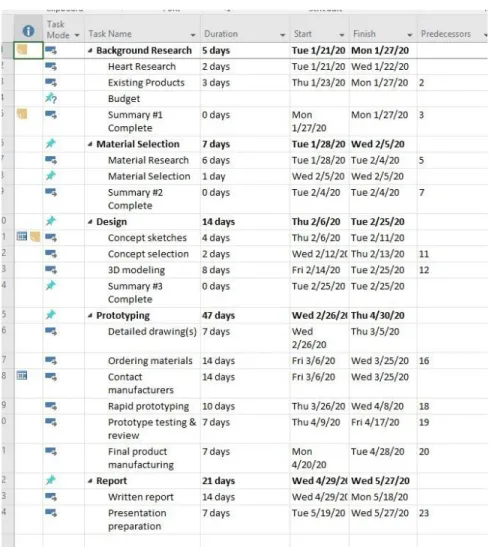
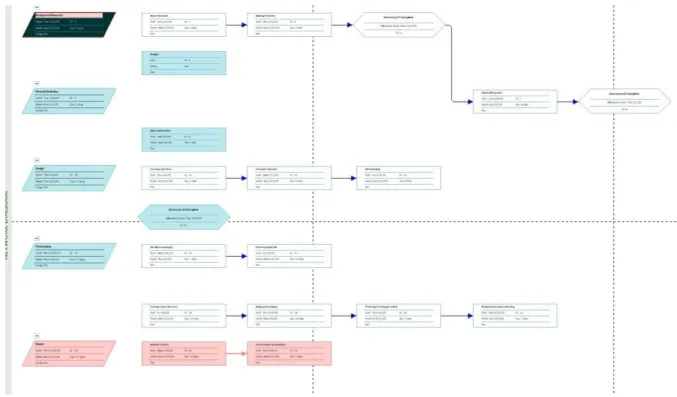
● This project is planned over the span of two quarters
Figure 2. Network Diagram Project Plan Modifications:
Nitinol scaffolding will be prototyped in week one of Spring quarter. The original plan was to prototype the scaffolding with a more available metal such as aluminum or steel. However, the Hannah-Forbes Fund will make a more advanced prototype possible.
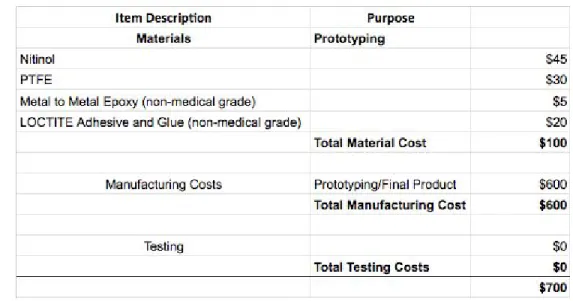
Budget
Figure 3. Budget spreadsheet for septal closure device taken from Microsoft Excel
Modifications:
The following prices of scaffolding and tissue integrator materials were obtained:
● Nitinol Scaffolding- 14.99 USD per 5 feet of 1 millimeter diameter wiring (amazon.com)
● PTFE Tissue Integrator- 4.70 USD per 9 square feet (eplastics.com)
Customer Requirements/Specification Development Table 1.Engineering Specifications
Factor Specification 1 Specification 2
Easy Implantation Adjustable sizing Straight forward directions for use
Physician Controlled Short implantation time Compatible with current catheter/scope techniques
Long Lifetime Materials that will not excessively degrade over time
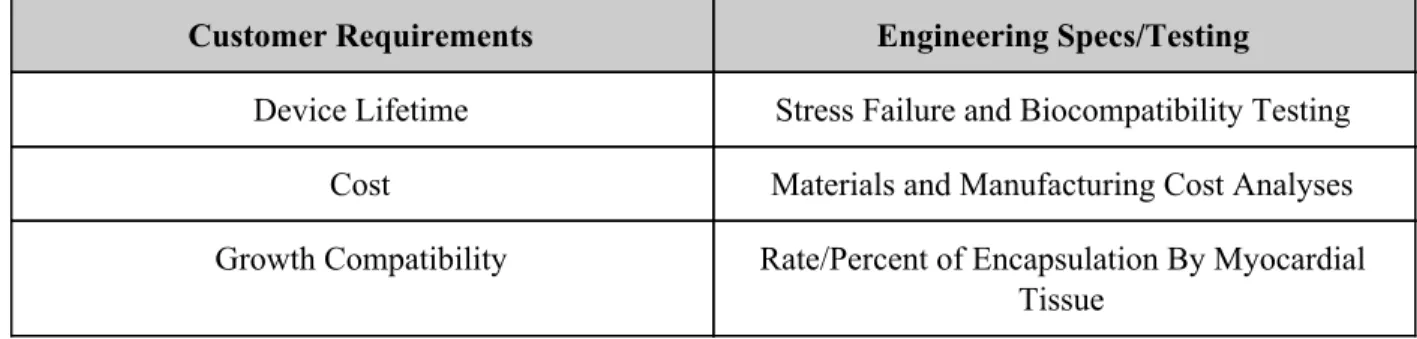
Table 2. Customer Requirements related to engineering specification
Customer Requirements Engineering Specs/Testing
Device Lifetime Stress Failure and Biocompatibility Testing
Cost Materials and Manufacturing Cost Analyses
Growth Compatibility Rate/Percent of Encapsulation By Myocardial Tissue
Table 3. Engineering Specifications Targets and Importance
Engineering Specs Targets and Importance
Stress Failure Must Withstand 40mmHg Pressure for simulated 100 years
Cost Target: ≤$250 per unit
Growth Compatibility Target: ≥75% encapsulation
TAM and Competitive Advantage
The global revenue for atrial septum closure devices is estimated to be about $93M (Marketwatch.com). The global average device cost is about $8000 (USD) (Marketwatch.com). Based on these statistics and the estimated prices of our device, our annual revenue is estimated to be about $2.9M assuming total control of the global market. After researching existing products, we came to the realization that our price estimates are grossly undervalued compared to the existing market and we will be revisiting the financial projections of our device.
Modifications: A recent report from Marketwatch.com indicates that the market is currently valued at $600 million and will reach $1.2 billion by 2025.
Intellectual Property Assignment Three issued patents:
1. Methods and systems for endovascularly clipping and repairing lumen and tissue defects a. Pulsar Vascular, Inc.
Potential Patent Infringements:
catheter, the implantable device comprising: a closure structure sized to substantially cover the opening or cavity, the closure structure comprising a convex surface facing the target tissue defect and an opposing concave surface facing away from the target tissue defect; and a first and second set of anchoring structures extending in substantially opposite directions from the closure
structure, the set of anchoring structures comprise a generally atraumatic single looped structure extending beyond a perimeter of the closure structure when the device is in a deployed condition and capable of engaging tissue above the opening of the tissue defect, wherein the looped
structures of the first and second set of anchoring structures have a diameter larger than that of the closure structure when the implantable device is in the deployed condition; wherein the
implantable device is positioned in a lumen in the distal end of the delivery catheter.
○ To avoid infringement, design an interface between the device and the target tissue that is different from the description in the highlighted region, above.
● A delivery system of claim 1, wherein the delivery catheter further comprises one or more radiopaque markers.
○ To avoid infringement, use a different form of markers.
http://patft.uspto.gov/netacgi/nph-Parser?Sect1=PTO2&Sect2=HITOFF&p=1&u=%2Fnetahtml%2FPTO %2Fsearch-bool.html&r=1&f=G&l=50&co1=AND&d=PTXT&s1=%22septal+closure%22&OS=%22se ptal+closure%22&RS=%22septal+closure%22
2. Septal closure device with centering mechanism a. W. L. Gore & Associates, Inc.
Potential Patent Infringements:
● An occluder having an elongated configuration and a deployed configuration, the occluder comprising: a proximal end, a distal end, and a plurality of struts extending therebetween; a proximal section formed by proximal portions of the plurality of struts, the proximal portions of the plurality of struts forming a plurality of proximal loops, each of the plurality of proximal loops overlapping with adjacent ones of the plurality of proximal loops at single discrete locations in the deployed configuration; a distal section formed by distal portions of the plurality of struts, the distal portions of the plurality of struts forming a plurality of distal loops, each of the plurality of distal loops overlapping with adjacent ones of the plurality of distal loops at single discrete locations in the deployed configuration; and a central section arranged between the proximal section and the distal section formed by curved central portions of each of the plurality of struts wherein the curved central portions are non-overlapping in the deployed configuration and the plurality of struts are unbraided in the elongated configuration and in the deployed configuration.
○ To avoid a patent infringement, design an occluder with a different order of struts as described above.
● The occluder of claim 1, wherein the central section includes an external diameter greater than an external diameter of the proximal end and the distal end in the deployed configuration.
http://patft.uspto.gov/netacgi/nph-Parser?Sect1=PTO2&Sect2=HITOFF&p=1&u=%2Fnetahtml%2FPTO %2Fsearch-bool.html&r=2&f=G&l=50&co1=AND&d=PTXT&s1=%22septal+closure%22&OS=%22se ptal+closure%22&RS=%22septal+closure%22
3. Patent foramen ovale (PFO) closure device with linearly elongating petals a. W.L. Gore & Associates Inc.
Potential Patent Infringements:
A device for occluding a defect in a body, the occluder comprising: an occluder body that is
reconfigurable between an elongated tubular cylindrical delivery configuration and a shortened deployed configuration, the occluder body comprising a plurality of filaments, each filament of the plurality of filaments comprising (i) a proximal end portion, (ii), a distal end portion, (iii) a central portion disposed between the proximal end portion and the distal end portion, (iv) a proximal free segment disposed between the proximal end portion and the central portion, and (v) a distal free segment disposed between the central portion and the distal end portion, the proximal end portion of each filament of the plurality of filaments being bonded together and aligned to form the proximal end portion and defining a generally tubular cylindrically shaped joint, the central portion of each filament of the plurality of filaments being bonded together and aligned to form the central portion and defining a generally tubular cylindrically shaped joint, and the distal end portion of each filament of the plurality of filaments being bonded together and aligned to form the distal end portion and defining a generally tubular cylindrically shaped joint, wherein, when the occluder body is in the deployed configuration, the proximal free segment of each filament of the plurality of filaments forms a proximal loop, and the distal free segment of each filament of the plurality of filaments forms a distal loop, wherein each of the proximal loops of each filament of the plurality of filaments overlaps with adjacent proximal loops of the plurality of filaments at a discrete location within an occlusive proximal face formed by the proximal loops, wherein each of the distal loops of each filament of the plurality of filaments overlaps with adjacent distal loops of the plurality of filaments at a discrete location within an occlusive distal face formed by the distal loops, wherein the occlusive distal face and the occlusive proximal face cooperate to occlude the defect and wherein each filament of the plurality of filaments comprises a discrete wire.
● The device of claim 1, wherein a first filament of the plurality of filaments has a semi-circular cross-section.
○ To avoid a patent infringement, design device so that the plurality of filaments does not have a semi-circular cross-section
● The device of claim 1, wherein, when the occluder body is in the deployed configuration, each of: (a) the proximal end portion, (b) the central portion, and (c) the distal end portion are generally coaxially aligned with a longitudinal axis of the occluder body.
● The device of claim 1, wherein a first filament of the plurality of filaments is coated with a therapeutic agent.
○ To avoid patent infringement, coat filaments with a different therapeutic agent.
Three patent applications:
1. Trans-Septal Closure Device a. Edwards Lifesciences
Potential Patent Infringements:
● “ An implantable closure device comprising: a self-expanding metal frame comprising a central portion defining a lumen and a plurality of first anchoring arms and a plurality of second anchoring arms angularly spaced around the central portion;”
○ Use a different general design and different material
http://appft.uspto.gov/netacgi/nph-Parser?Sect1=PTO2&Sect2=HITOFF&p=1&u=%2Fnetahtml%2FPTO %2Fsearch-bool.html&r=45&f=G&l=50&co1=AND&d=PG01&s1=septal&s2=closure&OS=septal+AN D+closure&RS=septal+AND+closure
2. Catheter Atrial Septal Closure Device a. TAVR Solutions, LLC
Potential Patent Infringements:
● “An apparatus for occluding a bodily passageway, the apparatus comprising: a structure comprising a shape-memory metal alloy; and a membranous material attached to the structure; wherein the structure is adapted to be deployed adjacent to the bodily passageway; wherein the structure is adapted to sealingly engage the bodily passageway.”
○ Use a different material and a possible different technique for the device to attach to the endothelium (this patent is very general as it isn’t specific to the heart only)
● …”wherein the securing region defined by the occlusion device sealing engages the bodily passageway.”
3. Trans-Septal Closure and Port Device a. Edwards Lifesciences
Potential Patent Infringements:
● “A septal closure and port device for implantation in an atrial septum of a patient's heart, comprising: an expandable frame comprising a central portion defining a lumen, and first and second opposing end portions extending from opposite ends of the central portion, the frame configured to expand and contract between a compressed, tubular configuration for delivery through the patient's vasculature and an expanded configuration…”
○ Introduce a new design; may have similar features as it is performing the same general function, but work towards a unique design.
● “...comprising fabric strips covering outer peripheral edge portions of the flanges to induce tissue in-growth with the covered portions of the flanges.”
○ Be very specific with how we plan to have our device grow within the tissue; is there more than one technique?
http://appft.uspto.gov/netacgi/nph-Parser?Sect1=PTO2&Sect2=HITOFF&p=3&u=%2Fnetahtml%2FPTO %2Fsearch-bool.html&r=119&f=G&l=50&co1=AND&d=PG01&s1=septal&s2=closure&OS=septal+AN D+closure&RS=septal+AND+closure
Conjoint Analysis
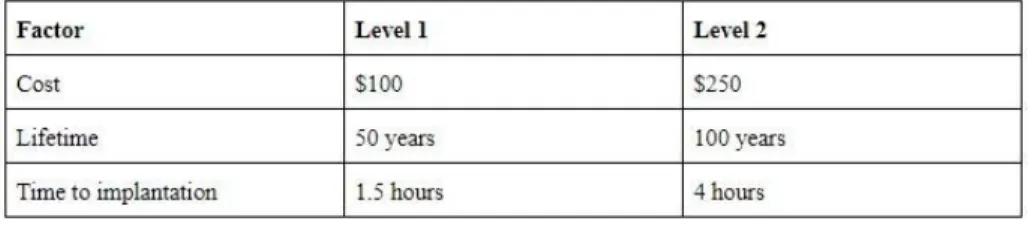
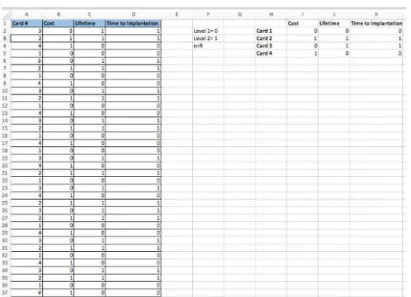
● A conjoint analysis statistical test was run using data from other students in Senior Design (n=9)
● The test was shown to be somewhat inconclusive, as the data collected didn’t come from physicians (actual customers)
● Based on our regression model, the only factor that can be considered significant is cost. It is important to take into account that students, instead of physicians, were surveyed which doesn’t necessarily make this data valid.
Figure 4. Conjoint table with factors and levels
Figure 6. Data input for conjoint analysis
Morphology
Conceptual Evaluation
Design Organization: Septal Closure Device Team Date: 02/19/2020
Table 4. Possible failures of different materials
Parameter Function Possible Failures
Nitinol Scaffolding Biocompatibility issues
● Can release nickel ions into the body [1]
PLGA Scaffolding Softening
● Studies showed that PLGA softened in wet environment versus dry environment [2]
PTFE Tissue Integration Negative Immune Response
● Thrombosis [3]
● Infection
PLGA Tissue Integration Negative Immune Response
● Infection
● May degrade too quickly [2]
Taurolidine-Citrate Solution (TCS)
Anti-infection Anti-Infection Properties
● May fail to prevent infection or lead to different type of infection
Current products that exist that demonstrate above qualities:
Nitinol:
● Stents
● Heart valve tools
● Septal Defect devices
Nitinol is already a common biomaterial used when developing septal defect devices.
Examples:
Amplatzer septal occluder (ASO): “ The device structure is a self-expanding double disk with larger left atrial disk and a starting size 4 mm connector waist. The structure is a nitinol metal wire mesh framework and is recapturable…” [4]
PLGA (scaffold):
Figure 8. Example of PLGA scaffolding techniques taken from article [2] cited in references.
PTFE:
● Shunts
● Valve repair
● Vascular grafts
● Atrial septal defects
PLGA (tissue integrator):
● Used in current septal closure defects
“The sealing capability of biodegradable occluders was found superior to that of Amplatzer occluders. In addition, the cell attachment and spreading of endothelial cells seeded on the PLGA/collagen nanofibrous matrix and the interaction between cells and PLGA/collagen nanofibers were studied. The nanofibrous membranes made of PLGA/collagen were very effective in promoting cell proliferation during culture.” [5]
TCS:
● Used to aid in the prevention of central-line associated bloodstream infections
● “TCS usage was highly successful in CLABSI reduction by 80% in all patients, 90% in H/O and 70% in GI patients. In patients with high baseline CLABSI rates, TCS is an effective
catheter-lock therapy to reduce CLABSI rates in paediatric patients.” [6]
Final Analysis
Based on our analysis, we believe that nitinol is the best choice for the scaffolding, PTFE as the tissue integrator, and Taurolidine-Citrate Solution (TCS) as the anti-infection agent. Based on our research of many different material options, these three choices overall follow our basic ideas and specifications we want in our design. This data was collected by using a modified version of the
Technology Readiness Assessment, where we looked at different factors that were important to us in our design, and how different materials would affect these specifications. The specifications we looked at, as they are the main components of our design, were the scaffolding, the tissue integration, and the
anti-infection agent.
For scaffolding, the two materials we were considering were nitinol and PLGA. Based on the technology readiness assessment, as well as some of our past research, nitinol seems to be the best choice moving forward. Nitinol has been used in septal closure devices previously, and has proven to be a reliable biomaterial when used in this aspect.
For the tissue integration aspect of our design, we want the device to be able to become integrated within the heart tissue. This will allow the device to function better as part of the body, and also promote cell growth to the damaged area, (atrial septal defect). Based on our analysis, we believe that PTFE is the best choice to use as the tissue integrator aspect of our device. PTFE has also been used previously in atrial septal defect devices.
Another important aspect of our design is the anti-infection agent. If a device is placed and an infection arises, that will lead to more surgery, which is not ideal for the physician or the patient.
Including some sort of anti-infection agent within our device may help prevent unnecessary surgeries post implantation. The agent we chose to include within our device is Taurolidine-Citrate Solution (TCS), which is used to aid in the prevention of certain infections. Studies have been done showing that TCS can help prevent central line associated bloodstream infections, as well as infections that may result from the use of a catheter in certain procedures. Our device will likely be implanted using a catheter technique, so we believe using TCS as an anti-infection agent is the best choice.
The technology readiness assessment will help us move forward in our design, as we have mostly solidified our material selection. One of our next steps is to finalize our physical design, as well as develop a prototype that allows us to fully understand how our device will work.
Design Comments
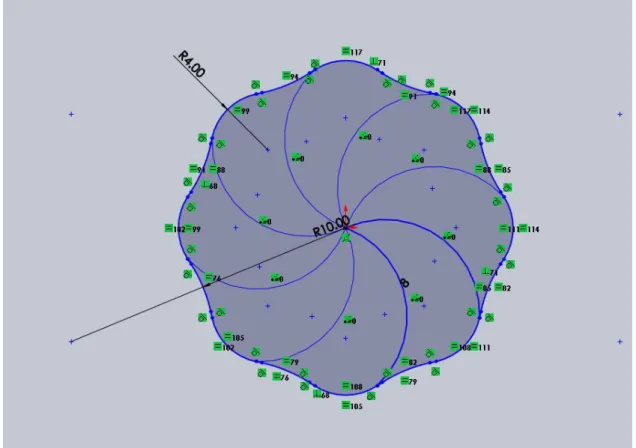
scaffolding through the middle of the disk will be comprised of nitinol. The disk will have roughly a 12.5mm radius from the center point to the outer edge. The outer curve of the edge has a fillet radius of 4mm, and the inner curve has a fillet radius of 10mm. The scaffold is a 6.6mm radius arc from center point to the end point of the outer curve fillet. An image of our rough design of our device can be seen below. After all our different analyses, these design components seem to be the most effective in meeting our specifications.
Conceptual Model
Figure 10. SolidWorks basic model of second design of septal closure device
Detailed Design
● Septal defects are classified into simple and complex defects
○ Simple: 4-26 mm diameter
○ Complex: >26 mm diameter
● Our device will be able to be adjusted to cover any size defect 1. 8 mm diameter
2. 12 mm diameter 3. 18 mm diameter 4. 24 mm diameter 5. 28 mm diameter
● This will allow for the device to work for all sized defects
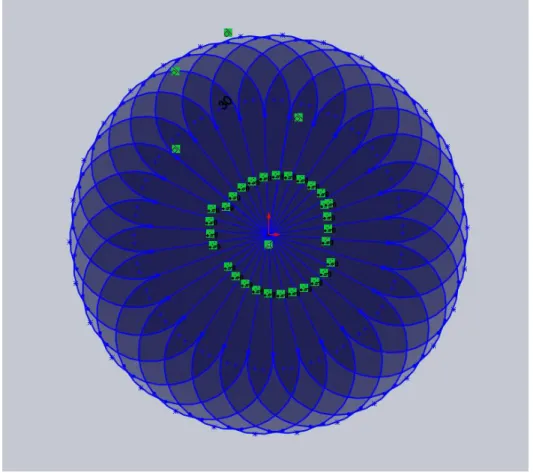
Figure 11. Solidworks design depicting full device
Prototype Manufacturing Plans
● We will develop a prototype to better understand how the scaffolding will sit inside the patch
● Prototype will be scaled up from actual dimensions
○ Nitinol
○ PTFE
○ Metal to metal epoxy (non-medical grade)
● Prototyping will take place mostly in 192-328
○ Nitinol wiring will require no tools (most likely) to bend
○ PTFE will be able to be cut with scissors
● Will use Mustang 60 if more equipment required
● Anti-infection agent will not be included in physical prototype
*Manufacturing was unable to take place due to COVID-19.
● Further information on this is examined in the Discussion section of this report
Test Plans
● Our device should have a lifetime of 50-100 years
○ Want to limit the need for secondary surgery to replace the device
○ Tissue ingrown
● Simulations will be run in COMSOL to test lifetime and durability of device
○ Simulations of 50 years, 75 years, 100 years
○ To better understand how wear in a beating heart will affect device
● Design will continue to be updated in SolidWorks as testing begins
Testing Data and Analysis
● Testing was unable to be completed due the current virtual classroom as a result of COVID-19.
○ Further information on this is examined in the Discussion section of this report Conclusions
and understand. The implant post implantation should demonstrate effectiveness in preventing blood from overfilling in the lungs and heart. The device should be able to become ingrown in the endothelium tissue. The device was designed with these ideas in mind, and engineering specifications were developed in order to achieve these goals.
This project was managed by three team members: Kai Harrison, Hillal Jarrar, and Olivia Welch. The team reported directly to Dr. Michael Whitt, and followed the implemented schedule to the best of their abilities. The project was completed over the span of two quarters.
As mentioned above the septal closure device is indicated for relief of an opening in the atrial septum in patients recovering from septal crossing procedures and/or who are born with septal defects. One of the first steps of the project included developing engineering specifications, which are based off the following factors:
● Easy implantation
● Physician controlled
● Long lifetime
The specifications related to easy implantation include the device having adjustable sizing and straight forward directions for use. In order to be physician controlled, the device will have a short implantation time and be compatible with current catheter/scope techniques. To provide a long device lifetime, the chosen materials will not excessively degrade over time, as well as become ingrown in the endothelium. These specifications were able to be met based on testing and analysis throughout the project. These specifications are shown in Table 1.
We also focused on the customer requirements of the device, which included device lifetime, cost, and growth compatibility. The device lifetime was/will be analyzed by stress failure and
biocompatibility testing. The cost was analyzed by a materials and manufacturing cost analysis. The growth compatibility was/will be specified by the rate/percent of encapsulation by myocardial tissue. The targets and importance of these factors can be viewed in Table 3.
The team also analyzed other devices on the market, in order to determine other intellectual properties and avoid copyright infringements. These current devices on the market, from Pulsar Vascular, W.L Gore and Associates, Edwards Lifesciences, and TAVR Solutions were researched in order to better understand what is presently available to the consumer.
A conjoint analysis was also run in order to better understand what factors are most important to the customer. The statistical test was run using data from other students in BMED-456 (n=9). The factors included in the test were cost, lifetime, and time to implantation. The test showed to be somewhat
inconclusive, as the students in senior design are not the device’s intended customers.
The morphology of the device was analyzed, and a pugh chart was used in order to determine the best design for the device. This analysis can be seen in the Morphology section of this report. Based on the morphology assessment, the device was planned to be:
● Circular, one patch
● PLGA scaffolding
● PTFE patch
● TCS anti-infection agent
A FMEA was conducted in order to officially choose the best materials for our device. After this test, the device’s morphology was changed to better reflect our design specifications. The final design and morphology included
● Circular, two patch geometry
● Nitinol scaffolding
● PTFE patches
● TCS anti-infection agent
The designs of the septal closure device can be seen in Figures 9-12. The device will be able to be manufactured in multiple different sizes, in order to cover any size defect.
As a result of COVID-19, prototype manufacturing and device testing were unable to be completed. This will be further discussed in the next section of this report.
Based on the team’s research and analysis, we believe that with further testing this device would be able to be competitive in the current market of septal closure devices.
Discussion
Due to the current COVID-19 situation, certain aspects of this project were unable to be completed. The two incomplete aspects include prototype manufacturing and device testing. Instead of completing the manufacturing and testing, we have developed a basic engineering package that includes directions for how these aspects would be completed in the future.
*Note that some of the engineering package repeats what is included in this report. The engineering package is included in this report for ease, but if distributed to a third party, would likely stand on its own. Table and figure numbers are separate from the previous tables and figures in this report.
Basic Engineering Package (BEP)
1. Device basic information and specifications
a. The septal closure device is indicated for use in patients in need of a closure in the atrial septum, either from the effects of surgery or atrial septal defects.
Table 1. Engineering Specifications
Factor Specification 1 Specification 2
Easy Implantation Adjustable sizing Straight forward directions for use
Physician Controlled Short implantation time Compatible with current catheter/scope techniques
Long Lifetime Materials that will not excessively degrade over time
Material will become ingrown in endothelium
c. Specific engineering specifications were also developed in order to address the factors of stress failure, cost, and growth compatibility. These are shown in the table below.
Table 2. Engineering Specifications and Importance
Engineering Specs Targets and Importance
Stress Failure Must Withstand 40mmHg Pressure for simulated 100 years
Cost Target: ≤$250 per unit
Growth Compatibility Target: ≥75% encapsulation
d. These specifications will be analyzed with more testing, which is discussed in the following sections
2. Prototype manufacturing
a. The septal closure device prototype will consist of the following materials i. Nitinol scaffolding
ii. PTFE patch
iii. Metal to metal epoxy (non-medical grade)
1. The TCS anti-infection agent will not be included in the basic prototype b. This prototype will allow the team to better understand how the nitinol scaffolding will
sit inside the PTFE patch
c. The device will have 5 different sizes in order to cover all septal defects i. 8 mm diameter
Figure 1. Solidworks design of septal closure device 3. Testing plans
a. The device, based on our specifications, should have a lifetime of 50-100 years
b. Simulations are to be run using COMSOL to test the lifetime and durability of the device i. Simulations of 50 years, 75 years, 100 years
ii. To better understand how wear in a beating heart will affect device
References
[1] Wadood, and Abdul. “Brief Overview on Nitinol as Biomaterial.” Advances in Materials Science and Engineering, Hindawi, 6 Nov. 2016, www.hindawi.com/journals/amse/2016/4173138/.
[2] Pan, Zhen, and Jiandong Ding. “Poly(Lactide- Co -Glycolide) Porous Scaffolds for Tissue Engineering and Regenerative Medicine.” Interface Focus, vol. 2, no. 3, 2012, pp. 366–377., doi:10.1098/rsfs.2011.0123.
[3] Lam, Mai T, and Joseph C Wu. “Biomaterial Applications in Cardiovascular Tissue Repair and Regeneration.” Expert Review of Cardiovascular Therapy, vol. 10, no. 8, 2012, pp. 1039–1049., doi:10.1586/erc.12.99.
[4] Bissessor, Naylin. “Current Perspectives in Percutaneous Atrial Septal Defect Closure Devices.” Medical Devices: Evidence and Research, 2015, p. 297., doi:10.2147/mder.s49368.
[5] Liu, Shih-Jung, et al. “Novel Biodegradable Polycaprolactone Occlusion Device Combining Nanofibrous PLGA/Collagen Membrane for Closure of Atrial Septal Defect (ASD).” Annals of Biomedical Engineering, vol. 39, no. 11, 2011, pp. 2759–2766., doi:10.1007/s10439-011-0368-4.
[6] Chong, Chia-Yin, et al. “Taurolidine–Citrate Lock Solution for the Prevention of Central
Line-Associated Bloodstream Infection in Paediatric Haematology–Oncology and Gastrointestinal Failure Patients with High Baseline Central-Line Associated Bloodstream Infection Rates.” Journal of

![Figure 8. Example of PLGA scaffolding techniques taken from article [2] cited in references](https://thumb-us.123doks.com/thumbv2/123dok_us/8220645.2179493/15.918.215.707.155.386/figure-example-plga-scaffolding-techniques-taken-article-references.webp)