BIROn - Birkbeck Institutional Research Online
Chen, H.-Y. and Cook, B. and Fuhs, Carsten and Nimkar, K. and O’Hearn,
P. (2014) Proving Nontermination via safety. In: Abraham, E. and Havelund,
K. (eds.) Tools and Algorithms for the Construction and Analysis of Systems.
Lecture Notes In Computer Science 8413. New York, U.S.: Springer, pp.
156-171. ISBN 9783642548611.
Downloaded from:
Usage Guidelines:
Please refer to usage guidelines at
or alternatively
Proving nontermination via safety
Hong-Yi Chen1, Byron Cook2,1, Carsten Fuhs1, Kaustubh Nimkar1, and Peter O’Hearn1
1
University College London 2
Microsoft Research
Abstract. We show how the problem of nontermination proving can be reduced to a question of underapproximation search guided by a safety prover. This reduction leads to new nontermination proving implementa-tion strategies based on existing tools for safety proving. Our preliminary implementation beats existing tools. Furthermore, our approach leads to easy support for programs with unbounded nondeterminism.
1
Introduction
The problem of proving programnontermination represents an interesting com-plement to termination as, unlike safety, termination’s falsification cannot be witnessed by a finite trace. While the problem of proving termination has now been extensively studied, the search for reliable and scalable methods for proving nontermination remains open.
In this paper we develop a new method of proving nontermination based on a reduction to safety proving that leverages the power of existing tools. An iterative algorithm is developed which uses counterexamples to a fixed safety property to refine an underapproximation of a program. With our approach, existing safety provers can now be employed to prove nontermination of programs that previous techniques could not handle. Not only does the new approach perform better, it also leads to nontermination proving tools supporting programs with nondeterminism, for which previous tools had only little support.
Limitations. Our proposed nontermination procedure can only prove
if(k≥0) skip; else
i :=−1;
while (i≥0){
i :=nondet(); }
i := 2; nontermination. On terminating programs the procedure is
likely to diverge (although some heuristics are proposed which aim to avoid this). While our method could be ex-tended to further programming language features (e.g.heap, recursion), in practice the supported features of an under-lying safety prover determine applicability. Our implemen-tation uses a safety prover for non-recursive programs with linear integer arithmetic commands.
Example. Before discussing our procedure in a formal set-ting, we begin with a simple example given to the right. In this program the command i:=nondet() represents
is nonterminating when the program is invoked with appropriate inputs and when appropriate choices fornondetassignment are made. We are interested in automatically detecting this nontermination. The basis of our procedure is the search for an underapproximation of the original program thatneverterminates. As “never terminates” can be encoded as safety property (defined later asclosed recurrencein Sect. 2), we can then iterate a safety prover together with a method of underapproximating based on counterexamples. We have to be careful, how-ever, to find the right underapproximation in order to avoid unsoundness.
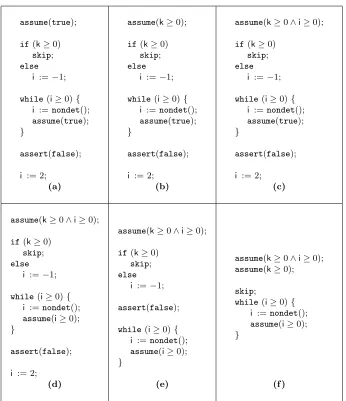
In order to find the desired underapproximation for our example, we intro-duce an assumestatement at the beginning with the initial preconditiontrue. We also place assume(true) statements after each use of nondet. We then put anassert(false) statement at points where the loop under consideration exits (thus encoding the “never terminates” property). See Fig. 1(a).
We can now use a safety checker to search for paths that violate this assertion. Any error path clearly cannot contribute towards the nontermination of the loop. After detecting such a path we calculate restrictions on the introduced assume statements such that the path is no longer feasible when the restriction is applied. Initially as a first counterexample to safety, we might get the pathk<0, i:= −1, i<0, from a safety prover. We now want to determine from which states we can reach assert(false) and eliminate those states. Using a precondition computation similar to Calcagno et al. [6] we find the condition k < 0. The trick is to use the standard weakest precondition rule for assignments, but to use pre(assume(Q), P),P∧Qinstead of the standardwp(assume(Q), P),Q⇒P. This way, we only consider executions that actually reach the error location. To rule out the statesk<0 we can add the negation (e.g.k≥0) to the precondition assumestatement. See Fig. 1(b).
In our procedure we try again to prove the assertion statement unreachable, using the program in Fig. 1(b). In this instance we might get the path k ≥ 0, skip, i < 0, which again violates the assertion. For this path we would discover the precondition k ≥0∧i<0, and to rule out these states we refine the precondition assume statement with “assume(k≥0∧i≥0);”. See Fig. 1(c). On this program our safety prover will again fail, perhaps resulting in the path
assume(true);
if(k≥0)
skip;
else i :=−1;
while(i≥0){
i :=nondet();
assume(true);
}
assert(false);
i := 2;
assume(k≥0);
if(k≥0)
skip;
else i :=−1;
while(i≥0){
i :=nondet();
assume(true);
}
assert(false);
i := 2;
assume(k≥0∧i≥0);
if(k≥0)
skip;
else i :=−1;
while(i≥0){
i :=nondet();
assume(true);
}
assert(false);
i := 2;
(a) (b) (c)
assume(k≥0∧i≥0);
if(k≥0)
skip;
else i :=−1;
while(i≥0){
i :=nondet();
assume(i≥0);
}
assert(false);
i := 2;
assume(k≥0∧i≥0);
if(k≥0)
skip;
else i :=−1;
assert(false);
while(i≥0){
i :=nondet();
assume(i≥0);
}
assume(k≥0∧i≥0);
assume(k≥0);
skip;
while(i≥0){
i :=nondet();
assume(i≥0);
}
[image:4.612.136.482.110.511.2](d) (e) (f )
Fig. 1. Original instrumented program (a) and its successive underapproximations (b), (c), (d). Reachability check for the loop(e), and nondeterminism-assume that must be checked for satisfiability(f ).
loop are still reachable. The path violating the assertion is our desired path to the loop which we refer to as stem. Fig. 1(f) shows the stem and the loop.
2
Closed recurrence sets
In this section we define a new concept which is at the heart of our procedure, calledclosed recurrence. Closed recurrence extends the known concept of (open) recurrence [16] in a way that facilitates automation, e.g. via a safety prover.
Preliminaries.LetS be the set of states. Given a transition relationR⊆S×S, for a stateswithR(s, s0), we say thats0 is a successor ofsunder R.
We will be considering programs P with finitely many program locations
L and a set of memory states M, so the program’s state space S is given as
S=L×M. For instance, for a program onninteger variables, we haveM =Zn,
and a memory state amounts to a valuation of the program variables.
A programP on locationsLis represented via itscontrol-flow graph (CFG) (L, ∆, li, lf, le). The program locations are the CFG’s nodes and ∆ is a set of
edges between locations labeled with commands. We designate special locations inL:liis the initial location,lf the final location, andlethe error location. Each
(l, T, l0)∈∆is a directed edge fromltol0 labeled with a commandT. We write RT ⊆M×M for the relation on memory states induced byT in the usual way.
We say that a memory states at node l has a successor s0 along the edge (l, T, l0)iff RT(s, s0) holds. A pathπin a CFG is a sequence of edges (l0, T0, l1)
(l1, T1, l2). . .(ln−1, Tn−1, ln). The composite transition relationRπof a pathπis
the compositionRT0◦RT1◦...◦RTn−1of the individual relations. We also describe
a pathπ by the sequence of nodes it visits, e.g.l0→l1→. . .→ln−1→ln.
Commands.We represent byV the set of all program variables. A deterministic assignment statement is of the formi:=expwherei∈V andexpis an expression over program variables. A nondeterministic assignment statement is of the form
i:=nondet();assume(Q); wherei∈V,nondet() is a nondeterministic choice and
Qis a boolean expression overV representing the restriction that thenondet() choice must obey. Conditional statements are encoded usingassumecommands (from Nelson [22]):assume(Q), whereQis a boolean expression overV. W.l.o.g. li has 0 incoming and 1 outgoing edge, labeled withassume(Q), where initially
usually Q ,true. For readability, in our example CFGs we often write Q for assume(Q). Our algorithm will later strengthenQin theassume-statements.
We define the indegree of a nodel in a CFG to be the number of incoming edges tol. Similarly, the outdegree of a nodelin a CFG is the number of outgoing edges froml. A node l∈L\ {li, lf, le}must be of one of the following types.
1. A deterministic assignment node:lhas outdegree exactly 1 and the outgoing edge is labeled with a deterministic assignment statement or skip. Any memory statesatl has a unique successors0 along the edge.
In our construction of a CFG, a lone statement assume(Q) from an input program is modeled by a deterministic conditional node, with one edge labeled assume(Q) and the other edge labeledassume(¬Q) leading to the end locationlf.
0
1
2
3
4
5
6 7
8 Error true
k≥0
k<0
skip
i:=−1
i≥0
i<0
i:=nondet() assume(true)
[image:6.612.134.476.155.336.2]i:= 2
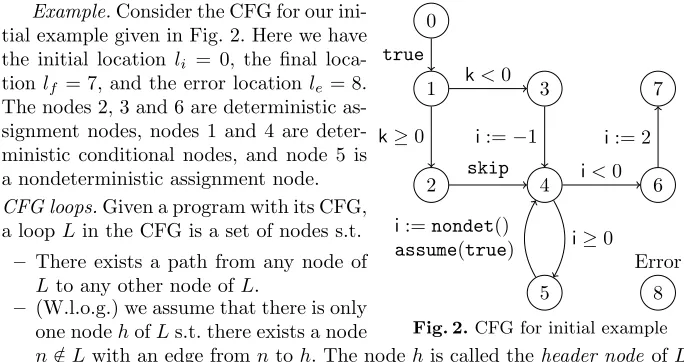
Fig. 2.CFG for initial example Example.Consider the CFG for our
ini-tial example given in Fig. 2. Here we have the initial location li = 0, the final
loca-tionlf = 7, and the error location le= 8.
The nodes 2, 3 and 6 are deterministic as-signment nodes, nodes 1 and 4 are deter-ministic conditional nodes, and node 5 is a nondeterministic assignment node. CFG loops.Given a program with its CFG, a loopL in the CFG is a set of nodes s.t.
– There exists a path from any node of Lto any other node ofL.
– (W.l.o.g.) we assume that there is only one nodehofLs.t. there exists a node
n /∈Lwith an edge fromntoh. The nodehis called theheader node ofL.
The subgraph of CFG containing all nodes ofLis called theloop body ofL. Header hof Lis a deterministic conditional node with one edge that is part of the loop body, the guard edge of L. The other edge ofhgoes to a node e /∈L. We call this edge theexit edge of Landetheexit location ofL.3
Example.In Fig. 2, the only loop is L={4,5}, and its header node his 4. The exit location ofLis 6.
Given a loop L in program P, we define a loop path πL as any finite path
throughL’s body of the form (l0=lh)→l1→...→ln−1→(ln=lh), wherelhis
the header node of L and ∀p.(0 < p < n)→ lp 6=lh. We define the composite
transition relationRLofLasRL(s, s0)iff there exists a loop pathπs.t.Rπ(s, s0).
HereRLcan be an infinite (or empty) set. The initial statesILforRLare the set
of reachable states at the loop header before the loop is entered for the first time. Preconditions.When computing preconditions of assumestatements we borrow from Calcagno et al. [6]: pre(assume(Q), P) , P ∧Q, called the “assume as assert trick”. This lets us interpret assume statements (often from conditional branches) in a way that allows us to determine in a precondition the states from which an error location can be reached in a safety counterexample path. For assignment statements we will use the standard weakest precondition [12].
Example.Note that the weakest precondition of an assignment with nonde-terminism is a little subtle. Let i := nondet(); assume(true); be the nondet statement under consideration. The weakest precondition for the postcondition (i<j) is false (equivalent to∀i. i<j). However the weakest precondition for the postcondition (i<j∨k>0) is (k>0).
3 Languages like Java or C allow loops with additional exit edges also from locations
Recurrence sets. A relation R with initial statesI is nonterminating iff there
exists an infinite transition sequence s0−R→s1 −→R s2 −R→. . . withs0∈I. Gupta et al. [16] characterize nontermination of a relation R by the existence of a recurrence set, viz. a nonempty set of states G such that for eachs ∈ G there exists a transition to somes0 ∈ G. In particular, an infinite transition sequence s0
R
−→s1
R
−→s2
R
−→. . .itself gives rise to the recurrence set{s0, s1, s2, . . .}. Here
∃s.G(s)∧I(s) (1) ∀s∃s0.G(s)→R(s, s0)∧ G(s0) (2) we extend the notion of a recurrence set
to include initial states. A transition rela-tionRwith initial statesI has an (open)
recurrence set of statesG(s)iff (1) and (2) hold. A transition relation R with initial statesI is nonterminatingiff it has a recurrence set of states.
∃s.G(s)∧I(s) (3) ∀s∃s0.G(s)→R(s, s0) (4) ∀s∀s0.G(s)∧R(s, s0)→ G(s0) (5) A setGis aclosed recurrence setfor a
transition relationR with initial statesI iff the conditions (3)–(5) hold. In contrast to open recurrence sets, we now require a
purely universal property: for eachs∈ Gandfor eachof its successorss0, alsos0
must be in the recurrence set (Condition (5)). So instead of requiring that wecan stay in the recurrence set, we now demand that wemust stay in the recurrence set. This now helps us to incorporate nondeterministic transition systems too.
Now what if a statesin our recurrence setG has no successors0at all? Our alleged infinite transition sequence would reach a sudden halt, yet our universal formula would trivially hold. Thus, we impose that eachs∈ Ghassomesuccessor s0 (Condition (4)). But this existential statement need not mention thats0 must be inG again—our previousuniversal statement already takes care of this.
Theorem 1 (Closed Recurrence Sets are Recurrence Sets). Let G be a closed recurrence set for R with initial states I. Then G is also an (open) recurrence set forR with initial statesI.
The proofs for all theorems can be found in the technical report [7]. ut
Underapproximation. We call a transition relation R0 with initial states I0 an underapproximation of transition relationRwith initial statesIiff R0⊆R,I0⊆
I. Then every nonterminating program contains a closed recurrence set as an underapproximation (i.e., together with underapproximation, closed recurrence sets characterize nontermination).
Theorem 2 (Open Recurrence Sets Always Contain Closed Recur-rence Sets). There exists a recurrence set G for a transition relation R with initial statesI iffthere exist an underapproximationR0 with initial statesI0 and G0⊆ G such that G0 is a closed recurrence set for R0 with initial statesI0.
3
Algorithm
Prover(CFGP, LoopL) h:= header node ofL e:= exit node ofLinP
P0:=Underapproximate(P, e) L0:= refined loopLinP0 if ¬Reachable(P0, h)then
returnUnknown,⊥
fi
Π:={π|πfeasible path tohinP0}
for allπ∈Π do
P0:=π::L0// concatenation if Validate(P0)then
returnNonTerminating,P0 fi
done
returnUnknown,⊥
Underapproximate(CFGP, Nodee) κ:= [ ]
whileReachable(P, e)do π:= feasible path toeinP κ:=π::κ
P :=Refine(P, π)
if thenmost recent paths inκ are repeatingthen
P:=Strengthen(P,First(κ)) fi
done returnP
Refine(CFGP, Pathπ)
(l0T0 l1)(l1T1 l2). . .(ln−1 Tn−1 ln) :=π Calculate WPsψ1, ψ2. . . ψn−1 alongπ
so{ψ1}T1{ψ2}T2. . .{ψn−1}Tn−1{true}
are valid Hoare-triples.
Findps.t.ψp6=false∧ ∀q < p. ψq=false
P :=P|(Tp−1,¬ψp) returnP
Strengthen(CFGP, Pathπ)
(l0T0 l1)(l1T1 l2). . .(ln−1 Tn−1 ln) :=π Calculate WPsψ1, ψ2. . . ψn−1 alongπ
so{ψ1}T1{ψ2}T2. . .{ψn−1}Tn−1{true}
are valid Hoare-triples.
Findps.t.ψp6=false∧ ∀q < p. ψq=false
W :={v|vgets updated in subpath (lpTplp+1). . .(ln−1Tn−1ln)}
ρp:=QE(∃W. ψp) P :=P|(Tp−1,¬ρp) returnP
Validate(CFGP0)
L0:= the outermost loop inP0
M:={l|lisnondetassignment node inL0}
for alll∈Mdo
Calculate invariantinvlat nodelinP0
letnondetstatement atlbe
v :=nondet();assume(ϕ);
if invl→ ∃v. ϕis not validthen returnfalse
[image:8.612.127.492.110.480.2]fi done returntrue
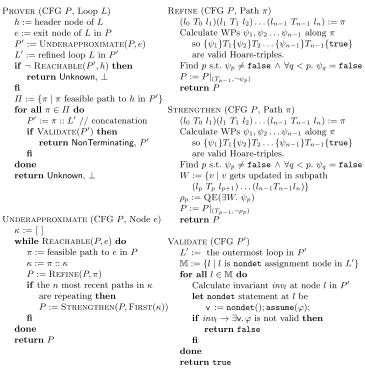
Fig. 3.AlgorithmProverfor underapproximation to synthesize a reachable nontermi-nating loop. To prove nontermination ofP,Provershould be run on all loopsL.
can be implemented sequentially, but then timeouts are advisable in Prover, as the procedure might diverge and cause another loop to not be considered.
The subprocedureUnderapproximateperforms the search for an underap-proximation such that we can prove the loop is never exited. While the loop exit is stillReachable(a.k.a.“unsafe”), we use the subprocedureRefineto exam-ine paths returned from an off-the-shelf safety prover. Here the notationP|(Ti,ϕ)
denotes P with an additionalassume(ϕ) added to the transition Ti. From the
In some cases our refinement is too weak, leading to divergence. The difficulty is that in cases the same loop path will be considered repeatedly, but at each instance the loop will be unrolled for an additional iteration. To avoid this prob-lem we impose a limitnfor the number of paths that go along the same locations (possibly with more and more repetitions). We call such paths repeating. If we reach this limit, we use the subprocedureStrengthento strengthen the precon-dition, inspired by a heuristic by Cook and Koskinen [8]. Here we again calculate a precondition, but when we have foundψp, we quantify out all the variables that
are written to afterψpand apply quantifier elimination (QE) to getρp. We then
refine with ¬ρp. This leads to a more aggressive pruning of the transition
rela-tion. This heuristic can lead to additional incompleteness. 0
1
2
3 4
5 6
Error
ϕ
i≥0
i<0
k≥0
k<0
i:=i−1 skip
skip Example. Consider the instrumented
pro-gram to the right. Suppose we have initially ϕ , i ≥ 0. We might get cex1 : 0 → 1 → 2 →3→5 →1→6 as a first counterexample. TheRefineprocedure finds the weakest precon-ditionk≥0∧i= 0 at location 1. Adding its nega-tion to ϕ and simplifying the formula gives us ϕ,(i≥0)∧(k<0 ∨ i≥1). Now we may get cex2 : 0→ 1 → 2 → 3 → 5 → 1 → 2 → 3 → 5→1→6 as next counterexample, andRefine
updatesϕ,(i≥0)∧(k<0 ∨ i≥2). Now we may get cex3: 0→1→2→3→5→1→2→
3 → 5 → 1 → 2 → 3 →5 →1 → 6 as next counterexample. Note that cex1, cex2, cex3 are repeating counterexamples and if we just use the Refine pro-cedure,Underapproximategets stuck in a sequence of infinite counterexam-ples. NowStrengthenidentifies the repeating counterexamples, considers cex1 and calculates the weakest preconditionψ1,k≥0∧i= 0. It then existentially quantifies out variableias it gets modified later along cex1. We get∃i.k≥0∧i= 0, and quantifier elimination yieldsρ1,k≥0. Clearlyψ1entailsρ1. Adding¬ρ1 to ϕ and simplifying the formula we getϕ,i≥0∧k<0. Now all repeating counterexamples are eliminated, the program is safe, and we have obtained a closed recurrence set witnessing nontermination of the original program.
In theUnderapproximateprocedure, once there are no further counterex-amples to safety of P, we know that in P the loop exit is not reachable. The procedure returns the final underapproximation (denoted byP0) that is safe.
WhenUnderapproximatereturns toProver, we check if inP0the original loopLafter refinements has a closed recurrence set. We refer to the refined loop asL0. In order to check the existence of a closed recurrence set, we first need to
in our implementation). For each such path π∈Π we then create a simplified CFGP0 by concatenatingπtoL0, thus eliminating other paths toL0.
At this point, we are sure that the header ofL0 is reachable and there is no path that can reach the exit location of L0. However refinements in
Underap-proximate may have restricted the nondet statements inside L0 by strength-ening the assume statements associated with them. Thus a reachable state at the nondeterministic assignment node may not have a successor along its
0
1
2
3
4 5
6 7
Error
i== 10
i== 10
i6= 10
j:=nondet() assume(ϕ)
j≥4
j<4
i:=i+ 1
i:=i−1 skip
Fig. 4.Program showing why we needValidateprocedure outgoing edge. This would bring our alleged
in-finite execution to a halt. The safety checker cannot detect this since then the path just gets blocked at this node, and the error location at the exit ofL0 cannot be reached.
Example. Consider the instrumented pro-gram in Fig. 4. Suppose initiallyϕ,true. The original program (without instrumentation) is clearly terminating. Our algorithm might give cex1 : 0 → 1 → 2 → 3 → 4 → 6 → 1 → 7 as the first counterexample. Thenondet state-ment at node 2 gets restricted by updating ϕ , (j ≤ 3 ∨i == 9). Now we might get cex2 : 0 → 1 → 2 → 3 → 5 → 6 → 1 → 7 as the next counterexample. Our algorithm re-stricts the nondetstatement at node 2 by up-datingϕ,(j≤3∨i== 9)∧(j≥4∨i== 11). However now there are no further coun-terexamples, and the safety checker returns safe. The state s i = 10 at node 2 has no successor along the outgoing edge as there is
no way to satisfy the condition ϕ and the execution is halted, so it would be unsound to report the result asNonterminating.
Note that at first it may appear that adding another outgoing edge to node 2 withj:=nondet();assume(¬ϕ); and marking the next node as an error node would help us catch the halted execution. However the problem is that this would discover again all of the previously eliminated counterexamples as well. Thus we need a special check by theValidateprocedure, which we describe next.
Validatetakes as input the final underapproximationP0. It first calculates
a location invariant at every nondet. assignment node inside the outermost loop L0inP0. Letlbe a nondet. assignment node with:v:=nondet();assume(ϕ); Let invbe a location invariant atl.Validatethen checks if (6) is valid. This formula
inv→ ∃v. ϕ (6) checks if for all reachable states atl, a choice can be made
for the nondetassignment obeying ϕ(and thus Condition
(4) holds).Validatereturnstrueiff (6) holds for allnondetstatements inL0.
Example.Consider the program in Fig. 1(f). Using a standard invariant gen-erator we calculate the invarianti≥0 before line 4. Substituting in (6) we get,
even the weakest invarianttruecan be sufficient to prove validity of (6). In this example as well we can easily prove that true→ ∃i0.i0 ≥0 is valid.
Moreover, consider the program in Fig. 4. Supposeϕ,(j≤3∨i== 9)∧ (j≥4∨i== 11). Using an invariant generator, we obtain the location invariant
i= 10 at location 2. Then (6) becomesi= 10→ ∃j.(j≤3∨i= 9)∧(j≥4∨i= 11). Clearly the formula is not valid. In this caseValidatereturnsfalse.
If Validate returns true, we are sure that every reachable state at the nondeterministic assignment node inL0 has a successor along the edge. At this
point, we report nontermination and return the final underapproximationP0 of
P as a proof of nontermination forP:P0 is a closed recurrence set.
Note that as invariants are overapproximations, we may report unknown in some cases even when the discovered underapproximation actually does have a closed recurrence set. However, the check is essential to retain soundness.
Theorem 3 (Correctness of Prover for Nontermination). Let P be a program andLa loop inP. SupposeProver(P, L) =Nonterminating, P0. Then P is nonterminating.
4
Nested Loops
if(i== 10){while (i>0){
i:=i−1; while (i== 0)
skip; }
assert(false); }
Our algorithm can handle nested loops easily. That is a part of the beauty of the reduction to safety, as ex-isting safety provers (e.g.SLAM, Impact,etc.) han-dle nested loops with ease. Note that technically we only need to consider an outermost loop. Consider the instrumented program with nested loops to the right.
Here the outer loop decreases the value of i10 times and then it is the inner loop that is nonterminating. However, it suffices only to consider the outermost loop for safety as theassert(false) at the end of the outer loop is not reachable, but the head of the outer loop is reachable, so that we have proved nontermination.
::::::::::: assume(ϕ); while (k≥0){
k :=k+ 1;
j :=k; while (j≥1)
j :=j−1; }
::::::::::::::: assert(false); Tricky example. We close with an example that
par-tially explains the advantage seen for our tool over TNT (discussed in Sect. 5). Consider the program to the right (already shown with our algorithm’s::::::::::::::::instrumentation, ini-tially withϕ,true). This program clearly does not ter-minate, yet TNTwill fail to prove it. In fact, our imple-mentation of TNT which follows the strategy discussed for enumerating lassos [16] diverges looking at larger and larger cyclic paths (i.e.straight-line code from a location
back to that location). The difficulty here is that each cyclic path is well-founded. Consider e.g.this cyclic path from the headhof the outer loop back toh:
k≥0, k:=k+ 1, j:=k, j≥1, j:=j−1, j<1, k≥0
This path is well-founded. In fact the path cannot be repeated. The root of the problem is the command sequencej≥1, j:=j−1, j<1, which tells us that
that k= 1, thus by thek:=k+ 1 command we know thatk= 0 at the start of the loop’s execution. Thus the command sequence respects the following condi-tion:k0>k∧k0≤1, and thus it is well-founded. Hence, the lasso-based toolTNT will never be able to prove nontermination of this program. The toolAProVE cannot prove suchaperiodic nontermination for nested loops either [5].
Our approach, however, does not fall victim to this problem. It will find the path:k<0, resulting inϕ,k≥0. Asassert(false) is unreachable with this restriction (and the loop is still reachable), we have proved nontermination.
5
Related work
Automatic tools for proving nontermination of term rewriting systems include [14, 23]. However, while nontermination analysis for term rewriting considers the entire state space as legitimate initial states for a (possibly infinite) evaluation sequence, our setting also factors in reachability from the initial states.
Static nontermination analysis has also been investigated for logic programs (e.g.[24, 31]). Most related to our setting are techniques for constraint-logic pro-grams (CLPs) [25]. Termination tools for CLPs (e.g.[25]) can in cases be used to prove nontermination of imperative programs (e.g.Julia[26] can show nontermi-nation for Java Bytecode programs if the abstraction to CLPs is exact, but gives no witness like a recurrence set to the user). The main difficulty for imperative programs is that typically overapproximating abstractions (in general unsound for nontermination) are used for converting languages like Java and C to CLPs.
TNT[16] uses a characterization of nontermination by recurrence sets. We
build upon this notion and introduceclosed recurrence sets in our formalization, as an intermediate concept during our nontermination proof search. In contrast to us,TNTis restricted to programs withperiodic“lasso-shaped” counterexam-ples to termination. We support unbounded nondeterminism in the program’s transition relation, whereasTNTis restricted to deterministic commands.
The toolInvel[30] analyzes nontermination of Java programs using a com-bination of theorem proving and invariant generation. However,Inveldoes not provide a witness for nontermination. Like Brockschmidt et al.[5], we were un-able to obtain a working version of Invel. Note that in the empirical evaluation by Brockschmidtet al.[5], theAProVEtool (which we have compared against) subsumedInvelonInvel’s data set. Finally,Invelis only applicable to deter-ministic (integer) programs, yet our approach allows nondeterminism as well.
AProVE[13] uses SMT to prove nontermination of Java programs [5]. First
nontermination of a loop regardless of its context is shown, then reachability of this loop with suitable values. Drawbacks are that they require recurrence sets to be singletons (after program slicing) or the loop conditions to be invariants.
Gurfinkelet al. [18] present the CEGAR-based model checkerYasm which supports arbitrary CTL properties, such as EG pc 6=END, denoting nontermi-nation.Yasmimplements a method of both under and over-approximating the input program. Unfortunately, together with the author of Yasm we were not able to get the tool working on our examples [17]. We suspect that our approach will be faster, as it uses current safety proving techniques,i.e.Impact[20] rather than Slam-style technology [2]. This is a feature of our approach:any off-the-shelf software model checker can be turned into a nontermination prover.
Nontermination proving for finite-state systems is essentially a question of safety [3]. Nontermination and/or related temporal logics are also supported for more expressive systems, e.g.pushdown automata [28].
Recent work on CTL proving for programs uses an off-the-shelf nontermina-tion prover [8]. We use a few steps when treating nondeterminism which look similar to the approach from [8]. The key difference is that our workprovides a nontermination prover, whereas the previous workrequires one off-the-shelf.
Gulwaniet al. [15] (Claim 3), make a false claim that is similar to our own. Their claim is false, as a nondeterministic program can be constructed which represents a counterexample. Much of the subtlety in our approach comes from our method of dealing with nondeterminism.
6
Experiments
We have built a preliminary implementation of our approach within the tool
T2[10, 4]4 and conducted an empirical evaluation with it against these tools:
– TNT[16], the originalTNTtool was not available, and thus we have reim-plemented its constraint-based algorithm withZ3[11] as SMT backend.
– AProVE[13], via the Java Bytecode frontend, using the SMT-based non-termination analysis by Brockschmidtet al. [5].
– Julia[29], which implements an approach via a reduction to constraint logic programming described by Payet and Spoto [26].
As a benchmark set, we used a set of 492 benchmarks for termination analysis from a variety of applications also used in prior tool evaluations (e.g.Windows device drivers, theApacheweb server, thePostgreSQLserver, integer approx-imations of numerical programs from a book on numerical recipes [27], integer approximations of benchmarks fromLLBMC[21] and other tool evaluations).5 Of these, 81 are known to be nonterminating and 254 terminating. For 157 examples, the termination status is unknown. These examples include a program whose termination would imply the Collatz conjecture, and the remaining ex-amples are too large to render a manual analysis feasible. On average a CFG in
4
We will make our implementation available in the next source code release of T2. 5
(a) (b) (c)
Nonterm TO No Res Nonterm TO No Res Nonterm TO No Res
Fig. 3 51 0 30 0 45 209 82 3 72
AProVE 0 61 20 0 142 112 0 139 18
Julia 3 8 70 0 40 214 0 91 66
TNT 19 3 59 0 48 206 32 12 113
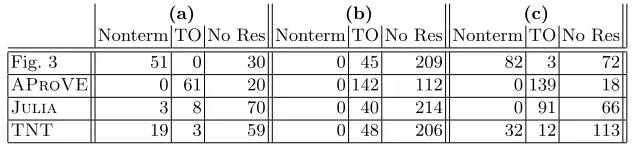
Fig. 5.Evaluation success overview, showing the number of problems solved for each tool. Here(a)represents the results for known nonterminating examples,(b)is known terminating examples,(c)is (previously) unknown examples.
our test suite has 18.4 nodes (max. 427 nodes) and 2.4 loops (max. 120 loops). Unfortunately each tool requires a different machine configuration, and thus a direct comparison is difficult. Experiments with our procedure were performed on a dualcore Intel Core 2 Duo U9400 (1.4 GHz, 2 GB RAM, Windows 7).TNTwas run on Intel Core i5-2520M (2.5 GHz, 8 GB RAM, Ubuntu Linux 12.04). We ran
AProVEon Intel Core i7-950 (3.07 GHz, 6 GB RAM, Debian Linux 7.2). Note that theTNT-/AProVE-machines are significantly faster than the machine our new procedure was run on, thus we can make some adjusted comparison between the tools. ForJulia, an unknown cloud-based configuration was used. All tools were run with a timeout of 60s. When a tool returned early with no definite result, we display this in the plots using the special “NR” (no result) value.
We ran three sets of experiments: (a) all the examples previously known to be nonterminating, (b) all the examples previously known to be terminating, and (c) all the examples where no previous results are known. With (a) we assess the efficiency of the algorithm, (b) is used to demonstrate its soundness, and (c) checks if our algorithm scales well on relatively large and complicated examples. The results of the three sets of experiments are given in Fig. 5, which shows for each tool and for each set (a)–(c) the numbers of benchmarks with nontermina-tion proofs (“Nonterm”), timeouts (“TO”), and no results (“No Res”). (Proofs oftermination, found byAProVEandJulia, are also listed as “No Res”.)
# Paths Nonterm Time [s]
2 133 272
4 133 301
6 129 264
∞ 123 272
Fig. 6. Repeated paths be-fore calling Strengthen On the 89 deterministic instances of our
bench-mark set, our implementation proves nontermina-tion of 33 examples, and TNT of 21 examples. We have also experimented with different values for the number of repeated paths before invoking
Strengthen. The results are reported in Fig. 6
(runtimes are for successful nontermination proofs).
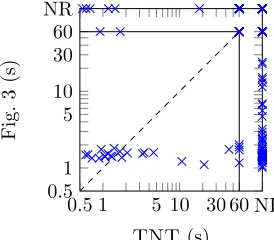
Fig. 7 charts the difference in power and performance between our imple-mentation and TNT in a scatter plot, in log scale. Here we have included all programs from (a)–(c). Each ‘x’-mark in the plot represents an example from the benchmark. The value of the x-axis plots the runtime of TNTand the y-axis value plots the runtime of our procedure on the same example. Points under the diagonal are in favor of our procedure. Thus, the more ‘x’-marks there are in the lower-righthand corner, the better our tool has performed.
[image:14.612.149.466.114.187.2]0.5 1 5 10 30 60 NR 0.5
1 5 10 30 60 NR
TNT(s)
Fig.
3
(s)
Fig. 7. Evaluation results of our procedure vs.TNT. Scatter plot in log scale. Timeout=60s. NR=“No Result”, indicating failure of the tool.
soundness bugs). The poor precision of
AProVE&Juliais mainly due to the
non-deterministic updates originally present in many of the benchmarks and also introduced by the (automated) conversion of the bench-marks to Java (the two tools’ input syntax). This shows the lack of reliable support of non-determinism in today’s nontermination tools. The TNT algorithm requires outright that nondeterminism must not occur in the input. Our implementation of TNT softens this requirement slightly: parts of the pro-gram withnondet-assignments are allowed as long as they are not used during the synthesis of recurrence sets.
Finally, we observe in Fig. 6 that theStrengthenprocedure provides ad-ditional precision for our approach without harming performance.
7
Conclusion
We have introduced a new method of proving nontermination. The idea is to split the reasoning in two parts: a safety prover is used to prove that a loop in an underapproximation of the original programnever terminates; meanwhile failed safety proofs are used to calculate the underapproximation. We have shown that nondeterminism can be easily handled in our framework while previous tools often fail. Furthermore, we have shown that our approach leads to performance improvements against previous tools where they are applicable.
Our technique is not restricted to linear integer arithmetic: Given suitable tools for safety proving and for precondition inference, in principle our approach is applicable toany program setting (note that theStrengthenprocedure is just an optimization). For future work,e.g.heap programs are a highly promising candidate for nontermination analysis via abduction tools for separation logic [6]. Acknowledgments. We thank Marc Brockschmidt, Fabian Emmes, Florian Frohn and Fausto Spoto for help with the experiments and Tony Hoare, Jules Villard and the anonymous reviewers for insightful comments.
References
1. Mohamed Faouzi Atig, Ahmed Bouajjani, Michael Emmi, and Akash Lal. Detect-ing fair non-termination in multithreaded programs. InProc. CAV ’12.
2. Thomas Ball and Sriram K. Rajamani. The SLAM toolkit. InProc. CAV ’01. 3. Armin Biere, Cyrille Artho, and Viktor Schuppan. Liveness checking as safety
checking. InProc. FMICS ’02.
[image:15.612.138.275.119.239.2]5. Marc Brockschmidt, Thomas Str¨oder, Carsten Otto, and J¨urgen Giesl. Automated detection of non-termination and NullPointerExceptions forJava Bytecode. In
Proc. FoVeOOS ’11.
6. Cristiano Calcagno, Dino Distefano, Peter W. O’Hearn, and Hongseok Yang. Com-positional shape analysis by means of bi-abduction. J. ACM, 58(6):26, 2011. 7. Hong-Yi Chen, Byron Cook, Carsten Fuhs, Kaustubh Nimkar, and Peter O’Hearn.
Proving nontermination via safety. Technical Report RN/13/23, UCL, 2014. 8. Byron Cook and Eric Koskinen. Reasoning about nondeterminism in programs.
InProc. PLDI ’13.
9. Byron Cook, Andreas Podelski, and Andrey Rybalchenko. Terminator: Beyond safety. InProc. CAV ’06.
10. Byron Cook, Abigail See, and Florian Zuleger. Ramsey vs. lexicographic termina-tion proving. InProc. TACAS ’13.
11. Leonardo de Moura and Nikolaj Bjørner. Z3: An efficient SMT solver. InProc. TACAS ’08.
12. Edsger W. Dijkstra. A Discipline of Programming. Prentice-Hall, 1976.
13. J¨urgen Giesl, Peter Schneider-Kamp, and Ren´e Thiemann.AProVE 1.2:Automatic termination proofs in the dependency pair framework. InProc. IJCAR ’06. 14. J¨urgen Giesl, Ren´e Thiemann, and Peter Schneider-Kamp. Proving and disproving
termination of higher-order functions. InProc. FroCoS ’05.
15. Sumit Gulwani, Saurabh Srivastava, and Ramarathnam Venkatesan. Program analysis as constraint solving. InProc. PLDI ’08.
16. Ashutosh Gupta, Thomas A. Henzinger, Rupak Majumdar, Andrey Rybalchenko, and Ru-Gang Xu. Proving non-termination. InProc. POPL ’08.
17. Arie Gurfinkel. Private communication. 2012.
18. Arie Gurfinkel, Ou Wei, and Marsha Chechik. Yasm: A software model-checker for verification and refutation. InProc. CAV ’06.
19. William R. Harris, Akash Lal, Aditya V. Nori, and Sriram K. Rajamani. Alterna-tion for terminaAlterna-tion. InProc. SAS ’10.
20. Ken McMillan. Lazy abstraction with interpolants. InProc. CAV ’06.
21. Florian Merz, Stephan Falke, and Carsten Sinz. LLBMC: Bounded model checking of C and C++ programs using a compiler IR. InProc. VSTTE ’12.
22. Greg Nelson. A generalization of Dijkstra’s calculus.ACM TOPLAS, 11(4), 1989. 23. ´Etienne Payet. Loop detection in term rewriting using the eliminating unfoldings.
Theor. Comput. Sci., 403(2-3), 2008.
24. ´Etienne Payet and Fr´ed´eric Mesnard. Nontermination inference of logic programs.
ACM TOPLAS, 28(2), 2006.
25. ´Etienne Payet and Fr´ed´eric Mesnard. A non-termination criterion for binary con-straint logic programs. TPLP, 9(2), 2009.
26. ´Etienne Payet and Fausto Spoto. Experiments with non-termination analysis for Java Bytecode. InProc. BYTECODE ’09.
27. William H. Press, Saul A. Teukolsky, William T. Vetterling, and Brian P. Flannery.
Numerical Recipes: The Art of Scientific Computing. Cambridge Univ. Press, 1989. 28. Fu Song and Tayssir Touili. Pushdown model checking for malware detection. In
Proc. TACAS ’12.
29. Fausto Spoto, Fred Mesnard, and ´Etienne Payet. A termination analyzer for Java bytecode based on path-length. ACM TOPLAS, 32(3), 2010.
30. Helga Velroyen and Philipp R¨ummer. Non-termination checking for imperative programs. InProc. TAP ’08.