ISSN 1998-0124 CN 11-5974/O4
2021, 14(2): 398–403 https://doi.org/10.1007/s12274-020-2777-x
Re
sea
rc
h A
rt
From a mononuclear FeL2 complex to a Fe4L4
molecular square:
Designed assembly and spin-crossover property
Zhuo Wang1,2, Li-Peng Zhou1,2, Li-Xuan Cai1,2, Chong-Bin Tian1,2(
), and Qing-Fu Sun1,2(
)
1 State Key Laboratory of Structural Chemistry, Fujian Institute of Research on the Structure of Matter, Chinese Academy of Sciences, Fuzhou 350002, China
2 University of Chinese Academy of Sciences, Beijing 100049, China
© Tsinghua University Press and Springer-Verlag GmbH Germany, part of Springer Nature 2020
Received: 31 January 2020 / Revised: 18 March 2020 / Accepted: 24 March 2020
ABSTRACT
By introduction of a new Fe(L1)
2 spin-crossover (SCO) unit into the polynuclear system, a nano-scale Fe4(L2)4 molecular square
architecture is designed through coordination-directed self-assembly strategy. Both the mononuclear Fe(L1)
2 and tetranuclear
Fe4(L2)4 complexes have been structurally confirmed by 1H nuclear magnetic resonance (NMR), electrospray ionization time-of-flight
mass spectrometry (ESI-TOF-MS), and temperature-dependent single crystal X-ray diffraction studies. Variable-temperature magnetic susceptibility measurements reveal the presence of an abrupt SCO behavior with a thermal hysteresis width of 4 K for Fe(L1)
2. By clear contrast, Fe4(L2)4 undergoes a gradual spin transition behavior with enlarged thermal hysteresis width and higher
spin transition temperature.
KEYWORDS
spin-crossover compound, molecular square, iron, coordination-directed self-assembly, supramolecular chemistry
1
Introduction
Development of new switchable molecular materials is one of the hot research topics in functional materials due to their potential applications in nano-electronics/spintronics, information memories, sensors and displays et al. [1–5]. Among them, the spin-crossover (SCO) compounds are excellent candidates, because the switch between the diamagnetic low spin (LS) state and paramagnetic high spin (HS) state has a dramatic impact on the physical properties of the material, including its color, magnetic moment, and electrical resistance [6]. If the ligands field splitting energy is comparable with the spin pairing energy, a SCO transition from a LS state to HS state (or vice versa) can be modulated through the external stimulus, such as temperature, pressure, light irradiation, guest uptake and release [7–11]. Up to now, the mononuclear FeII compounds with FeN6 octahedral or pseudo-octahedral coordination geometry have been systematically and thoroughly investigated. Compared to the mononuclear SCO FeII systems, polynuclear SCO FeII system is more attractive as the incorporation of mononuclear SCO-active building unit into polynuclear assemblies may not only give rise to engross structures but also lead to enhanced tunability. As a result, polynuclear systems with multiple SCO- active FeII centers have been reported in binuclear, trinuclear, tetranuclear, pentanuclear, hexanuclear, and even octanuclear systems [12, 13]. Actually, the tetranuclear assemblies (grid or square) [14–26], as an interesting class of compounds in this context, have received much attention for their tunable stimulus-response SCO properties as well as the accessibility up to five molecular spin states, i.e., (FeII
LS)n(FeIIHS)4−n (n = 0–4).
For example, Lehn and co-workers recently demonstrated that
the SCO behavior of the square-type Fe4 complex can be modified by the protonic modulation of a hydrazine-based ditopic isomeric ligand [23]. Oshio et al. showed that three molecular spin states can be trapped in a Fe4 square species [21]. Nevertheless, lack of construction approach together with the longstanding obstacles to acquire single crystal structures makes the fabrication of such multi-component assemblies rather challenging. Moreover, the FeN6 SCO-active centers in all the known examples all sited at the vertices of the square. To the best of our knowledge, however, SCO-active square-like compound with the FeII centers situated in the edge has never been explored.
Coordination-directed self-assembly has been testified to be a well-established method to construct discrete supramolecular architectures with fascinating shapes and desirable physico-chemical properties [27–39]. Generally, coordination assemblies are organized by metal ions and organic or metallic ligands, where the former play as junction nodes and the latter act as linkers. Moreover, the shapes and sizes of the assemblies are determined by the symmetry and length of the ligands [40–42]. As such, the key factor to prepare supramolecular entities with anticipatory structural configuration mainly relies on the appropriate design of the ligands. With one banana-shaped ligand where the intersection angle between the two multidentate chelate arms is equal to 90°, a square-like complex can be anticipated when assembling it with metal ions that bear a linear coordination geometry.
Di five-membered heterocycle based pyridine ligands, such as pyridine-2,6-bi-pyrazole, pyridine-2,6-bi-triazolate, and their derivatives are the most widely adopted ligands to fabricate SCO-active compounds [43–45]. Various SCO behaviors,
Nano Research
including abrupt, two steps, moderately gradual, incomplete spin conversion, and so on, have been observed in these compounds. To our surprise, the pyridine-2,6-bi-tetrazolate- based SCO-active compounds have never been explored so far, probably due to the potentially explosive features of tetrazoles. In this contribution, we report two novel FeII complexes, namely Fe(L1)
2 and Fe4(L2)4, obtained by the reaction of precisely designed pyridine-2,6-bi-tetrazolate ligands with Fe(CF3SO3)2 (Scheme 1). Distinct SCO behaviors have been detected, which may be contributed to the different degree of synergistic effect of intermolecular interactions and the intramolecular FeII–FeII communications. Compared with the mononuclear complex Fe(L1)
2, which exhibits an abrupt SCO behavior with a thermal hysteresis loop of 4 K in width, the square-like complex Fe4(L2)4 shows an improved spin transition process above room temperature. Importantly, compound Fe4(L2)4 by far represents the first anionic SCO-active square complex with the metal centers located in the edges of the square.
Scheme 1 Coordination self-assembly of mononuclear Fe(L1) 2 and
molecular square Fe4(L2)4 from ligand H2L1 and H4L2 (the Et3NH cations
are omitted).
2 Results and discussion
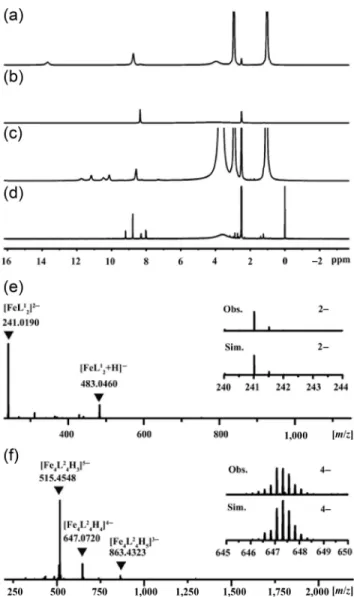
Two pyridine-2,6-bi-tetrazolate-based ligands H2L1 and H4L2 were synthesized by cycloaddition of sodium azide with the respective carbonitrile in anhydrous dimethylformamide (DMF) in the presence of NH4Cl. The key carbonitrile precursors of ligand H4L2 can be dehydrated by the corresponding pyridine diamide intermediates, which were synthesized by palladium-catalyzed Suzuki-Miyaura coupling reaction (see Scheme S1 in the Electronic Supplementary Material (ESM)). All ligands were fully characterized by nuclear magnetic resonance (NMR) and electrospray ionization time-of-flight mass spectrometry (ESI-TOF-MS) (see experimental section of the ESM for details). When 1 equiv. H2L1 was treated with 0.5 equiv. Fe(OTf)2 in dimethyl sulfoxide (DMSO) in the presence of 2 equiv. Et3N at 50 °C for 2 h, a homogeneous dark purple solution was afforded. The quantitative formation of a single species was first confirmed by 1H NMR spectrum (Fig. 1(a)). The formation of mononuclear Fe(L1)
2 was further confirmed by the ESI-TOF-MS (Fig. 1(e)), which showed a clear sequence of anionic peaks at m/z 241.0190 ([Fe(L1)
2]2−) and 483.0460 ([Fe(L1)
2+H]−)). Similarly, Fe4(L2)4 was obtained by the treatment of 1 equiv. H4L2 with 1 equiv. Fe(OTf)2 in DMSO in the presence of 4 equiv. Et3N at 50 °C for 4 h. 1H
Figure 1 1
H NMR spectra (400 MHz, DMSO-d6, 298 K) of (a) Fe(L1)2,
(b) H2L1, (c) Fe4(L2)4 and (d) H4L2; ESI-TOF-MS of (e) Fe(L1)2 and (f)
Fe4(L2)4, with insets showing the observed (Obs.) and simulated (Sim.)
isotopic patterns for the −4 and −2 peaks.
NMR spectrum was consistent with the formation of a highly symmetric architecture, with only one set of complex signals observed (Fig. 1(c)). ESI-TOF-MS analyses revealed a single set of peak series corresponding to the [Fe4(L2)4+(8−n)H]n− species (Fig. 1(f)), at m/z 515.4548 ([Fe4(L2)4+3H]5−), 647.0720 ([Fe4(L2)4+4H]4−), 863.4323 ([Fe4(L2)4+5H]3−). Unexpectedly, some untraceable precipitates were immediately observed when KOH was used as the base, suggesting that the self- assembly process of such ligand is very sensitive toward the counter ions.
In the ultraviolet–visible (UV–Vis) spectra in DMSO (Fig. S10 in the ESM), both complexes showed strong absorption in the 270–310 nm ranges, due to the π → π* and n → π* transitions on the aromatic ligands. Shoulder band up to ca. 500 nm was observed for Fe(L1)
2, assignable to the LS-FeII metal-to-ligand charge transfer (MLCT). Corresponding MLCT absorption for Fe4(L2)4 is slightly red-shifted to ca. 538 nm (Fig. S10 in the ESM). UV–Vis spectra in other solvents were then measured to probe the influence of solvents on their SCO behavior, which revealed that two complexes exhibit distinct solvent- dependent SCO behavior. For Fe(L1)
2, similar MLCT absorption was observed in CH3CN as in DMSO, but it became much weaker in less-polar solvents such as CHCl3 or DCM, or even vanished in ethyl acetate (EA) and tetrahydrofuran (THF) (Fig. S11 in the ESM), suggesting that polar solvents can stabilize the LS
state on Fe(L1)
2 [45]. While Fe4(L2)4 in DMSO also showed the largest adsorption strength, its MLCT absorption was less sensitive to different solvents (Fig. S12 in the ESM). Besides, MLCT absorption intensity for Fe4(L2)4 was higher than that for Fe(L1)
2 in the same solvent, which indicates that Fe4(L2)4 possesses a higher LS population than Fe(L1)
2 at 298 K. Single crystals were obtained by slow vapor diffusion of ethyl acetate into the DMSO solution of the corresponding complexes. Temperature-dependent diffraction data were collected at 100 and 350 K for Fe(L1)
2, 100 and 300 K for Fe4(L2)4, respectively. Crystallographic data and refinement parameters are displayed in Tables S1 and S2 in the ESM. Structure analyses manifest that the core structures of Fe(L1)
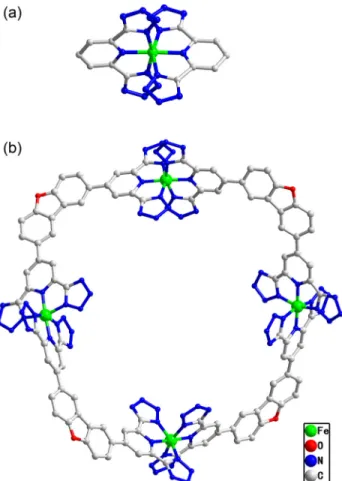
2 and Fe4(L2)4 are mononuclear and square-like tetranuclear complexes (Fig. 2), respectively. Fe(L1)
2 crystallized in the monoclinic space group of P21/c at 100 K and its asymmetric unit consisted of one FeII ion, two (L1)2− anions, two (Et
3NH)+ counter ions, and two water molecules (Fig. S13(a) in the ESM). The FeII atom has slightly distorted octahedral coordination geometry and is ligated by six nitrogen atoms from two different tridentate ligands. From the knowledge acquired, the LS and HS states can be distinguished by the metal–ligand bond distance, as the absence of the electrons in the antibonding eg* orbitals in the LS state. At 100 K, the average Fe–N bond length of Fe(L1)
2 is 1.960 Å (Table S3 in the ESM), typical for the FeII center being in the LS state. Upon warming to 350 K, the space group changed to orthorhombic space group Pbca, and then two lattice water molecules were not observed, probably due to destruction of the hydrogen-bonding interactions (Fig. S13(b) in the ESM). Despite the change of the space group at 350 K, only one crystallographic independent mononuclear FeII complex is observed in the asymmetric unit of Fe(L1)
2. The average Fe–N bond length is 2.175 Å, increased by about 0.215 Å in comparison with the corresponding average Fe–N bond length
Figure 2 View of the core structure of Fe(L1)
2 and Fe4(L2)4.
at 100 K, which is a characteristic feature of SCO behavior from LS to HS transition. At 100 K, the mononuclear units are connected into a three-dimensional (3D) supramolecular frame-work by the intermolecular O1–H···N and C–H···N hydrogen bonding interactions. Similar 3D supramolecular framework was also observable at 350 K (Fig. S15 in the ESM), but with different weak interactions, i.e., C–H···N hydrogen bonds and π···π interaction (Fig. S16 in the ESM).
At 100 and 300 K, the structures of Fe4(L2)4 crystallized in the tetragonal I41/acd and tetragonal P42/n space groups, respectively. The same asymmetric units containing one FeII ion, one (L2)4− ligand, and one quarter of water molecule (Fig. S17 in the ESM) were observed. The Fe–N bond lengths for Fe4(L2)4 are 1.860–1.939 Å at 100 K and 1.904–1.929 Å at 300 K, respectively (Table S3 in the ESM). At 300 K, an increase in the average Fe–N bond length by up to 0.023 Å can be clearly observed, suggesting the partial LS to HS transitions. Four FeII ions are linked together by four bridging bi-tridentate ligands to form a tetranuclear square, in which each of the FeII ions lays in the edge of the square with a pseudo-octahedral coordination geometry. Dihedral angle between the two chelation planes, which is defined by the terminal coordinated three nitrogen atoms of the ligands, is 34.49°, much lower than the ideal value of 90° expected for the ligand in a strictly coplanar square (Fig. S18 in the ESM). This means that distortion of ligand occurred during the assembly process, i.e., Fe4(L2)4 is not a standard square but rather can be viewed as a quasi-square: Two of the four ligands lie above the plane defined by the four FeII ions, while the other two lie below it. The distance between the “parallel edges” of the square is estimated to be 1.9 nm, which is so far the longest distance in the reported tetranuclear SCO FeII compounds. In the extended framework of Fe4(L2)4, the quasi-square molecules interact with adjacent molecules through π···π interactions and O–H···N hydrogen bonds (Fig. S19 in the ESM).
The spin conversion of the SCO-active FeII compounds leads to the change of total spin between S = 0 (LS state) and S = 2 (HS state). Meanwhile, such a conversion is accompanied by a considerable increase of effective magnetic moment of the system. Thus, measurement of magnetic susceptibility is a critical approach to investigate the spin conversion process. Variable-temperature magnetic susceptibility data for Fe(L1)
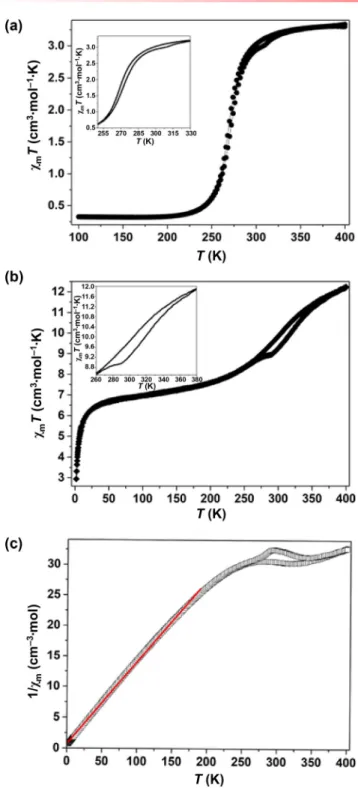
2 and Fe4(L2)4 were collected under an applied magnetic field of 1 kOe. The plots of xmT versus T for Fe(L1)2 and for Fe4(L2)4 are shown in Figs. 3(a) and 3(b), respectively. For Fe(L1)
2, the value of xmT at 400 K is 3.30 cm3·mol−1·K, which is a little larger than the spin-only value (3.00 cm3·mol−1·K) expected for magnetic isolated high spin FeII ions with S = 2. With the lowing of temperature, the xmT undergoes a slightly decrease to a value of 3.12 cm3·mol−1·K at 310 K, indicating the HS state above this temperature. Below 310 K, the xmT decreases abruptly to a value of 0.33 cm3·mol−1·K at about 200 K, and then a plateau region is observed down to 100 K. These results suggest that the spin transition from HS state to LS state occurs between 310 and 100 K as the xmT value decreases from 3.12 to 0.33 cm3·mol−1·K, which is a typical value for LS FeII ions. To gain insights into the possible thermal hysteresis loop behavior, the data are collected from 100 to 400 K under heating mode. Interestingly, data of warming cycle do not match well with that of the cooling cycle. The spin transition temperatures, T1/2, at which the populations of HS and LS both equal to 0.5, are 268 and 272 K for the cooling and heating modes, respectively, resulting in a narrow thermal hysteresis loop width (ΔT = 4 K).
Dramatically different SCO behavior is observed in Fe4(L2)4. At 400 K, the xmT value is 12.20 cm3·mol−1·K per Fe4(L2)4,
Nano Research
Figure 3 Plots of xmT vs. T for Fe(L1)
2(a) and Fe4(L2)4(b). The inset
shows thermal hysteresis loop. (c) Plots of 1/xm vs. T in the 2–400 K temperature ranges for Fe4(L2)4. The red solid line is the best fit with the
Curie-Weiss law in the temperature range of 2–190 K.
corresponding to the sum of spin-only value expected for four non-interacting high spin FeII ions (4HS states). As the temperature decreases, the xmT decreases gradually and reaches a value of around 7.50 cm3·mol−1·K at 190 K, which is in line with the value expected for magnetically independent 2.5 FeII ions, suggesting the presence of (FeII
LS)1.5 and (FeIIHS)2.5 states. Upon further cooling, the xmT decreases smoothly from 7.50 cm3·mol−1·K at 190 K to 6.70 cm3·mol−1·K at 50 K, and then followed by a sharp drop to 2.94 cm3·mol−1·K at 2 K. The sharp decreases below 50 K should be attributed to the zero-field splitting effect of high spin FeII ions. In the temperature ranges of 2–190 K, the magnetic susceptibilities can be fitted well by the Curie-Weiss law, giving a Curie constant of C = 7.56 cm3·mol−1·K and a Weiss constant of θ =
−5.35 K (Fig. 3(c)). The Curie constant is almost the same as that expected for 2.5 HS FeII ions, signifying the residual 2.5 FeII ions are still in its high spin state below 190 K, that is, the 2.5 HS FeII ions do not experience any spin conversion during the whole process. The smaller negative Weiss constant suggests very weak antiferromagnetic magnetic interactions in Fe4(L2)4. In brief, the above analysis implies that Fe4(L2)4 exhibits one step gradual SCO from (FeIIHS)4 state to (FeII
HS)2.5(FeIILS)1.5 states. Moreover, a 15 K thermal hysteresis loop is observed (T1/2cooling = 303 K and T1/2warming = 318 K). It is worth to note that Fe4 SCO tetranuclear clusters with a thermal hysteresis loop are very limited, and the only example was reported by Tao et al. in [Fe(tpa){N(CN)2}]4·(BF4)4(H2O)2 (tpa = tris(2-pyridylmethyl)amine) [46], where the thermal hysteresis loop width is only 6 K. The larger hysteresis loop width observed in Fe4(L2)4 is most probably due to the large void available in Fe4(L2)4, where various of weak supramolecular interactions can exist.
Compared with mononuclear Fe(L1)
2, the transition temperature and the width of thermal hysteresis loop of tetranuclear Fe4(L2)4 are all improved. It is well accepted that the intramolecular and cooperative intermolecular interactions play an important role in determining the nature of the SCO [47]. Moreover, the number and strength of weak interactions (such as hydrogen-bond interactions, π···π interactions, and C–H···π interactions) will also affect the SCO performance. Due to very weak diffraction data, only the core structure was determined for Fe4(L2)4, the cations and most of solvents are not solved. However, the intermolecular or intramolecular supramolecular interactions between those unsolved species and the Fe4(L2)4 should be in existence. Having this in mind, we suggest that the different degree of synergistic effect of intermolecular supramolecular interactions (π···π, O–H···N hydrogen-bond and C–H···π), intramolecular FeII–FeII communications, as well as intermolecular FeII
4–FeII4 magnetic interactions should be responsible for the difference in the critical temperature and the width of the thermal hysteresis loop for Fe(L1)
2 and Fe4(L2)4
.
3 Conclusions
In conclusion, a novel nanoscale molecular quasi-square tetranuclear Fe4(L2)4 is reported and the magnetic investigation displays a gradual spin-crossover with a thermal hysteresis width up to 15 K. This compound is the first quasi-square SCO- active complex that the metal centers situated in the edges. Compared with mononuclear Fe(L1)
2, which can be viewed as a “precursor” of Fe4(L2)4, the critical temperature and hysteresis width of Fe4(L2)4 are improved. Enhanced SCO properties can be attributed to the improved synergistic effect of intra- and inter-molecular interactions. This work demonstrated that the SCO performance can be improved through linking the mononuclear SCO centers into polynuclear systems. Construction of more diversified multi-component SCO systems by utilizing the coordination-driven self-assembly method is currently underway.
Acknowledgements
This work was supported by the National Natural Science Foundation of China (Nos. 21825107, 21971237, and 21801241) and the Strategic Priority Research Program of the Chinese Academy of Sciences (No. XDB20000000).
Electronic Supplementary Material: Supplementary material (the experimental section, NMR spectrum, single crystal
X-ray diffraction studies and thermogravimetric analyses) is available in the online version of this article at https://doi.org/ 10.1007/s12274-020-2777-x.
References
[1] Chappert, C.; Fert, A.; Van Dau, F. N. The emergence of spin electronics in data storage. Nat. Mater. 2007,6, 813–823.
[2] Irie, M.; Fukaminato, T.; Matsuda, K.; Kobatake, S. Photochromism of diarylethene molecules and crystals: Memories, switches, and actuators. Chem. Rev. 2014,114, 12174–12277.
[3] Sato, O. Dynamic molecular crystals with switchable physical properties.
Nat. Chem. 2016,8, 644–656.
[4] Meng, Y. S.; Liu, T. Manipulating spin transition to achieve switchable multifunctions. Acc. Chem. Res. 2019,52, 1369–1379.
[5] Ruben, M.; Kumar, K. S. Sublimable spin crossover complexes: From spin-state switching to molecular devices. Angew. Chem., Int. Ed., in press, DOI: 10.1002/anie.201911256.
[6] Halcrow, M. A. Spin-Crossover Materials: Properties and Applications; Wiley: UK, 2013.
[7] Sato, O.; Tao, J.; Zhang, Y. Z. Control of magnetic properties through external stimuli. Angew. Chem., Int. Ed. 2007,46, 2152–2187. [8] Tao, J.; Wei, R. J.; Huang, R. B.; Zheng, L. S. Polymorphism in spin-
crossover systems. Chem. Soc. Res. 2012,41, 703–737.
[9] Bertoni, R.; Cammarata, M.; Lorenc, M.; Matar, S. F.; Létard, J. F.; Lemke, H. T.; Collet, E. Ultrafast light-induced spin-state trapping photophysics investigated in Fe(phen)2(NCS)2 spin-crossover crystal. Acc. Chem. Res. 2015,48, 774–781.
[10] Ni, Z. P.; Liu, J. L.; Hogue, N.; Liu, W.; Li, J. Y.; Chen, Y. C.; Tong, M. L. Recent advances in guest effects on spin-crossover behavior in Hofmann-type metal-organic frameworks. Coord. Chem. Rev. 2017,
335, 28–43.
[11] Brooker, S. Spin crossover with thermal hysteresis: Practicalities and lessons learnt. Chem. Soc. Res. 2015,44, 2880–2892. [12] Hogue, R. W.; Singh, S.; Brooker, S. Spin crossover in discrete polynuclear
iron(II) complexes. Chem. Soc. Res. 2018,47, 7303–7338. [13] McConnell, A. J. Spin-state switching in Fe(II) helicates and cages.
Supramol. Chem. 2018,30, 858–868.
[14] Breuning, E.; Ruben, M.; Lehn, J. M.; Renz, F.; Garcia, Y.; Ksenofontov, V.; Gütlich, P.; Wegelius, E.; Rissanen, K. Spin crossover in a supramolecular Fe4II [2×2] grid triggered by temperature, pressure,
and light. Angew. Chem., Int. Ed. 2000,39, 2504–2507.
[15] Nihei, M.; Ui, M.; Yokota, M.; Han, L. Q.; Maeda, A.; Kishida, H.; Okamoto, H.; Oshio, H. Two-step spin conversion in a cyanide-bridged ferrous square. Angew. Chem., Int. Ed. 2005,44, 6484–6487. [16] Wu, D. Y.; Sato, O.; Einaga, Y.; Duan, C. Y. A spin-crossover cluster
of iron(II) exhibiting a mixed-spin structure and synergy between spin transition and magnetic interaction. Angew. Chem., Int. Ed. 2009,
48, 1475–1478.
[17] Schneider, B.; Demeshko, S.; Dechert, S.; Meyer, F. A double- switching multistable Fe4 grid complex with stepwise spin-crossover
and redox transitions. Angew. Chem., Int. Ed. 2010,49, 9274–9277. [18] Li, F.; Clegg, J. K.; Goux-Capes, L.; Chastanet, G.; D'Alessandro, D. M.; Létard, J. F.; Kepert, C. J. A mixed-spin molecular square with a hybrid [2×2] grid/metallocyclic architecture. Angew. Chem., Int. Ed.
2011,50, 2820–2823.
[19] Wei, R. J.; Huo, Q.; Tao, J.; Huang, R. B.; Zheng, L. S. Spin-crossover FeII
4 squares: Two-step complete spin transition and reversible single-
crystal-to-single-crystal transformation. Angew. Chem., Int. Ed. 2011,
50, 8940–8943.
[20] Wang, Y. T.; Li, S. T.; Wu, S. Q.; Cui, A. L.; Shen, D. Z.; Kou, H. Z. Spin transitions in Fe(II) metallogrids modulated by substituents, counteranions, and solvents. J. Am. Chem. Soc. 2013,135, 5942–5945. [21] Matsumoto, T.; Newton, G. N.; Shiga, T.; Hayami, S.; Matsui, Y.;
Okamoto, H.; Kumai, R.; Murakami, Y.; Oshio, H. Programmable spin-state switching in a mixed-valence spin-crossover iron grid.
Nat. Commun. 2014,5, 3865.
[22] Schäfer, B.; Greisch, J. F.; Faus, I.; Bodenstein, T.; Šalitroš, I.; Fuhr, O.; Fink, K.; Schünemann, V.; Kappes, M. M.; Ruben, M. Divergent coordination chemistry: Parallel synthesis of [2×2] iron(II) grid-
complex tauto-conformers. Angew. Chem., Int. Ed. 2016, 55, 10881– 10885.
[23] Dhers, S.; Mondal, A.; Aguilà, D.; Ramírez, J.; Vela, S.; Dechambenoit, P.; Rouzières, M.; Nitschke, J. R.; Clérac, R.; Lehn, J. M. Spin state chemistry: Modulation of ligand pKa by spin state switching in a
[2×2] iron(II) grid-type complex. J. Am. Chem. Soc. 2018,140, 8218– 8227.
[24] Shiga, T.; Sato, Y.; Tachibana, M.; Sato, H.; Matsumoto, T.; Sagayama, H.; Kumai, R.; Murakami, Y.; Newton, G. N.; Oshio, H. Carboxylic acid functionalized spin-crossover iron(II) grids for tunable switching and hybrid electrode fabrication. Inorg. Chem. 2018,57, 14013–14017. [25] Cougnon, F. B. L.; Caprice, K.; Pupier, M.; Bauzá, A.; Frontera, A. A strategy to synthesize molecular knots and links using the hydrophobic effect. J. Am. Chem. Soc. 2018,140, 12442–12450.
[26] Li, Z. Y.; Dai, J. W.; Damjanović, M.; Shiga, T.; Wang, J. H.; Zhao, J.; Oshio, H.; Yamashita, M.; Bu, X. H. Structure switching and modulation of the magnetic properties in diarylethene-bridged metallosupramolecular compounds by controlled coordination-driven self-assembly. Angew. Chem., Int. Ed. 2019,58, 4339–4344. [27] Chakrabarty, R.; Mukherjee, P. S.; Stang, P. J. Supramolecular
coordination: Self-assembly of finite two- and three-dimensional ensembles. Chem. Rev. 2011,111, 6810–6918.
[28] Zhang, T.; Zhou, L. P.; Guo, X. Q.; Cai, L. X.; Sun, Q. F. Adaptive self-assembly and induced-fit transformations of anion-binding metal- organic macrocycles. Nat. Commun. 2017,8, 15898.
[29] Tranchemontagne, D. J.; Ni, Z.; O'Keeffe, M.; Yaghi, O. M. Reticular chemistry of metal-organic polyhedra. Angew. Chem., Int. Ed. 2008,
47, 5136–5147.
[30] Lu, Y.; Zhang, H. N.; Jin, G. X. Molecular borromean rings based on half-sandwich organometallic rectangles. Acc. Chem. Res. 2018,51, 2148–2158.
[31] Han, M. X.; Engelhard, D. M.; Clever, G. H. Self-assembled coordination cages based on banana-shaped ligands. Chem. Soc. Rev.
2014, 43, 1848–1860.
[32] Hong, C. M.; Bergman, R. G.; Raymond, K. N.; Toste, F. D. Self- assembled tetrahedral hosts as supramolecular catalysts. Acc. Chem. Res. 2018,51, 2447–2455.
[33] McConnell, A. J.; Wood, C. S.; Neelakandan, P. P.; Nitschke, J. R. Stimuli-responsive metal-ligand assemblies. Chem. Rev. 2015,115, 7729–7793.
[34] Harris, K.; Fujita, D.; Fujita, M. Giant hollow MnL2n spherical complexes:
Structure, functionalisation and applications. Chem. Commun. 2013,
49, 6703–6712.
[35] Fujita, M.; Yazaki, J.; Ogura, K. Preparation of a macrocyclic polynuclear complex, [(en)Pd(4,4'-bpy)]4(NO3)8 (en = ethylenediamine,
bpy = bipyridine), which recognizes an organic molecule in aqueous media. J. Am. Chem. Soc. 1990,112, 5645–5647.
[36] Fujita, M.; Tominaga, M.; Hori, A.; Therrien, B. Coordination assemblies from a Pd(II)-cornered square complex. Acc. Chem. Res.
2005,38, 369–378.
[37] Liu, Y. Z.; O'Keeffe, M.; Treacy, M. M. J.; Yaghi, O. M. The geometry of periodic knots, polycatenanes and weaving from a chemical perspective: A library for reticular chemistry. Chem. Soc. Rev. 2018,
47, 4642–4664.
[38] Wu, K.; Li, K.; Chen, S.; Hou, Y. J.; Lu, Y. L.; Wang, J. S.; Wei, M. J.; Pan, M.; Su, C. Y. The redox coupling effect in a photocatalytic RuII-
PdII cage with TTF guest as electron relay mediator for visible-light
hydrogen-evolving promotion. Angew. Chem., Int. Ed. 2020, 59, 2639–2643.
[39] Wang, L.; Song, B.; Khalife, S.; Li, Y. M.; Ming, L. J.; Bai, S.; Xu, Y. P.; Yu, H.; Wang, M.; Wang, H. et al. Introducing seven transition metal ions into terpyridine-based supramolecules: Self-assembly and dynamic ligand exchange study. J. Am. Chem. Soc. 2020, 142, 1811–1821.
[40] Sepehrpour, H.; Fu, W. X.; Sun, Y.; Stang, P. J. Biomedically relevant self-assembled metallacycles and metallacages. J. Am.
Chem. Soc. 2019,141, 14005–14020.
[41] Li, X. Z.; Zhou, L. P.; Yan, L. L.; Yuan, D. Q.; Lin, C. S.; Sun, Q. F. Evolution of luminescent supramolecular lanthanide M2nL3n complexes
from helicates and tetrahedra to cubes. J. Am. Chem. Soc. 2017,139, 8237–8244.
Nano Research
[42] Wang, H.; Qian, X. M.; Wang, K.; Su, M.; Haoyang, W. W.; Jiang, X.; Brzozowski, R.; Wang, M.; Gao, X.; Li, Y. M. et al. Supramolecular kandinsky circles with high antibacterial activity. Nat. Commun. 2018,
9, 1815.
[43] Halcrow, M. A. Iron(II) complexes of 2,6-di(pyrazol-1-yl)pyridines— A versatile system for spin-crossover research. Coord. Chem. Rev.
2009,253, 2493–2514.
[44] Cook, L. J. K.; Mohammed, R.; Sherborne, G.; Roberts, T. D.; Alvarez, S.; Halcrow, M. A. Spin state behavior of iron(II)/dipyrazolylpyridine complexes. New insights from crystallographic and solution measurements. Coord. Chem. Rev. 2015,289–290, 2–12.
[45] Attwood, M.; Turner, S. S. Back to back 2,6-bis(pyrazol-1-yl)pyridine and 2,2':6',2''-terpyridine ligands: Untapped potential for spin crossover research and beyond. Coord. Chem. Rev. 2017,353, 247–277. [46] Wei, R. J.; Tao, J.; Huang, R. B.; Zheng, L. S. Anion-dependent spin
crossover and coordination assembly based on [Fe(tpa)]2+ [tpa =
tris(2-pyridylmethyl)amine] and [N(CN)2]–: Square, zigzag, dimeric,
and [4+1]-cocrystallized complexes. Eur. J. Inorg. Chem. 2013, 2013, 916–926.
[47] Real, J. A.; Gaspar, A. B.; Niel, V.; Muñoz, M. C. Communication between iron(II) building blocks in cooperative spin transition phenomena. Coord. Chem. Rev. 2003, 236, 121–141.