IntegratIng SocIal DetermInantS
of HealtH anD HealtH equIty Into
canaDIan PublIc HealtH PractIce:
environmental Scan 2010
Antigonish, NS B2G 2W5 [email protected]
tel: (902) 867-5406 fax: (902) 867-6130 www.nccdh.ca
The National Collaborating Centre for Determinants of Health is hosted by St. Francis Xavier University. Please cite information contained in the document as follows:
National Collaborating Centre for Determinants of Health. (2010). Integrating Social Determinants of Health and Health Equity into Canadian Public Health Practice: Environmental Scan 2010. Antigonish, NS: National Collaborating Centre for Determinants of Health, St. Francis Xavier University.
Production of this document has been made possible through a financial contribution from the Public Health Agency of Canada through funding for the National Collaborating Centre for Determinants of Health (NCCDH).
The views expressed herein do not necessarily represent the views of the Public Health Agency of Canada.
This document is available in its entirety in electronic format (PDF) on the National Collaborating Centre for Determinants of Health website at: www.nccdh.ca.
This report was researched and authored by Dr. Brent Moloughney of BWM Health Consultants Inc.
The preparation of this environmental scan report would not have been possible without the enthusiastic participation of numerous key informants, focus group participants and survey respondents. No particular observation or comment should be attributed to any specific individual. Any errors in description or interpretation are those of the author.
A four-member expert reference group provided strategic guidance to this project:
• ms. connie clement: Executive Director, Social Venture Partners Toronto at Centre for Social Innovation, Toronto, Ontarioi
• Dr. lynn mcIntyre: Professor and CIHR Chair in Gender and Health, Department of Community Health Sciences, Faculty of Medicine, University of Calgary, Calgary, Alberta
• Dr. John millar: Executive Director, Population Health Surveillance and Disease Control Planning, Provincial Health Services Authority, Vancouver, British Columbia
• Dr. cory neudorf: Chief Medical Health Officer, Saskatoon Health Region, Saskatoon, Saskatchewan.
Dr. David Mowat and Ms. Erica DiRuggiero also provided comments on a draft version of this report.
Staff of the National Collaborating Centre for Determinants of Health provided considerable logistical and technical support to the conduct of this environmental scan. In particular, Dawna MacDonald scheduled all of the interview and focus group appointments, Claire Betker led the conduct and analysis of the online survey, and Hope Beanlands recruited the key informant and focus group participants. Centre staff including Hope Beanlands, Claire Betker, Dr. Verlé Harrop, and Faith Layden provided feedback on a draft version of this report.
Translation into French provided by Language Market Place. Translation was reviewed by colleagues at the National Collaborating Centre for Healthy Public Policy and the Sudbury District Public Health Unit (Natalie Aubin).
The National Collaborating Centres (NCCs) for Public Health were created to promote and improve the use of the results of scientific research and other knowledge to strengthen public health practices and policies in Canada. The NCCs identify knowledge gaps, foster networks and translate existing knowledge to produce and exchange relevant, accessible, and evidence-informed products with researchers, practitioners, and policy-makers.
The National Collaborating Centre for Determinants of Health (NCCDH) is one of six NCCs funded by the Public Health Agency of Canada (PHAC). The focus of the NCCDH is on the social and economic factors that influence the health of Canadians. The NCCDH’s recent work has concentrated on early child development, particularly public health home visiting programs.
The NCCDH has requested this environmental scan to inform its future direction, priorities and activities through an analysis of the key challenges, needs, gaps, and opportunities in the determinants of health for public health. A four-member expert reference group was established to provide strategic input into the conduct of the scan.
This environmental scan utilized four information gathering approaches: a focussed scan of the literature; 31 key informant interviews with practice and research experts; four focus group teleconferences to validate early emerging themes; and, an online survey with over 600 respondents. There was considerable convergence of the findings across the four information gathering approaches.
Public health interest and action on health determinants to reduce health inequities is reflected throughout public health’s history including major public health concepts and reports of recent decades (e.g., Ottawa Charter, Reports on Health of Canadians, population health approach, etc.). Explicit expectations for action on health determinants are increasingly embedded within defining parameters of practice such as core public health program and accreditation standards.
Despite public health’s more distant and recent history, public health action on broader health determinants is not widespread and may even be viewed as ‘new’. Either the application of foundational concepts was never universally institutionalized throughout public health or enough time has passed and pressures exerted upon the public health sector that they have been lost. Even within early adopter organizations, action on determinants of health is still at a relatively early stage of implementation versus having been institutionalized throughout. A number of pervasive challenges are barriers to more widespread action. These include: the lack of clarity regarding what public health should or could do; a limited evidence base; preoccupation with behaviour and lifestyle approaches; bureaucratic organizational characteristics; limitations in organizational capacity; the need for leadership; more effective communication; and supportive political environments.
There are also a number of opportunities for achieving success. First, there is the past experience of successively addressing major society-wide challenges (e.g., sanitarians, tobacco control). Increasing evidence to inform
health organizations are taking action on health determinants and will thereby add to existing knowledge (i.e., ‘learn by doing’). As evidenced by the interest in this environmental scan, there is considerable and widespread interest in action on health determinants within the public health community. There is also evidence of interest from many sectors across society.
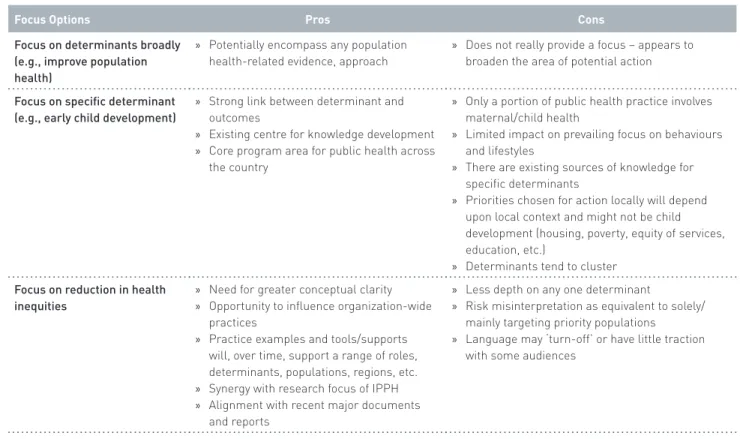
In its initial years of operation, the NCCDH has mainly been focussed on specific health determinants or on particular interventions. The challenge with this approach is that the NCCDH risks being relevant to only a particular program area of public health organizations. Determinants also tend not to function in isolation, but to cluster. Individual public health organizations will choose priorities based on the local context, which may not align with the NCCDH’s chosen focus. An alternative option would be to take a broader perspective on determinants as part of the population health approach. However, this would provide little guidance as to what the NCCDH should focus upon.
An alternative option is to focus the NCCDH’s knowledge synthesis and translation efforts on supporting public health action on health determinants to reduce health inequities. Despite substantial improvements in the health of the public on average, there continue to be marked differences in health experiences among Canadians. Among public health staff, there appear to be misperceptions that a population health approach equates with targeting the ‘general population’. Depending on the type of intervention, there are increasing concerns that some public health interventions may contribute to inequities.
relevant to public health organizations across the country. Such a focus would be consistent with the many international, national, provincial and local/regional reports that have highlighted the existence of inequities and recommended action. Several key informants stressed that what was required was for the NCCDH’s focus to be less about specific determinants and more about critical thinking and reflective practice to incorporate consideration of inequities in all of the actions of the organization. Through a series of knowledge translation products and activities (e.g., evidence synthesis, frameworks, case studies, tools, training, etc.), the NCCDH can address a cross-section of determinants, issues, populations, and settings.
Overall, there appear to be four key roles for public health action on health determinants to reduce health inequities:
• assess and report on the health of populations describing the existence and impact of health inequalities and inequities and, effective strategies to address those inequalities/inequities. • modify/orient public health interventions
to reduce inequities including the consideration of the unique needs and capacities of priority populations (i.e., do planning and implementation of existing programs considering inequities). • engage in community and multi-sectoral
collaboration in addressing the health needs of these populations through services and programs (i.e., when looking at the collectivity of our programming for ‘x’, where are the gaps?).
improvements in health determinant/ inequities.
There was widespread agreement regarding these roles for public health among key informants, focus group participants, and online respondents. Scan participants suggested a number of additional ‘roles’ that reflect approaches and areas for capacity building:
• Leadership
• Organizational and system development • Development and application of
information and evidence • Education and awareness raising • Skill development
• Partnership development.
A matrix of these two lists may assist public health organizations, as well as the NCCDH, to analyze gaps and identify opportunities for strengthening practice.
To achieve optimal impact on the field of public health, the NCCDH should become the ‘go-to’ hub for information and assistance on public health action on health determinants to reduce health inequities. It should be the lead source of current, quality, and relevant evidence and thinking in this area. It should synthesize
capture and build on existing promising practices and ensure their learning and experience are integrated with existing evidence. Since public health action addressing health determinants to reduce health inequities affects all aspects of programming, the work of the NCCDH needs to be informed by a strong understanding of the public health practice context at individual, organization and system levels. Leadership is essential for establishing organizational action on health determinants including its influence on priority setting, allocation of resources, modeling desired behaviours, establishing strategic partnerships, and overseeing implementation. As such, public health leaders will require particular attention and support in the work of the NCCDH. The action of the NCCDH needs to be strategic in order to increase linkages between the practice and research communities, particularly considering the synergy with IPPH’s research priorities. Reflecting the cross-cutting nature of the work, the NCCDH should collaborate and coordinate with the other NCCs and to support consideration of inequities in their work. The main body of this report discusses in more detail the implications for NCCDH priorities and actions and the appendices provide additional supplementary materials.
Executive Summary . . . ii
1. INtrODuCtION . . . 3
2. MEtHODOlOgy. . . 4
Overview. . . 4
Scan of the Literature . . . 4
Key Informant Interviews . . . 5
Online Survey. . . 5
Focus Group Teleconferences . . . 6
3. FINDINgS . . . 7
Context for Public Health Action on the Determinants of Health . . . 7
Key Concepts and Terminology . . . 7
Public Health’s Roots and History . . . 8
Recent Major Reports Addressing Health Determinants and Equity – Selected Examples . . . 10
Formal Expectations for Public Health Action on Health Determinants and Health Inequalities/Inequities. . . 12
Summary . . . 14
State of Public Health Action on Determinants of Health and Health Inequities. . . 15
Challenges to Public Health Action . . . 15
Opportunities (Reasons for Optimism) . . . 19
4. ANAlySIS AND IMPlICAtIONS FOr FuturE NCCDH ACtIONS . . . 24
Overview. . . 24
What Should be the NCCDH’s Focus? . . . 25
What is the Emerging Vision for the NCCDH? . . . 28
What Are the Public Health Roles for Action on health determinants to Reduce Inequities?. . . 29
Implications for NCCDH Practice - Principles and Approaches . . . 35
Position the NCCDH as the ‘Go-To’ Source for Information on Public Health Action on Health Determinants to Reduce Health Inequities . . . 35
Recognize that the ‘Unit of Adoption’ is Primarily the Public Health Organization . . . 35
Provide the Information and Tools to Support Public Health Action on Determinants of Health and Inequities. . . 36
Engage in Strategic Partnerships for Broader Public Engagement . . . 40
Potential Early Actions . . . 41
APPENDIX 3 List of Key Informants. . . 46
APPENDIX 4 Key Informant Interview Guide . . . 48
APPENDIX 5 Online Survey Questionnaire . . . 50
APPENDIX 6 Additional Online Survey Results . . . 55
APPENDIX 7 Focus Group Participants . . . 58
APPENDIX 8 Focus Group Feedback . . . 59
APPENDIX 9 Additional Discussion of Information Gathering Approaches . . . 61
APPENDIX 10 Public health Legislation and Core Programs . . . 63
APPENDIX 11 Accreditation Canada Standards . . . 66
APPENDIX 12 List of Practice Frameworks, Practice Examples, Tools and Other Resources . . . 67
Frameworks and Background Documents . . . 67
Practice Examples . . . 68
Tools and Resources . . . 74
Existing Comprehensive Health Inequality/Inequity Portals. . . 78
Training Opportunities . . . 79
Additional Tools and Resources . . . 80
Additional Examples . . . 82
references . . . 83
BC British Columbia
CIHI Canadian Institute for Health Information CIHR Canadian Institutes of Health Research CPHA Canadian Public Health Association CPHI Canadian Population Health Initiative (CIHI) CPHO Chief Public Health Officer (PHAC) DOH Determinants of Health F/P/T Federal, Provincial, Territorial HIA Health Impact Assessment
INSPQ Institut national de santé publique du Québec IPPH Institute of Population and Public Health (CIHR) MPH Master of Public Health
NCC National Collaborating Centre
NCCAH National Collaborating Centre for Aboriginal Health
NCCEH National Collaborating Centre for Environmental Health NCCHPP National Collaborating Centre for Healthy Public Policy NCCID National Collaborating Centre for Infectious Diseases NCCMT National Collaborating Centre for Methods & Tools OPHS Ontario Public Health Standards
PATH People Assessing Their Health PBS Public Broadcasting System (U.S.) PHAC Public Health Agency of Canada PHO Provincial Health Officer RFP Request for Proposals SDOH Social Determinants of Health SES Socio-Economic Status UPHN Urban Public Health Network WHO World Health Organization lISt of acronymS
IntroduCtIon
The National Collaborating Centres (NCCs) for Public Health were created “to promote and improve the use of [the results of] scientific research and other knowledge to strengthen public health practices and policies in Canada. They identify knowledge gaps, foster networks and translate existing knowledge to produce and exchange relevant, accessible, and evidence-informed products with researchers, practitioners, and policy-makers.”1
Six NCCs were established across Canada, each with a particular area of focus (see box). According to its website, the NCCDH “focuses on the social and economic factors that influence the health of Canadians.”2 The NCCDH’s recent work has concentrated on early child development, particularly public health home visiting programs.3
The primary audiences for the NCCs are public health decision-makers, practitioners and researchers. While there are many other sectors with an interest in, and ability to influence health determinants, the focus of the NCCDH is on how best to support, through knowledge synthesis and translation, the practice of its public health audiences as they engage and partner with these other sectors.
The NCCDH has requested this environmental scan to inform its future direction, priorities and activities through an analysis of the key challenges, needs, gaps, and opportunities in the determinants of health for public health. The specific deliverables stipulated in the NCCDH’s request for proposals (RFP) are listed in Appendix 1. It should be noted that this scan is not intended to be a review of the past work of the NCCDH nor is it to develop the NCCDH’s future strategic or implementation plans – although it is expected that the scan’s findings will be used to inform these subsequent planning steps.
Subsequent chapters of this report outline the environmental scan’s methodology (2), findings (3), analysis and implications (4), and next steps (5). The appendices provide a list of acronyms used in the report and additional detailed and supplementary materials.
national Collaborating Centres for Public Health
» Aboriginal Health (NCCAH) » Environmental Health (NCCEH) » Infectious Diseases (NCCID) » Methods & Tools (NCCMT) » Healthy Public Policy (NCCHPP) » Determinants of Health (NCCDH)
Integrating Social Determinants of Health and Health equity
metHodology
overview
The RFP’s description of the expectations for this environmental scan indicates a potential rethinking of the strategic direction of the NCCDH as compared with a simple refining of existing efforts. As such, ascertaining the state of current thinking, evidence and practice was viewed as a priority in order to inform future strategic directions. Since the scan needed to be completed within a 10-week time period overlapping the summer, efforts concentrated on two information gathering approaches: conducting a scan of the scientific and grey literature; and, conducting key informant interviews with practice and research experts. These approaches were supplemented with two others: an online survey to acquire broader input, particularly from front-line public health staff; and, a series of focus groups to also seek broader input and, in particular, seek validation of the emerging themes from the scan of the literature and initial key informant interviews. Considering the available timelines and project resources, a splitting of responsibilities between the project consultant and the NCCDH were arranged (see Appendix 2 for further details).
An expert reference group was established to provide input and guidance at key points in the project including: the identification of potential key informants and reference documents; the discussion of identified themes and their analysis; and, discussion of a draft version of this final report. Since only two reference group members were available for this latter step, additional input on the draft report was sought from two previously interviewed key informants.
This chapter provides a brief overview of each of the information gathering approaches. Appendix 9 provides additional discussion of implications for future information gathering efforts by the NCCDH.
Scan of the literature
The overall intent of this component was to address the following questions:
• What is the state of thinking, evidence and action on health determinants in public health practice? • What examples are there of health determinant frameworks, approaches, tools and training that
are available to, or being applied in, a public health context?
• What additional key informants should be considered for this environmental scan? A focused approach was taken to identify key reports:
• Requests to NCCDH and the expert reference group for key ‘not-to-miss’ reports
• Search of websites of progressive public health organizations known to the NCCDH and the project consultant to be engaged in action on health determinants
• Search of selected organizations’ websites that would be a source of key documents and reports (see Appendix 2).
Additional sites and materials were identified following leads from this primary search, as well as suggestions from key informants and focus group participants.
Key Informant Interviews
The initial list of key informants was developed by the NCCDH with input from the expert reference group and the project consultant (see Appendix 3). The key informant questionnaire was developed by the project consultant with input from the NCCDH and the expert reference group (see Appendix 4). A total of 31 key informant interviews were completed, which compares favourably with the scan’s target of 25-35. The extent of key informant participation on relatively short notice provides an indication of the level of interest in the topic area and in the future direction of the NCCDH.
While the intent was to identify additional key informants through the key informant interview process and the online survey, the timing of many of the primary interviews and the availability of online survey results did not permit the inclusion of additional interviewees. Since the main themes from the key informant interviews were largely consistent, it is unlikely that the addition of more interviewees would substantively alter the identified strategic themes.
online Survey
The online survey was included to broaden input into the environmental scan. Based on the timing of the survey (June-July) and the limited response to a survey during the NCCMT’s environmental scan, it was hoped that up to 200 respondents might participate.
One of the challenges in the design of the survey was how best to structure the questions. The extent of perceived uncertainty regarding public health’s work addressing health determinants would tend to favour open-ended questions. However, close-ended questions are more straight forward to analyze. A mix of questions was eventually chosen (see Appendix 5). The questions were translated into French and piloted in both languages. Piloting of the surveys indicated that they could be completed in approximately 15 minutes.
Promotion through electronic networks and at three public health-related conferences (Canadian Public Health Association, the Community Health Nurses of Canada, and the NCCPH Summer Institute) resulted in over 600 responses. The close-ended questions had many non-responders, although many individuals provided responses to the open-ended questions. In addition to the incorporation of selected survey findings into this report, Appendix 6 provides additional survey results. The NCCDH has also prepared a more detailed technical report to inform its future analysis and decision-making. The sheer volume of responses provides an indication of the level of interest in action on the health determinants and the respondents provide a potential pool of contacts for future communication and involvement in the NCCDH’s knowledge translation efforts.
focus group teleconferences
The focus group teleconferences were included to provide an additional opportunity for information gathering beyond the key informant interviews and to provide an early validation step of emerging themes from the scan of the literature and the key informant interviews collected to-date (approximately 1/3 of total). While it had been intended to have a focus group for each target population sub-group (decision-makers, front-line staff, researchers), a total of 4 teleconferences with between 3-7
participants were conducted (see Appendix 7). The participants in each focus group tended to be a mix of mainly front-line and middle management staff. A summary of the main themes and implications from the scan of the literature and the initial 13 key informant interviews was provided to focus group participants prior to the teleconferences. The two-hour teleconferences involved a guided discussion of the emerging themes and possible implications of the findings to-date. Appendix 8 provides a listing of key feedback points received from the focus groups.
FIndIngs
There was considerable convergence of the findings across the four information gathering approaches. This chapter provides a synthesis of those findings with the first section addressing the context for public health action on the health determinants, which is then followed by a discussion of the challenges and opportunities for such action.
context for Public Health action on the Determinants of Health
In order to set the stage for the subsequent section’s descriptions of challenges and opportunities for public health action, this section provides an overview of key terms and concepts, historical background on public health, recent major reports on health determinants, and current formal expectations for public health action.
Key concepts and terminology
A recent analysis by Daghofer and Edwards provides the following descriptions of several key concepts and terms:4
DEtErMINANtS OF HEAltH: the range of personal, social, economic and environmental factors that determine the health status of individuals or populations. The Public Health Agency of Canada lists the following as examples of determinants of health: income and social status; social support networks; education; employment and working conditions; genetics and biology; social environments; physical environments, personal health practices, healthy child development; health services; gender; and culture. These determinants intersect and interact with one another, so that the health of any individual is a complex summation of factors.
SOCIAl DEtErMINANtS OF HEAltH: social determinants of health can be understood as the social conditions in which people live and work.
HEAltH EquAlIty/INEquAlIty: the generic terms used to designate differences, variations, and disparities in the health achievements and risk factors of individuals and groups…that need not imply moral judgment. Some inequalities reflect random variations (i.e., unexplained causes), while others result from individual biological endowment, the consequences of personal choices, social organization, economic opportunity, or access to health care. Public policy is concerned with health inequalities attributable to modifiable factors, especially those that are perceived as inequitable.
HEAltH EquIty/INEquItIES: those inequalities in health that are deemed to be unfair or stemming from some form of injustice. The crux of the distinction between equality and equity is that the identification of health inequities entails normative judgment premised upon (a) one’s theories of justice, (b) one’s theories of society, and (c) one’s reasoning underlying the genesis of health inequalities. Because identifying health inequities involves normative judgment, science alone cannot determine which inequalities are also inequitable, nor what proportion of an observed inequality is unjust or unfair.
HEAltH DISPArItIES: differences in health status that occur among population groups defined by specific characteristics. For policy purposes, the most useful characteristics are those consistently associated with the largest variations in health status. The most prominent factors in Canada are socioeconomic status, Aboriginal identity, gender, and geographic location.
Public Health’s roots and History
Interest in why some people are healthy and others are not reflects the basis of the field of public health. This field emerged in the 1800s in response to large differences in observed health outcomes. In the mid-1800s, the father of epidemiology, Dr. John Snow, analyzed the London cholera epidemic attempting to determine why some people were sick and dying, and others were not. His well known study led to the identification of the contaminated water supply and the removal of that supply’s water pump handle.5 An early sanitarian, Sir Edwin Chadwick, documented marked differences in mortality rates among population groups and argued the need for clean water, removal of wastes and other public policies.6 He used economic arguments to convince decision-makers and his work led to the first Public Health Act and Board of Health.6 His work, while eventually successful, was not initially enthusiastically received and he even had to use his own funds to pay for his report’s publication.
Within Canada, public health leaders, over 80 years ago, were clearly speaking of conditions that we would today categorize as health determinants:
Every nation that permits people to remain under the fetters of preventable disease, and permits social conditions to exist that make it impossible for them to be properly fed, clothed and housed, so as to maintain a high degree of resistance and physical fitness, and that endorses a wage that does not afford sufficient revenue for the home, a revenue that will make possible the development of a sound mind and body, is trampling a primary principle of democracy under its feet. (Toronto Medical Officer of Health, 1929).7
Admittedly, the structure and specialization of roles within society have become considerably more complex over time, but the underlying perspective and impetus for public health action has not changed as evidenced by the 1998 annual report from the Montreal Public Health Department:
When we know that poverty is often associated with poorer health, this situation must be recognized as a critical public health issue...The poverty striking close to 30% of Montreal’s population constitutes a problem that the Department of Public Health cannot ignore...The Department is thus joining other social actors on the Montreal scene as a partner, who, armed with its specific brand of expertise, is determined to commit its forces to the common struggle... Reducing inequalities in health and well-being is essential to the progress of our society. Such an objective calls for the enthusiastic participation of every citizen and demands the concerted efforts of all sectors of society. The Department of Public Health is resolutely setting out on this path, counting on stepped-up relations with its travelling companions.8
Canada has been an international leader in gaining a better understanding about what makes and keeps people healthy. Key reports include:
• A New Perspective on the Health of Canadians (Lalonde Report) – 1974: raises human biology, environment and lifestyle to a level of categorical importance equal to that of health care organization.9
• Ottawa Charter for Health Promotion (Ottawa Charter) – 1986: describes the five components of health promotion action, as well as the prerequisites for health, which include: peace, shelter, education, food, income, a stable eco-system, sustainable resources, social justice and equity.10 • Achieving Health for All: A Framework for Health Promotion (Epp Framework) – 1986: identifies
challenge 1 as “reducing inequities in the health of low-versus high-income groups.”11 Implementation strategies include fostering public participation, strengthening community services and coordinating healthy public policy.
• Report on the Health of Canadians – 1996: prepared for the F/P/T Ministers of Health, this report describes how health is not shared equally by all sectors in Canadian society and how health inequalities can be reduced by addressing living and working conditions; the physical environment; personal health practices and coping skills; and, health services.12
• An Integrated Model of Population Health and Health Promotion (Population Health Promotion Cube) – 1996: the three dimensions of this cube include determinants of health; Ottawa Charter actions; and, level of intervention.13
• Toward a Healthy Future: Second Report on the Health of Canadians – 1999: this follow-up report for the F/P/T Ministers of Health, further describes the influence of health determinants on the health of Canadians, including inequities.14
• The Population Health Template: Key Elements and Actions That Define a Population Health Approach (Population Health Approach) – 2001: this planning framework incorporates measuring population health status, analyzing health determinants, evidence-based decision-making, increasing upstream investments, multiple strategies, public involvement and inter-sectoral collaboration.15
While a detailed analysis of the evolution of thinking represented in these reports is beyond the scope of this environmental scan, there is little doubt that a focus on the health of populations including the analysis of, and action to address, health determinants are intrinsic to the practice of public health. As described by the Public Health Agency of Canada:
A population health approach focuses on improving the health status of the population. Action is directed at the health of an entire population, or sub-population, rather than individuals. Focusing on the health of populations also necessitates the reduction in inequalities in health status between population groups. An underlying assumption of a population health approach is that reductions in health inequities require reductions in material and social inequities. The outcomes or benefits of a population health approach, therefore, extend beyond improved population health outcomes to include a sustainable and integrated health system, increased national growth and productivity, and strengthened social cohesion and citizen engagement.16
As noted above, reducing inequalities and inequities in health status between population groups is intrinsic to a population health approach. Interest in reducing inequalities/inequities has increased in recent years recognizing that improvements in overall measures of population health have not necessarily been reflected in reductions of health inequities among populations. The next sub- section will describe major reports addressing health determinants and equity, which is followed by a description of formal expectations for public health action.
recent major reports addressing Health Determinants and equity – Selected examples
In recent years, there have been several major reports addressing health determinants and equity from a range of sources. Although written for a broader audience than just the public health sector, these reports provide context and guidance for public health action. The following is a brief and non-exhaustive overview of selected reports.
• reducing Health Disparities – roles of the Health Sector: Discussion Paper –2005.17 This discussion paper summarizes information on the existence of health disparities in Canada, the causes and costs of health disparities, and the role of health services in addressing disparities. With respect to this latter point, the report notes that both health care and public health policies and activities can either reduce or increase health disparities depending on how they are implemented and taken up by the population. Noting that generalized public health interventions can potentially increase disparities due to greater uptake by more privileged populations, the report states that “the most appropriate and effective way to improve overall population health status is by improving the health of those in lower SES groups and other disadvantaged populations.”
A health sector framework for addressing health disparities is outlined: • Take an integrated approach to disadvantaged populations • Focus on four key policy directions for the health sector:
• Make health disparities reduction a health sector priority
• Integrate disparities reduction into health programs and services
• Engage with other sectors in health disparities reduction
• Population Health Policy: Issues and Options – 2008.18 This report from the Standing Senate Committee on Social Affairs, Science and Technology reviews the types of health determinants and the estimates for their impact on health outcomes, as well as the continuing deficiency in common understanding about health determinants among the public. The report identifies four key issues and possible options to address them:
• Tracking health outcomes and supporting research on interventions to enhance the health of the population
• Reorienting government policy
• Implementing an Aboriginal population health strategy
• Fostering political will.
• Closing the gap in a generation: Health Equity through Action on the Social Determinants of Health –2008.19 The WHO Commission’s report documents the health inequalities among and within countries. It explains that these inequalities reflect to a large degree inequities since they “arise because of the circumstances in which people grow, live, work, and age, and the systems put in place to deal with illness. The conditions in which people live and die are, in turn, shaped by political, social, and economic forces.” Following an extensive review of the evidence, the Commission identifies three principles for action:
• Improve the conditions of daily life
• Tackle the inequitable distribution of power, money, and resources
• Measure and understand the problem and assess the impact of action.19
• Healthy People, Healthy Performance, Healthy Profits: the Case for Business Action on the Socio-Economic Determinants of Health –2008.20 This Conference Board of Canada report provides health and economic arguments to support action on health determinants. The report outlines a framework for business action, as well as recommendations for areas of government action to support this action (e.g., tax or subsidy incentives to adopt agreed upon strategies to address one or more determinants; facilitate communication between employers and businesses, communities, and policy-makers; showcasing and celebrating successful initiatives and outlining the steps to success).
The initial two reports of Canada’s Chief Public Health Officer (CPHO) have focused on health inequalities and child development,21,22 and are discussed in greater detail later in this report. In analyzing these reports, Daghofer and Edwards identify the following guiding principles that are shared among the reviewed reports: social justice; universal and targeted programs; accountability and best practices; and, levelling up, not down.4
The authors also identify six cross-cutting strategies that appear in the reviewed reports: 1. Invest in social policies, programs and incentives for action (8 of 8 reports) 2. Develop and transfer knowledge (8 of 8 reports)
3. Provide leadership (7 of 8 reports)
4. Foster inter-sectoral action (7 of 8 reports) 5. Build public and political support (6 of 8 reports) 6. Develop community capacity (3 of 8 reports).4
While this analysis provides important context, it does not explicitly indicate what public health organizations can and should do to address inequities. The following sub-section reviews current expectations for public health action.
formal expectations for Public Health action on Health Determinants and Health Inequalities/Inequities
PublIc HealtH legISlatIon
Provincial/territorial public health acts are of varying age and explicitness regarding the expectations for public health action overall. Quebec’s Public Health Act provides a particularly comprehensive description of the functions and roles of public health. With respect to health determinants, it states that its contents pertain to “the means of exerting a positive influence on major health determinants, in particular through trans-sectoral coordination.”23 Further details are provided in Appendix 10. PublIc HealtH core ProgramS
Three provinces have legislatively linked descriptions of public health ‘core programs’. These documents provide explicit expectations for public health actions including those addressing determinants and health inequalities/inequities. For example, the new Ontario Public Health Standards (OPHS) state:
Addressing determinants of health and reducing health inequities are fundamental to the work of public health in Ontario. Effective public health programs and services consider the impact of the determinants of health on the achievement of intended health outcomes.
A key component of the requirements outlined in the Ontario Public Health Standards is to identify and work with local priority populations. Priority populations are identified by surveillance, epidemiological, or other research studies and are those populations that are at risk and for whom public health interventions may be reasonably considered to have a substantial impact at the population level. The Ontario Public Health Standards incorporate and address the determinants of health throughout, and include a broad range of population-based activities designed to promote the health of the population and reduce health inequities by working with community partners.24
In British Columbia (BC), the public health core function framework includes a lens to assess and address health inequalities, which “have their roots in the social, economic, cultural, and environmental determinants of population health.”25 While these determinants are not within the direct control of the public health sector, public health can contribute to reduce inequalities in health by:
• documenting inequalities, reporting on them so as to draw public attention to them, and analyzing the factors that contribute to these inequalities
• working with communities to change the conditions that contribute to inequalities in health in their community
• advocating for healthier public policies and changes in social, economic, cultural, and environmental conditions that will reduce inequalities in health
• directing programs to high-risk/disadvantaged groups
• improving access/removing barriers to public health programs
• forging partnerships with other organizations to address multiple barriers and/or issues in a coordinated and comprehensive manner
• using community development as a means to support self-advocacy and self-reliance • ensuring that the core programs provided by the health authorities reflect the priorities of the
people with greatest need.25
BC has developed a series of model core programs, each supported by an evidence review paper, which integrate consideration of health determinants and a reduction of health inequities.26 An additional evidence review document addresses the equity lens component of the overall framework.27 Quebec’s Public Health Program states “through its objectives, the program strives to change the determinants of health and well-being, enhance health and well-being, and reduce health or psychosocial problems and injuries.”28 The Program document contains discussion of different types of health determinants and the strategies that are reflected across all programs:
• Strengthen the potential of individuals • Support community development
• Participate in inter-sectoral action that promotes health and well-being • Support groups that are vulnerable
PublIc HealtH core comPetencIeS
The Core Competencies for Public Health in Canada (Release 1.0) provide a description of the essential knowledge, skills and attitudes necessary for the practice of public health.29 While many of the key concepts related to addressing health determinants and health inequities are included, at least implicitly, recent analysis commissioned by the NCCDH concluded that:
To adequately reflect the significance of the determinants of health framework in contemporary public health theory and practice, it is recommended that the current Version 1.0 of the Core Competencies be revised to include more specific content related to the determinants of health framework, that this content include statements concerning public health values and attitudes and that the content be incorporated directly into the Core Competency Statements themselves.30
Some key informants also commented that staff attitudes and values are critical for health
determinant-related work, which would argue for them being more explicit in future versions of the core competencies for public health.
PublIc HealtH accreDItatIon
Accreditation Canada provides accreditation of regional health authorities containing public health teams across Canada (with the exception of Ontario, which has a different health system structure). Both the general and more specific public health standards are explicit about assessing and taking action on health determinants. For example, the expectations for all accredited organizations include the following:
Organization’s leaders support and participate in ongoing community development to promote health and prevent disease (e.g., advocating for healthy public policy affecting determinants of health).
The governing body plays an advocacy role in the community. Examples include supporting healthy public policy to address the determinants of health (e.g., smoking bans in public places, environmental health legislation, and raising community awareness about issues).31
Further details are provided in Appendix 11. Within Ontario, public health units can voluntarily request accreditation by the Ontario Council on Community Health Accreditation.32 Its accreditation materials make occasional mention of health determinants, but are not as explicit as those of Accreditation Canada. Summary
Following a brief overview of key terminology, this section has highlighted the current breadth of interest in health determinants, which increasingly is focused on the reduction of health inequities. Such a perspective is by no means new for public health as it was a major impetus in the creation of the field and key concepts are embedded throughout major public health reports of recent decades. Of particular concern is the continuing existence of health gradients and the potential for some public health
interventions to contribute to inequities. A current trend is to embed more explicit expectations for public health action on health determinants within defining parameters of practice such as accreditation standards. There is also at least one example of explicit inclusion of expectations for public health action on health determinants within a provincial public health act (Quebec), as well as in the three provincial core public health program requirements (BC, Ontario, Quebec).
State of Public Health action on Determinants of Health and Health Inequities
Several examples of public health organizations that are engaged in action on determinants of health to reduce inequities were encountered during this scan. There was general agreement among key informants that these examples represented early adopters/innovators versus being reflective of typical or widespread public health practice in this country. In addition, even within these early adopter organizations, action on broader determinants of health is still at a relatively early stage of implementation versus having been institutionalized throughout. Further details regarding these examples will be provided later in this report. The purpose of this section is to explore the number of pervasive challenges that are barriers to more widespread action, as well as the many opportunities that also exist.challenges to Public Health action
The literature scan,33-35 key informant interviews, and focus groups indicate a number of challenges to public health action on health determinants and inequities.
tHe exIStIng evIDence baSe
Challenges regarding the extent of existing evidence include the nature of the relationship between determinants and health outcomes, as well as the interventions to effectively address this relationship. The influence of health determinants on health outcomes assessed through the steepness of gradients show that these gradients can vary for different outcomes, by interactions with other determinants (e.g., gender), by country, and over time.36,37 There are an increasing number of detailed reports describing determinants and gradients.7,21,38,39 There are a variety of frameworks for conceptualizing the pathways and inter-actions among determinants, but it is unclear which should be used when to guide research and interventions. There is a need for greater synthesis and wider understanding of what we know and do not know regarding existing gradients, the complexities of interactions among health determinants and pathways to health outcomes in the Canadian context.
There also appear to be a number of conceptual issues. Among public health staff, there appear to be continuing difficulties reconciling individual-level versus population-level approaches.35 Some key informants indicated a widespread misperception among public health staff that a population health approach means to only target the general population and to thereby not include targeting of higher risk/ priority populations.
Perhaps related to the foregoing conceptual challenges, there are also challenges related to the evidence for interventions. As noted in a recent report.
Although many in public health are committed to the need to reduce social inequities in health, they do not have tangible evidence-informed strategies for this work. The public health field requires such strategies along with supports to translate evidence and develop sustainable implementation strategies.34
There are many organizations across Canada that are applying public health principles to address health determinants to reduce inequities and ‘learning by doing’. To a large extent, their work is not widely known. As one key informant indicated, every public health worker should know the ‘stories’ of these innovators. However, much of the knowledge is produced by practitioners in service delivery mode where publishing is not a priority, and mechanisms are not well developed to capture and disseminate the learning from these experiences.34 In addition, there are limited mechanisms for public health practitioners to share experiences and challenges.
There is also a limited cadre of evaluators working in this area. In order to build the evidence, interventions need to be evaluated so that our understanding of what works and does not work is continually improved. Developing and interpreting evidence in this field is not without its challenges. There are multiple inter-related determinants operating at multiple levels over the life course.
Randomized trial evidence is rare and similar to the overall field of public health,40 reviewers of evidence have needed to utilize a variety of approaches.34
Public health staff have a need for ‘ammunition’ (e.g., summary of latest evidence, economic analyses, etc.) to inform their analyses and actions and are forced to search far and wide for this material or develop it themselves. For example, in the absence of existing syntheses, individual public health organizations have proceeded with conducting extensive literature reviews in order to inform local public health action.34,39 After assessing the impact of poverty across their catchment area, a key informant indicated that it would have been very helpful to have a list of available policy options by level of government to inform his organization’s recommendations and actions. Key informants observed that there are likely potential overlap areas between NCCDH and NCCHPP, as well as NCCAH that provide opportunities for collaboration and coordination of efforts.
unclear WHat PublIc HealtH coulD/SHoulD Do
Many of the recent high profiles reports on health determinants and health inequities do not explicitly indicate or illustrate what public health could or should do in this area. While there are many lists of determinants, they do not capture the interactions among and pathways through which determinants are believed to act and thereby provide guidance regarding specific interventions. Since most determinants are outside the direct control of the public health sector, determinants and inequities can be viewed as outside of public health’s mandate. Despite the field’s historical roots and the conceptual thinking reflected in decades of landmark reports, work on health determinants and inequities can be perceived as ‘extra work’ or ‘too big’ for public health, particularly considering the resource pressures on public health organizations.
lImItatIonS of exIStIng PublIc HealtH PractIceS
Many key informants indicated that public health has to move beyond just describing inequities and progress to taking action. Some key informants also expressed concern that there is a tendency to rely on quantitative methods to assess needs and that qualitative methods are also often required to more fully understand needs, meaning of results to communities, community problem solving, etc. In addition, in rural and remote areas with limited population size, alternative approaches to assessing needs are often required.
Key informants described a continuing preoccupation by public health with behaviour and lifestyle approaches such that the default is often services to the middle class with emphasis on ‘education’ versus structural or tailored approaches to priority populations. As one key informant noted, it is often easier to create a pamphlet or post information on the web than to tackle more challenging issues. A limited number of jurisdictions have explicit expectations for action on health determinants and inequities. However, these expectations are not necessarily actively supported or reinforced. As one key informant commented, unless accountability for taking action is established, then it is unlikely to occur on a widespread basis.
Gaps in the skills of public health staff were identified by several key informants, particularly in the areas of community engagement, mobilization and development. However, there are limited training opportunities to increase health determinant-related competencies. A recent examination of online training options found that a comprehensive online course on the topic of the determinants of health oriented to front-line public health professionals in Canada is not available at this time.41 At senior levels of organizations, the knowledge and skills required to take action involve domains that public health leaders may not have required previously (e.g., complex adaptive systems).
PublIc HealtH engagement WItH communItIeS
A number of key informants commented on the extent of engagement of public health organizations and their staff with communities. It was observed that the more an organization was focused on service delivery and harder outcomes, the less time and support was available for the development of strategic relationships with other service providers and the community. Some key informants hypothesized that the rigidity in program based orientations had led to a loss in the sense of ‘place’ and coordinated action among staff.
Several key informants commented on the nature of many public health organizations being overly bureaucratic and controlling. Some organizations appear to function as three separate organizations (i.e., senior leadership, middle management, front-line staff), each with their own perspectives towards communities and action on health determinants. Depending on the organization, one or more of these groups could be barriers to the others taking action. It was also observed that governance structures for public health may not be structured with sufficient breadth that would more likely support action on health determinants.
The regionalization process in many parts of the country appears to have hindered the traditional linkages between public health and municipalities. This is particularly problematic for work on health determinants since so many are influenced by the work of local governments.42,43 In England, where regionalization of health systems predated their occurrence in Canada, multiple efforts are occurring to support and formalize linkages between public health and local governments.
leaDerSHIP
For public health organizations to take action on health determinants and inequities, “local public health leadership needs to be intimately engaged in this work.”34 This is critical since they influence priority setting and allocation of resources, as well as modeling of desired behaviours. If that support is not in place, then it will be very difficult to make progress. Taking action on health determinants and inequities likely requires a change in organizational and individual practices. This may involve reallocation of staff and other resources to better address the needs of a priority population, shifting from education-based interventions to greater community development and policy perspectives, and other types of reorientation (e.g., organizational structure, staff skills, type of interaction with community, more intensive interventions with harder to reach populations, etc.) . As such, resistance to change can be anticipated and needs to be managed.
communIcatIon
Action on health determinants and inequities requires the strategic use of information and its
communication. In some instances, strategic use of a health status report and policy recommendations can be pre-planned, but there are also instances where nimbleness is required to take advantage of a current event. For example, in recent years there have been multiple high profile reports released related to health determinants and inequities. Some key informants expressed concern that public health organizations did not seem to effectively utilize those opportunities by adding local data and context to promote relevant policies and action. Such practice was the norm for local and provincial public health tobacco control efforts. As one commentator has suggested, public health needs to apply the comprehensive approaches it has used for health behaviours such as tobacco, healthy eating and physical activity, and apply these to other health determinants to address inequities.33
An additional concern expressed by several key informants is that public health professionals are spending too much time speaking to other (convinced) public health professionals and need to achieve greater public engagement.
tHe caPacIty of PublIc HealtH organIzatIonS
The capacity of public health organizations is highly variable and will impact their ability to address health determinants. For example, assessment/surveillance capacity is extremely important to inform deliberations and guide action. However, some regional health authorities and public health units have no or very limited epidemiologic capacity. The ability to engage with communities requires staff with community development skills, but this skill set may not be prevalent among staff. Pressures to provide traditional services and respond to health protection emergencies distract from broader, sustained action on health determinants.
The existing capacity within organizations will affect their receptivity towards new concepts and activities. The extent of existing implementation (i.e., whether an innovator versus newly starting) will affect the type of information required. For example, an organization already taking action on health determinants will have needs for more detailed evidence and be interested in more complex interventions. Organizations beginning to reorient themselves to action on health determinants will have greater interest in examples of effective practices and how to foster organizational change. Consideration needs to also be given to the needs of staff at different organizational levels (i.e., front-line, manager, executive).
An important consideration is that the current practice of some leading organizations reflects
development activities that have been occurring over a period of many years. Attempting to duplicate a practice from such a setting into one with less capacity and readiness will not likely generate the same result. In such circumstances, it will be more important to identify the principles underlying the example and how they relate to existing evidence, in order to allow their tailoring to the local context of another organization.
PolItIcal envIronment
Several aspects of the political environment were identified as challenges by the key informants. In some settings, the prevailing political ideology can make it extremely difficult to openly address the concept of inequalities/inequities or priority populations. At a minimum, there is a need to tailor messages to the audience and context (e.g., speak of ‘health gain’ versus ‘inequities’). Many key informants observed that public health leaders engage in self-censorship due to the fear of consequences. In some settings, the political agenda may be lifestyle focussed and emphasizing personal responsibility versus the social context for lifestyle and behaviour choices. Public health can also be faced with opposition when there is an attempt to reallocate resources serving middle/upper class populations to address the needs of priority populations.
opportunities (reasons for optimism) PaSt exPerIence
The public health sector has achieved many successes in the past 100 years.44 The experience of the sanitarians and tobacco control are but two examples. At their onset, both faced daunting challenges. As previously mentioned, Chadwick’s work was not universally embraced and he had to use his own funds to even get the report printed. When tobacco control efforts began, it was normal practice for the majority of the population to smoke and the tobacco industry was extremely powerful and politically connected. The public health response in both instances was to make heavy use of structural (i.e., policy) change and certainly for tobacco, the public health sector learned (i.e., developed the evidence) while doing.
IPPH’S StrategIc Plan
CIHR-IPPH has identified that supporting research in this area is a key priority. Its five-year strategic plan entitled “Health Equity Matters” includes four strategic research priorities:
• Pathways to equity – to further our understanding of pathways to health equity • Population health interventions – to examine the impact of complex population health
interventions on health and health equity
• Implementation systems for population health interventions in public health and other sectors – to examine how implementation systems for population health interventions may strengthen or weaken the impact of population health interventions on health and health equity
• Theoretical and methodological innovations – to stimulate theoretical and methodological innovations in knowledge generation, knowledge synthesis, and knowledge integration for population and public health.45
Pursuit of these strategic research priorities will be extremely informative for the work of the NCCDH and its audiences. It is directly targeting the expansion of the knowledge that will address many of the foregoing described challenges to public health action. With the NCCDH’s focus on knowledge synthesis, translation and exchange in this area, the IPPH’s strategic research priorities provide a tremendous opportunity for synergy. The NCCDH should therefore, strive to work closely with the IPPH.
exPerIence IS IncreaSIng
While the public health practice evidence base is limited, it is being expanded by a number of innovative organizations across the country. As part of this scan, multiple examples were encountered across the country including a growing list of frameworks and tools. For example, the Sudbury and District Health Unit conducted an extensive search of the literature for the evidence for public health interventions.34 Their review identified 10 promising practices for local public health action, which are shown in the following text box.
10 Promising Practices to reduce Social Inequities in Health in local Public Health
targetIng WItH unIverSalISm» Need a balance of targeted approaches with universal strategies to disproportionately improve the health of more disadvantaged groups while at the same time improving the health of the entire population
PurPoSeful rePortIng
» On the relationships between health and social inequities in all health status reporting
» Presenting publicly and intentionally the evidence about health inequities may be considered part of a strategy for change (e.g., stratify findings by socio-economic status (SES) versus controlling for it)
» Can also help track changes over time (i.e., are the disparities getting better or worse over time?) SocIal marKetIng
» Tailoring of interventions to disadvantaged populations
» Change the understanding and behaviour of decision makers and public to take or support action to improve social determinants of health (SDOH)
HealtH equIty target SettIng
» Some promise as part of strategy for reducing inequities - focus on targets for remediable areas
» Target setting as part of community engagement process connects target setting to other identified aspects of health inequity practice. equIty-focuSSeD HealtH ImPact aSSeSSment
» HIA is a structured method to assess potential health impacts of proposed policies and practices » Equity focussed HIA applies an equity lens to assess impact on inequities
» Challenges include resources, competencies and institutional nature of public health agencies » HIAs are a tool – interpretation of the evidence lies with decision makers and their values comPetencIeS/organIzatIonal StanDarDS
» Individual level
• Skills base required to work effectively on social inequities include community planning, partnership and coalition building • While these are reflected in the public health core competencies, they are not necessarily common knowledge or experience
for most public health staff
• Implications for recruitment, training, professional development, position descriptions » Organizational
• Making social inequities a priority - commit to work intersectorally and with community engagement
• Likely require an enabling change to the “bureaucratic/structural model upon which public health is built” (versus need for greater community engagement, consultation, participation)
contrIbutIon to evIDence baSe
» The burgeoning knowledge base on addressing social inequities through local public health action be strengthened by intentional distribution of knowledge.
early cHIlDHooD DeveloPment
» Comprehensive continuum of approaches is required in order to reduce health inequities
» Combination of services and policies designed through intersectoral collaboration and involve communities, especially vulnerable communities, in the program planning-implementation cycle.
communIty engagement
» Key cross-cutting strategy - best practice recommendations stress importance of consultation, involvement, support and/or engagement
» Nevertheless, there is a dearth of rigorous evaluations of social interventions aimed at reducing health inequalities InterSectoral actIon
» Many of the solutions to SDOH lie outside the health sector
» Building strong and durable relationships between public health and other sectors will be necessary for effective action.
Source: Sutcliffe, Snelling, Laclé. Implementing local public health practices to reduce social inequities in health. EXTRA/FORCES Intervention Project. Sudbury & District Health Unit, 2010.
In Saskatoon, documenting inequities was a preliminary step followed by a comprehensive set of community consultations to discuss the findings, an extensive literature review of potential policy actions, and further consultations to assess support for particular policies.39 This public health organization is now co-chairing an initiative with the United Way to pursue those policy options with the greatest level of community support. To systematically tackle how programs are planned and delivered, public health units in Waterloo and Sudbury have been developing frameworks to support the review of public health programs to strengthen their action against inequities.46,47 Additional examples of promising public health actions, frameworks and tools are listed in Appendix 12.
exIStIng moDelS of Web-baSeD DetermInantS of HealtH anD HealtH InequIty PortalS
There are several existing online toolkits/portals in the U.S., Europe, and Australia that provide a range of conceptual frameworks, case studies/profiles, training modules, tools and other resources to support action on health determinants (see Appendix 12). Their existence provides several opportunities:
• Provide links to these sites from the NCCDH’s website highlighting what they have to offer (i.e., their strengths)
• Select the best, most relevant and easiest items to adapt to the Canadian context
• Analyze the strengths and experiences of these sites and adapt these for improving the NCCDH’s website.
extent of IntereSt WItHIn PublIc HealtH
There are several reasons to believe that there is considerable interest in taking action on the health determinants to reduce inequities: the examples of innovative practice occurring across the country; increasingly explicit expectations for public health action; the new CIHR-IPPH strategic plan; and, the extent of response to this environmental scan. Some key informants indicated that the turnover in public health managers and leaders in upcoming years will provide an opportunity to groom a new cadre of future leaders with the knowledge and skills and orientation to address determinants.
extent of IntereSt outSIDe PublIc HealtH
Public health is one of many potential actors to address health determinants. As evidenced by the range of recent reports from a variety of sources, there appears to be widespread interest in these issues. These various sectors represent potential partners that public health could collaborate with for broader action. Examples include, but are not limited to:
• Senate Sub-Committee on Population Health of the Standing Senate Committee on Social Affairs’ report on population health18
• Conference Board of Canada’s report on the case for business action on the socio-economic determinants of health20
• Canadian Policy Research Networks analysis of the economic case for financing action on SDOHs48
• Business case for early childhood education and care49 • Provincial governments’ anti-poverty initiatives50-52 • Community-level development efforts53
• Business-led anti-poverty/prosperity initiatives54,55
• Canadian Institute for Health Information (CIHI) – recent report on inequities in health care.56 Some key informants suggested that there may be the beginning of a ‘sea change’ as more sectors become engaged.
Summary
There are many challenges facing the public health sector that have been impeding greater public health action on health determinants and inequities. However, there are also many opportunities. The challenge for the NCCDH is how best to take advantage of the opportunities and support public health to address these challenges. The next chapter of this report will pursue the implications of these findings regarding the future priorities and actions of the NCCDH.